Should You Break Ice Off Trees After a Storm?
Do not break ice off trees or shrubs after a winter storm—it causes more damage. Learn what to do instead, which plants are at risk, and when to call an arborist.
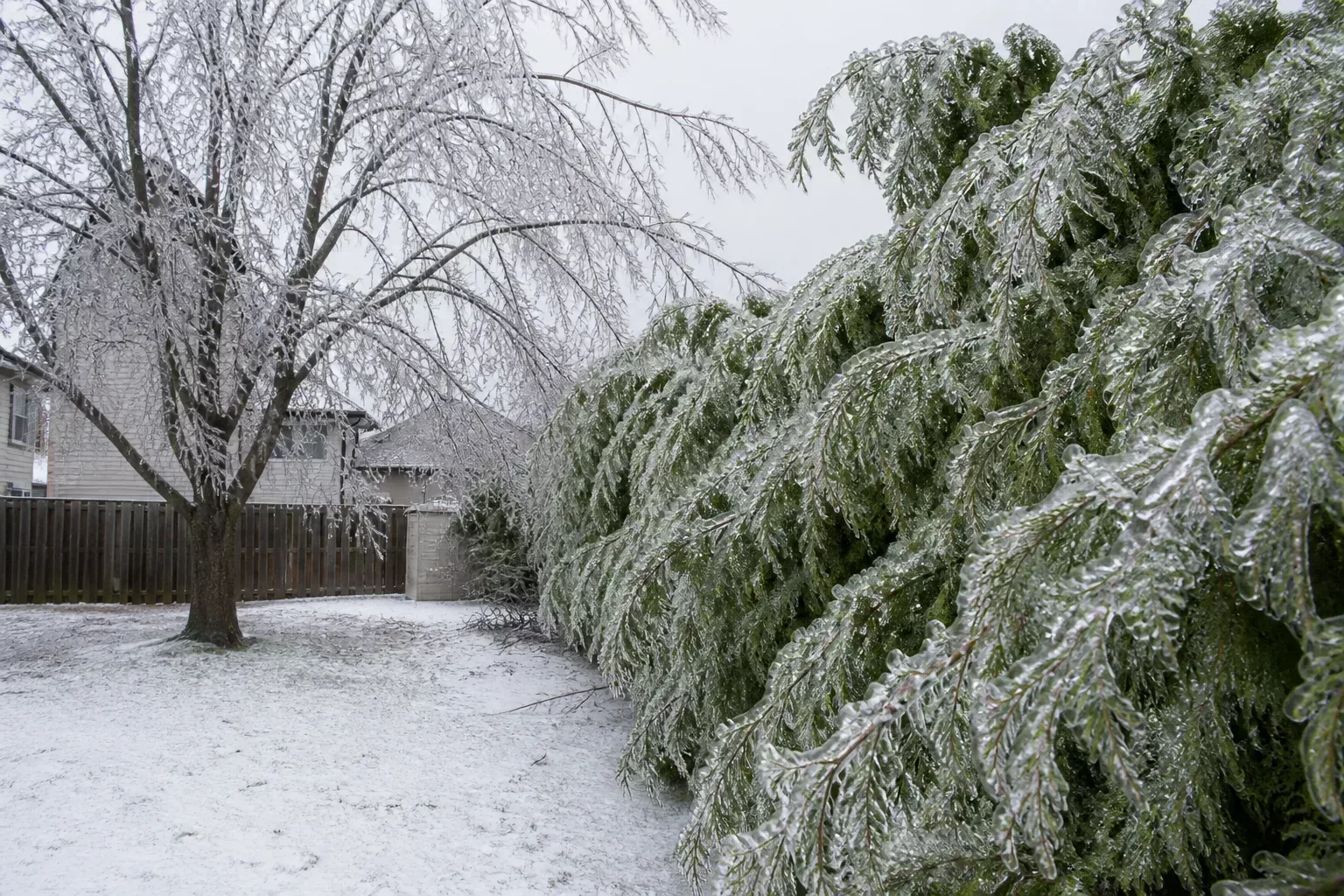
You step outside after a night of freezing rain and every branch glitters with a half-inch shell of ice. Your arborvitae hedge bows outward like a split umbrella. A maple limb hangs lower than you have ever seen it. The impulse is immediate: grab a broom, knock the ice free, and save the plant before something snaps.
Stop. Do not break, beat, knock, or shake ice off trees or shrubs. That instinct — understandable as it is — routinely causes more broken wood than the ice itself. Frozen branches are brittle. Ice is bonded to bark and needles. Every whack sends shock through tissue that cannot flex, and the ice you dislodge often takes live cambium with it.
The safe protocol is simpler than it feels in the moment: let glaze ice melt naturally, stay out from under loaded canopies, address true emergencies only (power lines, hanging limbs over walkways), and save structural pruning for late winter once you can see what actually broke. Here is the full decision map — including the one narrow exception where loose snow (not ice) on shrubs may be brushed off from the ground.
Quick Answer: Leave Ice Alone and Let It Melt
No — you should not break ice off trees or shrubs after a winter storm. NC State Extension is explicit: for trees weighed down by snow and ice, there is little you can do to help in the moment, and aggressive removal makes things worse. Veteran garden writer Jo Ellen Meyers Sharp puts it plainly on Hoosier Gardener: resist the temptation to knock ice and snow off limbs — improper removal increases damage according to Purdue Extension guidance on winter ornamental injury.
That does not mean doing nothing forever. It means the intervention window opens after melt, when you can assess bent vs broken wood, prop a few reachable low limbs if appropriate, and schedule pruning or arborist work on solid ground. During the ice event itself, your job is hazard avoidance and patience — not branch rescue.
Why Breaking Ice Off Branches Causes More Damage Than the Storm
Ice storms create a deceptively rigid load. Glaze ice — the clear coating from freezing rain — adheres directly to bark, needles, and twigs. Unlike fluffy snow that sits on top of foliage, ice locks branches in a fixed position and adds weight at every surface. When you strike that shell:
- Brittle wood snaps at weak points you cannot see under the ice. Cold-stiffened cellulose does not bend; it fractures.
- Ice shards act like blades along the branch, tearing bark as they shear off.
- The rebound shock from beating a limb can split narrow branch unions — the same narrow angles that made the tree vulnerable in the first place.
- You risk personal injury from falling ice chunks, whipping branches, and limbs that were already cracked and waiting for a trigger.
Sharp notes that multistemmed evergreens — yews, arborvitae, junipers — and soft hardwoods like Chinese elm, birch, and maple are especially prone to ice damage, and that beating ice-covered branches never helps. Horticultural expert Melinda Myers, writing for Birds & Blooms, agrees: do not shake ice and snow off plants; doing so breaks branches and causes more harm than the storm already did.
If a branch is going to fail, it will likely fail whether or not you hit it. Your goal is not to accelerate that failure.
Ice Is Not the Same as Snow — Different Rules Apply
This is where many storm articles go wrong: they lump snow load and ice load into one “don’t touch it” bucket, or they blur the line in ways that confuse gardeners. The distinction matters because snow and ice behave differently on plant tissue, and your response should differ too.
| Factor | Loose, fluffy snow | Glaze / freezing-rain ice |
|---|---|---|
| Adhesion | Sits on top; often brushes off | Bonds to bark and needles |
| Branch flexibility | Wood may still flex slightly | Wood frozen stiff; high snap risk |
| Safe removal | Possible on shrubs from ground | Do not knock, beat, or shake |
| Best action | Optional bottom-up brushing if light | Wait for melt; assess after |
| Water spray | Never helpful | Never — adds weight and refreezes |
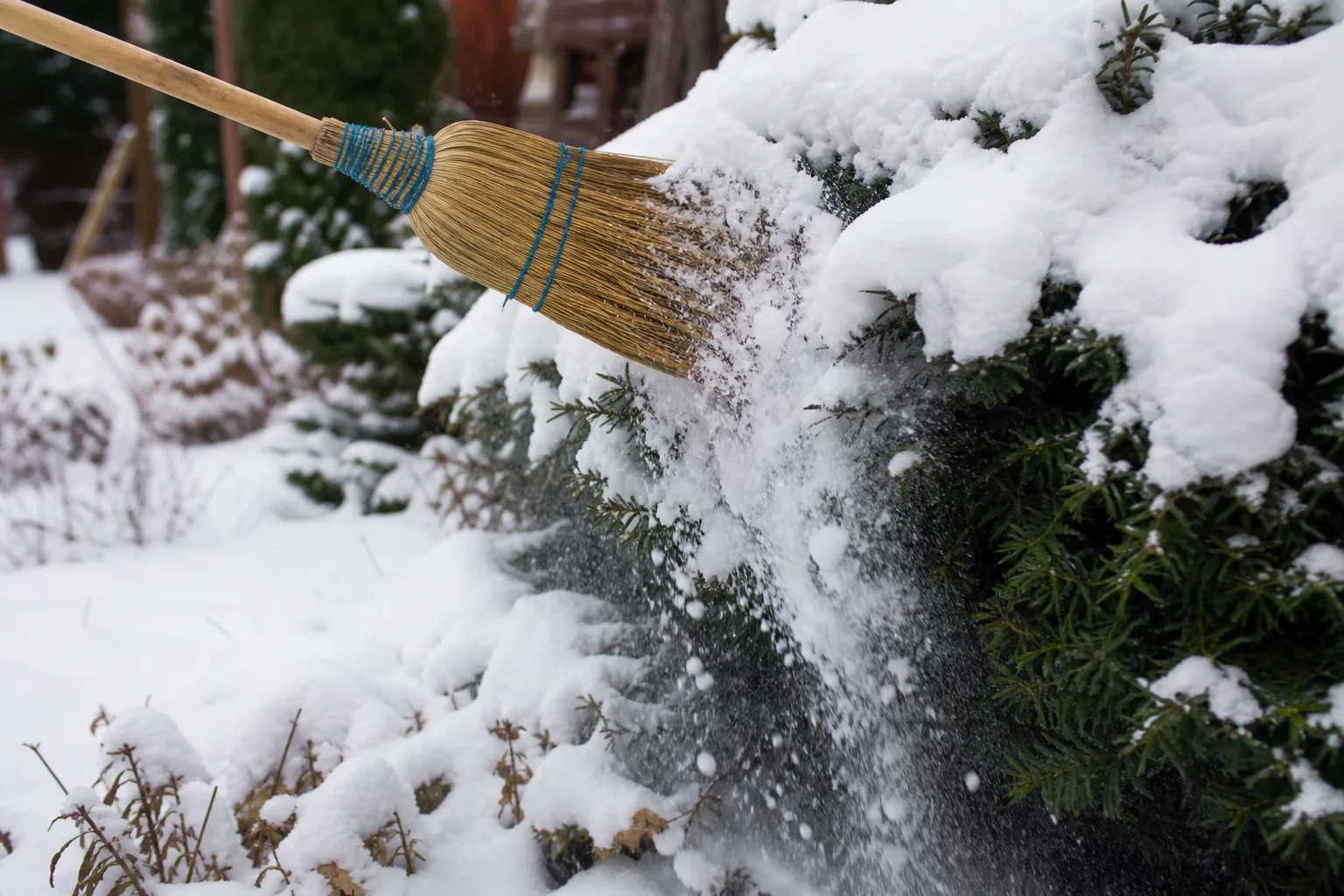
Snow can sometimes be swept off reachable shrubs with a soft broom, working from the bottom upward so you do not dump extra load onto lower limbs. NC State Extension recommends this for shrubs when snow is not frozen on — but explicitly says if snow is crusted or frozen, allow natural melt. Ice never gets that treatment. The bond is too strong and the wood too brittle.
For mature tree canopies you cannot reach safely from the ground, even loose snow is a wait-and-see situation. Extension guidance for trees emphasizes patience until melt regardless of precipitation type.
When You Can Gently Brush Loose Snow (But Never Ice)
The brushing exception applies only when all of these are true:
- The accumulation is snow, not glaze ice — you can tell the difference by touch (snow crumbles; ice is slick and rigid).
- The snow is light and dry, not wet cement or frozen crust.
- You can reach branches from the ground without a ladder.
- You use a soft broom or gloved hands, sweeping upward from the lowest branches.
- Branches are bending but not cracking — if you hear creaking or see splits, stop.
This is a shrub-level technique for boxwood, holly, rhododendron, or a young ornamental you can walk around safely. It is not permission to whack ice off an oak with a shovel. The moment you are tempted to chip ice with a tool, you have crossed into the danger zone Purdue and NC State warn against.
Why Spraying Water on Ice-Covered Plants Backfires
Another well-meaning mistake: hosing down ice-coated trees to “melt” the load. Do not spray water onto ice-covered plants. You add liquid that refreezes into a thicker shell, increasing total weight on already stressed limbs. Runoff also pools around roots and refreezes in soil cracks.
Warm-water tricks are equally risky — sudden temperature shock can damage cambium, and you cannot control where ice reforms. The only water intervention extension sources sometimes mention is rinsing salt spray off evergreen foliage after de-icing events, and only when temperatures are above freezing — a separate problem from ice load removal. For glaze ice on branches, nature’s thaw is the tool.
Which Trees and Shrubs Are Most Vulnerable to Ice
Not every plant in your yard faces the same risk. Ice damage is a physics problem: surface area × adhesion × wood strength × branch angle. Plants with lots of winter foliage, upright habit, soft wood, or narrow crotches collect more ice and fail more often.
Evergreens, Upright Hedges, and Multi-Stem Shrubs
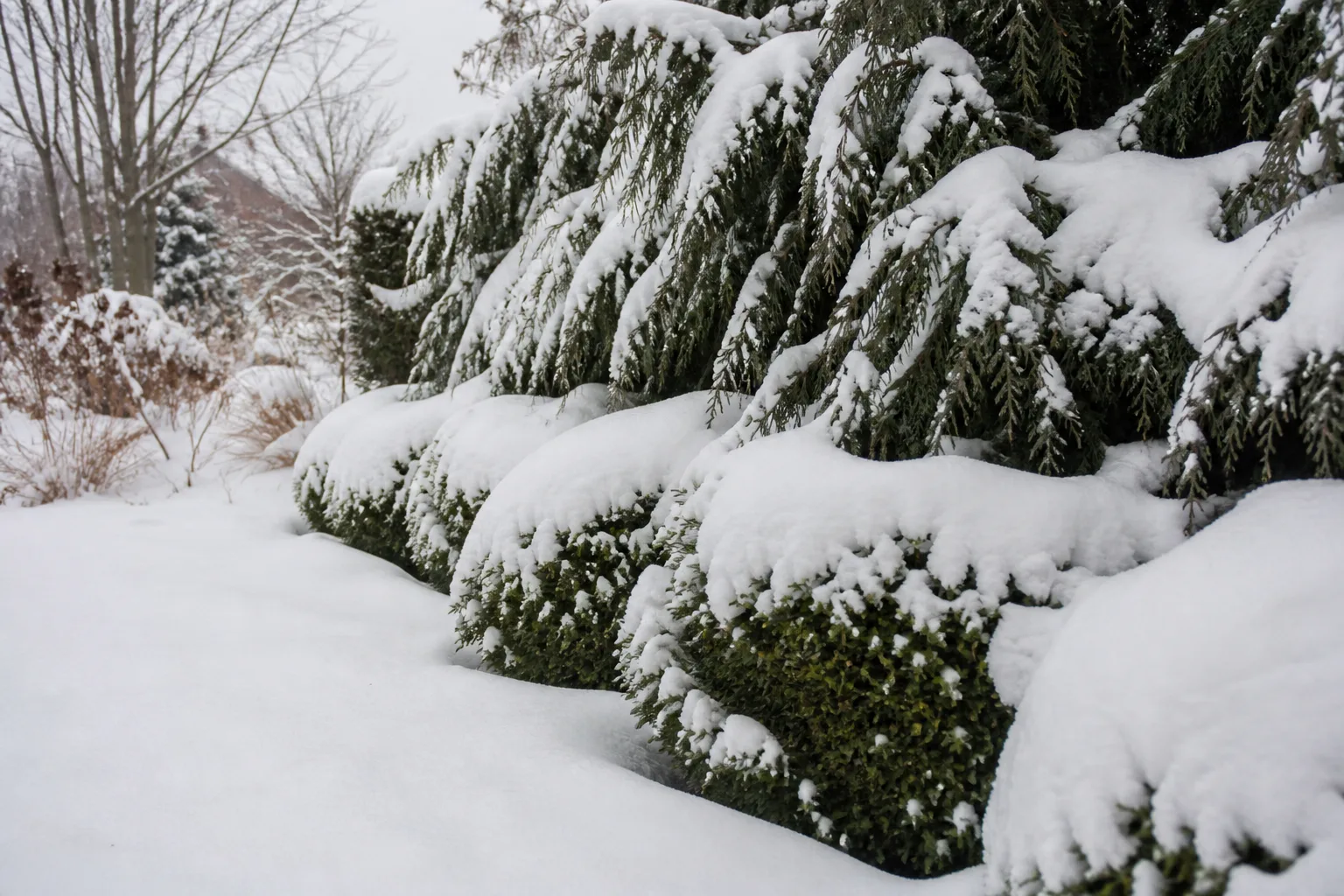
Needled and broadleaf evergreens carry leaves or needles through winter, giving ice far more to cling to than bare deciduous branches. The worst offenders in residential landscapes:
- Arborvitae (Thuja) — soft, fan-like sprays splay outward under load; multi-stem clumps often do not regain symmetry after major icing.
- Upright junipers and columnar cultivars — narrow profile catches ice on every scale-covered branch.
- Leyland cypress — fast growth, weak structure, and dense foliage make it a repeat ice-storm casualty.
- Boxwood and yew — formal hedges bend into concave shapes; small breaks at the top are common.
- Upright holly (including ‘Sky Pencil’ types) — tall, narrow silhouettes load heavily at the tips.
NC State Extension notes that conifers — arborvitae, juniper, cedar — that break apart in ice storms often do not recover and should be removed rather than patched repeatedly. That is a hard truth, but planning around it saves years of fighting a disfigured hedge.
Multi-stem shrubs (several trunks from one base) are vulnerable because ice pushes each stem outward independently. Tying stems together before a forecast ice event — covered in the prevention section — is one of the few proactive steps that genuinely helps.
Weak-Wooded Deciduous Trees That Fail in Glaze Ice
Deciduous trees without leaves still collect ice on every twig, but the catastrophic failures tend to concentrate in species with narrow branch angles, fast growth, or inherently weak wood:
- Bradford / Callery pear — the textbook weak-union tree; ice and wind expose structural flaws years of “looks fine” growth hid.
- Silver maple and willow — soft wood, long limbs, heavy ice at the tips.
- Green ash, lacebark elm, water oak, pecan — NC State lists these among trees more likely to fail in wind, snow, and ice events.
- River birch and Chinese elm — brittle twigs and multi-trunk habits.
If you are planting new trees in ice-prone regions, extension services recommend resilient alternatives: bald cypress, hickory, ironwood, ginkgo, white oak, and crape myrtle show better survival in Southeastern ice-storm guidance. Structural pruning of young trees — promoting wide branch angles and removing competing leaders — is the long game that reduces future ice damage more than any post-storm heroics.
What to Do Immediately After an Ice Storm
Once the freezing rain stops, your first hours are about safety and observation, not repair. The ice is still doing its slow work; your job is to stay clear of hazards and gather information for decisions you will make after melt.
Safety First: Power Lines, Hanging Limbs, and Falling Ice
Treat every ice-loaded tree near utilities as a potential electrical hazard until proven otherwise. NC State Extension is unambiguous: never cut limbs tangled in power lines — call your utility company. The same applies if a trunk or branch is touching or draped across lines, even if power is still on. Ice conducts current unpredictably; wood that contacts energized lines can electrify the ground around it.
Other immediate safety rules:
- Do not walk, park, or let children play under heavily iced canopies. Limbs can release without warning as wind shifts or sun warms one side.
- Do not stand beneath a branch while knocking anything — if you should not knock ice, you certainly should not stand in its fall zone experimenting.
- Treat hanging, splintered limbs as booby traps. A partially attached branch can swing when ice slides off. Mark the area and keep traffic away until an arborist or melt removes the threat.
- Call an ISA Certified Arborist for large breaks, trunk splits, or anything requiring a ladder or chainsaw. Find credentialed professionals through the International Society of Arboriculture.
If a limb blocks a driveway and does not involve power lines, you may still wait for melt before cutting unless it poses an active danger to people. Emergency removal is for immediate human safety, not cosmetic urgency.
How to Inspect Damage Without Touching Ice-Covered Wood
When conditions are safe, walk your property with binoculars and a notepad — not a broom. Document from a distance:
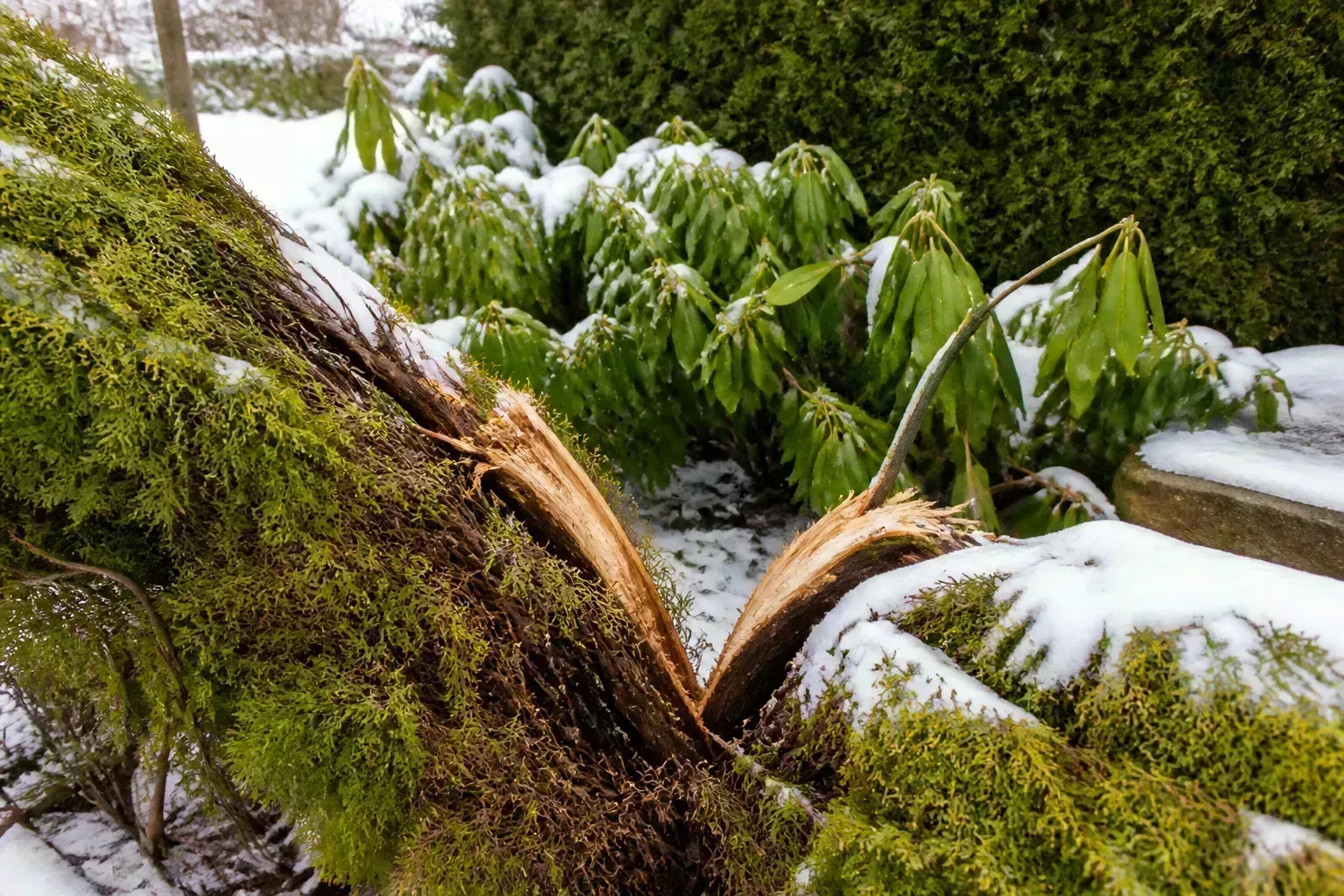
- Bent vs broken — bent leaders often rebound; sharp angles with bark gaps or hanging splinters mean failure.
- Splayed multi-stem shrubs — arborvitae and juniper bases pushed outward are a signature ice injury.
- Trunk cracks — vertical splits at branch unions on mature trees are serious; flag them for professional evaluation.
- Root plate lifting — soil mounding on the windward side of a leaning tree means root failure, not just bent wood.
Take photos. Ice makes every plant look worse than it may be, and a before-and-after series helps you judge recovery weeks later. Do not prune now unless a hanging limb threatens people. NC State Extension recommends waiting to assess until you can see live wood and the worst cold has passed — typically late winter into early spring for most pruning.
When Propping Low Branches Helps — and When It Does Not
In limited cases, you can support low-hanging limbs on small trees with a sturdy prop — a length of lumber set at an angle between the ground and the branch, not forcing the wood upward into its original position. The goal is to prevent further bending, not to yank branches back into shape. Forcing frozen wood straight is another version of the breaking-ice mistake.
Prop only when:
- The branch is within reach from the ground.
- The wood is bent but not cracked.
- The prop supports weight without lifting aggressively.
- You can remove the prop after melt without bark abrasion.
For splayed arborvitae, some gardeners tie loose twine around the outer stems and stake to a fence post to keep the clump from opening wider — again, support the current position; do not crank stems vertical. Remove ties in spring so summer growth is not girdled.
If the branch is already split, propping will not heal it. Mark it for proper pruning to the branch collar once ice is gone.
Recovery Timeline: Patience, Pruning, and Realistic Expectations
Ice storm gardening is a waiting game punctuated by a few decisive cuts. Rushing pruning while wood is still frozen leads to ragged tears; waiting too long on hazardous hangers puts people at risk. Use this sequence.
Phase 1 — During ice (hours to days): Leave ice intact. Stay safe. Optional props on reachable low limbs only.
Phase 2 — After melt (days to weeks): Re-walk the property. Many bent branches will have lifted on their own. Note what did not.
Phase 3 — Late winter / early spring pruning: Remove broken stubs back to the branch collar or trunk. Hire an arborist for large cuts, canopy work, or trees where more than a third of the crown is damaged. Apply slow-release fertilizer in spring if a tree lost significant leaf area, and water through dry summer spells — stressed wood needs hydration to compartmentalize wounds.
Do not use wound paint. Clean cuts at the collar outperform sealants.
Bent but Unbroken Branches Often Straighten After Melt
Gardeners routinely underestimate elastic recovery. A branch bent to the ground under ice may rise to within a few degrees of its original angle over two to six weeks after load disappears — especially on younger, flexible wood. Hollies, spirea, azaleas, and many maples surprise people with how much spring-back they retain.
Give plants that grace period before declaring them ruined. If a leader is still noticeably crooked by mid-spring and bothers you aesthetically, selective thinning or training may help — but only after you confirm the cambium is alive (scratch test or bud break).
Plants That Recover Well vs Conifers You May Need to Replace
Recovery potential varies sharply by species and damage type:
Often recover with hard pruning or time:
- Broadleaf evergreens — holly, camellia, rhododendron, azalea
- Deciduous flowering shrubs — spirea, butterfly bush, Knock Out roses
- Wax myrtle and similar multi-stem natives — NC State notes they can be cut nearly to the ground and regrow within one to two seasons
- Young deciduous trees with minor limb loss and intact leaders
Often poor candidates after major ice fracture:
- Arborvitae and upright junipers with split leaders or permanent splay
- Leyland cypress with broken tops — they do not back-bud reliably on old wood
- Bradford pear with trunk splits or multiple large union failures
- Mature trees with more than one-third crown loss or significant root plate movement
Spring-blooming shrubs pruned hard now sacrifice this year’s flowers — acceptable if the alternative is torn bark and dieback. Conifers that lost their central leader rarely regain the formal pyramidal shape homeowners want; replacement is sometimes the honest recommendation.
How to Prevent Ice Damage Before the Next Storm
Post-storm patience is necessary; pre-storm preparation is how you reduce the next round of damage. None of this guarantees survival in a quarter-inch ice event, but it shifts odds meaningfully.
Structural Pruning and Choosing Resilient Species
Annual structural pruning on young trees removes competing leaders, narrow V-crotches, and deadwood that becomes failure points under load. A few well-placed cuts at planting age prevent the “looks fine until ice” collapse NC State describes. Inspect mature trees every few years with a certified arborist — especially after any storm that exposed weaknesses.
When adding new plants, match species to your USDA hardiness zone and storm history. Favor trees with wide branch attachments and strong wood. Avoid repeating known weak performers in high-value spots near the house, driveway, or play areas. Remove bird feeders, holiday lights, and wind chimes from branches before ice forecasts — ice accumulates on those objects and adds localized weight.
Keep de-icing salt away from root zones. Sodium chloride within 30 feet of sensitive evergreens causes foliage burn and soil damage that compounds winter stress. NC State recommends potassium chloride, calcium magnesium acetate, or calcium chloride alternatives, plus sand for traction.
Tying Up Vulnerable Evergreens Before Ice Is Forecast
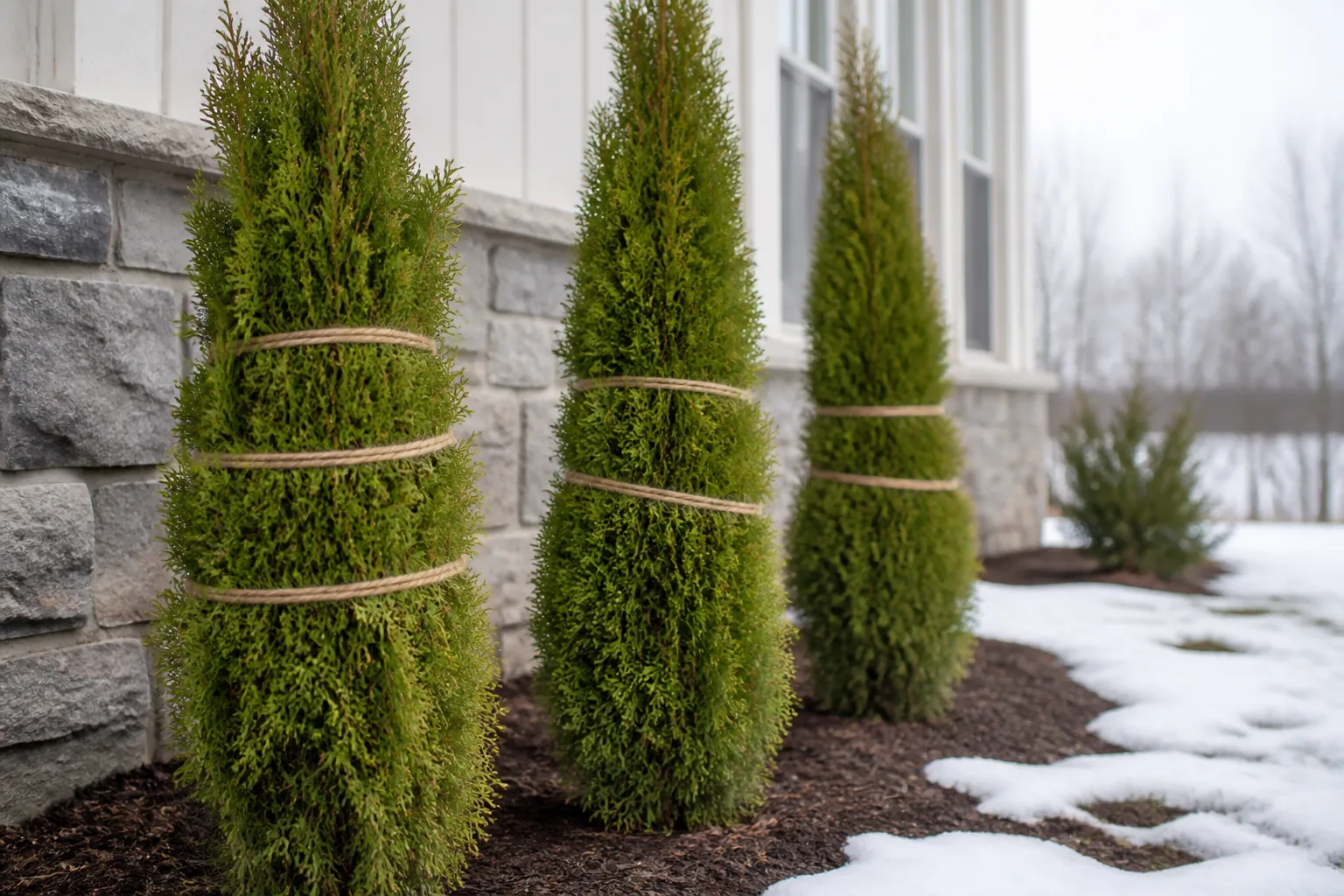
For narrow upright evergreens, pre-storm binding is one of the most effective prevention tactics extension services cite. Before freezing rain arrives:
- Ring the shrub with soft rope, twine, or cloth strips — never wire that cuts bark.
- Gather stems gently inward; tie high on the plant for columnar types, or loop the exterior for globe forms.
- For multi-leader clumps, tie leaders together inside the canopy where wraps are less visible.
- Remove all binding promptly after melt. Leaving ties through spring girdles stems and traps moisture.
This does not eliminate ice weight, but it keeps stems from splaying outward and snapping at the base — the most common arborvitae failure mode. Combine with choosing more storm-resistant holly cultivars (‘Nellie Stevens’, ‘Oakleaf’) when replanting splayed hedges.
Conclusion
Ice on trees and shrubs triggers a rescue reflex that almost always makes things worse. Do not break, beat, knock, or shake ice off branches — frozen wood shatters, bonded ice tears bark, and you put yourself under loads that can fall without warning. Let glaze ice melt, keep people and vehicles away from hazardous canopies, call the utility company about any line contact, and reserve pruning for late winter when you can see what bent wood recovered and what actually broke.
Remember the snow distinction: loose fluffy snow on reachable shrubs may be brushed off bottom-up when it is not frozen on; ice never gets that treatment, and water spray only adds weight. Know which plants in your yard are vulnerable — upright evergreens, weak-wooded pears and maples — and which are likely to bounce back with patience or hard pruning. Tie narrow evergreens before the next forecast, prune young trees for strong structure, and build a relationship with a certified arborist before you need emergency service.
The glittering branches will look alarming for a few days. In most cases, melt plus measured follow-up beats every heroic swing of a broom.



