When and How to Prune a Mimosa Tree
Learn when to prune a mimosa tree, which branches to remove first, how to make clean cuts, and why pruning cannot stop seed spread.
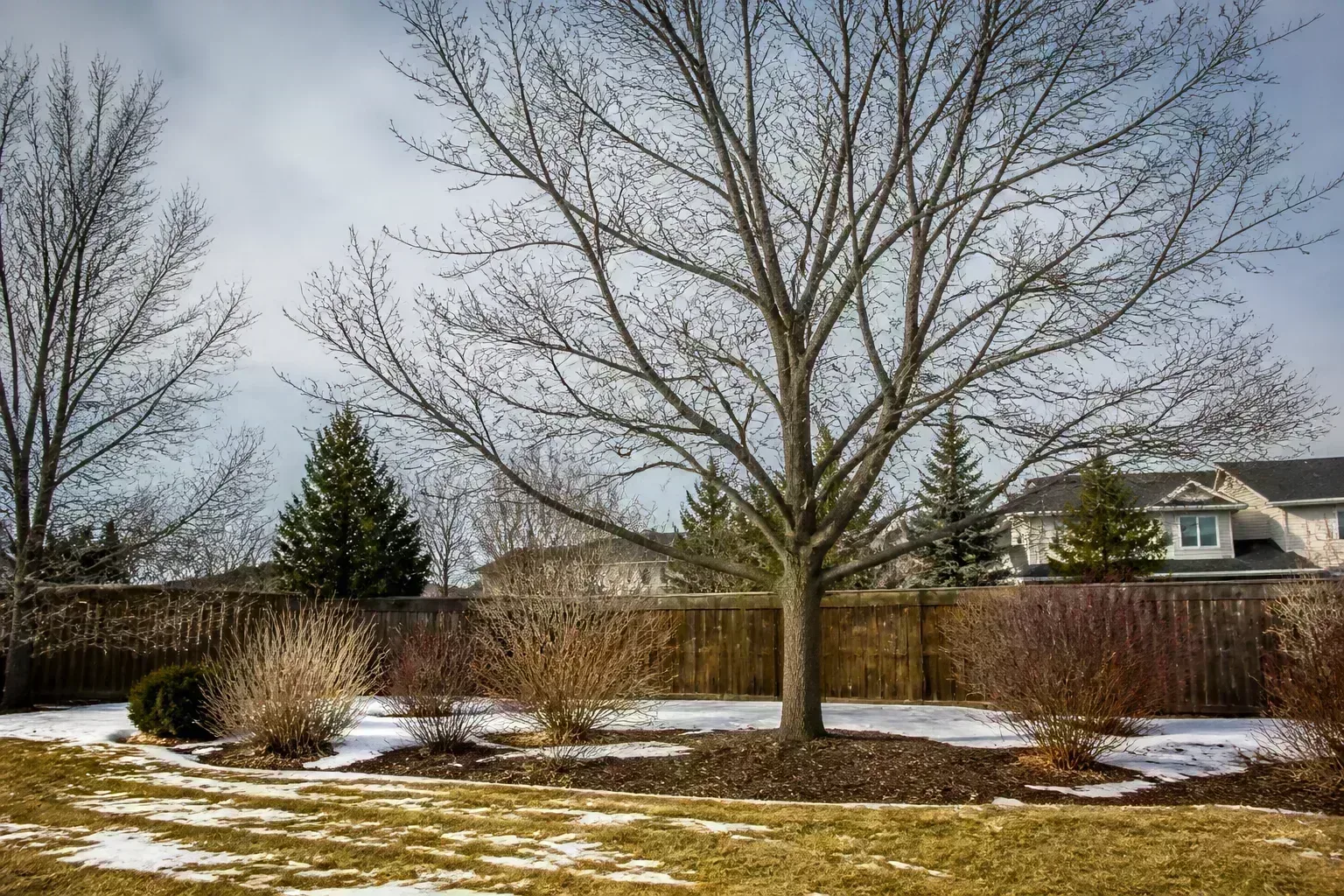
For the tree most American gardeners mean by “mimosa”—Albizia julibrissin, or the Persian silk tree—the best time for structural pruning is usually late winter, while the tree is dormant and before it leafs out. That window lets you see the framework, reduces the chance of cutting off developing flowers, and makes it easier to decide which limbs are actually worth keeping. Remove dead, storm-damaged, or obviously hazardous wood whenever conditions are dry and safe, but save major shaping for the dormant season.
Pruning can improve clearance, reduce rubbing, and keep a young tree from becoming an impossible tangle. It cannot make mimosa wood strong, cure Fusarium wilt, or prevent viable seeds from moving into the surrounding landscape. NC State Extension describes the species as fast-growing, weak-wooded, short-lived, and invasive in North Carolina and other parts of the Southeast, so the professional approach begins with realistic expectations rather than an aggressive haircut. (NC State Extension)
The short answer: prune for structure, not a smaller canopy
Start with a clear purpose. A good mimosa pruning session removes a specific defect—such as a broken limb, a branch rubbing its neighbor, a low shoot blocking a walkway, or a poorly attached stem that is likely to fail. It does not automatically mean shortening every branch around the outside of the crown until the tree looks like a flat umbrella.
Use this priority order: safety first, health second, structure third, appearance last. If a branch is hanging over a roof, crossing a utility line, split at a weak fork, or large enough to require a ladder and a chainsaw, the correct next step is an arborist, not a taller ladder. If the tree is healthy but simply too large for the space, repeated topping will create fast regrowth and more weakly attached shoots; removal and replacement may be the more honest long-term solution.
Confirm which “mimosa” you have before choosing a date
The common name creates a genuine timing trap. In the United States, “mimosa tree” usually means the deciduous, pink-flowering Albizia julibrissin. In many parts of Europe, nurseries use “mimosa” for the evergreen, yellow-flowering Acacia dealbata, sometimes called silver wattle. These are different species, with different foliage, hardiness, and bloom calendars.
Albizia julibrissin: the summer-flowering silk tree
Albizia has fern-like leaves and silky pink flower clusters in late spring or summer, depending on climate. It is often multi-stemmed, develops a broad crown, and can grow quickly; NC State lists a mature range of roughly 20 to 40 feet tall and 20 to 50 feet wide, with limbs that are vulnerable to wind, snow, and ice damage. The same source notes that it can resprout after cutting or other damage, which explains why a rough reduction often produces a thicket of shoots rather than a smaller, stronger tree.
For this species, do the main structural work in late winter or very early spring before new leaves expand. In colder areas, wait until the worst freezes have passed but before vigorous growth begins. Do not read “winter pruning” as permission to cut during a hard freeze, on wet wood, or immediately before several nights of severe cold.
Acacia dealbata: the winter-flowering silver wattle
Acacia dealbata is evergreen or semi-evergreen, carries yellow flowers in winter or early spring, and is the “mimosa” described by many Mediterranean-climate gardening references. A trusted horticulture guide from Nature & Garden specifically separates it from American silk tree and recommends pruning after flowering, not on the same dormant-season schedule used for a summer-blooming deciduous tree. (Nature & Garden)
If your tree has yellow winter flowers, do not blindly follow an Albizia pruning calendar. Wait until flowering has finished, check the local frost forecast, and remove only what the tree can safely replace. When the label, flower color, or foliage does not fit, identify the plant before making a major cut.
Choose the form before you cut
Young mimosa trees give you the most leverage. Decide whether you want one dominant trunk or a deliberate multi-stem form, then keep the strongest stems with good spacing and wide, sturdy attachments. Remove competing shoots gradually instead of stripping the trunk in one afternoon. A tree that has already grown several large trunks may not be a good candidate for conversion to a single leader; forcing that change can create large wounds without solving the original weakness.
For a single-trunk tree, establish a clear trunk to the height needed for people, vehicles, or mowing equipment, then preserve evenly spaced scaffold branches above it. For a multi-stem tree, keep the stems distributed around the trunk rather than allowing several to emerge from one tight, included fork. Stand back frequently. A cut that looks sensible from directly underneath can make the whole crown lopsided when viewed from the street or house.
Time the work to the tree’s growth cycle
Timing should follow both species and the reason for pruning. The broad rule is simple: shape a summer-flowering Albizia while dormant; shape a winter-flowering Acacia after it blooms; remove immediate hazards when the work can be done safely.
For dormant structural pruning
Late winter is useful for Albizia because fallen leaves reveal the branch framework. BBC Gardeners’ World Magazine explains the same general advantage for deciduous trees: when a tree is leafless, it is easier to see crowded, crossing, dead, damaged, or weak branches and choose the right tool for each diameter. Its practical crown-lifting guidance also emphasizes that a branch should be cut close to, but not flush against, the trunk. (BBC Gardeners’ World Magazine: Year-round garden pruning guide)
Choose a dry, calm day when the tree is not frozen. Avoid pruning immediately before a hard freeze; fresh cuts and shortened twigs are more exposed to cold injury. If spring warmth has already triggered a strong flush of leaves, switch from major reshaping to light correction unless there is a safety problem. Removing more live canopy after growth begins can stimulate another wave of vigorous shoots and reduce the tree’s stored energy.
For storm or disease cleanup
Storm cleanup is not the same as cosmetic pruning. Remove a hanging, split, or freshly broken limb only if you can do it from the ground with stable footing and a tool that can handle the diameter. Never cut a limb that is under tension, touching a power line, lodged in another tree, or suspended above a target you cannot protect.
Disease symptoms deserve diagnosis before a major reduction. Mimosa wilt can begin with pale, drooping leaves on one branch and progress through the canopy; UF/IFAS notes that infected trees may die within a year of symptoms appearing. Cutting random branches out of a declining tree can create many wounds without changing the outcome. If one-sided wilt, rapid dieback, or a cracked trunk is present, ask an arborist or local extension office to assess the tree. (UF/IFAS Gardening Solutions)
Gather tools and make the tree safe to work around
Use a sharp bypass hand pruner for pencil-thin shoots, loppers for branches within their rated capacity, and a pruning saw for larger limbs. A clean cut is easier to place and leaves less torn tissue than a dull blade. BBC Gardeners’ World Magazine recommends matching secateurs, loppers, and a pruning saw to branch size; a tool that flexes, pinches, or requires two-handed wrestling is too small for the job.
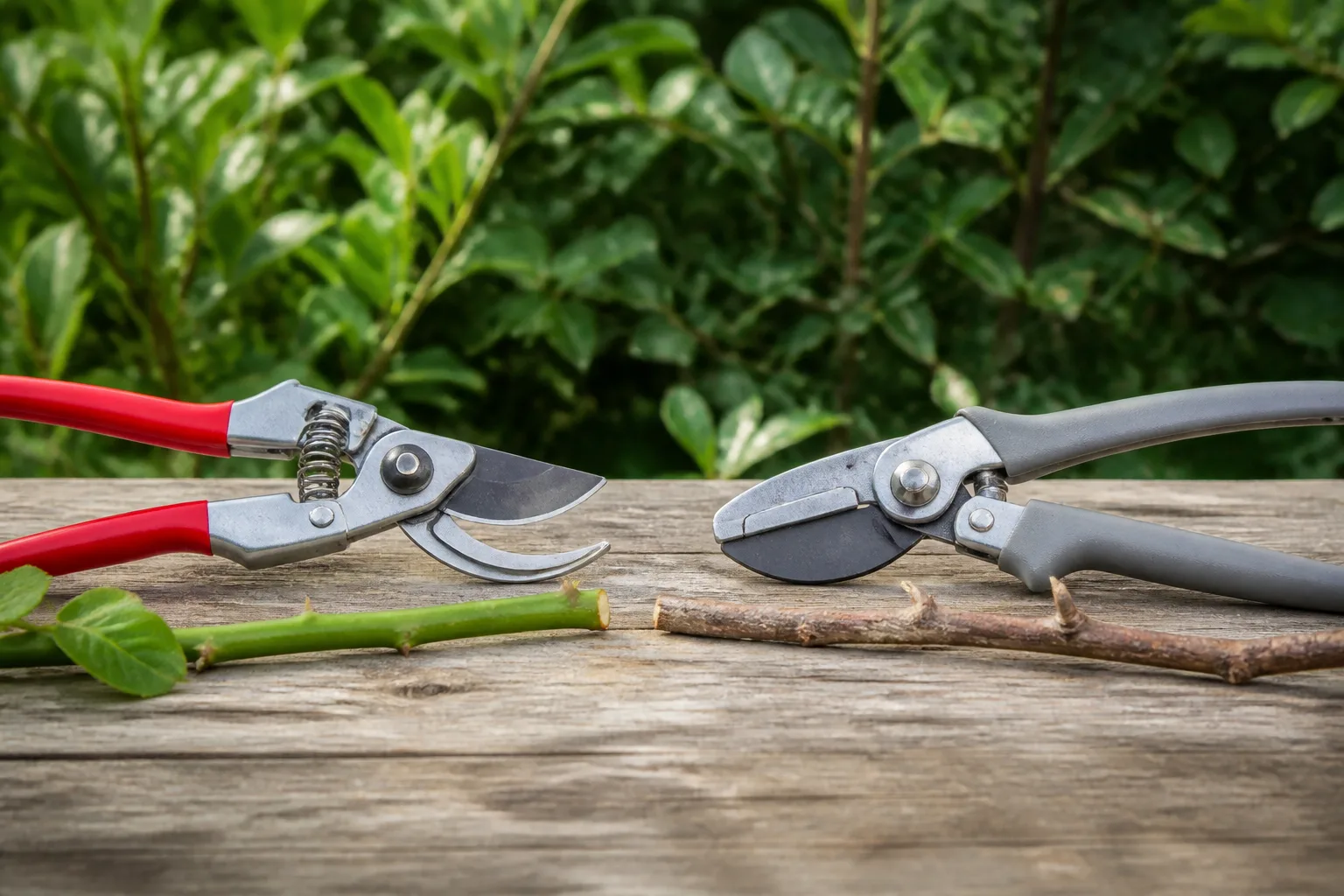
Before you start, move pets and children away from the drop zone, wear eye protection and gloves, and inspect the ground for hidden roots, stones, or slick mulch. Disinfect blades when moving between visibly diseased branches or different trees. Do not use a ladder to reach a branch that needs a chainsaw; that combination removes your ability to control the cut and the falling wood.
Inspect the mimosa in a repeatable order
Walk around the entire tree before making the first cut. Look up through the crown, then look down at the base and root flare. Mark the branches you think should go with a removable tie or a mental sequence, but do not cut until you can explain what each removal accomplishes.
First identify dead, broken, hanging, or diseased wood. Next find branches that cross, rub, grow inward, or attach at an acute, crowded fork. Then check low shoots, basal suckers, and fast vertical shoots that are stealing space from the chosen framework. Only after those problems are addressed should you shorten live branches for height or shape.
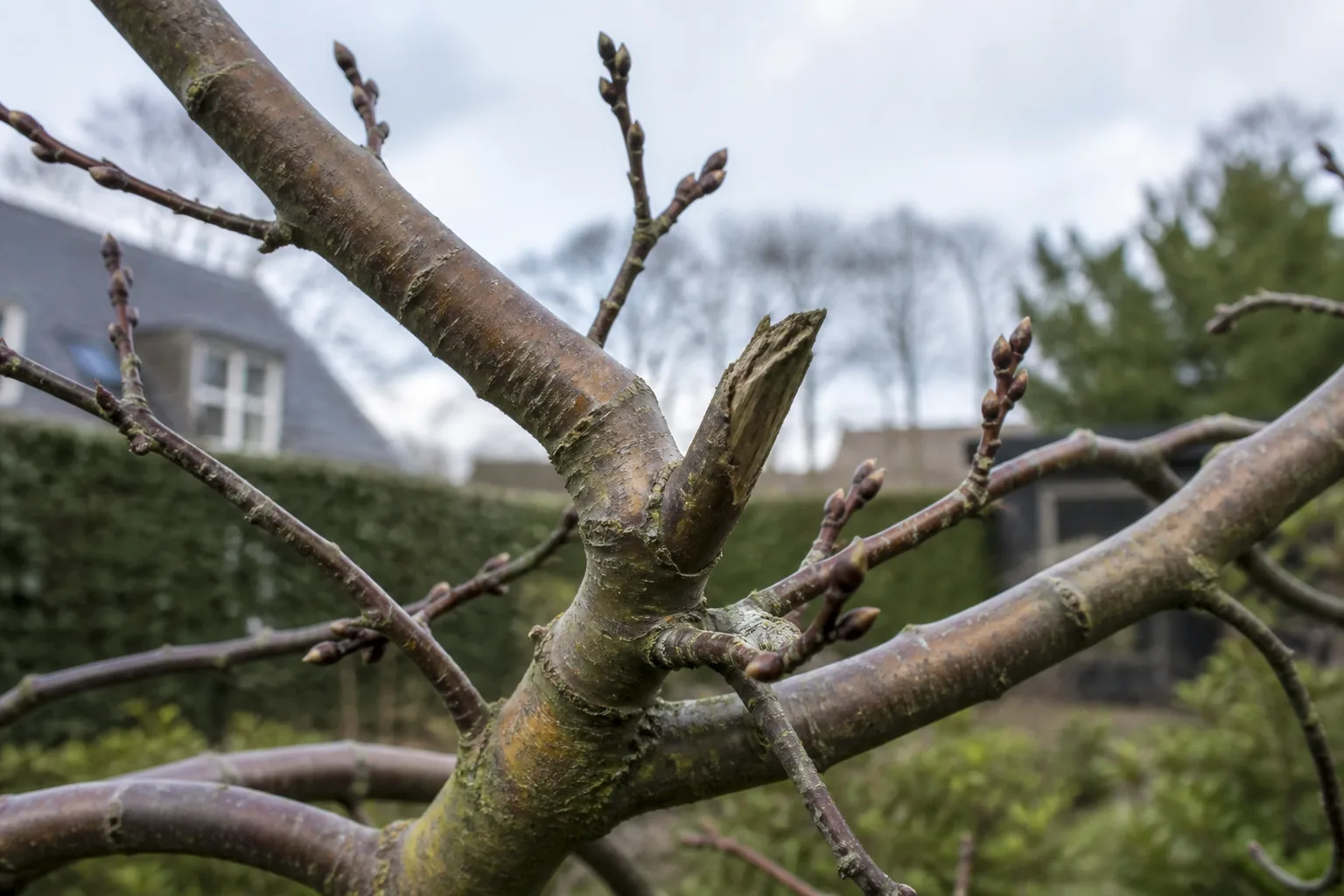
Look for failure points that the leaves hide. A long, heavy branch extending far beyond the main crown has more leverage in wind. A branch emerging from a narrow V-shaped fork may be attached less securely than one with a broad, open angle. Mimosa is already known for weak wood, so preserving every long shoot is not automatically kinder than removing one well-chosen branch.
Make each cut cleanly and deliberately
For a small twig, cut just beyond a healthy outward-facing bud or lateral branch, leaving enough wood that the bud is not damaged. For a whole branch, follow it back to its point of origin and remove it there rather than leaving a stub. A stub may die back, sprout several shoots, or remain as a site for decay; a flush cut removes the tree’s natural protective swelling and can create a larger wound than necessary.
Cut from the branch side you can control, keep the saw moving smoothly, and pause after every major removal. The goal is not to see how much wood you can remove. The goal is to make a small number of well-placed cuts that leave a balanced framework and enough live foliage to support recovery.
Use a three-cut sequence on heavy limbs
A heavy limb can tear bark as it falls. Use a three-cut sequence when the branch is too large for a single controlled cut: make a shallow undercut a short distance out from the trunk, make a top cut farther out to remove most of the limb’s weight, then make the final cut just outside the branch collar. The first two cuts prevent the falling section from ripping bark down the trunk; the last cut preserves the collar and leaves a clean wound boundary.
Work in sections if the branch is long. Removing the end weight first makes the remaining piece easier to control, but do not stand beneath it or allow it to swing into windows, fences, or people. If the limb is thick enough that you are uncertain about the cut sequence, stop and hire an arborist.
Leave the branch collar; never top the tree
The branch collar is the slightly swollen area where a branch joins the trunk or a larger limb. Cut just outside that collar, following the branch bark ridge and the natural angle of the attachment. Do not shave the cut flush against the trunk, and do not leave a long peg. BBC Gardeners’ World’s crown-lifting instructions make the same point: close is not the same as flush, and preserving the collar supports the tree’s normal compartmentalization response. (BBC Gardeners’ World Magazine: Crown lifting)
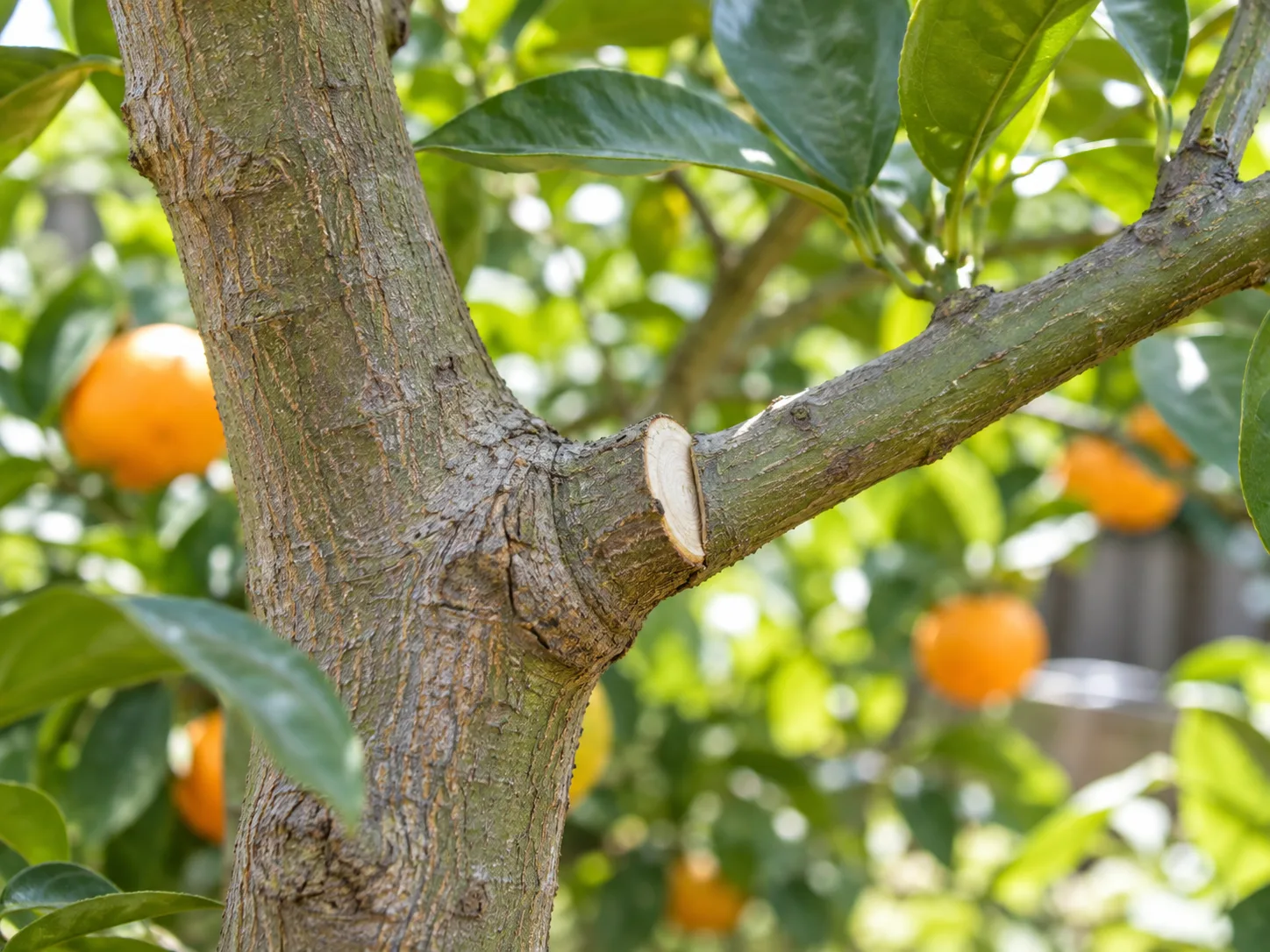
Never “top” a mimosa by cutting every main branch to the same height. Topping leaves large stubs, destroys the tree’s natural architecture, and encourages a burst of weak shoots near each cut. If the canopy is too tall for the site, remove a properly chosen branch back to a suitable lateral or have an arborist develop a reduction plan over more than one season.
Shape the canopy without forcing a weak rebound
After the defect cuts, step away and reassess. Preserve the tree’s natural rounded or umbrella-like outline rather than trying to make a perfectly flat top. Remove one competing branch instead of shortening five neighboring branches, and favor cuts that redirect growth toward open space rather than into the center of the crown.
Use a conservative limit. Treat removal of about one-third of the live canopy as an upper ceiling, not a pruning target; for a stressed, newly planted, diseased, or heavily damaged mimosa, less is safer. Many trees need only a few corrective cuts. Removing a quarter of the crown can still be too much if the cuts all occur on one side or if the remaining branches are long and poorly attached.
If you need major size control every year, the problem is likely the site or the tree’s natural growth habit, not a missing pruning trick. The University of Florida’s invasive-plant guidance does not recommend mimosa for landscape use and notes that cutting can reduce seed production but does not prevent root resprouting. (UF/IFAS Plant Directory)
Remove suckers, water sprouts, and low shoots
Mimosa can send up shoots from the base, roots, or trunk after damage. Remove basal suckers when they are young by cutting or pulling them from their point of origin; do not repeatedly shear them halfway up, which leaves a short-lived stub that returns with several shoots. If a sucker is emerging from a root away from the trunk, dig carefully enough to identify its origin before pulling so you do not leave a fragment behind.
Water sprouts are fast, upright shoots on larger limbs, often triggered by topping, storm damage, or severe pruning. Do not automatically remove every vertical shoot: some may be useful replacements on a young tree. On an established mimosa, keep only a well-placed shoot that helps rebuild the framework and remove crowded competitors at the base of the shoot during the dormant season.
Raise the crown gradually if people or vehicles need clearance. Removing too many low branches at once can leave a top-heavy silhouette and reduce the living crown that supports the trunk. Crown lifting is a design and access decision, not a race to expose as much trunk as possible.
Treat seed pods and invasive spread as a separate problem
Pruning controls branches; it does not control mimosa’s entire reproductive cycle. NC State reports that the tree reproduces by seed or root cuttings, produces pods with multiple seeds, and can spread those seeds by wind, water, and animals. UF/IFAS describes mature mimosa as a prolific seed producer and says physical cutting may reduce seed production while root resprouting still requires follow-up. (UF/IFAS Plant Directory)
If you are keeping an existing tree, add a separate seed-pod routine. Pick up or rake pods before they split, bag them according to local yard-waste rules, and patrol for seedlings after rain. Pull small seedlings while the soil is moist and remove the whole root. Do not assume that cutting the parent tree ends the problem; UF/IFAS advises watching for resprouts after cutting and continuing to remove new growth.
The seed and pods also deserve a pet-safety warning. NC State flags the seeds as containing a neurotoxin that can be toxic to livestock and dogs when ingested. Keep fallen pods out of areas where dogs chew objects, and call a veterinarian promptly if a pet may have eaten them; pruning is not a substitute for cleanup or a local invasive-plant decision.
Know when to stop and call an arborist
Stop the DIY job if you find a split trunk, a hanging limb, a cavity, extensive one-sided dieback, a branch over a roof, or any contact with electrical wires. Also stop if you must climb, use a chainsaw above shoulder height, or make a cut you cannot predict. Mimosa’s weak wood and rapid regrowth make a seemingly small correction more consequential than it looks from the ground.
An arborist can also tell you when pruning is only postponing removal. If the tree is repeatedly losing large limbs, has advanced wilt, is rooted in a tight space, or is spreading into a natural area, ask for an assessment rather than commissioning another severe reduction. In regions where mimosa is invasive, check local extension or invasive-species guidance before planting replacements; the most responsible choice may be to remove the tree and choose a non-invasive alternative.
Use this annual mimosa pruning checklist
Use this short sequence once the tree is dormant, or adapt it for a post-storm inspection:
- Identify the species. Pink summer flowers usually point to Albizia; yellow winter flowers suggest Acacia dealbata and a different pruning window.
- Choose the goal. Write down whether you are correcting a hazard, lifting the crown, training a young tree, or reducing a specific overextended branch.
- Check conditions. Work in dry, calm weather with no hard freeze imminent and no overhead utility conflict.
- Start with defects. Remove dead, broken, diseased, hanging, crossing, or rubbing branches before touching healthy outline growth.
- Preserve structure. Keep well-spaced scaffold branches, avoid narrow crowded forks, and maintain a natural crown rather than a flat top.
- Make controlled cuts. Use the right tool, preserve the branch collar, and use three cuts on heavy limbs.
- Limit the reduction. Stop well before the one-third ceiling if the tree is stressed or the remaining branches would be unbalanced.
- Clean up the spread. Collect seed pods, pull seedlings with their roots, and watch for resprouts after any major cut.
- Reassess next season. Mimosa can respond quickly; wait to see where useful shoots develop before making another major reduction.
Conclusion
Prune Albizia julibrissin in late winter or very early spring for planned structural work, and prune Acacia dealbata after its winter flowering. In either case, begin with safety and defects, make fewer high-quality cuts, preserve branch collars, and refuse the temptation to flatten the crown. A mimosa can look fuller after careful correction, but more growth is not the same as stronger structure.
The professional decision is sometimes a pruning plan and sometimes a removal plan. Because mimosa has weak wood, can resprout, and may spread by viable seeds, keep branches, pods, pets, nearby structures, and local invasive-plant guidance in the same picture. If the tree is beyond ground-based hand tools, call an arborist before the next cut.