Can a Humidifier Help a Live Christmas Tree Last Longer?
A humidifier may slow moisture loss slightly, but daily water, a fresh trunk cut, cool placement, and low-heat lights protect a tree best.
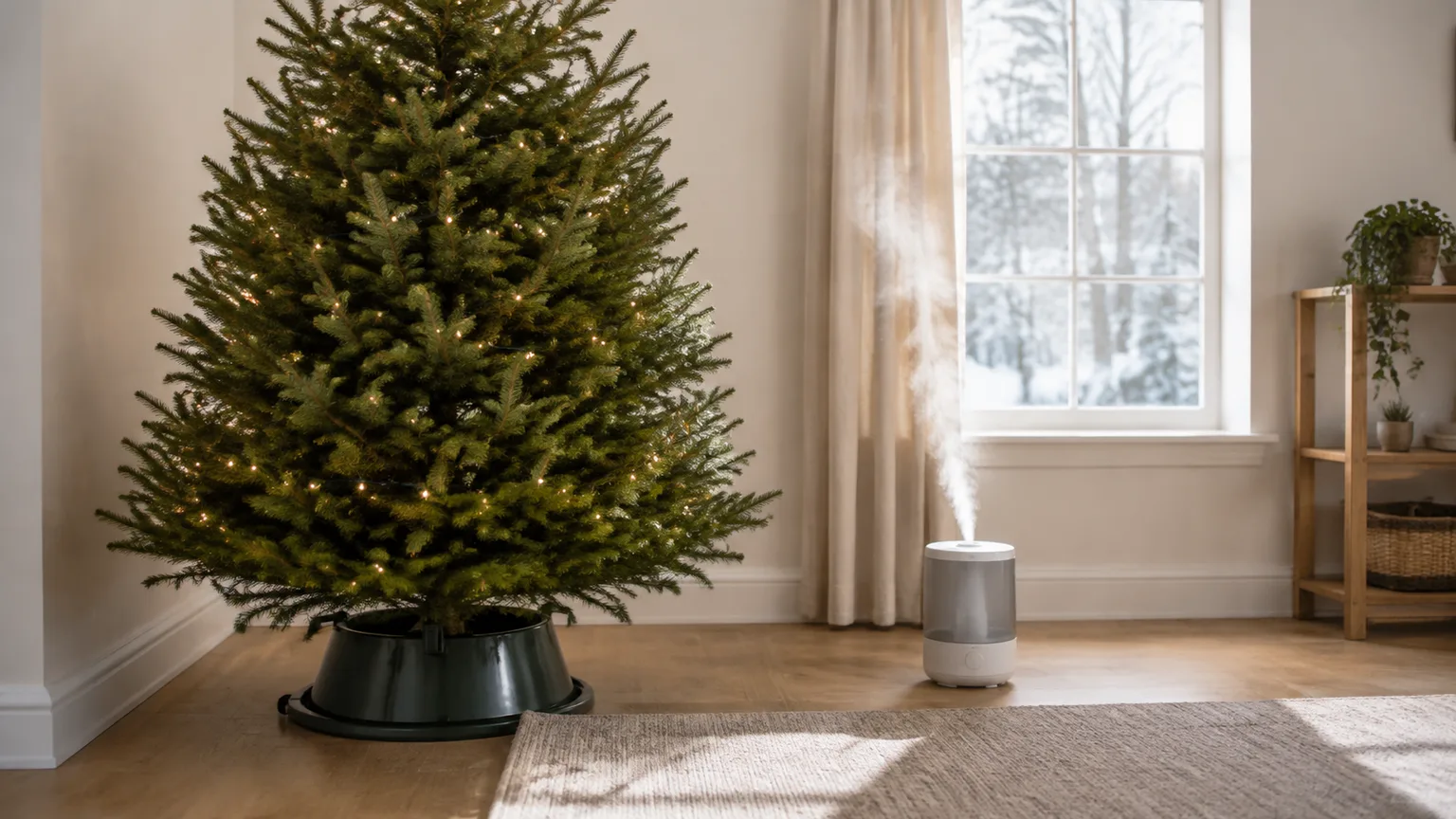
Yes, a humidifier can help a little—but it is rarely the reason a live Christmas tree makes it through the holidays looking fresh. A cut tree loses water through its needles, so a room with very dry, heated air can increase moisture loss. Raising the room’s relative humidity may reduce that pressure modestly.
The important word is modestly. A humidifier does not send water into a cut trunk, reopen a sealed base, or compensate for a stand that ran dry overnight. Tree professionals put their effort into a fresh tree, a straight fresh cut when needed, a correctly sized water reservoir, daily water checks, and a cool location. Treat the humidifier as a supporting measure for a dry room—not as the tree’s watering system.
The short answer: yes, but only at the margins
Think of a cut Christmas tree as a very large bouquet with a working water-conducting stem. Its roots are gone, but the needles are still alive for a time and still exchanging moisture with the surrounding air. The stand is the direct supply line; the room’s humidity changes how quickly water leaves the foliage.
That makes the humidifier question reasonable, but it also puts it in the right place in the priority list. If your tree is fresh, the trunk is properly seated in clean water, and the room is dry because a furnace is running constantly, a humidifier may slow the rate of moisture loss. You may notice that the room feels better and the tree’s outer needles stay flexible a little longer. There is no dependable household formula that converts a humidifier’s output into an extra week of display life.
| Care decision | What it changes | Priority |
|---|---|---|
| Keep the trunk base submerged | Directly supports water uptake | Essential |
| Keep the tree away from heat and sun | Reduces drying pressure | Essential |
| Start with a fresh tree and fresh cut | Gives the tree open water pathways | Essential when needed |
| Run a humidifier | May modestly reduce needle moisture loss | Optional |
The practical verdict is simple: use a humidifier if you already need one, but never use it as permission to relax about the stand. If you can afford only one improvement, buy or borrow a stable stand with a generous reservoir and make the water check easy to perform.
Know which kind of Christmas tree you have
“Live Christmas tree” can describe two very different plants. A cut tree has no root ball and depends on the water-holding stand. A potted or balled-and-burlapped tree still has roots, so its soil or root ball must stay moist without remaining flooded. The correct humidity advice changes with that distinction.
For a cut Fraser fir, balsam fir, Douglas fir, spruce, or pine, a humidifier affects the air around the needles. It does not replace water in the stand. For a container-grown tree, the first question is whether the potting mix is drying; for a balled tree, the first question is whether the root ball remains slightly damp and drains rather than sitting in a tub of water. Penn State Extension’s guidance for living holiday trees also emphasizes that warmer, drier indoor air means checking the root ball daily and keeping rooted trees away from heat and direct sun. Penn State Extension explains the separate care routine for living, rooted trees.
Norfolk Island pine is another common source of confusion. It is a rooted houseplant sold and decorated as a miniature Christmas tree, and it genuinely benefits from higher humidity indoors. BBC Gardeners’ World Magazine lists misting, a pebble water tray, or a room humidifier as options for that plant. That advice should not be copied wholesale onto a six-foot cut fir: the Norfolk Island pine has roots and a pot, while the cut tree’s critical water path is the trunk and stand. Gardeners’ World’s Christmas-plant guidance distinguishes humidity-loving rooted plants.
Why dry winter air can speed needle loss
Needles lose water through tiny openings and their outer surfaces, a process related to transpiration. The drier the surrounding air, the larger the moisture difference between the needle and the room, so water can leave the foliage more readily. Warm air also tends to increase the demand for water, especially when a vent, radiator, or fireplace creates a moving stream of dry air across one side of the tree.
The tree can offset that loss only if water moves upward from the stand through the trunk’s conducting tissue. If the cut end is exposed to air, the base is dirty or sealed with resin, or the stand cannot keep up with the first week’s drinking, the needles lose the supply-line advantage. A humidifier can change the air; it cannot repair the plumbing.
This is why a tree placed beside a heat register can look brown on one side even when the room’s hygrometer shows a reasonable average reading. The needle-level microclimate is hotter and drier than the number on a shelf across the room. Move the tree away from the airflow first, then decide whether humidity needs attention.
Research on postharvest needle abscission in balsam fir has examined humidity and temperature under controlled conditions, which supports the biological logic behind the question. But controlled postharvest research is not the same as a trial showing that one portable household unit will materially extend every living room tree’s life. The American Society for Horticultural Science study describes the humidity-and-temperature research context.
What a humidifier can and cannot change
A humidifier can raise relative humidity in part of a room. That may reduce the drying gradient around the needles, especially in a small, closed room with forced-air heat. It can also make a home more comfortable for people and help humidity-sensitive houseplants elsewhere in the room.
It cannot hydrate needles the way a rooted plant draws water from soil, and it cannot force water through a trunk whose cut end has been dry. It cannot undo a tree that was harvested too early, stored in wind and sun, or already lost a large amount of internal moisture. It also cannot make a hot room behave like the cool outdoor conditions where the tree developed.
The National Christmas Tree Association describes water in a traditional reservoir stand as the most effective way to maintain freshness and minimize needle-loss problems. Penn State Extension calls maintaining a high moisture level in the tree the single most important factor in reducing needle loss. Those priorities do not make the humidifier useless; they show why it belongs after the basics. The National Christmas Tree Association’s care tips cover water, fresh cuts, heat, and lights, and Penn State Extension’s research-based cut-tree guidance covers the same priorities.
When running one is worth trying
A humidifier is a sensible optional tool when the tree is already receiving water correctly and the room has a clear dry-air problem. Good candidates include a small heated room where windows do not show persistent condensation, a home where you already run a humidifier for winter comfort, or a tree that must share space with unavoidable but moderate heating.
Use a hygrometer if you want a useful signal rather than guessing from how your skin feels. You do not need to create tropical humidity around the tree. A comfortable, stable indoor reading is a better goal than chasing a high number, and the acceptable setting depends on your room, outdoor weather, ventilation, and condensation risk. If windows, walls, wood floors, or the tree stand area become damp, reduce the output.
When it is mostly wasted effort
Skip the purchase if the stand is hard to reach, the tree was already dry when you bought it, or a fireplace and heating vent still dominate the placement. A humidifier on the opposite side of a large open-plan room will not create a dependable pocket of moist air around every branch. Nor will a unit help much if it runs dry, has a clogged filter, or is aimed so high that its mist disappears into the ceiling.
The strongest “no” is a tree that is already brittle and shedding heavily. Humidity cannot restore lost flexibility or make a dry tree safe again. At that point, the right action is to turn off the lights, remove the tree, and follow local recycling guidance—not to add more moisture to the room and hope for a reversal.
The moisture-first routine that protects needle retention
The most reliable routine starts before the humidifier is switched on. Washington State University’s Christmas-tree research coverage describes moisture and needle retention as major postharvest quality traits that growers evaluate across species and genetic stock. In a home, you cannot change the tree’s genetics, but you can control the four practical links in the chain: freshness, cut surface, stand, and waterline. Washington State University reports on the postharvest moisture and needle-retention research behind Christmas-tree quality.
Start with a fresh, well-handled tree
Ask when the tree was harvested and how it was stored. A choose-and-cut tree may have a short dry interval, while a pre-cut tree can still be excellent if it was shaded, handled gently, and kept hydrated after harvest. The seller’s handling matters more than the sales channel’s name.
Test several branches before you commit. Needles should feel flexible rather than brittle, and a gentle brush should not release a green shower. The tree should have a healthy color and a resinous scent appropriate to its species. A few older inner needles on the ground are normal; widespread exterior drop is a warning that your starting moisture reserve is already low.
Transport is part of freshness. Wind strips moisture from foliage, so wrap the tree for the trip when practical and avoid leaving it exposed on a car roof longer than necessary. Once home, keep the base cool and protected until you can make the stand ready. If setup must wait, place the fresh trunk in a bucket of plain water in a cool, shaded, protected location.
Recut the trunk correctly
If more than roughly 12 hours have passed since harvest—or you cannot verify the timing—remove a thin disk from the base before display. A cut of about one-quarter to one-half inch is enough. Make it straight across and perpendicular to the trunk, not angled and not V-shaped. A flat cut makes stable contact with the stand and preserves a broad, usable water-entry surface.
Put the trunk into water as soon as the cut is made. Do not leave it on a dirty garage floor, drag it across a rug, or spend twenty minutes decorating before filling the basin. If you need a stand that fits a larger trunk, buy the correct stand rather than shaving the trunk sides. The outer wood is efficient at water uptake, so whittling can remove the tissue you are trying to preserve.
Drilling a hole into the base or installing a tube into the trunk is not a better substitute for a reservoir stand. It adds complication at the exact moment you want a clean, submerged cut surface. If the trunk will not take up water after a dry interval, a properly timed recut is more useful than a gadget.
Match stand capacity to trunk diameter
Measure the trunk where it will sit in the stand, not just the tree’s height. A useful industry rule is roughly one quart of water-holding capacity for every inch of trunk diameter, with at least a gallon of capacity for most household trees. That is a reservoir-sizing rule, not a promise that your tree will drink that exact amount every day.
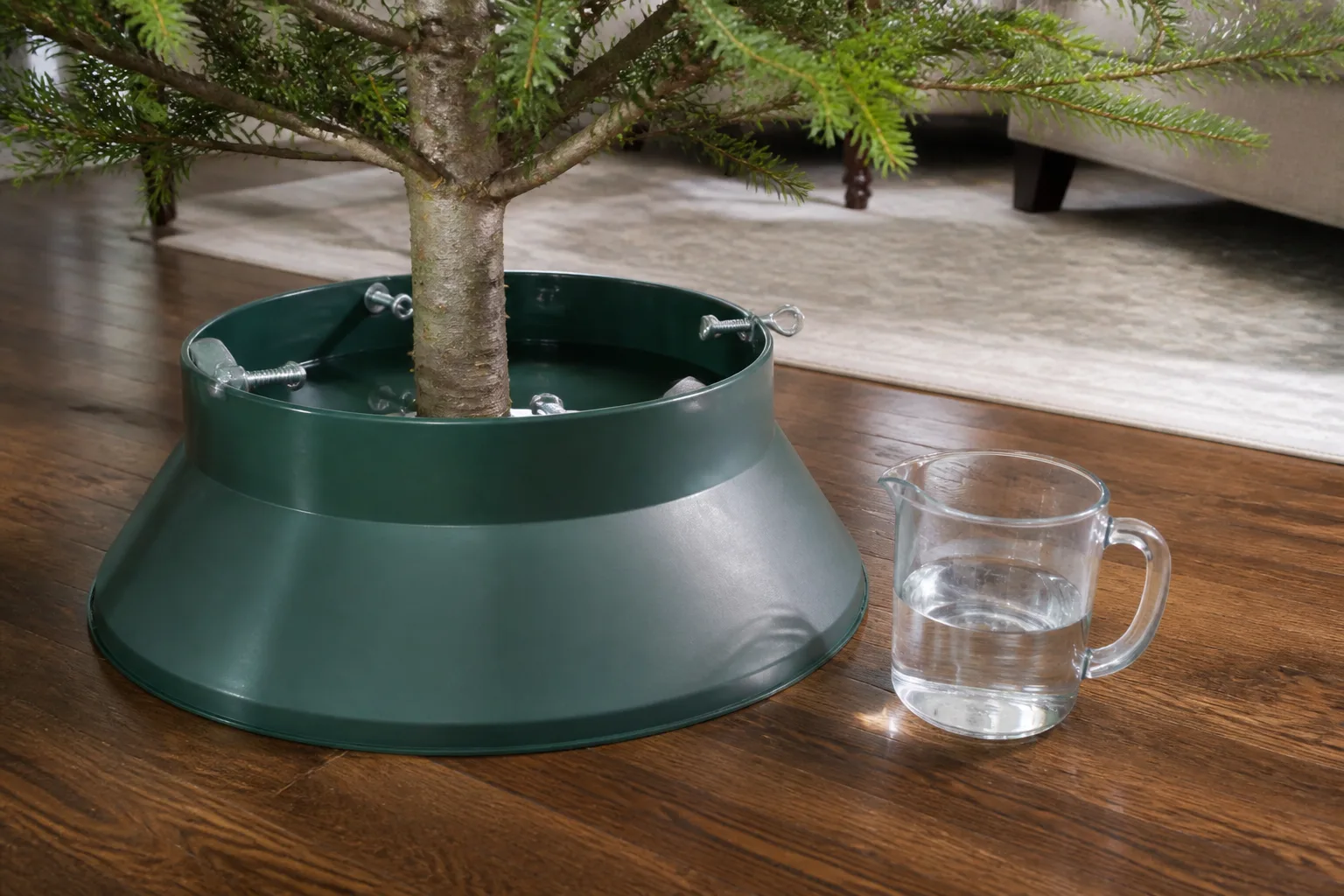
The stand must fit the trunk without carving and remain stable when branches are decorated. A wide basin is valuable because a fresh tree can drink heavily during its first week indoors, when warm household air increases demand. A narrow stand that empties overnight turns one missed check into a moisture crisis.
Avoid hiding the basin under a skirt so completely that checking it becomes annoying. The best stand is the one you can inspect without moving ornaments, crawling behind furniture, or relying on a water-level device you have not tested. Convenience is a care feature because it determines whether the check actually happens.
Keep the cut end underwater every day
Check the stand each morning and refill whenever the water level drops. On the first day, check again later in the day because the initial uptake can be substantial. Always confirm that the bottom of the trunk itself remains submerged; a stand may contain water while the cut surface sits just above it.
Use clean, ordinary water. Water temperature is not the freshness lever, so there is no need to heat it or add ice. Homemade recipes involving sugar, soda, aspirin, honey, bleach, floral preservative, or other additives are unnecessary and can create a dirty, sticky, microbe-friendly reservoir. Penn State Extension specifically recommends clean water and warns against water-holding gels, additives, and anti-transpirant products for indoor cut trees.
If the waterline has stayed unchanged for a full day, investigate instead of assuming the tree is no longer thirsty. Check that the cut end is actually under water, the stand has not tilted, the trunk was not shaved too aggressively, and the basin is not coated with slime. A fresh cut may be necessary if a long dry interval allowed the base to seal. Refill first; reach for the humidifier only after the direct water path is working.
Place the tree to reduce heat and airflow stress
Room placement often beats room humidity. A tree in a cool corner with reliable water can outperform a tree in a humidified room that sits over a floor vent. Keep the tree away from fireplaces, radiators, space heaters, heating vents, and strong direct sun. The National Christmas Tree Association and Penn State Extension both connect cooler placement with slower drying and lower daily water demand.
Do not overcorrect by placing the tree beside an exterior door that opens frequently or in a spot exposed to freezing air. The goal is a stable, comfortably cool indoor location, not repeated temperature shock. Leave enough space around the base to inspect the stand and enough clearance that branches do not brush hot equipment, curtains, or light fixtures.
Set the room, not just the humidifier
Walk the room at floor level before setting up. Feel for warm airflow from a vent, look for afternoon sun on the branches, and check whether a radiator is hidden behind a sofa. If one side of the tree is already drying faster, rotate or relocate the tree rather than pointing more mist at that side.
Keep the room at a normal comfortable temperature and avoid turning the thermostat high just because the weather is cold outside. Lowering the room temperature slightly can reduce drying, but a minor thermostat change is less important than removing a direct heat source. Humidifier output cannot cancel radiant heat from a fireplace or continuous air movement from a register.
Choose low-heat lights and shut them off
Lights add heat close to the needles. Modern LED strings generally produce less heat than older incandescent mini-lights, so they are the better choice for a tree you want to keep fresh. Inspect every string for frayed insulation, broken sockets, or loose connections before decorating, and do not overload an outlet or power strip.
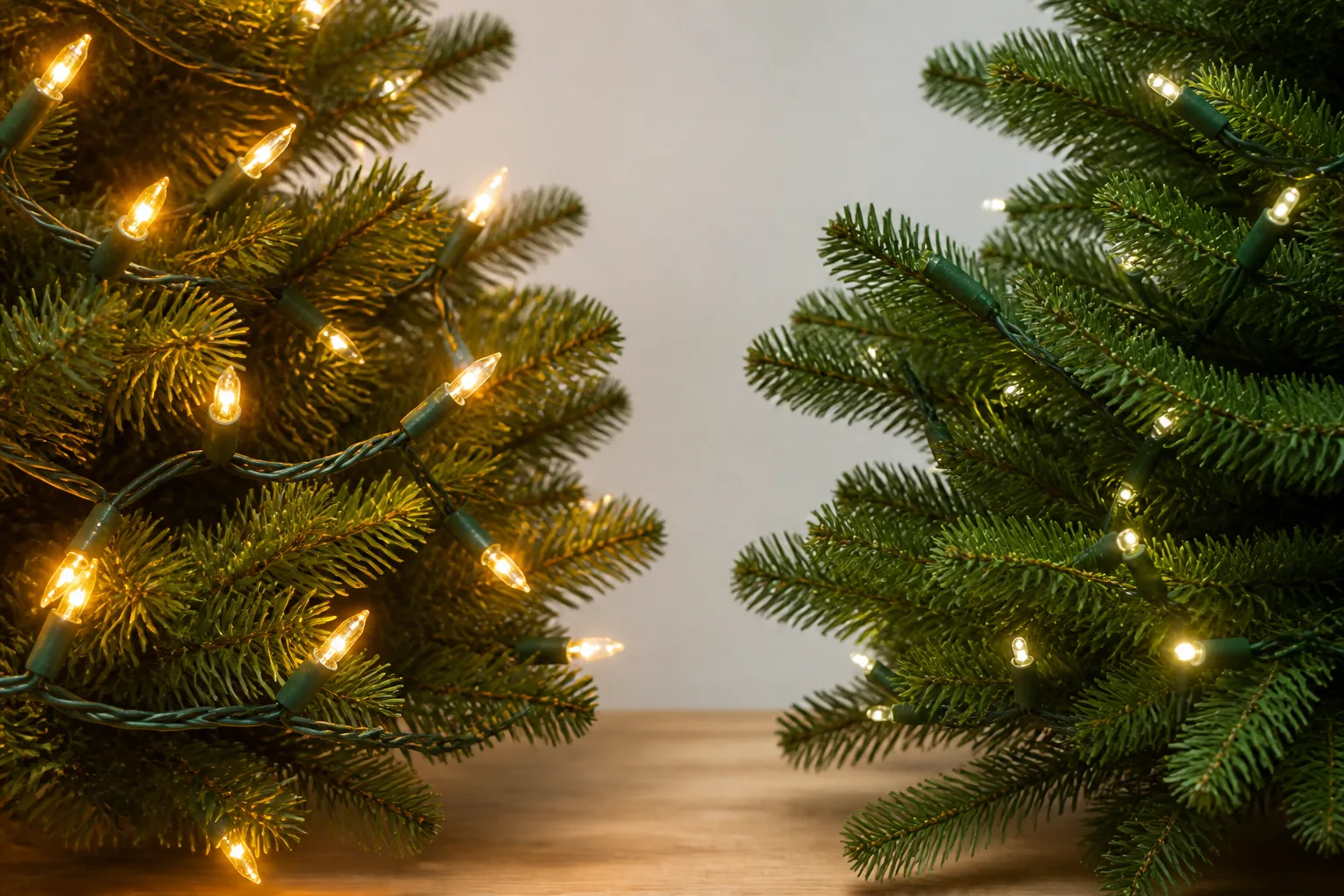
Turn the lights off when you leave the house and when you go to bed. Never use real candles on a Christmas tree, and do not use a humidifier to justify placing the tree closer to a flame or heater. A well-watered tree is safer than a dry one, but no watering routine makes unsafe lighting or open flames acceptable.
Use a humidifier safely near a Christmas tree
Set the humidifier on a stable, waterproof mat several feet from the tree, not inside the stand and not directly beneath the lowest branches. Start with the plume directed into open room air, where it can disperse naturally. You are trying to improve the room’s humidity, not coat the needles or ornaments.
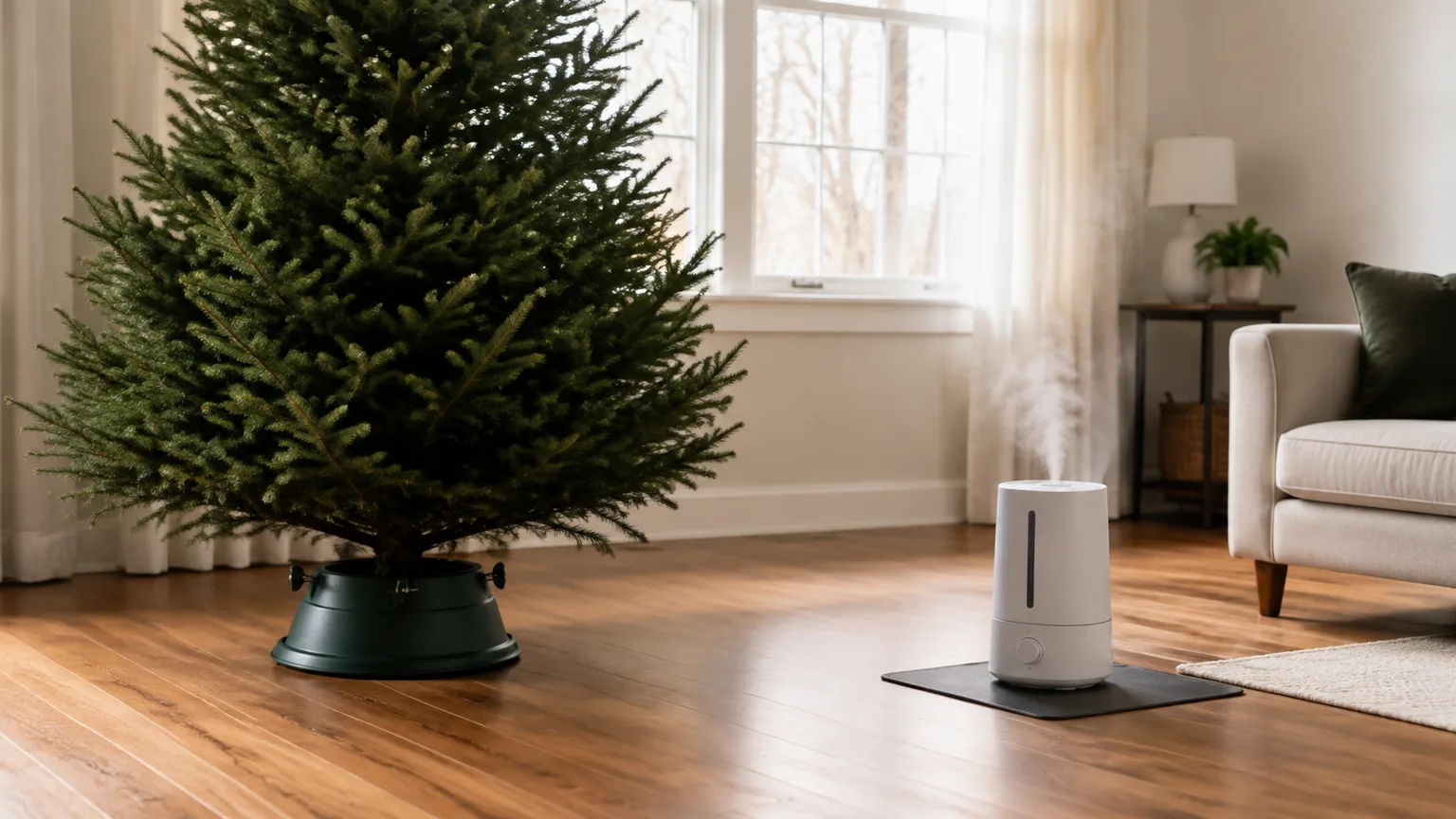
Keep the humidifier clear of power strips, extension-cord connections, presents, paper, and the tree skirt. Wipe up any condensation or spill immediately, especially on wood floors. A visible puddle, damp wall, or wet electrical connection is a stop signal, not evidence that the unit is working better.
Use the water and cleaning routine specified by the appliance manufacturer. Empty and clean the tank on schedule, and do not add fragrance oils or tree additives to it. If you see a white mineral film on nearby surfaces, switch to the water type recommended for your unit, lower the output, or stop using it; mineral dust is a household-air problem, not a tree-care benefit.
A hygrometer placed near the tree can show whether the unit is changing the local room at all, but do not chase a high reading. Relative humidity changes with temperature, airflow, and outdoor weather, and a single number cannot tell you whether the trunk is submerged. Let the waterline and needle condition decide tree care; let the hygrometer help you avoid an excessively dry or damp room.
Troubleshoot a tree that is already dropping needles
Needle drop is a symptom, not a diagnosis. Start with the pattern and timing rather than adding a product.
- Drop began immediately after setup: Check tree freshness, transport exposure, and whether the trunk went into water promptly. A dry starting tree may be past the point where a humidifier can help.
- The stand is full but the tree is not drinking: Look at the actual cut surface, not the visible water in the bowl. Confirm the tree is upright, the basin is not tilted, and the trunk base is submerged. If it sat dry for a long period, consider a fresh straight cut.
- One side is browning near a wall or vent: Move the tree away from the heat or airflow. A room-wide humidity increase is a weaker fix than removing the local hot spot.
- Needles feel brittle and break easily: Stop treating this as a humidity experiment. Unplug the lights, remove ornaments carefully, take the tree outside, and recycle it according to local rules.
- The water level barely changes after a strong first week: Lower uptake can be normal as the tree acclimates, but a sudden stop paired with brittle needles is a warning. Inspect the base and overall freshness before assuming the tree is fine.
Do not judge dryness by color alone. Some species retain green color while their needles become brittle, and interior needle loss can occur naturally. Texture, attachment, branch flexibility, water uptake, and the tree’s location together give a better picture.
Myths that sound more powerful than they are
Misting the branches is not the same as watering the tree. Surface droplets evaporate quickly and do not replace water traveling from the stand through the trunk. Wet foliage near electrical lights also creates a poor safety trade-off, so avoid spraying the decorated tree.
Drilling the trunk is not a secret hydration shortcut. A hole does not outperform a clean fresh cut and a conventional water-holding stand. Side-hole “IV” systems add failure points and can be less effective than simply keeping the cut end submerged.
Warm water, ice, sugar, soda, aspirin, and bleach do not beat clean water. The water’s temperature is not the important variable, and additives can dirty the basin or damage the tree. The correct recipe is unglamorous: a clean stand, plain water, and a waterline that never falls below the cut.
Anti-transpirant sprays and water gels are not a replacement for a stand. Penn State Extension reports little effect from anti-transpirants on indoor cut trees and says gels can reduce the amount of free water available to the trunk. A product that makes the surface look glossy is not necessarily preserving the tree’s internal moisture.
A humidifier does not make a dry tree safe. Once the tree is brittle and shedding heavily, continuing to run lights while trying to rescue it adds risk without restoring the tree. Freshness is not an on-off switch; it declines, and the safest decision is to remove a tree that has clearly dried.
A 10-minute daily Christmas tree checklist
Make the routine easy enough to repeat on busy days. The following sequence takes only a few minutes once the tree is accessible:
- Look at the tree’s overall color and the floor for a sudden increase in green needle drop.
- Run your fingers gently along one outer branch. Needles should not feel brittle or fall away in a green cascade.
- Check the stand from the side and confirm that water touches the bottom of the trunk.
- Refill with clean water before the cut end is exposed.
- Look for a slick film, strong odor, tilt, or leak around the basin.
- Check that the humidifier, if you use one, is upright, dry underneath, clean, and not aimed at the tree.
- Look at the nearest vent, radiator, sunny window, or fireplace and make sure the tree has not been pushed into a hotter position.
- Inspect the light cord for damage and turn lights off when the room is unattended.
During the first 24 hours, perform an extra water check because uptake can be heavy. After that, keep the morning check permanent rather than relying on a reminder that fades after the first week. If the tree has stopped drinking and shows brittle needles, prioritize removal and recycling over experiments with humidity or additives.
Conclusion
A humidifier can be a reasonable assist in a very dry winter room, and it may modestly slow moisture loss from a healthy cut tree’s needles. It is not the main answer, and it is not a rescue device. The tree lasts longest when its direct water path stays open and continuous: begin with a fresh, well-handled tree, make a straight fresh cut when timing is uncertain, use a stand sized to the trunk, keep the cut end submerged, and check the basin every day.
Then improve the room. Move the tree away from heat, drafts, direct sun, and flames; choose low-heat LED lights; and shut them off when you leave or sleep. If you already own a humidifier, run it several feet away on a waterproof mat, let the mist disperse into the room, and stop if it creates condensation or damp electrical surfaces. That balanced approach gives you the real benefit of humidity without letting a small optional improvement distract from the habits that keep a Christmas tree fresh.



