21 Shrubs and Plants for the Front of Your House
Compare 21 shrubs and plants for the front of your house by light, mature size, climate, and care, plus spacing tips to keep windows and walks clear.
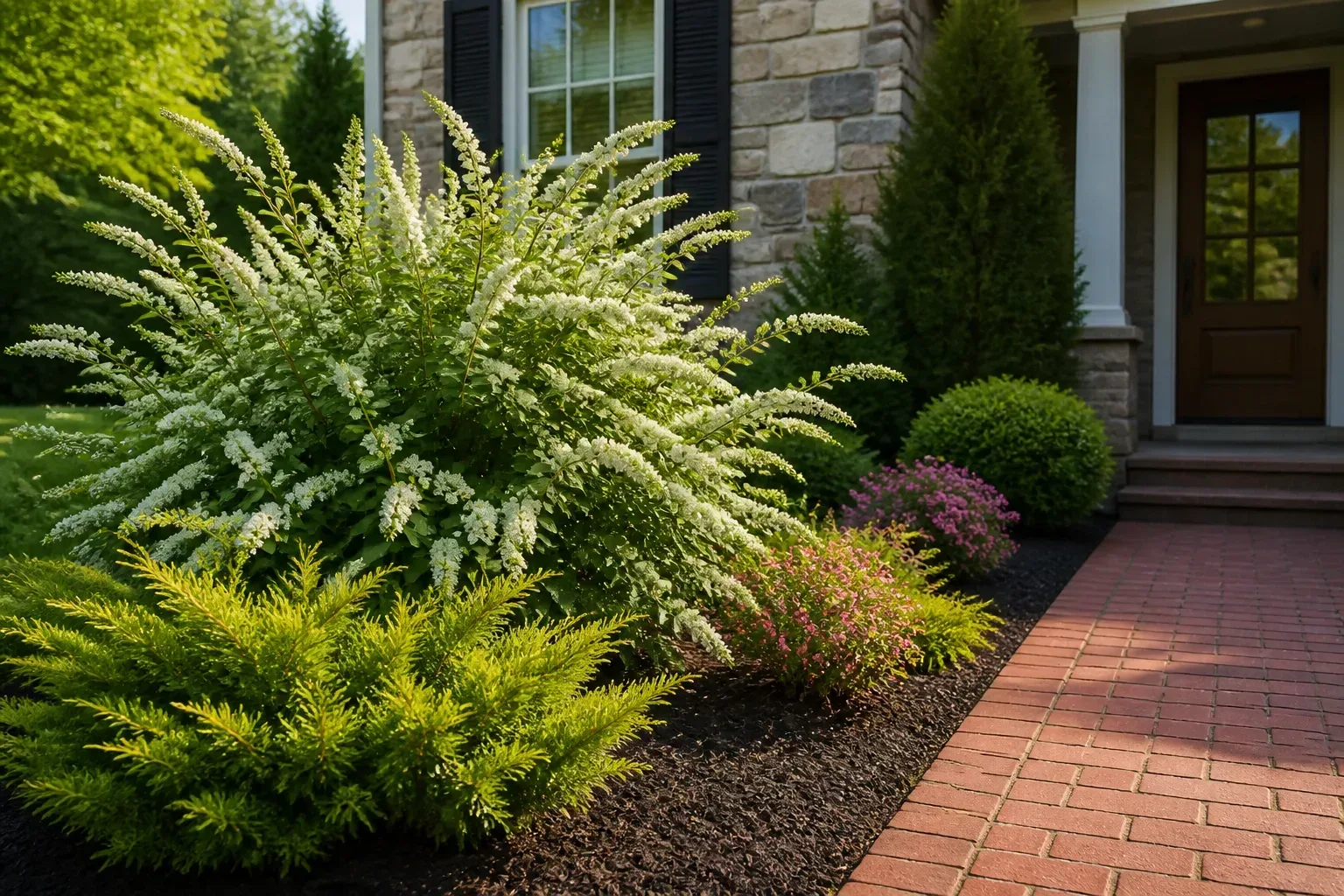
Start with the view from inside the house, not the color of a shrub at the nursery. A plant that fits beneath a window, tolerates the sun and soil beside your wall, and reaches its mature width without weekly shearing will make a better foundation planting than a faster-growing shrub that has to be cut back every season.
Use the choices below as a regional shortlist, not a universal ranking. Each plant has a different fit: some give winter structure, some bring a short flowering season, and a few work only where winters are mild or soil stays acidic. The practical profiles below name compact cultivars where possible; the mature dimensions are typical estimates, so verify the cultivar label and local hardiness before buying. University of Georgia Extension’s small-shrub recommendations and Savvy Gardening’s front-of-house shrub profiles illustrate why cultivar identity matters: two plants sharing a common name can have very different footprints.
Choose for the site, not the nursery pot
Foundation planting can soften the junction between a house and the ground, frame the entry, and provide seasonal color. It does not have to hide the entire foundation. Virginia Tech Extension recommends matching a shrub to its site and mature size; its planting guidance also makes the key trade-off clear: crowding plants closes a hedge sooner, while wider spacing costs less and leaves room for the plants to develop. Virginia Tech’s shrub selection and maintenance guide is a useful reference for planning that space.
Measure the mature plant below the window line
Write down the height from grade to each windowsill and the depth of the bed from wall to walk or driveway. Then compare those measurements with a plant’s expected mature height and width, not the height of the small pot you can lift today. A two-foot-wide shrub centered only a foot from the wall is already a poor long-term fit; a plant expected to spread six feet can crowd a narrow foundation bed even if its height looks manageable.
Pay special attention to corners, meters, hose bibs, vents, and the path to the front door. Leave enough room to reach siding and equipment, and keep mature branches out of windows and walkways. A dwarf cultivar can be the right answer where the species is too large, but “dwarf” is not a universal size: look up the exact cultivar and allow for its full spread.
Map sun, moisture, drainage, and winter exposure
Observe the bed at different times of day. Six or more hours of direct light generally favors full-sun plants such as lavender, creeping juniper, and compact roses; a north-facing wall, porch roof, or dense tree canopy may favor inkberry or other shade-tolerant choices. Part shade is not a fixed condition: bright morning light and hot reflected afternoon sun can stress a plant differently from the same number of hours in cool shade.
The first few feet beside a house can be a difficult growing site. Roof overhangs create a rain shadow, downspouts can saturate soil, and construction often leaves compacted ground. Bricks, concrete, and mortar may raise soil pH around acid-loving plants. UGA Extension explains these foundation-site stresses, while UF/IFAS cautions against repeatedly shearing shrubs to keep them below low windows. Check drainage after rain and get a soil test if you are considering azaleas or camellias beside masonry.
21 front-of-house plants, organized by job
The best front yard is rarely a row of 21 different plants. Think of the profiles as a menu: choose a few that solve real problems, repeat them to create rhythm, and use one or two flowering plants as accents. A mixed planting gives year-round structure without forcing every shrub to bloom at once. Oklahoma State Extension’s shrub-selection guidance recommends weighing mature height and width alongside flowers, foliage, and regional adaptation; the profiles below follow that same practical filter.
Evergreen structure for a steady foundation
Evergreens carry the composition when flowers are gone, but their mature size and winter hardiness still matter. This group ranges from clipped-looking broadleaf shrubs to low conifers that can soften the edge of a bed.
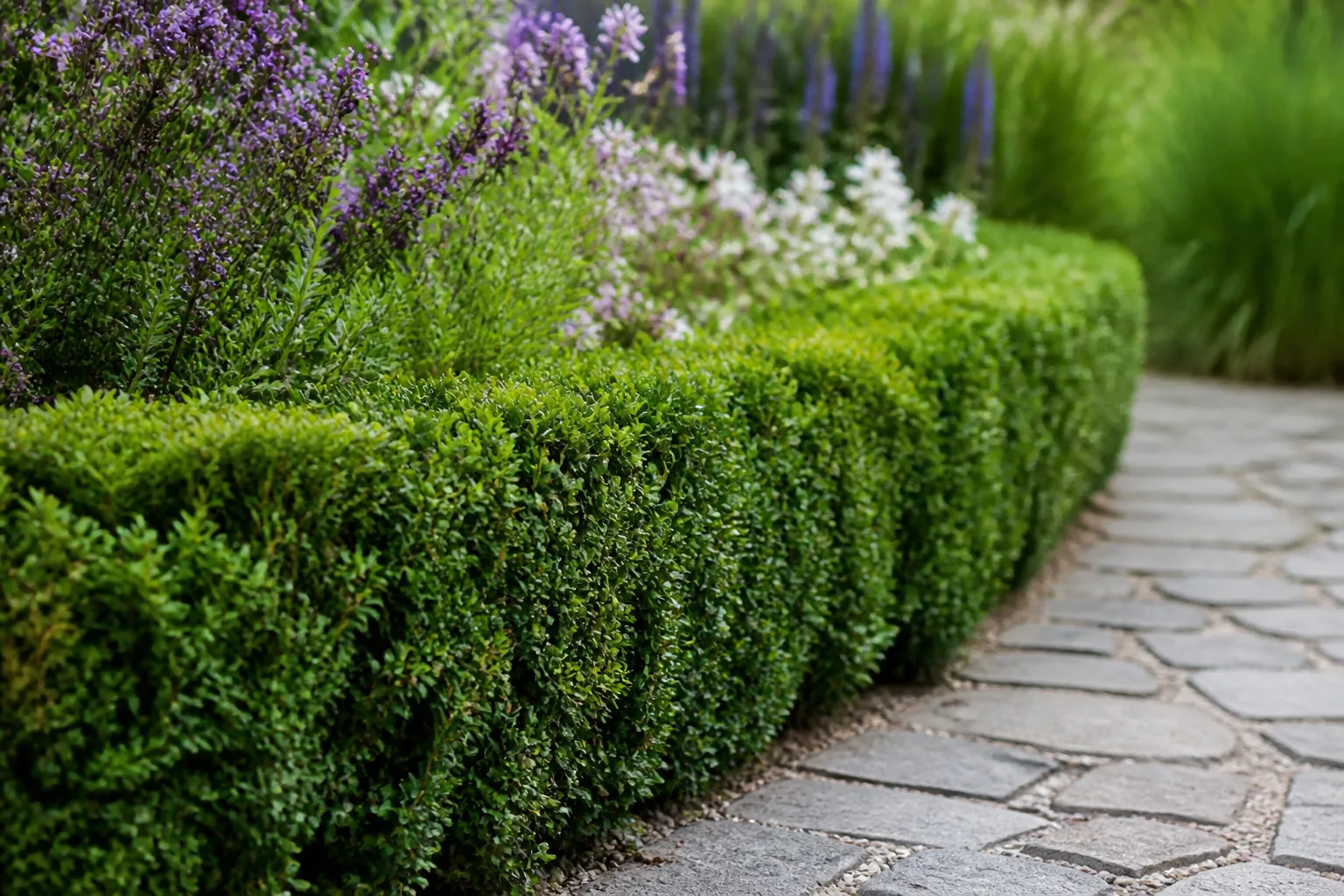
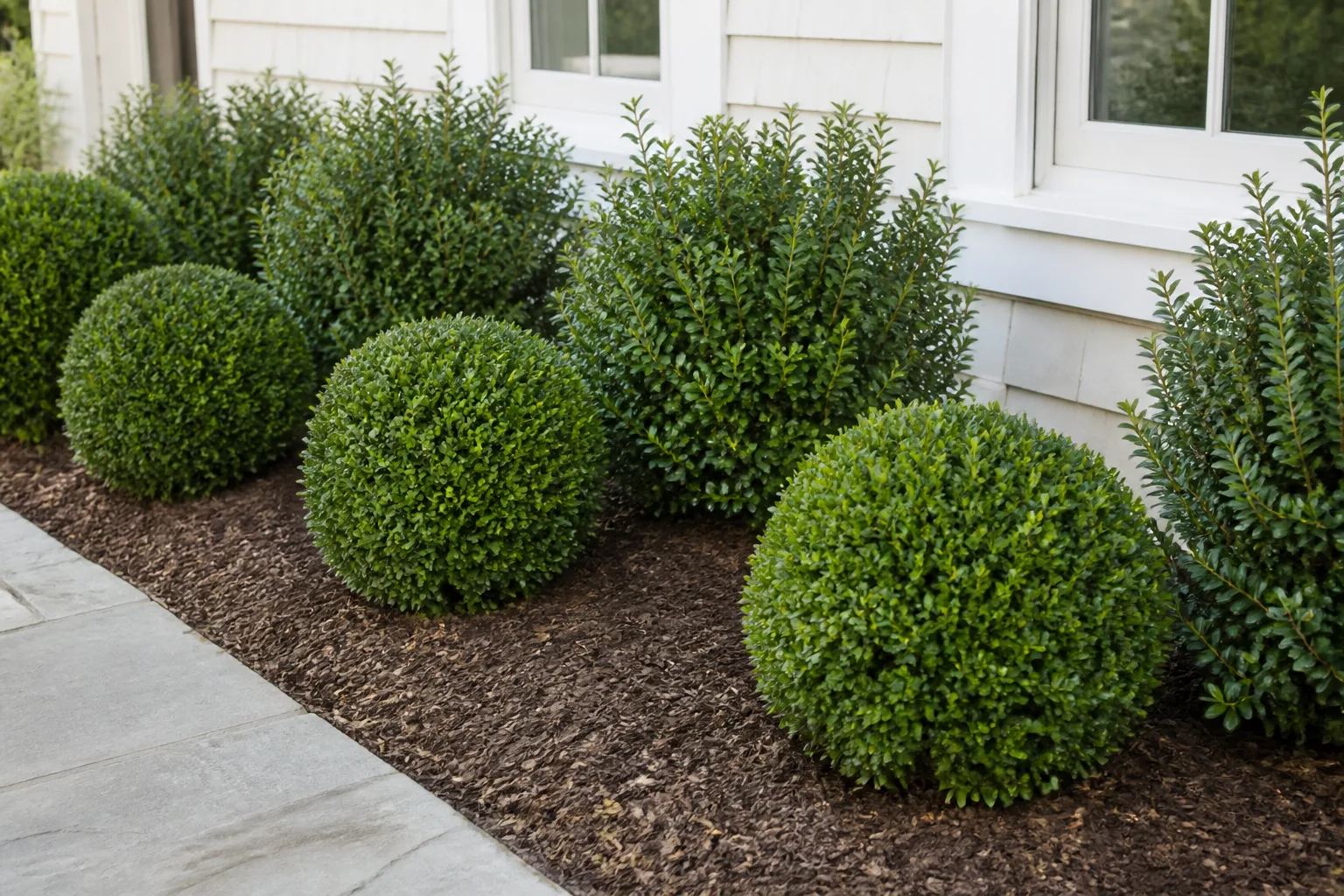
1. Compact boxwood (Buxus spp. cultivars). Look for a named slow-growing form such as ‘Green Gem’ or ‘Baby Gem’ if you want a rounded evergreen near an entry; many stay roughly 2 to 4 feet tall and wide, but the label is decisive. Boxwood suits full sun to part shade in moderate climates, often USDA Zones 5–8 depending on the cultivar, and asks for occasional shaping rather than constant cutting when it has room. Avoid a tight sheared shell: dense outer growth shades the interior and can leave a thin, bare center.
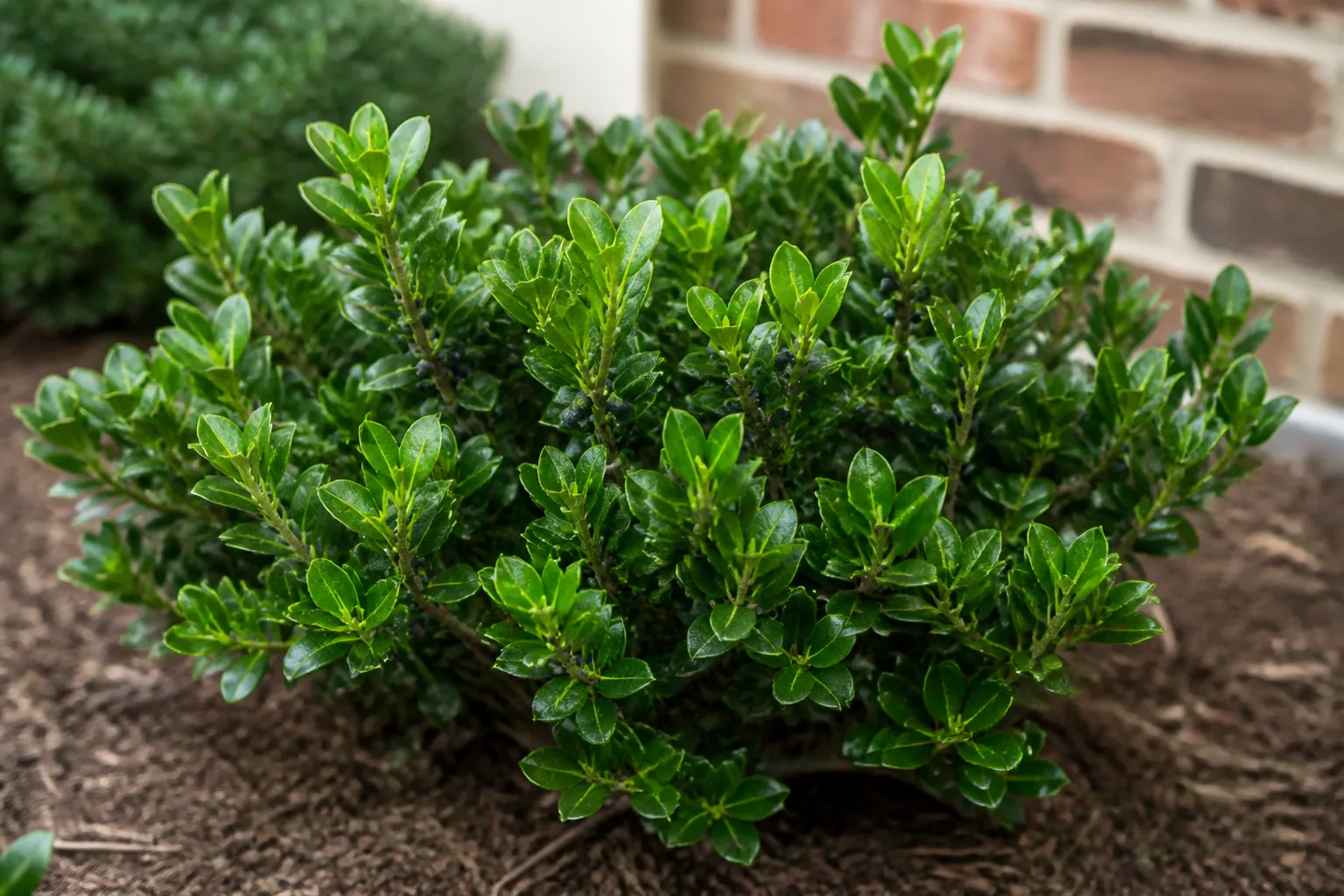
2. Inkberry holly (Ilex glabra), compact cultivar. ‘Gem Box’ or ‘Shamrock’ gives you a rounded, spineless-leaved evergreen often around 2 to 4 feet tall and wide; the species can grow larger, so do not shop by “inkberry” alone. This eastern North American native tolerates sun to part shade and performs best with consistently moist, acidic soil in roughly Zones 4–9. It needs little shaping, but prolonged dryness and alkaline soil can make it a poor choice beside hot paving or concrete.
3. Japanese holly (Ilex crenata), ‘Soft Touch’ or another compact form. A small-leaved, dense habit offers a boxwood-like outline, typically about 2 to 3 feet high and wide for compact selections. It grows in full sun or part shade in regions around Zones 5–8; give it drainage and enough moisture during establishment, and verify local performance because wet soils and high-pH sites can cause trouble. It is a reasonable alternative when you want small evergreen leaves, but not a reason to plant a large holly cultivar under a window.
4. Globe arborvitae (Thuja occidentalis), ‘Mr. Bowling Ball’. This naturally rounded cultivar commonly reaches around 2 to 3 feet tall and wide, with soft, threadlike foliage that needs little or no shearing. Give it sun to light shade and well-drained soil in cool-to-temperate climates, often Zones 3–7; its main front-yard drawback is deer browsing, which can permanently spoil its symmetrical form. Do not confuse it with ‘Green Giant’: a large screening arborvitae is a poor choice below windows unless you have a truly spacious site.
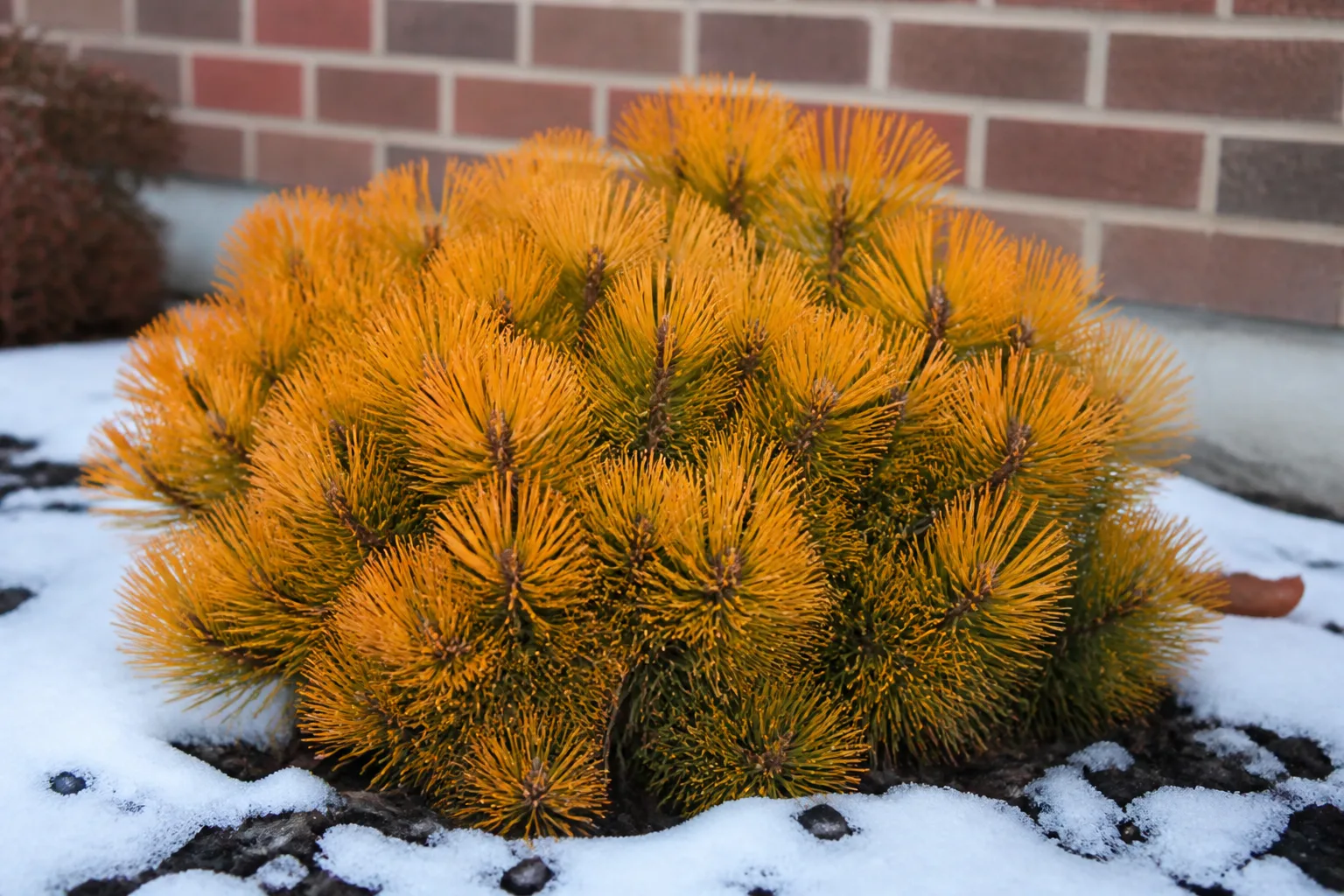
5. Dwarf mugo pine (Pinus mugo). ‘Paul’s Dwarf’ usually forms a mounded shrub about 2 to 3 feet high and several feet wide, while other dwarf selections differ substantially. It wants full sun, good drainage, and a cool-to-temperate climate, commonly Zones 2–7; it is slow enough to reduce pruning but too broad for a narrow strip if you plant it without measuring. Once established it handles dry spells better than many flowering shrubs, but a soggy planting hole is still a bad fit.
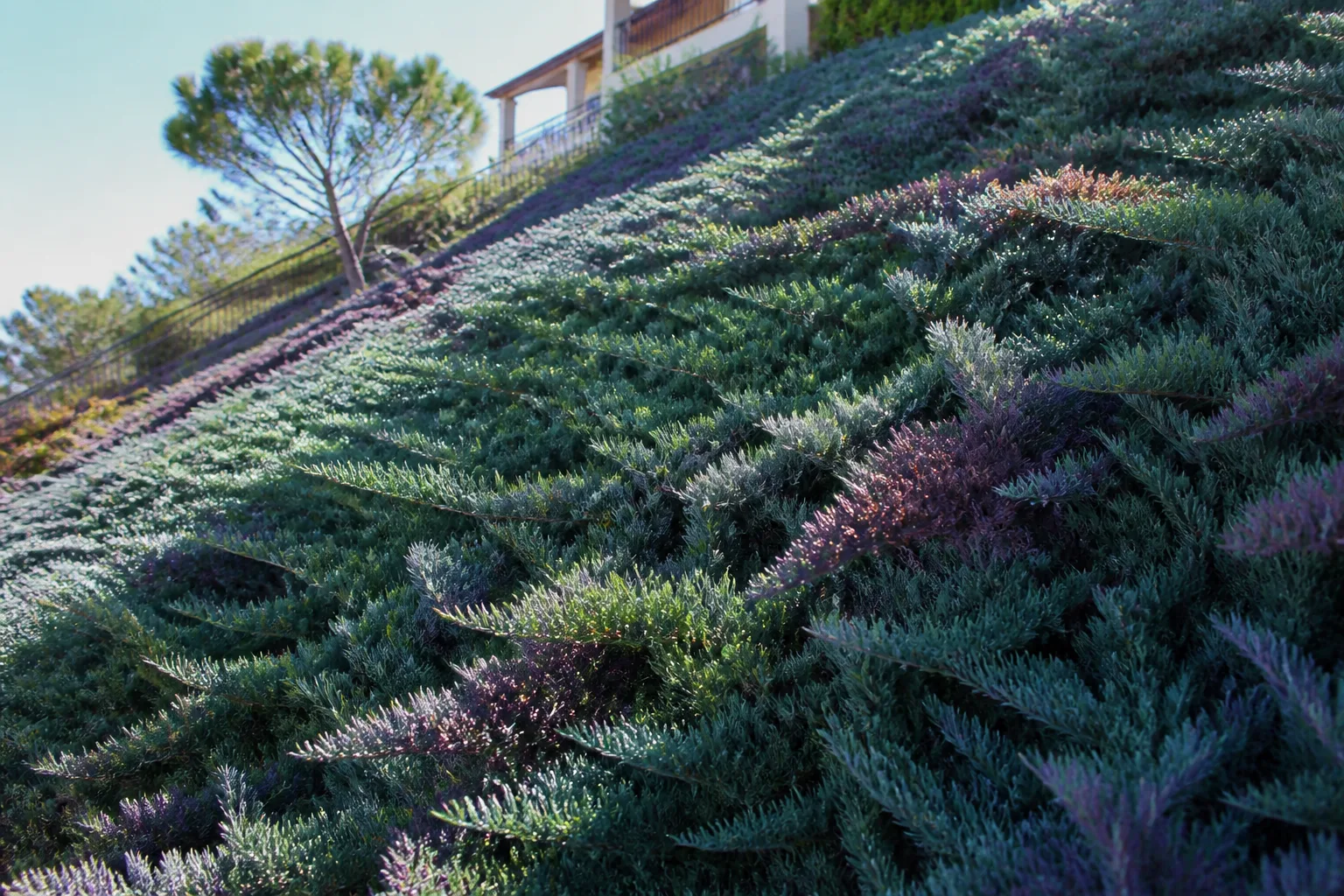
6. Creeping juniper (Juniperus horizontalis), ‘Blue Rug’ or a similarly low cultivar. Use this as a groundcover shrub at the front edge rather than a mound under a window: it may stay under a foot tall while spreading 5 to 8 feet. Full sun, sharp drainage, and a cold-to-temperate climate—many cultivars tolerate Zones 3–9—suit it; once established, it needs little pruning and tolerates dry conditions. The trade-off is its reach: keep it back from steps, drains, and beds you need to weed by hand.
7. Indian hawthorn (Rhaphiolepis indica). In mild-winter landscapes, this evergreen can form a rounded shrub about 3 to 6 feet tall and wide; select compact cultivars for a foundation bed and expect larger forms to need more room. It prefers full sun to part shade, well-drained soil, and warm climates, generally Zones 7–10. Maintenance is modest in suitable regions, but cold snaps, prolonged wet leaves, or humid conditions that favor leaf spot make it less reliable outside its range. NC State Extension’s plant profile gives regional growing information before you commit.
8. Camellia (Camellia japonica or C. sasanqua). Camellias provide glossy evergreen leaves and fall or winter flowers, but a typical plant can reach 6 to 12 feet or more; reserve one for a broad corner well back from the foundation, sidewalk, and driveway, or seek a truly compact cultivar. They fit mild climates, roughly Zones 7–9 depending on species and cultivar, with bright shade or filtered light, acidic soil, and even moisture. UGA Extension cautions against planting camellias close to foundations and masonry, where compacted soil and higher pH can undermine an acid-lover; confirm soil and drainage first, and prune only to correct shape after flowering.
9. Dwarf Chinese fringe flower (Loropetalum chinense), ‘Purple Pixie’. This selection stays low—roughly 1 to 2 feet tall but can spread 4 feet or more—so it works as a warm-climate groundcover accent rather than a shrub squeezed into a narrow hole. It needs sun to part shade, good drainage, and mild winters, commonly Zones 7–10; once established it tolerates heat, but severe cold can damage its evergreen foliage. The species grows larger, and the cultivar’s broad spread is easy to underestimate. UGA lists this dwarf cultivar among its small-space selections.
Flowering shrubs that add a seasonal focal point
Flowering shrubs are most useful when their bloom season fills a gap in the yard. Read the pruning notes before purchase: spring-flowering shrubs often form next year’s buds on older stems, so trimming them at the wrong time removes the display.
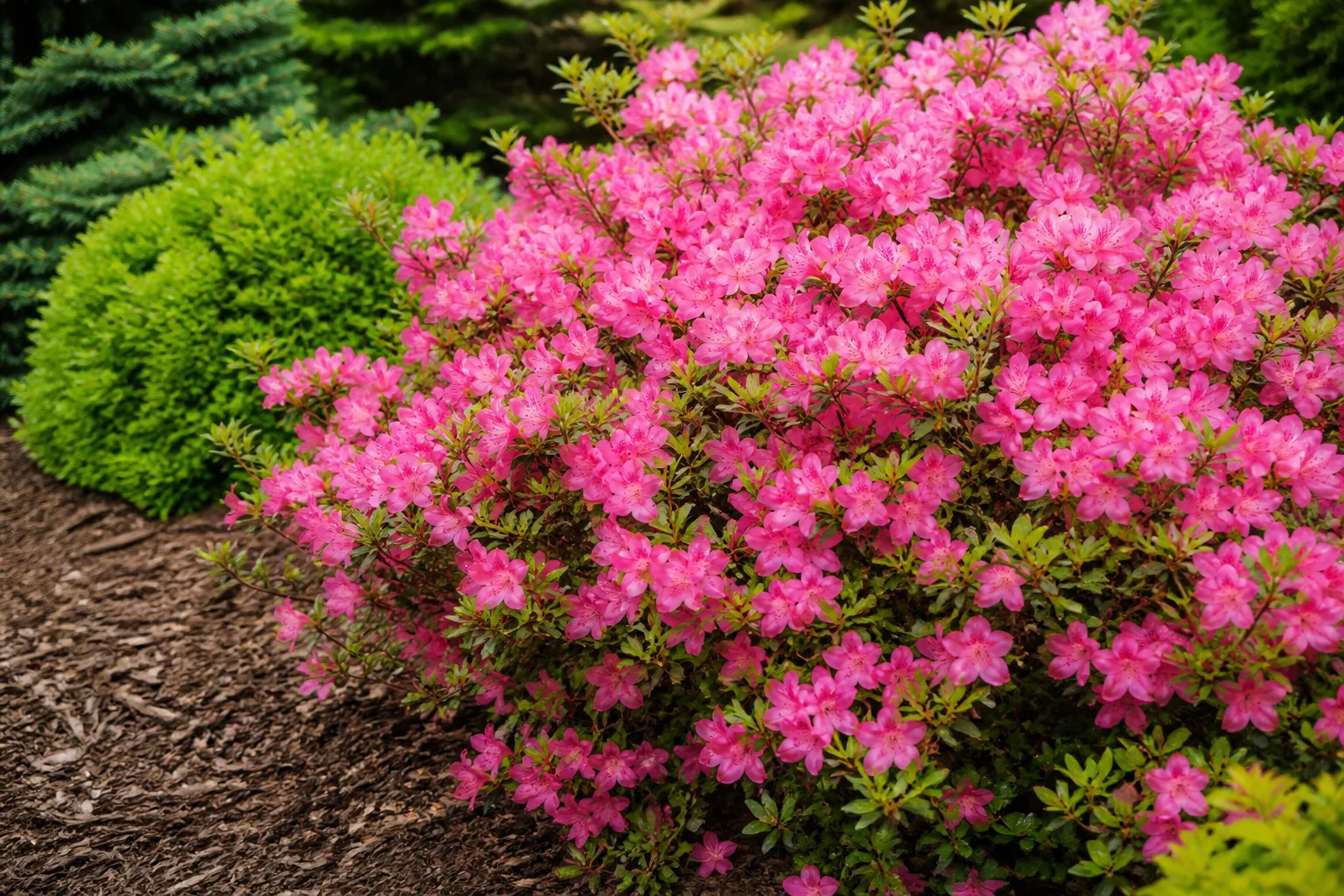
10. Compact azalea (Rhododendron spp. and cultivars). Choose a dwarf cultivar whose label puts mature height and width within your bed—many compact forms settle around 2 to 4 feet—rather than assuming all azaleas stay small. Most prefer part shade, evenly moist but well-drained acidic soil, and climates around Zones 5–9 depending on the cultivar; morning sun with protection from hot afternoon exposure is often a safer setting. Keep azaleas in a separate, suitable bed rather than tight against the foundation, sidewalk, or driveway: UGA Extension warns that masonry and hard, alkaline soil can make acid-loving azaleas struggle. Azaleas are toxic to pets; the ASPCA plant database is a useful safety check for households with animals.
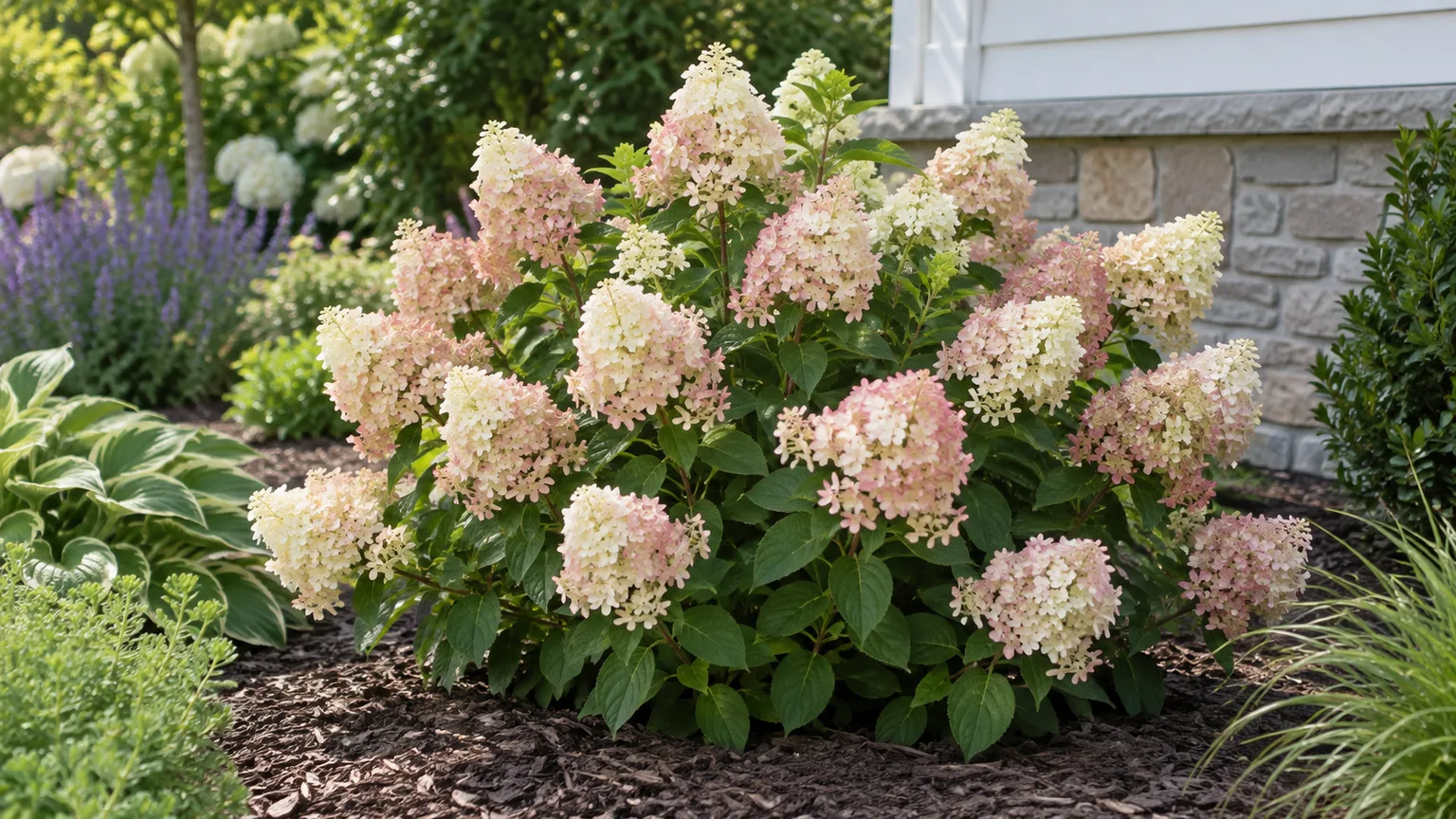
11. Dwarf panicle hydrangea, such as ‘Bobo’ (Hydrangea paniculata). ‘Bobo’ is usually about 2.5 to 3 feet tall and 3 to 4 feet wide, making it more realistic below a window than a full-size hydrangea. It grows in sun to part shade and is cold-hardy in many regions around Zones 3–8; give it moisture during dry spells and prune lightly in late winter because it flowers on new growth. It is not drought-free just because it is compact, and a hot western wall can mean more summer watering.
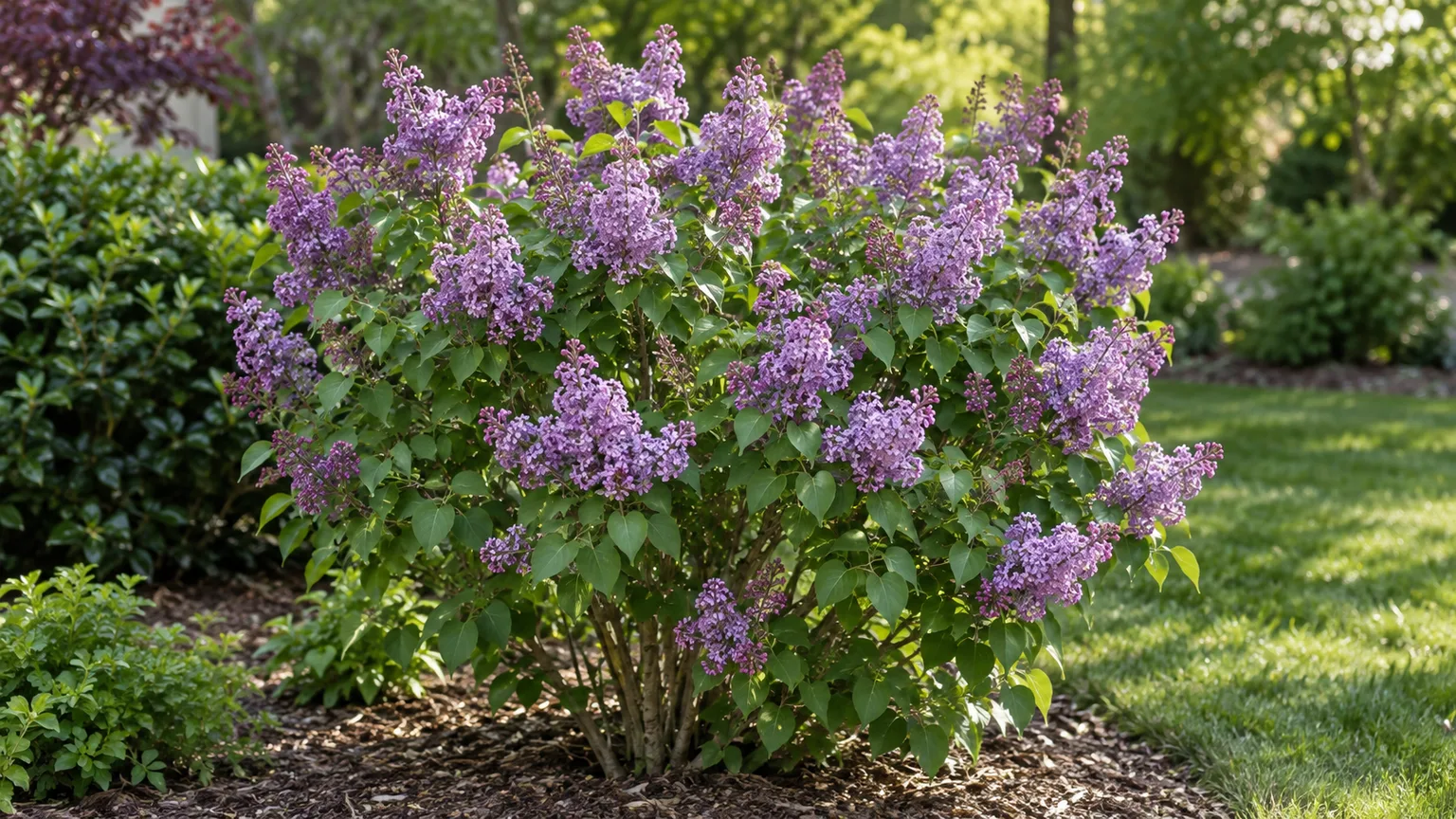
12. Dwarf Korean lilac (Syringa meyeri ‘Palibin’). Expect a broad mound around 4 to 5 feet high and 5 to 7 feet wide, fragrant with spring flowers but too large for the tightest strips. Full sun and well-drained soil suit it in cold-winter areas, often Zones 3–7; it usually needs only a light cleanup, timed just after flowering so you preserve next year’s buds. Savvy Gardening describes this cultivar as a compact option that avoids some of the mildew trouble common in larger traditional lilacs.
13. Compact weigela (Weigela florida), such as ‘Minuet’. A compact cultivar can stay about 2 to 3 feet tall and 3 to 4 feet wide, rather than the much larger spread of old-fashioned forms. Give it full sun for the strongest flowering and a temperate climate, roughly Zones 4–8; maintenance is light, with selective pruning after the late-spring bloom instead of repeated shearing. Flowers appear on older wood, so a late-summer haircut can cost you next year’s display.
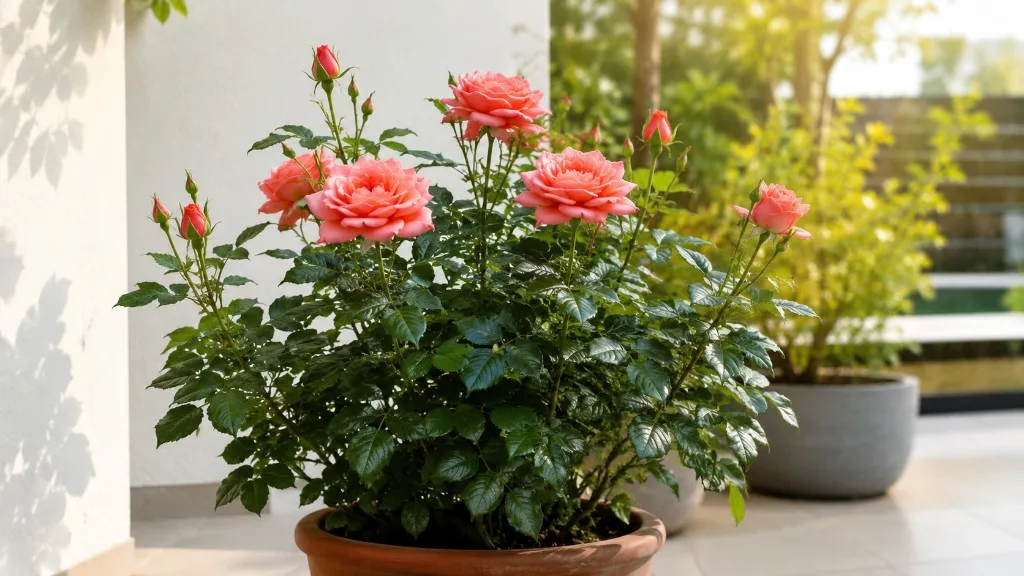
14. Compact landscape rose (Rosa spp., including low-growing cultivars). Groundcover and patio rose cultivars often remain around 1 to 2 feet tall and 2 to 4 feet wide, though hardiness varies widely by rose and region, roughly Zones 4–11. Choose full sun and airflow, keep thorny branches away from the entry path, and expect seasonal cleanup plus spring pruning even with a self-cleaning variety. Roses return months of color, but they are not the lowest-maintenance choice where black spot or repeated drought is common.
15. Compact forsythia, such as ‘Show Off Sugar Baby’ (Forsythia). This cultivar is often sold as a shrub around 2 to 3 feet tall and wide, far smaller than many old forsythias. It wants full sun and a cold-to-temperate climate near Zones 5–8; flowers open on old wood in early spring, so prune only after flowering and allow a little extra width if the plant sends up new shoots. The result is a short burst of yellow, not year-round foliage.
16. Virginia sweetspire, ‘Little Henry’ (Itea virginica ‘Sprich’). This native cultivar generally reaches about 2 to 3 feet tall and 3 to 4 feet wide, with white flower tassels and strong fall color. It takes sun to part shade in roughly Zones 5–9 and handles moist soil better than many shrubs; moderate moisture gives the best start, while occasional suckers may need removal. Use it where runoff keeps the soil damp, not in a bone-dry strip under a deep eave.
17. Fothergilla, ‘Mt. Airy’ (Fothergilla × intermedia). A mature plant typically reaches about 4 to 5 feet high and wide, with spring bottlebrush flowers and vivid autumn foliage. It prefers sun to part shade, acid to neutral soil, and a temperate climate often in Zones 5–8; leave room for its natural shape and prune only if a branch actually needs correcting. It is a good choice for a broader foundation bed, but too large for the narrow space below a low sill.
Low front-edge plants for color and softer lines
These selections are useful where a tall evergreen would obscure a view. Some are technically subshrubs or small shrubs, but their low, spreading habit makes them valuable in a foundation border; give each room to grow rather than clipping it into a shape it does not naturally hold.
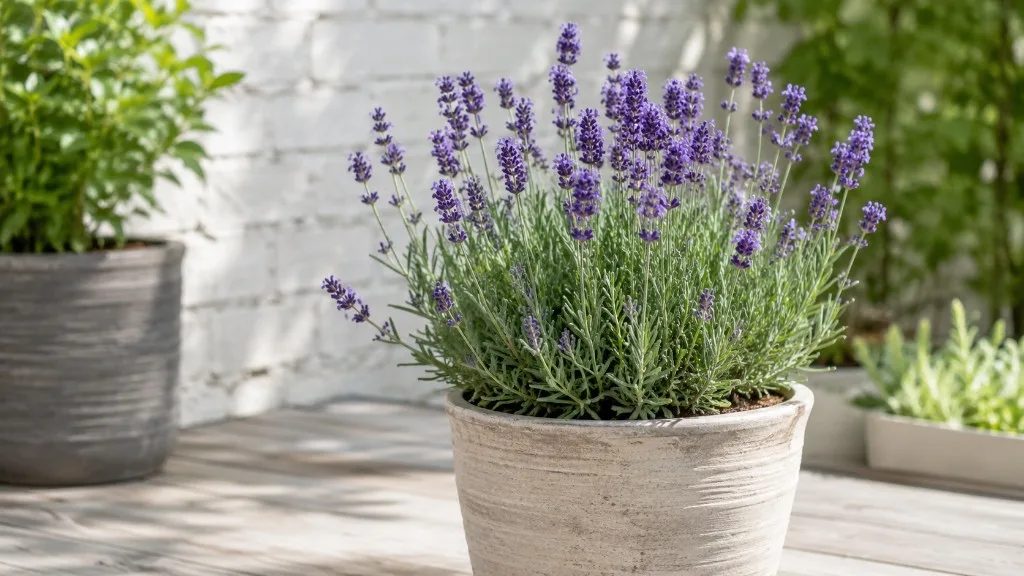
18. English lavender (Lavandula angustifolia). Most garden forms grow roughly 1.5 to 3 feet high and wide, with silver-green foliage and summer flowers. Full sun, lean well-drained soil, and cool-to-temperate regions—commonly Zones 5–9—are the fit; maintenance is low if you prune lightly after bloom, but never cut hard into old bare wood. Lavender often fails beside wet clay, in humid heat, or where roof runoff keeps the root zone saturated.
19. ‘Little Princess’ Japanese spirea (Spiraea japonica). This compact mound usually finishes around 2 to 3 feet tall and wide, flowers in late spring to summer, and suits full sun in climates around Zones 4–8. It blooms on new growth, so a light late-winter prune is optional rather than a constant chore; provide drainage and some water during establishment. Its rounded form works at the front of a wider bed, but the cultivar is still wider than many shoppers expect from a “dwarf” plant.
20. Summersweet, ‘Hummingbird’ (Clethra alnifolia). This compact native shrub is commonly about 3 to 4 feet tall and wide, and its fragrant summer flowers make it a strong choice for a shady or damp front bed. It grows in sun to shade and cold-winter climates around Zones 3–9, though flowering improves with several hours of sun; moisture is welcome, and the plant can spread by suckers over time. It needs more watering in dry shade than the phrase “low maintenance” suggests.
21. Glossy abelia, ‘Kaleidoscope’ (Abelia × grandiflora). This rounded variegated cultivar is often close to 2 to 3 feet tall and wide, with summer flowers and foliage that may stay evergreen in mild winters. It favors sun to part shade in warmer regions, roughly Zones 6–9; it is heat-tolerant and needs only occasional thinning, but it may lose leaves or die back in colder sites. UGA Extension lists it at about 3 feet in height and width, which makes a cultivar label especially useful here.
Pair plants with common front-yard conditions
A good shortlist is easier to use when it is tied to the problem in front of you. Choose one or two anchors, then fill open ground with smaller repeats; avoid turning the entire foundation into a collection bed with one specimen of everything.
Hot, sunny, narrow beds
On a bright southern or western wall, avoid an acid-loving camellia or azalea unless your soil and irrigation suit it and you can protect the roots from reflected heat. A compact boxwood, dwarf mugo pine, or low-growing rose may be more adaptable in a temperate climate; in a mild-winter region, Indian hawthorn or abelia can handle heat better. Near a hot driveway, reserve the front edge for lavender or creeping juniper only if water drains away quickly.
For a narrow bed, one plant that stays naturally small beats a tall shrub trimmed into an artificial box. Measure the eventual spread, then use two or three repeated plants instead of a tight hedge. Repetition makes the line look intentional and reduces the number of different care routines.
Shady entries and low windows
Under a porch roof or north-facing window, start with the plants that tolerate shade, such as inkberry, compact Japanese holly, or summersweet. If you have an acidic, well-drained bed set away from foundation masonry, a dwarf azalea can add spring bloom; if it is dry under the eaves, use fewer woody shrubs and consider a mulch-covered bed with shade perennials between them. Less sun can reduce flowers and make variegated foliage less colorful, so do not buy a shade-tolerant shrub expecting its brightest color in deep shade.
A low window does not demand a shrub. The UF/IFAS foundation planting guidance specifically notes that low groundcovers or perennials can preserve the view and break up a repetitive shrub row. Use a compact shrub at the end of the window grouping, then keep the central sightline low.
Place shrubs without crowding the house
Use a simple spacing calculation before digging: start with half the expected mature width, then add the clearance you want between foliage and siding for airflow, access, and maintenance. A shrub expected to spread four feet has a two-foot radius; planting its center only a foot from the wall leaves little access when it matures. Gardening Know How offers three feet as a minimum clearance for shorter foundation shrubs, but that is only a starting point: a wider cultivar needs more room. The precise gap depends on the house and plant, but mature branches should not touch siding or block vents.
Check the bed’s water pattern as carefully as its dimensions. Keep downspouts and air-conditioner condensate from dumping into the root zone, and do not bury the foundation in mulch. UGA Extension points out that building debris and masonry can alter drainage and soil chemistry around the house; that matters most for acid-loving camellias and azaleas. Choose a more tolerant plant or move the acid-lover away from the concrete’s influence if you cannot change the soil conditions.
For an entry that needs structure through winter, combine one or two evergreen forms with flowering shrubs rather than planting a solid hedge. A rounded inkberry or boxwood can anchor the composition; hydrangea, lilac, or sweetspire can supply seasonal flowers; and lavender or juniper can finish the front edge. Stagger bloom times where possible, and leave open space so each plant can be seen from the curb.
Plant for establishment and easy upkeep
Set the plant at the same depth it grew in its container or slightly above grade where drainage is a concern. Virginia Tech advises digging a hole at least twice as wide as the root ball, loosening circling roots, and keeping the root flare level with or just above the surrounding ground; the Virginia Tech shrub guide explains why depth and spacing affect establishment.
Water the root ball deeply after planting, then check it during dry weather through the first growing season. The surrounding soil can look damp while the nursery mix inside the root ball dries out, so feel both. A 2- to 3-inch mulch layer limits weeds and moisture loss, but keep it away from stems and the house siding. Avoid routine fertilizer unless a soil test or plant need supports it; newly purchased nursery shrubs may already have slow-release fertilizer in their container mix.
Water, mulch, and prune with the plant’s growth cycle
Young shrubs need more attention than established ones. Group plants with similar water needs, and do not pair a thirsty hydrangea with lavender in one irrigation zone. After roots spread into the bed, reduce supplemental watering according to rainfall, soil, and heat rather than following an automatic calendar.
Pruning timing depends on when flowers form. Spring bloomers such as lilac and forsythia usually set buds on older stems, so prune them just after flowering; shrubs that bloom on new growth, including panicle hydrangeas and spirea, can be shaped in late winter or early spring. Virginia Tech’s pruning guidance explains this old-wood/new-wood distinction. The simplest way to avoid annual pruning is to choose a cultivar that already fits the window and walkway.
Common choices to reconsider
A plant can be attractive in a wide landscape and still be wrong at the front of a house. The Green Giant arborvitae in particular is a large screening tree, not a compact foundation shrub; use a rounded cultivar if you want arborvitae beside a window. Full-size lilacs, large hollies, and unselected hydrangeas can all outgrow the usual foundation bed. The fix is not aggressive annual cutting; it is choosing a plant whose mature form fits the space.
Be careful about choosing a shrub only for its name or flowers. Butterfly bush (Buddleja davidii) supplies nectar for adult butterflies, but NC State Extension notes it can self-seed and become invasive in parts of the country, and its foliage is not a host plant for native butterfly caterpillars. Check local invasive-plant guidance before planting it; native summersweet and other locally appropriate native shrubs can offer a better ecological fit. NC State’s butterfly-bush profile details those regional concerns.
Finally, do not treat “evergreen” as shorthand for “no care.” Drought, deer, winter wind, reflected heat, and compacted soil can stress evergreens just as readily as deciduous shrubs. The dependable choice is the one matched to your site and maintenance time, not the plant marketed as indestructible.
Conclusion
Choose front-of-house shrubs by their mature height and spread, then check that light, moisture, soil pH, and climate fit the exact cultivar. A small set of well-spaced plants—evergreen structure, one or two seasonal accents, and a low front edge—usually looks more intentional and needs less corrective pruning than a crowded row.
Before you buy, measure the wall-to-walk distance, note the lowest window, watch where rain and roof runoff go, and read the plant label for cultivar dimensions. If a favorite plant needs conditions your foundation bed cannot provide, move it to a better part of the yard. Matching the plant to the place is what keeps the entry welcoming after the first season.