How to Grow and Care for Spanish Bluebells in Your Garden
Spanish bluebells are easy to grow but can naturalize widely. Get planting, watering, propagation, container, and regional spread guidance for your garden.
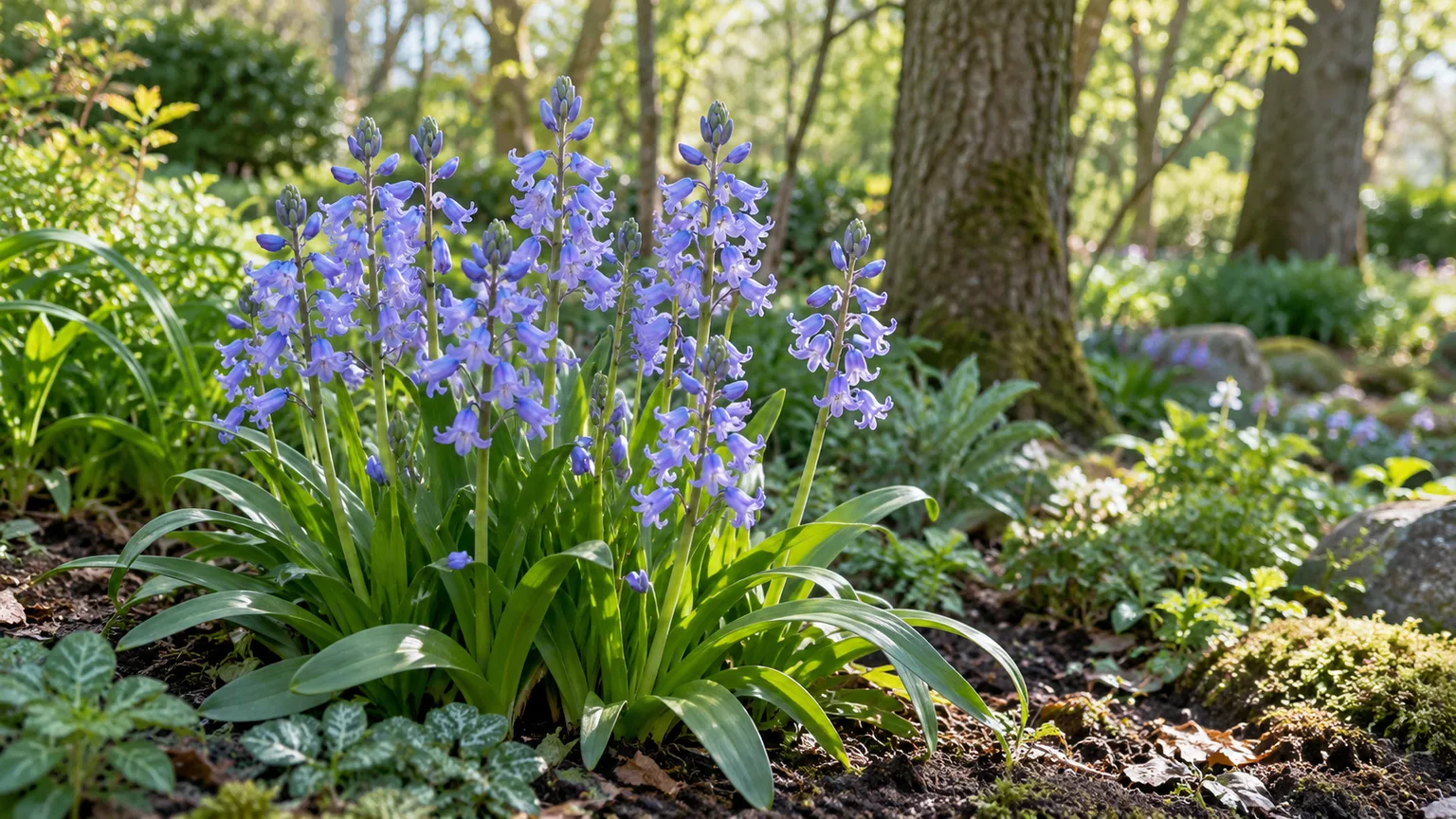
Spanish bluebells can make an easy spring display in a cool, partly shaded bed, but their ability to settle in and spread is part of the care plan—not a minor footnote. Before planting, identify the bulb correctly, check whether it is appropriate in your area, and decide how you will keep seed and daughter bulbs within bounds. If the location is suitable, the basic routine is straightforward: plant healthy bulbs in fall in well-drained soil, water during dry spring growth, and leave the leaves alone until they yellow naturally.
The name usually refers to Hyacinthoides hispanica, a bulbous perennial native to the Iberian Peninsula. Older labels may use Scilla hispanica, Scilla campanulata, or Endymion campanulatus. Plant profiles do not always use the same genus name, so the species name and the plant’s features matter more than a familiar label. Spanish bluebell is also not the same species as English bluebell, and garden plants may be hybrids of the two.
Spanish bluebells at a glance
| Growing point | Practical guidance |
|---|---|
| Type | Spring-flowering bulbous perennial in the asparagus family |
| Native range | Portugal and western or southern Spain, with some references including northwestern Africa |
| Mature size | Often about 1 to 1½ feet tall; flower stems and cultivars vary |
| Light | Partial shade is reliable; cooler sites may support more sun if soil stays moist |
| Soil | Moist during spring growth but well-drained; avoid a bed that stays soggy |
| Planting window | Fall, while the soil is workable and before hard freezing |
| Bloom | Spring; timing shifts with climate and weather |
| Spread | Daughter bulbs and seed; deadheading controls seed, not bulb offsets |
| Safety | Do not eat any part; sap may irritate skin, so wear gloves when handling |
Use those figures as a starting point rather than a promise about every cultivar or climate. NC State Extension describes a clump-forming plant that can reach about 1½ feet and spread by both offsets and seed; its preferred site is moist, well-drained soil in part sun or shade. Local labels and extension advice are more useful for hardiness than a single zone range copied across regions. The NC State Extension Plant Toolbox gives a regional profile, while the RHS plant profile records the related botanical names and UK cultivation notes.
Decide whether Spanish bluebells fit your garden
First ask what you want the plant to do—and what you are willing to manage. Spanish bluebells suit gardeners who want a spring bulb for a managed woodland edge, a border, or a container and who can remove spent flower heads or thin a clump when needed. They are a poor choice for someone seeking a strictly contained, no-maintenance planting, for a site next to a sensitive native bluebell population, or for a place where local rules restrict them.
Their “naturalizing” habit means a planting can slowly become a colony. That can be attractive beneath deciduous trees where spring light reaches the ground, but the same behavior can push into a lawn, crowd smaller spring plants, or produce seedlings beyond the intended bed. A pot is a useful boundary for bulbs, but it does not prevent seed from traveling if the flowers are allowed to mature. If monitoring each spring sounds like work you do not want, choose a less self-seeding spring bulb instead.
The caution is location-specific. The RHS advises avoiding Spanish or hybrid bluebells near wild native English bluebell populations because pollen transfer can contribute to hybridization. The RHS also notes that Spanish bluebell is listed as invasive non-native in Northern Ireland, and Ireland’s National Biodiversity Data Centre list includes it throughout the state. Legal classifications differ from ecological risk labels and change over time, so check current local government or conservation guidance before buying or moving plants. In the United States and elsewhere, check state, provincial, or regional invasive-plant lists and nearby natural-area guidance rather than assuming the same rules apply everywhere.
Identify Spanish bluebells before planting
A typical Spanish bluebell has several broad, strap-shaped leaves at the base and upright flower stems with open, bell-shaped blooms arranged around the stem. Flowers are commonly lavender-blue, although white and pink forms are sold. The plant is clump-forming, and one bulb may produce more than one flowering scape as the clump develops. The blooms appear in spring, with dates determined by local temperatures rather than a fixed calendar date.
A nursery label alone is not a reliable identification test. Bulbs may be sold under older synonyms, and common names overlap among Spanish, English, and hybrid bluebells. Before planting near a sensitive habitat, compare several features, look for a reputable supplier that names the species, and avoid transplanting wild bulbs. A flowering specimen is easier to assess than a dormant bulb, but hybrids can still defeat a simple checklist.
Spanish bluebells, English bluebells, and hybrids
English bluebell is Hyacinthoides non-scripta. It usually has an arching, nodding flower stem, flowers mostly on one side, narrow leaves, petals that curl back at the tips, creamy-white pollen, and a sweet fragrance. Spanish bluebell is generally more upright, carries flowers around the stem, has broader leaves, and has little or no scent. Its flowers are often paler or more open, but color by itself is not decisive because both species have color variants.
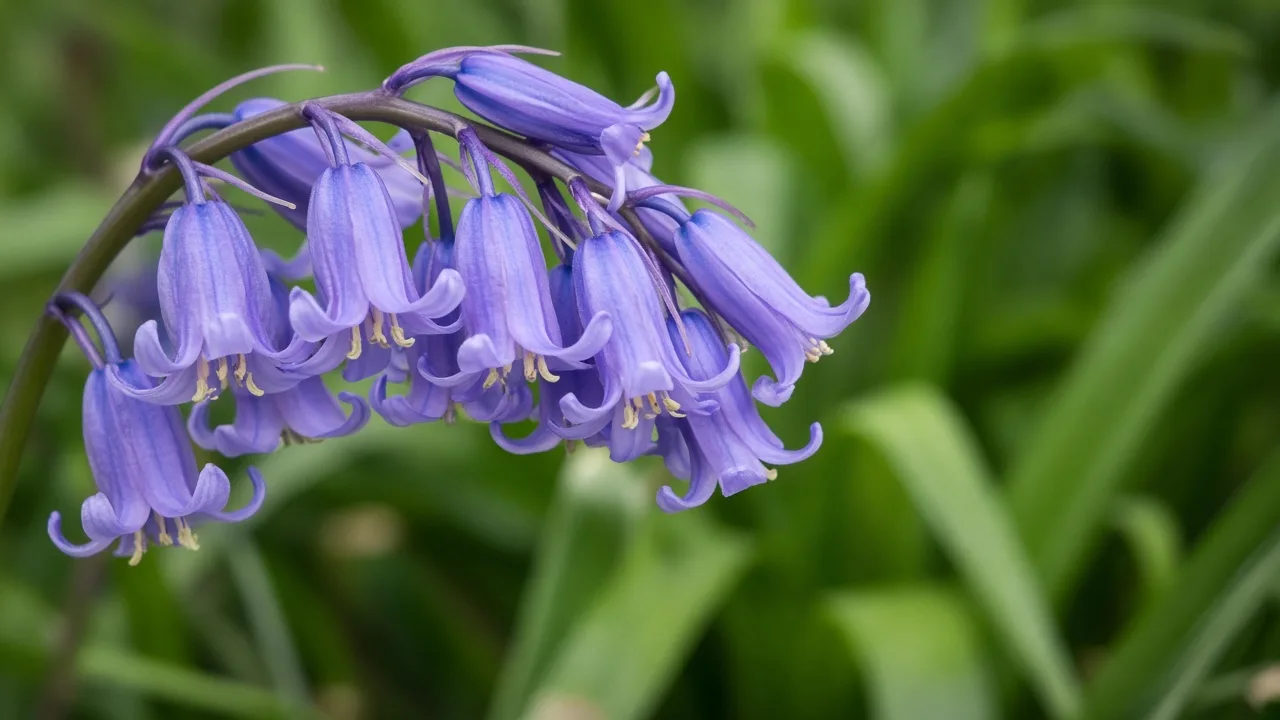
Hybrids, often called Hyacinthoides × massartiana, can combine these traits: a partly curved stem, flowers around much of the spike, intermediate leaf width, or faint scent. The RHS comparison, Plantlife’s woodland plant identification guide, and the Sheffield & Rotherham Wildlife Trust identification guide all emphasize that hybrids vary. Treat the traits as clues, not a definitive home test. If protecting a nearby native population is the concern, the safer choice is not to plant a questionable bluebell at all.
When to plant Spanish bluebell bulbs
Plant dry bulbs in fall, when the soil has cooled but remains workable. In many temperate Northern Hemisphere gardens that means early to mid-autumn; warmer or colder regions shift the window. Planting before the ground freezes gives roots time to establish. If bulbs arrive early, keep them in a cool, dry, ventilated place and plant promptly rather than sealing them in a damp bag where rot can start.
Choose firm bulbs without mushy patches, mold, or a strong sour smell. Small bulbs may take a season or more to build into a reliable flowering clump, so do not assume a lack of flowers in the first spring means the planting failed. Potted bluebells can be moved after flowering while foliage still makes their location visible, but dry autumn bulbs are the usual, straightforward option for new beds. The National Trust’s bulb guidance recommends fall planting for dry bulbs and leaving foliage to die back; its depth guidance covers bluebells generally, so use Spanish-bluebell-specific supplier directions when available.
Choose a site with spring light and good drainage
Partial shade is a dependable starting point, especially where spring is bright and summer is hot. A spot beneath a deciduous tree can receive more light before the canopy fills in, then shade the foliage as temperatures rise. In a cool climate, more sun may work if the soil does not dry out during active growth. In a hot, exposed bed, afternoon sun can dry the root zone quickly and shorten the display.
Moist soil is not the same as waterlogged soil. Spanish bluebells need enough spring moisture to support leaves and flowers, but bulbs can rot where water sits after rain or irrigation. Test a potential bed after a storm: if puddles remain or the soil is sticky and saturated for a long time, use a raised or sloped position, improve the bed broadly with organic matter, or choose another site. Avoid a small pocket of gravel at the base of a planting hole; it does not fix poorly drained soil around the bulb.
A loose, humus-rich soil is convenient, but the plant tolerates a range of garden soils if drainage is adequate. Add finished compost or leaf mold across the bed when soil is compacted or low in organic matter. Do not over-enrich it or add repeated fertilizer by habit. Good structure, a spring moisture supply, and room for the clump matter more than a precise pH target.
Plant bulbs at a measured depth
For typical bulbs, begin with a hole about 3 inches deep and space bulbs roughly 4 to 6 inches apart. NC State Extension gives 3 inches as a planting depth and 4 to 6 inches between bulbs for Spanish bluebells. Because bulb size and supplier recommendations vary, use the directions that came with a healthy, correctly identified bulb if they differ modestly. A simple rule is to cover the bulb with soil to the advised depth while keeping the pointed end up and the basal plate down.
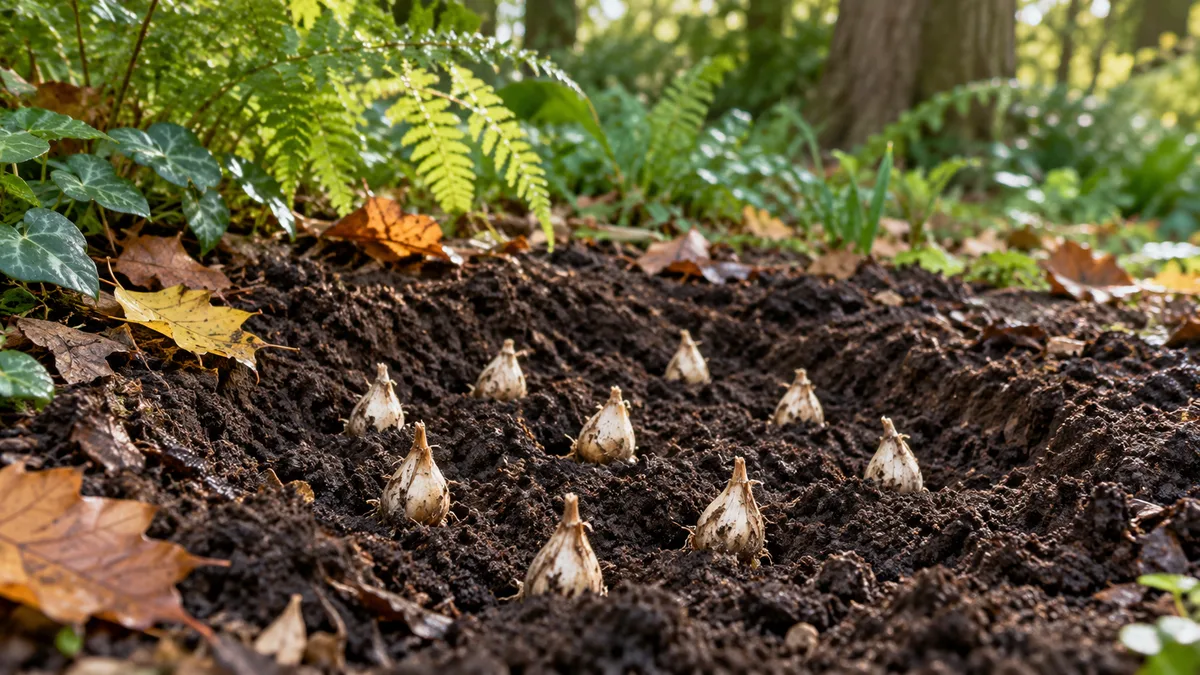
Prepare the whole planting area before placing bulbs. Loosen the soil without pulverizing it, remove perennial weed roots, and mix compost into the upper layer if the bed needs it. Set bulbs in small groups rather than a straight line for a natural look, but keep enough separation to inspect and thin the colony later. Backfill, firm gently to remove large air pockets, and water once if the soil is dry; do not leave the bed saturated.
If you want the display to remain controlled, resist planting a dense carpet. Wider spacing makes it easier to see offsets and lift them, while a restrained first planting lets you learn how quickly the bulbs behave in your conditions. Mark the site, especially if neighboring perennials will cover it later in the year.
Watering and feeding through active growth
After planting, rain often supplies enough moisture in autumn. Water newly planted bulbs if the soil is dry, then let the bed drain. In spring, check the soil during leaf and flower growth. Water deeply when the root zone begins to dry rather than giving frequent shallow sprinkles that wet only the surface. Established plantings usually need little extra water in a cool, rainy spring, but a dry spell during active growth can reduce flowering and weaken bulbs for the next season.
Containers dry faster than open ground, so check them more often. Keep the mix lightly moist while leaves are growing, never continuously soggy. Once foliage has yellowed and collapsed, the plant is dormant and needs far less water; a pot kept wet through summer is more likely to lose bulbs to rot than one allowed to dry somewhat between rains. Do not mistake dormant bulbs for a reason to keep watering on a schedule.
Fertilizer is usually optional in a reasonably fertile bed. A light top-dressing of compost in early spring can replenish organic matter, but a high-nitrogen feed is not a shortcut to stronger blooms and may encourage lush leaves at the expense of a tidy display. If flowers decline, first check crowding, light, moisture, and drainage before adding fertilizer. The Plantura care guide similarly stresses moderate spring moisture, drainage, and letting foliage fade fully before removing it.
Care after flowering and through dormancy
Once most flowers have faded, decide whether you want seed. If you do not want seedlings, snip off the flower stalks before seed capsules mature. Remove the stalk, not the leaves. Deadheading limits one route of spread, but daughter bulbs keep forming underground, so it is not a complete containment strategy. If you are happy for a colony to expand in a contained bed, you can leave a few stems to set seed and remove the rest.
Let the foliage remain until it has yellowed and withered naturally. The green leaves use sunlight to replenish the bulb for the next spring; cutting, braiding, tying, or mowing them early removes that energy source. When leaves are fully yellow, you can tidy them away. A companion groundcover can mask the fading leaves without sacrificing them, which is better than tying foliage into bundles to make the bed look neat.
During summer dormancy, the underground bulb is not asking for routine feeding or irrigation. Keep track of where the clump sits so you do not dig through it while planting summer annuals. In autumn, inspect the planting footprint and remove any seedlings or bulbs that have moved beyond the boundary. The RHS bluebell advice notes that bluebells spread by both seed and bulb offsets and that established clumps can take years to eradicate, making small, regular corrections easier than waiting for a major takeover.
Manage spread without losing the whole display
Spanish bluebells spread by two routes: seed from mature capsules and daughter bulbs, also called offsets. These are different problems. Deadheading before capsules ripen reduces seedlings, but it will not stop the original bulbs from multiplying beside one another. Thinning a clump addresses offsets, but seed can still establish at the bed edge if flowers are left to mature.
For a managed border, walk the bed after flowering and clip unwanted seed stalks. In late summer or fall, lift congested clumps when foliage is absent only if you have marked the location; some gardeners find it easier to lift while leaves are still visible after bloom. Separate the bulbs gently, replant only the number you intend to keep, and do not move extras to woods, roadside verges, or other natural areas. Where spread is not welcome, remove seed heads promptly and inspect the outside edge annually for new shoots.
If the colony is already larger than you want, removal is a multiseason task. While leaves identify the bulbs, loosen the surrounding soil with a fork or hand tool and lift the bulbs and visible offsets. Work carefully so you do not cut bulbs into pieces or leave small offsets behind. Recheck the site in following springs and remove regrowth; missing one dormant bulb can restart a patch. Keep removed seed-bearing heads and viable bulbs out of casual compost piles and follow municipal or local invasive-plant disposal guidance. Do not dump garden waste where it can reach a stream, woodland, or road verge.
The goal is not to panic over every bluebell. It is to make a deliberate choice: keep a bounded planting where it is appropriate, or remove it steadily where its spread creates a conservation or legal concern. If the stand is close to native H. non-scripta, avoid planting Spanish bluebells and hybrids; the RHS specifically advises that precaution because pollinators can move pollen between nearby garden and wild plants.
Propagate by offsets or seed
Offsets are the practical way to expand an existing clump. Lift a crowded group when the bulbs are dormant or as the foliage is fading and still visible. Brush off loose soil, separate the small bulbs by hand, discard soft or damaged ones, and replant the firm offsets promptly at the recommended depth. Do not expect every small offset to flower the next spring; some need time to reach flowering size. Division is also the best moment to reduce a colony, so decide the destination before you lift it.
Seed is slower and less predictable. If you want seedlings, leave selected flowers to mature and collect the capsules when they are dry and beginning to open. Sow fresh seed in a labeled pot or prepared nursery bed and keep it from drying out; germination and flowering can take several seasons, and offspring may not look exactly like a named cultivar. If the goal is to stop spread, do the reverse: remove every unwanted flower head before seed ripens.
Do not gather bulbs or seed from wild bluebell populations. Buy cultivated material from a reputable nursery and check the label for the species, particularly if the vendor uses only “bluebell” or “wood hyacinth.” When local regulation applies, moving bulbs from one property or transporting them for disposal may also have rules; ask the relevant environmental authority before moving a problem population.
Grow Spanish bluebells in containers
A pot can make the planting easier to monitor, especially on a patio or in a small garden. Choose a wide, stable container with drainage holes and use a free-draining multipurpose potting mix. Set bulbs at the same approximate depth and spacing as an in-ground planting, leaving room for foliage and flowers to form a clump. A shallow decorative bowl without drainage is a poor choice because waterlogged bulbs are prone to rot.
Place the container where it gets spring light and some protection from the hottest afternoon sun. Water when the upper mix is drying during active growth, then allow the pot to drain fully. After flowering, deadhead if you do not want seedlings and retain leaves until they turn yellow. The plant can stay outdoors in many temperate climates, but a pot exposes bulbs to temperature swings more than the ground does; follow a local cultivar recommendation and protect the container in severe cold rather than assuming an indoor warm room is a good winter substitute.
A container limits underground offsets to the pot, but seed can still leave it. Do not let seed capsules mature if the pot sits near sensitive habitat or if the plant is discouraged where you live. Divide the clump when it becomes crowded or flowering declines, and dispose of unwanted bulbs responsibly. A pot is containment only when you manage the flowers and the contents.
Choose companions and design around fading foliage
Spanish bluebells look most natural in loose groups at a woodland edge, beneath deciduous shrubs, or in a spring border that has other plants ready to fill the space. Choose companions that emerge later or have shallow roots and do not demand summer sun at the exact time the bluebell leaves are still replenishing the bulbs. Ferns and shade-tolerant perennials can cover the yellowing foliage after bloom; leave enough room to lift the bulbs if you need to thin them.
Do not pair Spanish bluebells with native English bluebells in or near a natural area simply because the two look attractive together. That mix increases the chance of hybridization and makes identification harder later. In regions where Spanish bluebells are locally discouraged, choose a locally appropriate native spring ephemeral instead. In regions where they are permissible and manageable, use the plant as a small, deliberate accent rather than a groundcover that you expect to stay exactly where it was first planted.
Think about the bed’s appearance across the whole year. Bluebells provide spring color and then retreat; they are not a summer foliage plant. If a tidy, continuously green border is the priority, combine them with plants that expand after flowering, but avoid aggressive companions that will make future bulb inspection impossible. A simple garden map or dated spring photo can save time when the dormant clump is invisible.
Troubleshoot weak blooms and crowded clumps
Leaves appear but flowers do not: overcrowding is one possibility, especially if the clump has not been thinned for years. Too much shade, bulbs planted too deeply, immature offsets, or poor storage before planting can also reduce bloom. Check the site and bulb health before applying fertilizer; lift a small test section only when you can identify the bulbs and replant them at the right depth.
Bulbs rot or fail to return: persistent waterlogging is a more likely cause than lack of fertilizer. Improve drainage across the bed, reduce summer watering, and discard bulbs that are soft or foul-smelling. If the bulbs are in a pot, empty standing water from the saucer and confirm that the drainage holes are open.
The colony escapes its border: remove flower heads before seed capsules mature, then lift offsets from the edge while foliage helps you locate them. Expect to repeat checks; seed control will not erase existing bulbs, and a single digging may miss small offsets. For a stand close to wild native bluebells, get local conservation advice before disturbing or transporting plants.
Flowers flop or open poorly: tall flower scapes may lean after heavy rain or in a very exposed position. A sheltered site helps, but avoid staking every stem unless necessary; the clump is usually best treated as a low woodland bulb, not as a formal cut-flower plant. A plant that fails repeatedly in hot, dry conditions may be in the wrong site rather than suffering from a hidden disease.
Handle bulbs and foliage safely
Do not eat Spanish bluebells or offer them to children as edible flowers. NC State Extension flags the plant as poisonous to people, and the RHS lists the plant as harmful if eaten by people and pets. Keep bulbs away from food-preparation areas and prevent pets from chewing leaves or bulbs. If a person or animal eats any part, contact the appropriate poison-control service, veterinarian, or medical professional rather than waiting for symptoms to worsen.
The sap can irritate sensitive skin. Wear gloves when planting, dividing, or clearing a large patch, avoid rubbing your eyes, and wash hands and tools afterward. Gloves are a simple precaution, not a sign that normal garden contact is inherently dangerous. Keep removed bulbs and seed capsules secured until they can be disposed of according to local guidance.
Conclusion: grow them only where you can manage them
Spanish bluebells are straightforward bulbs when the site has spring moisture, good drainage, and partial shade, but responsible care begins before planting. Confirm that you have Hyacinthoides hispanica or a known cultivar, check local invasive-plant guidance, and avoid planting near native English bluebell habitat. If the plant is appropriate in your area, set bulbs in fall at a measured depth, water through dry spells while leaves are active, deadhead unwanted seed, and let foliage yellow before removing it.
The best planting is one whose future spread you have already planned for. A managed bed or monitored container can provide spring flowers; an uncontained colony beside native habitat may create a problem you cannot solve with deadheading alone. If you are unsure about identity, local rules, or how close you are to a sensitive wild population, wait and choose a locally suitable alternative until you can verify the answer.



