Choose Spruce Trees by Mature Size, Shape, and Climate
Compare 18 spruce species and cultivars by mature size, site fit, and care tradeoffs so you can avoid planting a slow grower that still gets too large.
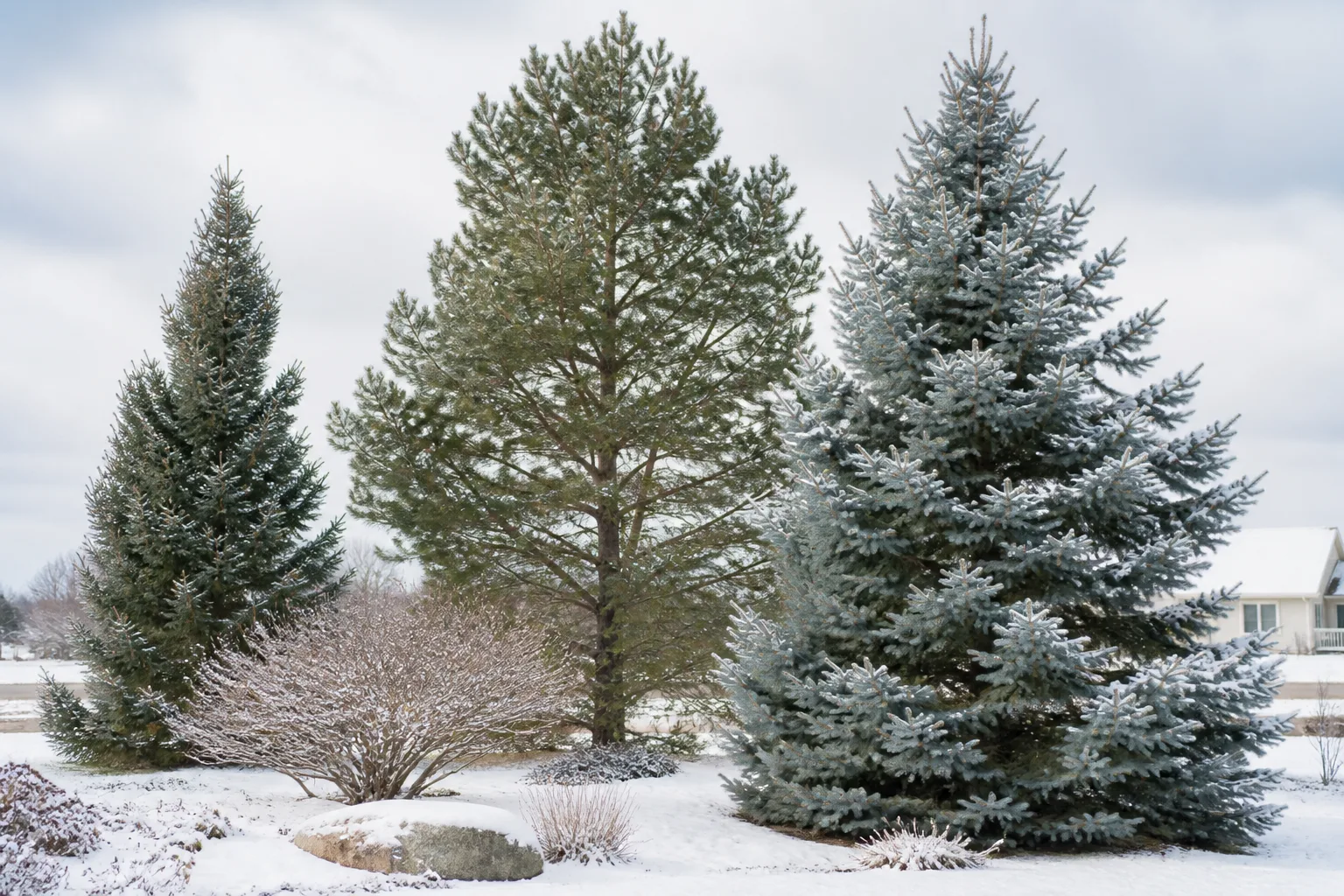
Spruce can mean a knee-high evergreen mound, a tidy cone beside a doorway, or a tree that eventually rises above a house. The right choice depends on the plant’s mature width as much as its height, plus whether your summers, soil, and available space suit that particular Picea.
Botanically, these selections belong to Picea, a genus in the pine family, Pinaceae. The list includes full-size species and named cultivars: a cultivar such as ‘Conica’ is a selected form of white spruce, while “dwarf” describes its slower, smaller habit rather than a promise that it stops growing.
NC State Extension’s Dwarf White Spruce ‘Conica’ profile gives a useful example: about 3 to 4 feet tall after 10 years, then roughly 10 to 13 feet tall and 7 to 10 feet wide after several decades. The Royal Horticultural Society’s Norway spruce profile also describes the genus’s rigid needles arranged singly around shoots and its hanging cones.
Before you buy, measure the planting bed and check the nursery tag for both mature height and spread. A narrow upright plant can still shade a window, reach overhead wires, or block a path as it grows.
Also match the tree to summer conditions; winter hardiness alone does not tell you whether a spruce will cope with months of heat and humidity. For a quick identification clue, spruce needles grow singly on small woody pegs and their cones hang down; pines carry needles in bundles, while true firs have different needle attachments and upright cones.
Our guide to types of fir trees explains that comparison in more detail. Spruces also seldom regrow from bare old wood, so repeated hard pruning is a poor way to rescue a tree planted in too little space; Gardening Know How’s pruning guide explains that limitation.
The estimates below describe common garden expectations, not guarantees. Sources may report a 10-year size, a mature cultivated size, or the much larger dimensions of a tree in the wild. A local nursery or extension office can help you interpret a cultivar label for your region, especially if summer heat or wet soil is a concern.
1. Bird’s Nest Spruce
Bird’s nest spruce, Picea abies ‘Nidiformis’, is a low, spreading Norway spruce cultivar with a shallow dip near the center that gives the crown its familiar name. It is slow growing and generally stays a few feet high, but its width can surprise people who judge it only by the small nursery pot. BBC Gardeners’ World’s Norway spruce profile lists a long-term estimate near 1.5 meters tall by 4 meters wide, so allow room for a broad mound rather than treating it as a narrow foundation plant.
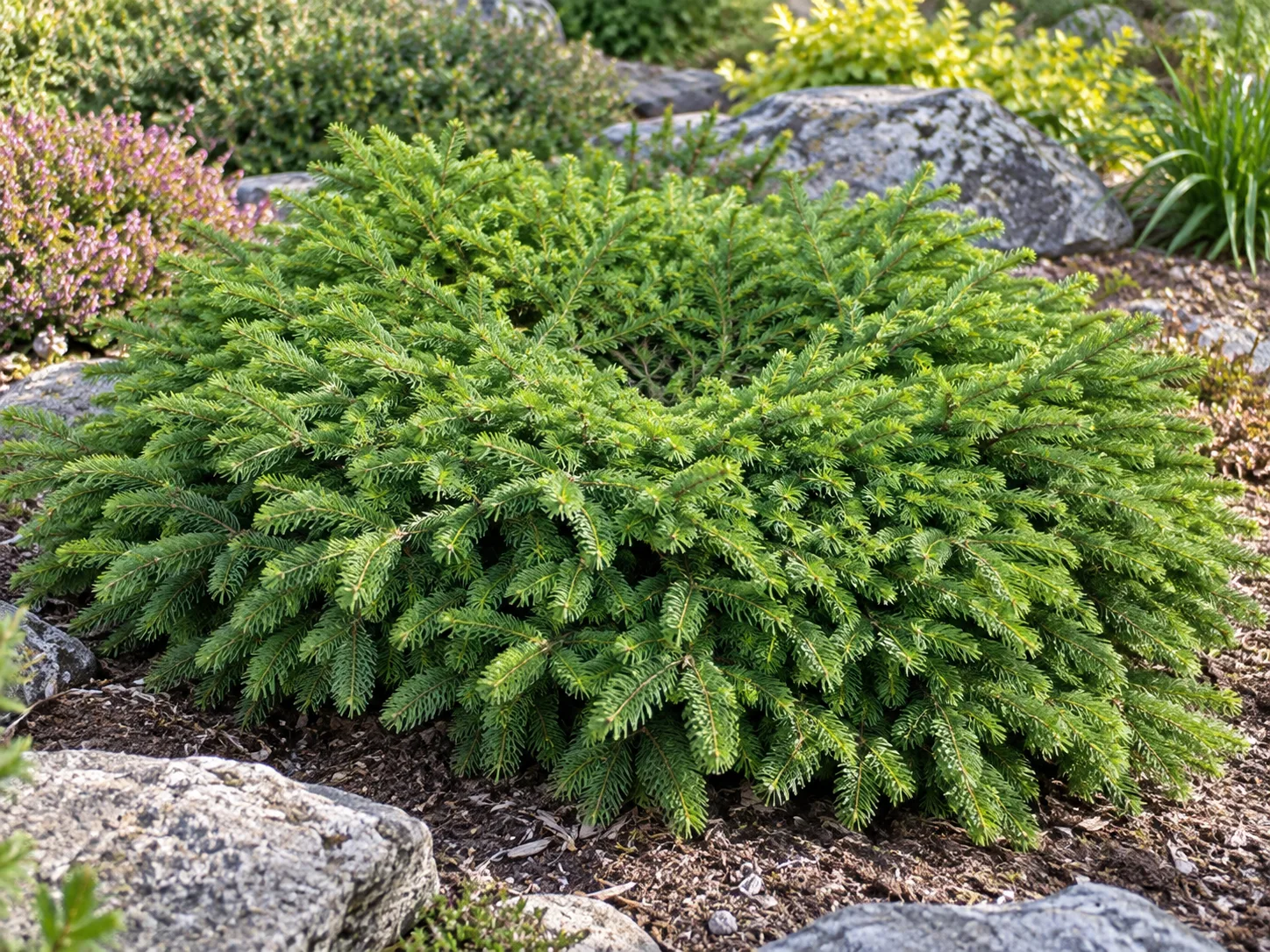
Use it at the front of a sunny or lightly shaded border, in a rock garden, or as a low evergreen anchor among perennials. Its layered branches look best when allowed to spread naturally; repeated shearing can erase the characteristic outline and expose brown inner foliage. A container can work while the plant is young, but the wide crown and root zone eventually need more room than a small porch pot provides.
2. Black Spruce
Black spruce, Picea mariana, is a northern North American species with a narrow, spire-like outline. NC State Extension describes it as a slow-growing tree for cool climates and lists a typical landscape range of about 30 to 40 feet tall and 8 to 12 feet wide. It can suit a large naturalistic garden, a cool-climate windbreak, or a wetland-edge planting where the soil stays moderately moist without keeping roots oxygen-starved.
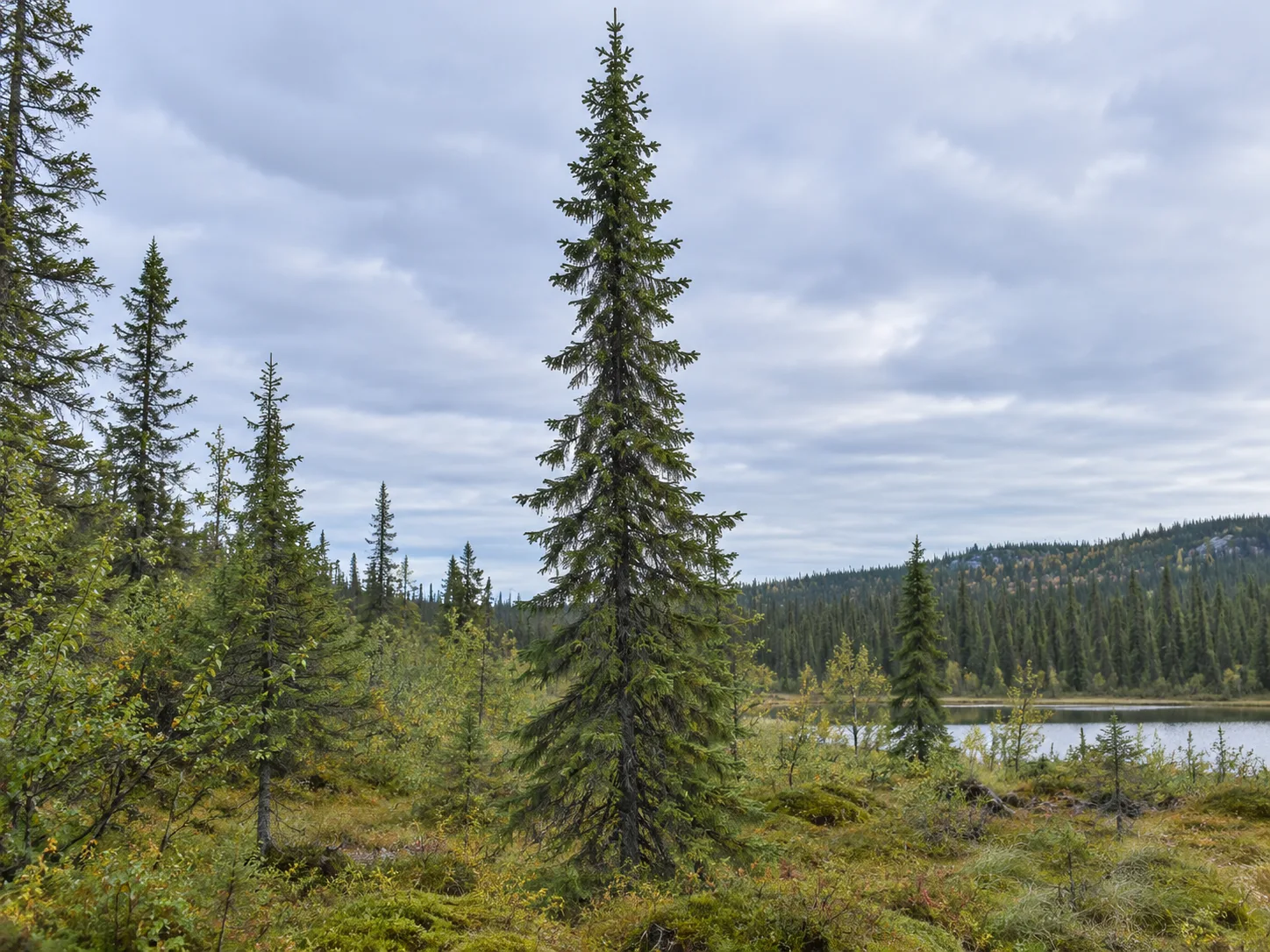
The species is adapted to boreal conditions, so a hot, humid lowland garden is a poor bet even if the winter zone looks suitable. Black spruce also has a genuinely compact selection: ‘Nana’ is a rounded, dense shrub only about 1 to 2 feet tall and 2 to 3 feet wide, according to the NC State Extension profile. That cultivar makes sense for a rock garden or small evergreen border; the species tree does not belong in the same size category.
3. Brewer Spruce
Brewer spruce, Picea breweriana, is a distinctive western species known for fine branchlets that hang down from its horizontal limbs like soft green curtains. It is native to a limited part of northern California and southern Oregon, where cool, moist winters and comparatively dry summers shape its growing conditions.
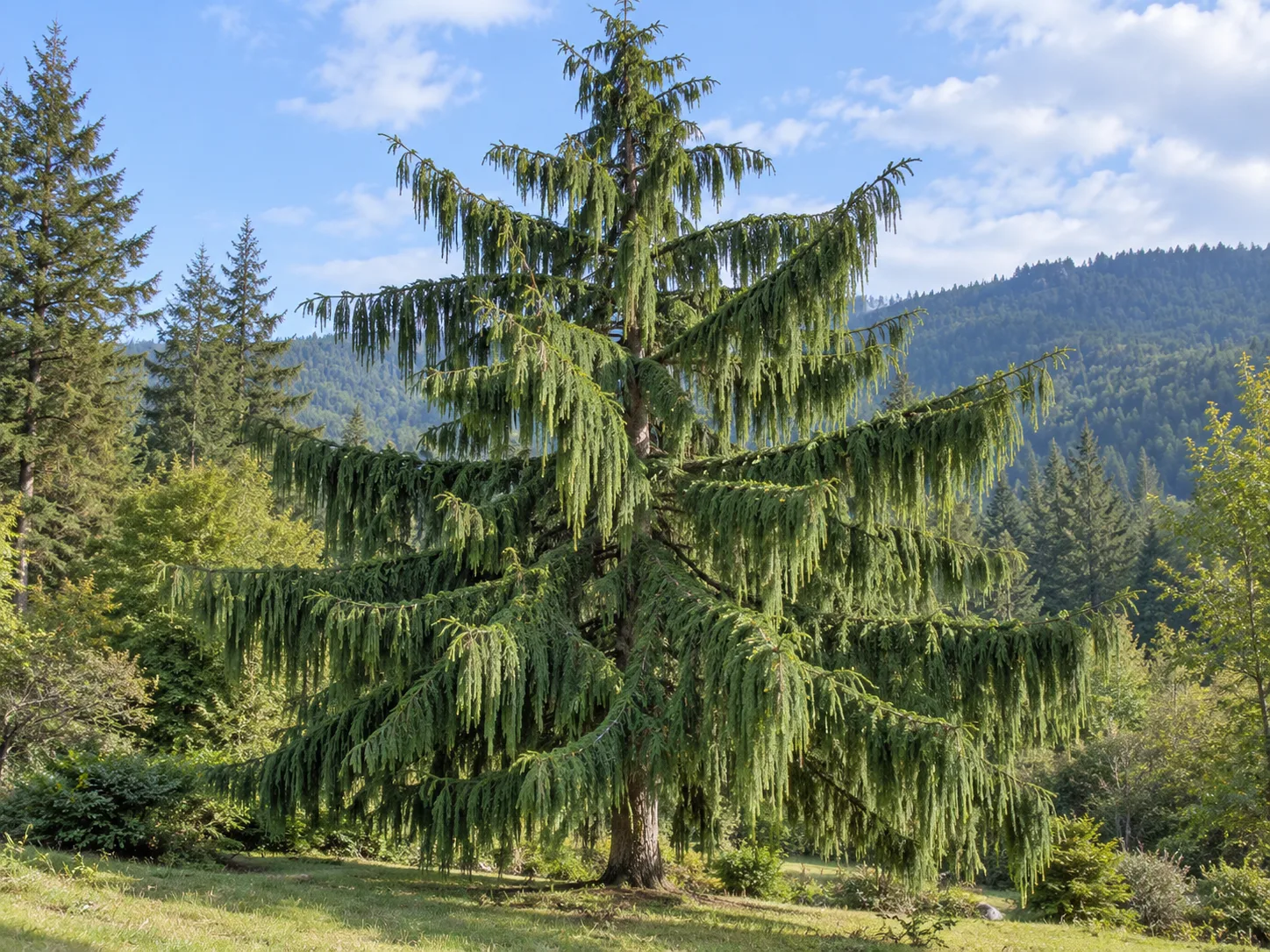
Oregon State University’s landscape profile describes a slow-growing tree 50 to 80 feet tall, with an open crown and long, drooping branches. Allow roughly 25 to 40 feet of width for those limbs to hang clear of paths and neighboring plants; that is a site-planning range, not a fixed cultivar measurement.
Choose it as a specimen only when the climate and room are right, and expect slower establishment than with a fast-growing screen tree. It is not a reliable substitute for an adaptable hedge spruce: warm, humid summers can make it difficult to keep healthy, and its flowing branch structure needs space to be seen from several angles. If your site is hot, compact, or heavily irrigated, admire this species in an arboretum and choose a more locally proven conifer for the yard.
4. Oriental Spruce
Oriental spruce, Picea orientalis, has short, dark-green needles and a dense, refined silhouette. NC State Extension gives the species an approximate mature range of 50 to 60 feet tall and 15 to 20 feet wide, with a slow growth rate. That makes it a useful upright specimen for a larger garden where a narrow evergreen shape is wanted, though it is still a tree rather than a small shrub.
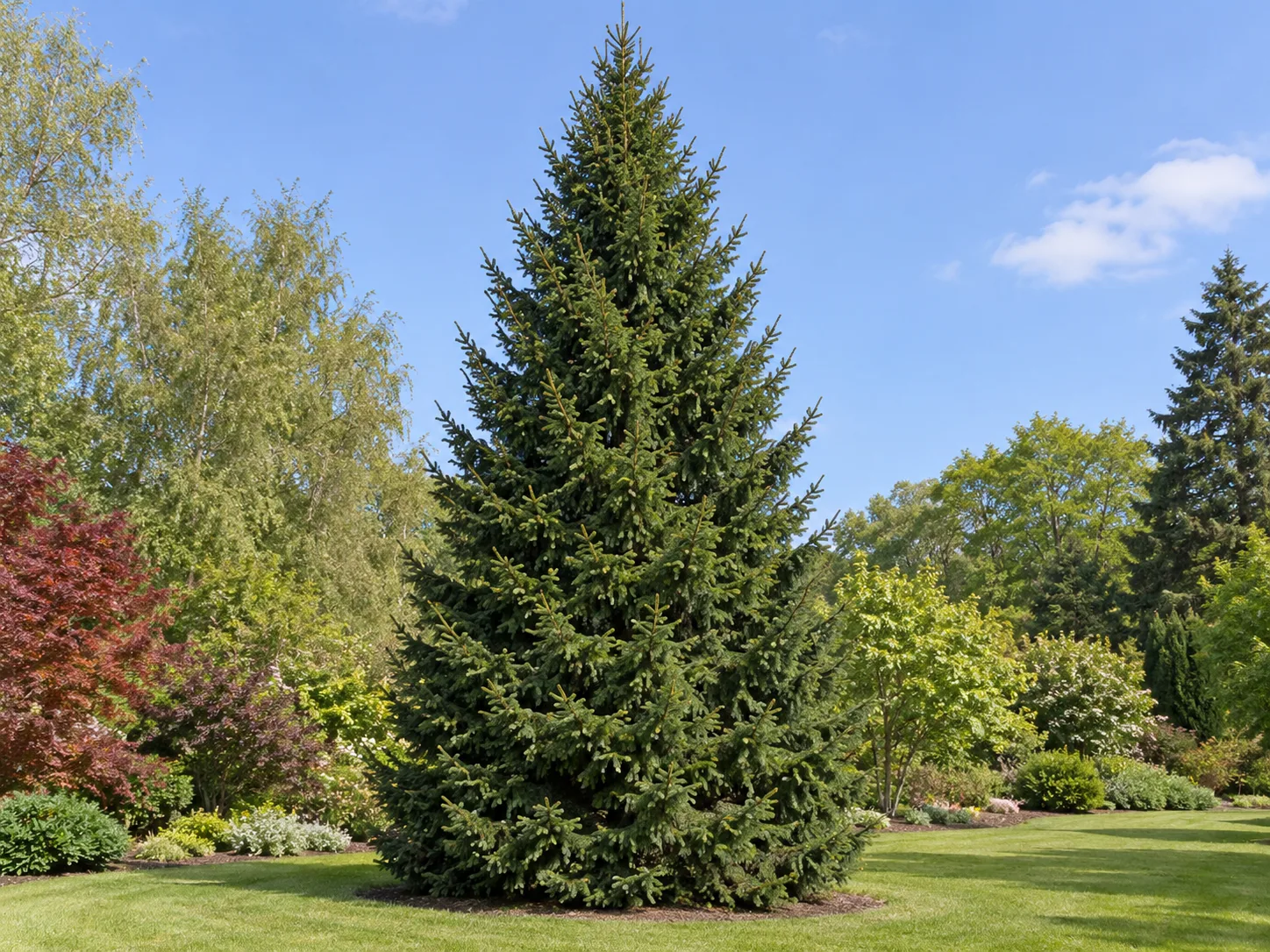
Several cultivars offer a different scale or seasonal color. ‘Nana’ forms a compact rounded shrub; ‘Gowdy’ grows narrowly and slowly; and gold-foliaged selections such as ‘Skylands’ bring yellow new growth that fades as the season advances.
NC State notes that the yellow foliage can burn in hot climates. Check the exact cultivar on the label because “oriental spruce” alone describes the species, not the final width or color behavior.
5. Colorado Blue Spruce
Colorado blue spruce, Picea pungens, is the familiar blue-needled conifer of cold, dry western landscapes. NC State Extension lists the species at about 30 to 60 feet tall by 10 to 20 feet wide, with a slow to medium growth rate. Its stiff branches and dense pyramidal form make it a strong specimen or windbreak, but sharp needle tips can be uncomfortable beside a narrow path, play area, or pool deck.
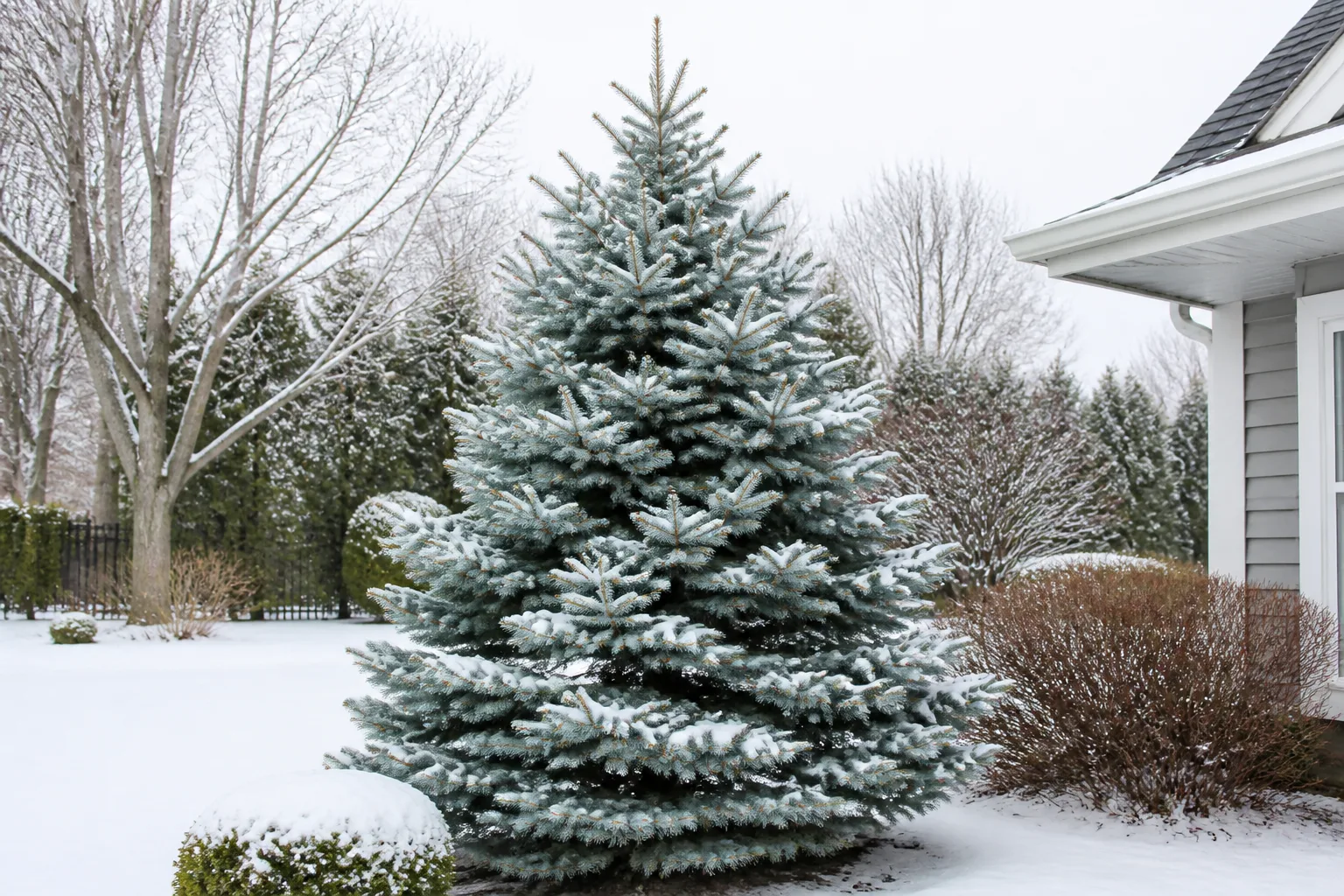
Color varies among seedlings, so buy a named cultivar if blue foliage is the reason you want the tree. Even then, the local climate matters: this species generally performs best with good drainage, full sun, and cooler summers, while prolonged heat and humidity can increase stress and disease pressure.
Established trees tolerate some drought better than newly planted ones, but a young root ball still needs consistent moisture. NC State’s blue spruce profile describes both the species’ dimensions and the range of available forms.
6. Dwarf Alberta Spruce
Dwarf Alberta spruce is Picea glauca ‘Conica’, a compact white spruce cultivar rather than a separate species. It makes a dense, formal cone that works beside an entry, at a path intersection, or as a focal point in a small bed. Its reputation for staying small comes from slow growth: NC State Extension estimates 3 to 4 feet of height and about 18 inches of width after 10 years, but 10 to 13 feet tall and 7 to 10 feet wide after several decades.
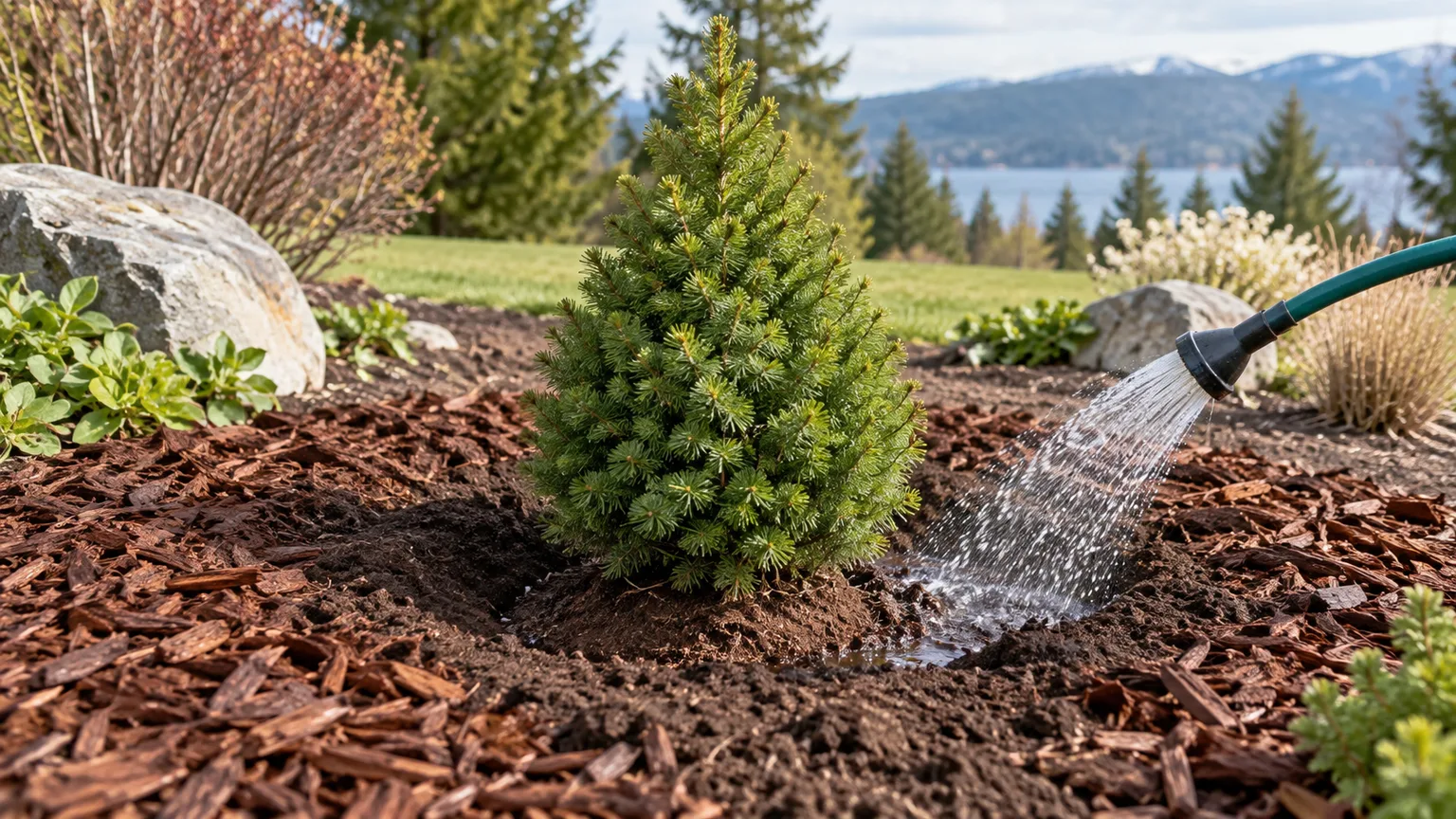
That longer view is useful when deciding whether it fits below a window or near a doorway. Give it a cool site with good airflow and moist, well-drained soil; hot, humid conditions and repeated mite infestations can spoil the foliage.
Do not shear it into a smaller shape or assume a pot makes it permanently miniature. A well-drained container can work for a time, but root protection and regular watering become more demanding as it matures.
7. Engelmann Spruce
Engelmann spruce, Picea engelmannii, belongs to the high-elevation forests of the Rocky Mountains. It forms a narrow conical crown and can reach roughly 70 to 100 feet tall with a spread around 20 to 30 feet in suitable conditions. At that scale, it fits a spacious cool-climate property, a mountain garden, or a naturalistic planting with room for a full tree—not a foundation strip or small front lawn.
Oregon State University describes it as an 80- to 100-foot tree with a dense, narrow crown, and notes that it naturally grows at high elevations in cold, often wet mountain environments. Allow roughly 20 to 30 feet of width and avoid hot lowland sites where the climate differs sharply from its native habitat. Plant Engelmann spruce only if local growers can show established examples nearby; otherwise, select a spruce already proven in your climate. Oregon State’s Engelmann spruce profile also lists unusually small named selections, including ‘Missy’ at about 1 foot by 1 foot after 10 years.
8. Norway Spruce
Norway spruce, Picea abies, is a fast-growing European tree with glossy dark-green needles and long, hanging cones. The Royal Horticultural Society’s plant profile describes it reaching about 30 meters tall and more than 8 meters wide at maturity; BBC Gardeners’ World’s Norway spruce guide similarly recommends it for large gardens and parks rather than tight residential beds. Those figures matter more than the familiar Christmas-tree shape of a young specimen.
Use the species for a large property, a broad screen, or a windbreak where the canopy can expand without constant cutting. A named cultivar can be much smaller: ‘Little Gem’ is a low mound, while ‘Nidiformis’ spreads broadly and remains shrub-like for a long time.
The RHS recommends moist but well-drained soil and notes that regular pruning is unnecessary. Norway spruce can naturalize in some regions, so check local invasive-plant guidance before planting rather than assuming its behavior is the same everywhere.
9. Red Spruce
Red spruce, Picea rubens, is native to the cool forests of northeastern North America and southeastern Canada. Oregon State University’s profile describes a broadly conical tree that can reach about 80 feet tall and notes that it suffers in warm-summer areas.
For a landscape plan, reserve roughly 25 to 35 feet of width for its open crown; the exact spread varies with growing conditions. Its best garden use is a spacious woodland edge or cool-climate property where a full evergreen canopy can develop without competing with buildings or overhead lines.
This is not the spruce to choose for a hot, dry, exposed site. Red spruce grows best where summers remain relatively cool and the soil stays evenly moist while still draining; it can take some shade when young, but a mature tree needs room and access to light. A Christmas-tree-sized plant may look manageable for years before its eventual scale becomes obvious, so treat the species as a long-term tree rather than a large shrub.
10. Serbian Spruce
Serbian spruce, Picea omorika, combines a narrow pyramidal outline with slender, arching branches and needles that show a paler underside. NC State Extension gives the species a mature range of about 50 to 60 feet tall and 15 to 25 feet wide. That relatively narrow spread can make it easier to place than a broad Norway spruce, but its eventual height still rules out sites under wires or beside a low roof.
It suits a specimen planting, a loose screen, or a large mixed border where the fine branch texture can be seen. The species prefers cool conditions and good drainage; NC State notes it may adapt to hot, humid settings better than some spruces, but that is not a guarantee of good performance in a southern heat island. If you want the same silver-backed foliage in a much smaller plant, look for a named dwarf cultivar such as ‘Nana’ rather than buying the standard species.
11. Sitka Spruce
Sitka spruce, Picea sitchensis, is a forest-scale Pacific species native to the coast from Alaska into California. Oregon State University’s landscape profile gives a common cultivated range of 40 to 60 feet tall and notes exceptional trees around 160 feet.
Its horizontally spreading branches need a broad, open site; allow at least 30 feet of width and keep it away from buildings and overhead lines. The blue-green needles can tempt buyers looking for a quick screen, but this is not an ordinary residential-lot tree.
This species is adapted to a cool maritime climate with moist air and reliable soil moisture; Oregon State notes it is typically found near the Pacific coast and prefers cool, moist air. Inland heat, dry wind, and a small planting bed are a mismatch.
Reserve Sitka spruce for very large coastal properties, parks, or restoration settings where local climate and land use support it. A nursery plant can look compact in a container, but the eventual tree is measured against forest trees, not shrubs beside a porch.
12. White Spruce
White spruce, Picea glauca, is a hardy northern species with a dense, pyramidal crown and blue-green to green needles. A common landscape range is about 40 to 60 feet tall and 10 to 20 feet wide. It can work as a specimen, a windbreak, or a screen on a large cool-climate property, especially where a tough evergreen structure is needed through cold winters.
White spruce tolerates wind and cold, and established trees handle some dry periods, but compacted or persistently waterlogged soil is still a problem. It also may not thrive in heat, humidity, road salt, or polluted street conditions.
Names can vary among plant databases and nursery labels; one NC State profile uses Picea laxa and lists P. glauca among the names previously applied to white spruce. Check both the botanical name and the cultivar so you know whether the tag describes the full-size species or a selected form such as ‘Conica’.
13. Globe Blue Spruce
Globe blue spruce, Picea pungens ‘Glauca Globosa’, is a rounded blue selection of Colorado spruce. It usually grows into a low mound about 3 to 5 feet tall and 4 to 6 feet wide, making it more practical for a small border than the full-size species. The compact shape is useful where you want blue foliage at eye level without planting a large tree.
The outline is not always perfectly spherical forever. Some plants develop a stronger upright shoot or leader as they age; if you want the globe form, inspect the plant before buying and remove a vigorous leader while it is still small rather than repeatedly shearing the entire shrub.
Like other blue spruce selections, it needs a sunny, well-drained site and can struggle in hot, humid locations. Give it enough width to keep its lower branches visible and accessible.
14. Weeping Serbian Spruce
Weeping Serbian spruce is Picea omorika ‘Pendula’, a cultivar valued for its narrow upright leader and cascading side branches. Its eventual height depends partly on how the leader is staked or trained, so two plants with the same cultivar name may develop different outlines. A typical garden specimen may reach about 15 to 25 feet tall and 5 to 10 feet wide, but ask the nursery how its stock is trained before placing it in a tight gap.
This is a sculptural accent for a large border or a small courtyard with vertical clearance. The flowing branches need open space around them; planted too close to a wall or hedge, the weeping form becomes one-sided and difficult to appreciate. It is not a miniature version of Serbian spruce, and pruning the leader casually can permanently change its characteristic shape.
15. Black Hills Spruce
Black Hills spruce is a dense, cold-hardy selection of white spruce from the Black Hills region. It may be sold as Picea glauca ‘Densata’, P. glauca var. densata, or under a regional common name.
That naming variation is a reason to check the actual nursery label. A slower-growing tree can stay in the 20- to 25-foot range for many years, but it can eventually reach roughly 40 to 50 feet tall and 15 to 25 feet wide.
Use it where you want a compact-looking young tree that will become a substantial evergreen screen or specimen over time. Do not treat “Black Hills” as a dwarf cultivar or assume the early size is its final size. It is a better fit for a large property in a cold region than for a narrow foundation planting, and it needs open soil and crown space to develop its dense pyramidal form.
16. Fat Albert Blue Spruce
‘Fat Albert’ is a named cultivar of Colorado blue spruce, Picea pungens, selected for a broad, dense pyramid and steel-blue needles. NC State Extension lists it at about 8 to 15 feet tall and 7 to 10 feet wide, substantially smaller than the species but large enough to become a focal tree. Its close branches create a strong winter silhouette and provide a fuller look than many narrow conifers.
Choose a nursery-grown named plant rather than a seedling if the exact color and form matter. ‘Fat Albert’ prefers full sun and well-drained soil, and NC State says it can struggle in hot, humid climates.
It is not a miniature; leave several feet around the branches and do not plant it where the mature width will push against a walkway or foundation. Its slower growth buys time to plan, not permission to ignore its final footprint.
17. Dwarf Black Spruce
Dwarf black spruce is Picea mariana ‘Nana’, also sold as blue nest spruce. It forms a slow-growing, dense rounded shrub with blue-green needles and a slight nest-like dip. NC State Extension lists it at about 1 to 2 feet tall and 2 to 3 feet wide, a true small-space option compared with the 30- to 40-foot black spruce species.
Use it at the edge of a rock garden, in a cool-climate foundation bed, or as a low evergreen between perennials. It prefers full sun, acidic soil, and cool summers; young plants need steady moisture and should not dry out completely.
Unlike a full-size tree, the cultivar needs little corrective shaping, but it still looks better when given enough width to develop its natural mound. Confirm the label says ‘Nana’ before buying, because “black spruce” alone may refer to the much taller species.
18. Golden Oriental Spruce
Golden oriental spruce is usually sold as Picea orientalis ‘Aureospicata’, a cultivar chosen for yellow new growth that contrasts with older dark-green needles. The spring color is seasonal rather than a permanent golden canopy, so a shopper expecting every branch to remain bright yellow may be disappointed. The underlying species is a slow-growing but substantial tree, with NC State Extension listing about 50 to 60 feet tall and 15 to 20 feet wide.
Related gold-foliaged cultivars can behave differently: NC State describes ‘Skylands’ as having yellow new foliage that fades through summer and may burn in hot climates. Ask the nursery for the exact cultivar name and mature dimensions, then plant it where the spring flush can be seen without exposing it to reflected heat or dry soil. A golden cultivar may be an unusual specimen, but its mature size still follows the scale of its parent species unless the label identifies a genuinely dwarf selection.
Conclusion
The best spruce for a yard is the one whose mature spread, climate needs, and growth habit fit the site without years of corrective pruning. For a compact bed, start with a named dwarf such as ‘Nana’, ‘Glauca Globosa’, or ‘Conica’ and check its long-term width. For an open property, a full-size species such as Norway, white, or Serbian spruce can provide height and year-round structure; coastal or mountain species need conditions close to their native climate.
Before you buy, measure the space in both directions, check summer performance with a local nursery or extension service, and verify the cultivar name on the tag. “Slow growing” tells you how long the plant takes to reach its size; it does not tell you that the size will stay small.



