6 Tomato Staking Tips for Healthy Plants
Learn when to stake tomatoes, how tall supports should be, which cages or trellises fit each type, and how to avoid broken stems.
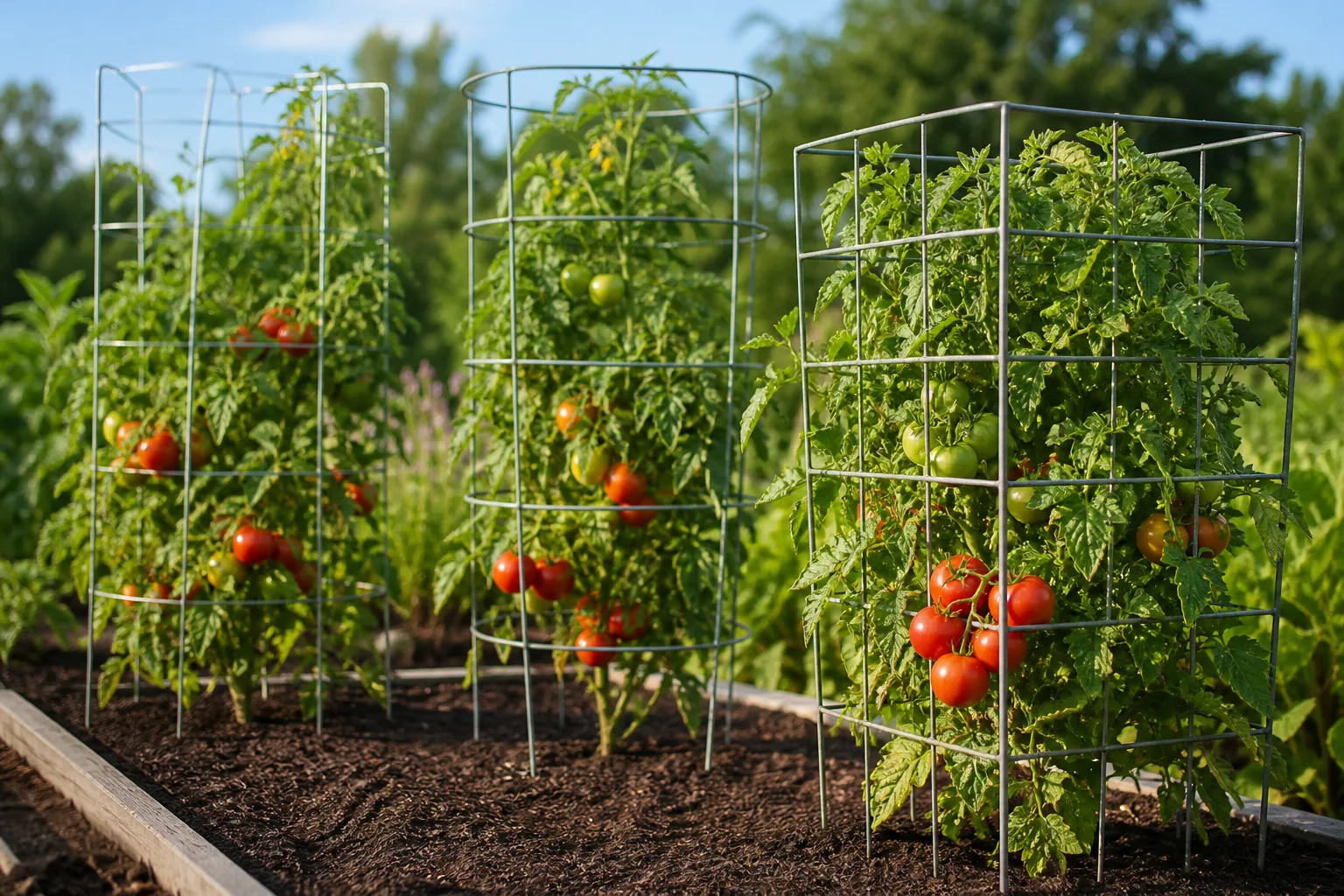
A tomato plant can look perfectly stable at transplanting and still become a sprawling, breakable mass a few weeks later. Fruit adds weight, rain makes foliage heavier, and a vigorous vine can outgrow a short cage before you notice. The best tomato staking tips are therefore about planning for the mature plant, not rescuing it after the first branch hits the soil.
Support does more than make a bed look tidy. Keeping stems and fruit off the ground can make harvesting easier, improve air movement after rain, and reduce the contact between foliage and soil. It does not replace good watering or disease management, but it gives those practices a better chance to work. The University of Georgia Cooperative Extension explains that nearly every tomato can benefit from some form of support, with the best system depending on the tomato’s growth habit and how aggressively you plan to prune.
Start by matching the support to the tomato
Before buying a stake or unfolding a cage, check the variety’s growth habit. Determinate tomatoes grow into a more compact plant, set much of their crop over a shorter period, and usually stop extending once fruit clusters form near the tips. They still benefit from support because a heavy crop or a summer storm can tip them, but they rarely need a tall, elaborate structure.
Indeterminate tomatoes keep extending their stems and can produce flowers and fruit over a long season. They need a support that can handle height, repeated growth, and a heavier upper canopy. Vigorous cherry tomatoes can behave similarly even when the fruit is small; the plant, not the individual tomato, determines the structural demand. A variety sold as “compact” or “patio” may be the exception, so use the mature height on the seed packet as a starting point rather than assuming all tomatoes need the same setup.
Determinate and indeterminate tomatoes behave differently
The distinction affects both the structure and your maintenance schedule. A determinate plant can often grow well inside a sturdy 2- to 4-foot cage or with a moderate stake, while an indeterminate plant may outgrow that support and fold over its top. The Penn State Extension guide on tomatoes describes 2- to 3-foot supports for determinate types and supports around 5 feet for indeterminate types, while also noting that the exact choice should account for the plant’s mature size.
That difference also changes pruning. A single-staked indeterminate is usually trained to one or a few leaders so the structure can carry the plant. A determinate tomato generally needs lighter pruning because removing too much of its limited foliage can reduce the plant’s ability to protect fruit from intense sun. If you want a low-maintenance crop, a roomy cage is often more forgiving than a single stake that requires constant training.
A quick support decision for containers, beds, and rows
Use this shortcut before you plant:
| Growing situation | Good starting support | Why it fits |
|---|---|---|
| One compact or determinate tomato in a container | Sturdy cage, tower, or 4-foot stake | Supports a bushy plant without forcing a single leader |
| One indeterminate plant in a container | Tall spiral stake, tower, or anchored trellis | Gives a long vine room to climb while keeping the pot from becoming top-heavy |
| A few plants in a raised bed | Individual stakes or heavy-duty cages | Lets you adjust care plant by plant and reach fruit easily |
| A straight row of several plants | Florida weave between end and intermediate posts | Shares one strong framework and reduces the number of supports per plant |
| Vigorous vines in a long season | Tall trellis, sturdy tower, or overhead string system | Leaves room for continued growth and repeated tie points |
The table is a starting point, not a promise. Windy sites, loose soil, large-fruited varieties, and containers with small footprints all need more anchoring than a sheltered bed with compact plants.
1. Install support at planting time
Put the support in the ground when you transplant the tomato, or within the first week. This is the single most useful timing decision because the plant’s root system is still concentrated near the original planting hole. Driving a stake beside a small plant is less disruptive than pushing one through roots that have already spread under a mature canopy.
The Penn State Extension staking instructions place a stake 3 to 4 inches from the stem and recommend positioning it on the side away from the first bloom cluster. That placement keeps early fruit from being pinched between the stem and stake. If you are installing a cage or trellis, set it in place before the foliage fills the space; trying to wrap a rigid cage around a sprawling plant usually bends branches and breaks flower clusters.
Early installation also lets the plant grow into its support. As soon as the main stem reaches roughly a foot tall, begin guiding it instead of waiting for a lean. A young tomato may not appear to need help, but rapid growth can turn a small plant into a difficult rescue project quickly. If you missed the ideal window, do not yank the plant upright or drive a stake through the root zone. Choose the safest open side, place support just outside the main root area, and use gentle ties to bring the plant upright over several checks.
2. Size the structure for the mature plant
The support must be tall enough to hold the plant where it will actually finish, with extra length or a strong top framework if the vine will continue upward. A stake that looks tall beside a seedling is not necessarily tall enough for an indeterminate tomato in midsummer. Include the buried portion when you buy materials: a 6-foot stake does not provide 6 feet of above-ground support if a foot is in the soil.
For a standard in-ground stake, 1 foot in the soil is a useful baseline in firm garden ground. The Penn State Extension recommendation calls for stakes at least 6 feet long and about 1.5 inches in diameter for a single-stake system, with approximately 12 inches driven into the ground. The University of Georgia guidance gives a range of 6 to 12 inches depending on soil and support, so go deeper or add an anchor when the site is loose, windy, or carrying an unusually heavy plant.
As a practical rule, choose a support that reaches the expected mature height and can carry the fruiting branches without leaving an unsupported top. For compact determinates, height matters less than diameter and stability. For indeterminates, height and rigidity both matter, and a structure that only supports the lower half can leave the upper vine to split or cascade.
Width matters for cages too. A narrow cone-shaped cage may hold a small patio tomato, but it can trap a bushy plant against the wire. Georgia Extension recommends a cage at least 3 feet in diameter for fuller plants, with 4- to 6-inch openings that let you reach fruit. A tall cage should also be pinned or anchored; height without a broad, stable base simply creates a lever that can tip in wind.
3. Choose a support method that fits your workload
There is no universally best tomato support. The right choice balances plant type, space, pruning time, harvest access, material cost, and whether you want to reuse the structure. Single stakes save space but demand regular tying and pruning. Cages and towers hold more branches with less daily training, but flimsy versions can collapse under an indeterminate plant. Florida weave supports a row efficiently, but it works best when plants are arranged in a reasonably straight line.
Single stakes and spiral stakes
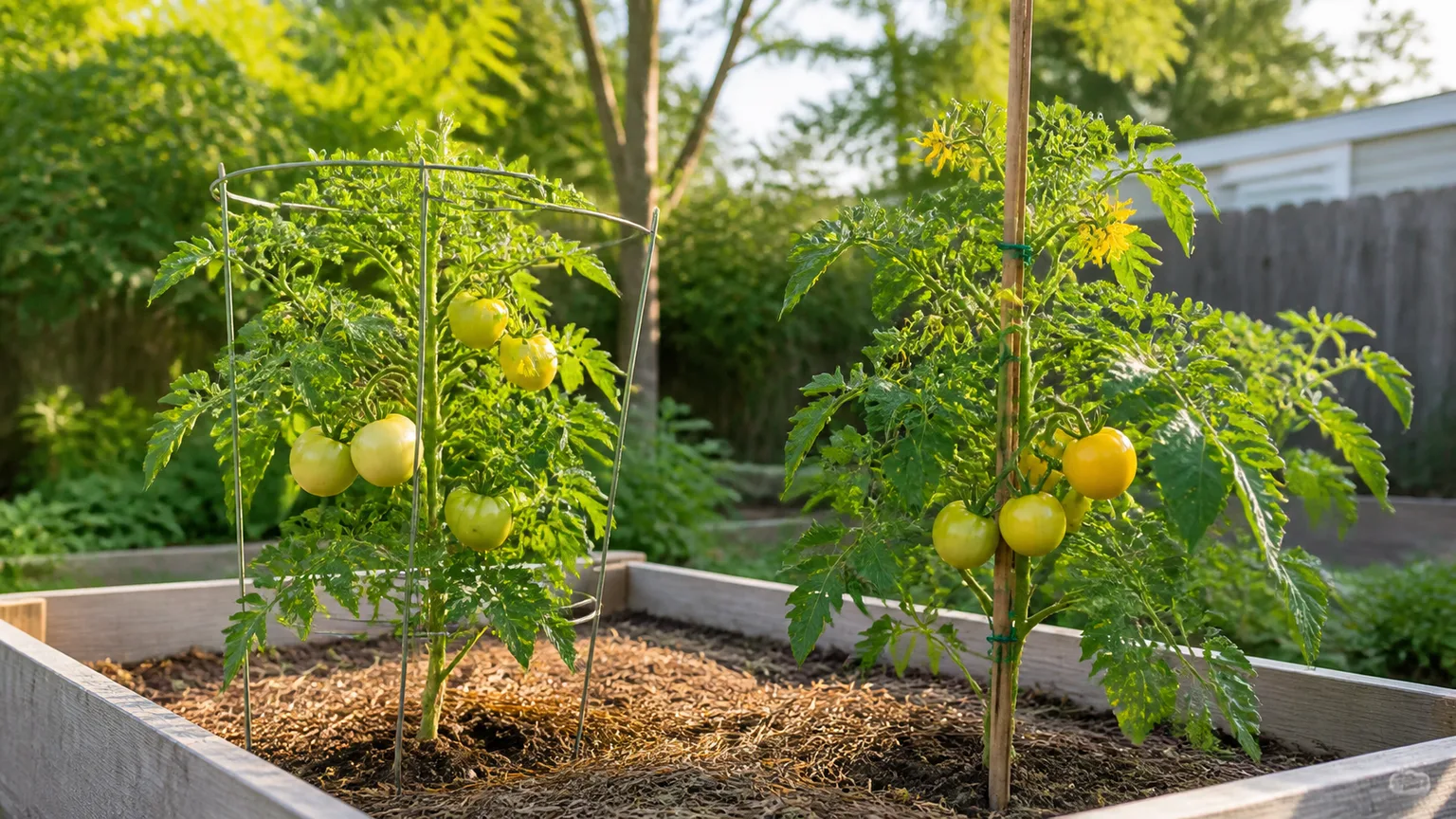
Single staking is a good fit for a compact determinate plant or a gardener who wants a narrow, vertical plant and is willing to check it often. Use wood, bamboo, or metal, but choose a material that will not bow under a wet canopy. Tie the stem loosely at regular intervals, keeping the support on the side opposite the first fruit cluster when possible.
Spiral stakes can reduce the number of separate ties because the main stem is trained through the spiral as it grows. They still need a firm base and may not be enough for a multi-leader plant or a large, heavily fruited indeterminate. If several branches are competing for the same narrow support, add a second stake or move to a cage, tower, or trellis before the branches become woody and difficult to reposition.
Heavy-duty cages and towers
A roomy, strong cage is often the easiest choice for a determinate tomato, a plant you do not want to prune heavily, or a gardener who wants fruit supported from several sides. It lets branches rest on the wire as they grow instead of requiring every stem to be tied to one vertical line. A tower serves a similar purpose for taller plants when it has enough height, diameter, and anchoring to carry the mature canopy.
Avoid the common mistake of judging a cage while it is empty. The light wire cone that holds a young plant upright may not support a large vine with wet leaves and dozens of fruits. Look for thick, weather-resistant wire and openings large enough for your hand. Savvy Gardening’s comparison of tomato supports makes the same practical distinction: compact cages suit smaller plants, while vigorous indeterminates need taller, stronger structures with accessible openings.
Florida weave and trellises for rows
The Florida weave, also called the basket weave, is efficient for a row of tomatoes. Set sturdy end posts and intermediate stakes, then run durable twine along one side of the plants, loop it around each stake, and return on the opposite side so the stems are held between two lines of support. Add another pass as the plants grow.
The Georgia Extension explanation of the Florida weave recommends placing stakes at the ends and between every third or fourth plant, keeping the string taut, and adding passes about 1 to 2 inches apart. Penn State describes a similar system beginning when plants are around 12 inches tall and adding another layer 6 to 8 inches above the previous one after a week or two. In a home garden, you do not need to obsess over a single measurement; the important points are a taut line, strong end posts, and another layer before branches spill out.
A trellis or overhead string system is a better fit when you want to grow tall indeterminate tomatoes vertically for a long season. It can support a row or individual plants, but it must be built before the vines become heavy. The trellis is the load-bearing structure; twine alone will not rescue weak posts or shallow anchors.
4. Anchor the support before the canopy gets heavy
Most support failures start below the soil line. A cage that leans, a stake that pulls sideways, or a Florida-weave end post that bows may be strong enough for a seedling but not for a wet, fruiting plant. Press or drive the support firmly into the ground, then test it with a deliberate push before the plant is attached. If it moves easily, it will move more once the canopy catches wind.
Use the strongest posts at the ends of a row because they carry the tension from every pass of twine. Add an extra stake to a cage in loose soil or pin its base with landscape staples. In a container, the pot is part of the support system: a tall plant can tip the entire container, so choose a wide, heavy pot and anchor the stake deep into the root-free edge of the container rather than relying on a short clip at the rim.
Keep the plant slightly separate from the rigid structure where possible. A small gap protects the stem from rubbing and gives you room to inspect for constriction, disease, and fruit that is pressed against wire. Support should guide the plant’s weight into the ground; it should not clamp the stem in place.
5. Tie and train without strangling stems
Use soft, flexible material: stretchy plant tape, cloth strips, a soft reusable tie, or durable tomato twine used in a loose loop. Avoid bare wire, thin string, or anything that can cut into a swelling stem. Epic Gardening’s review of common tomato-staking mistakes emphasizes that rigid or overtightened ties can wound stems and restrict growth as the plant thickens.
The reliable tie shape is a loose figure eight. Make one loop around the stake and a second loop around the stem, with the crossing point between them. Leave enough slack for the stem to expand and move slightly in wind. The tie should support the plant without pulling the stem hard against the stake. Check it every week during rapid growth; a tie that was loose on Monday can become a damaging band surprisingly quickly.
Start tying when the plant is about 10 to 12 inches tall, then add support roughly every 8 to 12 inches of main-stem growth. These intervals are a guide, not a substitute for looking at the plant. Add a tie sooner if the stem bows under fruit or wind, and add a separate support to a branch whose fruit cluster is pulling it down. Penn State Extension recommends ties at 8- to 12-inch intervals, while Georgia Extension recommends tying a single-staked plant about every 8 inches up the main trunk.
Training is easier when you decide how many leaders the support can carry. A single narrow stake may be manageable with one main stem. A broad cage can accommodate several branches. Do not wait until a branch has wrapped around neighboring plants; guide new growth while it is still flexible, and turn the plant a little at a time rather than forcing a sharp bend.
6. Prune with airflow and fruit shade in mind
Staking and pruning are connected, but pruning is not a race to remove every side shoot. The goal is a plant that the support can carry with enough healthy foliage to feed the crop and shade fruit. Over-pruning can expose tomatoes to intense sun, while under-pruning can leave an indeterminate plant too dense to tie or inspect.
What to remove
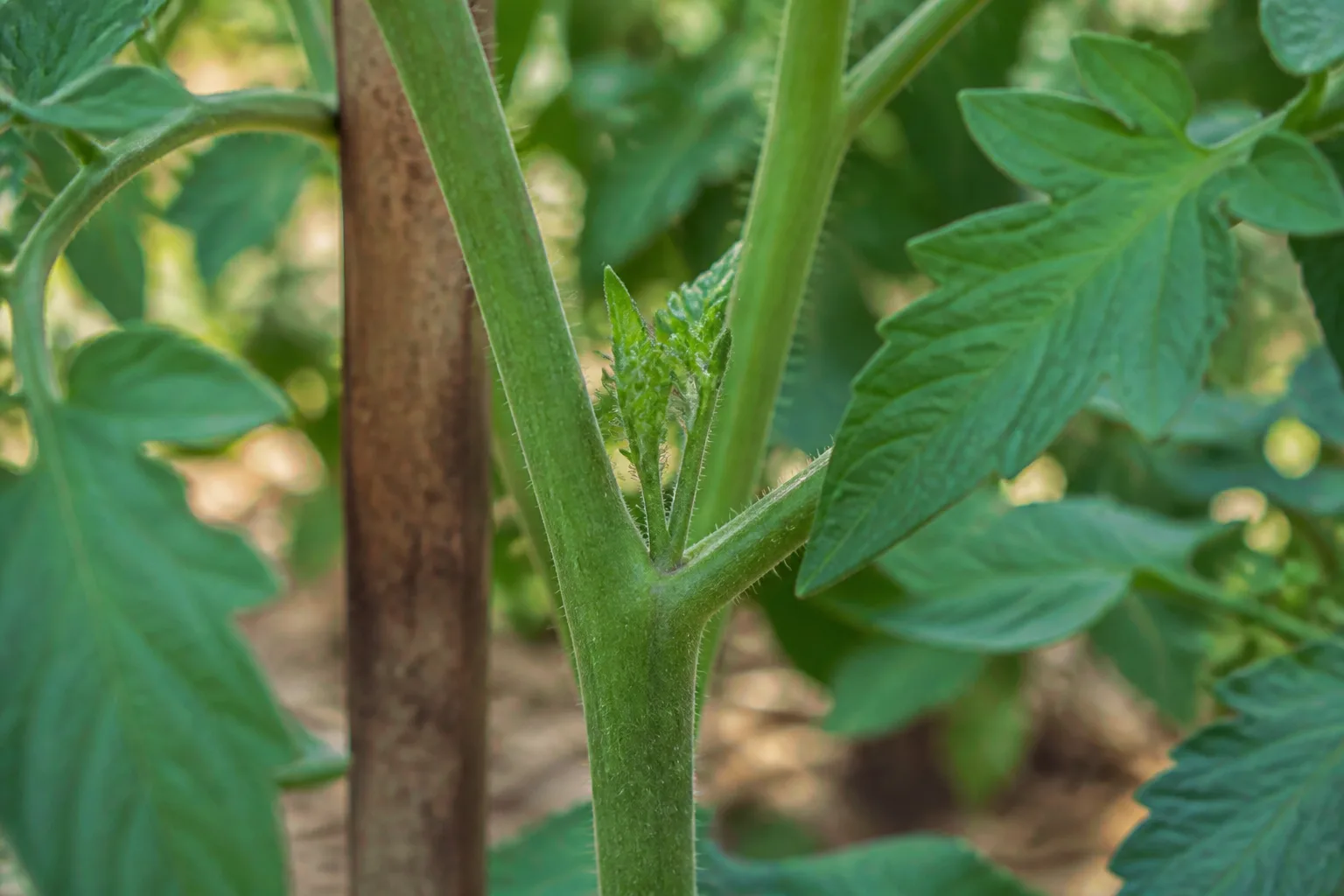
At planting, remove lower leaves or stems that will touch the soil. During the season, remove foliage that is lying on the ground, damaged, or clearly diseased, and take away drooping branches that remain wet or drag against the soil. Removing a few strategically chosen suckers or nonbearing branches from an indeterminate can improve access and airflow and make the leader easier to train.
Use clean, sharp pruners and keep clippings out of the plant’s base. The Georgia Extension guide recommends disinfecting clippers between plants with an alcohol-containing disinfectant, especially when removing diseased tissue. Make cuts on a dry day when practical, and do not turn pruning into a large harvest of green foliage just because the plant looks crowded.
Determinate tomatoes generally need lighter pruning than indeterminate tomatoes. If a determinate plant is inside a roomy cage, remove only soil-touching, damaged, diseased, or truly obstructive growth unless the variety’s instructions say otherwise. For an indeterminate on a single stake, remove selected suckers according to the number of leaders your support can hold. The Penn State tomato guide notes that staked plants are often trained more tightly and require more pruning than caged plants, which is an important trade-off to consider before you choose the method.
What not to remove
Do not strip every leaf below a fruit cluster or expose all ripening tomatoes to full afternoon sun. Leaves make the sugars that fill fruit, and foliage provides shade that can help reduce sunscald. Remove diseased tissue promptly, but preserve a balanced canopy above and around healthy fruit.
Do not assume a stake automatically makes aggressive pruning safe. A plant with fewer leaves may be easier to tie and may dry faster after rain, but it can also have less capacity to support fruit and protect it from heat. If you are growing a large-fruited variety in a hot, bright site, favor a sturdy cage or multi-sided support that lets you keep more foliage while still lifting the plant off the ground.
Keep spacing, watering, and tool hygiene working with the support
Support cannot compensate for plants packed so tightly that leaves stay wet all day. Give each plant enough room for the selected structure and for your hand to reach fruit, ties, and lower leaves. Penn State suggests closer spacing for staked tomatoes than caged ones because trained plants take up less horizontal space, but do not use close spacing as an excuse to create a solid wall of foliage. Air must still move between plants.
Water the soil rather than spraying the leaves, and water consistently enough to avoid a cycle of severe drying followed by flooding. Mulch can limit soil splash onto lower leaves and help the root zone hold moisture, while morning watering gives foliage that does get wet more time to dry. Staking is one part of a disease-conscious routine: it lifts leaves and fruit, but it cannot undo overhead irrigation or a chronically waterlogged bed.
Clean pruners between plants, remove diseased clippings from the bed, and sanitize reusable stakes or cages at the end of the season. Penn State notes that a Florida-weave system can be easier to sanitize than wire cages, while Georgia Extension emphasizes removing clippings and cleaning tools to avoid carrying problems from one plant to another. Store ties and structures dry so they are ready before the next transplanting day.
Troubleshoot a leaning, split, or broken tomato plant
The whole plant is leaning. Check the support before tying more tightly. If the stake is shallow or the cage is lifting, stabilize the structure first with a deeper post, a second stake, or a ground anchor. Then bring the plant upright in stages, starting with the lowest safe tie. Tightening a tie around a moving support only transfers the problem to the stem.
The top is falling over the cage. The support is probably too short, too narrow, or both. For a determinate plant that has reached its normal size, add a horizontal brace or a second support without removing healthy foliage. For an indeterminate, redirect the new growth onto a taller tower or trellis if possible. If the variety will always outgrow the structure, replace the support next season rather than repeatedly cutting the plant back to fit.
A branch is cracking under fruit. Support the branch separately with a soft tie or sling connected to a nearby cage wire, stake, or trellis line. Do not cinch the tie at the fruit cluster. If the break is partial, position the branch gently and reduce additional stress; if it is fully severed or diseased, remove it cleanly and keep the cut material out of the bed.
The stem has a groove where the tie sits. Cut or loosen the tie immediately and replace it with a wider, flexible loop. A constriction can worsen as the stem thickens. Inspect every tie during harvest rounds, not only on scheduled garden days.
The plant is upright but leaves stay wet and disease is spreading. Look beyond the stake. A dense canopy, crowded spacing, overhead watering, soil splash, or infected lower leaves may be the real bottleneck. Remove only the damaged or obstructive tissue you can justify, improve watering technique, and keep the support open enough for air to move through the plant.
A cage or trellis worked last year but fails this year. The plant, soil, and weather may have changed. A larger variety, wetter canopy, loose soil, or a windier position can turn a previously adequate structure into an undersized one. Treat the support as seasonal infrastructure: inspect it before transplanting, reinforce weak points, and size it to this year’s plants rather than to the smallest plant it held before.
Conclusion
The best support is the one you install early, anchor firmly, and can maintain without damaging the plant. Match a modest cage or stake to a determinate tomato, give an indeterminate a taller and stronger structure, and use a Florida weave or trellis when a row makes shared support more efficient.
Then keep the system alive through the season: add soft ties before branches droop, check for constriction, prune only what improves access and airflow, and preserve enough foliage to shade fruit. Those small, repeated decisions prevent the most common failures—root damage from late staking, toppled supports, broken stems, and a tomato plant that outgrows its garden before the harvest is ready.