12 North American Sumac Trees and Shrubs
Twelve native sumac trees and shrubs for fall color, wildlife, and tough sites — plus how to tell safe red-berry sumacs from poison sumac and tree of heaven.
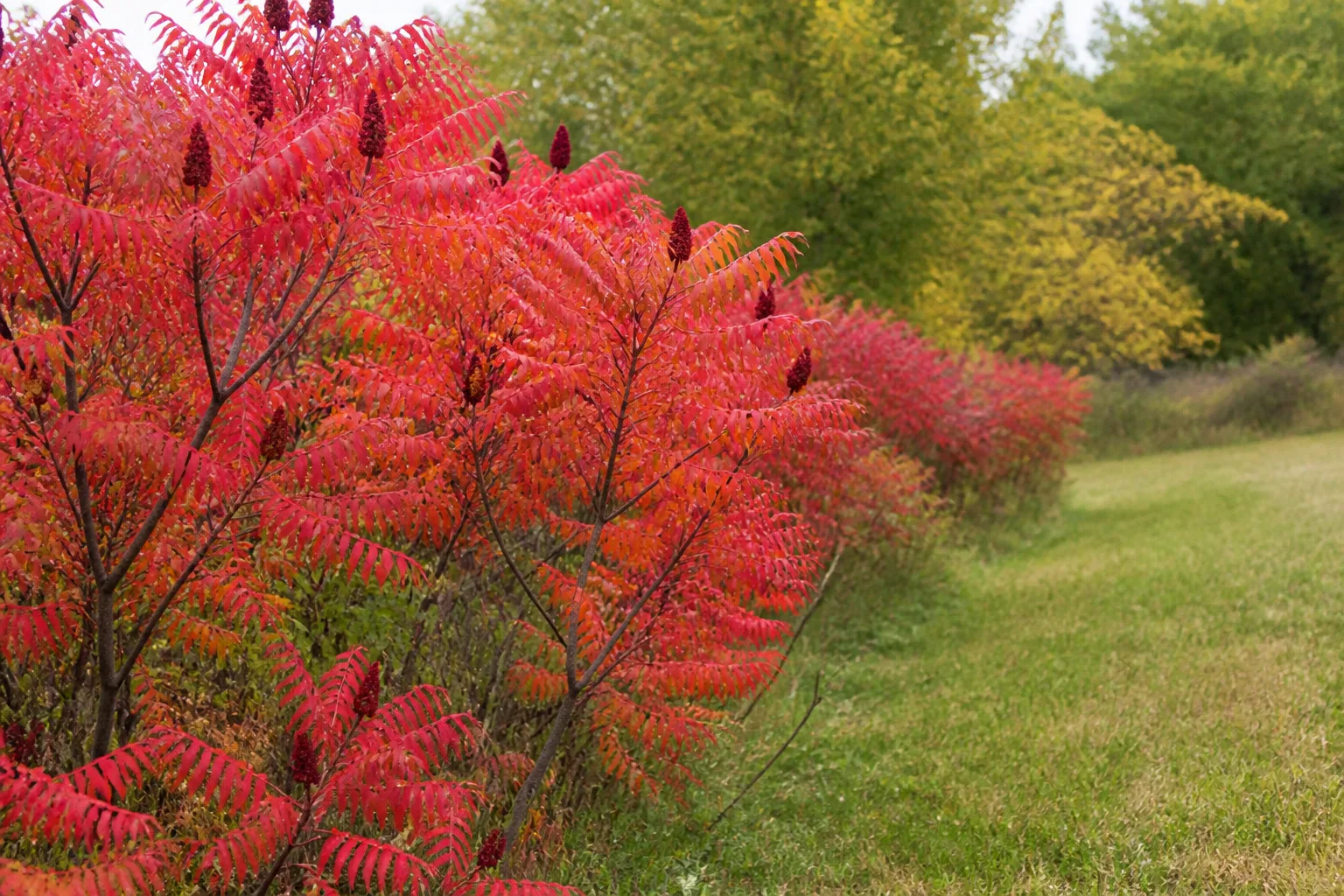
Sumac trees and shrubs in the Rhus genus are some of the most underrated native plants in North American landscaping — brilliant autumn color, winter-persistent red fruit clusters, drought tolerance, and serious value for bees and birds. They also share a family with cashews, mangoes, and the plants that cause poison-ivy rash, which makes identification the first job before you put any sumac near a patio or play area.
The twelve species below are all native to North America. Several popular online lists mix in Rhus coriaria (Mediterranean tanner’s sumac used in spice blends) — that plant is valuable in its own right but is not a North American native, so it is omitted here in favor of Rhus choriophylla (Mearns sumac), a southwestern native many eastern lists skip entirely.
What Makes Sumac Different From Poison Ivy and Poison Sumac
Ornamental and native sumacs (Rhus) are not the same plants as poison sumac (Toxicodendron vernix) or poison ivy (Toxicodendron radicans). Botanists moved the toxic species out of Rhus decades ago, but the old names still confuse gardeners — especially when both groups produce compound leaves and grow in similar edge habitats.
Touching healthy Rhus foliage does not cause the classic poison-ivy rash for most people. NC State Extension notes that staghorn sumac (Rhus typhina) is not poisonous, though it can spread aggressively by suckers. The CDC still warns that workers handling poison ivy, poison oak, and poison sumac should expect urushiol dermatitis — another reason to confirm identity before pruning anything with compound leaves near a wetland edge. (NC State Extension) (CDC NIOSH)
Red Berries Versus White Berries
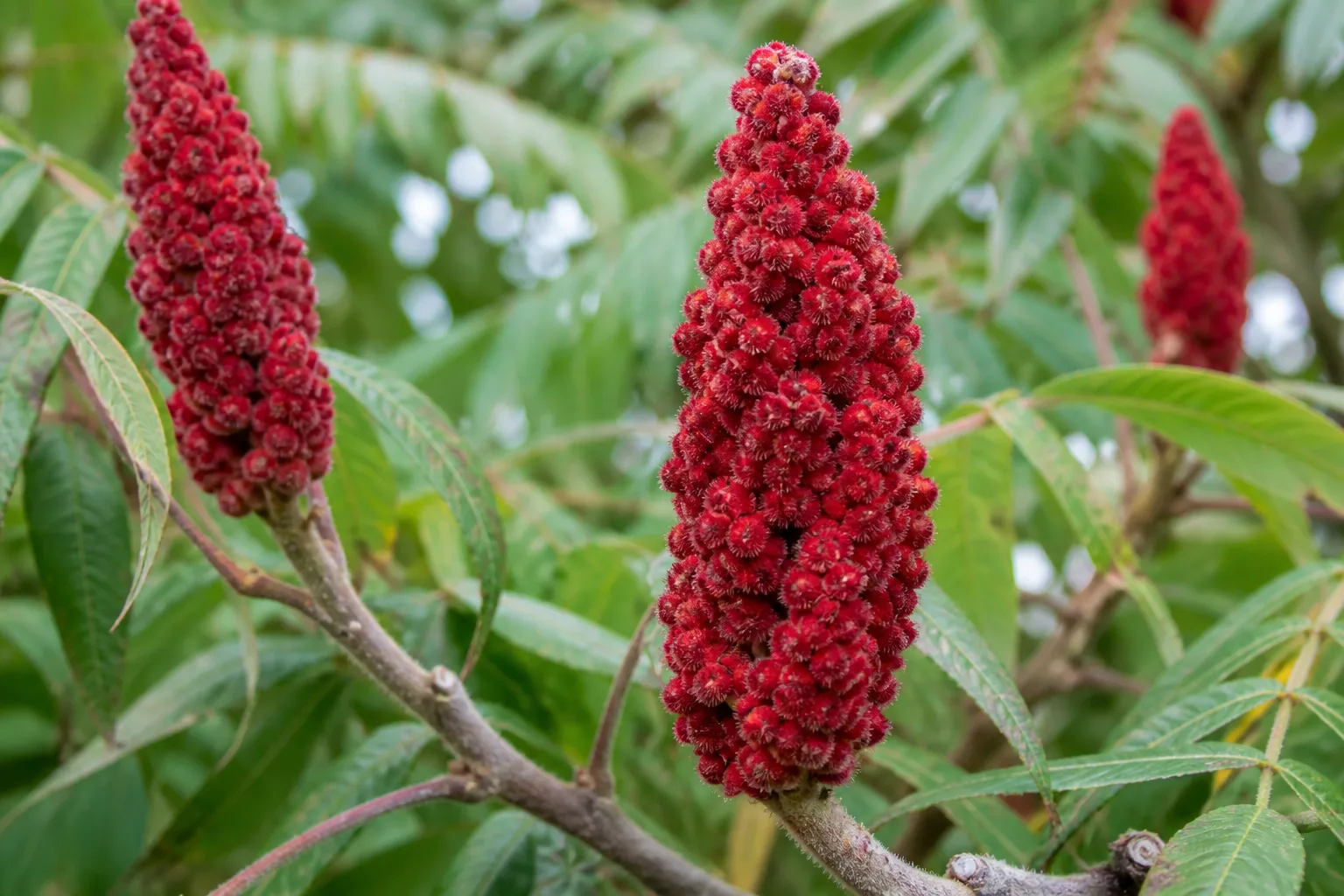
The fastest field rule on a sunny trail: safe ornamental sumacs carry dense clusters of red drupes that ripen in late summer and often persist into winter. Poison sumac fruits are whitish-gray and hang in loose clusters on plants that favor wet, acidic soils — bogs, swamps, and shaded shrub swamps — not the dry roadside banks where staghorn and smooth sumac thrive.
If you are unsure, do not taste fruit or touch sap on unknown plants. Photograph the fruit color, leaf arrangement, and habitat, then compare before planting near children or pets.
Leaf Patterns That Separate Look-Alikes
Tree of heaven (Ailanthus altissima) is the other common look-alike, especially for staghorn sumac’s tall compound leaves. Ohio State’s Buckeye Yard and Garden onLine (BYGL) contrasts them this way: sumac flowers in upright, cone-shaped greenish clusters that become tight red berry heads; tree of heaven produces orange-brown, drooping, malodorous flower panicles followed by papery samaras (winged seeds), not red drupes. Sumac leaflets are typically toothed; tree-of-heaven leaflets often show one or more glandular notches near the base. (Ohio State BYGL)
NC State Extension explicitly lists tree of heaven as a plant commonly confused with staghorn sumac — worth checking any “sumac” volunteer that appears after disturbance. (NC State Extension)
How to Choose a Sumac for Your Yard
Sumacs are not interchangeable. Some colonize dry slopes within three seasons; others stay low enough for a foundation hedge if you prune suckers. Start with three filters:
Match Zone, Space, and Suckering Tolerance
USDA zone narrows the list quickly — evergreen and lemonade berry sumacs need warm Southwest or coastal climates (roughly zones 8–10), while smooth and staghorn sumacs handle cold to zone 3. Mature height and spread matter because many species routinely reach 15–25 feet if left alone. Suckering tolerance is the decision most suburban lots get wrong: if you cannot mow a 10-foot buffer around the plant, choose fragrant sumac, a clumping cultivar like ‘Tiger Eyes’, or keep sumac on a back slope where colonizing roots stabilize soil instead of swallowing lawn.
Best for large naturalized areas: smooth, staghorn, winged, prairie flameleaf. Best for smaller beds with maintenance: fragrant sumac, skunkbush, sugar sumac (with annual sucker patrol). Best for dry Southwest firewise slopes: lemonade berry, littleleaf, evergreen, Mearns sumac. Leave in the wild: Michaux’s sumac — endangered and rarely appropriate for casual garden digging.
Managing Sumac Spread Before It Becomes a Problem
Most Rhus species spread by root suckers and, on female plants, self-seeding from bird-distributed fruit. That is a feature on a highway embankment and a headache next to turf.
Before planting, decide whether you want a thicket or a single specimen. For a specimen, install root barrier around the drip line (18–24 inches deep in heavy clay may need professional trenching) or plan to mow suckers monthly through the growing season. Cutting a sucker and painting the fresh cut with a brush-killer labeled for woody stems (following the product label exactly) can slow re-sprouting on problem shoots without spraying the whole colony.
Renovate leggy colonies by cutting stems to the ground in late winter — staghorn and smooth sumac respond with vigorous fresh growth and better fall color on new wood, according to NC State Extension. (NC State Extension) Remove unwanted seedlings in spring while roots are shallow. Never compost fruit heads if you are trying to limit spread — bag and trash them instead.
Smooth Sumac (Rhus glabra)
Smooth sumac is the workhorse colonizer of prairies, roadsides, and clearings across much of eastern and central North America. It differs from staghorn sumac by smooth, hairless young stems (staghorn stems feel velvety). Pinnate leaves carry 11–31 toothed leaflets that turn scarlet-orange in fall.
Expect 9–15 feet in height, USDA zones 3–9, and full sun to part shade. It excels at erosion control and wildlife cover but is rarely sold as a tidy foundation plant because it will form thickets. Pair it with intentional boundaries — pavement, mowed strips, or deep shade on one side — rather than hoping it stays put.
Staghorn Sumac (Rhus typhina)
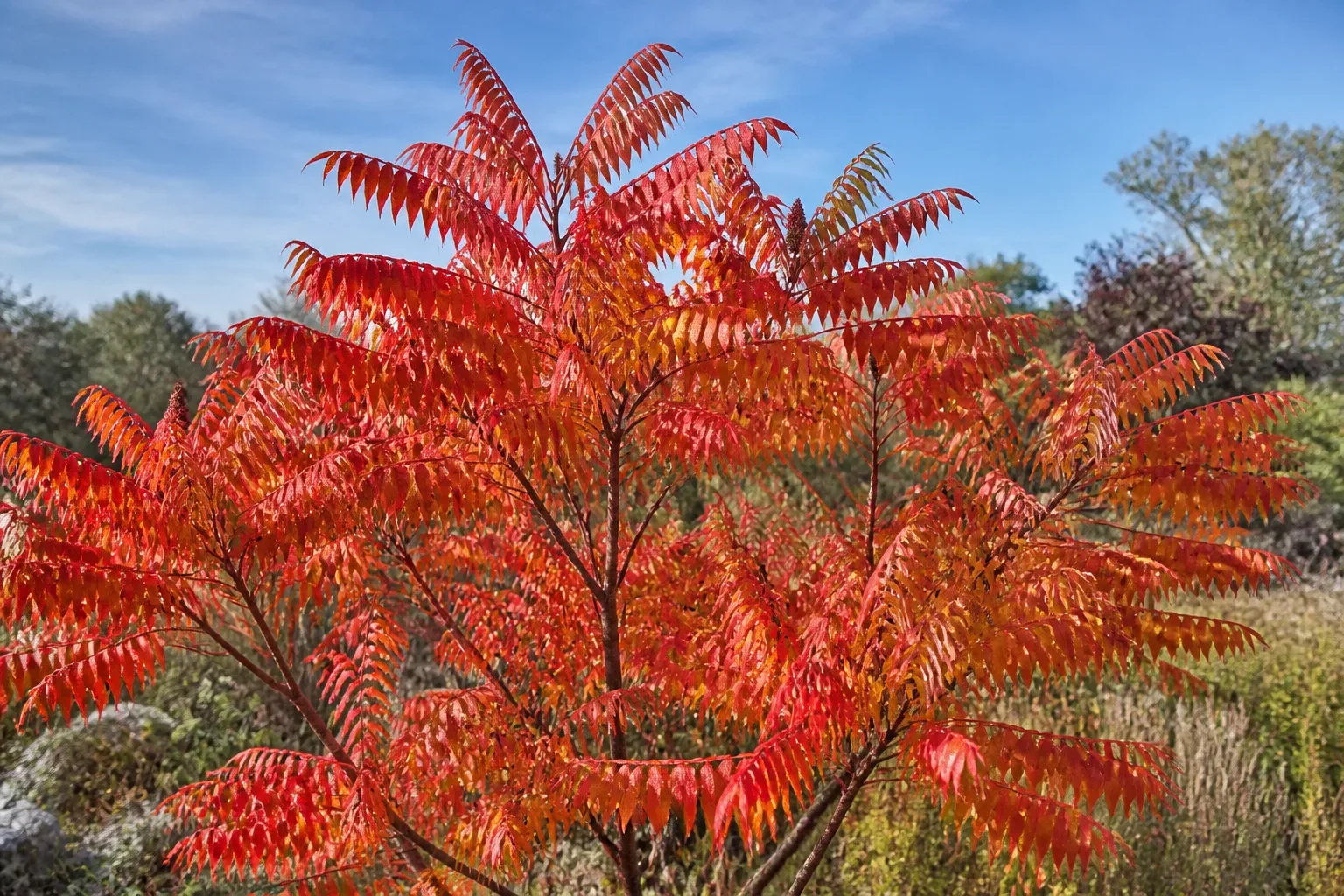
Staghorn sumac is the showiest eastern native, named for velvety, antler-like hairs on young branches. It is dioecious — male and female flowers on separate plants — so plant several if you want the iconic crimson winter fruit clusters; one female among males is enough for fruit set.
Missouri Botanical Garden lists mature size at 15–25 feet tall and wide, USDA zones 3–8, with scarlet-yellow-orange fall foliage and tolerance of poor, dry, urban soils when drainage is decent. (Missouri Botanical Garden) Cultivars matter here: ‘Tiger Eyes’ offers golden cutleaf foliage with reduced suckering compared to the species — a strong pick when you want the look without a meadow takeover. ‘Laciniata’ and ‘Dissecta’ bring ferny leaves but can still spread; read the tag and plan barrier or mowing.
Female fruit clusters soak into a tart, pink “sumac-ade” when rinsed in cool water — never use unripe or rain-washed berries that lost flavor to leaching.
Winged Sumac (Rhus copallinum)
Winged sumac — also called flameleaf or shining sumac — is a multi-stem shrub of dry, open eastern woods and old fields. Its leaf stalks carry narrow “wings” between leaflets, an easy ID cue smooth and staghorn lack. Leaves have 9–21 untoothed, glossy leaflets turning bright red in autumn.
Height typically 7–15 feet, zones 4–9, full sun to part shade. Like smooth sumac, it is for large areas where colonizing is welcome — not small suburban islands surrounded by lawn.
Fragrant Sumac (Rhus aromatica)
If you need sumac behavior in a small footprint, start here. Fragrant sumac stays 2–6 feet tall, spreads lower and slower than tree-form species, and offers trifoliate leaves that smell citrus-spicy when crushed — a reliable scratch-and-sniff ID test.
Zones 3–9, full sun to part shade, excellent for slopes, informal hedges, and dry banks. Cultivars like ‘Gro-Low’ are widely planted as ground-covering natives. Fall color runs orange-red-purple. Birds eat the red drupes; bees work early spring flowers.
Evergreen Sumac (Rhus virens)
Evergreen sumac — sometimes called tobacco sumac — is a Southwest native with glossy, mostly evergreen leaves that pinken in spring, green in summer, and bronze after frost. It reaches 6–8 feet, zones 8–10, and tolerates drought and reflected heat once established.
Use it as an informal screen or pruned small tree in xeriscapes. Only female plants bear clusters of red berries. It is slower to colonize than eastern thicket formers but still sends suckers — maintain a mulched border if it sits near a path.
Lemonade Berry (Rhus integrifolia)
Lemonade berry is a coastal Southern California and Baja native with simple, leathery, waxy leaves — not the pinnate look most people picture as “sumac.” Red fruits are tart enough to flavor drinks; wildlife consumes the rest.
Up to 10 feet, zones 8–10, full sun to part shade, drought-tolerant and noted for fire-resistance in wildland-urban interface plantings when sited on slopes. Growth is slower and less aggressively suckering than eastern species — a good warm-climate alternative when you want sumac fruit without a thicket in five years.
Littleleaf Sumac (Rhus microphylla)
Littleleaf or desert sumac is a compact, multi-branched shrub of the Southwest and northern Mexico. Small pinnate leaves, white spring flowers before leaf-out, and orange-red fruit distinguish it on dry hillsides.
Up to 6 feet, zones 6–10, full sun. Autumn color is muted purple-rose rather than blazing scarlet. Excellent pollinator and bird plant for desert gardens where larger sumacs would scorch.
Michaux’s Sumac (Rhus michauxii)
Michaux’s sumac is a rare, low shrub (often 1–3 feet) of sandy openings in the Southeast. Extremely hairy stems and small stature separate it from poison sumac despite superficial resemblance — hence the old name “false poison sumac.”
It is endangered in much of its native range. Do not collect from the wild. If you encounter it on protected land, appreciate it in place rather than transplanting. Landscape use is limited to specialized native restoration with appropriate permits — not a casual nursery pick for home beds.
Prairie Flameleaf Sumac (Rhus lanceolata)
Prairie flameleaf sumac serves central North American prairies and oak openings where staghorn is absent. Lance-shaped leaflets (13–17 per leaf) turn bright red-orange; fruit is dark red and heavily eaten by birds.
Up to 20 feet, zones 6–8, full sun to part shade. It works as a small specimen tree for autumn color in the southern Great Plains when you want sumac drama with a narrower native range than smooth sumac.
Skunkbush Sumac (Rhus trilobata)
Skunkbush sumac — also called three-leaf sumac — is a western native with trifoliate, lobed leaves that smell pungent when bruised (the “skunk” name). Low, spreading habit 2–3 feet in harsh sites, taller with moisture, zones 4–6 in its core range though it stretches wider in cultivation.
Plant it for windbreaks, erosion control, and autumn yellow-to-orange-red color on dry plains and foothills. Some selections are sold under friendlier cultivar names; species form can naturalize — check regional invasive guidance before planting outside its native West.
Mearns Sumac (Rhus choriophylla)
Mearns sumac is a Southwestern native — Arizona, New Mexico, and northern Mexico — that eastern listicles often skip. It forms a rounded shrub 3–8 feet tall with small, leathery, pinnate leaves that stay evergreen in mild winters and turn red in cold snaps.
Zones 7–10, full sun, extreme drought tolerance once established. Yellow spring flowers give way to sticky red fruit wildlife eats. Suckering is moderate compared to eastern thicket formers — useful for desert washes and rocky slopes where smooth or staghorn sumac would not survive the heat.
Sugar Sumac (Rhus ovata)
Sugar sumac is an evergreen to semi-evergreen shrub or small tree of Arizona, southern California, and Baja. Large, simple, leathery leaves and sticky reddish fruit give it the “sugar bush” name — Native Americans used the fruit as a sweetener, though other plant parts can irritate sensitive skin (Anacardiaceae caution applies).
4–10 feet, zones 7–11, full sun to part shade, drought-tolerant once rooted. Shear for formal shape or allow multi-stem thickets on banks. Good warm-climate screen when lemonade berry is too coastal.
Sumac for Wildlife, Pollinators, and Erosion Control
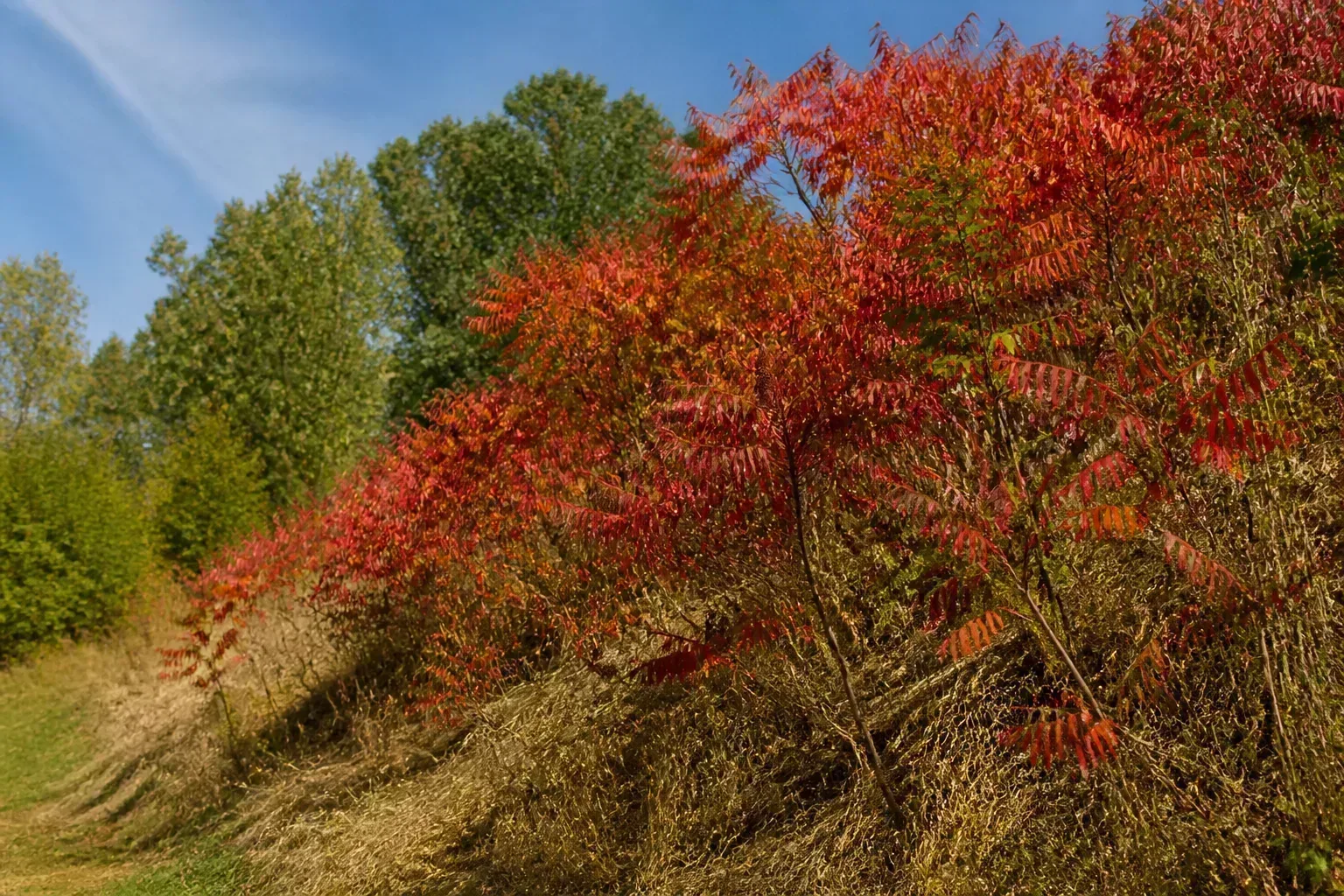
Sumacs punch above their weight ecologically. NC State Extension lists staghorn sumac as a nectar source for native bees and notes fruit eaten by quail, turkey, and songbirds, with larval hosting for luna moth and spring azure butterfly. (NC State Extension)
Colonizing root systems bind disturbed slopes, cut banks, and pipeline rights-of-way where turf fails. That same colonizing habit demands planning in mixed borders — treat sumac as infrastructure planting, not filler between hostas.
Kitchen note: Eastern red-berry sumacs yield a sour drink when fruit heads are soaked in cool water and strained — never boil, which releases bitter tannins. Middle Eastern ground sumac spice traditionally comes from Mediterranean Rhus coriaria, not native U.S. species, though foraged red drupes can be dried for home use when identified with the red-fruit rule above.
Conclusion
North American sumacs reward gardeners who match species to site and respect their suckering nature. For maximum fall drama on a large lot, staghorn or smooth sumac — with mowing boundaries — is hard to beat. For small yards, fragrant sumac or the ‘Tiger Eyes’ cultivar delivers color with less chaos. For Southwest dryness, evergreen, lemonade berry, littleleaf, or sugar sumac fit climate and firewise goals.
Identify before you plant: red berry clusters, correct habitat, and none of poison sumac’s white drupes. Manage spread early with barriers and sucker removal, and you get native structure, pollinator support, and some of the boldest autumn red outside a maple grove — without handing your back corner to tree of heaven by mistake.



