5 Different Fluorescent Tube Sizes and How to Choose
Compare T2, T5, T5HO, T8, and T12 fluorescent tube sizes, then match length, pins, ballast, brightness, and color before you buy.
If you are replacing a fluorescent lamp, do not order the first tube that looks the same in a photograph. A correct replacement has to match the tube family, physical length, pin base, wattage, ballast, and intended use. A tube can share a pin spacing with another lamp and still be the wrong electrical match.
The useful shortcut is to treat the label on the old lamp as a specification, not a suggestion. Find the code printed near one end, photograph it before removing the tube, and use the guide below to decode what matters. If the label is missing, measure the tube and inspect the fixture label, but do not guess the ballast from diameter alone.
Why the T number is not the whole tube size
The phrase “fluorescent tube size” hides two different measurements. The T number describes the tube’s diameter, while the length, end-cap design, electrical rating, and fixture determine whether it is a usable replacement. That distinction explains why a short T5 and a long T5 are the same diameter but not the same lamp, and why a T8 and T12 may share a cap yet need different operating conditions.
What T2, T5, T8, and T12 mean
The T stands for tubular. The number that follows is the diameter in eighths of an inch: T2 is 2/8 inch, T5 is 5/8 inch, T8 is 8/8 inch, and T12 is 12/8 inch. In practical measurements, that is about 1/4 inch (6.35 millimeters), 5/8 inch (15.9 mm), 1 inch (25.4 mm), and 1 1/2 inches (38.1 mm), respectively. This eighths-of-an-inch convention is also used in the standard T-type families described by RS Online.
T2 is often encountered in compact fluorescent lamps rather than a traditional shop-light tube. T5, T8, and T12 are the familiar straight linear families, although each family has several lengths and wattages. “T5” is therefore a diameter label, not a promise that every T5 lamp has the same output or will fit every slim fixture.
Why diameter alone is not enough
Diameter is the first filter because the glass has to clear the fixture and the pins have to reach the correct lampholders. It is not the final filter because length controls socket spacing, the cap controls the contact geometry, and the ballast controls the current and starting sequence.
There is a second trap: the number printed in a lamp code may include more than the T designation. A code such as F32T8 points to a fluorescent lamp associated with a nominal 32-watt rating and a T8 diameter, but the complete product code, length, ballast listing, and color code still matter. Product families also use metric nominal lengths, imperial nominal lengths, reduced-wattage versions, energy-saving versions, and high-output versions.
Use the old lamp or fixture label whenever possible, and use measurements to confirm rather than replace those specifications.
The five common fluorescent tube sizes
These are the five types most often grouped together in household, workshop, office, and indoor-growing discussions. They are not ranked from best to worst; each is a different combination of diameter, output, fixture design, and age of installation.
| Tube family | Approximate diameter | Where it is commonly encountered | Main caution |
|---|---|---|---|
| T2 | 1/4 in. / 6.35 mm | CFLs, compact task lamps, specialty small fixtures | Often has a screw-in CFL base or a nonstandard compact fitting |
| T5 | 5/8 in. / 15.9 mm | Slim under-cabinet lights, plant shelves, shallow fixtures | Usually needs a T5-specific electronic ballast and G5 pins |
| T5HO | 5/8 in. / 15.9 mm | High-output plant fixtures and commercial slim luminaires | High output is a separate lamp/ballast system, not a drop-in brightness setting |
| T8 | 1 in. / 25.4 mm | Offices, schools, garages, workshops, general linear fixtures | T8 and T12 can share G13 pins but are not automatically interchangeable |
| T12 | 1 1/2 in. / 38.1 mm | Older shop lights, warehouses, and legacy fixtures | Bulky, less efficient, and commonly paired with older magnetic ballasts |
T2 fluorescent tubes
T2 is the smallest family in this five-type comparison. You will see it most often inside a compact fluorescent lamp (CFL), where a narrow tube is folded or coiled and a ballast is built into the screw-in base. In that form, the lamp goes into a normal household socket, so it is a different replacement problem from a two-pin linear tube.
Straight T2 lamps also appear in compact task-lighting fixtures. Their advantage is a small profile when a full-width linear lamp would be awkward, such as a narrow display, craft, or sewing light. Their small diameter does not mean they are universal: the base, overall shape, and integrated or external ballast still have to match.
If an old lamp screws into an E26 or E27-style socket, do not buy a G5 or G13 linear tube simply because its glass looks similar. If it has a compact plug-in base, read that base code and the fixture label. T2 is best understood as a narrow lamp family that often arrives in compact formats, not as a direct substitute for every other narrow fluorescent tube.
T5 fluorescent tubes
T5 lamps are 5/8 inch in diameter and were designed for slim fixtures that need a lot of light in relatively little space. They are common in shallow under-cabinet fixtures, dedicated plant shelves, display lighting, and commercial luminaires with electronic ballasts. Most straight T5 lamps use the smaller G5 bi-pin base, with the pins 5 millimeters apart.
The most important T5 detail is that its nominal length does not behave exactly like a T8 or T12 length. Many T5 systems use metric-based lamp lengths and fixture dimensions, so a lamp that is described casually as “four feet” may not have the same end-to-end measurement as a nominal 48-inch T8. Measure the old lamp and the socket spacing, then compare the manufacturer’s dimensional drawing.
T5 is a strong option when you are maintaining a dedicated slim fixture or a compact seed-starting shelf. It is not automatically the right option for retrofitting an older shop light. A T5 lamp generally belongs in a T5 fixture with a ballast designed for that lamp family.
T5HO fluorescent tubes
T5HO means T5 high output. It keeps the T5 diameter but uses a different high-output lamp and ballast system to deliver more light from the fixture. That makes it popular for seed trays, cuttings, herbs, and other close-canopy growing setups. A current T5HO horticultural fixture listing, for example, pairs its lamps with an electronic ballast and specifies different wattages for 18-, 24-, 36-, and 48-inch versions rather than treating every T5HO as one universal lamp. Greenhouse Megastore
The word “high output” is where many replacements go wrong. You cannot safely turn an ordinary T5 fixture into a T5HO fixture by buying a brighter-looking tube. The ballast, lamp wattage, wiring, thermal conditions, and reflector are designed as a system. Use T5HO only when the fixture label or the ballast documentation calls for the high-output lamp.
For plants, T5HO is useful over a relatively flat canopy, but the center may receive much more light than the edges. A reflector, level shelf, and adjustable chains matter as much as the tube family.
T8 fluorescent tubes
T8 lamps are 1 inch in diameter and are probably the most recognizable linear fluorescent format in offices, schools, garages, and general-purpose shop fixtures. Standard T8 linear lamps usually use the G13 medium bi-pin base, meaning the two pins at each end are 13 millimeters apart. Common nominal lengths include 2, 3, and 4 feet, with additional lengths and wattage families available.
T8 is often the sensible like-for-like replacement when an existing fixture is clearly labeled T8 and its ballast is still serviceable. It generally offers a slimmer, more efficient alternative to an older T12 system, but “T8” alone does not identify the wattage, start method, color, or exact length. A 32-watt, 4-foot T8 is not interchangeable with every other 4-foot T8 lamp.
T8 lamps also show up in plant shelves and seed-starting racks. They can give even, diffuse coverage across a tray, but the fixture needs to be close enough to the canopy and wide enough to cover the edges. For a living-room plant, choose based on the fixture and desired appearance; for seedlings, inspect coverage and height before you focus on the color label.
T12 fluorescent tubes
T12 lamps are the largest of these five at 1 1/2 inches in diameter. They are strongly associated with older shop lights, industrial fixtures, and warehouse installations. Many use the same G13 pin spacing as T8 lamps, which is why the two families can appear physically interchangeable at a glance.
That shared cap is not a license to swap them. T12 lamps have different electrical characteristics and are commonly paired with older magnetic ballasts. If the fixture was built for T12, read the ballast label before trying a T8 lamp. If the ballast is noisy, the fixture flickers, or replacement lamps are becoming difficult to find, a planned fixture retrofit may be more sensible than repeatedly buying legacy tubes.
T12 can still make sense as a documented like-for-like repair when the fixture is sound and the correct lamp is available. It is usually a poor choice for a new plant shelf or room installation.
Match length, cap, and tube shape to the fixture
Once you know the T family, match the physical envelope. Measure the glass from end to end without counting the metal pins, but also measure the distance between the inside faces of the lampholders. Nominal length is a useful shopping label; socket spacing is the reality that determines whether the lamp can seat.
Do not assume that two lamps with the same nominal length are identical. Some compact and T5 systems use metric lengths, some linear lamps are slightly shorter than the name suggests, and some fixtures are built around a specific end-cap arrangement. When an old tube is still intact, photograph the printed code and both ends before removing it.
Then confirm the shape. A straight linear tube belongs in a straight linear fixture. Circular and U-shaped lamps may use different diameters, different overall dimensions, and different bases; they are not interchangeable with a straight lamp just because they share a T number. A CFL may use a screw-in base with an integral ballast rather than pins at all.
G5 versus G13 bi-pin bases
The base code describes the pin arrangement. G5 is the small bi-pin base normally associated with straight T5 lamps. G13 is the larger-spaced bi-pin base commonly associated with T8 and T12 linear lamps. The letter-and-number code tells you about the cap geometry, not the lamp’s complete electrical compatibility.
This is the T8/T12 trap in one sentence: both may have a G13 base, but the ballast and wattage still need to match. A pin can enter a socket while the lamp operates poorly, fails to start, overheats the system, or shortens the life of the lamp and ballast. Treat the base as a physical checkpoint and the ballast label as a separate electrical checkpoint.
Some fixtures use single-pin, recessed double-contact, four-pin circular, or compact plug-in bases. If the end of the old lamp does not look like a normal G5 or G13 cap, stop relying on a generic size chart and match the exact base code printed on the lamp or fixture.
Ballast compatibility is the electrical deal-breaker
A fluorescent tube does not normally regulate its own current the way a simple incandescent filament does. The ballast starts the discharge and limits current while the lamp operates. That is why a bulb aisle’s diameter and length are not enough to identify a safe replacement.
Read the ballast label inside the fixture, often behind the diffuser or reflector. Look for the lamp families it supports, the number of lamps, input voltage, wattage combinations, and start type. A ballast may list codes such as F32T8, F40T12, or F54T5HO. Those details are more valuable than a retailer’s broad description such as “works with 4-foot fluorescent tubes.”
Magnetic, electronic, and start-type differences
Older T12 fixtures often use magnetic ballasts, sometimes with a separate cylindrical starter. Many T5 and newer T8 systems use electronic ballasts that start the lamp differently and operate at a higher frequency. Electronic ballasts can reduce audible hum and visible flicker, but only when paired with lamps in their listed range.
Start type matters too. Preheat systems use a starter and may take a moment to come on, while rapid-start, programmed-start, and instant-start systems use different electrode-heating and starting sequences. Do not add or remove a starter as a guess; use the fixture’s wiring diagram and ballast instructions.
If the new lamp has the correct diameter and cap but flickers, glows only at one end, or fails to start, check in this order: seat the pins correctly, confirm the lamp code and length, inspect the starter if the fixture has one, and verify the ballast’s listed lamp family. A fresh tube will not fix a ballast that is failing. GrowVeg’s fluorescent maintenance guidance also flags darkened ends, dimness, and persistent flicker as reasons to inspect the ballast rather than repeatedly swapping lamps. GrowVeg
Ballast replacement is a wiring job, not a routine bulb change. If the label is unreadable, the fixture has heat damage, or you are not comfortable isolating the circuit, stop and use a qualified electrician.
How to identify the tube you already have
Use this sequence before you shop:
- Turn the light off and let it cool. If you will open a hardwired fixture or touch ballast wiring, switch off the circuit at the breaker and verify that it is de-energized.
- Photograph the lamp label. Look near either end for a code containing F, T, a number, wattage, length, color, or a manufacturer’s model number.
- Read the fixture and ballast labels. The ballast is often the decisive source for lamp family and wattage. Record the exact text rather than only the brand.
- Measure the glass length without the pins. Compare it with the fixture’s socket spacing and the replacement’s dimensional specification.
- Measure the diameter. A ruler is enough for T8 versus T12; a caliper helps with slim T2 and T5 tubes. Convert the result to the nearest T family only as a cross-check.
- Inspect the base and shape. Confirm G5, G13, screw-in CFL, circular, U-shaped, or another cap arrangement.
Take the old lamp or a clear photo to a lighting supplier if any part of the code is missing. Do not test an uncertain replacement by forcing it into the lampholders. If the tube broke, follow local mercury-lamp cleanup guidance and use the waste channel recommended by your local authority.
Choose by the job: room lighting, task lighting, or plants
After compatibility, choose the lamp for the way the light will be used. A garage workbench needs comfortable, broad light with good color rendering. A shallow kitchen fixture needs a lamp that physically clears the cabinet and does not overheat the enclosure. A plant shelf needs usable light at the leaf surface, even coverage, and a height that can be adjusted as plants grow.
For ordinary room and workshop lighting, T8 is often the practical installed-base choice when the fixture is already T8-compatible. T12 makes sense mainly as a documented like-for-like repair. T5 and T5HO fit slim fixtures and dedicated growing systems; T2 suits compact lamps and CFL-style sockets. These are starting points, not universal “best” labels.
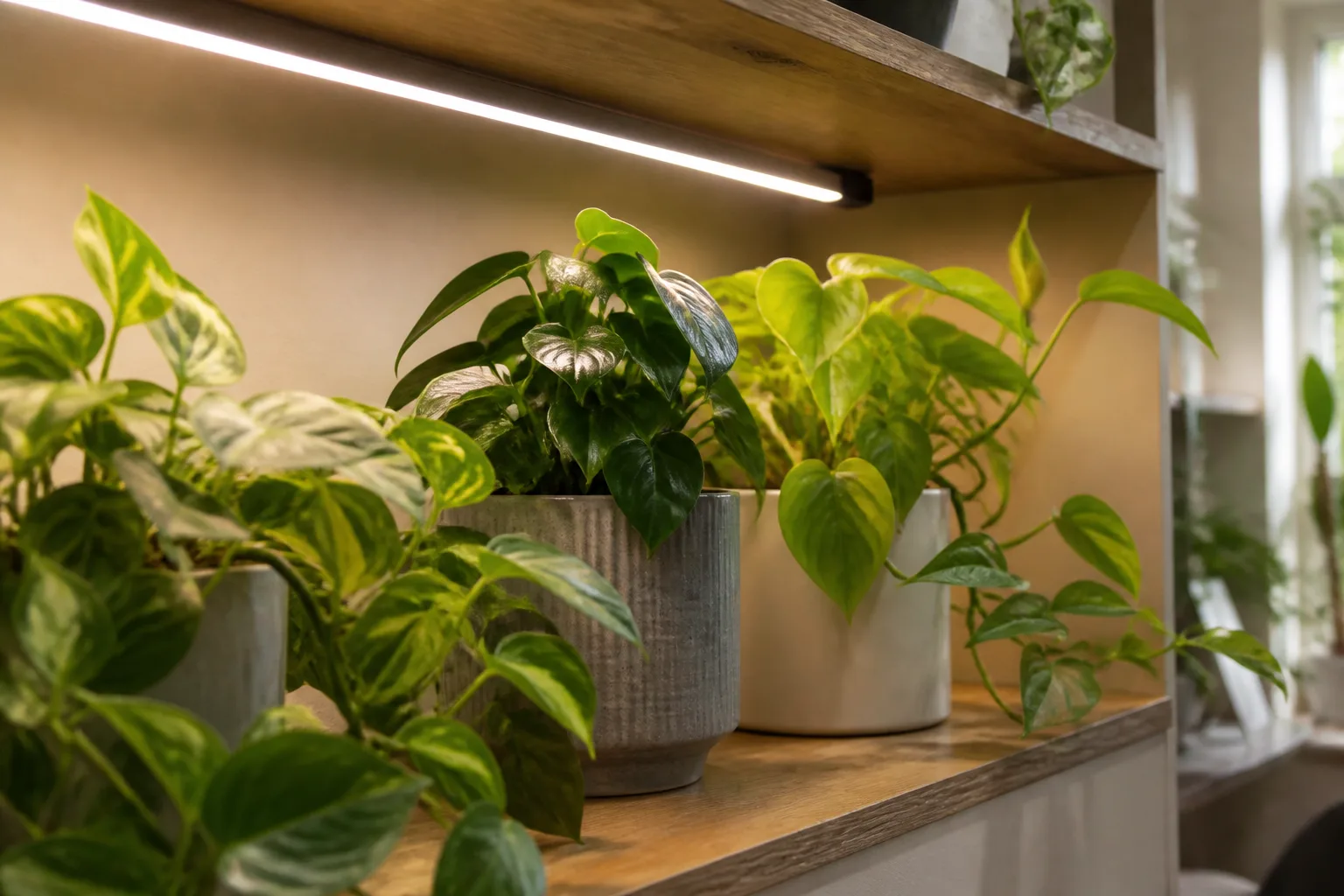
The number of tubes matters as much as the tube family. One narrow lamp in a deep shelf may light the center while leaving corners dim. A reflector can redirect light downward, while white side panels can soften edge falloff; GrowVeg describes using reflective white panels to improve light at the ends of a seedling tray. GrowVeg
Choosing a fluorescent tube for seedlings and houseplants
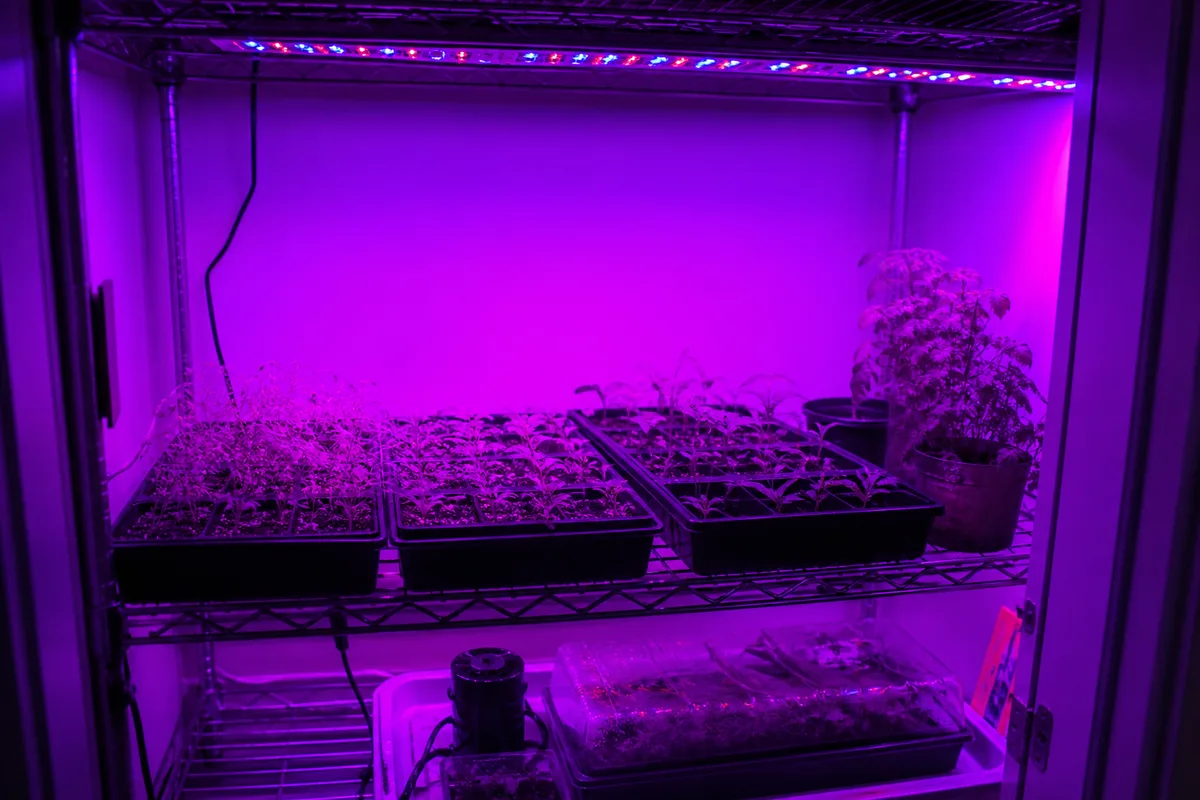
Fluorescent lighting can still be effective for seedlings, cuttings, herbs, and foliage plants when the fixture is positioned close to the canopy and operated on a consistent schedule. T5HO systems are popular for this job because their slim, high-output lamps and reflectors can cover a tray without the heat of some older high-intensity technologies. A commercial horticultural example lists T5HO systems for seed starts, cuttings, and herbs, but its output claims are tied to that specific fixture, reflector, and lamp combination—not to every T5HO tube. Greenhouse Megastore
Start with the plant, not the word “grow.” Seedlings and herbs generally need more usable light than a low-light foliage plant. A tray several feet from a window can produce stretched, thin seedlings even if the room feels bright; Savvy Gardening’s seed-starting experience shows why a dedicated fixture gives a more repeatable schedule. Savvy Gardening
For a fluorescent shelf, set the fixture so the tube illuminates the whole growing area rather than only the tallest plant. Use adjustable chains or brackets if possible. Keep tender seedlings close enough that they do not stretch, but watch for curled, bleached, or scorched foliage and raise the fixture if the light or heat is excessive. Rotate trays when the edges lag behind the center, and clean dust from the reflector and lamp because grime reduces the light reaching leaves.
Color is useful but not magic. A cool-white or daylight-looking lamp may make a plant shelf easier to inspect and can be pleasant for seedlings, but color temperature does not tell you how much light reaches the leaves. University of Minnesota Extension frames artificial lighting around quality, duration, and intensity, which is the more useful way to assess a plant setup. University of Minnesota Extension
Use a timer rather than relying on memory, and give plants a dark period. GrowVeg and Savvy Gardening both show that fluorescent fixtures can remain reasonable when you already own a functioning shelf. GrowVeg Savvy Gardening If you are building from scratch, compare power draw, replacement-lamp availability, heat, and disposal obligations with a quality LED bar.
Compare lumens, watts, CRI, and color temperature
Watts describe electrical power, not brightness. A high-wattage old tube can produce less useful light than a lower-wattage modern lamp, and a ballast adds its own system losses. Use wattage to confirm the ballast match and estimate energy use; use the manufacturer’s lumen rating, fixture distribution, and plant-light data to compare illumination.
Lumens describe visible light weighted for human vision. They are useful for room and task lighting, but they are not a complete plant-light measurement. Plants respond to photons in the photosynthetically active range, so a plant setup is better evaluated with a fixture’s PPFD map or a measured response at canopy height when that information is available. A lamp can look bright to your eyes and still be poorly positioned for leaves at the edges of a shelf.
CRI, or color rendering index, describes how naturally colors appear compared with a reference source. A higher CRI is helpful in kitchens, workshops, and plant rooms where you want to distinguish green leaves, yellowing, pests, and soil moisture accurately. It is a color-quality measure, not a substitute for sufficient intensity.
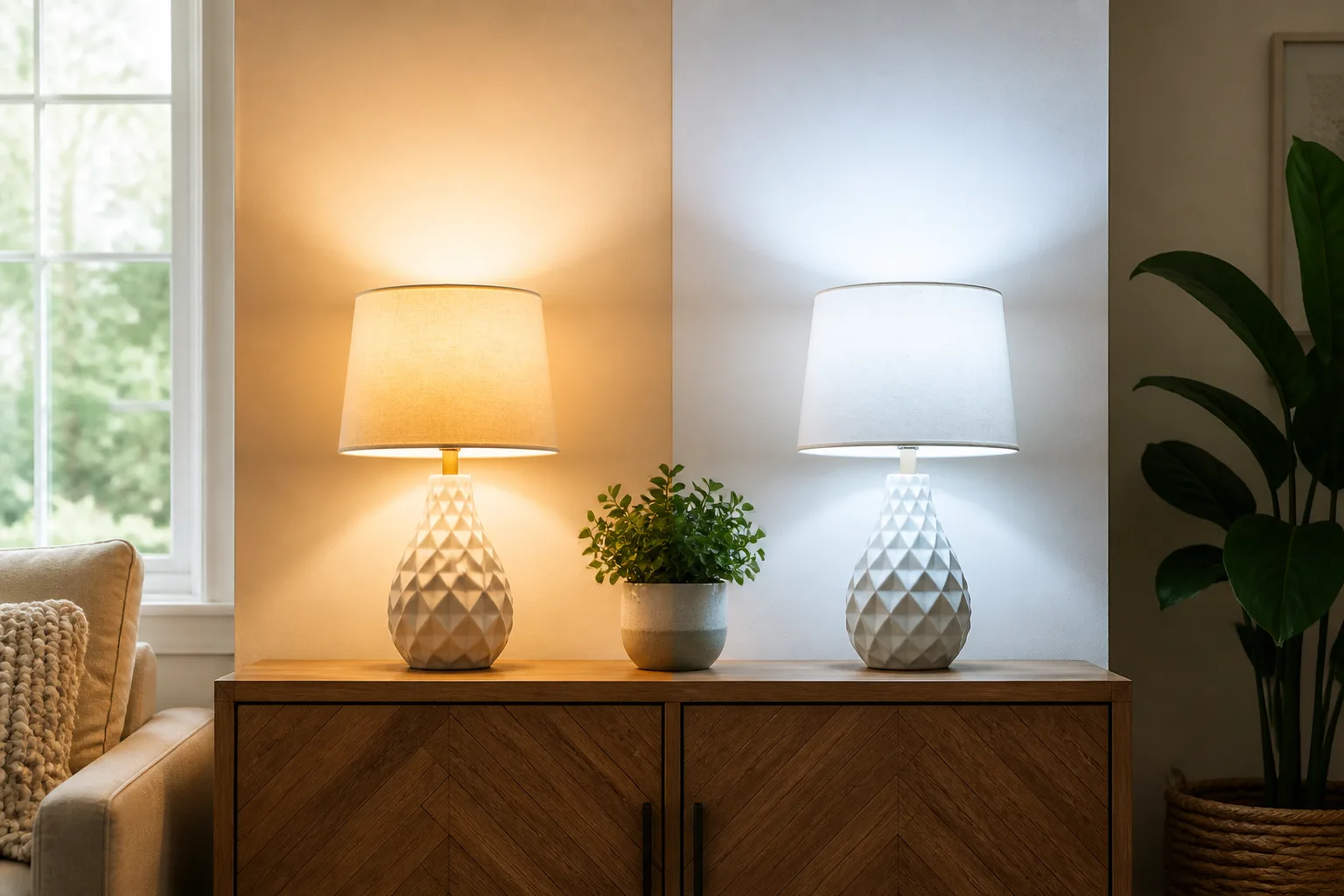
CCT, or correlated color temperature, describes the visual warmth or coolness of white light in kelvins. Around 2700–3000K looks warm and yellow; around 3500–4100K looks neutral to cool; around 5000–6500K looks like daylight. For a living area, choose the appearance you can tolerate for hours. For a plant shelf, a daylight or neutral lamp may make inspection easier, but intensity, coverage, and duration remain the deciding factors.
Do not read “full spectrum” as a guarantee of strong plant growth. It is a description of spectral distribution and marketing language varies. If a plant-light fixture provides PPFD at a stated distance, that is more actionable than a color label by itself. For ordinary household lighting, choose lumens and CRI; for plant production, look for plant-use data and then watch the plant’s growth: stretching suggests insufficient usable light or excessive distance, while bleaching and crispy patches suggest too much intensity or heat.
LED replacement, safe handling, and disposal
If the old fluorescent fixture is failing, you have two decisions: install another fluorescent lamp or convert the fixture. A like-for-like fluorescent replacement is simplest when the fixture and ballast are healthy, the correct tube is available, and you want to avoid electrical modification. An LED retrofit may be more practical when ballast replacements are scarce, the fixture hums, the lamp supply is shrinking, or lower maintenance and energy use matter more than preserving the old system.
LED tubes are not one universal product. Ballast-compatible or plug-and-play tubes are designed to work with specific fluorescent ballasts; the ballast still needs to be on the LED maker’s compatibility list. Ballast-bypass or direct-wire tubes require the ballast to be removed or bypassed and the fixture rewired. Some dual-mode lamps support more than one installation method, but that does not remove the need to follow the exact wiring diagram.
Never assume that a T8 LED tube can be dropped into a T8 fluorescent fixture merely because the physical length and G13 pins match. Check whether the lamp is Type A, Type B, or a dual-mode product, and confirm the fixture wiring, shunted or non-shunted sockets, input voltage, and certification. If a conversion requires rewiring, de-energize the circuit and use a qualified electrician when you are not trained for the work.
The environmental difference is also practical. Fluorescent lamps contain mercury, and the federal rules define lamps—including fluorescent lamps—as a category of universal waste when they meet the applicable hazardous-waste conditions. 40 CFR Part 273 State and local requirements can be more protective or more specific, so an online statement that every burned-out tube can go in household trash is not a safe general rule.
For disposal, keep the tube intact, protect it from impact, and use your local household hazardous-waste program, lamp-recycling collection, or a retailer program that explicitly accepts fluorescent lamps. Oregon’s environmental agency directs homeowners to recycle fluorescent tubes and CFLs through household hazardous-waste facilities, collection events, or participating retail locations. Oregon DEQ Call ahead because collection rules, accepted lengths, fees, and packaging requirements vary.
If a tube breaks, keep people and pets away and follow cleanup instructions from your local environmental or health agency. Do not casually crush intact lamps to save space; careful handling prevents glass and mercury-containing material from entering the room or waste stream. A damaged ballast may also require separate disposal.
Conclusion
The right fluorescent tube is the one that matches the entire fixture system, not just the diameter. Decode the T number, verify the length without counting pins, match the base and shape, read the ballast, then choose wattage, lumens, CRI, and color temperature for the job.
For a compact socket, start with the exact T2/CFL format and base. For a slim dedicated fixture, verify T5 or T5HO and its electronic ballast. For a common linear shop or office fixture, distinguish T8 from the older T12 system even when both use G13 pins. And before buying a large stock of fluorescent lamps, compare a documented LED retrofit or new LED fixture—installed by the correct method—with the cost and availability of continued fluorescent maintenance.