16 Flowers That Bloom Earliest in Spring
Find early spring flowers for sun, shade, beds, and lawn edges. Learn which bloom first, which naturalize, and what to consider before planting.
The first spring color rarely arrives all at once. Snowdrops may open while the ground is cold, witch hazel can flower before winter has fully let go, and later-blooming daffodils or shrubs take over as days lengthen. Planting a mix of bulbs, low perennials, and woody plants gives you a sequence rather than a brief burst.
“Early” is local, too. A south-facing garden in a mild climate can be weeks ahead of a shaded site at higher elevation, and a warm spell can push buds open before a late freeze. These 16 choices include flowers and a few shrubs grown for early flowers; each profile notes where it fits, what to expect, and when its spreading or care habits deserve attention.
Why “Earliest” Depends on Your Garden
A calendar date is a poor way to compare spring flowers across the country. Bloom follows soil temperature, winter chill, sunlight, elevation, and the plant’s genetics. Even one genus can span several weeks: an early daffodil cultivar may flower before late varieties have emerged, while a cold spring can compress or delay the whole display. Use the bloom season on the bulb or plant label as a relative guide, then observe what flowers first in your own yard.
The site matters as much as the weather. Snowdrops and hellebores can flower in the cool, dappled light beneath deciduous trees, where the canopy is still bare; crocuses and pasque flowers are better where they receive more sun. Shrubs such as forsythia and star magnolia put flowers on bare or nearly bare branches, but an exposed site can make their open buds vulnerable to a sudden hard freeze. The Brooklyn Botanic Garden’s early-spring highlights show how the display unfolds in one garden, but that local sequence is not a universal calendar.
The list also includes several kinds of “flowers.” Pussy willow’s fuzzy structures are catkins, not showy petals, and winter jasmine is a woody vine or groundcover rather than a bulb. They still earn a place because they bring visible color or texture when many perennial beds are dormant.
Start With Late-Winter Bulbs and Corms
Bulbs and corms are efficient first-color plants: they store energy underground, flower before trees leaf out, and often need little care once established. Most spring-flowering bulbs are planted in autumn, but depth, light, moisture, and chilling needs differ by species. For a dependable display, group them in drifts and place them where their foliage can remain until it yellows naturally after flowering.
Snowdrops and Crocus
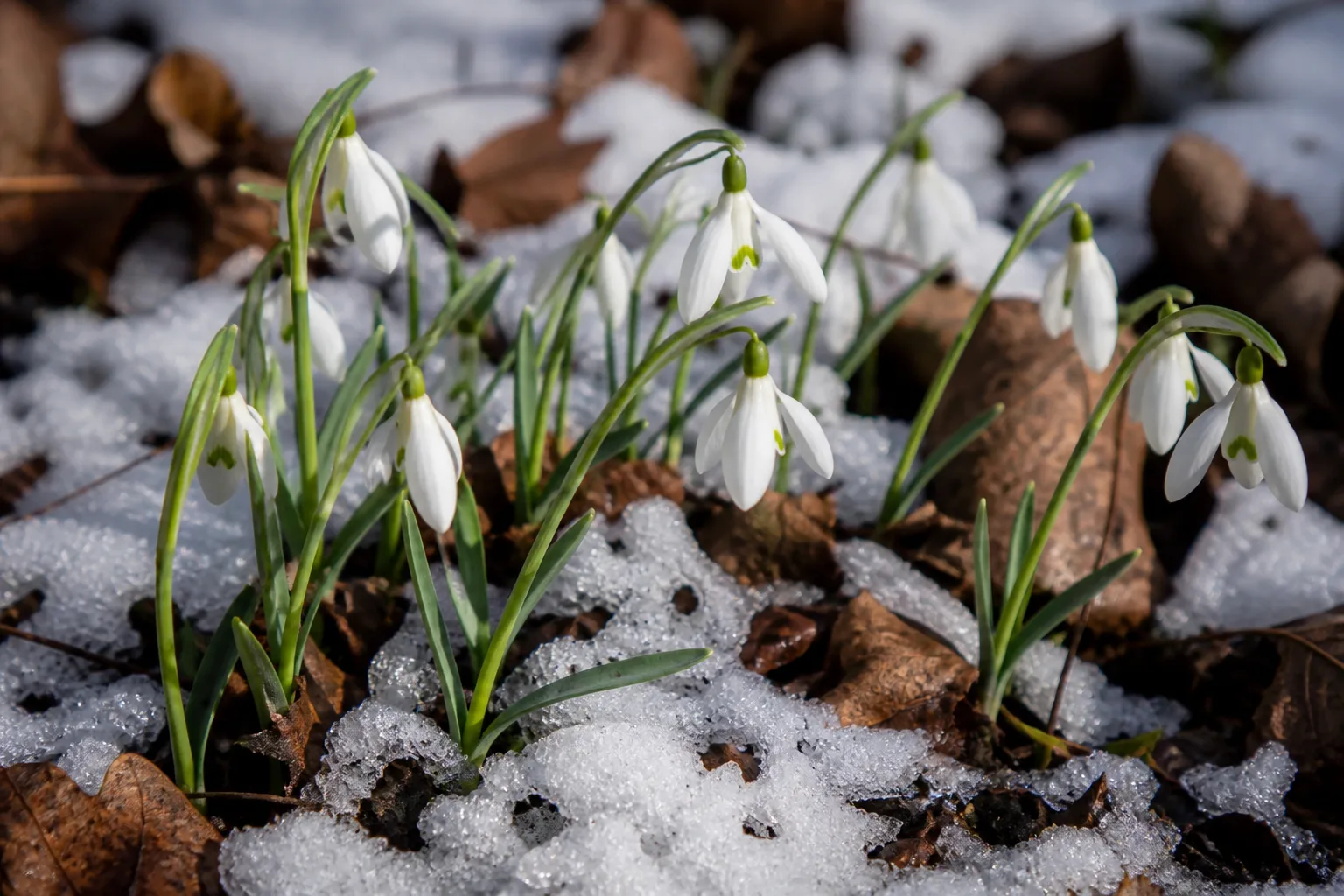
1. Snowdrops (Galanthus nivalis) are among the most reliable late-winter signals: a single white, nodding flower hangs above narrow leaves, sometimes appearing while snow remains. The Royal Horticultural Society’s snowdrop guide recommends partial shade and soil that is not permanently wet; the cool, bright ground under a deciduous tree is a natural fit. They can be planted as dormant bulbs in autumn or as actively growing clumps, and they look more convincing in drifts than as isolated dots. Do not mow or cut their leaves while they are still green.
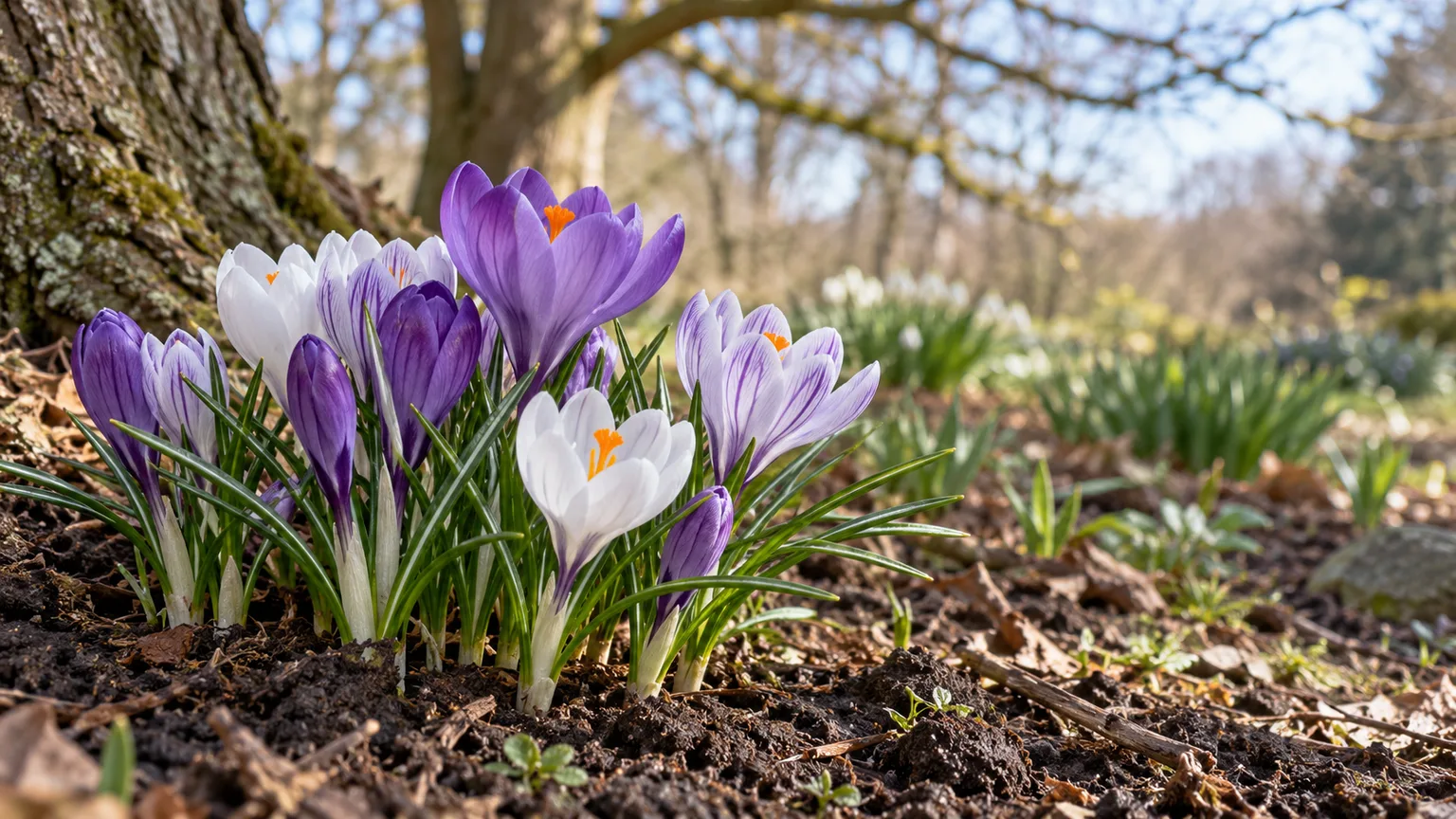
2. Crocus brings larger, open cups in purple, white, yellow, or striped combinations. Spring crocuses often flower near the end of winter or at the start of spring, but autumn-flowering crocus also exist, so check the species and season on the label. Plant corms in a sunny or lightly shaded, well-drained spot; damp, heavy soil can rot them, and squirrels or other wildlife may dig up freshly planted corms. Crocuses are small enough to naturalize in a lawn, but only where you can delay mowing until the foliage has faded.
Daffodils, Glory-of-the-Snow, and Siberian Squill
3. Daffodils (Narcissus) are not one bloom-time category. Species and cultivars range from very early to late spring, and flower size, color, and number of blooms per stem vary widely. Choose a bulb sold as early-flowering if the first weeks of the season matter; the RHS overview of daffodils explains the range of forms within Narcissus. Plant bulbs in autumn in a site with sun to light shade and drainage. After flowers fade, remove the spent flower head if you wish, but leave the leaves until they yellow so the bulb can replenish itself; NC State Extension’s plant profile describes this post-bloom foliage cycle.
4. Glory-of-the-snow (Chionodoxa luciliae) has upward-facing, starry blue or violet flowers with pale centers. It is a small bulb for the front of a border, rock garden, or the open ground beneath deciduous trees. It can seed and form colonies, which is useful where a naturalized patch is wanted but less ideal in a tightly controlled design. The naming around this plant can vary in horticultural references; check the botanical label so you know which species or selection you are buying.
5. Siberian squill (Scilla siberica) produces short stems of saturated blue, nodding flowers that can open early in the season. It is often planted in lawns or woodland edges because it can multiply into a carpet, but that same ability to seed and spread means you should avoid it where you need a restrained planting. Give it autumn planting, drainage, and access to spring light; it can grow under deciduous trees because it flowers before their leaves shade the ground. This bulb is also poisonous if eaten, so see the safety section before planting where children or pets investigate the garden.
Low Perennials for Sun and Shade
Low-growing perennials fill the time before summer borders get going. Some finish their show and retreat underground; others keep useful foliage after bloom. Leave space for that mature habit instead of filling every gap with plants that will compete when the early flowers are dormant.
Amur Adonis and Pasque Flower
6. Amur adonis (Adonis amurensis) is a compact perennial with bright yellow, buttercup-like flowers and finely divided foliage. It can bloom very early in a cool climate, often before the surrounding plants have leafed out, then go dormant as the season warms. Give it a well-drained site with spring light and avoid digging around its crown once it is established. Its short growing season is not a problem if you let neighboring plants fill the space later; it is a problem if you expect it to provide summer foliage.
7. Pasque flower (Pulsatilla vulgaris) offers solitary purple, lavender, or occasionally pale flowers above softly divided, often silky foliage. It is best for a sunny, sharply drained bed, gravel garden, or rock garden; heavy wet soil is a more serious threat than a dry spell once the plant is settled. Unlike a bulb that can be lifted and moved casually, pasque flower develops a deep root and resents disturbance, so choose its position carefully. It has poisonous properties if ingested, a point confirmed in NC State Extension’s profile.
Lenten Rose and Creeping Phlox
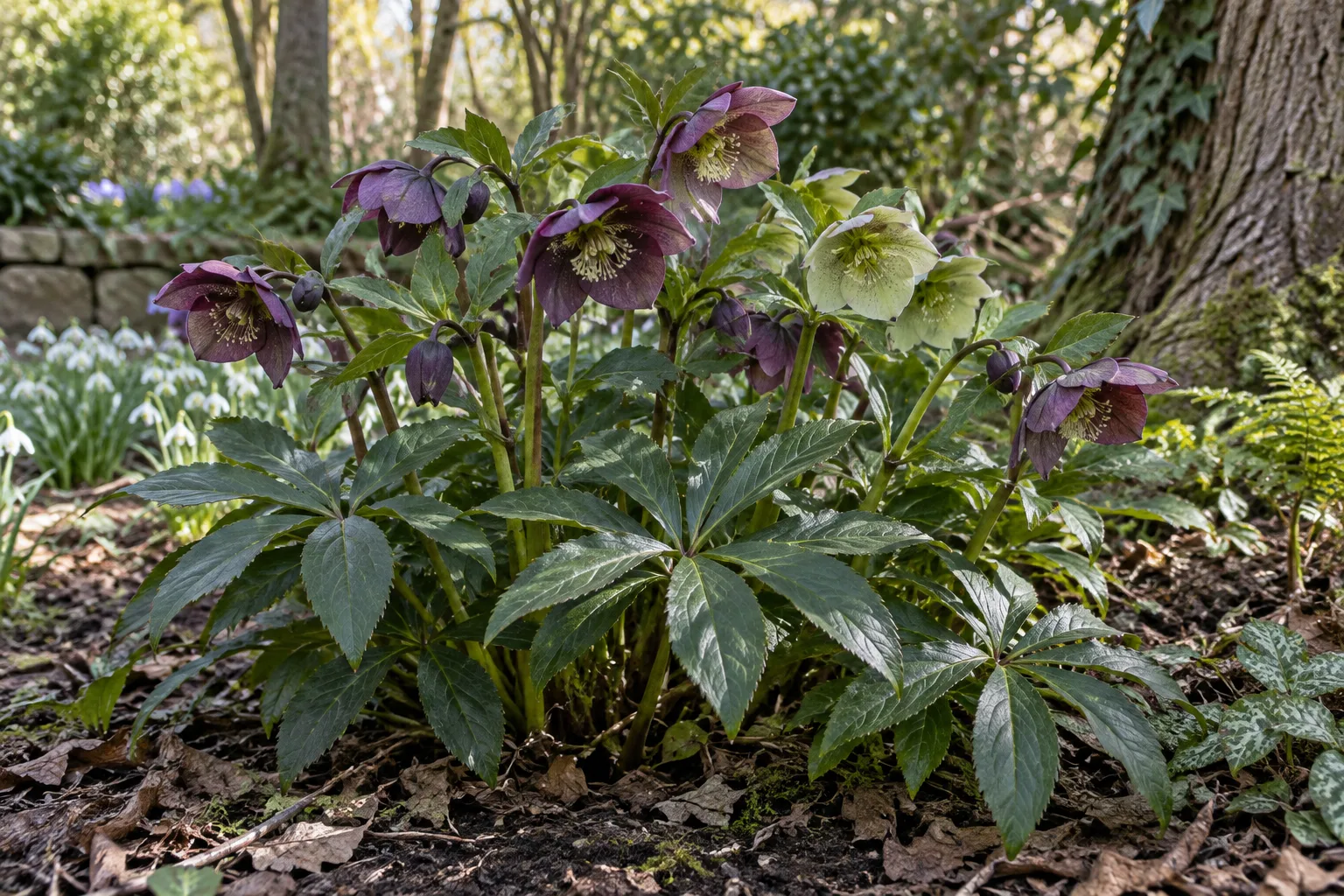
8. Lenten rose (Helleborus orientalis) is not a rose but a clumping hellebore with nodding, cup-shaped flowers that can persist from late winter into spring. Flowers may be white, pink, plum, or greenish, and the leathery leaves provide structure after the first bloom wave. It is a strong choice for partial shade beneath deciduous trees or along a sheltered border; avoid soil that stays waterlogged or becomes extremely dry. The RHS hellebore guide describes their preference for light shade and evenly moist soil, while NC State Extension flags ingestion and skin-contact risks. Wear gloves when cutting old foliage, and keep plant material away from children and pets.
9. Creeping phlox (Phlox stolonifera) is a woodland groundcover that produces low clusters of pink, purple, blue, or white flowers in spring. It prefers humus-rich, well-drained soil and partial shade, though it can tolerate more sun when the soil stays evenly moist. Its stems creep and root, making it useful on a bank or at the edge of a woodland bed. Do not confuse it with moss phlox (Phlox subulata), a sun-loving, mat-forming species that is often marketed under the same “creeping phlox” common name.
Shrubs and Small Trees That Flower Early
Woody plants give early spring height and structure, and several flower before leaves appear. Think about mature size before you buy: a shrub that looks tidy in a nursery pot may become a broad arching specimen that blocks a path or shades smaller bulbs.
Pussy Willow and Witch Hazel
10. Pussy willow (Salix discolor) is grown for soft, silvery catkins that swell on bare branches in late winter or early spring. The catkins make useful cut stems and provide a close-up texture rather than a bright petal display. Willows generally need room and consistent moisture; S. discolor is naturally associated with wet habitats, so a dry, compact urban bed is a poor match. It can grow quickly, and some willows spread by suckers, so choose a location where the mature shrub can be managed rather than planting one beside a foundation or narrow path.
11. Witch hazel (Hamamelis × intermedia) produces narrow, ribbon-like petals in yellow, orange, or red on bare branches. Many cultivars flower in late winter, so it may be a winter-blooming plant as much as an early spring one. It works best as a specimen shrub where people can see the delicate flowers up close; give it room for its eventual width and avoid repeatedly shearing it into a small hedge. The exact flowering window, color, and mature dimensions depend on the species and cultivar, so read the label rather than assuming every witch hazel behaves alike.
Forsythia and Flowering Quince
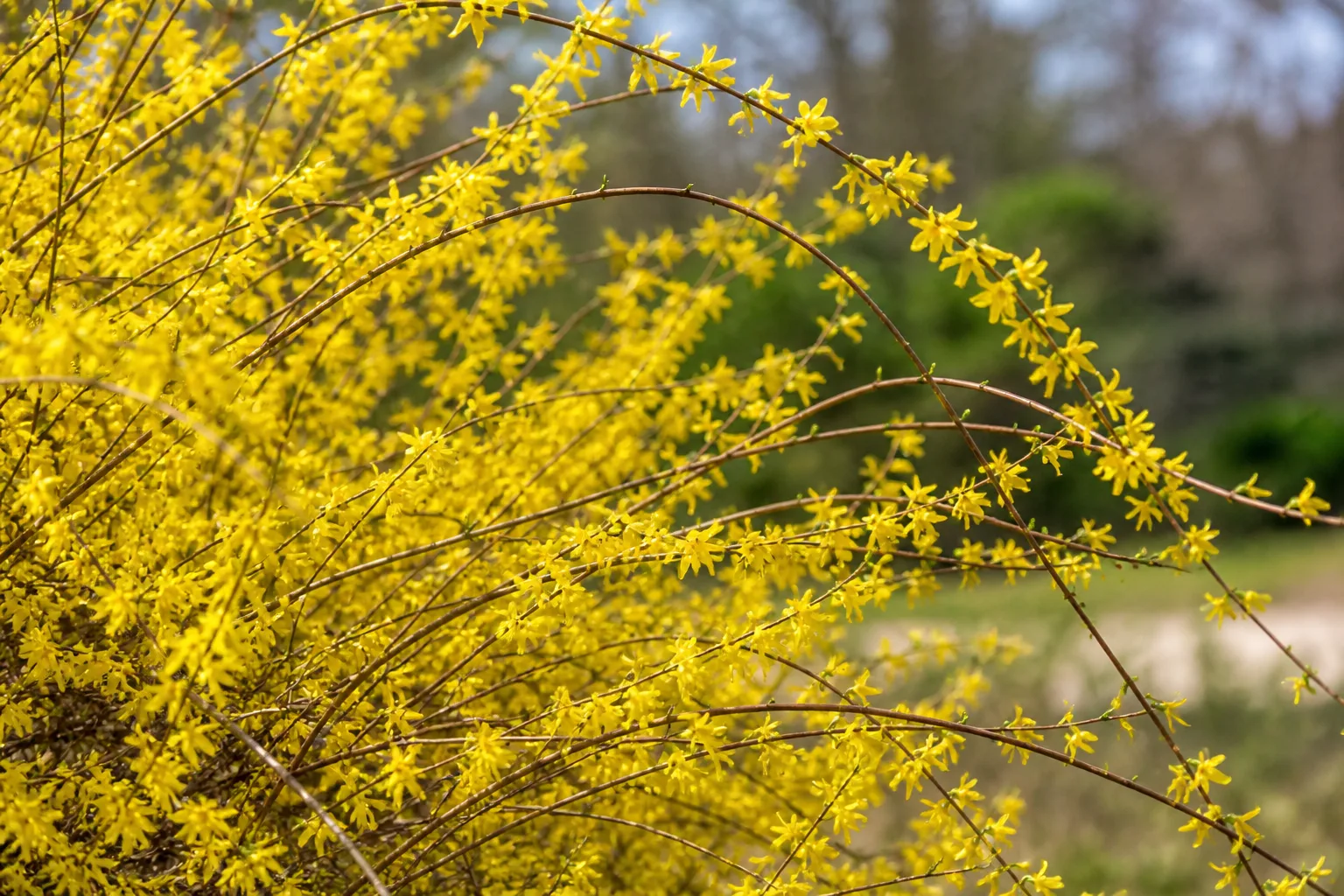
12. Forsythia announces spring with a rush of yellow flowers along arching, mostly bare stems. It is adaptable and vigorous, but it can become large and unruly if planted where a compact outline is essential. The RHS forsythia guide notes that it flowers on bare branches and tolerates a range of soils in sun or light shade; prune after flowering, not in late summer or winter, when you could remove the next season’s buds. Choose a compact cultivar if space is limited, and check its mature size before putting it near a walkway.
13. Flowering quince (Chaenomeles speciosa) is a thorny, often dense shrub with red, orange, pink, or white flowers on bare branches in early spring. Its rugged habit suits an informal hedge or boundary, but the thorns make it a poor choice beside a narrow walkway where people brush past. It can produce hard, aromatic fruit after bloom, depending on the plant and growing conditions. Prune just after the flowers finish if you need to shape it, because later cuts can remove developing flower buds.
Winter Jasmine and Star Magnolia
14. Winter jasmine (Jasminum nudiflorum) bears small yellow flowers on green, arching stems before or near the start of spring. It is not the fragrant jasmine many gardeners expect; its value is its early color and flexible habit. Allow it to cascade over a wall or train it against a support, and prune after flowering to control size. A groundcover planting may root where stems touch the soil, so keep its spread in mind around paths and neighboring plants.
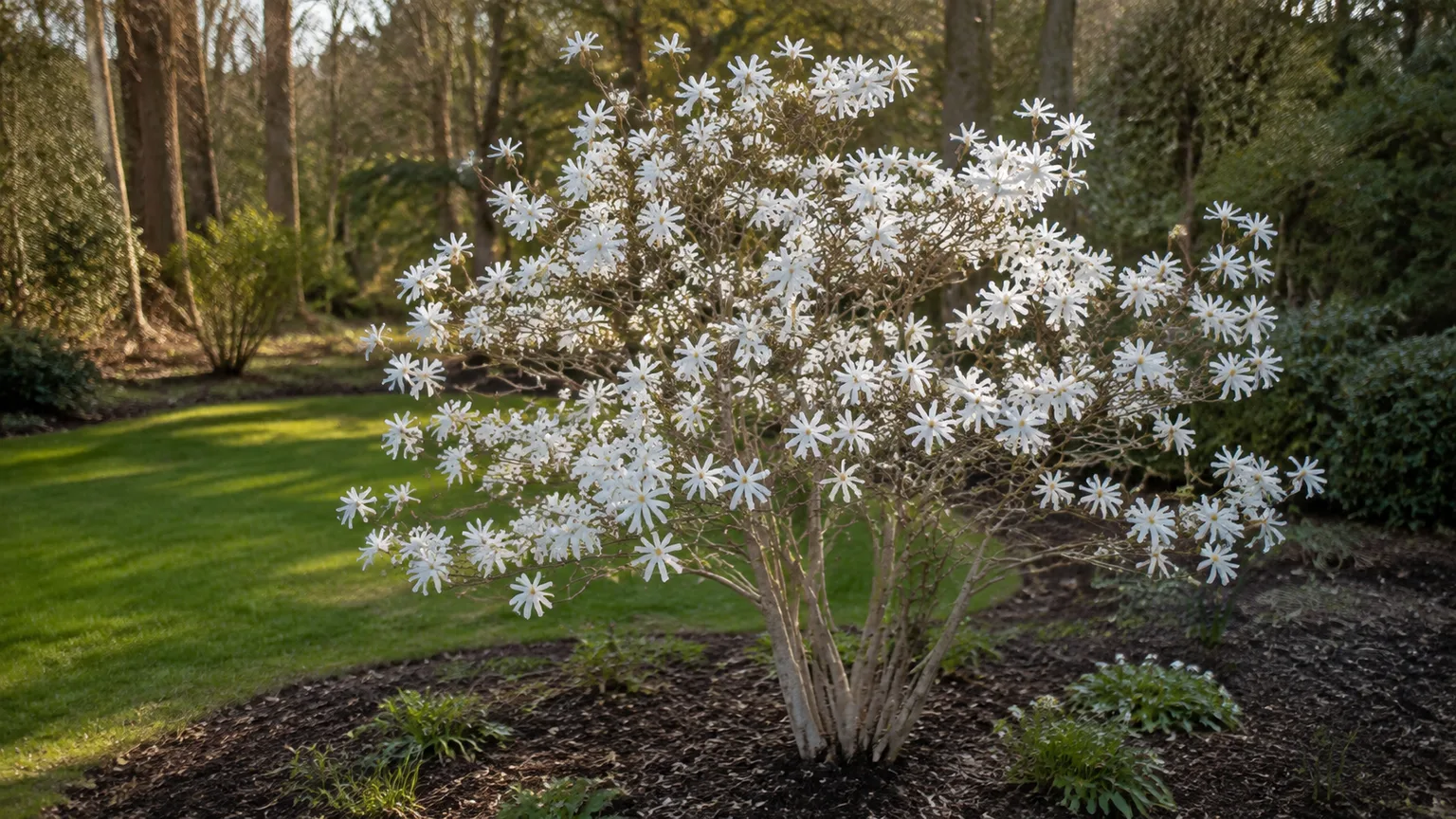
15. Star magnolia (Magnolia stellata) is a small tree or large shrub with white, many-petaled flowers that open before its leaves. Its early display makes it a focal point, but buds and open flowers can be damaged by a late freeze; a warm south-facing wall may push bloom forward and increase that exposure. Plant it where it has room to mature and where you can accept a less-than-perfect year after cold weather. The Brooklyn Botanic Garden notes that magnolia collections can begin flowering in late March in its New York garden, with other trees following later—an example of how even one site has a sequence rather than a single “spring date.”
A Groundcover for a Spring Carpet
16. Creeping myrtle (Vinca minor), also called periwinkle, carries simple blue, lavender, or white flowers above evergreen leaves. It can cover ground beneath trees where turf struggles, but its trailing stems root as they spread and can escape a small bed. Do not treat it as a harmless filler simply because it is low-growing; ask your local extension office or native-plant organization whether it is considered invasive in your region, and choose a contained alternative if spread would be difficult to manage. Its dependable foliage may be more valuable than its short spring bloom.
If you want a floral carpet without committing to a vigorous groundcover, use small drifts of bulbs among low perennials. The bulbs create a brief early wave, then their leaves fade while the perennial foliage expands. A mixed planting is easier to adjust than a single dense mat that has to be dug up to control its edges.
Build a Longer Bloom Sequence
The simplest way to extend the display is to choose plants with overlapping, not identical, bloom windows. Start with winter-to-early-spring shrubs and snowdrops, follow with crocus and early daffodils, then let hellebores, creeping phlox, and later daffodil cultivars carry the garden farther into spring. A warm spell may advance all of them, while a cold year can delay them, so plan a sequence instead of a promised week-by-week calendar.
Match the sequence to the structure of your yard. Plant snowdrops and hellebores near a path where you will notice small flowers, crocuses in a sunny lawn edge that can stay unmown, and larger shrubs where their bare-branch show can be seen from indoors. If you have only a small bed, choose one shrub and two or three bulb types with different bloom classes; a crowded collection of 16 plants is not automatically better than a thoughtfully spaced handful.
For pollinators, favor flowers that offer accessible pollen or nectar and avoid assuming every early bloom is equally valuable. The BBC’s winter-flowering plant guide notes that some winter and early-season flowers can support active pollinators, while bloom timing and suitability vary by plant. A garden with several kinds of flowers is more likely to offer something across changing weather than one that peaks all at once.
Plant and Care for Early Flowers
Most spring bulbs are planted in fall, before the ground freezes, so they can establish roots and experience the winter conditions their cycle expects. Follow the package depth and spacing for the species, because tiny snowdrops and larger daffodils are not planted at the same depth. For bulbs that are already growing, use the nursery’s directions and handle the roots gently; a dry bulb planted in spring may not flower immediately even if it survives.
Drainage is a shared requirement for many early bulbs and perennials. Soil that stays saturated in winter is cold, oxygen-poor, and more likely to rot bulbs or crowns; if rainwater sits for hours, use a raised bed, improve the whole planting area, or select plants suited to wetter ground rather than putting gravel in the bottom of each planting hole. Water newly planted perennials while they establish, then adjust to rainfall and soil texture instead of using a fixed weekly schedule.
After flowering, deadhead only if you want to prevent seed formation or tidy the bed. Keep bulb foliage intact until it yellows naturally; tying leaves into knots, braiding them, or cutting them green reduces the energy available for next year’s bloom. This matters especially in lawns: mark the patch and wait to mow until the foliage has died back, or choose a border where you do not need to cut the leaves early. Gardener’s Path’s early-blooming flower guide also emphasizes fall planting and allowing spring bulbs to naturalize over time.
Plan Around Spread, Frost, and Safety
Some plants are appealing precisely because they multiply, but naturalizing is not the same as staying put. Crocuses, snowdrops, and other small bulbs can slowly form drifts; Siberian squill, glory-of-the-snow, winter jasmine, and vinca may spread more assertively through seed or creeping stems. Before planting them in a lawn, woodland edge, or shared boundary, check whether their spread is acceptable in your local ecosystem and how you would remove them if the bed changes.
A warm early spell can open buds and flowers before the last freeze. Hellebores and many bulbs tolerate cold well, but flowers on magnolia, forsythia, or flowering quince can be browned by a sharp freeze; that usually affects the display more than the entire plant. Avoid trying to “protect” a mature shrub with a small cover that can break branches, and do not fertilize or prune in response to one frost-damaged bloom. Wait for new growth before deciding whether the plant itself has been harmed.
Plant ingestion is a separate concern from frost damage. NC State Extension lists poison characteristics for several plants on this list, and its profiles do not assign the same severity to every species: see its entries for daffodil, snowdrop, Lenten rose, pasque flower, and Siberian squill. Some risks involve ingestion and some plants can irritate skin, so do not assume every bulb or perennial has the same hazard. For pets specifically, the ASPCA lists daffodil as toxic to dogs, cats, and horses; use a veterinary or animal poison-control service for suspected pet exposure rather than treating a human plant profile as a dose guide. Keep labeled plant material away from children and pets, wear gloves when handling plants known to irritate skin, and seek professional advice promptly if ingestion is suspected rather than waiting for symptoms.
Conclusion
The earliest spring color comes from a mix of small bulbs, low perennials, and woody plants that flower before or just as leaves emerge. Snowdrops, crocus, early daffodils, and hellebores suit many gardens, while shrubs such as witch hazel, forsythia, flowering quince, and star magnolia add height and a stronger focal point. Their bloom dates shift with cultivar and local weather, so think in ranges and observe your own yard.
Start with the site you have: choose shade-tolerant plants beneath deciduous trees, sun-loving choices for open ground, and moisture-tolerant pussy willow only where the soil and space fit. Then combine a few plants with staggered bloom, allow bulb foliage to finish naturally, and check local guidance before planting species that spread or may be harmful if eaten. That is how a brief first bloom becomes a spring display that feels planned rather than accidental.