Thrips on Houseplants: Damage, Treatment, and Prevention
Identify thrips damage on your houseplants, learn proven treatment methods, and stop infestations before they spread to your entire collection.
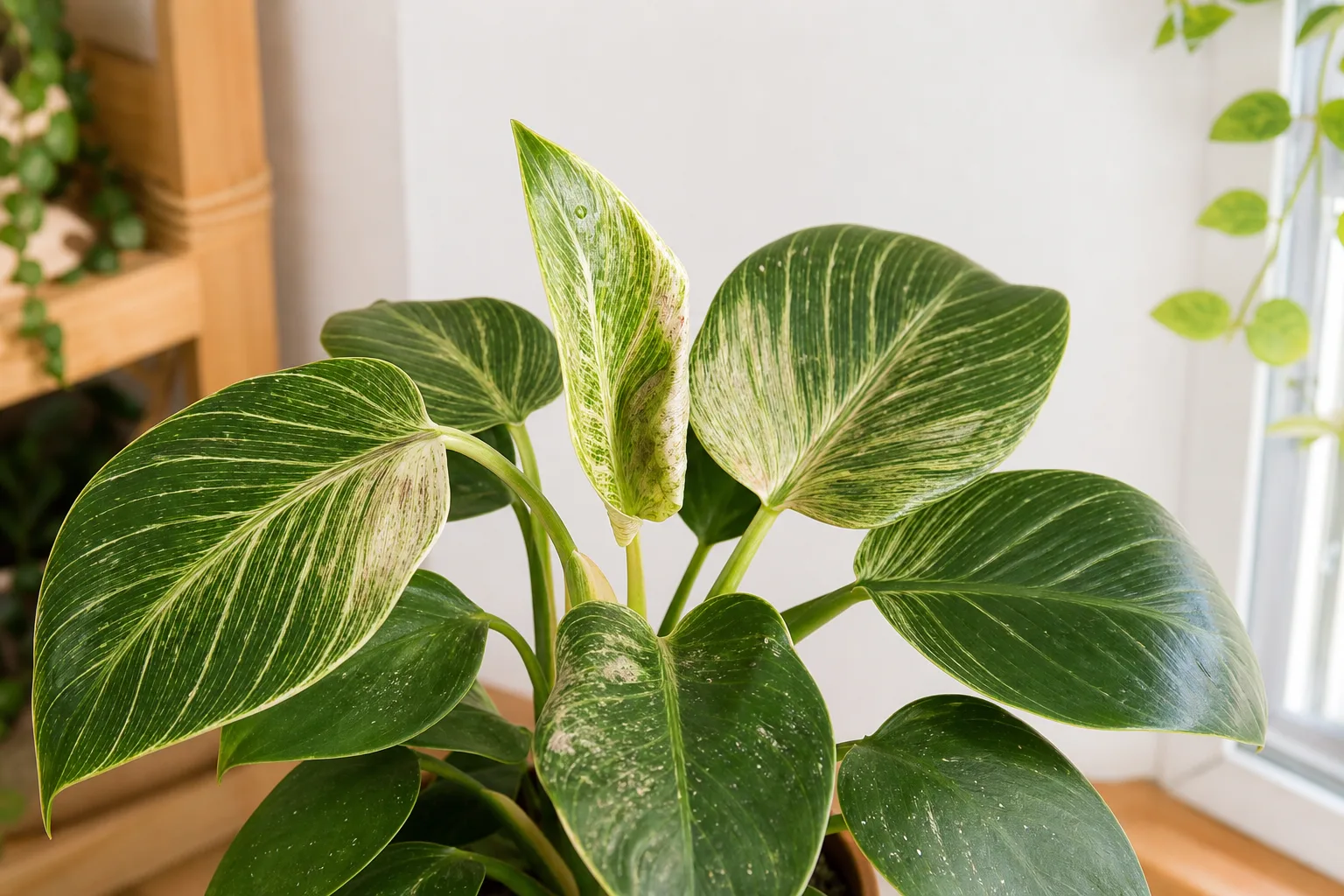
Thrips are one of the most persistent indoor plant pests because they hide where casual inspection does not reach, reproduce quickly, and have life stages that are protected from surface sprays. A philodendron with silvery streaks and black specks, a monstera leaf unfurling already scarred, flower buds that open already discolored — these are all classic thrips calling cards. The good news is that controlling thrips is not about finding a single miracle product. It is about understanding their life cycle and applying the right treatment at the right time, consistently, until every generation is interrupted.
This guide covers thrips identification, treatment, and prevention for houseplants. For collection-wide pest identification and other insect problems, start with our indoor plant pest guide. When you need a repeatable weekly schedule and treatment log, use the integrated pest management indoors guide.
Thrips are small — about 1/16 inch (1–2 mm) — slender, and rice-shaped, appearing in colors from pale yellow to dark brown or black. The University of Maryland Extension describes them as tiny insects with fringed wings held flat over their backs at rest, though the wings are hard to see without magnification. (University of Maryland Extension) Their small size means you often see the damage before you see the insect.
Recognizing Thrips Damage on Houseplants
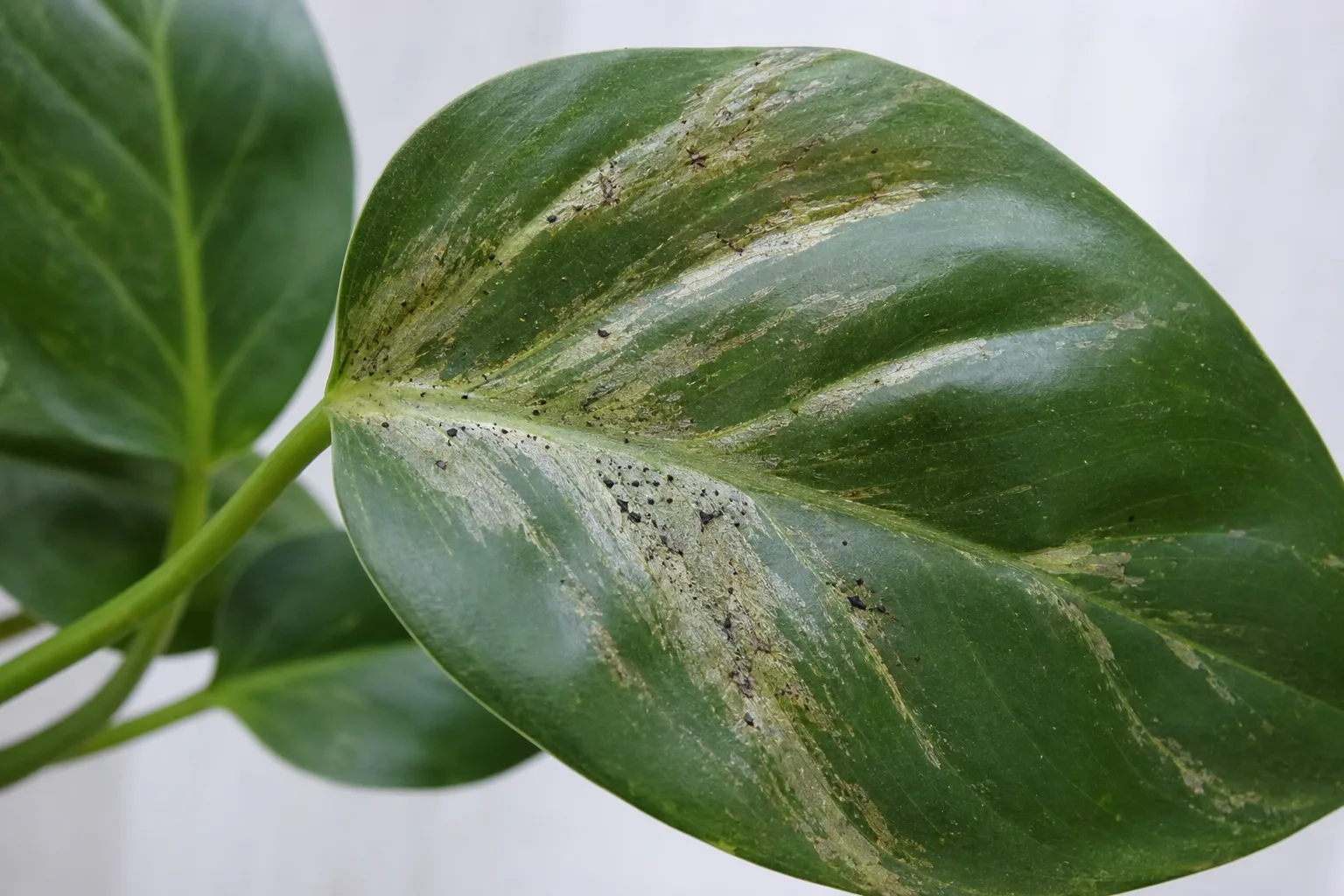
The Classic Signs
Thrips feed by rasping plant cells open and sucking out the contents, which produces a distinctive pattern. Unlike spider mites that create fine stippling, thrips damage tends to be more linear, silvery, or scar-like. Colorado State University Extension notes that thrips produce light, irregular silvery areas on the leaf surface around feeding sites, with tiny dark spots of excrement left behind. (Colorado State University Extension)
The three signature signs of thrips on houseplants:
- Silvery or bronze streaking — irregular patches where leaf cells have been drained, often following leaf veins or appearing in linear patterns
- Black specks of frass — tiny dark tar-like dots clustered near the silvery areas; these are thrips excrement
- Distorted new growth — emerging leaves that are curled, crinkled, stunted, or already scarred before they fully open
Flower buds are another favorite hiding spot. Thrips feeding inside developing buds can cause petals to emerge with pale streaks, brown edges, or what growers call “color break” — discolored tissue killed before the bud opened. You may also notice buds that brown and drop without opening. UC IPM describes this as pale or dark discoloring of petal tissue killed by thrips feeding before buds opened. (UC IPM)
Where to Inspect First
Thrips are not evenly distributed on a plant. They concentrate in specific hiding spots that a quick glance misses entirely. University of Maryland Extension recommends checking young leaves, leaf margins, along the main vein, flower buds, and the crevices where leaf stalks join the main stem. (University of Maryland Extension)
Priority inspection checklist:
- Unfurling new leaves — thrips often feed inside rolled or folded new growth before the leaf opens, causing damage that only becomes visible days or weeks later
- Leaf undersides — adults and larvae shelter there, especially along the midrib
- Flower buds and open blooms — pollen-feeding species congregate in flowers
- Leaf axils and stem joints — tight spaces where the leaf meets the stem
- Pot rim, saucer, and nearby surfaces — pupal stages may drop to the soil or rest in crevices
A magnifying lens helps, but you can also use a simple tap test. Hold a sheet of white paper under a suspect leaf and tap the foliage firmly. If tiny elongated insects fall onto the paper and start crawling, you are likely dealing with thrips. They move quickly compared to most other small indoor pests.
Thrips vs. Spider Mites and Other Lookalikes
Thrips damage is frequently confused with spider mite damage, but the two have distinct differences. Spider mites produce fine, uniform stippling and may leave webbing. Thrips create larger, more irregular silvery patches with visible black fecal specks. CSU Extension notes that thrips feeding may somewhat resemble spider mite damage, but the wounds are larger and more silvery. (Colorado State University Extension)
If the plant has fine webbing, bronzed leaves, and dust-like particles on the undersides, you are more likely dealing with spider mites. If you see irregular silver streaks, black tar-like droplets, and distorted unfurling leaves, think thrips. The two pests can coexist, so inspect carefully and treat for the confirmed pest.
Quick symptom comparison:
| Symptom | More likely thrips | More likely spider mites |
|---|---|---|
| Leaf pattern | Irregular silvery streaks, larger patches | Fine uniform stippling, overall bronzing |
| Black specks | Distinct tar-like frass droplets | Absent or far less prominent |
| Webbing | None | Fine webbing in heavy infestations |
| New growth | Distorted, scarred, curled before opening | May look normal initially |
| Insect appearance | Slender, rice-shaped, moves quickly | Tiny round dots, slower, often in colonies |
Why Thrips Are So Hard to Eliminate
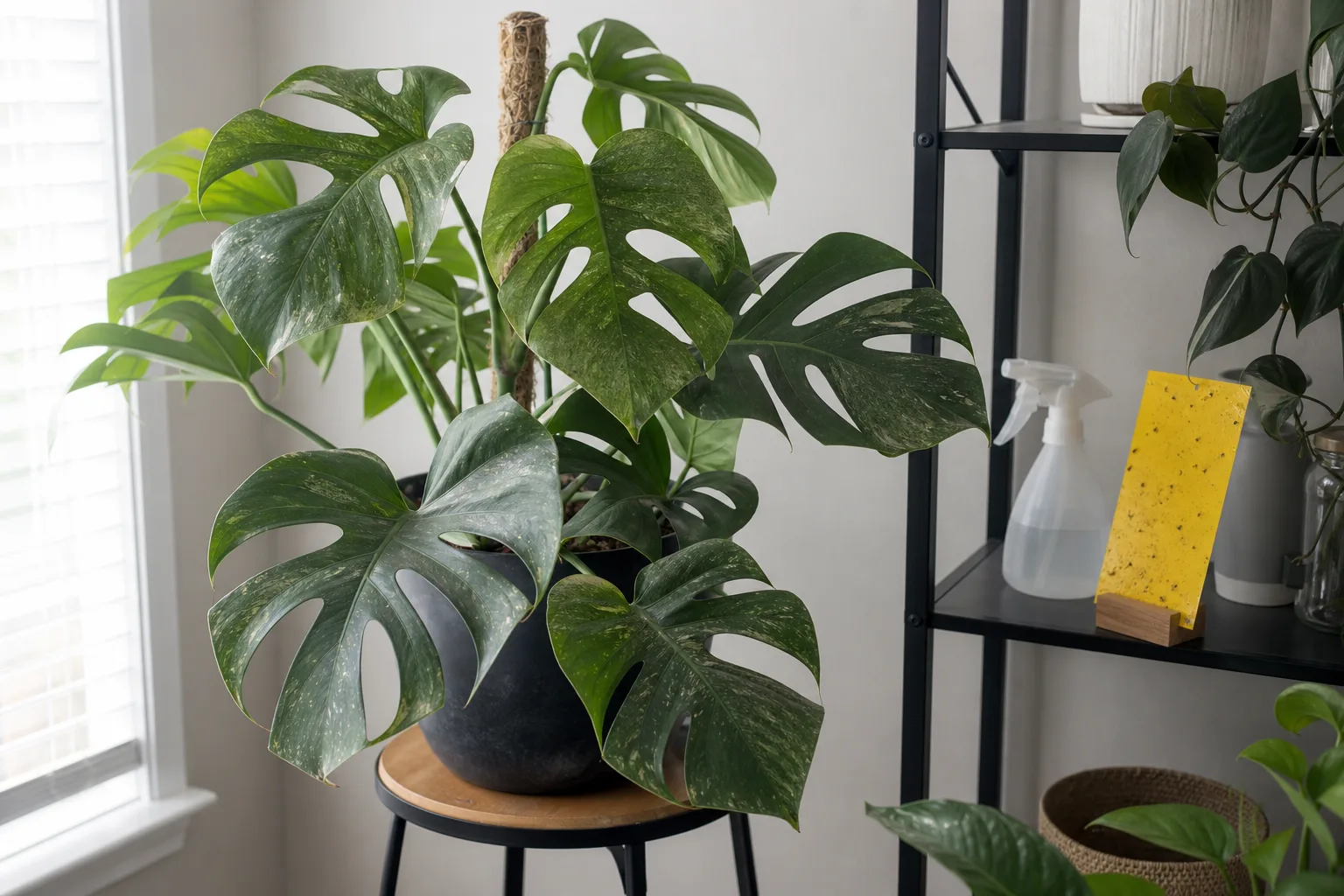
The Life Cycle Problem
The single biggest reason thrips treatments fail is their life cycle. Female thrips insert eggs directly into plant tissue — inside leaves, stems, or petals — where no surface spray can reach them. The larvae that hatch feed on the plant for one to two weeks, then typically drop to the soil or move into leaf crevices to pass through two non-feeding stages (prepupa and pupa) before emerging as winged adults.
University of Maryland Extension explains that under warm conditions (around 85°F), the egg-to-adult cycle can complete in as little as two weeks, and that adults can live for a month or more. (University of Maryland Extension) In cooler indoor conditions (around 60°F), development may take closer to a month. This speed, combined with protected eggs and soil-dwelling pupae, means a single spray application — however thorough — misses large portions of the population.
Adding to the challenge, female thrips can reproduce through parthenogenesis — producing viable eggs without mating. University of Maryland Extension notes that most if not all adult thrips on a plant will be female, which is one reason populations can rise so rapidly. (University of Maryland Extension)
Thrips life stages and why they matter for treatment:
| Stage | Location | Vulnerable to surface sprays? | Why it matters |
|---|---|---|---|
| Egg | Inside leaf, stem, or petal tissue | No | Protected; no contact spray can reach them |
| Larva (1st–2nd instar) | Leaf surfaces, buds, crevices | Yes | The most vulnerable feeding stage |
| Prepupa / Pupa | Soil, leaf litter, crevices | Usually no | Often overlooked; reinfestation source |
| Adult | Leaves, flowers, flying between plants | Yes, if contacted | Can fly, jump, and lay new eggs daily |
The practical implication is simple: you must repeat treatments on a schedule that catches each newly emerging generation before those adults can lay more eggs. A single treatment kills exposed larvae and adults but does nothing to eggs already embedded in tissue or pupae resting in the soil. Those protected stages mature days later, and the cycle continues.
Resistance and Hiding Behavior
Thrips are notorious for developing insecticide resistance, especially in greenhouse settings where the same products are used repeatedly. Colorado State University Extension emphasizes that many strains are resistant to insecticides, and their habits make them even harder to control. (Colorado State University Extension)
Beyond resistance, thrips are behaviorally evasive. They tuck into unfurling leaves, wedge between stems and petioles, retreat into flower buds, and drop from the plant when disturbed. Spraying a plant without first opening curled leaves, separating crowded stems, and thoroughly coating all surfaces almost guarantees survivors. Even a careful application misses thrips that are inside tissue or in the potting mix.
Houseplants Most Affected by Thrips
Thrips feed on a wide range of indoor plants. University of Maryland Extension lists commonly affected indoor groups as African violet family (gesneriads), spiderwort family (such as Tradescantia), aroid family (Alocasia, Philodendron, Anthurium, and others), orchids, Peperomia, poinsettia, Ficus, palms, miniature roses, and herbs. (University of Maryland Extension)
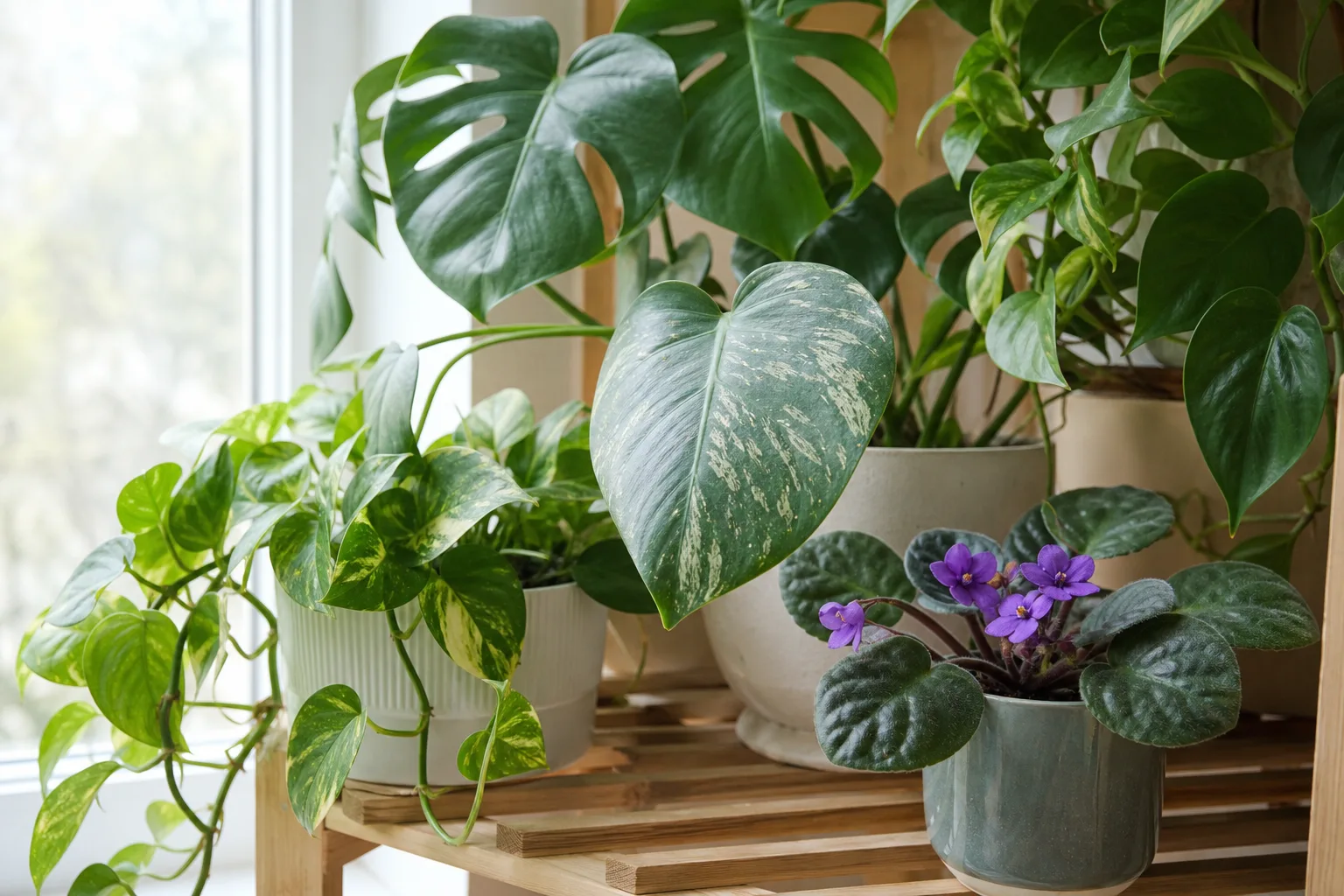
Aroids — including monsteras, philodendrons, pothos, alocasias, and anthuriums — are among the most frequently reported victims in indoor collections. Their unfurling new leaves create perfect sheltered feeding sites where thrips can reproduce undetected for weeks. By the time the leaf opens with silvery scars and black specks, multiple generations may already be active.
Plants with thin, tender leaves tend to show damage more dramatically, but even thick-leaved plants like hoyas and snake plants can host thrips. The insects often go unnoticed on tougher foliage because the scarring is less visible.
What to Do When You Find Thrips
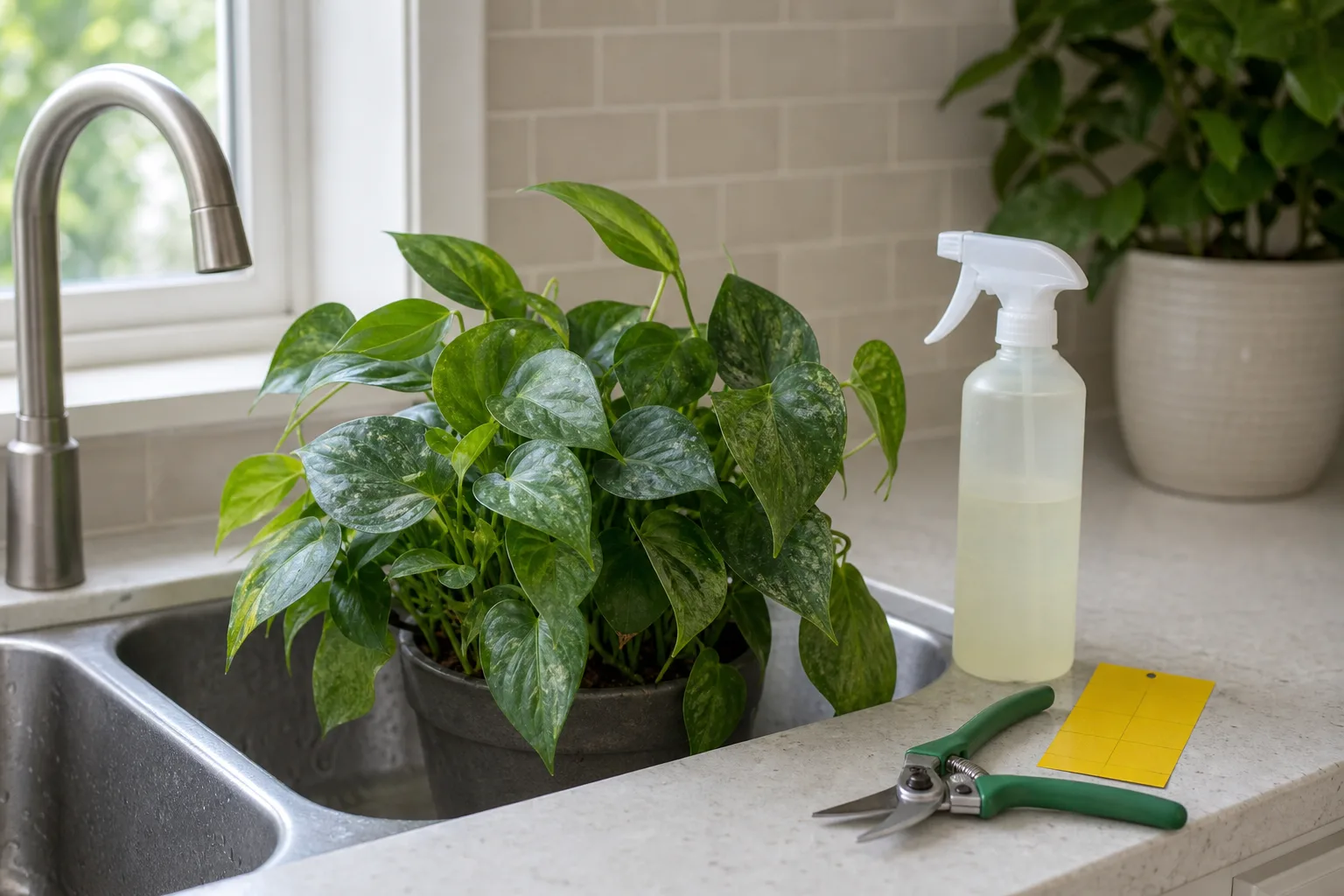
Step 1: Isolate Immediately
The first move is always isolation. Adult thrips can fly, jump, and drift on air currents, so simply moving the plant a few feet away is not enough. Place it in a separate room if possible, or at minimum create distance and avoid placing it near or above other plants. UAF’s indoor plant guidance recommends isolating the affected plant from healthy plants to prevent pests from spreading, and checking all surrounding plants for signs of infestation. (UAF News)
Keep the plant isolated until you have completed multiple treatment cycles and observed at least two to four weeks of clean new growth with no fresh damage. A single clean inspection is not sufficient because eggs and pupae may still be present.
Step 2: Inspect Thoroughly and Remove What You Can
Before applying any treatment, physically reduce the pest population. This step is often skipped, but it makes every subsequent treatment more effective.
Rinse the entire plant with a strong spray of water — in a sink, shower, or outdoors in shade. Focus on leaf undersides and stem joints where thrips congregate. University of Maryland Extension notes that a strong jet of plain water from a sink or hose can knock pests off leaves, especially juveniles with softer bodies. (University of Maryland Extension)
Prune and discard heavily infested leaves, damaged flowers, and badly distorted new growth. Bag the removed material before carrying it past other plants. Clean the pot exterior, saucer, shelf, and any nearby surfaces. If the plant has been in the same pot for a while and you suspect pupae in the soil, repotting into fresh mix can remove that reservoir — but repotting alone does not eliminate thrips living on the foliage, so it must be combined with canopy treatment.
Step 3: Choose the Right Treatment
Match the treatment to the pest’s biology. Because thrips have protected egg and pupal stages, the goal is not a one-time kill but repeated applications that intercept each new generation as it reaches the vulnerable larval and adult stages.
Treatment options in order of increasing intensity:
| Method | What it targets | Strengths | Limitations |
|---|---|---|---|
| Water rinsing | Larvae, some adults | No chemicals, immediate population reduction | Does not kill eggs or pupae; must repeat |
| Sticky traps (yellow or blue) | Flying adults | Monitors population; catches some adults | Does not reach larvae, eggs, or pupae; not a standalone solution |
| Insecticidal soap | Larvae, soft-bodied adults on contact | Low toxicity; readily available | No residual effect; must contact insect directly; repeat every 4–7 days |
| Horticultural oil | Larvae, adults (smothers on contact) | Effective on exposed stages; low toxicity | Can burn sensitive plants; no residual effect |
| Neem oil | Larvae (growth disruption), some repellency | Plant-derived; dual action | Variable effectiveness against adults; can burn foliage |
| Spinosad | Larvae, adults (contact and ingestion) | More effective than soaps/oils; translaminar activity reaches some hidden thrips | Toxic to bees if plants go outdoors; repeat applications still needed |
| Pyrethrins | Adults on contact | Fast knockdown | Short persistence (hours); must contact insect directly |
UC IPM states that spinosad is generally more effective against thrips than horticultural oils, insecticidal soaps, or pyrethrins, noting that it lasts a week or more and has translaminar activity — meaning it moves short distances into sprayed tissue to reach thrips feeding in protected plant parts. (UC IPM) University of Minnesota Extension lists pyrethrins, insecticidal soap, neem, and plant oil extracts as effective against thrips, while emphasizing that repeat applications are usually necessary for products with no residual activity. (University of Minnesota Extension)
For most indoor thrips infestations, spinosad applied at the label interval is the most reliable single-product approach. If you prefer lower-toxicity options, insecticidal soap or horticultural oil can work — but they demand more thorough coverage and more frequent applications because they have no residual effect and only kill insects they directly contact.
Treatment application tips:
- Apply in the evening or move the plant out of direct light until sprays dry to reduce leaf burn risk
- Thoroughly coat both leaf surfaces, stems, petioles, and the top layer of potting mix
- Unfurl any curled leaves gently and spray inside; thrips often shelter there
- Repeat at the manufacturer’s recommended interval — typically every 5 to 7 days for at least three to four cycles
- Do not increase concentration beyond the label rate; stronger mixes burn leaves and do not work faster
Step 4: Repeat Until the Life Cycle Breaks
The most common reason thrips treatments fail indoors is stopping too soon. A plant looks better after one or two applications because exposed larvae and adults have died. But eggs inside the tissue are still hatching, and pupae in the soil are still maturing. Within two weeks, new adults emerge and the damage resumes — this is not reinfestation. It is the same infestation continuing on schedule.
A practical treatment rhythm is to spray at the label interval for a minimum of three to four full cycles, which typically spans three to four weeks. Keep sticky traps in or near the plant to monitor adult activity. Track your applications and inspections — a note on your phone with the date, treatment used, and what you observed prevents the guesswork that leads to stopping early.
Preventing Thrips on Houseplants
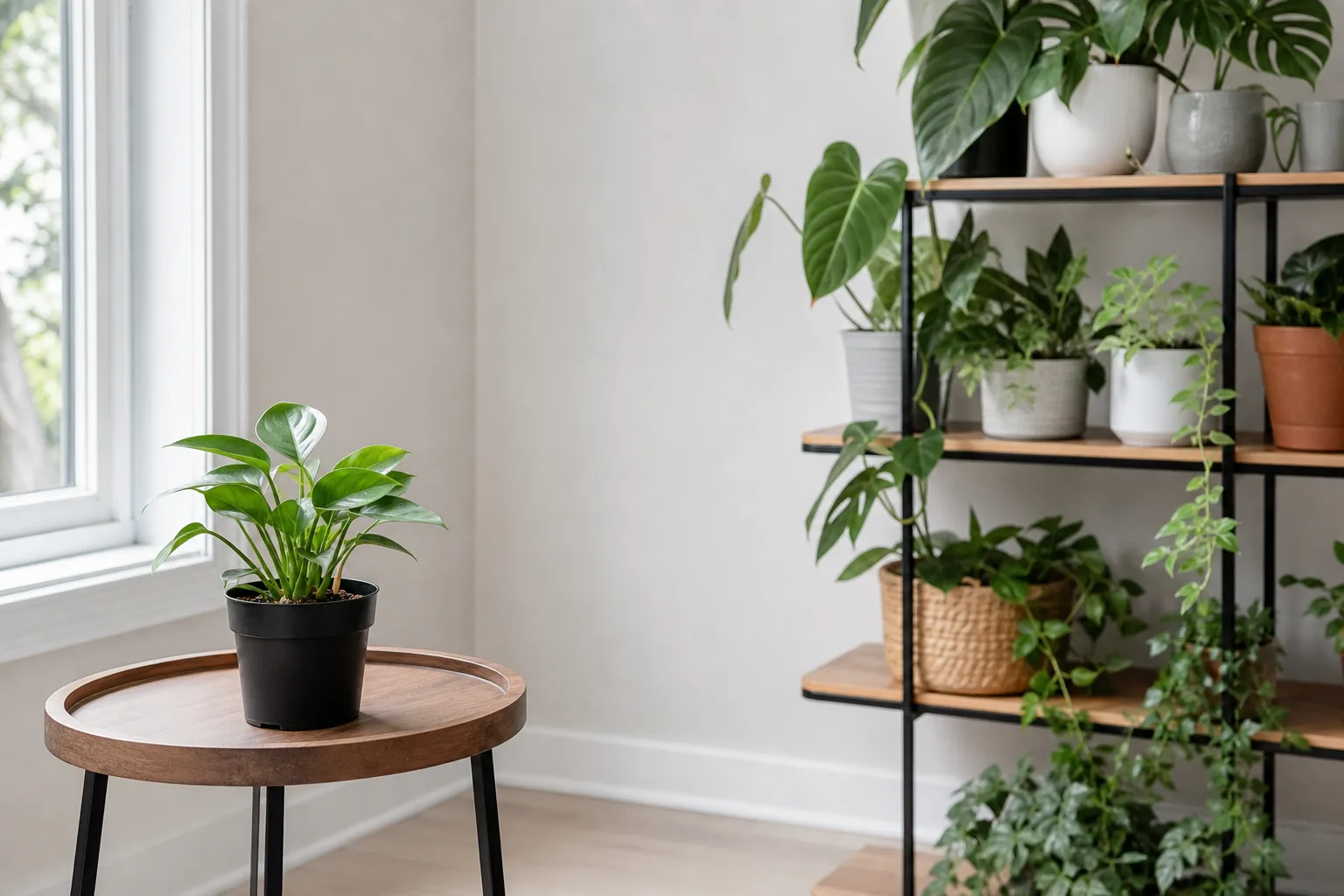
Quarantine New Plants
Most indoor thrips problems begin with an infested plant brought into the collection. A plant from a nursery, grocery store, plant swap, or outdoor patio can carry thrips without obvious symptoms. The population may be small and the damage invisible on day one, but once the plant enters a warm indoor space without natural predators, generations can build quickly.
University of Maryland Extension recommends quarantining new plants and inspecting them during this period. (University of Maryland Extension) Colorado State University Extension advises a minimum three-week quarantine for new plants, with a careful inspection at the end to confirm pest-free status. (Colorado State University Extension) During quarantine, keep the plant in a separate room and inspect new growth, leaf undersides, and flowers at least twice before integrating it with your collection.
Weekly Monitoring and Good Culture
A weekly inspection routine prevents small thrips populations from becoming full-blown infestations. Check new growth first, then leaf undersides, then stems and petioles. Look for the early signs — a few faint silver streaks, one or two black specks, or the first hint of distortion on emerging leaves. The earlier you catch thrips, the fewer treatment cycles you need.
Avoid over-fertilizing with nitrogen. University of Maryland Extension explains that excess nitrogen promotes rapid, tender growth which is often more attractive to thrips and other insect pests. (University of Maryland Extension) A plant pushing soft, lush foliage is sending up a welcome sign.
Maintain good airflow and avoid crowding plants together. When leaves press against each other, thrips move freely between plants, and sprays cannot reach protected surfaces. Spacing plants also makes inspection easier and reduces the humid, stagnant microclimate that favors many pest and disease problems.
Using Pesticides Safely Indoors
Indoor pesticide use requires extra caution because homes are less ventilated than outdoor spaces and may contain children, pets, and aquariums. The National Pesticide Information Center emphasizes reading the entire label and using only products labeled for the pest, the plant type, and indoor use. (National Pesticide Information Center)
Indoor pesticide safety checklist:
- Confirm the product label allows indoor use on ornamental plants and names thrips as a target pest
- Move children and pets out of the treatment area until sprays are fully dry and any label re-entry interval has passed
- Protect aquariums — turn off air pumps, close tank lids, and cover tanks before spraying nearby; NPIC advises preventing airborne pesticide from entering tank pumps (National Pesticide Information Center)
- Ventilate the room during and after application
- Test on a small leaf area first, especially on ferns, calatheas, begonias, and fuzzy-leaved plants that may be sensitive to oils and soaps
- Never exceed label rates or mix products
- Store concentrates locked away from children and pets
There is a point where discarding a plant is the right decision. If the infestation is severe, the plant is inexpensive or easily replaced, treatments have failed after consistent effort, or thrips are spreading to healthier plants despite isolation — discard the plant. One badly infested plant can cost you an entire collection.
Related Guides
- How to tackle indoor plant pests at home — identification and treatment for the full range of indoor pests
- Integrated pest management indoors — weekly treatment schedule, log template, and repeat-application discipline
- Houseplant diseases identification and treatment — when symptoms point to fungal or bacterial problems, not thrips
- Monstera pest and disease guide — species-specific thrips diagnosis for aroids
- Indoor plant watering basics — moisture management that keeps plants resilient against pests
Conclusion
Thrips control succeeds when you work with their life cycle, not against it. Isolate the affected plant, rinse or remove the visible population, treat with a product labeled for thrips, and repeat on schedule until every generation is interrupted. One thorough inspection is not enough; two to four weeks of clean new growth is the real finish line.