4 Types of Pole Pruners and How to Choose One
Choose a manual pruner, pole saw, pole hedge trimmer, or powered pole saw by the cut you need. Compare reach, weight, limits, and safety before buying.
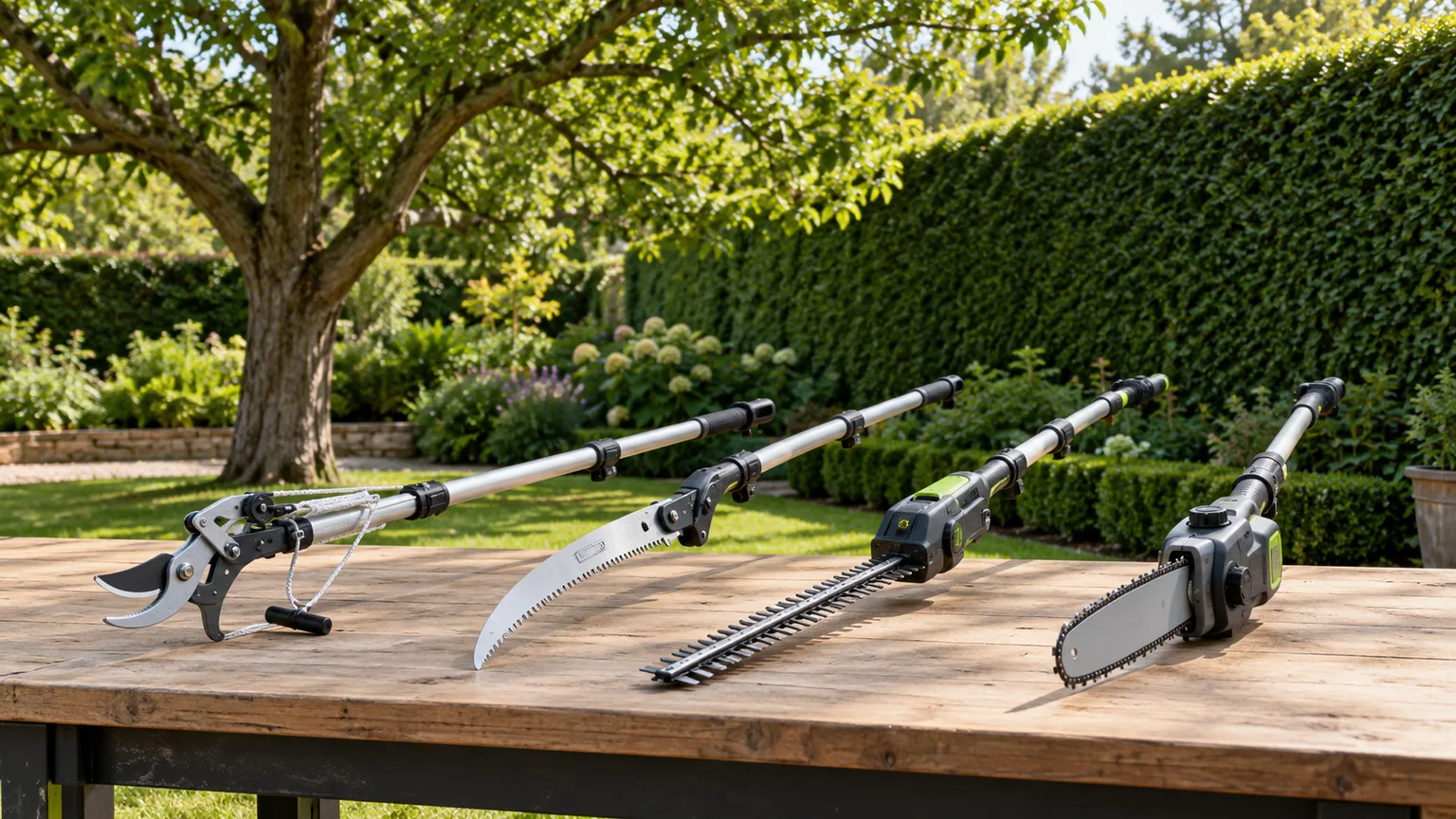
The right pole pruner depends on what you need to cut. A bypass head clips a small branch, a manual pole saw cuts a thicker woody limb, a pole hedge trimmer shears a row of fine shoots, and a powered pole saw uses a chain for heavier pruning. Those heads are not interchangeable in practice: choosing the wrong one can leave ragged cuts, damage the hedge, or make the tool too difficult to control.
For most occasional garden work, start with the lightest tool that can make a clean cut from firm ground. Do not shop by the longest advertised reach alone. A long pole with a heavy head can flex, twist, and tire your shoulders; a compact manual saw that you can guide accurately may be the better tool for a higher branch.
The quick answer: choose by the cut, not maximum reach
Use a manual bypass pole pruner for small, reachable twigs where a scissor-like cut matters. Choose a manual pole saw for isolated woody branches beyond arm’s reach, a pole hedge trimmer for shaping many small shoots along a hedge, and a powered pole saw only when the limbs are too thick or numerous for manual sawing and you can operate the saw safely.
| Tool type | Best fit | Main limitation |
|---|---|---|
| Manual bypass pole pruner | Small live twigs and shoots | Hard to cut larger or dry wood cleanly |
| Manual pole saw | Selective cuts on woody branches | Requires controlled strokes and a clear view of the cut |
| Pole hedge trimmer | Fine growth across a hedge or shrub surface | Not for removing individual thick branches |
| Powered pole saw | Repeated or larger limb cuts within the tool’s rating | Heavier, noisier, and more hazardous; operator skill matters |
What counts as a pole pruner?
“Pole pruner” is an umbrella term for tools that let you reach a branch from the ground. In some catalogs, the term means only a pole-mounted bypass jaw with a rope or sliding handle. Gardeners also use it loosely for manual pole saws and powered pole saws, while “pole trimmer” commonly means a hedge-trimming blade on an extension shaft.
Before comparing products, look at the cutting head. A pair of overlapping blades closes around a small stem; a saw blade removes wood with repeated strokes; a long reciprocating bar trims many fine shoots; and a chain moving around a guide bar cuts thicker woody growth. A familiar brand name or a long pole does not tell you which job the head can do.
1. Manual bypass pole pruners: small branches with clean cuts
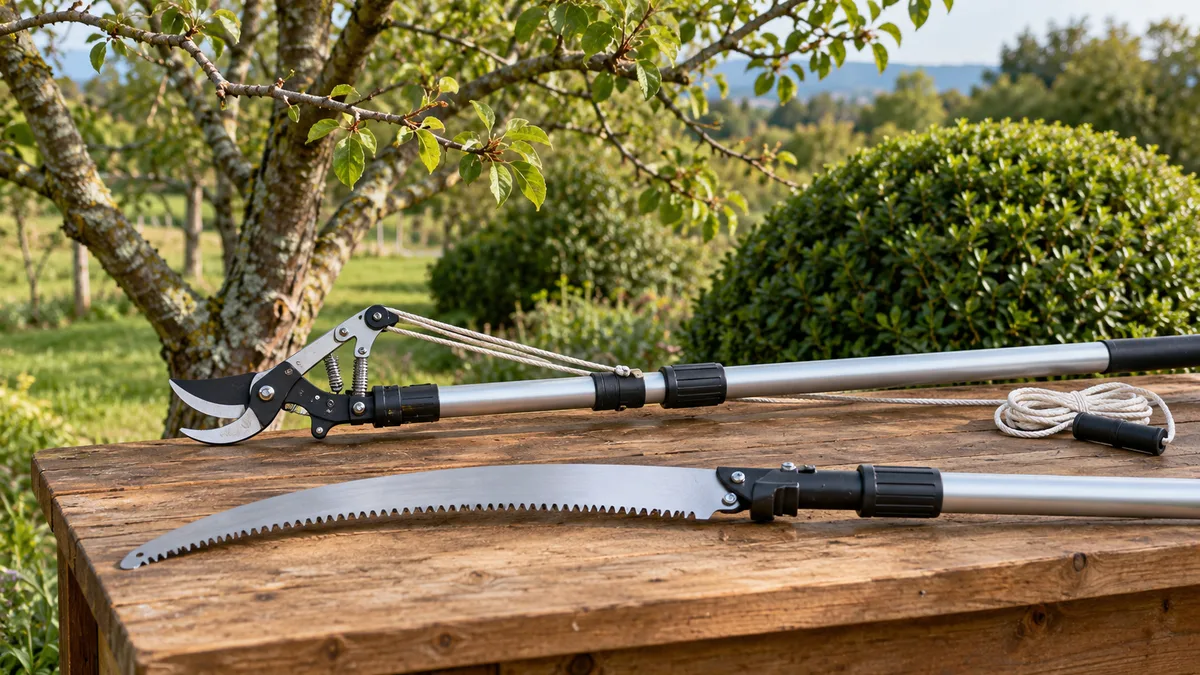
A manual bypass pole pruner has a sharp blade that passes a hooked counter-blade, much like hand pruners. The head may close through a pull cord, rope, lever, or internal linkage. The specific mechanism changes the feel of the pull, but the goal is the same: cut a small stem in one controlled motion while keeping your feet on the ground.
This is the most useful style for pruning light growth in a dense shrub, removing a few small branches from a young tree, or reaching a dead twig that is otherwise awkward to access. Bypass blades are suited to live stems because they slice rather than press the full cut surface against a flat anvil. Do not force the jaws around a branch that exceeds the maker’s stated capacity; the pole can twist while the blade stalls, and the resulting crushed or torn stub may be harder for the plant to compartmentalize.
Published ratings are model-specific. For example, one extendable Fiskars pole saw-pruner lists a 7-to-12-foot pole and a jaw capacity of up to 1 inch, then supplies a separate saw blade for thicker branches.Fiskars’ model details Treat that number as the tool’s stated upper limit under its own conditions, not a promise that every 1-inch branch will cut easily. Hard, dry, knotted, or poorly positioned wood can be much more demanding than a fresh straight shoot.
Some gardeners prefer a rope-operated head because the cutting action is direct and familiar; others prefer a lever or rope-free mechanism that keeps a loose cord from catching on nearby branches. Test the closing action if possible. Check whether the blade opens freely, whether the rope rubs on the shaft, and whether you can position the hook without pushing the pole sideways through the canopy.
2. Manual pole saws: controlled cuts through woody branches
A manual pole saw is a pruning saw fixed to a long shaft, often with a curved, toothed blade. It is designed for a branch that is too large for a bypass jaw but still small enough for you to guide the saw from the ground. Some kits let you replace the saw with a pruner head, but each attachment still has its own cutting limit.
The main advantage is control without a motor. You can start with short, light strokes to establish a groove, then lengthen the pull once the blade tracks. Many pruning saws cut most efficiently on the pull stroke, but tooth direction varies, so follow the blade’s instructions. A hook or branch catcher can help retrieve a loose cut limb on some designs; it is not a reason to tug hard on a limb that is hung up or under tension.
The trade-off is that pole length magnifies small movements. If the blade skips, flexes, or keeps slipping from the kerf, stop and reset your stance rather than leaning the shaft harder into the branch. A pole saw is useful for a few precise cuts; it is not a good substitute for an arborist’s control when the limb is heavy, cracked, or positioned above a roof, path, or fence.
Manual pole saws can also be easier to maintain than powered models: inspect the teeth, clean sap and debris, and replace or sharpen the blade according to the maker’s directions. However, a dull blade is not merely slower. It encourages forceful pulling, which makes it harder to keep the cut where you intended.
3. Pole hedge trimmers: repeated fine cuts across hedges
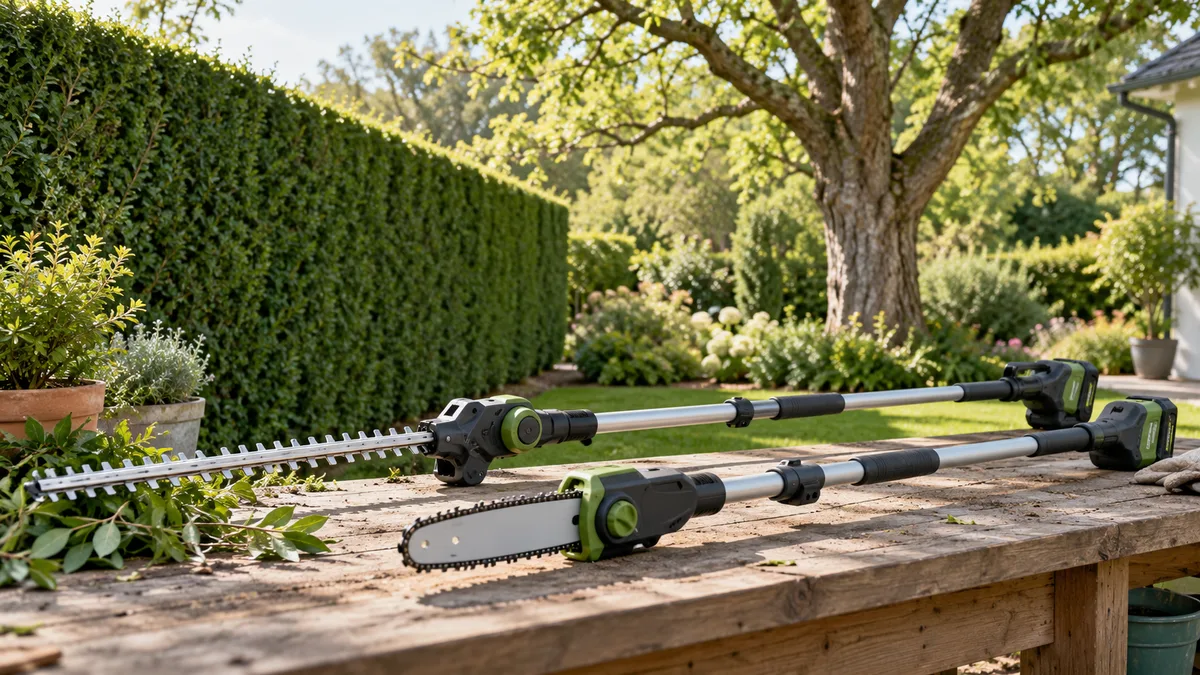
A pole hedge trimmer has a long, narrow reciprocating blade mounted on an extension shaft. Many heads pivot so you can set the blade for the top or side of a tall hedge. Manufacturers describe these tools for high or wide hedges; for instance, Husqvarna’s pole-hedge-trimmer range includes fixed-shaft and telescoping models with adjustable cutting heads.Husqvarna’s pole hedge-trimmer guide
Use this tool when the job is to trim a surface: shorten lots of fine, flexible shoots to maintain a hedge line or tidy a shrub that is already shaped. The long bar makes a continuous, even pass more efficient than clipping each small shoot with a pole pruner. It can also reduce the need to reach overhead with a standard hedge trimmer.
It is the wrong tool for a large branch inside the hedge or a selective cut near a branch collar. The blade can snag on stems that exceed its designed cutting gap, and its fast shearing action may leave torn or crushed wood. University of Minnesota Extension distinguishes hedge shears, which are intended for hedges and small or succulent stems, from saws used for larger branches.UMN Extension’s pruning-tool guidance
Consider hedge structure before reaching for this tool. If the plant needs selective thinning, renewal pruning, or removal of a few older stems, a hedge trimmer may create an even surface while leaving the crowded interior untouched. A pole trimmer is best for an established shearing routine, not for correcting a shrub that has outgrown its space.
4. Powered pole saws: faster cuts on larger limbs
A powered pole saw, often called a pole chainsaw or pole pruner, has a small chain running around a guide bar at the end of a shaft. It can cut a woody branch more quickly than a manual saw and can be useful for repeated pruning on a larger property. Battery, corded-electric, and gas models exist, although the exact range and configuration vary by manufacturer.
The motor does not make a branch safe to cut. A powered saw can remove wood quickly, but chain movement, kickback, binding, falling limbs, vibration, and head weight raise the consequences of a poor setup. A STIHL battery pole-pruner listing, for example, identifies a professional model with a rigid shaft and says it is intended for tree care, forestry, orchard, and municipal work.STIHL’s pole-pruner range That is a useful reminder that a powered pole saw is not automatically a beginner tool just because it is battery-powered.
Use a powered pole saw only for a cut within the tool’s manual and your training. Keep the bar out of the dirt and away from fences, nails, and other hard objects; inspect the limb for pressure or tension; and never force the chain through a binding cut. Do not stand directly underneath the branch. If you cannot predict where it will fall or move out of the drop zone, leave the job to a professional.
The shortest usable shaft and lightest head are usually easier to control than maximum extension. Compare the complete tool’s weight, balance, shaft stiffness, battery position, and shoulder support—not just its cutting speed. A pole saw that feels manageable for a short test can become exhausting when held at an angle through several cuts.
Battery, corded, or gas: a drive-source decision
For a homeowner making occasional cuts, a battery model is convenient when it is compatible with a battery platform you already own and its run time is enough for the job. It starts without pulling a cord or mixing fuel, but the battery adds weight, costs extra in some kits, and can run down during repeated cuts. Battery performance also differs among models, so compare the manufacturer’s stated run time and the conditions used to measure it.
A corded-electric pole saw avoids battery run time but tethers you to an outlet and makes cord routing part of the work zone. Never let the cord pass through the branch-drop area, touch the blade, or become a trip hazard. If the cord cannot stay clearly behind you and away from the cutting head, choose a different tool or postpone the cut.
Gas models can suit longer work sessions or professional use where refueling and maintenance are part of the routine. They tend to bring more noise, vibration, exhaust, and upkeep than a battery tool. The right source is the one that fits your scale of work and ability to control the complete tool; buying more power than the job requires does not improve a pruning cut.
Pole-pruner comparison by job
Use this table to narrow the type first, then compare individual models. The word “reach” is not a cutting-capacity rating, and the maximum branch diameter on a package is not a universal pruning rule.
| If your job is… | Start with… | Why | Check before buying |
|---|---|---|---|
| A few small green shoots above arm height | Manual bypass pole pruner | Quiet, simple, precise when the branch fits the jaw | Fresh-wood rating, head angle, cord or lever action |
| One or two larger woody branches | Manual pole saw | Slower but lets you track a selective cut | Blade length, tooth direction, pole stiffness |
| A long, flat hedge top or broad side | Pole hedge trimmer | A long cutting bar covers many fine stems | Bar length, pivot range, total weight |
| Several limbs beyond manual-saw capacity | Powered pole saw | Chain drive cuts faster through larger wood | Tool weight, training, PPE, chain maintenance, fall zone |
Size the tool to branch diameter and wood condition
Start by estimating the largest branch you actually need to remove, then check the exact model’s rated cutting capacity. Manual bypass pole pruners are generally for small stems; some models publish limits around an inch, but this varies by head design and whether the wood is fresh or dry.The Fiskars pole saw-pruner specifications A larger branch usually calls for a saw head, not extra force on the pruner rope.
Diameter alone is not enough. Hard or dry wood resists a jaw cutter differently from pliable green growth, while a branch that is bending or under compression can pinch a saw or spring when severed. For a hedge, the number and thickness of fine shoots matter more than one isolated woody stem; for a tree, the branch’s weight and attachment matter as much as its thickness.
Extension recommendations for using a three-cut method vary by threshold. Colorado State University Extension recommends it for branches over 1 inch, while other extension guidance describes the method for larger limbs at different sizes.Colorado State’s pruning-cut guide UMN Extension’s large-branch instructions The practical test is whether the branch could tear bark as its weight drops. If it could, remove weight with separate cuts before making the finishing cut just outside the branch collar—but do this only when you can place each cut accurately and keep the falling section controlled.
Never exceed the manufacturer’s limit to save time. If the branch is beyond the rating, too high to see clearly, or large enough that its fall could injure someone or damage property, the decision has moved beyond “which pruner?” to “who can safely do this work?”
Choose working reach and weight together
The printed pole length and the height of the branch above the ground are not always the same measurement. Product descriptions may report shaft length, extended length, or approximate cutting reach. Cutting reach can include the operator’s height and the tool head, so check how a manufacturer defines the figure before comparing two models.
Stand on level ground and picture the actual cutting position. You need enough pole to place the head without stretching, but you also need the shaft short enough to hold steady and guide the blade. At full extension, an aluminum or fiberglass pole may flex; a long shaft also gives wind, nearby branches, and small hand movements more leverage over the cutting head.
Weight matters most when the head is held above shoulder height or out in front of you. Compare the tool’s weight with battery and cutting attachment installed, and look for balance near the grip rather than the bare-shaft number. If possible, hold a showroom model in the position you will use; a tool that feels light vertically may feel tiring when angled across a hedge top.
For one isolated branch, a manual tool with modest reach may be easier and less expensive than a powered model. For repeated work over a large hedge or orchard, the time saved by a powered tool may be worthwhile if the operator can handle its weight throughout the job.
Fixed, sectional, or telescoping pole?
A telescoping shaft adjusts to different heights and can be shorter for storage or low branches. The clamp or locking sleeve becomes an important part of the tool: it should lock securely, release intentionally, and stay clear of the cutting action. If the pole slips under load or twists at the joint, stop using it until the connection is repaired.
Sectional poles add or remove lengths, which gives you a few stable configurations rather than continuous adjustment. Fixed-length models can feel more rigid and have fewer moving joints, but they may be awkward to store or too long for some jobs. For a tool you will use in tight branches, a shorter rigid shaft may offer better accuracy than maximum telescoping reach.
Fiber-reinforced poles can reduce weight compared with some traditional materials, but construction quality, wall thickness, and connection design matter more than the material label alone. Check how the sections lock and whether replacement poles, ropes, blades, and heads are available.
Adjustable heads and interchangeable attachments
An adjustable head can let you align a bypass blade or saw with a branch rather than twisting your shoulders to force the pole into position. It is useful only if the angle locks firmly and does not shift while cutting. A loose or awkward joint can make the head harder to guide, especially when the shaft is fully extended.
Interchangeable systems can save storage space and let one pole serve a pruner, saw, or fruit picker. Confirm compatibility by model number; two heads that look similar may not fit the same shaft or locking collar. Consider how often you will switch attachments, whether each head has a real use in your yard, and whether replacement parts are easy to find.
A combination saw-and-pruner head is convenient for small jobs but can be heavier and wider than either dedicated head. In a crowded canopy, the extra hardware may catch on twigs before the blade reaches its target. If you mostly prune small live growth, a compact jaw head is easier to position; if you mostly saw, a dedicated saw can be simpler to control.
How to make a cleaner pruning cut from the ground
Before raising the tool, decide whether you are removing an entire branch, reducing it to a suitable side branch, or trimming a hedge surface. Do not make a cut simply because a branch is reachable. For trees, a removal cut should preserve the branch collar instead of cutting flush to the trunk or leaving a long stub; the branch collar helps limit decay entering the trunk.Colorado State University Extension’s cut guidance
Position the head so you can see where the blade or chain meets the branch. With a manual saw, start slowly until the teeth track in a stable groove. With a bypass pruner, seat the branch fully in the jaws before pulling the rope or lever. Avoid bending the pole sideways to reach around an obstacle; move to a better position or skip the cut.
A heavy limb can strip bark as it falls. Extension guides describe the three-cut approach: an undercut some distance from the trunk, a second cut farther out to remove the limb’s weight, and a final cut just outside the collar.Colorado State University Extension Penn State Extension The exact distance depends on the branch and the guidance used. A pole saw can make it hard to see the collar and control a falling section, so do not attempt the technique overhead if you cannot make each cut accurately.
When trimming a hedge, take light passes and step back to inspect the shape. A clean flat plane is not always the healthiest geometry: if the hedge is much wider at the top than the bottom, lower foliage can be shaded. Use selective pruning tools when the plant needs interior thinning rather than another surface trim.
Safety checks before you raise the pole
Walk around the tree or hedge first. Look for dead hangers, cracked limbs, rot, leaning branches, wires, windows, roofs, paths, vehicles, pets, and people who might enter the drop zone. Branches can fall or swing in directions that are hard to predict, especially when they are caught in neighboring limbs.
Work from stable ground, keep your body out from under the limb, and do not overreach to finish a cut. Long tools can pull you off balance when the head catches or the branch shifts. A ladder does not make a pole tool safer: the shaft adds leverage, and a powered saw on a ladder is a particularly poor combination. University of Minnesota Extension warns against using chainsaws from ladders or to reach above shoulder height and recommends leaving large-tree pruning to qualified professionals.UMN Extension
Wear eye protection for chips and debris, gloves for grip, sturdy closed footwear, and a hard hat when falling material is possible. Powered saws require the manufacturer’s specified protective equipment and operating procedures; OSHA’s chainsaw safety guidance emphasizes PPE, stable footing, checking the saw, and watching for branches under tension.OSHA Chainsaw Safety Keep bystanders well away and remove the battery or disable the tool before clearing a jam or adjusting the chain.
Treat power lines as a stop-work boundary. Do not use a pole pruner, ladder, or powered saw on a limb that is near or over an energized line; contact the utility or a qualified line-clearance tree professional. OSHA’s workplace standard treats trimming within 10 feet of energized lines as specialized line-clearance work with training and equipment requirements.OSHA’s line-clearance guidance That rule is not a homeowner’s distance-measuring shortcut: the voltage, line type, branch movement, and tool can all change the hazard.
When to stop and call a certified arborist
Hire a qualified arborist when the branch is large, high, dead, cracked, decayed, storm-damaged, or likely to fall onto a structure or public area. Also call when the cut is close to a utility line, when you would need to climb, when the tree has a split trunk or hanging limbs, or when the work would remove a major leader or large portion of the canopy. Penn State Extension advises leaving climbing and hazardous large-tree work to trained professionals with the proper equipment and knowledge.Penn State Extension’s tree-pruning guidance
An arborist is not simply someone with a chainsaw. Ask about credentials, insurance, the proposed pruning objective, and whether the work will preserve the tree’s natural structure. For work near electrical lines, confirm that the contractor is qualified for line-clearance work rather than assuming a general tree crew can safely approach the wires.
The tool choice should make a safe, precise job possible from the ground. If you cannot see the cut, control the branch, and predict where it will land, stop. Renting or buying a more powerful pole saw does not fix an unsafe location or a branch beyond your skill.
Keep blades, ropes, and chains ready for the next cut
Clean sap and dirt from pruner blades and saw teeth after use, then dry the tool before storage. Keep bypass blades sharp so they cut rather than crush; inspect ropes, pulleys, locks, and telescoping clamps for fraying or wear. A damaged rope or pole joint can fail when tension is applied.
For a powered pole saw, follow the manual for chain tension, bar oil, cleaning, sharpening, and battery care. Remove the battery before inspecting the chain or clearing debris. A chain that is dull, too loose, or poorly lubricated creates more heat and effort and can make the saw harder to control.
Store the pole collapsed or separated only as the maker recommends, with the cutting head covered. Keep replacement blades and attachments compatible with the exact model. If a pole no longer locks securely or a head shifts when loaded, take it out of service rather than compensating with a tighter grip.
Common buying mistakes to avoid
Buying for the tallest advertised reach. Maximum extension may be uncomfortable to control, and listed “reach” may not mean the same thing across brands. Match a tool to the branches you can safely reach, not to the highest number on a product page.
Choosing a jaw pruner for every branch. Bypass jaws are useful for small stems; a saw head is usually the better choice for larger wood. Pushing a branch into an undersized jaw risks a crushed cut and a pole that twists under load.
Using a hedge trimmer as a branch saw. The long bar is designed to shear many small shoots across a surface, not to remove a major branch near its union. Selective pruning and hedge shaping are different jobs.
Ignoring total weight and balance. A long extension pole can feel much heavier when held at an angle than the package suggests. Try the grip, pole locks, shoulder strap, and head position before buying, especially if you have limited upper-body strength.
Assuming more power means a better cut. A chainsaw head can remove wood quickly, but speed does not help if you cannot place it accurately or control the fall. For a handful of small branches, a manual tool may be quieter, easier to maintain, and more precise.
Skipping replacement-part checks. Blades, ropes, chains, and batteries wear out. A tool with replaceable parts and a clear manual may serve longer than an inexpensive model with no available head or shaft components.
Conclusion
Choose a pole pruner by matching its head to the job: bypass jaws for small shoots, a manual pole saw for selective woody branches, a pole hedge trimmer for fine growth along a hedge, and a powered pole saw for heavier cuts that remain within the tool’s rating and your ability. Then check working reach, total weight, balance, shaft locks, and the maker’s capacity before you buy.
The safest choice is often the least powerful tool that makes a clean, controllable cut from stable ground. If the branch is heavy, damaged, over a structure, near a power line, or impossible to guide accurately, hire a qualified arborist instead of extending the pole farther.



