Tree Burls: What They Are and What Causes Them to Grow
Find out what a tree burl is, why its exact cause can be hard to identify, how it differs from galls and knots, and why it should stay on a living tree.
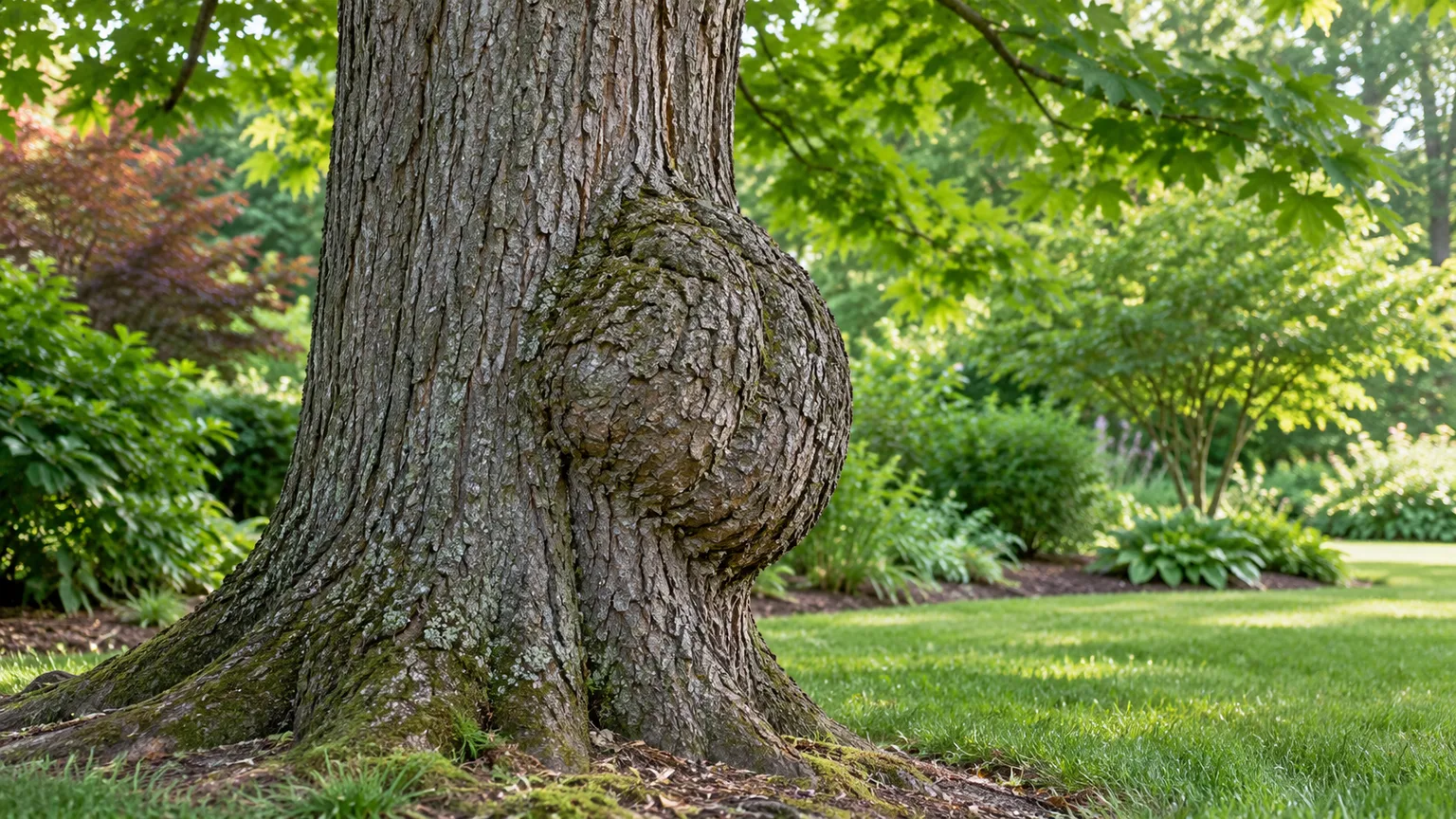
A tree burl is a rounded, irregular swelling of woody tissue that grows as part of a tree’s trunk, branch, or sometimes root. The bark usually continues across its surface, and the tree may keep growing normally around it. A burl can be startling because it looks like a large knot or tumor, but the bump alone usually does not mean the tree is sick or unsafe.
The short answer to what causes a tree burl is that some part of the tree’s growth becomes unusually active and produces wood in a concentrated, irregular pattern. Researchers and extension specialists describe several possible triggers, including injury, insects, infection, and genetic factors, but the exact cause of a particular burl is often impossible to identify after it has grown. That uncertainty matters: a burl is a visible feature, not a diagnosis of the tree’s overall health.
If you spot one in your yard, leave the bark intact, take a photo, and look at the tree as a whole. Do not carve, drill, or cut the burl away. If you also see a crack, large dead limb, decay sign, or a noticeable change in the tree’s stability, have a qualified arborist assess the tree rather than trying to diagnose the swelling from one close-up.
What Is a Tree Burl?
A burl is an abnormal but integrated mass of wood. It is not an object attached to the trunk like a nest, shelf fungus, or insect casing; it develops from the tree’s own tissues and can become part of the trunk, a large branch, or a root. Some burls are small knobs. Others form broad, lobed swellings that wrap partway—or, in unusual cases, around much of a trunk.
The University of Connecticut Home & Garden Education Center describes burls as hard, woody growths with the tree’s normal bark over the outside. Inside, their growth pattern differs from the relatively straight grain of ordinary trunk wood. The burl’s shape and grain are irregular, so two burls—even on the same species—do not necessarily look alike.
“Burl” and “burr” are regional spellings for similar kinds of woody swelling, but the word can also be used differently in specialized settings. In everyday tree care, a homeowner usually means a conspicuous, rounded growth on the trunk or a large limb. The important practical point is that you should not cut into it to confirm what it is; the diagnosis should be based on the outside appearance, location, and surrounding tree condition.
How Does a Tree Burl Form?
Trees add new wood through growth tissues beneath the bark. A burl develops when that local growth no longer follows the tree’s usual pattern, producing a dense swelling rather than a straight extension of a trunk or branch. University of Connecticut guidance describes abnormal cell proliferation in the xylem and notes that injury, insect feeding, fungal or bacterial infection, and genetic factors may be involved.
One proposed pathway involves dormant or adventitious buds—small growth points that can remain inactive in woody tissue. If many of them begin growing close together, the resulting wood can have numerous tiny knot centers and swirling grain. That explanation helps make sense of the woodworker’s view of a burl, but it should not be treated as a complete recipe that explains every burl. Different species and different growths may not share one initiating mechanism.
The initiating event is also difficult to reconstruct. A storm wound, branch loss, insect feeding, or infection may have happened years earlier, and the tree may have covered or grown around the affected area. A genetic tendency could contribute in some cases. By the time a burl is obvious, neither a homeowner nor a single photograph can reliably tell which factor started it.
The careful conclusion is that a burl records localized abnormal growth, while its original trigger often remains unknown. The Gardening Know How overview likewise notes that no single cause has been established. Be skeptical of claims that every burl proves a specific fungus, pest, or past injury; the shape alone cannot support that conclusion.
What Does a Burl Look Like?
Most burls appear as a swollen, rounded or uneven area that interrupts the trunk’s normal outline. The surface may be lumpy, ridged, or contorted, and the bark may be patterned differently from the surrounding trunk. A burl can also appear at the base of a limb or near the root flare, so location by itself does not confirm or rule it out.
The key general clue is continuity: bark typically covers the growth as part of the tree. The outer texture is not a perfect test, though. Bark varies by species and age, and some burls are weathered or deeply furrowed. Do not peel bark back, scrape the surface, tap it with a tool, or make a small cut to see whether the wood is solid; those actions can injure the living tissue and still may not settle the diagnosis.
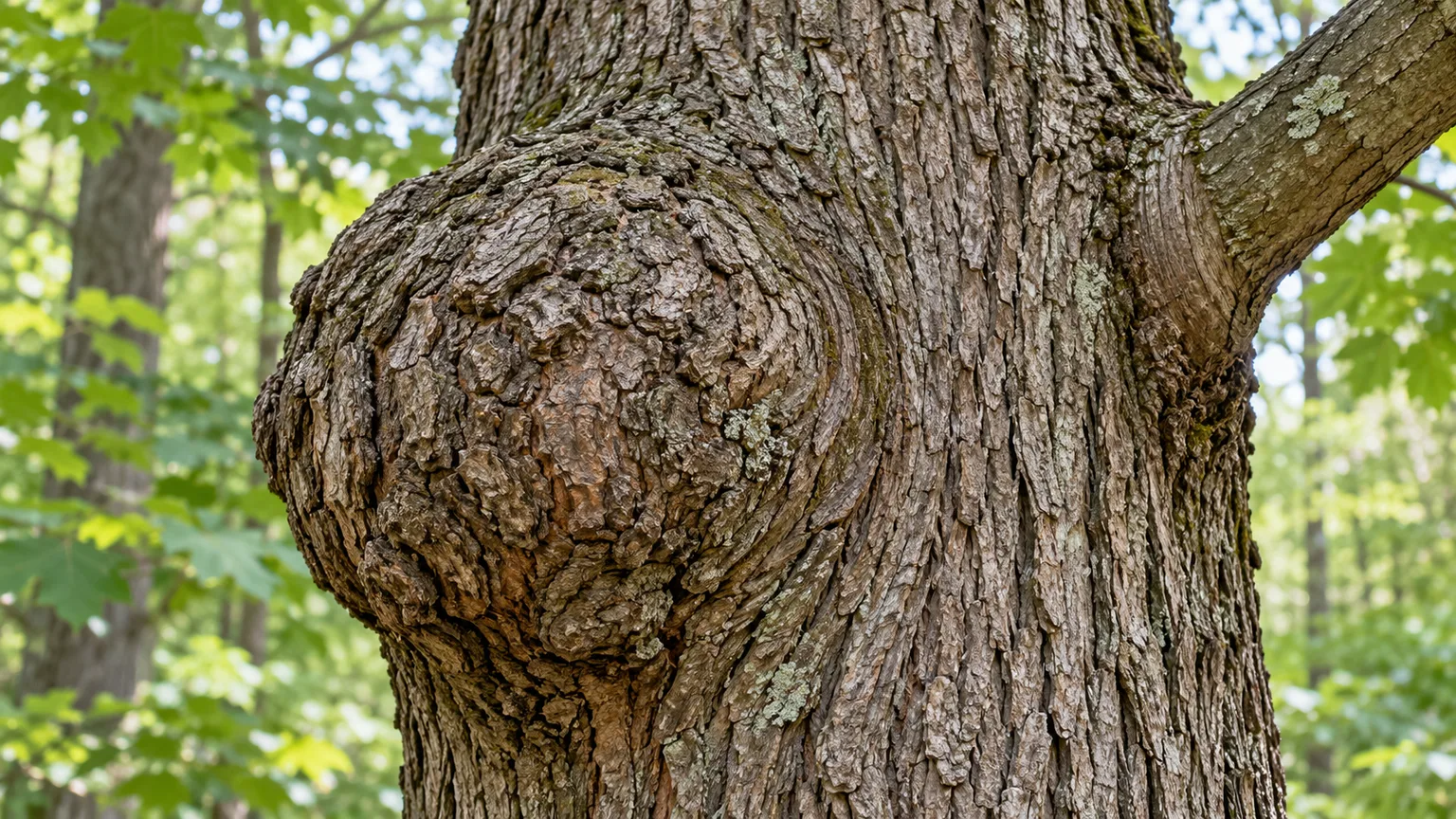
The size can change slowly as the tree adds wood, but a visible increase does not automatically mean disease is spreading. Note whether the surrounding bark remains intact, whether the tree’s crown is leafy and balanced for that season, and whether other symptoms appear. A tree’s health is judged from more than one surface feature.
Burl vs. a Branch Knot, Gall, or Canker
Several different tree structures can look like an unusual lump. Their differences are useful clues, but they are not a home laboratory test. The UConn extension comparison explains that some woody galls can be confused with burls and that the causes and implications can differ.
| Growth | Typical clue | What that clue can—and cannot—tell you |
|---|---|---|
| Burl | A broad woody swelling integrated with the trunk or large limb, often covered by normal bark | Consistent with a burl, but appearance alone cannot identify its trigger or prove that the rest of the tree is sound. |
| Branch knot or collar | A swelling centered where a branch joins or once joined the trunk; the branch direction or old stub may be traceable | Usually part of ordinary branch structure or its growth history, not the same as a broad burl. |
| Gall | An abnormal growth associated with a particular insect, mite, fungus, or bacterium; some are small, rough, clustered, or discolored | Galls vary widely. A few are harmless, while others affect the host; identification depends on the organism and tree. |
| Canker | A dead or injured patch of bark that may look sunken, cracked, loose, or surrounded by discolored tissue | A canker can indicate a disease or wound that needs diagnosis, especially when bark is dying or branches are declining. |
A branch knot follows a branch
A knot in wood commonly marks the base of a branch that grew from or was enclosed by the trunk. On a living tree, you may see a collar, stub, or clear branch axis that gives the swelling a direction. A burl, by contrast, is usually a larger mass whose outline does not read simply as the base of one branch.
This is a distinction, not a guarantee. A branch union can become enlarged, and a burl can form near a branch, so the two features may overlap. If the swelling is small, stable, and covered by intact bark while the tree otherwise looks normal, observation is reasonable; if it is split, decaying, or above a target area, ask an arborist.
Galls and cankers need a different assessment
Galls are growth responses associated with particular organisms or interactions; cankers are damaged or diseased areas of bark and underlying tissue. Some galls have rough, ridged, or wart-like surfaces, while a canker may be sunken or have a dead margin. But a photo may not reveal whether a growth is solid wood, infected tissue, an old wound, or more than one thing at once.
The GardenersPath explanation of burr knots and crown galls is useful for one specific look-alike: orchard burr knots are clusters of adventitious root initials on some fruit-tree rootstocks, while crown galls are a different growth associated with a bacterial pathogen. Those fruit-tree terms should not be applied automatically to every rounded swelling on an oak, maple, or other landscape tree.
Do not cut a growth open to distinguish it. If it is soft, discolored, oozing, surrounded by dying bark, or accompanied by branch dieback, photograph it from several angles and contact your local cooperative extension office or an arborist for a proper identification.
“Burr knot” can mean something different on fruit trees
Apple growers may use burr knot for clusters of root initials on the above-ground portion of a rootstock. These can appear as dense, small bumps on stems, rather than the large, rounded trunk swelling most homeowners mean by a burl. If the tree is a young apple or another grafted fruit tree, mention the species and rootstock if known when you ask for help; management recommendations for an orchard condition are not the same as advice for a mature landscape-tree burl.
Are Burls Harmful to Trees?
Most burls are not a problem for a tree that is otherwise growing normally. University of Connecticut Extension says that many do not affect the health of a healthy tree and advises against removing them. UNH Extension’s discussion of tree burls makes a related practical point: even if a burl looks unattractive, cutting off a large one can create a substantial wound that may invite decay.
That does not mean every tree with a burl is automatically safe. A burl itself does not tell you how strong the trunk is, what is happening inside the wood, or whether a nearby limb could fail. A tree with a burl may also have unrelated root damage, a canker, a crack, a dead top, or a fungal decay structure. Evaluate those conditions separately rather than blaming the burl for every sign of decline.
Size is not a stand-alone risk rating either. A broad swelling on a mature tree can look dramatic yet be part of a stable, normally growing tree. Conversely, a smaller bump near a split union or a decaying trunk may be part of a situation that deserves attention. The target beneath the tree matters: a defect over a play area, driveway, public path, or occupied room deserves more caution than the same feature in an unvisited woodland.
Which Trees Commonly Develop Burls?
Burls can occur on many kinds of trees, but some species and regions seem to produce them more often than others. UConn Extension lists oaks, maples, willows, cherries, and elms as species that show a tendency in its region. That list is regional guidance, not a universal ranking; a burl on another species is still possible.
Coast redwoods are also well known for large basal growths, but a large root or trunk swelling on one species does not mean all burls share the same origin or function. Avoid using the tree species as proof of a cause. It can help an extension specialist narrow the possibilities, especially if paired with a clear photo of the whole trunk, the growth, and nearby leaves or branches.
How to Monitor a Burl Without Injuring the Tree
You do not need special equipment to keep an eye on a burl. Take a clear photo that includes the full tree and another closer view from a safe distance; include a ruler or familiar object only if you can do so without touching or climbing on the tree. Record the date, species if known, approximate height on the trunk, and whether the growth is on the main trunk, a branch, or near the root flare.
Repeat the same views later in the growing season or after a noticeable change. Comparing photographs is more useful than trying to remember whether the shape grew. Do not mark the bark with a knife, drive a nail into the trunk, remove moss, or attach a measuring tape tightly around it. If the burl is not easy to reach from the ground, leave it; climbing or using a ladder is not necessary for routine observation.
Look at the whole tree, not only the lump. Useful notes include whether the crown leafs out at the usual time, whether foliage is unusually sparse compared with neighboring trees of the same species, and whether major branches are dying back. At ground level, note fresh soil cracking or lifting near the roots, a new lean, open trunk cracks, detached bark, cavities, or fungal conks. None of these observations by itself proves the tree is hazardous, but they give an arborist better context than a close-up photo of the burl alone.
Keep routine care gentle. Avoid striking the trunk with a mower or string trimmer, piling soil or mulch against the root flare, and making unnecessary wounds nearby. There is no special fertilizer or spray that will flatten a burl, and trying one can waste money or stress the tree without addressing the question you actually have.
What to Do When You Find a Burl
If the growth is woody, bark-covered, and the tree’s crown and trunk otherwise appear stable, the best first response is usually to leave it alone. You can take a baseline photo and observe the tree during normal seasonal care. You do not need to paint it, cover it, or treat it as a pest outbreak just because it looks unusual.
If you are uncertain whether it is a burl, gall, canker, or branch union, start with a local cooperative extension office or a certified arborist. Send photos that show the tree at a distance and the feature close-up, and include the species, approximate age if known, when you first noticed it, and any recent construction, storm damage, pruning, or crown changes. A short description of those details is more useful than a photo with no context.
If the tree is near a house or regularly used area, consider the location and potential consequences without assuming that a burl itself is a hazard. A simple, intact growth with a healthy canopy may need no action. A crack or decayed area above a roof, walkway, or other target is a separate reason to have the tree assessed.
Why You Should Not Remove a Burl Yourself
Do not shave, saw, drill, or carve a burl from a living tree you want to keep. A burl is integrated into the trunk or branch; it is not a removable cap. Trying to detach it can remove bark and living wood over a wide area, creating a much larger injury than the visible bump suggests.
Trees do not repair wounds in the same way people heal a cut. They compartmentalize damaged wood and grow new tissue around it, but the injured wood remains inside the tree. Penn State Extension’s explanation of decay spread describes how a tree walls off damaged tissue and how decay organisms can move through wounded wood. A large, poorly placed cut can make that job harder; it may expose the tree to decay without making the trunk safer or healthier.
Do not apply tar, oil-based paint, or a generic wound sealant to a cut or cracked burl. Penn State Extension explains that oil-based sealants do not stop decay and can inhibit wound closure. If a burl seems to interfere with a walkway, structure, or planned landscape work, ask an arborist to assess the tree and explain the options before anyone cuts into it.
There is also no good reason to fell a healthy tree just because a burl might contain valuable wood. A burl’s internal figure is unknown until the wood has been cut, and a tree’s value as a living shade tree, habitat, or landscape feature may be far greater than a speculative slab. Any work on a standing tree should be based on a legitimate tree-care or safety need, carried out with the owner’s permission and by appropriately trained professionals.
Why Burl Wood Has Swirling Grain
Ordinary trunk wood tends to have a more predictable grain because the tree adds wood in organized growth layers. In a burl, growth is irregular and may wrap around clusters of tiny buds or other growth centers. When a burl is later milled, those changing directions can reveal eyes, curls, ripples, and swirls rather than long straight lines.
The result is called figure: a visible pattern that changes with the angle of the cut, light, and finish. Some pieces show dramatic contrast; others reveal less striking grain or contain checks, voids, bark inclusions, or decay. You cannot reliably judge the finished pattern from the outside of a living tree, which is one reason a burl should not be treated as a guaranteed windfall.
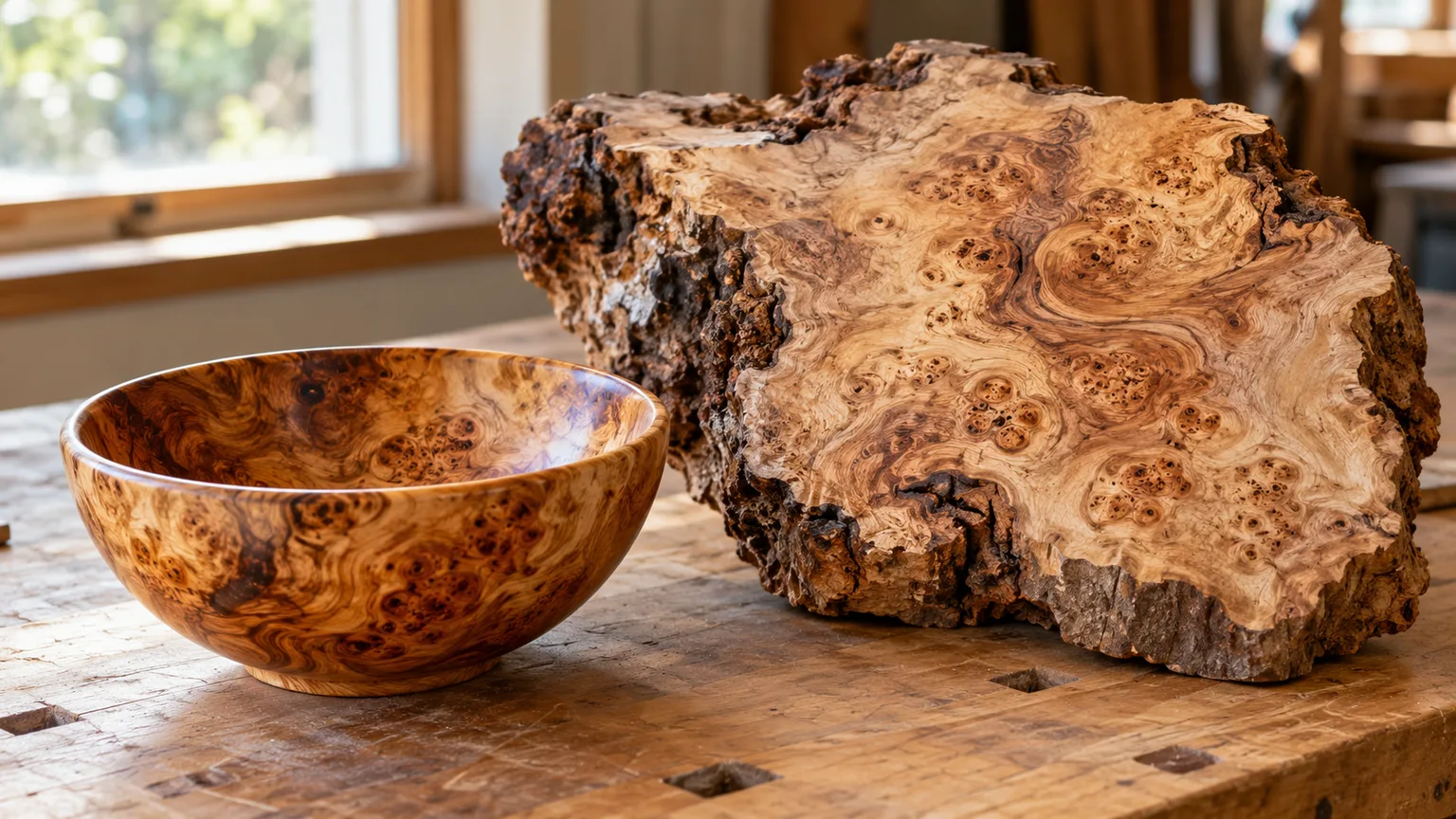
The term “bird’s-eye” is sometimes associated with burl-like patterns, but not every bird’s-eye figure is a large burl and not every burl has bird’s-eye figure. The UConn overview notes that aborted adventitious buds can create bird’s-eye patterns. Species, growth history, cut direction, and what the wood reveals after milling all influence the final look.
What Burl Wood Is Used For—and What Determines Its Value
Because the grain changes direction, burl wood is often used where a small area of distinctive figure can be seen rather than for long structural boards. Woodworkers may use suitable pieces for veneers, decorative furniture panels, cabinet inlays, bowls, boxes, instrument details, or turned objects. The same twisted grain that looks striking can also make milling and shaping difficult.
There is no universal price for a tree burl. Value depends on species, usable dimensions, figure, cracks or decay, how the material was dried, the amount of waste, and whether the piece is raw, milled, bookmatched, or finished. A large swelling is not automatically valuable, and an attractive pattern cannot be confirmed before processing. Treat online price examples as specific transactions or listings, not a reliable estimate for a burl in your yard.
If the wood interests you, look for finished objects or material sold by a reputable wood supplier who can explain where it came from. A seller should distinguish a burl from other figured wood and describe any stabilizing resin, checks, or repairs. For a tree on your property, consult a qualified arborist before considering any tree work; do not make the decision from a speculative wood price.
How to Source Burl Wood Responsibly
The responsible place to obtain burl wood is from a legitimate supplier or from a tree that has already fallen or is being removed for an independent, documented reason. Permission matters even when a tree appears dead or down: it may be on public land, a neighbor’s property, a protected site, or part of a managed forest. Local rules may restrict collection or cutting, so check before taking anything.
Salvage is still skilled work. A large downed tree, root plate, or trunk section can shift under tension, and chainsaw work carries serious hazards. Let the tree crew or an experienced sawyer handle any recovery that involves heavy wood, unstable material, climbing, or power equipment. For a homeowner, buying a finished bowl or a properly documented slab is safer and more transparent than trying to harvest a burl from a standing tree.
When to Ask an Arborist to Assess the Tree
Call a qualified arborist when the burl is accompanied by signs that could affect the whole tree’s stability or health: a fresh trunk split, widening crack, large dead limb, cavity, mushroom-like conk, extensive loose or dead bark, sudden lean, lifted soil near the roots, or rapid crown dieback. A change after a storm or construction deserves prompt attention, especially if a branch or trunk section could reach a roof, road, play area, or public path.
An arborist can assess the tree and its targets in person, distinguish a cosmetic growth from a separate defect, and explain whether monitoring or further evaluation is appropriate. For larger trees, work near a home, or questions about structural risk, seek an ISA Certified Arborist or another properly credentialed professional with relevant tree-risk experience. Do not climb, probe cavities, or cut a limb to test whether a tree is sound.
If the tree has normal seasonal foliage and no cracks, decay signs, or structural changes, a burl by itself is generally a reason to observe, not an emergency. If the tree is declining, the burl may simply be one visible feature among several; the arborist should evaluate the crown, trunk, roots, site, and targets together rather than making a diagnosis from the swelling alone.
Conclusion
A tree burl is a woody swelling formed by abnormal localized growth, often covered by the tree’s own bark. Injury, infection, insects, or inherited growth tendencies may play a role, but the exact cause is frequently unknown. Most burls on otherwise normally growing trees can be left in place; the safest response is to preserve the bark, watch the whole tree, and ask a qualified arborist about cracks, decay, decline, or a potential target beneath the tree.



