14 White Flowering Trees for Spring-to-Summer Color
Compare 14 white flowering trees by bloom window, mature size and site needs so you can choose one that fits your yard, climate, and tolerance for cleanup.
A white-flowering tree can be a spring showpiece, a small shade tree, or a summer-blooming native that flowers after the early magnolias are finished. The right choice depends as much on your site’s light, drainage, mature space, and tolerance for fruit as on the color of the flowers.
The list below keeps to trees and woody plants commonly grown in tree form. It spans early spring to summer, and several selections carry useful color, fruit, fragrance, or wildlife value after bloom. Flowering dates shift with region and weather, so use the timing as a sequence rather than a calendar appointment.
Start With the Site, Then Compare Bloom Time
Before choosing a name, write down four things: the sun hours at the planting spot, whether soil stays wet after rain, the clear width available for the mature canopy, and whether fruit or falling petals over a path would bother you. A tree advertised as “small” can still be too broad for a narrow foundation bed, and a species that accepts partial shade may flower sparsely in deep shade.
Most bloom periods below are approximate for temperate North American landscapes. Trees react to accumulated warmth, elevation, winter chill, and cultivar, so a magnolia that flowers in March in one state may open several weeks later elsewhere. A warm wall can pull buds forward and increase frost exposure; a cooler, protected site can delay bloom and preserve it longer. Better Homes & Gardens and Fine Gardening both emphasize matching a tree to scale and setting, while their selections show that “spring flowering tree” covers a wide range of bloom windows and forms (Better Homes & Gardens, Fine Gardening).
| Tree | Approximate mature size | Usual bloom window | Strongest fit | Main trade-off |
|---|---|---|---|---|
| Star magnolia | 15–20 ft tall; 10–15 ft wide | Late winter to early spring | Small specimen, foundation edge with room | Early flowers can be frosted |
| Serviceberry | About 15 ft; varies by species | Early spring | Birds, flowers, edible fruit | Suckers and fruit litter |
| Flowering dogwood | 15–25 ft tall | Mid-spring | Woodland edge or afternoon shade | Disease and drought sensitivity |
| White redbud ‘White Pom Poms’ | Up to 12 ft tall; 15 ft wide | Mid-spring | Compact accent tree | Needs a permanent site |
| ‘Adirondack’ crabapple | Up to 18 ft tall; 10 ft wide | Mid-spring | Narrow space, white flowers and fruit | Fruit may drop or attract wildlife |
| Kousa dogwood | About 15–30 ft | Late spring to early summer | Showy bracts and fall fruit | Fruit drop; check local guidance |
| Pagoda dogwood | About 15–25 ft | Late spring to early summer | Dappled shade and layered form | Wants moisture and shelter |
| Carolina silverbell | Often 20–40 ft; site dependent | Mid-to-late spring | Moist woodland edge | Sensitive to drought and compaction |
| Fringetree | 12–20 ft tall and wide | Late spring | Fragrant native specimen | Fruiting depends on pollination and sex |
| Japanese snowbell | About 20–30 ft | Late spring | Fragrant flowers and light shade | Needs steady moisture; dislikes drought |
| Sourwood | 20–30 ft tall; 10–15 ft wide | Mid-summer | Acidic soil, fall color | Poor fit for polluted or alkaline sites |
| Sweetbay magnolia | 10–35 ft; can be larger in warm regions | Summer | Moist or wet ground | Size and evergreen habit vary by climate |
| Japanese tree lilac | 15–30 ft, depending on cultivar | Early summer | Sunny yard or street-tree site | Short bloom period |
| Mountain stewartia | 10–15 ft tall and wide | Summer | Sheltered native woodland garden | Slow, drought-sensitive, hard to transplant |
Those numbers are guides, not promises. Species, named cultivar, rootstock, pruning, and local climate all affect final size; confirm the nursery label and leave room for the mature width, not just the trunk. Do not put a fruiting tree directly over a deck, vehicle, or frequently used path unless cleanup and wildlife visits are welcome.
A hardiness-zone rating is a useful first filter for winter cold, not proof that a tree will thrive in a hot, humid summer or a dry, compacted yard. Check local extension recommendations, drainage, and summer heat tolerance as well. If white flowers are the goal, buy a named white-flowering cultivar where species vary in color; a common name alone may not guarantee white blooms.
Skip the Callery or Bradford pear even though its flowers are white. NC State Extension describes it as invasive in North Carolina and parts of the Southeast, notes its foul-smelling flowers and weak branch attachments, and recommends alternatives such as native redbud, dogwood, or serviceberry (NC State Extension Plant Toolbox). Choose a permanent site before planting: NC State Extension notes that redbuds do not transplant well and sourwood is best moved while young (white redbud profile, sourwood profile).
White Flowering Trees for Early Spring
The first flowers often open on bare branches, before leaves or shade fill in. That makes early trees visible from a distance, but it also exposes their buds to late freezes; a protected site can matter as much as the nominal hardiness range.
1. Star Magnolia (Magnolia stellata)
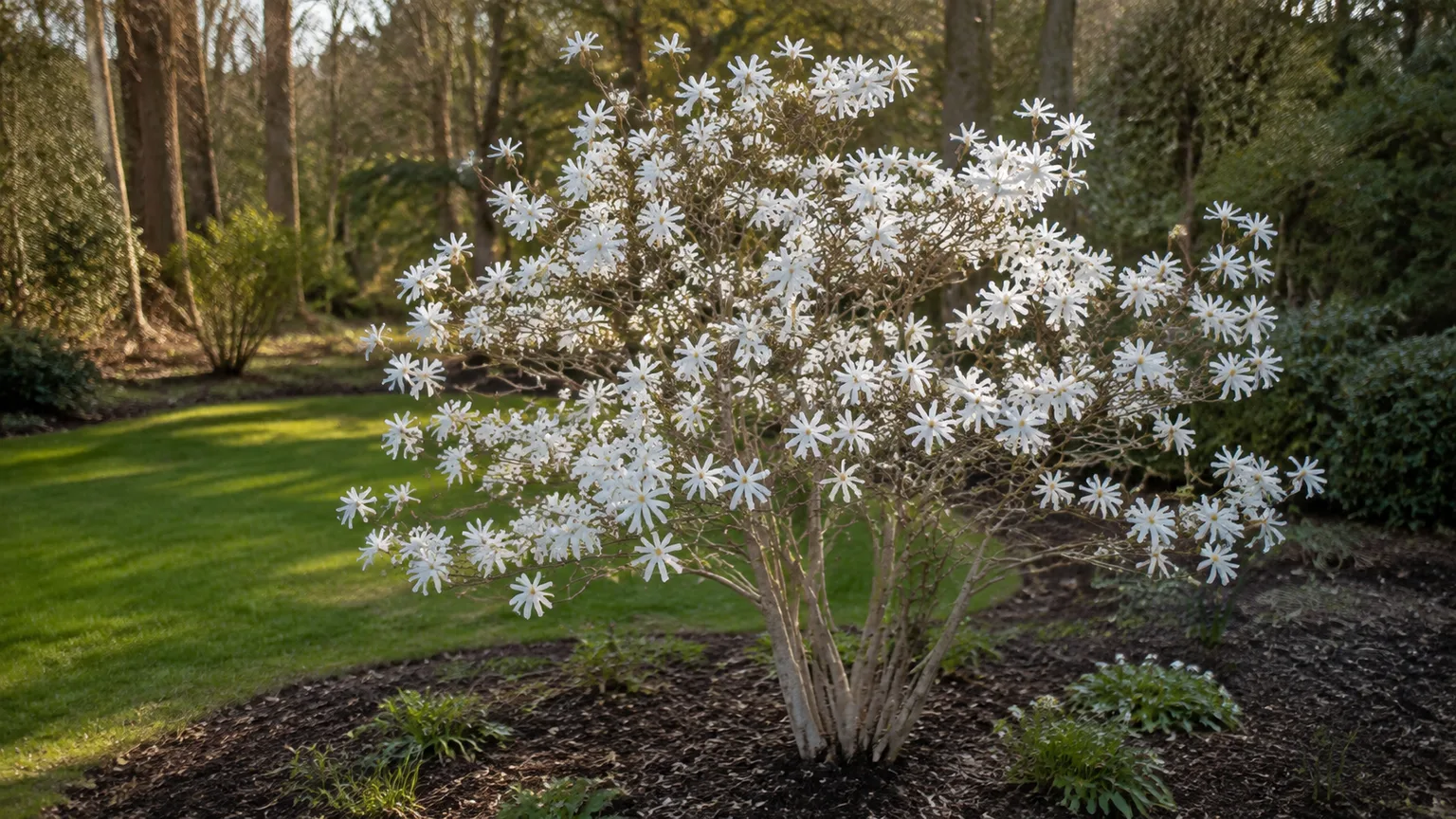
Star magnolia is one of the best small white-flowering trees when you want flowers before the canopy leafs out. Its compact, often multi-stemmed form generally reaches 15 to 20 feet tall and 10 to 15 feet wide, and its narrow white petals make the blooms look like stars along the branches. NC State Extension lists it among the earliest deciduous magnolias to flower and notes that its late-winter or early-spring buds are vulnerable to frost (NC State Extension Plant Toolbox).
Give it rich, well-drained soil and steady moisture, with enough sun for good flowering. Avoid the warmest south-facing pocket if it encourages buds to open before the last cold snaps; the same exposure that brings earlier flowers can brown them overnight. If the tree is near a walkway, remember that petals fall in a short, noticeable burst rather than disappearing into a woodland floor.
2. Serviceberry (Amelanchier spp.)
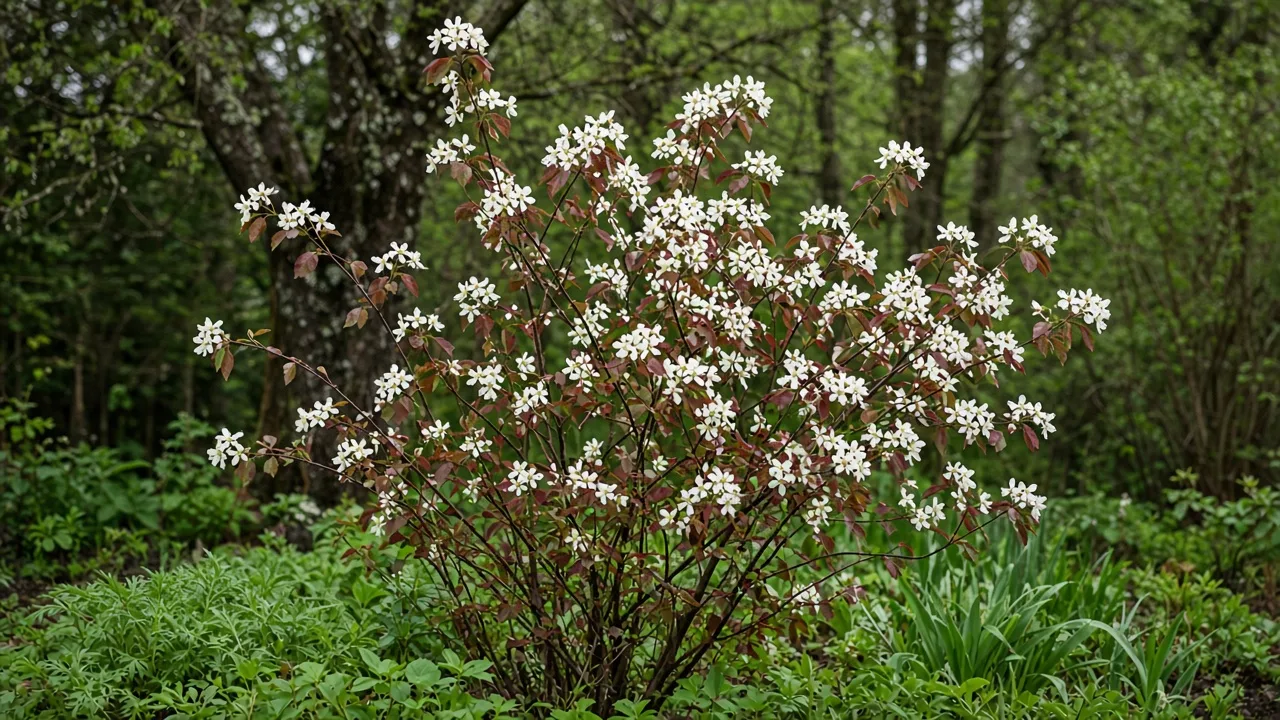
Serviceberry is a small native tree or multi-stemmed shrub with a useful sequence of white spring flowers, edible berry-like fruit, and strong fall color. Several Amelanchier species are sold under the same common name, so a nursery tag should identify the species or cultivar if mature size matters. NC State Extension describes the genus as early-flowering and notes that root suckers can gradually turn a single tree into a colony (NC State Extension Plant Toolbox).
Choose it for a woodland edge, lawn, pollinator planting, or a bird-friendly yard, not above a spotless patio. Birds may take the fruit, but berries, petals, and leaves still land beneath the canopy; remove unwanted suckers while young if you want one trunk. Most species accept sun or partial shade, yet deeper shade usually means fewer flowers and less fruit.
3. Flowering Dogwood (Cornus florida)
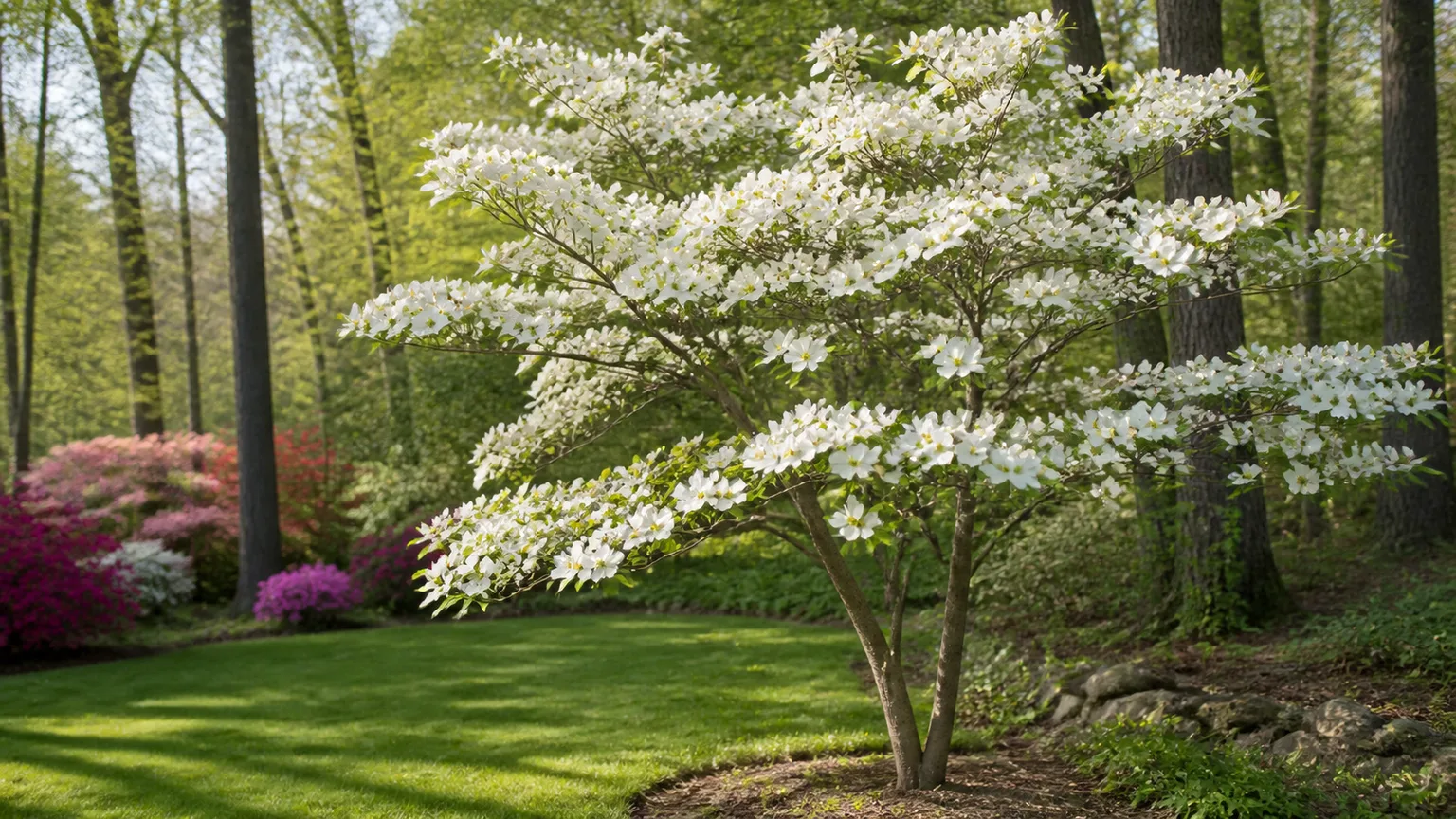
Flowering dogwood is a small eastern North American understory tree, commonly 15 to 25 feet tall, that fits a woodland margin better than a hot, exposed parking strip. Its showy white display is not made of petals: the true flowers sit in a small central cluster, framed by four broad bracts. Those bracts open around mid-spring, followed by red fruit and red-purple fall foliage; NC State Extension notes that the fruit feeds birds and that the species can struggle in hot, dry, or stressful urban sites (NC State Extension Plant Toolbox).
Give it well-drained, organic soil and morning or filtered sun; afternoon shade is useful in warmer regions. Do not plant it in deep, dry shade and expect the best flowering, or in a compacted lawn where roots stay hot and thirsty. It can be a beautiful native choice, but if your site is harsh and reflected heat is unavoidable, consider a more adaptable small tree instead.
4. White Redbud (Cercis canadensis ‘White Pom Poms’)
White-flowering eastern redbuds are cultivar-specific: the species is best known for pink or purple blooms, so look for a named white selection rather than assuming every redbud will be white. ‘White Pom Poms’ is a compact, double-flowered selection developed by NC State; the extension profile gives a mature size of up to about 12 feet tall by 15 feet wide and reports that its flowers do not set seed pods (NC State Extension Plant Toolbox).
This makes it a strong choice for a small yard where a broader canopy fits better than a tall one, or for an understory accent with light shade. Redbuds do not transplant well, so make the location decision before planting and keep the root area undisturbed. Avoid sites that hold water for long periods; average, well-drained soil is a safer fit than a soggy low spot.
5. White-Flowering Crabapple (Malus spp.)
Crabapples offer a range of forms, from narrow and upright to spreading, and named cultivars may flower white, pink, or red. ‘Adirondack’ is a useful white-flowered choice for a tighter space: Better Homes & Gardens describes its flowers as nearly pure white, its upright habit as suitable for small landscapes, and its mature size as about 18 feet tall by 10 feet wide. It also reports strong resistance to several common crabapple diseases (Better Homes & Gardens crabapple guide).
Pick a named cultivar with good regional disease resistance rather than buying a generic “crabapple” based on the flowers alone. Fruit can feed birds and add fall interest, but it may also drop onto paving; flowering and fruiting can vary by cultivar. Give the canopy sun and airflow, then check the final spread before setting it near a walk, driveway, or overhead line.
White Flowering Trees for Mid-to-Late Spring
As leaves emerge, late-spring flowers appear against a greener background instead of a bare branch. These are often better choices if an early frost frequently damages magnolia blooms, though a cold spring can still delay flowering.
6. Kousa Dogwood (Cornus kousa)
Kousa dogwood flowers later than flowering dogwood, usually after leaves have emerged. Its pointed white bracts surround small true flowers, so the tree looks more layered and leafy during bloom than a bare-branched spring magnolia. It develops red, rounded fruits later in the season and often shows reddish fall color; Better Homes & Gardens notes that kousa dogwood is generally more resistant to disease than flowering dogwood (Better Homes & Gardens small-tree guide).
Allow room for a broad small-tree canopy, and plant it where fruit drop will not become a nuisance. It is native to East Asia rather than North America, so gardeners building a native planting should compare it with flowering or pagoda dogwood instead. Check your regional invasive-plant guidance before buying any nonnative tree, and confirm that the cultivar’s eventual size works in the available space.
7. Pagoda Dogwood (Cornus alternifolia)
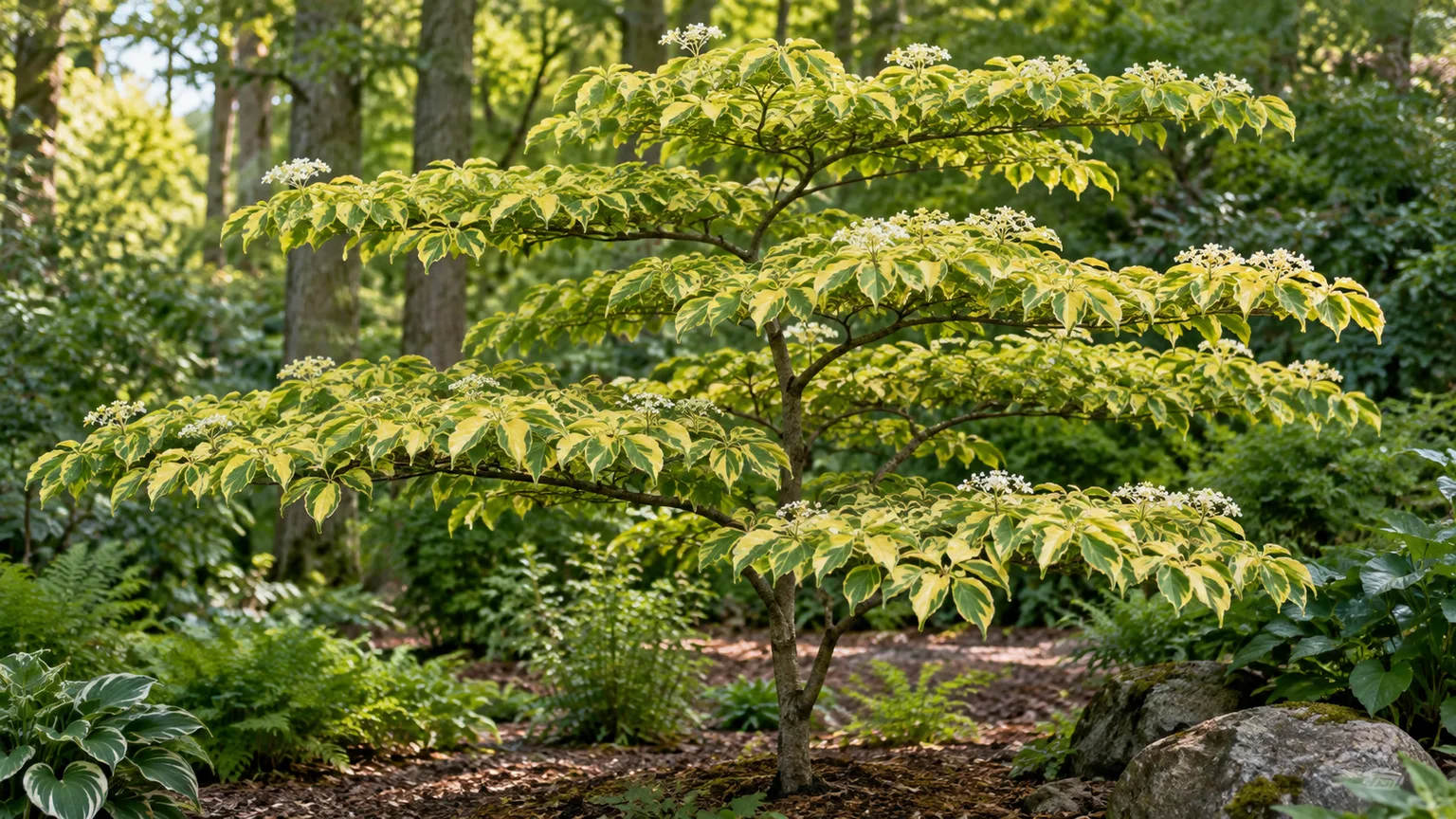
Pagoda dogwood earns its name from the horizontal tiers of branches that make a natural layered silhouette. Its creamy-white flower clusters open in late spring to early summer, followed by blue-purple fruit that can attract birds. Better Homes & Gardens highlights it as a North American native that suits shadier sites, a useful combination if you want a smaller tree at the edge of existing canopy (Better Homes & Gardens small-tree guide).
Give it moist, well-drained soil and dappled shade or gentle morning sun. It is less forgiving of a hot, dry, exposed lawn than a sun-loving crabapple, and its tiered branches need room to spread sideways. Choose this one for a woodland edge or a layered border, not for a narrow strip between a fence and a foundation.
8. Carolina Silverbell (Halesia carolina)
Carolina silverbell carries small bell-shaped white flowers along its branches in spring, often as the leaves begin to open. It is native to the southeastern United States and can grow as a multi-trunked large shrub or an understory tree; its scale varies with conditions, and its graceful open crown works best where it can grow naturally. Fine Gardening includes it among its small-property spring trees, while NC State Extension recommends moist, acidic, organic soil and warns that drought, compaction, and salt can stress it (Fine Gardening, NC State Extension Plant Toolbox).
Use it in a protected woodland garden, near a moist border, or as a lawn specimen where the soil does not dry hard in summer. Its wood is relatively weak, so a wind-sheltered planting spot is preferable. If your site is alkaline, salty, or compacted, pick a tougher tree rather than trying to correct every condition after planting.
9. White Fringetree (Chionanthus virginicus)
White fringetree is a small eastern North American tree, often 12 to 20 feet tall and wide, with late-spring flowers that look like soft, fringed ribbons. Its loose, multi-stemmed habit feels less formal than a clipped ornamental, and female plants may form blue-black fruit that birds eat. NC State Extension notes that male flowers are slightly larger and showier, while fruit set depends on pollination and the tree’s functional sex expression (NC State Extension Plant Toolbox).
Choose a sunny to partly sunny site with well-drained soil; full sun generally gives the heaviest flowering. The plant tolerates some drought once established, but drought stress can make pest problems more likely. Nursery plants may not be labeled by sex, so buy for the flowers and form rather than counting on a specific amount of fruit.
10. Japanese Snowbell (Styrax japonicus)
Japanese snowbell has pendulous, bell-shaped white flowers that hang beneath the foliage in late spring. It grows as a small tree with low horizontal branches, creating a light, rounded crown rather than a tall shade canopy. Fine Gardening includes it among expert-recommended spring trees, and NC State Extension describes fragrant blooms, orange-brown bark, and a preference for moist, acidic, well-drained soil (Fine Gardening, NC State Extension Plant Toolbox).
Plant it where the canopy can widen and the soil will not dry out repeatedly; a cool, partly shaded site can help in a hot summer climate. The flowers are fragrant, but fragrance strength is subjective and less intense than some gardeners expect. Heat and drought are the main reasons to pass on this tree, and seedlings may volunteer in some gardens.
White Flowering Trees for Summer
Summer bloomers shift the display later, when spring’s dogwoods and magnolias are finished. They are not all equally easy: some need acidic soil, reliable moisture, or a cool woodland setting, so match the tree to the site instead of assuming a summer flower means heat tolerance.
11. Sourwood (Oxydendrum arboreum)
Sourwood is a native eastern U.S. tree with a narrow, upright crown, white urn-shaped flowers in fragrant summer panicles, and vivid red to reddish-purple fall foliage. NC State Extension lists its typical mature size at about 20 to 30 feet tall and 10 to 15 feet wide and recommends acidic, peaty, moist but well-drained soil. The species also resents transplanting when large, so a young tree belongs in its permanent spot from the start (NC State Extension Plant Toolbox).
Use it in a woodland or native garden with acidic soil and some protection from urban pollution. Do not plant it in alkaline ground and expect fertilizer to fix the mismatch; yellowing and weak growth can persist if soil pH is wrong. The blooms arrive after spring flowering trees are done, while the fall color gives it a second season of interest.
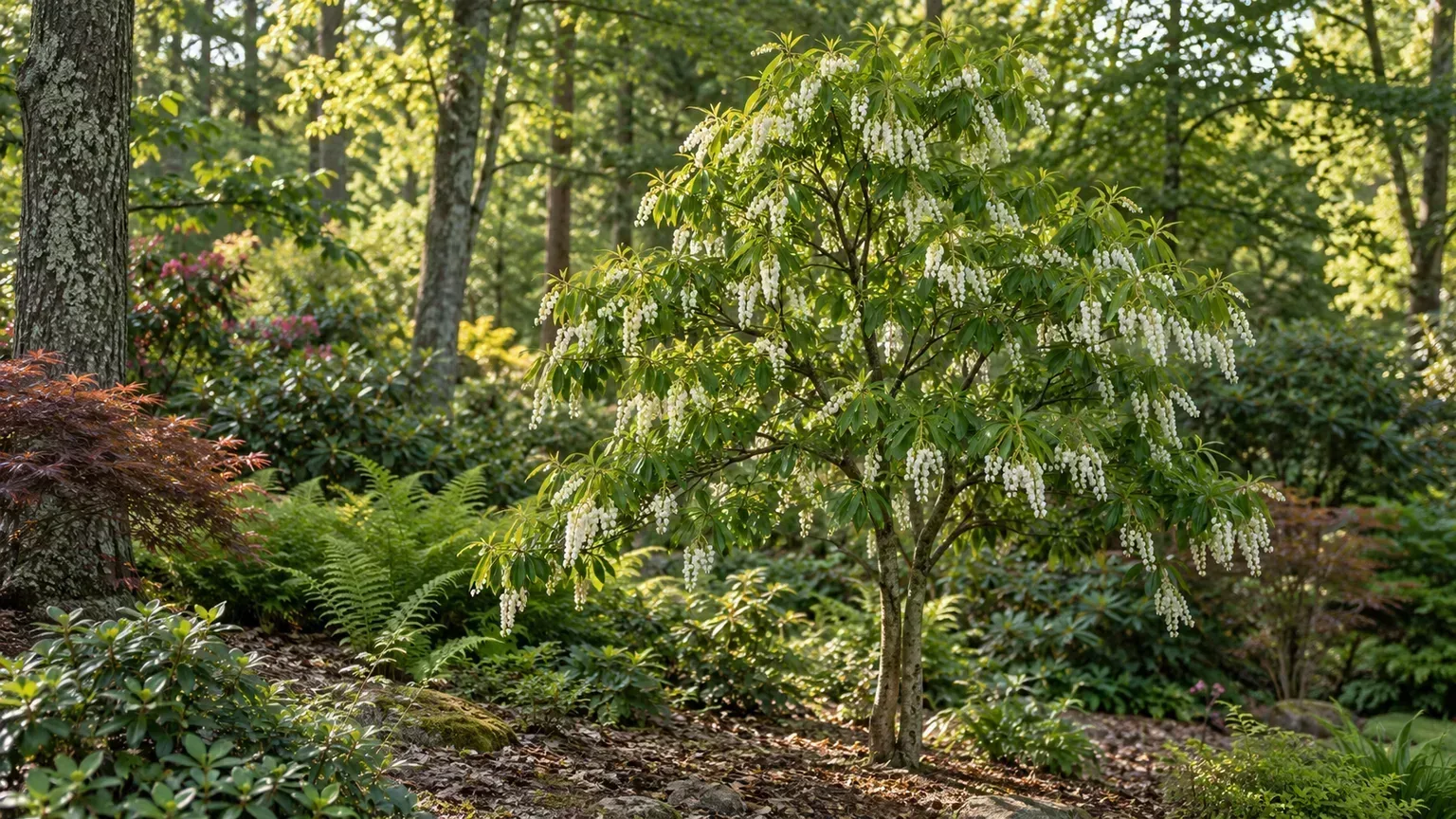
12. Sweetbay Magnolia (Magnolia virginiana)
Sweetbay magnolia produces fragrant, creamy-white flowers in summer and suits a wetter site than most ornamental magnolias. In cooler climates it may be deciduous; farther south it can remain semi-evergreen or evergreen. NC State Extension gives a typical range of roughly 10 to 35 feet but notes that it can grow larger in deep-southern conditions, and that it tolerates swampy or boggy soil that many magnolias cannot (NC State Extension Plant Toolbox).
Choose it for consistently moist, acidic soil near a pond, rain garden, or naturally damp border, with enough width for an open crown. It is a poor match for a dry, compacted lawn that bakes between waterings. If winter cold is near the edge of the cultivar’s range, confirm hardiness locally; winter damage and evergreen behavior vary with the selection.
13. Japanese Tree Lilac (Syringa reticulata)
Japanese tree lilac extends the white display into early summer with creamy flower panicles, often in June. It grows as a small tree or large shrub, with a rounded canopy, reddish-brown bark, and clusters of flowers that are showy but brief. University of Wisconsin Extension lists ‘Ivory Silk’ among summer-flowering landscape trees, and NC State Extension notes that full sun produces the best flowering and that individual blooms may last only about two weeks (University of Wisconsin Extension, NC State Extension Plant Toolbox).
This is a practical choice for a sunny yard, street-tree planting, or a border that can accommodate its mature spread. Do not confuse its tree-scale habit with the compact spring-blooming lilacs; it needs more room than a shrub border usually suggests. The flowers have a noticeable, sometimes privet-like scent rather than the classic sweet fragrance people expect from common lilacs.
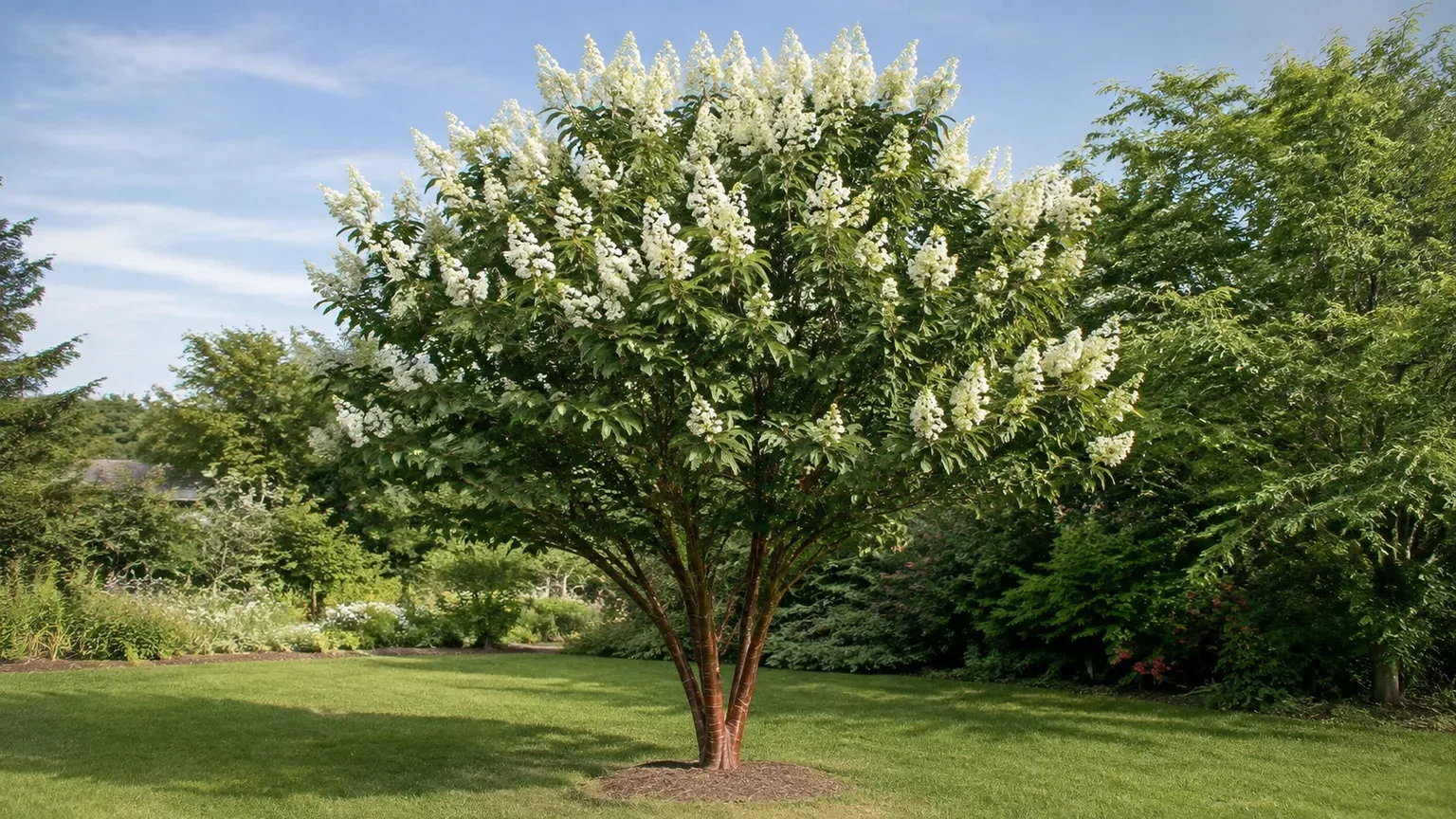
14. Mountain Stewartia (Stewartia ovata)
Mountain stewartia, also called mountain camellia or summer dogwood, is a southeastern native small tree or large shrub with white, camellia-like flowers in summer. The open blooms have ruffled petals and contrasting stamens, and the plant follows them with orange-to-scarlet fall foliage. NC State Extension describes a typical height and spread of about 10 to 15 feet, a slow growth rate, and sensitivity to drought, heat, and soil compaction (NC State Extension Plant Toolbox).
Treat it as a carefully chosen specimen rather than a quick-fill tree. It performs best in moist, rich, well-drained soil with some protection from intense afternoon heat, and it can be difficult to transplant once established. If your garden is hot, dry, and fully exposed, sweetbay magnolia or Japanese tree lilac is likely a more forgiving summer-blooming option.
Conclusion
The best white-flowering tree is the one that fits the site after the flowers fade. Choose by mature width first, then narrow the list by bloom timing, sun, drainage, local hardiness, and the cleanup you can live with. For a small space, compare star magnolia, ‘White Pom Poms’ redbud, or ‘Adirondack’ crabapple; for a moist woodland edge, consider pagoda dogwood or Carolina silverbell; for summer flowers, look at sourwood, sweetbay magnolia, Japanese tree lilac, or mountain stewartia. Before you buy, confirm the exact cultivar and mature dimensions with a local nursery or extension office.



