Juniper Tree Types: Find the Right Shape for Your Yard
Need a juniper for a slope, small garden, or privacy screen? Compare 12 types by mature height, spread, growth habit, and site fit before buying for your site.
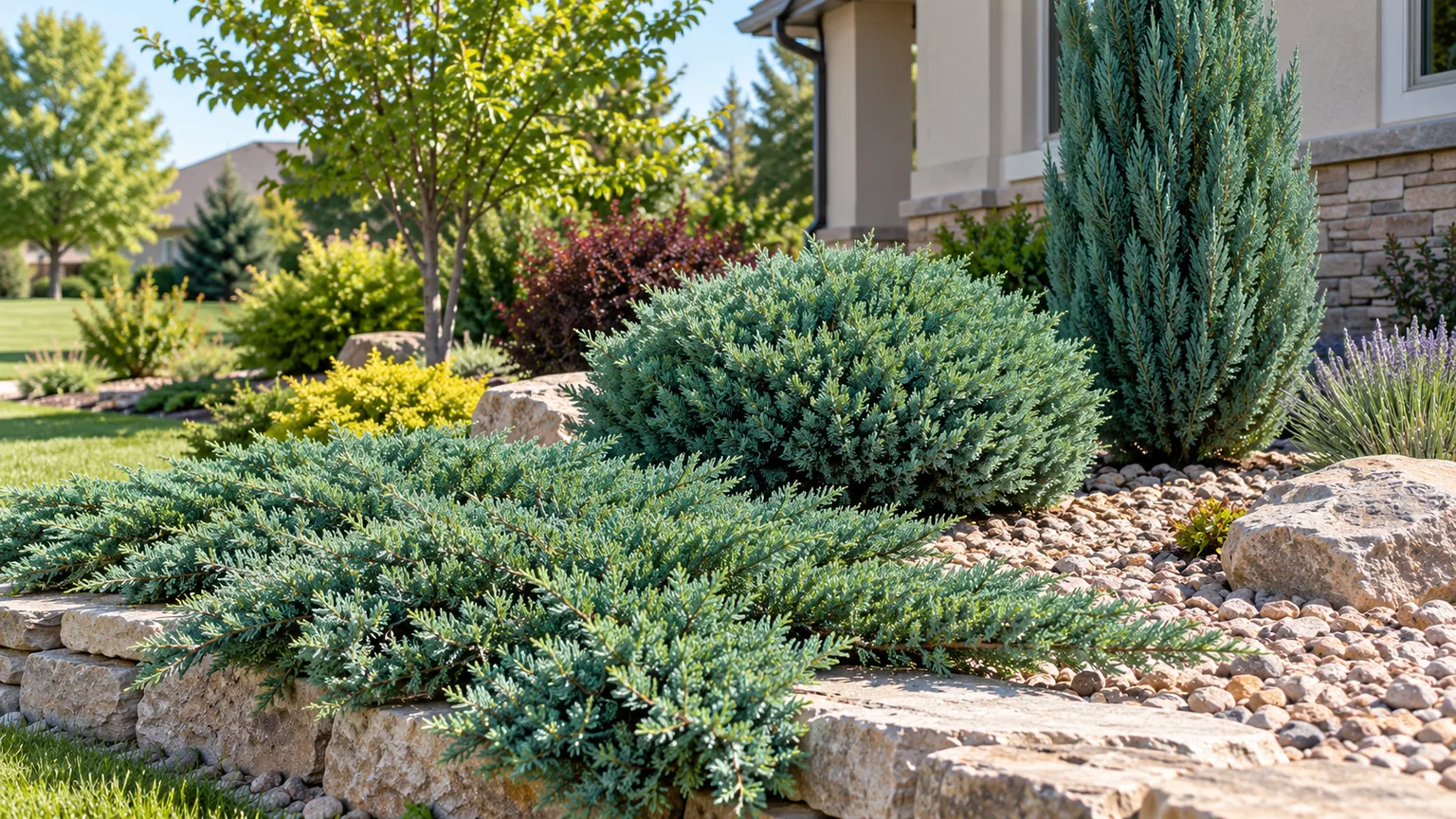
The right juniper depends first on the job. Some selections hug the soil and spread several feet; others make rounded blue-green mounds, while columnar forms rise high with little width. A plant tag that says only “juniper” leaves out the detail that matters most: its mature shape.
Use the botanical name and cultivar on the nursery label to compare plants, then check the expected height and spread against your site. The 12 choices below cover familiar groundcovers, compact shrubs, and upright trees, with practical notes on light, soil, and where each one fits.
Start with the shape you need
Sort the options into three landscape roles before you compare color. Prostrate junipers spread outward and stay low, so they can cover a sunny slope, edge a bed, or fill a broad dry area. Their width is the key measurement: a plant only a few inches tall can still occupy several feet of ground.
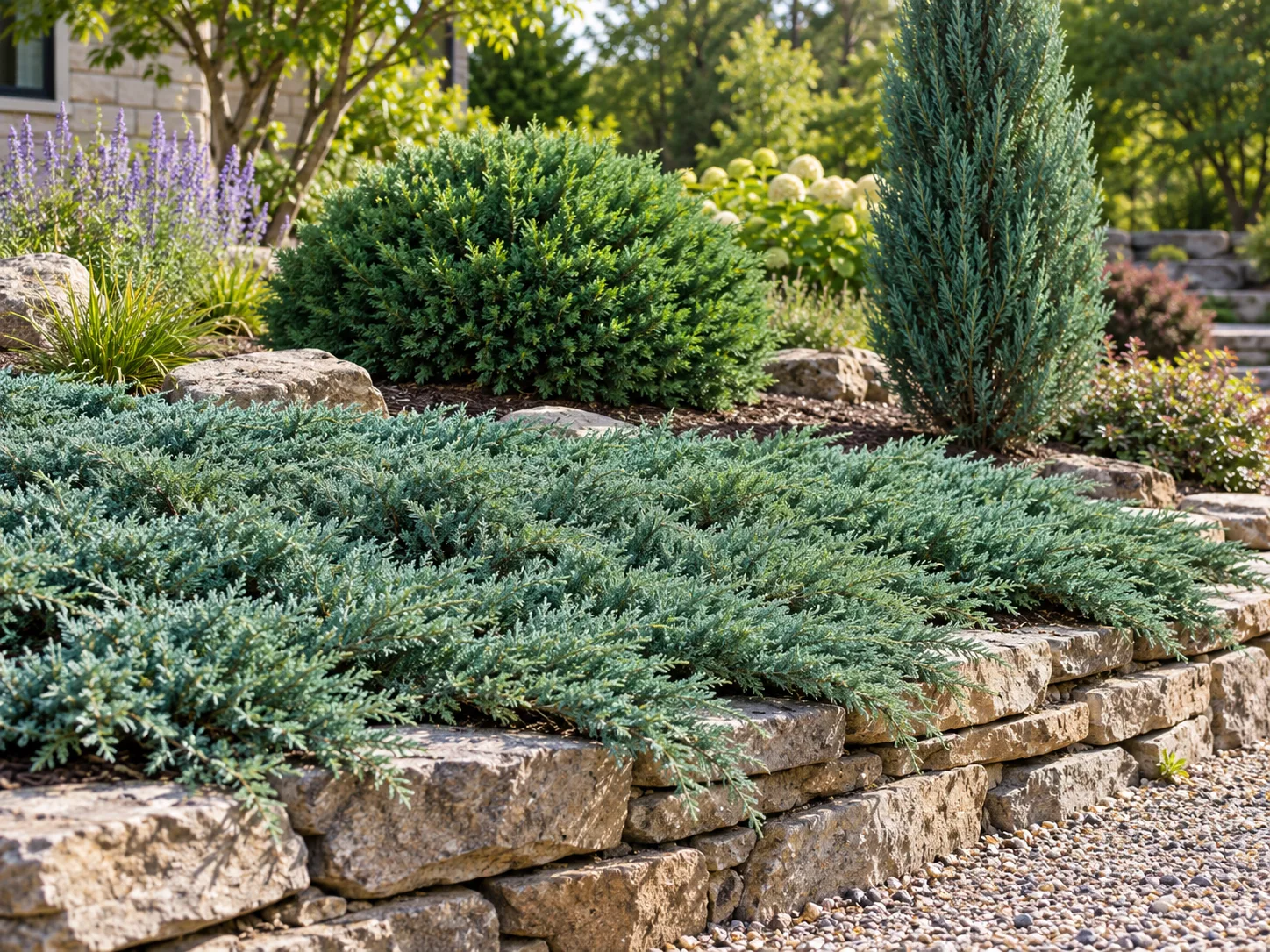
Mounded or broadly upright selections work as accents, low screens, or structural evergreen shrubs. Narrow columnar junipers add height with little ground-level width, which can suit a tight foundation bed or a vertical punctuation mark in a sunny border. A narrow plant is not automatically a privacy hedge, though; consider how much visual coverage it gives at eye level and whether you want a single accent or a continuous screen.
Color helps refine the choice after habit and dimensions. Juniper foliage may read blue, blue-green, green, or gold, and many selections shift toward purple or bronze in winter. Treat catalog photos as a color preview, not a guarantee: light, climate, season, and the exact cultivar can change the effect.
Species and cultivar mean different things
A species is a botanical kind, such as Juniperus horizontalis or J. virginiana. A cultivar is a named selection within a species, chosen and maintained for traits such as a particular height, spread, foliage color, or growth habit. A species name alone may describe a plant with a broad range of forms; a cultivar name is often what makes the nursery plant predictable enough for a specific spot.
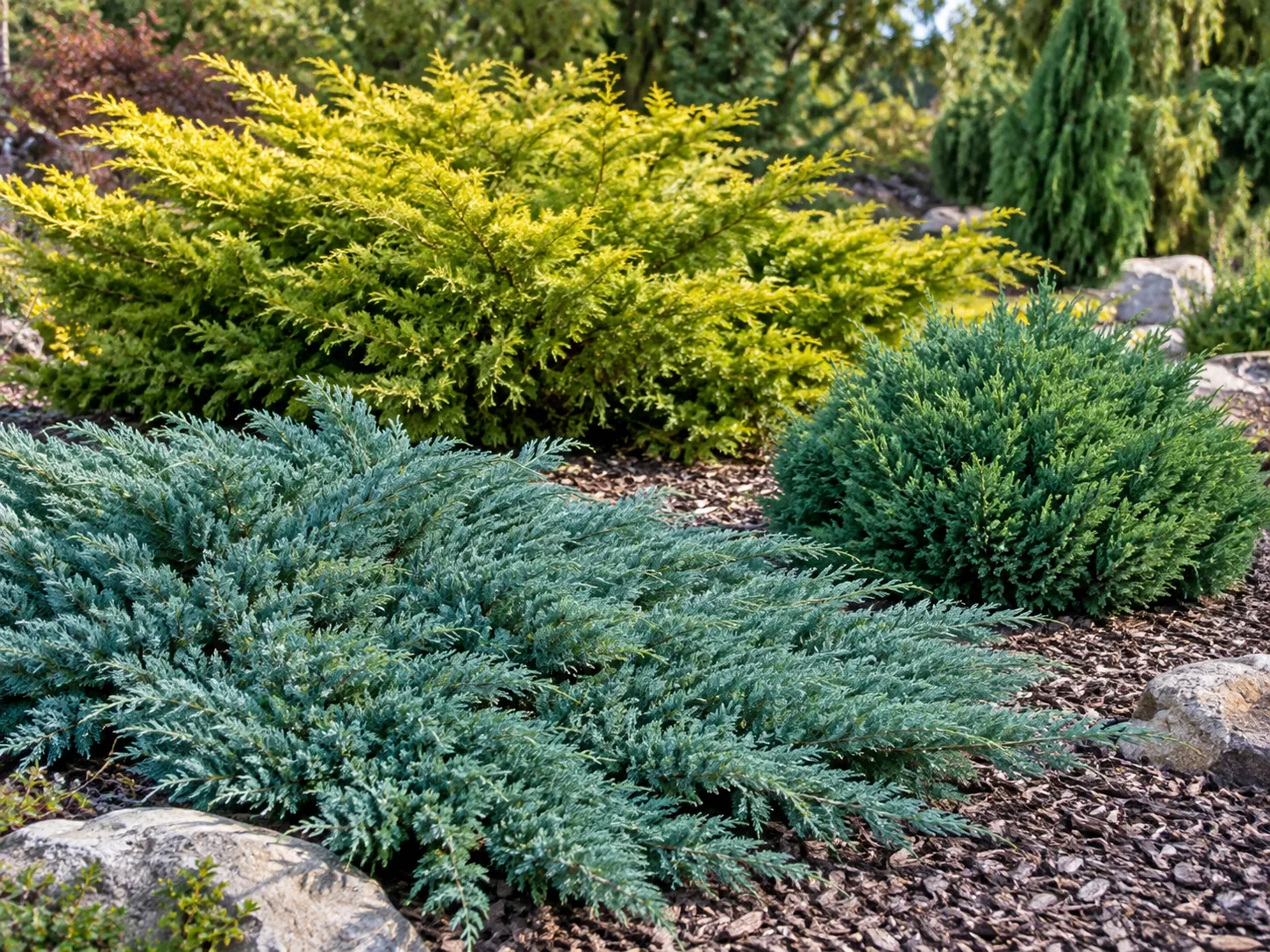
That distinction prevents a common shopping mistake. “Chinese juniper” names a species with many shapes and sizes, while ‘Blue Point’ and ‘Gold Lace’ identify particular selections of that species. If the design depends on staying under a window or fitting a narrow strip, buy by the full label, including the quoted cultivar name, and confirm its mature dimensions with the grower or a local extension source.
Junipers are conifers in the genus Juniperus. Common names can be confusing—eastern red cedar is a juniper, for example—so botanical names are useful when comparing plants across catalogs and regions.
Even with the right name, published mature sizes can differ because references describe different clones, climates, or growing periods. Use a range as a planning guide and leave room for the plant to reach its natural width.
12 juniper types to compare
These are a mix of species and named cultivars because gardeners shop for both. Dimensions are approximate mature sizes from horticultural references, not promises about how fast a plant will fill a space. Confirm the label and local hardiness guidance before buying, especially if your garden has hot summers, severe winters, or heavy soil.
1. Creeping juniper (Juniperus horizontalis)
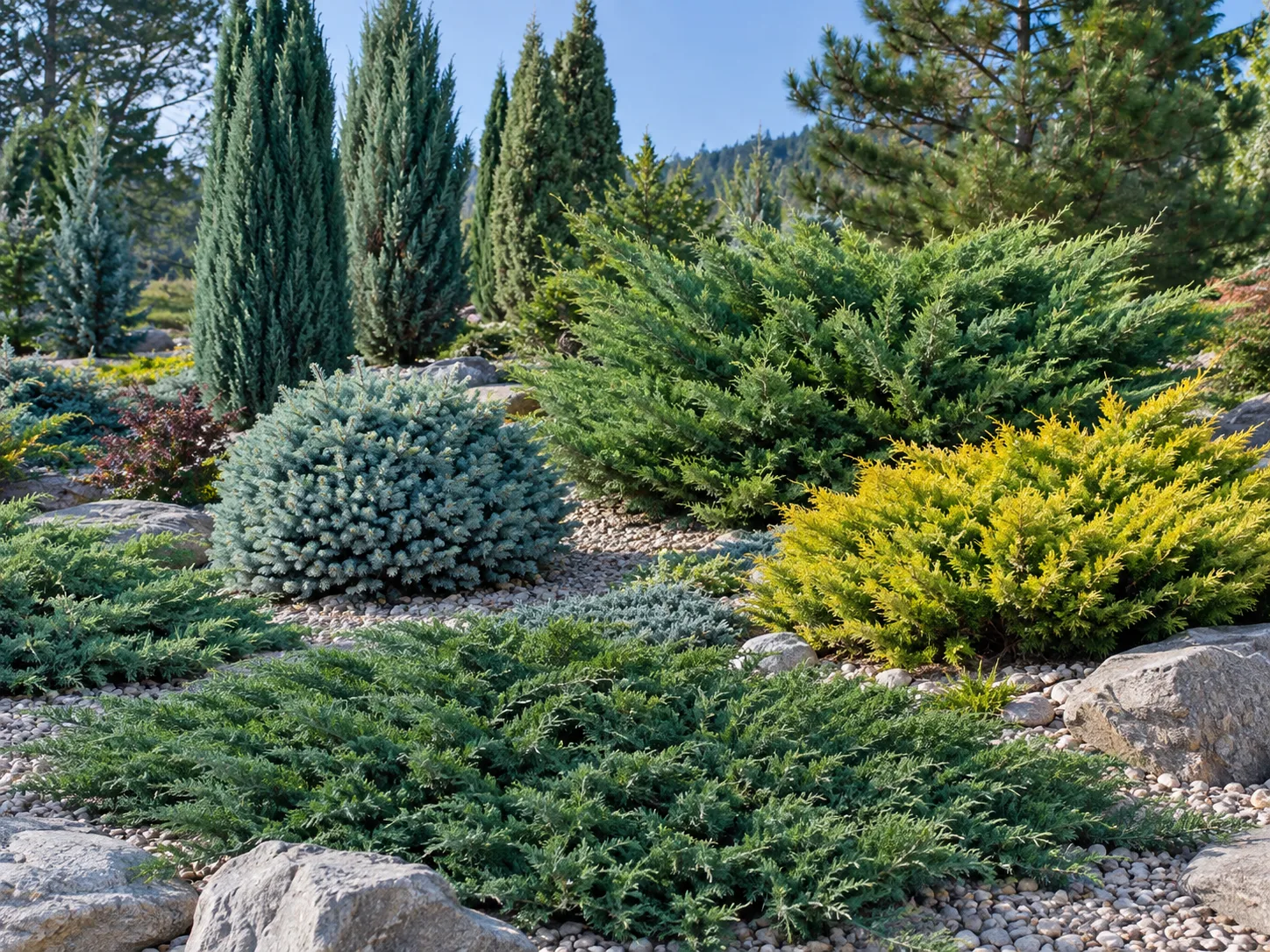
Creeping juniper is a North American groundcover species with a low, spreading habit. The Missouri Botanical Garden describes typical plants around 6 inches to 1.5 feet tall and roughly 5 to 8 feet wide, while other references note mats may spread farther.
That makes it useful on a sunny slope, along a retaining wall, or in a broad rock garden where a low evergreen layer is wanted. Missouri Botanical Garden’s plant profile and NC State Extension’s profile both emphasize its low form and preference for good drainage.
Give it full sun and soil that drains rather than staying saturated. It can tolerate dry conditions once established, but “drought tolerant” does not mean it needs no establishment water or that it will thrive in compacted, waterlogged ground. Plan for the mature mat instead of planting several close together to get instant coverage; crowding can create a patchwork that is hard to access and maintain.
2. Blue Rug juniper (J. horizontalis ‘Wiltonii’)
Blue Rug is a named, especially low selection of creeping juniper. UConn’s plant database lists ‘Wiltonii’ at about 4 to 6 inches high and up to 5 feet wide; Better Homes & Gardens gives a broader 6-to-8-foot spread.
That published difference is a useful reminder to size the planting around the stock you are buying and to allow extra width where the mat can roam. UConn Plant Database and Better Homes & Gardens’ cultivar guide describe this low blue-green form.
Choose it when you want foliage close to the ground rather than a shrub with visible height. It can soften a sunny bank or edge a low wall, but it will not screen a view. Its blue cast is most useful in a planting that needs contrast with green perennials or stone; don’t buy it only from a photo because the exact hue changes with light and season.
3. Golden Carpet juniper (J. horizontalis ‘Golden Carpet’)
Golden Carpet brings yellow-green foliage to the same broad, ground-hugging role. Gardenia.net describes it at roughly 4 inches high and 4 feet wide after ten years, while noting that climate can affect its dimensions.
Use that as a measured growth expectation rather than assuming a small nursery pot will cover a large slope quickly. Gardenia.net’s Golden Carpet profile gives its size and site preferences.
This selection needs sun to hold its brighter color and well-drained soil to avoid root problems. A gold mat can brighten the front of a border or the top of a sunny retaining wall, but it may read more chartreuse than yellow in some conditions. If you are combining it with another creeping juniper, leave enough room for both mature spreads so one does not bury the other.
4. Common juniper (J. communis)
Common juniper occurs across a wide northern range and can appear as an upright shrub or a nearly prostrate form, depending on the variety and selection. TreeVitalize’s identification guide gives a broad range of roughly 5 to 25 feet tall and 3 to 12 feet wide across forms, so the species name by itself is not a compact-size guarantee. TreeVitalize’s juniper guide describes the variation in common juniper’s habit and size.
This species is worth considering when a regionally hardy juniper is a priority, but check the exact form and local climate fit. The broad natural range does not erase differences in heat, humidity, drainage, and cultivar hardiness. If you want a low carpet, shop for a named groundcover selection rather than assuming every J. communis will stay low.
5. Green Carpet juniper (J. communis ‘Green Carpet’)
Green Carpet is a low, spreading selection of common juniper. Better Homes & Gardens lists it at about 4 to 6 inches tall and 2 to 3 feet wide, a smaller footprint than many creeping J. horizontalis selections. Its scale can suit a rock garden, a small sunny bed, or the edge of a path where a large mat would spill too far.
Check the label carefully because common juniper includes forms with very different habits. Green Carpet’s low stature means it will not hide a fence or soften a tall retaining wall by itself; use it as a foreground layer.
As with other junipers, drainage matters. A compact groundcover is still a poor choice where the root zone remains wet after rain.
6. Chinese juniper (J. chinensis)
Chinese juniper is a species with a particularly wide range of landscape forms. Some cultivars grow into substantial upright trees; others remain rounded shrubs or low mounds.
For that reason, “Chinese juniper” is not enough information to estimate mature size or decide whether a plant belongs beneath a window. Better Homes & Gardens’ cultivar guide illustrates this contrast among selections such as ‘Gold Lace’ and ‘Blue Point’.
Use the species as a prompt to inspect the cultivar, not as a design specification. The label should include the cultivar name and, ideally, dimensions at maturity.
Ask whether the stated size is an expected height and width or a pruning-maintained size. A plant that reaches the right shape only through repeated shearing may not suit a low-maintenance site, and repeated trimming cannot reliably make a naturally broad cultivar into a narrow one.
7. Gold Lace Chinese juniper (J. chinensis ‘Gold Lace’)
Gold Lace is a colorful, spreading shrub rather than a groundcover. Better Homes & Gardens describes it at roughly 3 to 4 feet tall and 4 to 6 feet wide, with foliage that combines gold and green. That intermediate scale can anchor a mixed evergreen bed or create a low broad accent without the height of a tree-form juniper.
Measure the available width from the center of the planting spot to paths, windows, and neighboring plants. A shrub expected to reach 6 feet across needs room on both sides, even if the young specimen looks tidy in its pot. Gold foliage can brighten a sunny composition; use the mature spread to decide whether it belongs as a solitary specimen or in a group.
8. Blue Point Chinese juniper (J. chinensis ‘Blue Point’)
Blue Point grows upright into a substantial evergreen accent. Better Homes & Gardens lists about 12 feet high and 8 feet wide at maturity. That is much larger than a compact shrub, so it belongs where the mature footprint can be accommodated—at a corner, as a specimen, or in a roomy planting where its blue-green foliage has space around it.
Do not infer that it will stay narrow because the word “point” appears in its name. The listed width is almost as important as the height, and a tree planted too close to a wall or path may eventually need costly removal or unsuitable pruning. Confirm the variety on the tag and compare the nursery’s regional estimate with the available site before purchasing.
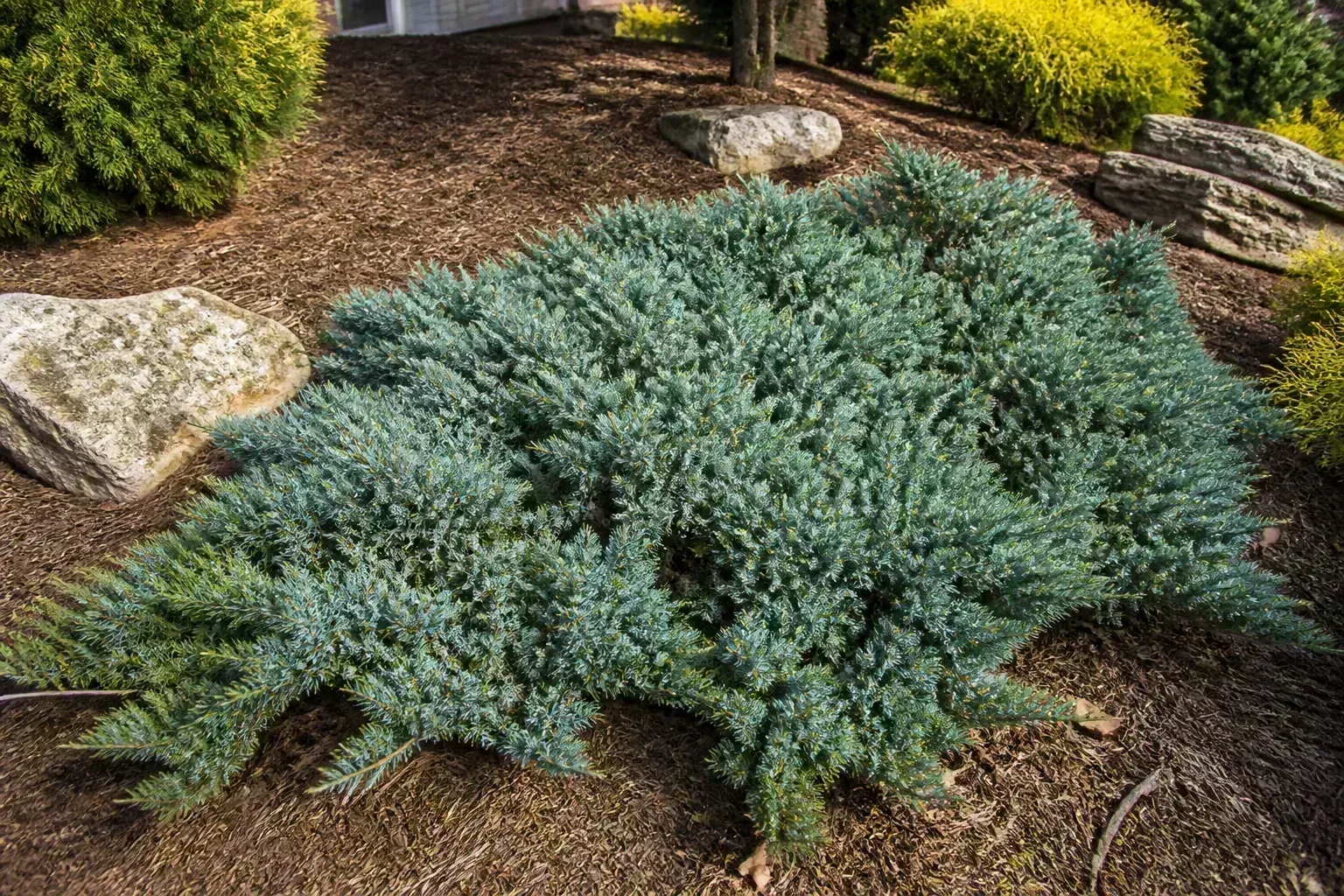
9. Blue Star juniper (J. squamata ‘Blue Star’)
Blue Star, a selection of flaky juniper, forms a compact, rounded mound with silvery blue foliage. Better Homes & Gardens gives an approximate mature range of 1 to 3 feet tall and 1 to 3 feet wide. That makes it useful as a small focal point, in a sunny mixed border, or where a boulder or low wall needs a contrasting evergreen companion.
Its compact shape is an advantage when space is tight, but it still needs air and room to reach its natural width. Avoid tucking it into a shaded, crowded pocket simply because the plant is small. The blue color is a visual feature, not a substitute for checking sun, drainage, and the mature dimensions on the exact nursery label.
10. Blue Arrow Rocky Mountain juniper (J. scopulorum ‘Blue Arrow’)
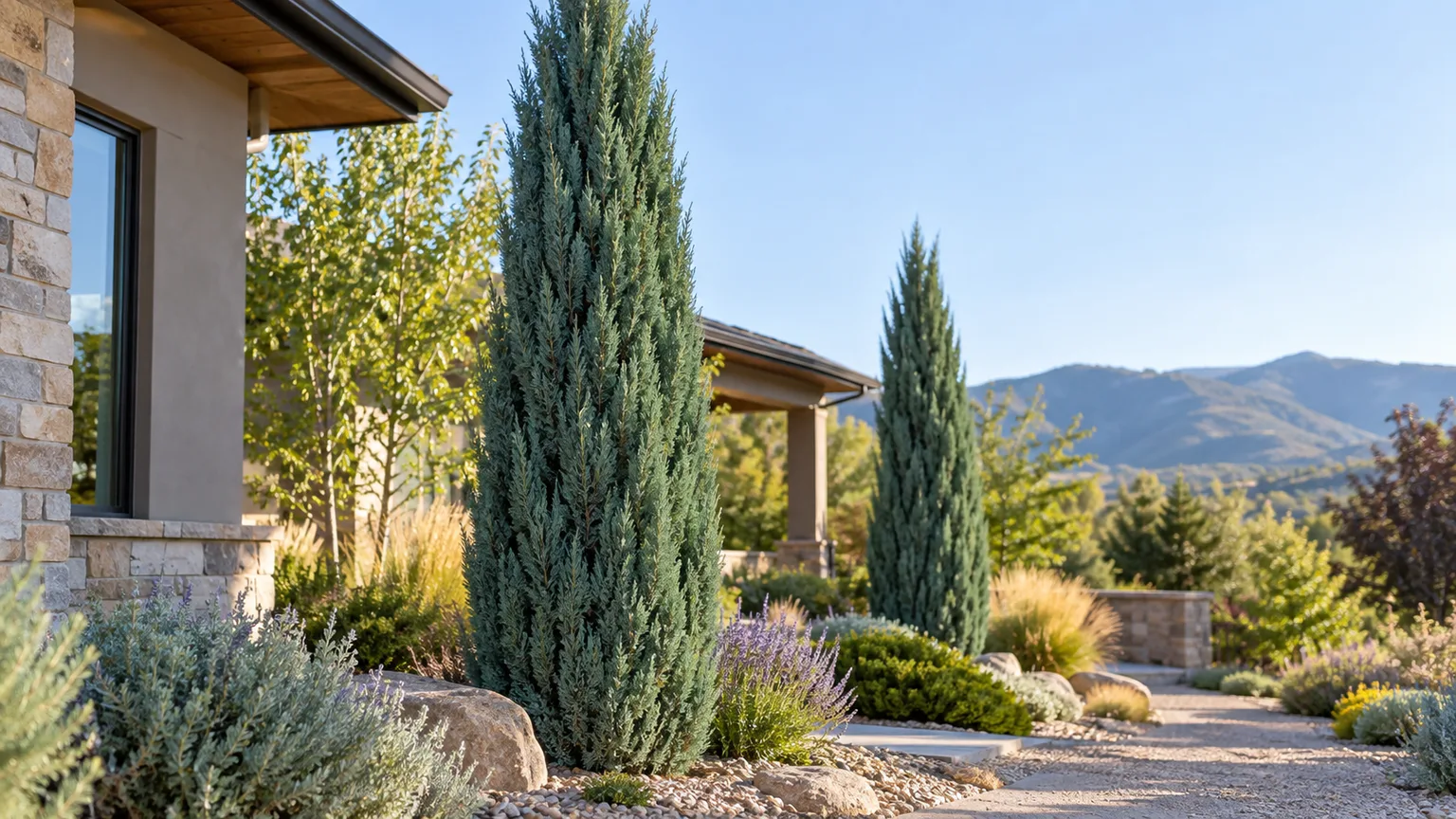
Blue Arrow is a narrow, upright selection of Rocky Mountain juniper. Better Homes & Gardens lists it at roughly 12 to 15 feet tall and about 2 feet wide, a distinctly vertical profile for a sunny border, a pair of entry accents, or a tight planting strip. Use the height and width together: its narrow footprint does not mean it will remain a small plant.
Columnar habit can create a screen-like rhythm, but one plant is not a solid privacy wall. For a row, verify spacing recommendations for the cultivar and allow room for mature width rather than planting trunks nearly shoulder to shoulder. Narrow evergreens also need adequate light; avoid placing them where neighboring trees will shade them out as the garden matures.
11. Eastern red cedar (J. virginiana)
Eastern red cedar is a North American juniper that can grow into a large tree. NC State Extension gives a typical landscape size of about 30 to 40 feet tall and 10 to 20 feet wide. It handles full sun and a range of soil moisture once established, but the soil should drain; prolonged wetness is a poor fit.
Its size and evergreen structure can work for a spacious screen, windbreak, or specimen, but it is not a small foundation shrub. NC State Extension’s eastern redcedar profile details its size and site tolerance.
The species has separate male and female plants. Female plants, when present and pollinated, may carry blue, berry-like seed cones; male plants produce pollen cones. NC State also notes that eastern red cedar can host cedar-apple rust, a disease that alternates between junipers and susceptible apple relatives.
If you grow apples, consider local rust pressure and cultivar susceptibility before placing a new juniper; removing every juniper in a region is not a practical disease plan. NC State Extension’s cedar-apple rust guidance explains the two-host cycle.
12. Taylor eastern red cedar (J. virginiana ‘Taylor’)
Taylor is a particularly narrow selection of eastern red cedar. Better Homes & Gardens lists it at around 30 feet high and only 3 feet wide, so it offers height where a broad tree would crowd a driveway or bed. It can mark a property edge or create vertical accents, but a row should be planned from mature height, spacing, and the coverage you need—not just the tiny width of a young plant.
It shares the species’ basic site considerations: full sun, drainage, and enough overhead and root-zone space for a tree. The slim form may be useful where screening needs a tall vertical element, but it will not block every view at ground level. Check the nursery label because names and dimensions can be confused among cultivars, and ask whether the quoted width reflects typical unpruned growth in your region.
Check the site before buying
Start with sunlight and drainage because they eliminate many mismatches quickly. Most landscape junipers perform best in full sun and soil that drains freely; a low, sunny slope is often a better fit than a shaded hollow that holds runoff.
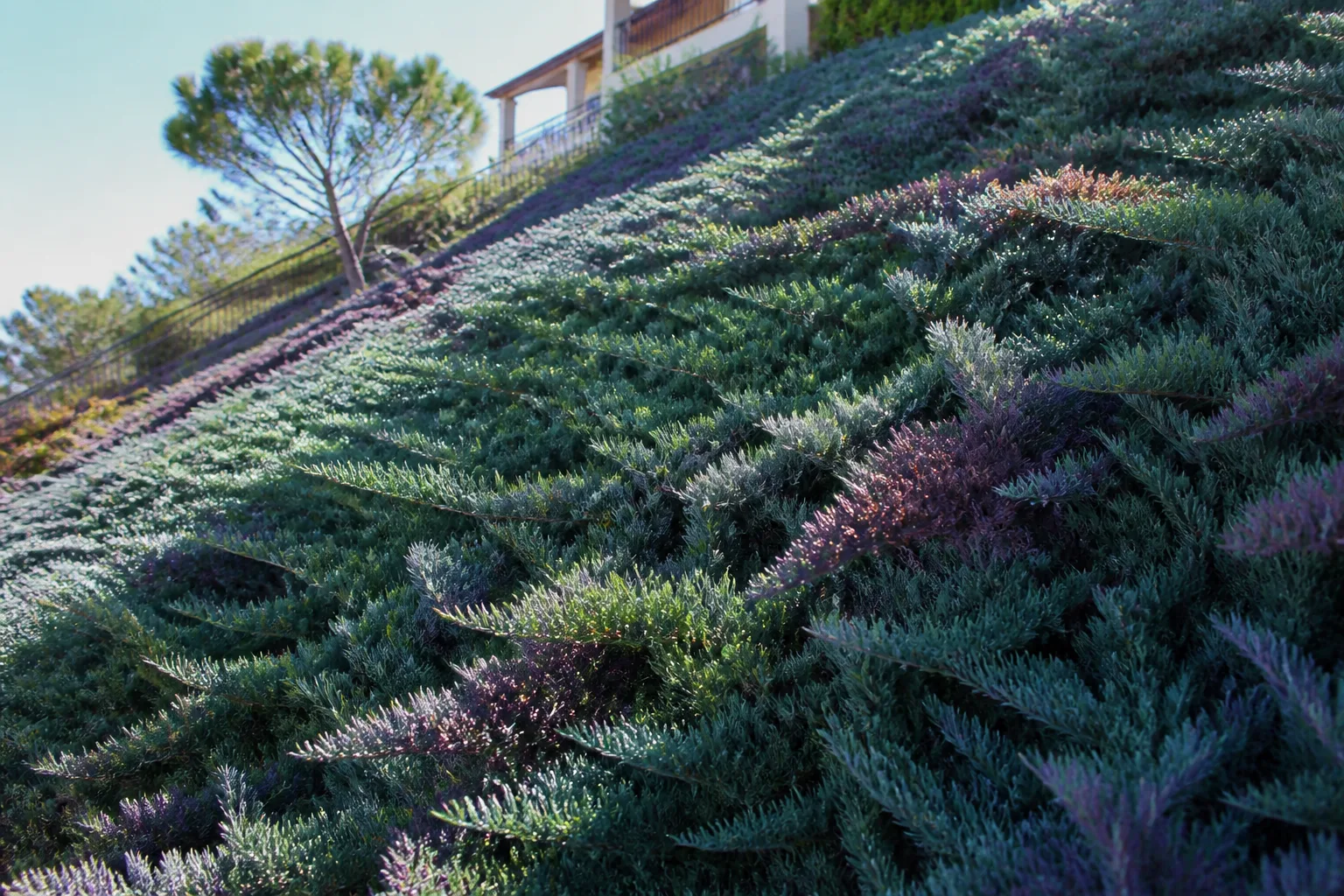
Extension profiles for creeping juniper specifically warn against wet conditions, and Minnesota Extension’s juniper diagnostic guidance identifies waterlogged soil as a setting for root problems. If water stands after rain, improve drainage or choose a plant adapted to that moisture rather than hoping a drought-tolerant conifer will cope.
Next, compare mature spread with the actual planting footprint. For a groundcover, measure the area it can cover without climbing over a path or smothering smaller plants.
For an upright tree, check not only the trunk-to-wall distance but also the branch spread near windows, eaves, and walkways. In a screen, decide whether you need a continuous visual barrier or simply a series of upright accents; those goals call for different widths and spacing.
Climate labels are a useful filter, not a complete forecast. A hardiness zone describes winter minimums, but summer heat, humidity, wind, reflected pavement heat, and winter salt can also influence performance.
Match the named cultivar to local conditions and ask a regional extension service or reputable nursery about problems common in your area. Where apple scab or cedar-apple rust is a concern, check local disease advice before choosing an eastern red cedar or ornamental juniper near susceptible apples.
Before checkout, read the full tag and look for four things: botanical species, cultivar name, mature height and width, and light or soil notes. If the seller provides only a pot size and a vague label like “blue juniper,” ask for the plant’s exact name. A small plant can be a bargain only if its future size and care fit the location; otherwise, the low purchase price can become years of pruning or an early removal.
What cones and “berries” can tell you
The blue structures commonly called juniper berries are generally fleshy, berry-like seed cones, not botanical berries. Juniper species vary in reproductive biology: some are monoecious, with male and female reproductive structures on the same plant, while others are dioecious, with male and female plants separate. The individual species or cultivar label matters if fruiting is important because a particular clone may be male or may produce few cones.
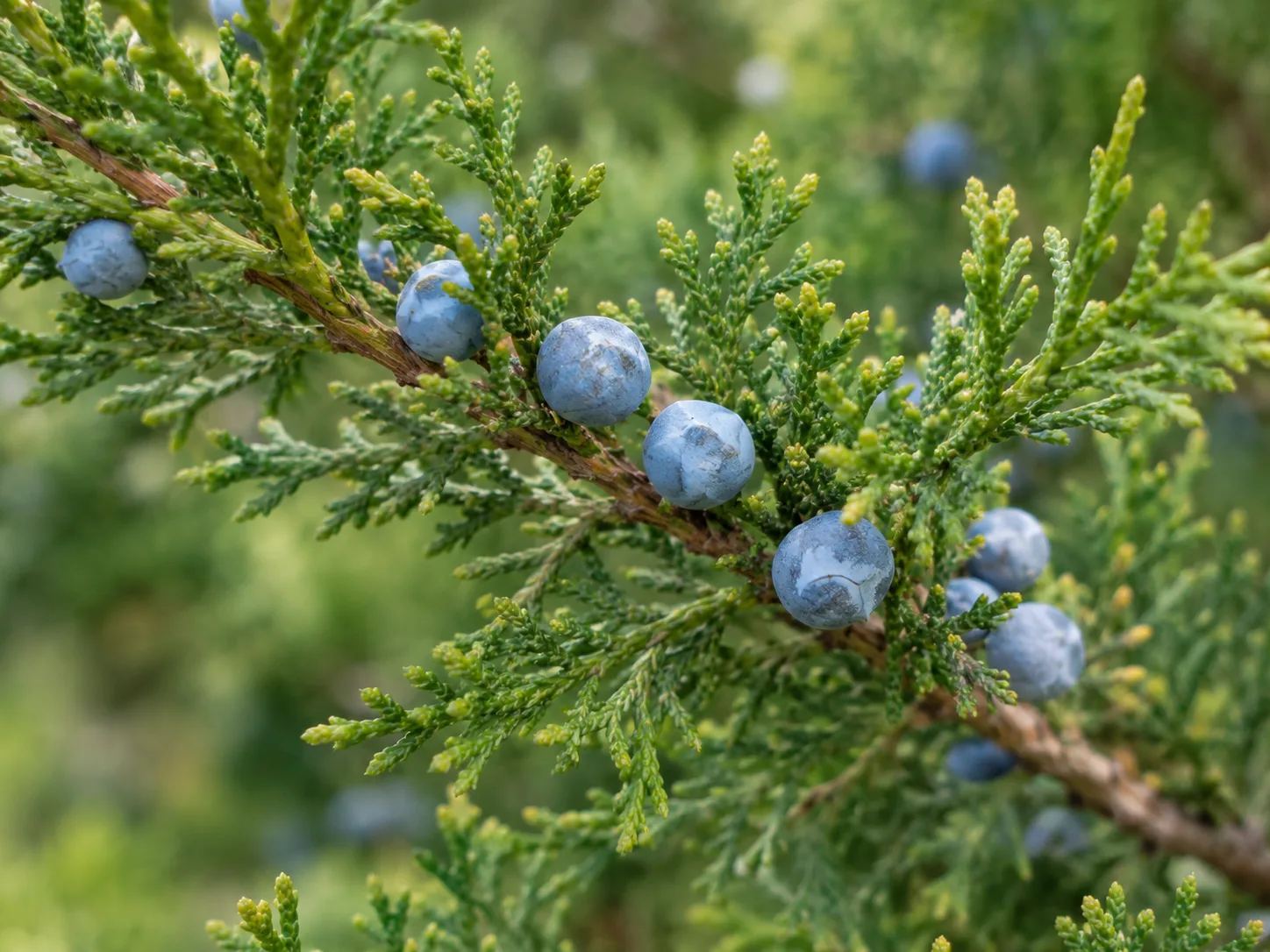
For example, UConn identifies creeping juniper ‘Bar Harbor’ as a male clone. Eastern red cedar has male and female plants, and the female plants can produce blue cones when pollinated.
So a general promise that “this juniper will have berries” is too broad. If you want visible cones, ask whether the selection is female or fruiting and whether a compatible pollen source is nearby; local nursery stock may not make that information easy to confirm.
Cones can also matter because eastern red cedar and some ornamental junipers participate in the cedar-apple rust life cycle. The fungus needs both a juniper host and an apple or related host to complete its cycle, and spores can travel beyond a single backyard. That does not mean every juniper near every apple tree will cause an outbreak.
Choose resistant apple cultivars where possible and follow regional extension recommendations for your area rather than relying on a fixed distance rule. For edible or pet-safety questions, identify the exact species and consult a primary source; the common word “berry” alone says nothing reliable about safety.
Planting and care after selection
Place the root ball at the same level it grew in its nursery container and set the plant where the mature canopy has room. Break up circling roots gently when you find them, backfill with the soil removed from the planting hole, and water the root zone thoroughly after planting. During establishment, check soil moisture below the surface and water when the root area begins to dry; repeated shallow sprinkling encourages a shallow root zone, while constantly soggy soil can damage roots.
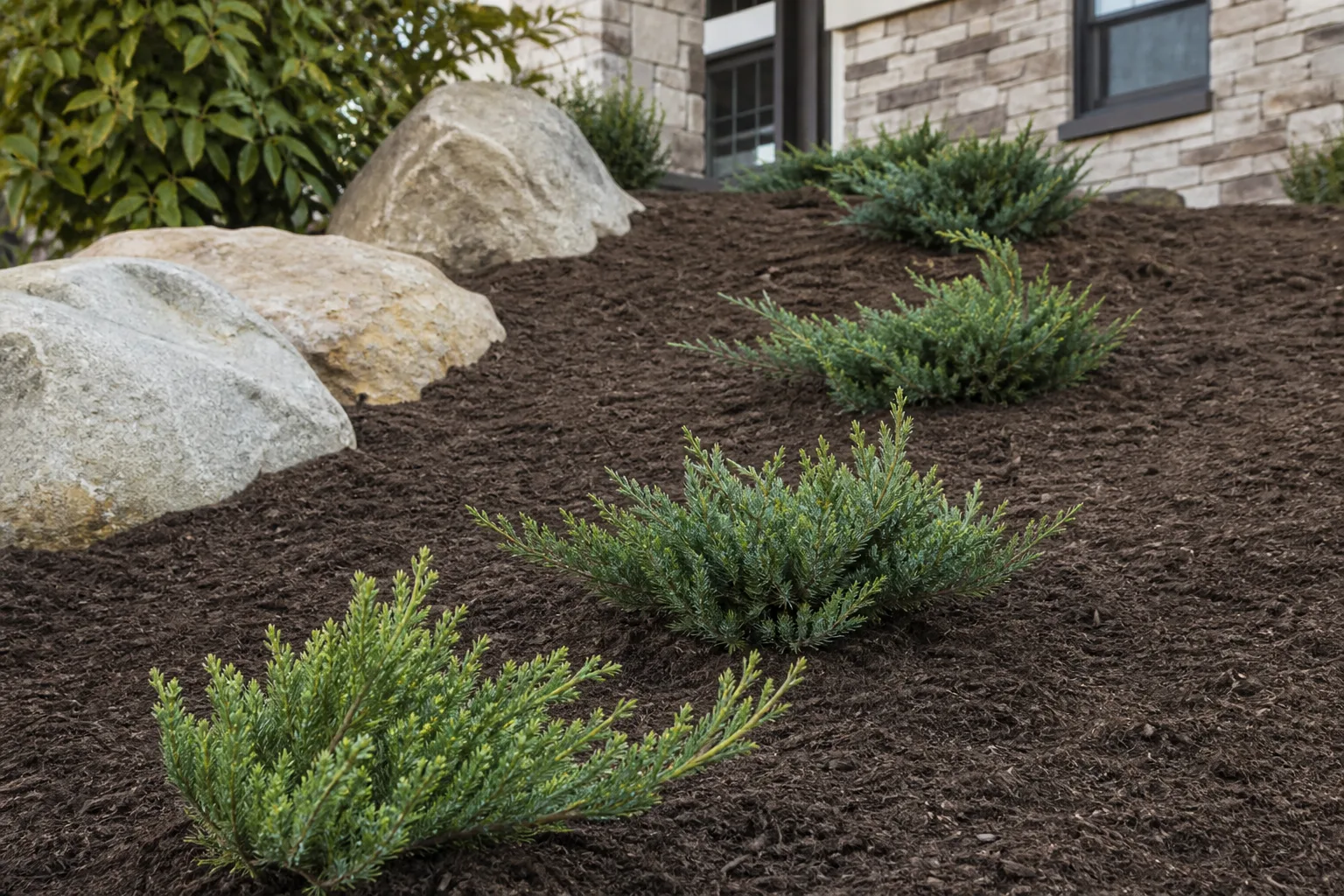
Keep mulch over the root zone to moderate temperature and limit weeds, but do not pile it against the trunk or bury the crown. Once established, many junipers tolerate dry spells better than consistently wet soil, but actual watering needs depend on rainfall, soil texture, exposure, and plant age.
A new plant in fast-draining sand needs closer monitoring than a mature one in a cooler, loamy site. Use the condition of the root zone rather than a rigid calendar.
Pruning should preserve the plant’s natural habit. Remove dead or damaged branches and correct a small problem while the cut can be made back to a live side branch. Avoid shearing a low juniper into an arbitrary shape or cutting deep into old bare wood; many conifers do not refill bare interior sections reliably.
If a columnar cultivar is outgrowing its site, repeated topping is unlikely to turn it into a sound long-term fit. Recheck the mature size before planting to avoid that problem.
When a juniper browns, diagnose the pattern before reaching for fertilizer or pesticide. Brown tips, whole branch dieback, salt injury, insects, and root stress can look different and need different responses.
University of Minnesota Extension’s diagnostic guide covers common juniper problems, including blights and environmental injury. Inspect drainage, recent weather, and the affected growth; if symptoms spread or the plant is valuable, send clear photos or a sample to a local extension diagnostic service.
Conclusion
Choose a juniper by its mature outline first: creeping forms cover ground, mounded cultivars anchor a bed, and columnar selections add height in a narrow footprint. Then verify the full botanical and cultivar name, compare mature width as carefully as height, and match the site to sun and drainage needs. Those checks make the choice more dependable than picking by foliage color or nursery-pot size alone.
If a label leaves out the cultivar or mature dimensions, pause and ask before planting. With the right form in the right place, a juniper can fill a clear landscape role for years; with the wrong form, even a healthy plant can become a constant pruning problem.



