Types of Holiday Cactus: How to Tell Them Apart
Learn how to identify Thanksgiving, Christmas, and Easter cactus by stem shape, bloom timing, flowers, and the care that brings reliable holiday blooms.
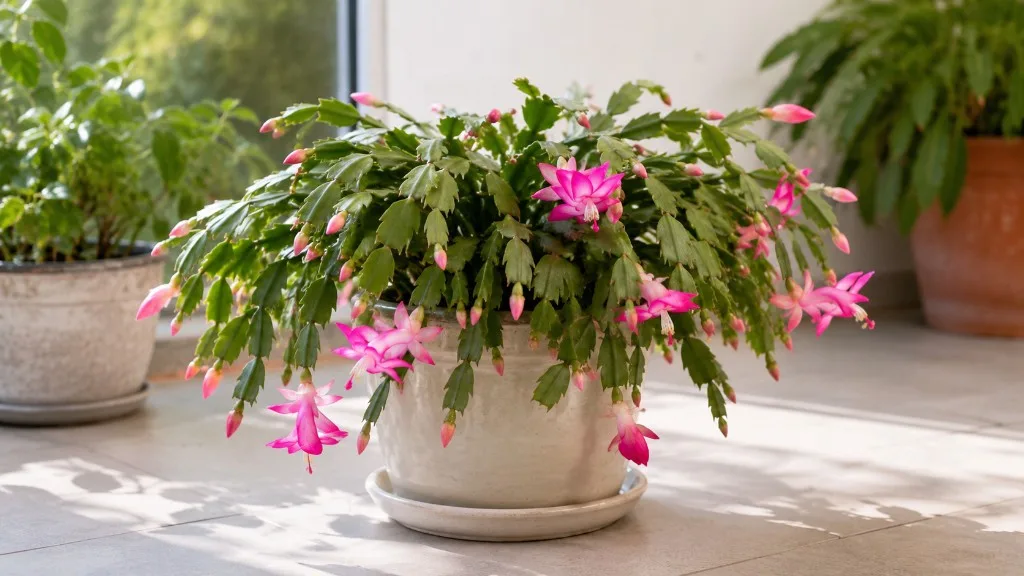
If your “Christmas cactus” flowers before Thanksgiving, you may not have a Christmas cactus at all. The label is often used loosely for several closely related Brazilian forest cacti, and the quickest way to sort them out is to inspect the flat stem segments—not the flower color or the date printed on the plant tag.
The three plants share bright flowers, trailing growth, and a preference for filtered light and fast drainage. They do not share exactly the same bloom calendar, though, and Easter cactus follows a different spring rhythm from the two Schlumbergera types. Identify the plant first, then give it the cool, dark, stable conditions that match its season.
A quick comparison of Thanksgiving, Christmas, and Easter cactus
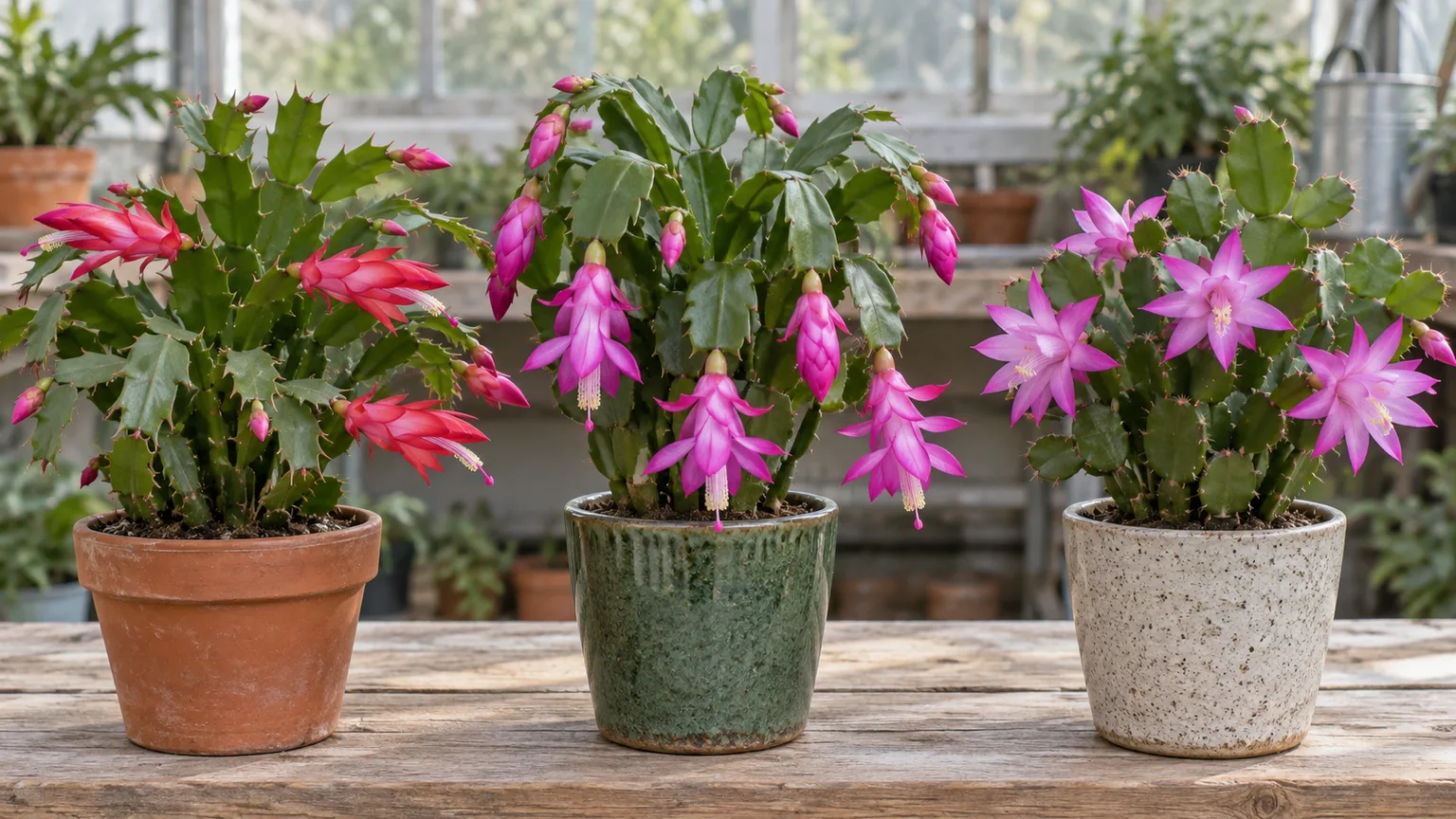
| Type | Botanical name commonly used | Stem clue | Flower clue | Usual bloom window |
|---|---|---|---|---|
| Thanksgiving cactus | Schlumbergera truncata | Pointed, claw-like projections at the segment edges | More upright or sideways tubular flowers, often with yellow anthers | Late October through November, sometimes into December |
| Christmas cactus | Schlumbergera × buckleyi; related to S. russelliana | Softer, rounded scallops with no obvious claws | Tubular flowers that tend to hang downward; purple-brown anthers are common | December through January |
| Easter cactus | Hatiora gaertneri, also listed as Rhipsalidopsis gaertneri | Rounded segments with small bristles or hairs at the tips | Broad, star-shaped flowers | March through May |
Those windows are useful clues, not appointments. A hybrid, a plant grown in the Southern Hemisphere, an unusually warm room, or a nursery that manipulated light can move flowering earlier or later. The stem shape is the best starting point; bloom time and flower form are confirmation.
Why holiday cacti are so often mislabeled
Holiday cacti are true members of the cactus family, but they are not desert cacti. In their native southeastern Brazil, they grow as epiphytes on trees or among rocks in humid, shaded mountain forests. Their flattened green stems perform the work that leaves do on many other plants, while their roots need air as well as water.
That habitat explains two common mistakes. A plant sold as a cactus is given a bone-dry, sunny windowsill and declines, or it is watered frequently in a dense mix with no air around the roots and rots. The University of Wisconsin–Madison holiday cactus guide describes the plants as forest epiphytes that receive moisture but also have excellent drainage, a combination very different from a dry-land cactus.
The naming problem has a second cause: growers favor forms that root, ship, and flower predictably for the retail season. The plant on a store shelf may be a Thanksgiving cactus, a Christmas hybrid, or a cultivar with mixed parentage, while the tag uses “Christmas cactus” as a broad selling name. A wrong label does not mean the plant is unhealthy; it means you should trust the plant’s structure and behavior more than the card in the pot. Gardening Know How’s comparison likewise treats stem shape as the most useful first distinction and notes that care is broadly similar between the two winter types.
Use stem segments as your first identification test
Look at a mature segment in the middle of the plant, not only the soft new growth at the tip. Hold the pot at eye level and trace the margin of one flattened segment. You are looking for the outline of the segment, the presence or absence of bristles, and the way the segments join—not for a particular flower color.
Thanksgiving cactus: pointed, claw-like edges
Thanksgiving cactus (Schlumbergera truncata) has pointed projections along the segment edges. They can look like small claws or a saw-toothed outline, although the plant is spineless and the projections are not dangerous spines. The segments often look more angular and squared-off than those of a Christmas cactus.
This is the plant most likely to be sold as a Christmas cactus in late fall because its natural bloom period fits the retail calendar. NC State Extension’s plant profile for Schlumbergera truncata also notes the pointed stem margins and the plant’s tendency to form a bushy, cascading container specimen. If your plant has obvious claws and opens flowers in November, Thanksgiving cactus is the strongest match.
Christmas cactus: rounded scallops and hanging flowers
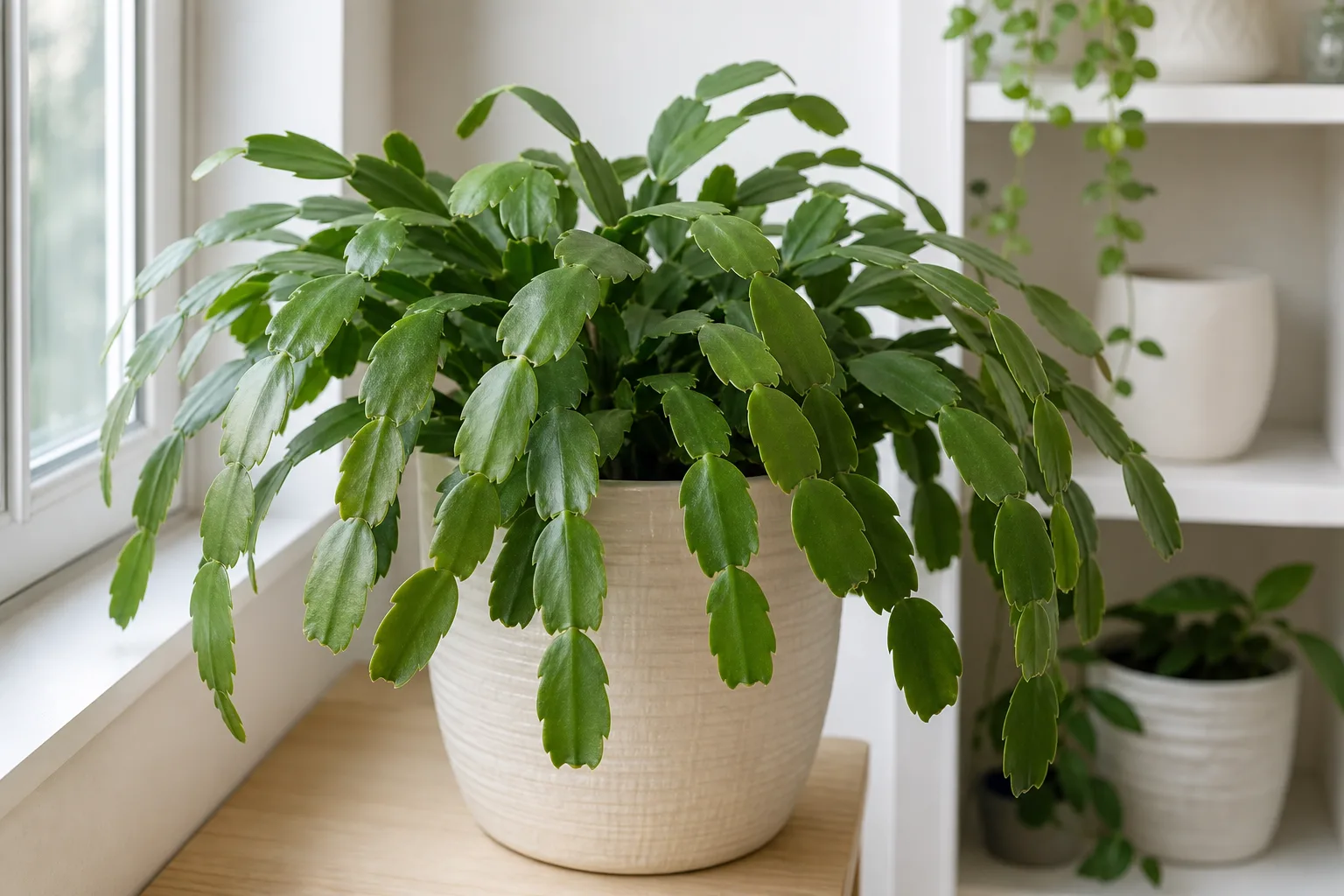
Christmas cactus is commonly associated with the hybrid Schlumbergera × buckleyi, which combines Christmas-cactus and Thanksgiving-cactus parentage. Its segment edges are more gently scalloped or teardrop-shaped, with no sharp claw-like projections. The whole plant usually develops a softer, more pendulous outline as the stems lengthen.
The flowers provide a second clue. They are tubular and often hang downward from the stem tips, giving the plant a tiered, chandelier-like display. The original Christmas-cactus species, Schlumbergera russelliana, has flattened segments with a few notches and flowers that point down; NC State’s profile of S. russelliana explains why the species and the modern hybrid are often discussed together.
Do not reject a Christmas-cactus identification just because the plant flowers in January. Late December and January flowering is often more informative than a “Christmas” label, but a hybrid can bridge the two winter windows.
Easter cactus: rounded segments with tiny bristles
Easter cactus is the easiest of the three to separate once you know what to look for. Its segments have rounded margins and may carry tiny brownish or yellowish bristles at the tips. It lacks the obvious claw-like projections of Thanksgiving cactus and usually has a more starburst-shaped flower.
The name is complicated by taxonomy. It is commonly listed as Rhipsalidopsis gaertneri in extension resources and as Hatiora gaertneri in newer horticultural treatments. NC State’s Easter-cactus profile describes the plant as an epiphytic Brazilian cactus with rounded, bristled segments and spring flowers that can reach about three inches across.
Easter cactus is also somewhat less forgiving of uneven watering. Letting it swing from bone-dry to saturated can cause segment drop, so its spring-blooming schedule should not be treated as a copy of a winter Schlumbergera routine.
Confirm the ID with flowers and bloom timing
Flower color is a poor identifier. All three types may have red, pink, white, purple, orange, yellow, or bicolored cultivars, and hybrid breeding makes color overlap even wider. Use color as a pleasant description, not as the deciding test.
Flower posture and structure are better. Thanksgiving cactus flowers tend to project outward or upward from the segment tips, while Christmas-cactus flowers tend to hang down. Easter-cactus flowers are broader and more obviously star-shaped, with petals that open into a flat, airy display rather than a long, narrow tube.
The calendar is useful when you interpret it as a pattern. Thanksgiving cactus generally leads in late fall, Christmas cactus follows in December or January, and Easter cactus brings the spring display. Epic Gardening’s comparison of the three cacti makes the same practical distinction: look at leaves or stem segments first, then use bloom shape and season as supporting clues.
If the clues disagree, record what you see for a full year. A plant with clawed segments that blooms in early December is likely a Thanksgiving hybrid or a plant whose conditions delayed flowering. A plant with rounded segments that flowers in November may be a hybrid or simply responding to a warmer, brighter room. You do not need a perfect label to care for it well; you need a reliable observation of when it sets buds and how it responds to water and temperature.
The care all three types share
The identification changes the bloom schedule more than the everyday care. All three prefer bright, filtered light; a fast-draining, organic-rich mix; regular but measured watering; moderate humidity; and a pot with a drainage hole.
Bright filtered light, not desert-cactus sun
Place holiday cactus near an east- or north-facing window, or a little back from a bright south- or west-facing window. A sheer curtain or several feet of distance can prevent the hot, direct midday sun that scorches the flattened stems. The RHS Christmas-cactus growing guide recommends bright light without full sun and describes these plants as rainforest cacti that do not share desert-cactus light preferences.
Outdoor summering can work in a frost-free season if the plant is acclimated and kept in bright shade or dappled light. A sheltered porch or the shade of a tree is closer to its natural setting than an exposed patio. Bring it in before cold nights or frost, and inspect for insects before placing it beside other houseplants.
Moisture, drainage, humidity, and temperature
Water thoroughly when the upper layer of mix has started to dry, then let excess water drain from the pot and empty the saucer. The exact interval depends on pot size, mix, light, and season; a calendar instruction such as “water every Sunday” is less reliable than feeling the mix and checking whether the pot is becoming lighter.
The plant should not sit in water, but it should not be forced through months of dust-dry soil either. Wisconsin Extension notes that holiday cactus roots receive frequent rain in the forest but never remain in stagnant water. A loose mix with organic matter plus perlite, bark, coarse sand, or another drainage component is a better model than heavy garden soil.
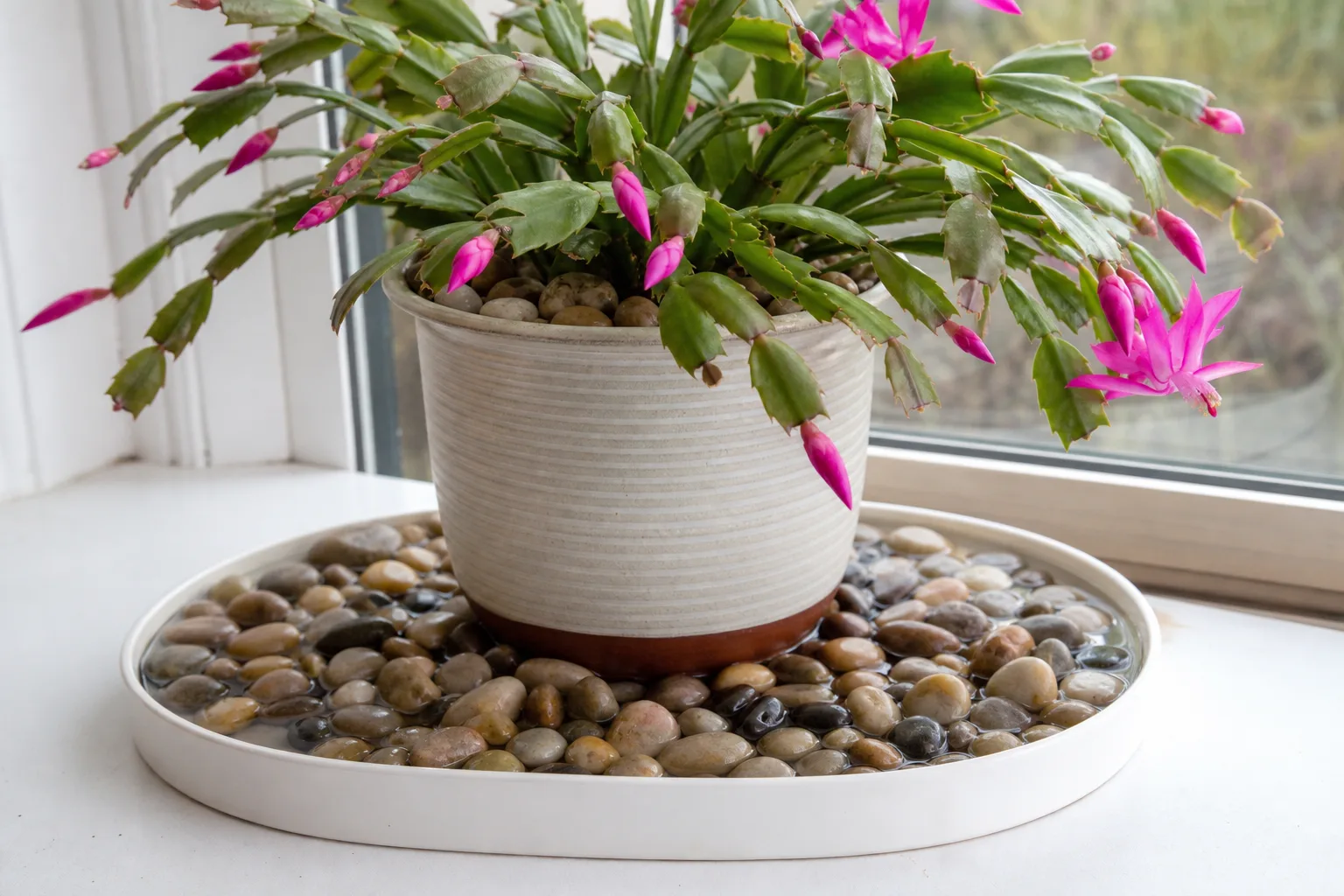
Humidity is helpful, especially in heated winter rooms, but it cannot compensate for poor roots. If you use a pebble tray, keep the pot on top of the stones and the water below the stone surface so the drainage hole is above the waterline. A humidifier, grouped plants, or a bright bathroom can also help; misting should never leave the foliage wet for long in a stagnant room.
During active growth, ordinary room temperatures around 60 to 70°F work well. For bud set, a cooler night period around 50 to 60°F is often more useful than turning the room cold all day. Keep the plant away from frost, cold drafts, radiators, forced-air vents, and doors that open onto freezing air.
Fertilizer, potting, pruning, and outdoor summers
Feed during spring and summer growth with a balanced houseplant fertilizer at the label rate, or a weaker solution if the plant is growing slowly. Stop or sharply reduce feeding during the fall bloom-setting rest; fertilizer cannot replace the cool, dark signal that initiates buds and may push soft growth at the wrong time.
Repot after flowering when the mix has broken down, roots circle densely, drainage has slowed, or the plant is repeatedly staying wet. Holiday cacti often flower well when slightly snug, so repotting into a much larger pot is not an automatic improvement. Choose the next pot size only when the root system and deteriorating mix justify it.
Prune or pinch after flowering, in spring, by removing a few segments at a joint from long or sparse stems. This encourages branching, and more stem tips eventually mean more places for flowers. Avoid heavy pruning or repotting while buds are forming; the disturbance can cost the display you were trying to protect.
A dependable routine for setting buds
Holiday cactus flowering is controlled by a combination of day length, night temperature, moisture, and plant maturity. You can improve the odds of a target-season display, but you cannot promise an exact holiday because cultivars do not all respond at the same speed.
Thanksgiving and Christmas cactus: start in early fall
For a Thanksgiving or Christmas type, begin the bloom-setting routine about six to eight weeks before the desired flowering window. The practical sequence is:
- Keep the plant in bright light during the day, but give it a genuinely dark night. A lamp, television, or bright hallway light can interrupt the long-night signal.
- Provide cooler nights, commonly around 50 to 60°F, while avoiding frost and sharp temperature swings.
- Reduce watering enough that the upper mix dries a little more between waterings, but do not let the stems shrivel or the roots sit in dry, compacted soil for weeks.
- Stop moving the plant between warm and cold locations. Stable conditions are more useful than a dramatic temperature stunt.
- Once buds are visible, return to normal bright indirect light, moderate room temperatures, and regular watering without soaking the pot repeatedly.
Wisconsin Extension describes cool nights together with a shorter photoperiod as the flowering signal and warns that radical changes after buds appear can cause abortion. RHS guidance similarly recommends a cooler, drier autumn rest and returning the plant to warmer conditions once buds develop. If your plant is already covered in buds when you bring it home, skip the forcing routine and protect the existing display from drafts and sudden moves.
Easter cactus: give it a longer, later rest
Easter cactus is not simply a late Christmas cactus. Its buds form on a different seasonal schedule, typically in late winter as days begin to lengthen, and it commonly flowers from late March into May. Extension guidance describes a longer cool period—often roughly eight to twelve weeks—before the spring bloom cycle.
During its rest, keep the plant cool and somewhat drier, but not abandoned. When you see new buds, increase watering gradually and return it to bright indirect light. Because Easter cactus is more sensitive to big moisture swings, “drier” should mean allowing the mix to dry somewhat between waterings, not repeatedly starving a plant until its segments collapse.
This is also why an Easter cactus bought in spring may flower beautifully without any complicated forcing. The plant is already near its natural cue. Your job is mostly to keep the roots healthy and avoid moving it into strong sun or a hot, dry room while the buds open.
When the plant misses its bloom or drops buds
Start with the simplest diagnosis: identify the plant, then ask whether it had the right season-long signal. A Thanksgiving cactus that flowers in November has not failed because it missed Christmas; it may simply be the type you own. A true Christmas cactus that never buds may have spent autumn beside a lamp, in a warm room, or in constantly wet soil.
Use this order of checks:
- No buds: check for bright light during the day, uninterrupted darkness at night, and cooler fall temperatures. If the plant stayed warm and brightly lit around the clock, fix the night environment before adding fertilizer or moving it into stronger sun.
- Buds formed but fell: think recent change first. Drafts, a cold car ride, a hot radiator, a sudden move, a dry root ball, overwatering, or a light change can all interrupt development. Keep the plant stable and water when the mix needs it rather than trying to compensate with a flood.
- Shriveled segments in damp soil: inspect the roots. Soil that stays wet while the stems lose firmness can indicate root deterioration, not thirst. Take healthy cuttings as insurance before attempting a rescue.
- Pale, scorched, or reddish segments: move the plant out of harsh direct sun and check whether a window or patio has become hotter with the season. Do not solve a light problem with more fertilizer.
The RHS problem guidance for Christmas cactus links few or late flowers with insufficient autumn shortening of the day or warmth that stays too high, and links bud drop with fluctuating temperatures and overwatering. These clues are more useful than a single diagnosis based on the symptom alone.
Do not repot a plant in full bud just because it has not opened yet. Repotting may be necessary if the mix is sour, compacted, or waterlogged, but if the roots look healthy and buds are developing, a stable location is usually the lower-risk choice. Save structural repairs for after flowering.
Propagate a favorite before it becomes an heirloom problem
Holiday cacti are easy to preserve through stem cuttings, and propagation is sensible insurance for a plant with sentimental value. It also gives you a way to create a fuller pot: several rooted cuttings can be planted together after they establish.
In late spring or summer, take a healthy cutting with two or three segments. Twist or cut at a joint, let the base dry in shade for a day or two, then set it into a lightly moist, well-drained rooting medium. Keep it bright but out of direct sun, and resist the urge to keep the medium saturated. Wisconsin Extension’s propagation instructions report that rooting commonly takes a few weeks, after which new growth can begin.
If the parent plant is failing, take cuttings before you unpot it. A plant with dead roots can still have viable green segments, while a long rescue attempt can leave you with neither a healthy parent nor backup plants. Once cuttings are growing, pinch the tips in spring to encourage branching and a more flower-filled shape in later seasons.
Conclusion: identify the plant, then manage the season
The stem is the most dependable label on a holiday cactus. Pointed, claw-like segments usually indicate Thanksgiving cactus; rounded scallops and hanging flowers point toward Christmas cactus or a related hybrid; rounded, bristled segments and broad spring flowers indicate Easter cactus.
After that first identification, the care is straightforward: bright filtered light, a well-drained mix, thorough but measured watering, no frost, and a stable cool-and-dark rest that matches the plant’s bloom cycle. If the label and calendar disagree, trust a full season of observation. The plant will tell you what it is—and, with fewer abrupt changes, when it is ready to flower.