11 Walnut Tree Species for North American Landscapes
Compare 11 walnut tree species by climate, mature size, nut value, native range, and landscape trade-offs before choosing one for your property.
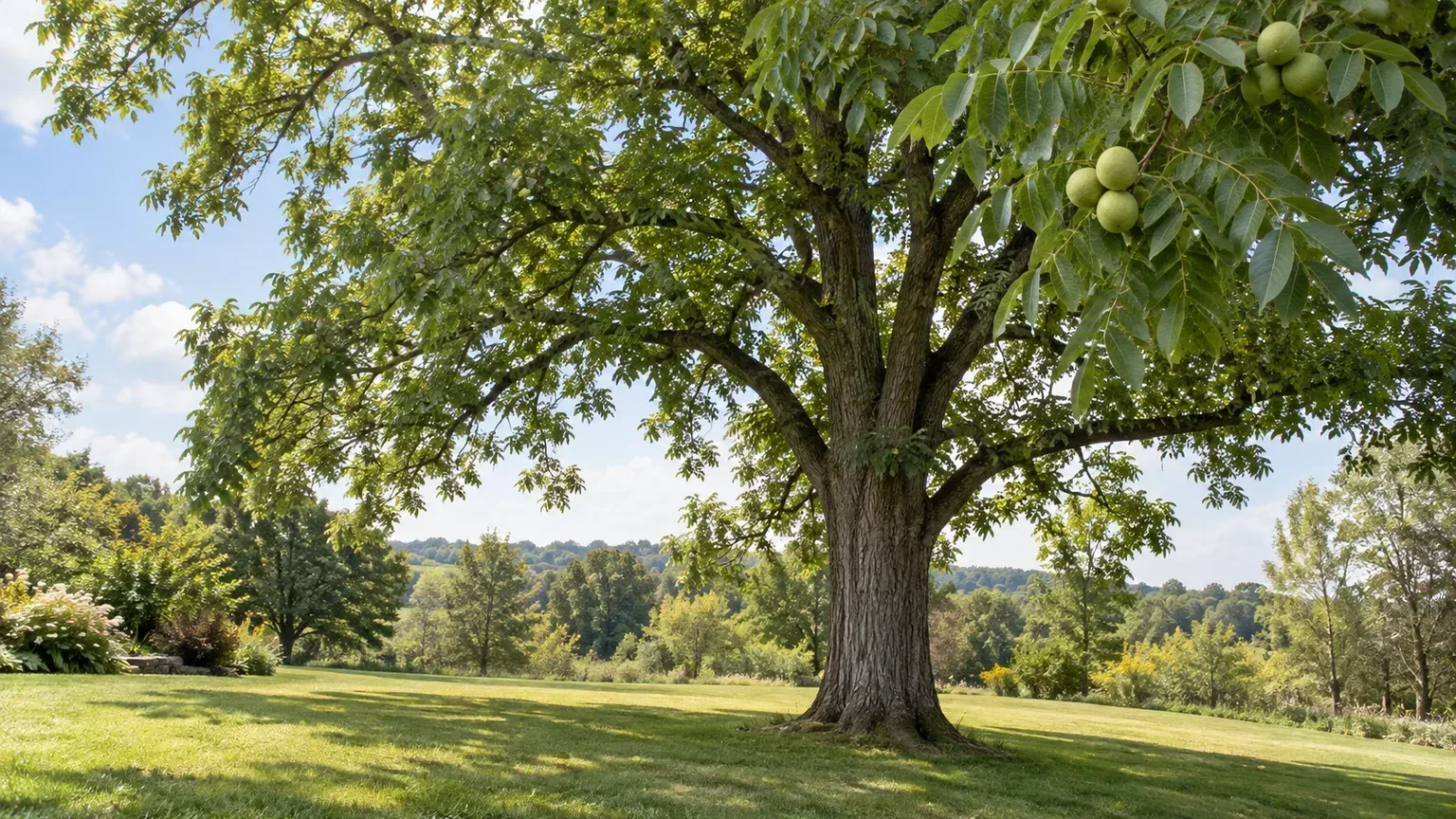
Walnut trees are long-lived shade trees, wildlife food sources, and potential nut crops, but the name covers species with very different climates and footprints. A tropical walnut that reaches a hundred feet, a California shrub-form native, and a productive English walnut are not interchangeable choices for a North American yard.
The genus Juglans contains about 20 species distributed across the Americas and parts of Europe and Asia. The list below focuses on 11 often encountered in garden references, arboretums, and nut-tree discussions; only some are practical landscape choices in the continental United States and Canada. The USDA Agricultural Research Service groups North American black walnuts, Asian butternuts, and Old World walnuts separately, a useful reminder to confirm the botanical name before buying a tree.
Quick choices for North American gardens
Start with climate and space, then decide whether you want a native shade tree, a harvest, or a botanical collector’s specimen. For a large eastern property, eastern black walnut is the best-known native choice; for a smaller, drier Southwest site, little walnut may fit better than a giant canopy tree. English walnut is the usual choice for familiar thin-shelled nuts, but its success depends on matching cultivar and climate rather than choosing by common name alone.
| If your priority is… | Start by comparing… | Check before buying |
|---|---|---|
| A native eastern shade tree | Black walnut | Mature crown, fruit drop, nearby garden beds |
| An edible, easy-to-crack crop | English walnut or a named heartnut selection | Local cultivar, chill needs, pollen overlap |
| A walnut for a dry Southwest landscape | Arizona walnut or little walnut | Local rainfall, water during establishment, proven local provenance |
| A smaller walnut habit | Little walnut or California black walnut | These are still woody trees or large shrubs, not compact patio trees |
| A cold-region ornamental | Manchurian walnut | The site still needs room, sun, and well-drained soil |
| A rare native conservation planting | Butternut or a California native walnut | Source locally and ask about disease and conservation status |
USDA hardiness zones are a useful first screen, not a complete answer. A tree can survive a winter yet fail to set nuts because the summer is too cool, bloom is hit by a late frost, or the chosen cultivar’s pollen shed does not overlap the female flowers. Ask a regional extension office or a reputable nut-tree nursery about the cultivar itself, not only the species label.
Eleven walnut species, matched to place and purpose
Most walnuts want sun and room for a substantial root system. Soil moisture, winter lows, summer heat, and the intended use of the nuts vary enough that the “best” tree is the one that fits the site, not the one with the longest list of virtues.
Andean walnut (Juglans neotropica)
Andean walnut comes from high-elevation forests of Colombia, Ecuador, and Peru, where its tall stature and valuable wood have made it important in its native range. It is a large tropical-to-subtropical tree, not a realistic outdoor choice for most of North America; frost-free or nearly frost-free conditions and generous space are essential. The USDA ARS places it among the South American walnut taxa, and it is reported as threatened in parts of its native range, so a gardener should not treat it as a routine ornamental to import.
For a warm coastal or subtropical garden, first check that a nursery can identify the species and document a lawful, responsible source. If the goal is a shade tree or edible walnuts in a temperate U.S. yard, choose a regionally adapted species instead. The USDA ARS taxonomy places this South American species with the New World black walnuts, despite its tropical origin.
Arizona walnut (Juglans major)
Arizona walnut is native to the Southwest and adjacent northern Mexico. In the wild it is associated with canyons, washes, and stream corridors, so it is better thought of as a regional riparian tree than as a cactus-garden plant that needs no water. Its mature form varies with moisture: a tree with a steady water supply can develop a stout trunk, while harsher sites may produce a more irregular, multi-stem shape.
Choose it for a sunny, spacious property within or near its native range, especially where the soil drains but does not bake dry through the establishment years. It gives a more locally grounded alternative to an eastern black walnut in the desert Southwest, but it is not a quick, compact shade solution. Confirm seed provenance and local availability; natural populations are adapted to particular watersheds and elevations.
Black walnut (Juglans nigra)
Eastern black walnut is the signature North American walnut: a large, long-lived tree native across much of the eastern and central United States. Mature trees can dominate a yard with a broad canopy, deeply furrowed bark, and long pinnate leaves; thick green husks ripen around hard-shelled nuts in fall. The USDA Forest Service describes black walnut as a shade-intolerant hardwood common in riparian forests. The kernel has a stronger flavor than the mild walnuts commonly sold in grocery stores, while the dark, prized timber adds value for some landowners.
Plant it where a broad crown and years of nut cleanup are acceptable, not beside a narrow sidewalk, parking pad, or the only vegetable bed. Its roots and fruiting habit matter as much as its attractive shade. A named nut cultivar may improve kernel size or shelling, but buyers should ask about local performance and pollen timing. For identity, black-staining husks and a strong citrus-like smell from crushed leaves or twigs are useful clues; no single trait is foolproof.
Butternut (Juglans cinerea)
Butternut, also called white walnut, is a medium-to-large eastern North American tree with an open crown, light gray bark, and long leaves commonly carrying 11 to 19 leaflets. Its oblong nuts grow inside ridged, sticky-hairy husks and are valued for a sweet, oily kernel. NC State Extension describes its native range, crown, leaflets, and elongated fruit. Compared with black walnut, the tree is often shorter and less massive, and the fruit shape is more elongated than round.
The main landscape question is conservation, not just size. Butternut canker has caused severe declines across much of its native range, and NC State Extension notes that native populations have been devastated. If you are considering one, buy from a knowledgeable regional source, ask how the stock was selected, and do not dig up a wild seedling or move plant material without checking local rules. A locally sourced healthy tree can support a native planting, but disease risk should be part of the decision.
Brazilian walnut (Juglans australis)
Brazilian walnut, also called southern walnut in some references, is a South American species rather than a cold-hardy North American shade tree. USDA ARS places it among the South American members of the New World walnut group. Its large size and tropical-to-subtropical climate needs make it unsuitable for most yards north of warm coastal regions, even if a nursery listing makes it sound like a general “walnut tree.”
Treat this as a specialty botanical collection tree for a warm site, not a substitute for black walnut or English walnut. Before purchase, verify the exact scientific name because “Brazilian walnut” can also refer to unrelated timber or food plants. If a seller cannot state the Latin name and the expected climate range, choose a better-documented tree for a landscape investment that may outlive the gardener.
California black walnut (Juglans californica)
California black walnut is native to southern California and adjoining parts of Baja California. It can grow as a broad shrub with several trunks or as a small tree, often branching low rather than forming the tall, straight trunk of eastern black walnut. Its compact leaflets and hard, small nuts reflect a plant adapted to a drier Mediterranean climate.
This is one of the more plausible walnuts for a native garden in the right part of California, but it still needs sun and room to spread. It is not a high-yield nut tree for easy backyard cracking: the shells are hard and the kernels can be difficult to extract. Because local populations and hybrids are a conservation concern in some areas, favor nursery-grown plants of known origin over collecting from wild stands.
English walnut (Juglans regia)
English walnut, also called Persian or common walnut, is native from southeastern Europe through western and central Asia. It supplies most of the familiar commercial walnut crop, with a thinner shell and milder kernel than black walnut; Britannica distinguishes its smooth-edged leaflets and commercial cultivation. In a suitable climate, it can make an attractive, wide-crowned shade tree, but orchards usually rely on named cultivars chosen for productivity, local chill conditions, disease pressure, and harvest timing.
This is the strongest candidate when the main goal is the grocery-style nut, provided your summer is warm enough for reliable ripening and your winter is not too severe for the selected cultivar. Do not assume that any single English walnut will crop well alone: male catkins and female flowers occur on the same tree, but their timing may not overlap enough for dependable production. Check whether the variety is self-fruitful in your area or needs a compatible pollinizer nearby.
Northern California black walnut (Juglans hindsii)
Northern California black walnut, or Hinds’ walnut, is a California native with a large canopy and compound leaves that can carry roughly 13 to 21 toothed leaflets. Its natural range is much narrower than the name “black walnut” suggests. The USDA ARS treats J. hindsii as a distinct California taxon. It has also been used as a rootstock for English walnut orchards, which complicates identification where cultivated trees and hybrids occur.
Consider it for a regional restoration or native landscape only after confirming the tree’s identity and local conservation guidance. It is not a small-yard walnut, and nursery material sold simply as “California black walnut” may not make clear whether it is J. hindsii, J. californica, or a hybrid. The USDA ARS classification recognizes both taxa, while noting that walnut taxonomy and cultivated material can be complicated; a precise botanical label matters here.
Japanese walnut and heartnut (Juglans ailantifolia)
Japanese walnut is a large, cold-tolerant Asian tree with especially long compound leaves and a broad crown; the University College Dublin tree guide documents its large foliage and flowers. The wild-type nuts are relatively small, thick-shelled, and laborious to extract. Heartnut is generally treated as a selected form of Japanese walnut, J. ailantifolia var. cordiformis, rather than a separate species; its heart-shaped shell can split more readily than the species’ typical nut.
Choose a named heartnut cultivar if the crop is the point, and verify that it suits your climate and has appropriate pollen nearby. Japanese walnut itself can be an ornamental specimen where a wide crown is welcome, but its size and fallen fruit make it a poor fit for tight patios. Its large leaves also make it easy to recognize in summer, though leaf size alone cannot establish a confident species identification.
Manchurian walnut (Juglans mandshurica)
Manchurian walnut is native to East Asia and is grown as an ornamental in cold temperate regions because it tolerates severe winters better than many walnuts. It can grow rapidly into a large tree, with long leaves bearing many leaflets. The nuts are edible but usually small and difficult to process, so its value in a home landscape is more often shade, foliage, and botanical interest than convenient food.
Give it full sun and ample room, and do not mistake cold hardiness for tolerance of every difficult site. A young tree still needs establishment watering, and poorly drained ground can undermine a tree that otherwise handles cold. It is worth comparing with locally native shade trees before planting; its hardiness makes it possible, not automatically preferable.
Little walnut (Juglans microcarpa)
Little walnut, often called Texas or river walnut, is the smallest species on this list in many landscape settings, but it is not a dwarf cultivar. Native to parts of the south-central United States and northern Mexico, it grows along streams and ravines as a large shrub or small, branching tree. Its leaves have narrow leaflets, and its small nuts are usually about an inch across, with a hard shell and little kernel compared with English walnut.
For a dry-region native planting, this can be a more proportionate choice than a towering eastern walnut. It still needs enough room for its mature spread, and its native streamside habitat means young plants benefit from regular water while roots establish. Choose it for regional character and wildlife value, not a substantial nut harvest.
Identify a walnut by its leaves, twigs, and fruit
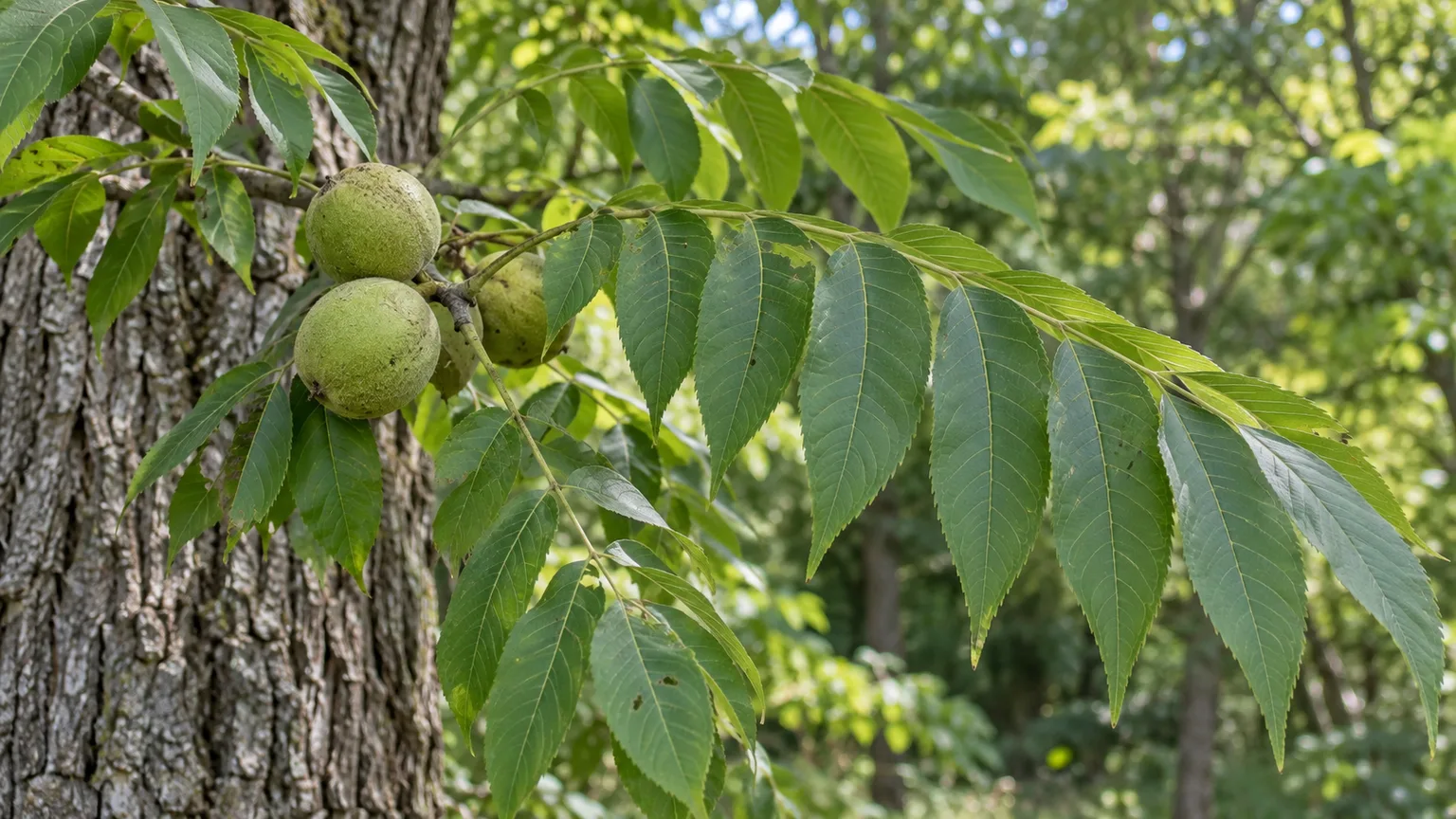
Walnuts usually have alternate, pinnately compound leaves: multiple leaflets line up along one central stalk. The number, shape, and size of leaflets vary by species, so use the entire leaf rather than one leaflet as your first clue. Many walnuts also have chambered pith inside a twig; a cut twig can reveal small internal partitions, a useful winter clue when leaves and fruits are gone. University College Dublin’s tree-identification guide describes the genus-level pattern and compares leaves and fruit of several species.
For a quick field check, work from broad evidence to detail. Look at the whole tree’s region and overall form, then check a full leaf, bark, fruit husk, and twig; compare at least two of these features with a local native-tree guide. Black walnut usually has a rounder green husk that stains dark, while butternut has a more elongated, ridged fruit and lighter bark. English walnut leaflets tend to have smoother edges and a larger terminal leaflet than many native North American walnuts, whose leaflets are often toothed.
Do not crack and eat an unidentified wild “walnut” based only on the shell or leaf. Some look-alikes in the broader walnut family are not interchangeable as food, and a tree’s common name can be misleading. The botanical distinction is useful: a walnut’s fleshy outer covering and hard inner shell make the fruit a drupe botanically, even though people call the edible seed a nut.
Plan for mature size, pollination, nuts, and upkeep
Before planting, picture the tree at maturity rather than the nursery height. Most walnuts become substantial trees, and even smaller species can develop a wide, low crown; keep the eventual canopy clear of buildings, overhead wires, driveways, and high-traffic paths. A walnut’s deep shade can be an asset over a lawn or seating area, but fruit drop can stain paving, attract squirrels, and make autumn cleanup part of the routine.
Match the tree to the site in this order: winter minimums and summer heat; drainage and water availability; available crown and root room; then whether nuts matter. Full sun and deep, well-drained soil suit many walnuts, while Southwest species require a different water strategy from an eastern bottomland tree. Avoid planting in a low spot that stays saturated, and plan to water a new tree through dry spells until it has established a broad root system.
Nut production brings another decision. Walnut trees bear separate male catkins and female flowers on the same tree, but blooming periods can differ; a second compatible cultivar may increase reliable pollination. If harvest matters, choose the cultivar first and ask the nursery for its pollination partner, ripening window, and local track record. A species name by itself does not tell you whether nuts will ripen before your first hard fall freeze or whether the shell will be easy to crack.
Think through cleanup and maintenance as well as harvest. Husk stains are difficult to remove from skin and light-colored paving, and nuts falling from a tall crown can be hazardous over play spaces or parked vehicles. Do not prune large limbs from a mature walnut without a clear arboricultural reason; hire a qualified arborist for structural work, and preserve sound scaffold branches rather than trying to force a naturally broad tree into a small footprint.
Judge juglone with care, especially near black walnut
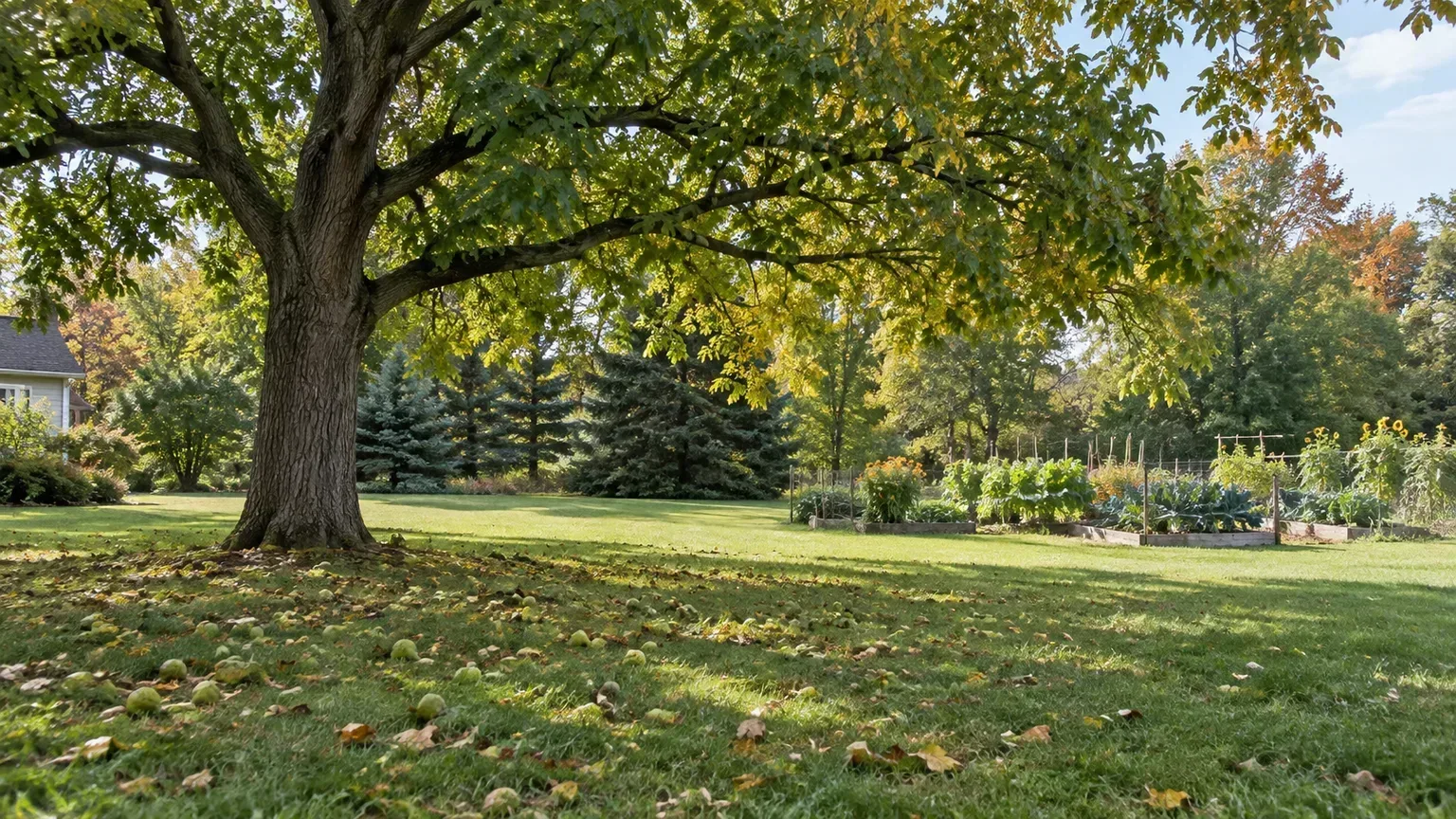
Black walnut is associated with juglone, a chemical found in several parts of the tree and linked to injury in sensitive plants. Wisconsin Extension lists tomatoes, peppers, potatoes, eggplant, some ornamental shrubs, and other plants among those that can be affected, and it notes that the tree’s root zone can extend well beyond the trunk. But its own guidance also cautions that sensitivity lists are incomplete, based largely on observation, and sometimes disagree. That is more useful than treating every plant under every walnut as doomed.
Look at the whole site before blaming juglone. A plant beneath a mature tree also faces shade, dry soil, dense competing roots, fallen leaves, and less rainfall reaching the ground; each can cause poor growth on its own. The Morton Arboretum cautions that the allelopathic effect has not been studied in depth, while Robert Pavlis at Garden Myths reviews why the popular explanation can overstate what is known about the mechanism. Gardening Channel’s larger tolerance list is a starting point for possibilities, not a guarantee that a plant will thrive in a specific root zone.
If you already garden near black walnut, try tolerant species first and observe them through a full growing season. Keep sensitive crops away from the canopy and root zone when practical, remove accumulated husks and leaves from beds, and prioritize light, drainage, and irrigation. Raised beds can help with rooting depth, but they are not a sealed shield if walnut roots can grow up into them; use a root barrier only when its installation will not damage the tree and the bed’s location justifies the work.
Conclusion
For a large eastern property, black walnut is the classic native shade-and-nut tree; for a grocery-style crop, compare local English walnut cultivars; for a Southwest native planting, consider Arizona or little walnut; and for a conservation-minded eastern garden, learn more about butternut before buying. The remaining species are valuable to know, but several are better suited to warm specialty collections or spacious arboretums than everyday yards.
Choose by the tree’s eventual crown, local climate, harvest needs, and the site around it—not by a hardiness-zone label or a common name on a tag. Confirm the scientific name and ask a knowledgeable nursery or extension service about provenance, pollen timing, and disease risk. Those checks turn a walnut list into a durable landscape decision.



