Best Light Color for Plant Growth: Full Spectrum Guide
Compare red, blue, green, and full-spectrum grow lights, then match color, brightness, distance, and daily hours to your plant’s needs without guesswork.
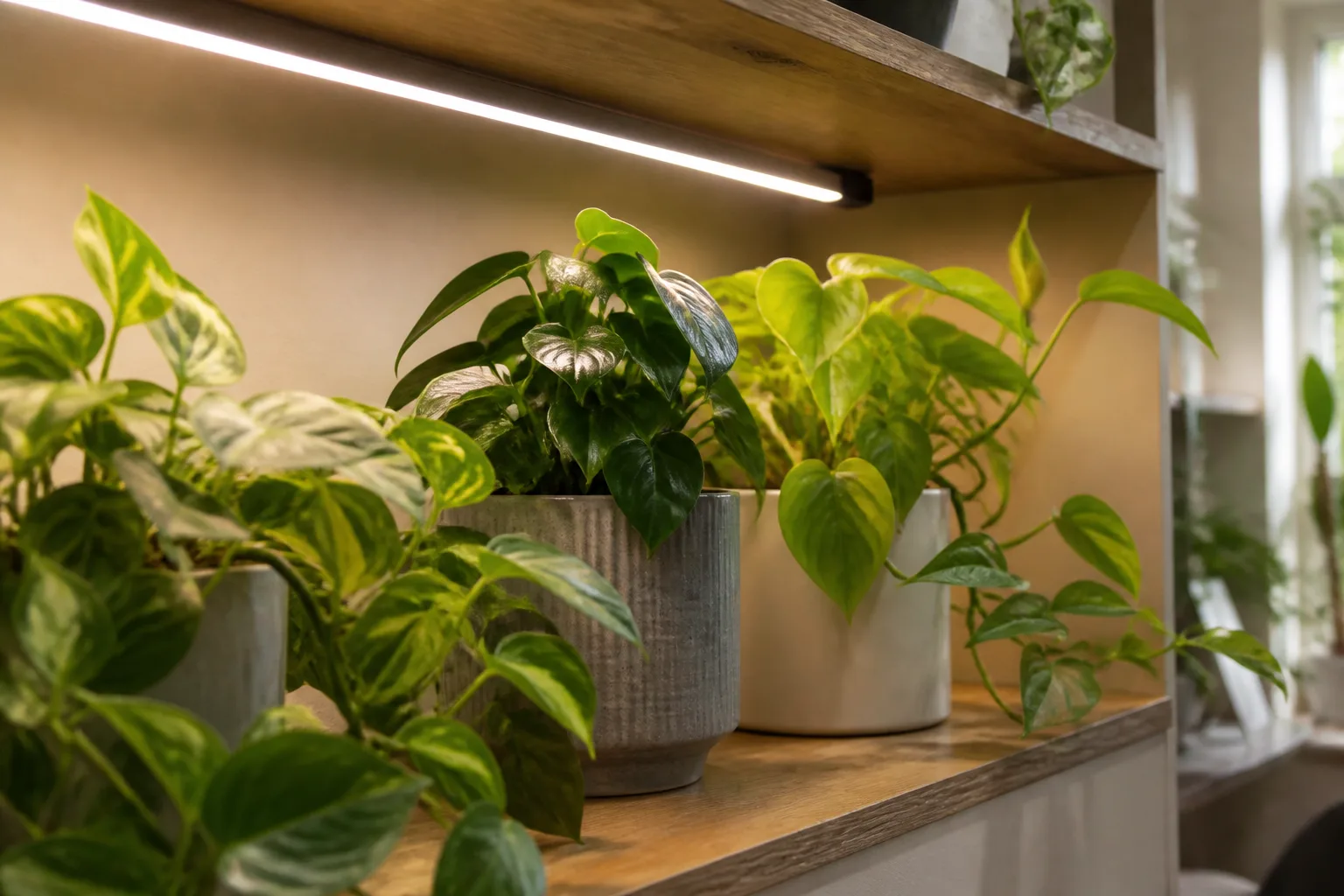
For most houseplants, seedlings, and home growing shelves, choose a balanced, full-spectrum white LED grow light. Plants use multiple parts of the spectrum; the familiar purple glow from a red-and-blue fixture does not mean it will grow every plant better. In a home setup, the amount of light reaching leaves, how evenly it covers them, and how long it runs usually matter more than whether the lamp looks blue, pink, or warm white.
That answer has an important limit: a broad spectrum is a sensible default, not a universal recipe. Commercial growers may tune wavelengths for a crop, cultivar, or flowering schedule. If you are raising a mixed shelf of pothos, herbs, and seedlings, a white full-spectrum fixture makes plant health easier to judge and usually avoids the trade-offs of a highly specialized color mix.
The Best Default: Balanced, Full-Spectrum White
A broad-spectrum white LED is the simplest choice for ordinary indoor growing because it supplies a mix of wavelengths plants can use while letting you see leaf color naturally. That makes it easier to spot pale new growth, pests, yellowing, and early scorch than under a deep-purple lamp. The light can be both pleasant for a room and useful for plants; it does not need to look like sunlight to work, but white fixtures tend to be the easiest to live with.
“Full spectrum” is not a tightly regulated promise that every fixture has the same output. One product may have a broad white distribution with a noticeable red peak, while another may mix white LEDs with extra red or blue diodes. Think of the label as a starting clue. For an ordinary plant shelf, prefer a fixture intended for plant growth, with a published coverage area and usable output information, rather than paying extra for a color name alone.
A dedicated red-and-blue light can work, especially in a grow tent or shelf where human color perception is not important. But there is no simple rule that blue grows leaves while red makes flowers: both wavelengths can contribute to photosynthesis, and their effects on shape or flowering depend on dose, timing, species, and other conditions. The University of Georgia Extension’s overview of grow lights describes these responses as variable among plants, which is why a balanced spectrum is more reliable for a mixed collection.
Color, Spectrum, and Light Quantity Are Different
A bulb’s visible color is only one way to describe it. To choose a useful grow light, separate three ideas that product listings often blur together: wavelength (the colors and wavelengths emitted), intensity (how much reaches the leaves), and duration (how long the plant receives it). A lamp can have an appropriate spectrum but be too weak, too far away, or on for too few hours to help.
Wavelength and PAR
Light is electromagnetic radiation, and wavelength is measured in nanometers (nm). The conventional plant-production term photosynthetically active radiation (PAR) refers to light in the 400-to-700-nm range. Chlorophyll absorbs strongly in parts of the blue and red regions, but photosynthesis does not run on two narrow bands alone. Green wavelengths are also useful, and plant photoreceptors respond to additional wavelengths that affect form and development.
Some horticulture research and equipment makers discuss far-red light up to 750 nm as part of an extended photosynthetic range. That is one reason spectral charts can differ: not every label or measurement uses the same boundary. A fixture advertised as “full spectrum” may not include meaningful ultraviolet or far-red output, and most general houseplant growers do not need those specialty wavelengths. Oklahoma State University Extension’s guide to LED grow lights describes PAR as the range plants use for photosynthesis and explains why horticultural LED fixtures can be tuned to distinct spectral outputs.
Kelvin and “Daylight” Labels
Kelvin (K) describes a lamp’s color appearance, not its full spectral recipe. A lower color temperature, such as 2,700 K, tends to look warm and yellowish; a higher one, such as 6,500 K, looks cooler or bluer to people. Those numbers do not reveal exactly how much red, blue, green, or far-red a lamp emits. Two bulbs with the same Kelvin rating can have different spectral distributions.
That makes advice such as “buy 6,500 K for leaves and 3,000 K for flowers” too blunt to guide a real purchase. A 6,500 K shop light may look cool-white but still deliver too little intensity at plant height. Conversely, a warmer broad-spectrum grow light can support growth if its photon output and coverage are adequate. Treat “daylight,” “cool white,” and Kelvin as visual descriptors; look for plant-specific output data when you need to compare performance.
PPFD and DLI
For comparing plant light, photosynthetic photon flux density (PPFD) is more informative than watts or lumens. PPFD estimates the number of PAR photons arriving at a square meter of canopy each second, commonly written as micromoles per square meter per second (µmol·m⁻²·s⁻¹). A fixture’s PPFD map can show how output changes from the center to the edges and at different hanging heights. The map is meaningful only when it names the tested distance and the illuminated area.
Daily light integral (DLI) is the total PAR delivered over a day. It combines intensity and hours, so a dim light run longer may not deliver the same result as a brighter light run for fewer hours; plant response is not always interchangeable, either. Many houseplant owners do not need to calculate DLI, but the concept explains why choosing a bulb by color or wattage alone misses the practical question: what dose reaches the leaves across the day? Oklahoma State Extension outlines PPFD and DLI for growers, while Epic Gardening’s seed-starting guidance emphasizes that fixture height and daily runtime both affect results.
Watts measure electricity use, not the light delivered to a plant. Lumens and lux are weighted toward how bright a source appears to the human eye, so they are poor substitutes for PPFD when comparing fixtures with different spectra. A phone app can help you compare positions under the same lamp, but it is not a calibrated PAR meter and may read red-blue fixtures especially poorly. Use it as a rough relative check, not as proof that a plant receives a precise light dose.
How Blue, Red, Green, and Far-Red Affect Plants
No color acts as a stand-alone growth switch. Wavelengths affect photosynthesis and plant signaling in overlapping ways, and the same adjustment can produce different results among species. In controlled production, growers can manipulate a spectrum because they are targeting a specific crop and measuring the outcome. For a home grower, that science is most useful for understanding why balanced light works and why a narrow color change may not fix weak growth.
Blue Light Shapes Compact Growth
Blue wavelengths contribute to photosynthesis and signal through plant photoreceptors. In many species, blue light helps regulate leaf development, chlorophyll production, stomatal behavior, and compact growth. If a plant receives too little usable light overall, however, adding a blue diode will not compensate for a weak fixture or poor placement.
The effect of blue light depends on both its proportion and the total intensity. Michigan State University Extension’s discussion of blue light explains that plant responses can include changes to shape and development, but those responses depend on the crop and growing conditions. For a seedling tray or leafy herb shelf, a balanced white fixture gives plants blue wavelengths without forcing the room into a monochrome purple cast. If seedlings stretch, check intensity, coverage, and distance before concluding that the spectrum lacks blue.
Red Light Supports Photosynthesis and Flowering Cues
Red wavelengths are absorbed efficiently by chlorophyll and can support photosynthesis, leaf expansion, and biomass accumulation. Red light also interacts with phytochrome, a light-sensing system involved in seed germination, stem responses, and seasonal flowering signals. Those effects are not equivalent to putting a red bulb over any plant and expecting flowers.
Flowering depends on the plant’s genetics and the pattern of light and darkness it experiences, as well as maturity and growing conditions. Some species use day length as a cue; others flower in response to age or environmental conditions. A red-rich fixture cannot turn a plant that is not ready to bloom into a flowering plant, and an overly long lighting schedule may interfere with a species that responds to long nights. Use a plant-specific photoperiod when flowering is the goal instead of relying on bulb color alone.
Green Light Reaches Deeper Leaf Layers
Green light is often treated as “wasted” because leaves reflect more green wavelengths than red or blue, which is why foliage looks green to us. Reflection is not the same as total rejection. Green photons can penetrate farther into leaf tissue and through upper leaves to reach lower parts of a dense canopy, where they can contribute to photosynthesis.
For one small houseplant, you do not need to seek out a green-only lamp. The practical takeaway is that a broad white spectrum is not inferior just because it looks less dramatic than red-blue light. In a dense plant shelf, even coverage and enough light through the canopy are more useful goals than maximizing one visible band. Rotate pots or adjust the fixture if upper leaves shade lower growth.
Far-Red Changes Shade and Flowering Signals
Far-red lies just beyond the conventional PAR boundary, and it can affect how a plant interprets shade and day length. When plants detect a high far-red signal relative to red, some species respond with stem elongation or other shade-avoidance growth. In controlled horticulture, far-red can also be used to influence flowering in certain crops. The response is species-specific and depends on the amount and timing of exposure.
A home grow light does not need to advertise far-red to be useful. Avoid adding far-red as a generic fix for slow growth: extra stretch is not always desirable, and the plant may simply need more photosynthetically useful light. Growers who use spectral tuning usually have a defined crop goal and a way to measure results. For a mixed home collection, broad white light is the lower-risk baseline.
Match a Broad Spectrum to the Growing Goal
The plant’s goal and light environment should drive the setup. Spectrum is one variable among several, and it usually becomes a fine-tuning tool only after the plant receives enough light across the leaves. The following distinctions help without pretending every species follows one schedule.
Seedlings and Leafy Growth
For seedlings, herbs, lettuce, and foliage plants, start with a broad-spectrum white LED that covers the whole tray or canopy evenly. Seedlings need enough intensity to avoid long, weak stems; a fixture that lights only the center can leave edge plants leaning and stretched even when the color mix is excellent. Raise or lower the light according to the manufacturer’s tested distance and the plants’ response, and lift it as the canopy grows.
The Epic Gardening seed-starting guide gives 4 to 8 inches as a common setup range for some LED fixtures and recommends roughly 14 to 16 hours of light for seedlings. Treat those as a starting point for the described setup, not universal requirements: different fixtures have different output, and different species and natural-light conditions change the total. Use a timer for consistency and leave a daily dark period. If a tray shows pale patches directly under the lamp, increase distance or reduce output; if stems keep stretching, check coverage and intensity before simply adding more hours.
Flowering, Fruiting, and Mixed Collections
A flowering plant may need more total light than a low-light foliage plant, but that does not mean it needs a red-only bulb. For tomatoes, citrus, peppers, or sun-loving flowering plants grown indoors, first choose a fixture with sufficient output for the canopy area and a spectrum designed for sustained growth. Then confirm that the plant gets the right photoperiod and that indoor temperatures, nutrition, pollination, and maturity are suitable. Spectrum cannot replace these conditions.
For a mixed shelf, choose a balanced white light and group plants with similar intensity needs together. Place higher-light plants closer to the fixture’s strong central zone; move shade-tolerant plants toward the edge or farther away. A compromise spectrum is rarely the main problem in a mixed collection. Unequal distance and shading usually create more visible differences, so adjust position or use separate dimmable fixtures before buying multiple color-specific bulbs.
Indoor light also depends on the room. Epic Gardening’s houseplant-light guide notes how window direction and the distance from a window change the light a plant receives, so treat a grow lamp as part of the shelf’s overall exposure rather than an isolated color choice.
Choose a Grow Light by Performance, Not Purple Color
When comparing lights, move down this list in order: coverage area, output at the listed distance, uniformity, dimming or height adjustment, then spectrum. A red-blue fixture can deliver plenty of photons, but so can white LEDs; the color cast itself does not tell you how strong or even that output is. A product page that advertises only “full spectrum” and a watt equivalent leaves important questions unanswered.
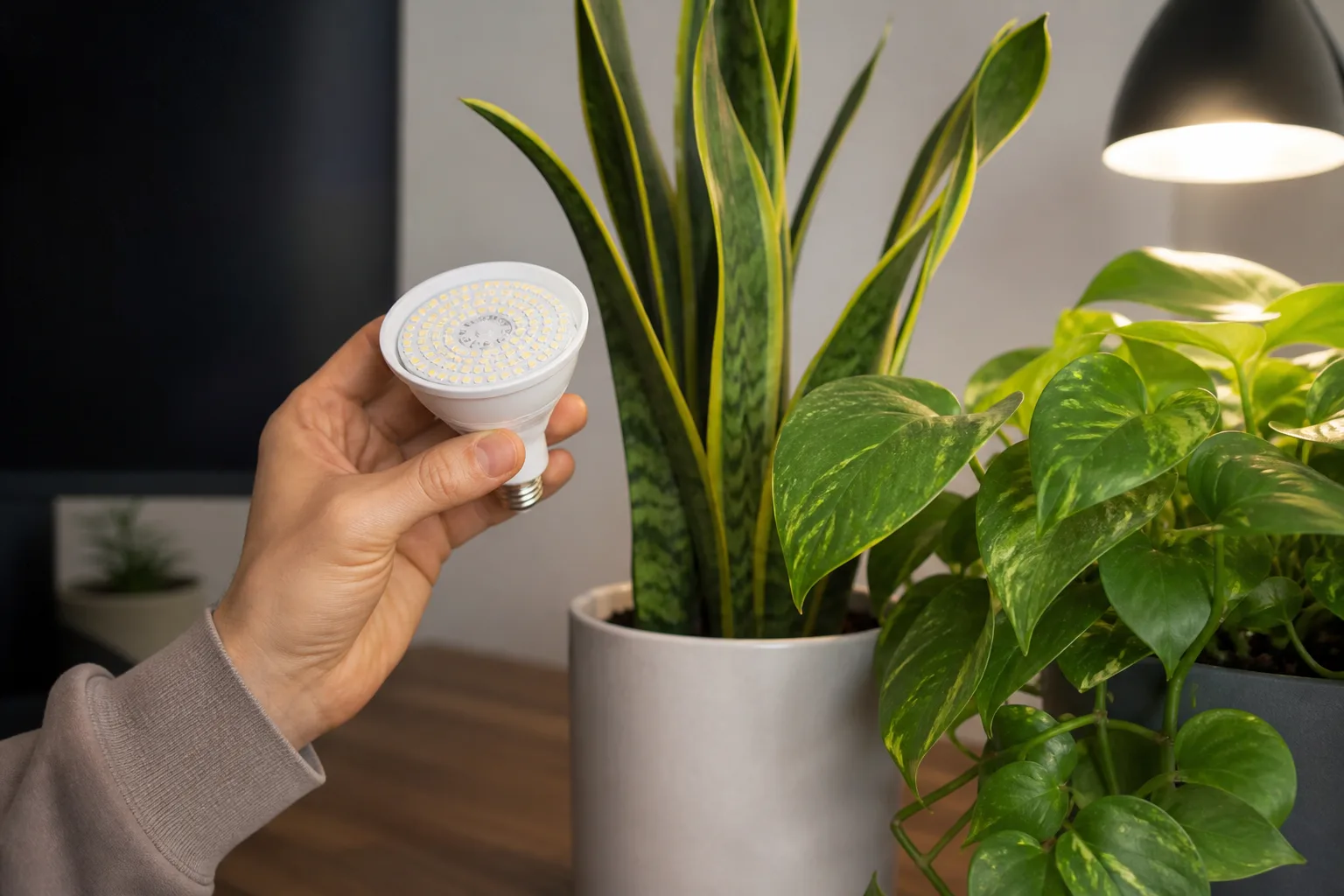
Look for a PPFD chart or map that shows the light at a stated height over a stated footprint. Check whether the listed watts are actual power draw or a comparison to an older bulb, and whether the light is intended for a single plant, a shelf, or a seed tray. For white fixtures, a color temperature can help you decide whether the lamp looks comfortable in your room, but it should not outrank intensity or coverage. “Full spectrum” may be reassuring, but a full-spectrum bulb with low output can still be inadequate for a sun-loving plant.
For a single pothos or a small windowsill, a simple bulb in an adjustable lamp may be enough if it is designed for plant growth and can be positioned near the canopy. For a row of seedlings, a linear bar or panel spreads light more evenly across the tray. For a large plant rack, compare the manufacturer’s coverage map and consider whether separate fixtures give better uniformity than one bright center light. The best format is the one that delivers an even, useful dose to the leaves you are actually growing.
Set Light Distance, Coverage, and Schedule
Start with the manufacturer’s hanging-height or distance recommendation for the fixture and plant type. The same distance cannot be applied to every lamp: output differs with diode power, optics, dimming, and reflector design. If no tested height is supplied, that is a reason to be cautious about claims, not a reason to assume that any household bulb can sit inches above leaves.
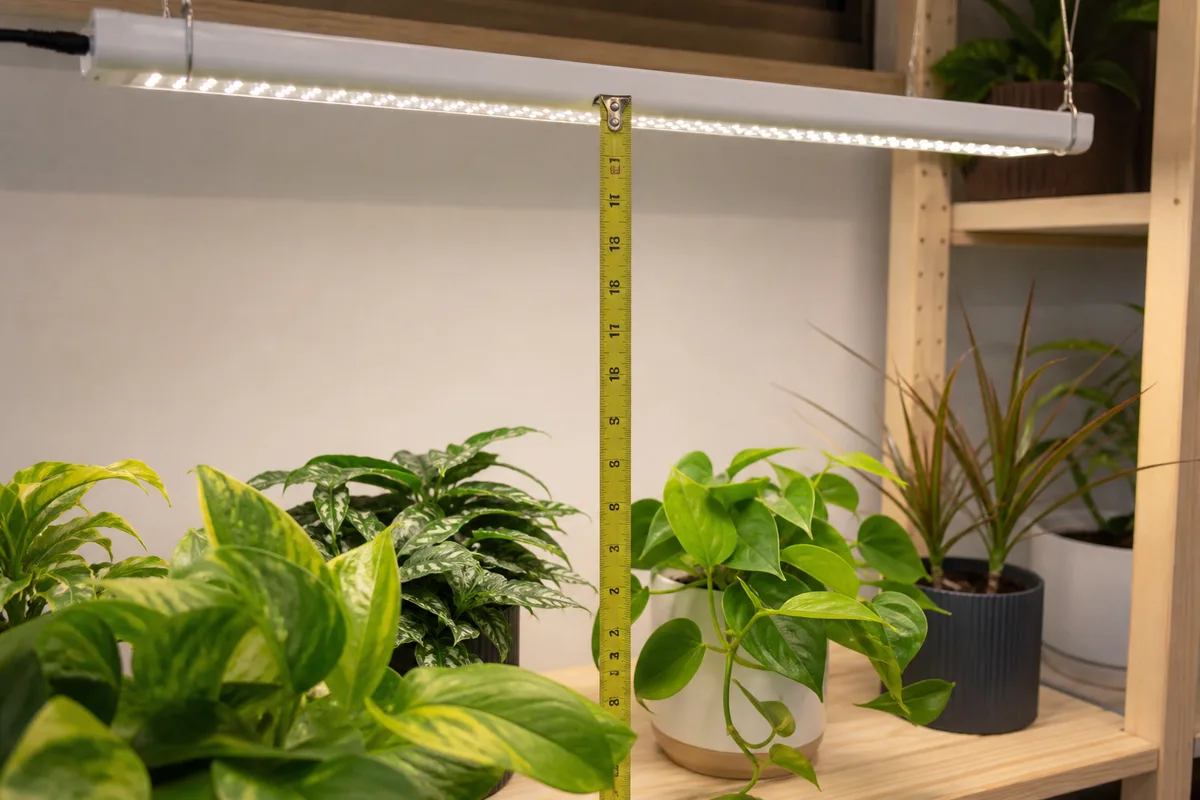
Measure from the light to the top of the foliage, not the pot rim or floor. Keep the fixture centered over the growing area and make sure outer leaves receive similar light. A long bar generally gives more even shelf coverage than a small bulb over the same width. If plants at the edges tilt toward the center, the canopy may extend beyond the fixture’s useful footprint; moving the lamp lower may intensify the center without fixing edge coverage.
Use a timer so the plant gets a repeatable day and night. The right number of hours depends on existing window light, fixture intensity, species, and whether the goal is foliage or flowering. Count the daylight the plant already receives instead of automatically adding a full long artificial day on top. A dark period matters: plants use light and dark cues for normal rhythms, and day-length-sensitive species may respond to uninterrupted night. If a plant needs a particular flowering schedule, follow species-specific guidance rather than applying one timer setting to every pot.
Troubleshoot Plant Response Before Switching Spectrum
Plant appearance can help you decide what to adjust, but one symptom rarely identifies a wavelength problem by itself. Check the fixture, distance, coverage, timer, window exposure, watering, and temperature as a system. Change one variable at a time so you can tell whether the adjustment helped.
- Long, thin stems or leaning growth: increase usable light by following the fixture’s distance guidance, improve coverage, and turn the pot periodically if light comes from one side. Do not assume a lack of blue light before checking intensity.
- Bleached, curled, or crisp upper leaves: the light may be too intense or too close, or the canopy may be overheating. Raise or dim the fixture and check leaf temperature; color is not the only cause of this damage.
- Healthy center, weak outer plants: widen the illuminated footprint or move the shelf edge plants closer to the useful zone. More runtime may increase exposure but will not correct a severe coverage gap.
- Plants look healthy but growth is slow: confirm that the plant is in active growth and check roots, water, nutrition, temperature, and season before buying a new spectrum. Low light is only one possible cause.
Judge an adjustment by new growth, not by expecting old leaves to change shape. Move the fixture in small steps, keep the timer consistent, and give the plant time to produce new leaves. If you change distance, schedule, and fertilizer all in the same week, you will not know what solved the issue and may accidentally create a second one.
Common Grow-Light Color Mistakes
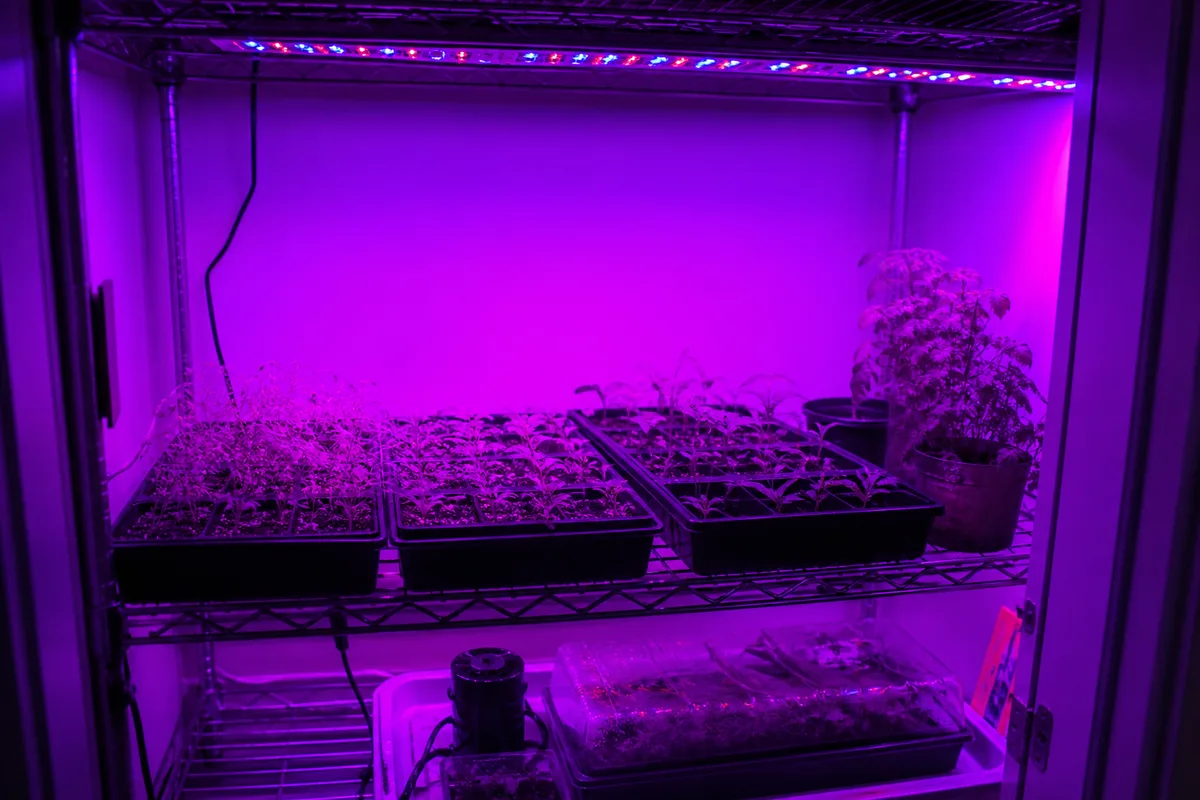
Buying by purple appearance. Deep magenta light can make a shelf look like a high-tech growing room, but it does not prove that the fixture is stronger, more efficient, or more complete. Compare the output and coverage data instead. If you cannot inspect foliage colors under the lamp, that can also make early pest and stress checks harder.
Treating Kelvin as a spectrum chart. A “daylight” rating describes the appearance of white light, not the precise wavelengths and photon output plants receive. Use Kelvin to choose a comfortable-looking white lamp, not as a substitute for a grow-light specification.
Assuming red means flowers and blue means leaves. These wavelengths influence plant processes, but the outcomes depend on the spectrum ratio, dose, developmental stage, species, and darkness pattern. A red bulb will not compensate for insufficient intensity, and a blue bulb cannot force a mature plant to flower.
Using watts or lumens as the final measure. Wattage describes power consumption; lumens describe perceived brightness. Both can help in limited contexts, but neither tells you how much useful light reaches the whole canopy. Prefer PPFD information at an actual hanging height when it is available.
Running lights all day and night. More hours are not automatically better. A consistent photoperiod and dark interval are safer than leaving a lamp on continuously, especially for plants whose flowering depends on day length. Use an outlet timer and follow the crop’s needs.
Conclusion
For most indoor plants and seed-starting shelves, balanced full-spectrum white light is the best color to start with. It supplies a broad mix of wavelengths, keeps leaf color visible, and works across more plant types than a narrow red-or-blue recipe. Red, blue, green, and far-red all have useful roles, but their effects depend on the whole spectrum and how much light reaches the canopy.
When you shop, prioritize a fixture’s coverage and output at a stated distance, then set its height and daily schedule for the plant. If growth looks weak, inspect intensity, unevenness, and photoperiod before replacing a white fixture with purple one. Let the plant’s new growth tell you whether the setup is working.



