When to Fertilize Fruit Trees by Age and Type
Learn when to fertilize fruit trees by species, age, and growth. Find the right spring window, avoid excess nitrogen, and apply nutrients where roots can use them.
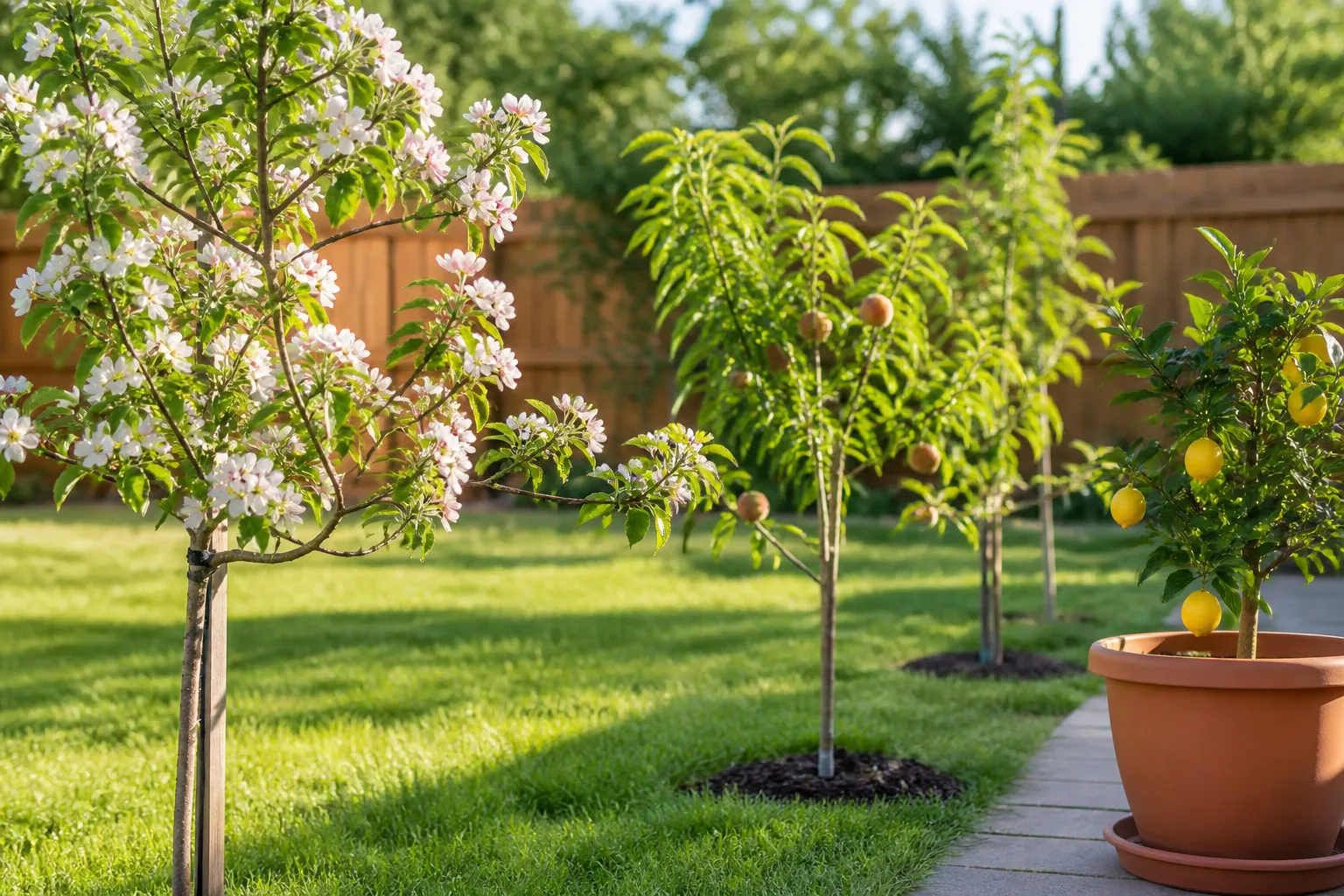
For most temperate fruit trees, the useful window for fertilizer is late winter through spring, as the tree is coming out of dormancy and before vigorous shoot growth is well underway. The right week depends on your climate, species, tree age, and the tree’s growth last year; a calendar date or the last frost date alone cannot tell you whether feeding is needed.
Start with the tree, not the fertilizer bag. If it made healthy annual growth, carried a reasonable crop, and grows in a regularly fertilized lawn or fertile soil, it may need no extra fertilizer. A soil test and a look at last year’s shoots can help you choose between feeding, waiting, or addressing a different cause of poor fruiting.
The best window is spring, but not one fixed date
In a cold-winter climate, spring feeding usually means applying fertilizer after the ground has thawed and the soil is moist, around bud swell or the start of new growth. In a warmer region, that same stage can arrive weeks or months earlier. The practical cue is the tree’s seasonal growth, not a universal date such as one week before the last frost.
Extension and horticultural guidance commonly places nutrient feeding in spring, but the exact timing differs by crop and region. The Royal Horticultural Society’s fruit-tree guidance recommends late winter or early spring for its UK audience.
The University of Maine Cooperative Extension identifies May as a key nitrogen window for plum growth in Maine, while Montana State University’s orchard nutrition guidance says to apply nitrogen in spring and no later than mid-July in its region. Those are not competing universal calendars; they reflect different climates, tree types, and growing seasons.
For a home orchard, aim to make the decision before the season’s shoot growth is mostly complete. Avoid applying nitrogen to frozen, waterlogged, or drought-stressed soil, and do not treat an impending frost as a reason to feed. Fertilizer does not protect blossoms from frost; it only supplies nutrients, and extra nitrogen can push excessive leafy growth rather than rescue a crop.
Check whether the tree needs fertilizer first
Fruit trees need nutrients, but an established tree is not a houseplant that must be fed on a fixed monthly schedule. It stores and reuses some nutrients, draws others from the soil, and responds to the amount of fruit it carries. As the University of Maine Cooperative Extension explains in its plum production bulletin, the tree’s reserves support early spring growth, and nitrogen requirements are more conservative than for an annual crop.
Before adding anything, ask what changed: did the tree grow poorly last year or carry an unusually heavy crop? Check the root zone for dryness, compaction, shade, or turf competition, then compare leaf color across the canopy. Drought, waterlogged roots, disease, poor pollination, and crop overload can resemble nutrient trouble, yet fertilizer will not fix them.
Read last year’s shoot growth and crop
Look for the length and character of last season’s new shoots. A tree with very short extension, sparse foliage, and a light crop may be short of nutrients, but also check water and root health before concluding that nitrogen is the cause.
Conversely, long, soft shoots, dense leafy growth, poor fruit color, or little flowering can be signs that vigor is already too high. Adding nitrogen in that situation may worsen the balance between wood and fruit.
Use growth as a screening clue, not a universal ruler. Expected shoot extension varies with species, rootstock, age, cultivar, pruning, water, and climate.
A Better Homes & Gardens home-orchard guide gives a broad annual-growth check for bearing trees, but extension recommendations use crop-specific ranges. If you track one tree, measure a few representative shoots at the end of the growing season and compare the same branches from year to year.
Use a soil test for pH and minerals, not a calendar guess
A soil test can show pH and whether phosphorus, potassium, or other minerals are already high or low. That helps prevent the common mistake of buying a balanced fertilizer that supplies nutrients the soil does not need. Many backyard labs do not give a dependable picture of a mature orchard tree’s nitrogen status from soil alone, because available nitrogen changes through the season and the roots may be drawing from a wide area.
For a large orchard or a tree with recurring symptoms, leaf-tissue analysis can show what the plant actually absorbed. Penn State Extension’s orchard nutrition overview explains that leaf analysis is more useful than a soil test for assessing the nutritional status of established fruit trees; it also provides a sampling window and instructions for keeping cultivar and tree-age groups separate. Home growers usually do not need annual lab analysis for one healthy tree, but a test is useful when problems repeat or when a specific micronutrient is being considered.
Do not add boron, zinc, iron, or another micronutrient because a leaf looks unusual. Deficiency symptoms overlap, and the difference between enough and too much can be small for some elements. Test first or ask your local extension office for a diagnosis before applying a trace nutrient.
Timing by tree age: newly planted, young, bearing
The tree’s stage of establishment changes the decision as much as the season does. A new tree needs water, sound planting depth, and room for roots; a young nonbearing tree needs enough nitrogen to build a framework; and a mature bearing tree needs nutrients only when its growth and soil indicate a shortage.
| Tree stage | First decision | Typical timing approach |
|---|---|---|
| Newly planted | Is the root system establishing and producing new growth? | Do not put fertilizer in the planting hole; wait for establishment and follow a local recommendation if feeding is needed. |
| Young, nonbearing | Was shoot growth weak, or is the soil already fertile? | If a nutrient need is confirmed, use a modest, label-based spring application suited to the species and age. |
| Mature, bearing | Was growth adequate, and did the tree carry a heavy or light crop? | Feed in the local spring window only when tests or growth history support it; skip if vigor is already strong. |
Newly planted trees need roots before a feeding
Do not mix granular fertilizer into a planting hole or pile it against a bare-root tree. Concentrated salts can injure new roots, and fresh roots need contact with soil and consistent moisture more than a boost of nitrogen. The University of Maine’s planting guidance says to avoid adding fertilizer or other materials to the hole; the RHS also distinguishes establishment care from the routine feeding of established trees.
During the first season, water deeply when the root ball and surrounding soil begin to dry, keep grass from crowding the young tree, and use a thin mulch layer with a clear gap around the trunk. Wait until the tree has settled and started active growth before considering fertilizer. If the planting soil was tested and amended before planting, or the tree is already making healthy shoots, you may not need to feed it that year.
Young nonbearing trees need modest nitrogen
A young tree should build roots and scaffold branches, but it does not need to be forced into rapid growth. If annual extension is weak after you have ruled out drought, waterlogging, planting depth, and competition, use the soil-test or local extension recommendation for that species and rootstock. Apply only the amount of actual nutrient called for; a few pounds of a low-nitrogen product can still deliver a substantial amount if the label percentage is high.
Young trees growing in a frequently fertilized lawn may already receive nitrogen from turf applications. That does not mean lawn fertilizer is automatically safe or correctly placed for the tree; it means you should count nearby nutrient inputs before adding another dose. A weed-free, mulched ring also reduces competition so the tree can use available moisture and nutrients more effectively.
Mature trees need replacement only when growth calls for it
An established fruit tree with moderate annual shoot growth, good leaf color, and a steady crop may need little or no added fertilizer. A heavy crop can remove nutrients, but it does not automatically justify a large dose; the next step is to consider crop load, soil fertility, and the tree’s growth. If the tree was weak after a heavy harvest, the correct response may be a measured spring application, improved irrigation, fruit thinning, or a combination—not a blanket increase in NPK.
For commercial orchards, leaf analysis and yield records can guide nutrient replacement precisely. A backyard grower can borrow the same logic without applying commercial per-acre rates: record the species, age, shoot growth, crop, fertilizer used, and timing. Those notes make next year’s decision more accurate than repeating the same bag rate simply because it worked once.
How timing shifts by climate and fruit type
“Spring” is a growth stage, not a fixed month. In the northern United States, a workable window may be later than it is in a warm coastal or southern garden; in mild-winter regions, buds can swell while a northern tree would still be dormant. Local extension guidance is more useful than hardiness-zone labels alone because a zone describes winter lows, not soil temperature, rainfall, bloom timing, or late-frost risk.
Species matter, too. Tree fruits differ in vigor and nutrient demand, and some extension references set crop-specific nitrogen limits or use tissue tests to decide whether a crop needs more. The advice below is a starting framework for temperate fruit trees, not a replacement for a local recommendation when a species-specific rate is needed.
Apples and pears
For apples and pears in a temperate climate, make the nitrogen decision in early spring as buds swell and growth begins, rather than waiting for a calendar date. Young nonbearing trees may need nitrogen for shoot development, while mature trees with vigorous growth may need very little. Pears also vary by rootstock and cultivar, so do not apply an apple rate to a pear or assume every tree needs an annual dose.
Avoid late-season nitrogen when growth is slowing and the tree should be hardening for dormancy. Montana State notes that excess nitrogen can produce overly vigorous shoots, reduce fruit quality, and delay dormancy; its guide sets a regional spring cutoff. The precise cutoff in your area should come from local extension advice, especially in a short growing season.
Peaches, cherries, plums, and other stone fruits
Peaches, cherries, plums, nectarines, and apricots also benefit from a measured spring feeding when growth or testing shows a need, but there is no single dose for all stone fruits. The Maine plum bulletin describes May as the period of greatest nitrogen-driven shoot growth in its climate and warns that later nitrogen can harm fruit quality. That regional point is more useful than applying a fixed week before the average frost date.
Stone fruits may also be affected by spring frost, poor pollination, disease, and crop load. If the tree flowered but did not set fruit, more fertilizer will not replace pollination or restore frost-damaged blossoms. Diagnose the step where fruit production failed before changing the feeding plan.
Citrus and other evergreen fruit trees
Citrus has a different seasonal rhythm from dormant apples, pears, and stone fruits, particularly in warm climates or containers. Do not automatically apply a temperate deciduous-tree schedule to citrus, avocado, or other evergreen fruit trees; follow the local crop guide and the fertilizer label for the tree’s growth pattern and climate.
If an evergreen tree is in a region with several growth flushes, its fertilizer schedule may be divided across the active season. That is not a reason to keep feeding a tree through heat stress, dry soil, or dormancy. For a potted citrus tree, container volume, irrigation frequency, salt buildup, and the product’s dilution rate all affect the safe interval, so use a citrus-specific source rather than the general rate for an orchard tree.
When to skip fertilizer, including late season
Skip nitrogen when a tree is already growing too vigorously, when soil or leaf results show adequate nutrients, or when the tree is under drought or root stress. A fertilizer cannot repair compacted soil, standing water, poor drainage, a dead root system, or a pollination gap. Adding nitrogen to a stressed tree may increase salt stress or push shoots that the roots cannot support.
For temperate deciduous trees, do not make late summer or fall nitrogen feeding a routine. Nitrogen can encourage soft new growth when the tree should be preparing for dormancy, and excess growth can reduce fruit quality or increase winter injury risk. Regional recommendations differ, and a specific late application may be appropriate in a managed orchard after testing; for a backyard tree, follow local extension instructions rather than a generic online exception.
Separate fertilizer from mulch. A surface layer of compost or well-rotted organic matter can improve soil structure and conserve moisture, but it is not a predictable substitute for a nutrient recommendation.
The RHS notes that bulky organic mulches contain few nutrients compared with fertilizers. In fall, adding a modest organic mulch may be useful; that does not mean a high-nitrogen fertilizer should be applied then.
Choose fertilizer by nutrient gap, not a bag’s promise
The three numbers on a fertilizer label give the percentages of nitrogen, phosphate, and potash by weight. A 10-10-10 product is not automatically the best choice for every fruit tree: if a soil test says phosphorus is already high, a balanced blend adds more than the tree needs. If the tree only needs nitrogen, a product chosen for its nitrogen content may be more appropriate, but only when the amount is based on a recommendation and the label allows that use.
Nitrogen supports shoots and leaves, potassium plays important roles in water balance and fruit development, and phosphorus supports energy transfer and roots. That does not mean more phosphorus creates more fruit or that a potassium-rich fertilizer guarantees a better crop.
Fruit quality depends on light, pollination, water, crop load, cultivar, pruning, and nutrient balance together. The RHS’s general feeding guidance notes that fruit trees can have high potassium needs, but a soil test is the way to check whether your site actually needs it.
Compost and aged manure can add organic matter and nutrients, but their nutrient content varies with source and maturity. They can be useful soil amendments rather than precision fertilizer. Avoid fresh manure around active roots and follow local food-safety guidance for manure in fruiting plantings; do not assume that “organic” means weak, balanced, or risk-free.
Apply fertilizer across the root zone, not at the trunk
Most of a tree’s active feeder roots occupy the soil beneath and beyond the canopy, not a small circle against the trunk. The RHS advises spreading fertilizer across the tree’s rooting area just beyond the canopy, while keeping it away from the trunk and following the product label. A clear, weed-free ring helps reduce competition from turf and makes the application easier to control.
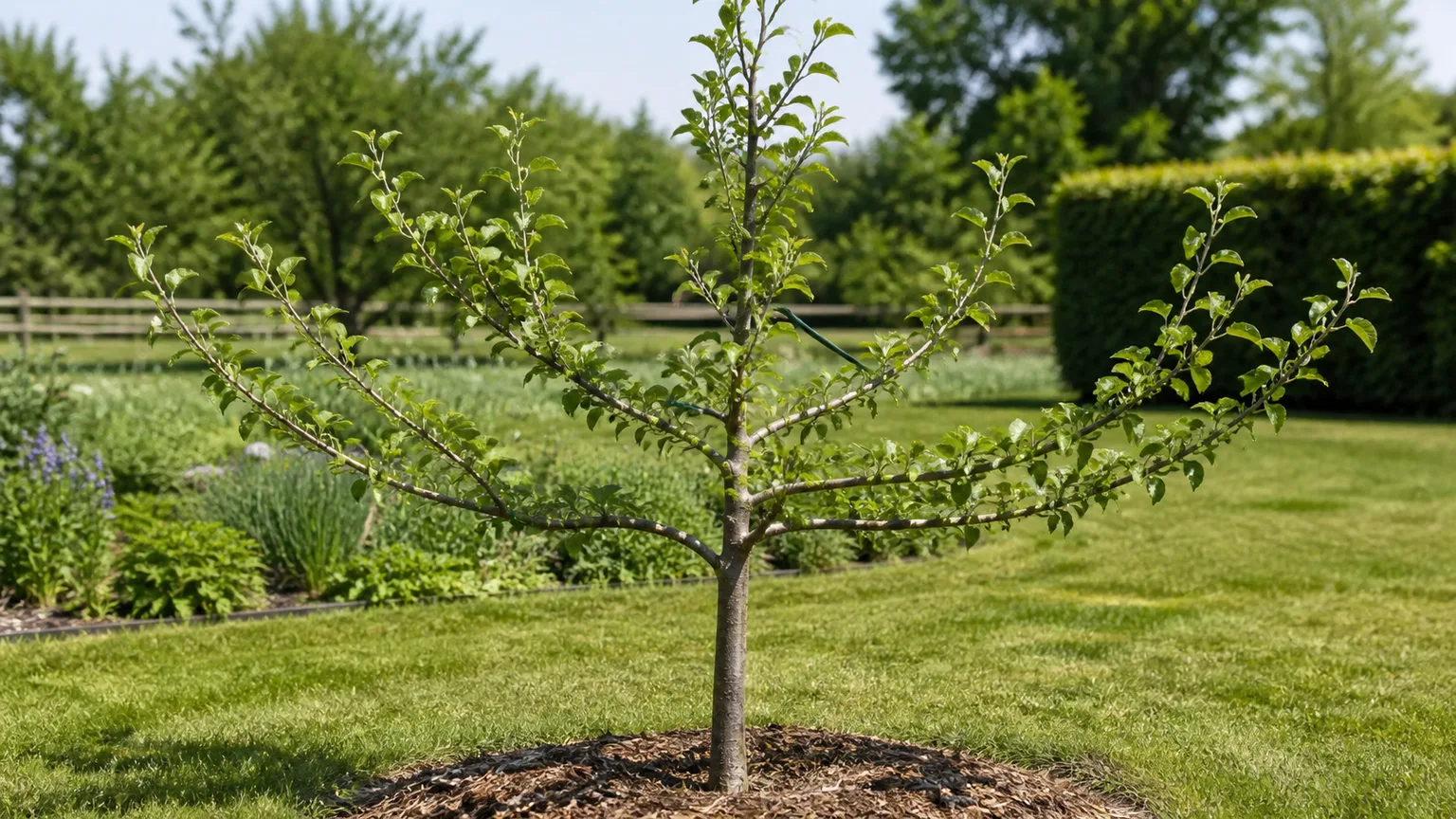
If the tree grows in lawn, do not dump the entire dose into a few holes drilled beside the trunk. Deep holes can damage roots and create concentrated pockets. Instead, use the method and placement on the product label; if a lawn fertilizer program overlaps the root zone, count that nitrogen as part of the tree’s total input and avoid double-feeding.
Calculate amount from label and actual nutrient
Follow the soil-test recommendation and the product label. When a recommendation gives pounds of actual nitrogen, divide that figure by the label’s nitrogen percentage written as a decimal to find the product amount.
For example, a hypothetical recommendation of 0.2 pound of actual nitrogen divided by 0.10 for a 10-percent-nitrogen fertilizer equals 2 pounds of product. This calculation explains the label; it is not a rate recommendation for every fruit tree.
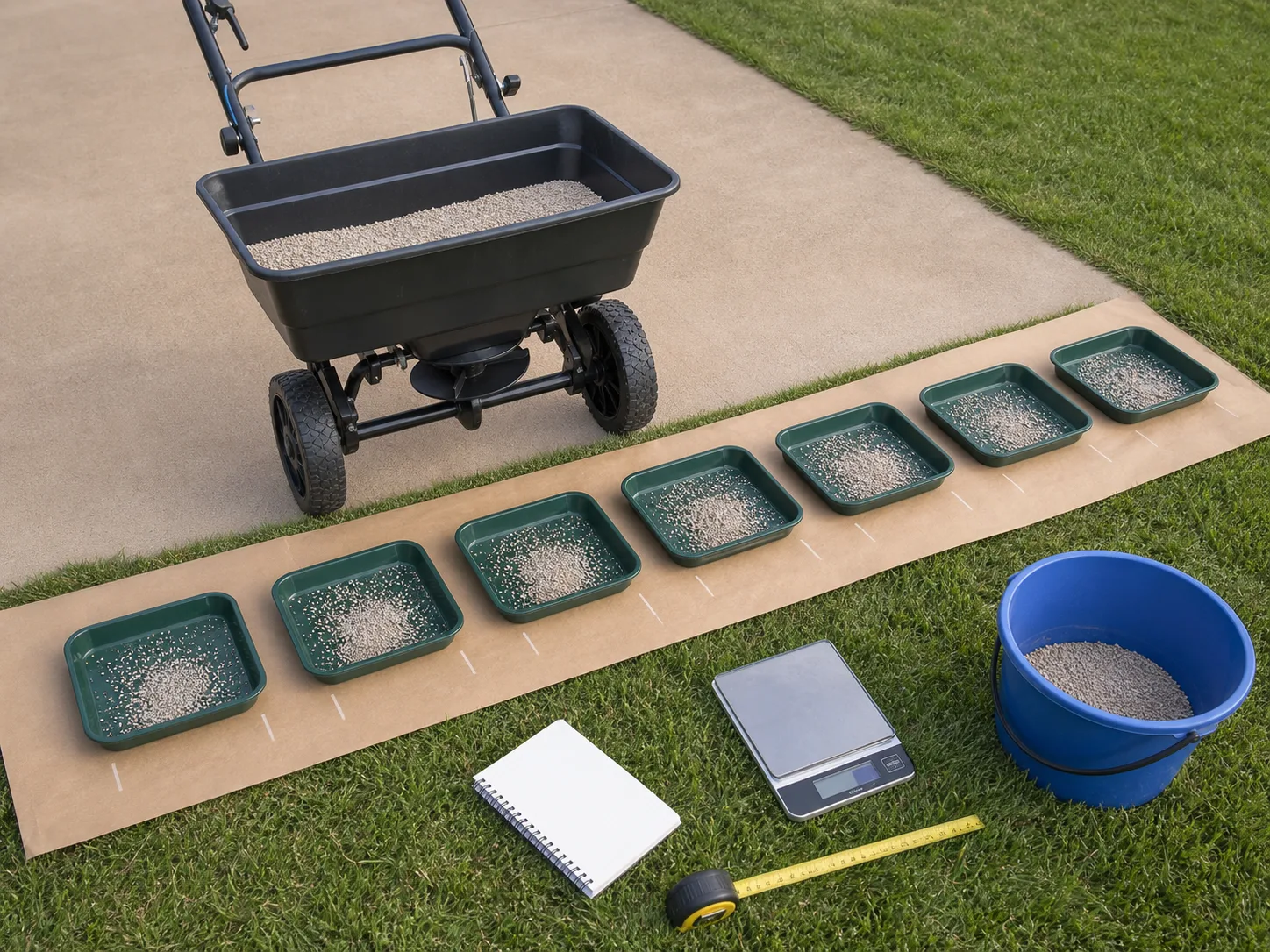
The Montana State orchard guide, for example, bases nitrogen on tree age, crop goals, soil texture, organic matter, and leaf results and gives a region-specific upper limit. That is why a trunk-diameter rule or a single pounds-per-year formula should not be used as a universal shortcut. Measure carefully, calibrate a spreader if you use one, and never round a small-tree dose up to a convenient scoop.
Water, mulch, and protect the surrounding soil
Apply granular fertilizer when the soil is moist, then water it in as the label directs. Avoid spreading on frozen ground, saturated soil, or before heavy rain that could wash nutrients away. Keep granules off pavement, storm drains, and the tree trunk; sweep any spill back onto the intended root zone rather than hosing it into a drain.
After feeding, replace mulch in a shallow, even layer if you moved it aside. Keep a visible gap around the trunk and do not build a “mulch volcano.” Water deeply enough to moisten the feeder-root zone, but not so much that water pools or runs off. A dry tree cannot use fertilizer well, and fertilizer is not a substitute for steady irrigation during fruit development.
Diagnose poor fruiting before adding more food
A leafy tree with few fruits is not automatically hungry. Excess nitrogen can push leaves and shoots at the expense of flower buds and fruit quality, but a crop failure can also follow a late frost, incompatible pollination, lack of pollinators, deep shade, an oversized previous crop, drought, disease, or pruning that removed fruiting wood. Adding more fertilizer before identifying the failure point can make the canopy denser while leaving the real problem untouched.
Use the tree’s season as a diagnostic: no flowers suggests age, shade, pruning, or excess vigor; flowers that fail to set fruit point toward frost or pollination; tiny fruit that drops may reflect stress, poor fertilization, or natural thinning; alternating heavy and light crops may need fruit thinning. If leaves are discolored, compare symptoms across the whole tree, inspect watering and drainage, then use a soil test or local diagnostic service before treating a presumed deficiency.
Keep a simple record of the date, product, nutrient percentage, amount, soil condition, new shoot growth, and crop. One season will not answer every question, but a few years of notes can show whether the tree responded, whether fertilizer coincided with a poor harvest, and whether you should reduce or skip the next application. That record is especially valuable for established trees, where overfeeding can take longer to correct than a modest deficiency.
Conclusion
For most temperate fruit trees, plan any needed fertilizer for the local spring growth window, after the soil is workable and before the season’s shoot growth is far along. Let tree age, species, last year’s growth, soil conditions, and test results decide whether to feed; do not rely on a fixed last-frost date, a generic 10-10-10 blend, or a trunk-diameter formula.
New trees need establishment before feeding, young trees need modest support, and mature trees often need less than gardeners expect. Apply only the labeled amount across the root zone, water it in as directed, and skip fertilizer when the tree is already vigorous or when its problem is not nutritional. Those choices protect fruit quality and help the tree use nutrients rather than simply grow more leaves.