10 Pink Daffodil Varieties for Spring Gardens
Compare 10 pink daffodils by bloom color, flower form, fragrance, and garden use, then learn when to plant bulbs and how to help them return each spring.
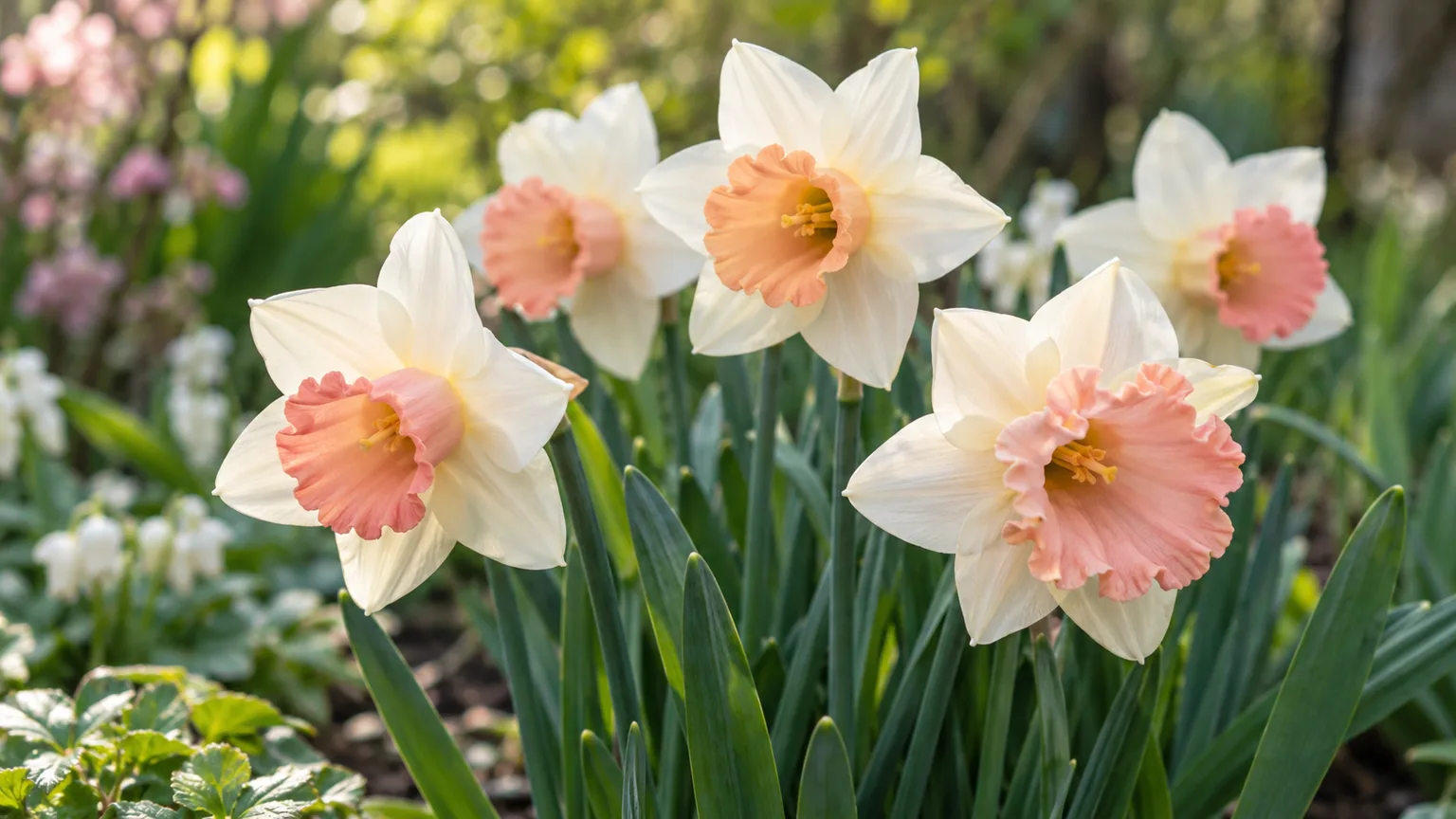
Pink daffodils are worth choosing for their shape as much as their color. Two cultivars can both be sold as “pink” and look quite different: one may have a white flower with a salmon cup, another a yellow jonquilla with a blush center, and a third a layered double bloom in peach and ivory. If you want a spring planting that feels softer than a row of bright yellow trumpets, these differences help you buy bulbs you’ll actually enjoy.
One timing detail matters before you shop: dormant daffodil bulbs are normally planted in fall to flower the following spring. In spring, you can buy blooming or budded potted daffodils for immediate color, then let their leaves mature; plant dry bulbs in fall for the most reliable display next year. The cultivars below include single, fragrant, double, and split-corona forms, with notes to help you decide where each will work.
What “Pink” Means in a Daffodil
In most pink daffodils, the color sits in the corona—the cup or trumpet in the middle—not across every petal. The outer, petal-like segments are usually white or ivory, though some are pale yellow. The pink itself tends toward salmon, peach, coral, or apricot, so “pink” is a warm color family rather than a promise of vivid rose petals. Better Homes & Gardens describes these same warm shades and notes that a flower’s appearance may change as it opens and with the season’s temperatures. Better Homes & Gardens is useful for comparing named cultivars, but catalog photos should still be treated as a range, not an exact color guarantee.
The flower’s structure also changes how that color reads. A long cup makes the center look bolder; a small cup leaves more of the white outer segments visible; a double flower adds layers; and a split corona opens into a ruffled form. The American Daffodil Society’s DaffSeek database organizes cultivars by division, name, and color, while Penn State Extension explains the 13-division classification and how it separates flower forms. A division is a helpful description of shape, not a rating of garden performance.
Pink cups can shift over the life of a bloom. Some open with a yellowish or pale center before warming to pink, and a hot spell or strong exposure may make a delicate cup look paler sooner. That variation is normal; it does not necessarily mean the cultivar was mislabeled. If a precise color is essential, check photographs from more than one grower and prioritize a bulb supplier that identifies the cultivar rather than selling a generic “pink daffodil mix.”
Ten Pink Daffodils Worth Comparing
These ten choices are not a ranking. They are a shortlist of different flower forms and garden uses, and stock varies by nursery and year. Use bloom time and hardiness notes on the bulb supplier’s listing to confirm that a cultivar suits your local climate; labels and average heights can vary between catalogs.
1. ‘Fragrant Rose’ for Fragrance and a Rosy Cup
Choose ‘Fragrant Rose’ when you want the pink tone and scent to be part of the experience. Its white outer segments frame a deeper rose-to-raspberry cup, and established gardening coverage describes it as notably fragrant and mid-to-late season. That combination makes it a strong candidate near a path, entry, or cut-flower bed, where you can appreciate the scent instead of seeing it only from across the lawn. Gardeners’ World, while Better Homes & Gardens describes its richer cup and late-season timing.
Pink daffodils do not all have the same scent strength. If fragrance is your priority, ‘Fragrant Rose’ is a safer first pick than choosing a cultivar from a color photo alone. Plant a small group first if you are uncertain about its exact hue; a cluster gives the color more impact and lets you judge how it looks in your light.
2. ‘Pink Charm’ for a Coral-Rimmed Flower
‘Pink Charm’ is a good fit if you like a light, polished bloom rather than a solid block of pink. Its ivory outer segments surround a pale center with a coral-pink rim, so the flower reads as cream and blush from a distance and shows more detail up close. Better Homes & Gardens lists it among pink daffodils and describes the ruffled edge; the narrow color band makes it an easy bridge between white spring bulbs and stronger salmon cultivars.
Use it where the individual flower can be seen: along a path, at a border edge, or in a container that sits near a doorway. Against very dark foliage, its pale petals stand out; in a broad lawn, a small scattered planting may disappear. Repeat groups rather than planting isolated bulbs if you want the rim color to register across the bed.
3. ‘Accent’ for a Classic Salmon Cup
‘Accent’ offers the familiar daffodil outline—white outer segments and a large, warm salmon cup—without the extra frills of a double or split-corona type. It is a useful middle ground for gardeners who want a clear pink note but still prefer a flower that reads as a classic daffodil. Better Homes & Gardens describes its salmon cup and long-standing garden use; the color is softer than a vivid red but more visible than the faint blush on some cultivars.
Try it in a repeated drift with white or pale-yellow daffodils so the cup color becomes a deliberate accent rather than one isolated bloom. Its large-cupped shape also pairs well with small spring flowers beneath it, where lower plants can fill the space without competing with the central corona. For a broader comparison of trumpet, double, and other shapes, see our guide to 15 daffodil varieties for different gardens.
4. ‘Chromacolor’ for Stronger Color
If subtle blush is not enough, look for ‘Chromacolor.’ Its broad, conspicuous coral-pink cup contrasts strongly with white outer segments, giving it more visual weight than a narrow pink rim. Gardener’s Path describes the cultivar as a large, intensely colored two-tone daffodil; Better Homes & Gardens also notes its wider, more vivid peach-pink cup. It works best where the flowers have room to make a focal point—near a path, in a repeated border group, or in a bed viewed from a window.
Because the cup is the show, avoid crowding it with many equally bright flowers right beside it. A quiet background of green foliage, white bulbs, or blue-violet companions lets the warmer color stand out. Confirm the mature height and bloom window with your supplier, then place it behind shorter bulbs rather than assuming every catalog’s size figure will match your conditions.
5. ‘Salome’ for a Changing Apricot Cup
‘Salome’ is for gardeners who enjoy watching a flower change, not just buying a fixed color. Its cup begins more yellow and develops an apricot-to-pink cast as the bloom matures, with the exact balance depending on the flower’s stage and the season. Better Homes & Gardens describes it as a later-blooming choice with white outer segments and a yellow-to-apricot-pink cup. That color progression can extend interest in a bed after earlier yellow daffodils have faded.
Plant it where you can notice the transition—near a terrace, path, or kitchen window—and combine it with a steadier white or blue spring flower. Do not judge every open flower by the first day it appears. If a new bloom looks yellow at first, give it time to develop before deciding the bulb failed to produce the color shown on its label.
6. ‘Blushing Lady’ for Multiple Fragrant Blooms
‘Blushing Lady’ departs from the single, white-petaled look: it is a jonquilla-type daffodil with soft yellow outer segments, a cup that blushes pink, fragrance, and several flowers on a stem. The repeated florets create a fuller display from fewer stems, which suits a path edge or mixed border where the group can be viewed close up. Gardener’s Path; Better Homes & Gardens also identifies it as a late-season jonquil.
This is a useful cultivar to investigate if your winters are mild, but do not assume one warm-climate note applies to every bulb sold under its name. Hardiness listings differ by source and region. Confirm the supplier’s local guidance, including whether bulbs need pre-chilling, before ordering a large quantity. Plant it with early cultivars if you want to spread the display across more of spring.
7. ‘Pink Pride’ for a Large Salmon Cup
‘Pink Pride’ has broad white outer segments and a flared salmon-pink cup on a taller, large-cupped flower. The Royal Horticultural Society’s cultivar profile lists it at about 60 centimeters high and notes its full-sun or partial-shade position and moist, well-drained soil preference. Those details make it useful as a visible border flower, especially when you want the cup color to read clearly from a short distance.
Give the taller stems room among lower early bulbs, and keep the bed open enough that flowers are not hidden behind evergreen shrubs or a dense layer of groundcover. If you have a small container, select a compact cultivar instead; a tall bloom may feel top-heavy in a shallow pot. Catalog heights are approximate, so use the listed size as a placement guide rather than an exact measurement.
8. ‘Pink Parasol’ for a Rounded, Two-Tone Bloom
‘Pink Parasol’ pairs white outer segments with a salmon-pink trumpet, making it a useful choice for a midseason display that needs a warm center but not the strong scale of ‘Chromacolor.’ Gardener’s Path describes its overlapping white petals, salmon cup, and roughly 14-to-16-inch stature. The combination is simple enough for a naturalized drift and distinctive enough to repeat in a small, planned cluster.
Use it where the flower’s outline is visible, such as the front of a mixed border or the edge of a lawn planting. It can also soften a row of yellow daffodils without making the whole bed look pastel. The name should not be taken as a guarantee of a single shade: the cup may look more coral or apricot depending on maturity and growing conditions.
9. ‘Delnashaugh’ for a Peach-Pink Double
‘Delnashaugh’ is a double daffodil: instead of a simple ring of outer segments and a neat central cup, it opens into a fuller, layered flower. Gardening Know How describes its delicate peach-pink coloring among double narcissus varieties. Choose it for texture and a romantic, ruffled look, especially near a path or in a cutting area where you can see the extra petals.
A double flower has more visual mass than a single daffodil, so it can look busy if you plant it beside several other frilly cultivars. Pair it with simple white blooms or restrained foliage, and use a group rather than a few widely separated bulbs. Its flower form is the main reason to grow it; if you need a crisp, easy-to-read cup shape for a large naturalized area, choose a single large-cupped type instead.
10. ‘Pink Wonder’ for a Split-Corona Shape
‘Pink Wonder’ is a split-corona daffodil, a form in which the center is divided and flared rather than shaped like one closed trumpet. Gardening Know How includes it among the pink- and salmon-toned ruffled narcissus cultivars and explains how split-corona flowers differ from traditional cups and doubles. The opened center makes the flower look wide and sculptural, so a small group can create more texture than a larger planting of uniform trumpets.
Plant it where the center will be easy to see, such as a border edge or a pot beside a seating area. If the label uses “split-cupped,” “split-corona,” or “ruffled,” check a photo before ordering; catalogs sometimes use the terms loosely, and a photograph is more useful than the name alone when flower shape is the deciding feature.
Choose by Color, Form, Fragrance, and Space
Start with the color effect you want. For a more noticeable pink impression, compare ‘Chromacolor’ and ‘Fragrant Rose’; for a softer, changing tone, look at ‘Salome’ or ‘Pink Pride’; for cream-and-coral contrast, consider ‘Pink Charm’ or ‘Accent.’ If fragrance matters, prioritize ‘Fragrant Rose’ or ‘Blushing Lady.’ If shape matters more than hue, choose between the layered petals of ‘Delnashaugh’ and the open center of ‘Pink Wonder.’
Then match plant scale to the viewing distance. Taller single blooms can anchor a border or repeat through a large bed. Double flowers and split coronas are easier to appreciate near a path, patio, or seating area. Compact forms are usually more reliable in small pots than tall cultivars, but check the label for mature height and pot suitability; there is no reason to choose a variety solely because a catalog photo looks miniature.
For a longer spring display, combine early-, mid-, and late-season bulbs rather than buying ten cultivars with the same bloom window. The dates are relative to your climate: a “late” daffodil in one region can open earlier in a warmer spring elsewhere. The American Daffodil Society’s cultivar database and a regional supplier’s listing can help verify a name, division, and color description before you order. If you want one color to repeat across the bed, choose two or three compatible cultivars instead of mixing all ten in small numbers.
When and Where to Plant Pink Daffodil Bulbs
In most cold-winter gardens, plant dormant daffodil bulbs in fall, while the soil is workable and before it freezes. This gives the bulbs time to make roots ahead of spring growth. The best date is local rather than universal: Penn State Extension gives an October-to-early-November window for its region, while Gardeners’ World describes autumn planting from September through November. Use those as climate examples, then check local extension or supplier advice for your own ground-freeze pattern. Our guide to when to plant daffodil bulbs explains how to adapt the timing.
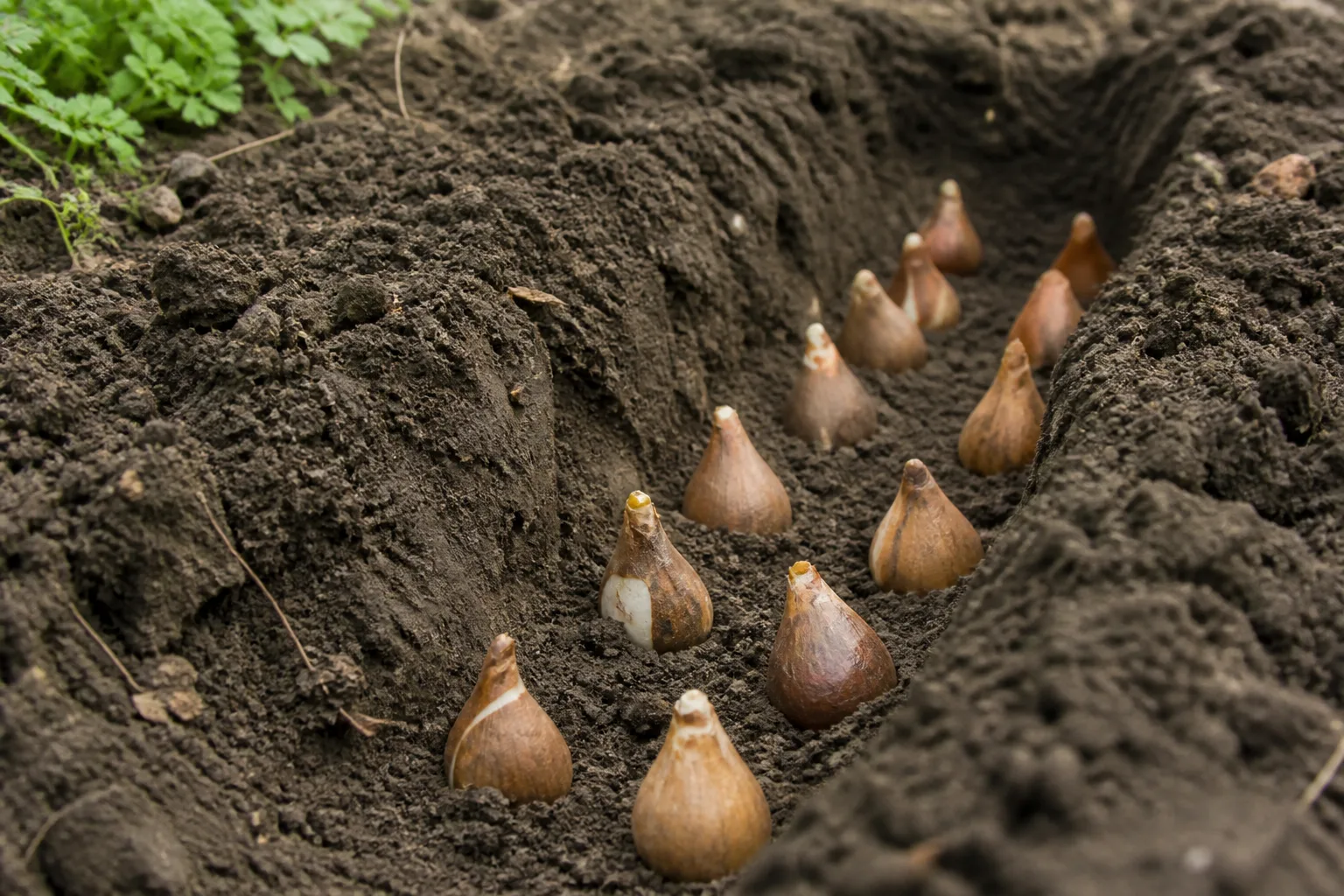
Choose a site that receives sun or light shade in spring and drains well. Daffodils tolerate some shade, but deep shade can produce foliage with few flowers. Avoid a low pocket where rainwater sits; bulb rot is more likely in saturated soil. If your bed is heavy clay, improve drainage across the planting area or use a raised bed rather than making a small gravel-lined hole that traps water around each bulb.
Plant pointed end up and follow the bulb label for depth and spacing. Recommendations can sound inconsistent because some count from the bulb’s top to the soil surface, while others count from the base. Penn State Extension describes a depth of about twice the bulb’s height measured from the soil surface to the bulb’s top; the RHS guide uses roughly three times the bulb height as the overall planting depth. Follow the supplier’s stated measurement convention for the bulb size you bought, and plant in loose groups rather than a straight line. The RHS daffodil growing guide and Penn State’s Narcissus guidance are useful cross-checks.
Spring planting has a different purpose. If you want flowers this spring, buy a potted plant that is already budded or flowering; dormant dry bulbs planted in spring usually will not produce a normal display immediately. Let the potted bulbs finish flowering, keep their foliage growing, and move them into the garden after the leaves yellow if conditions allow. For a dependable bed from dry bulbs, order in season and plant in fall. In mild-winter regions, choose cultivars specifically recommended for local conditions and ask whether pre-chilling is needed; not every daffodil has the same cold requirement.
Care That Protects Next Spring’s Display
After planting, water once to settle the soil if it is dry. In garden beds, established daffodils often need little extra irrigation, but they do need moisture during active root and leaf growth if rainfall is scarce. Containers dry faster and can become waterlogged more easily, so use a pot with drainage holes and check the compost rather than following a fixed weekly schedule. Keep dormant summer bulbs from sitting in soggy soil.
Light has a small trade-off for pink cultivars. Daffodils generally flower best in sun or light shade, and too much shade can mean leaves without flowers. At the same time, warm pink cups may fade or look paler as a flower ages and receives strong sun. If your spring is hot, a site with morning sun and some afternoon shade can help the color stay attractive for longer while still giving the foliage enough light; do not trade away most of the plant’s spring sun in pursuit of a color that naturally changes. A little variation between years is normal.
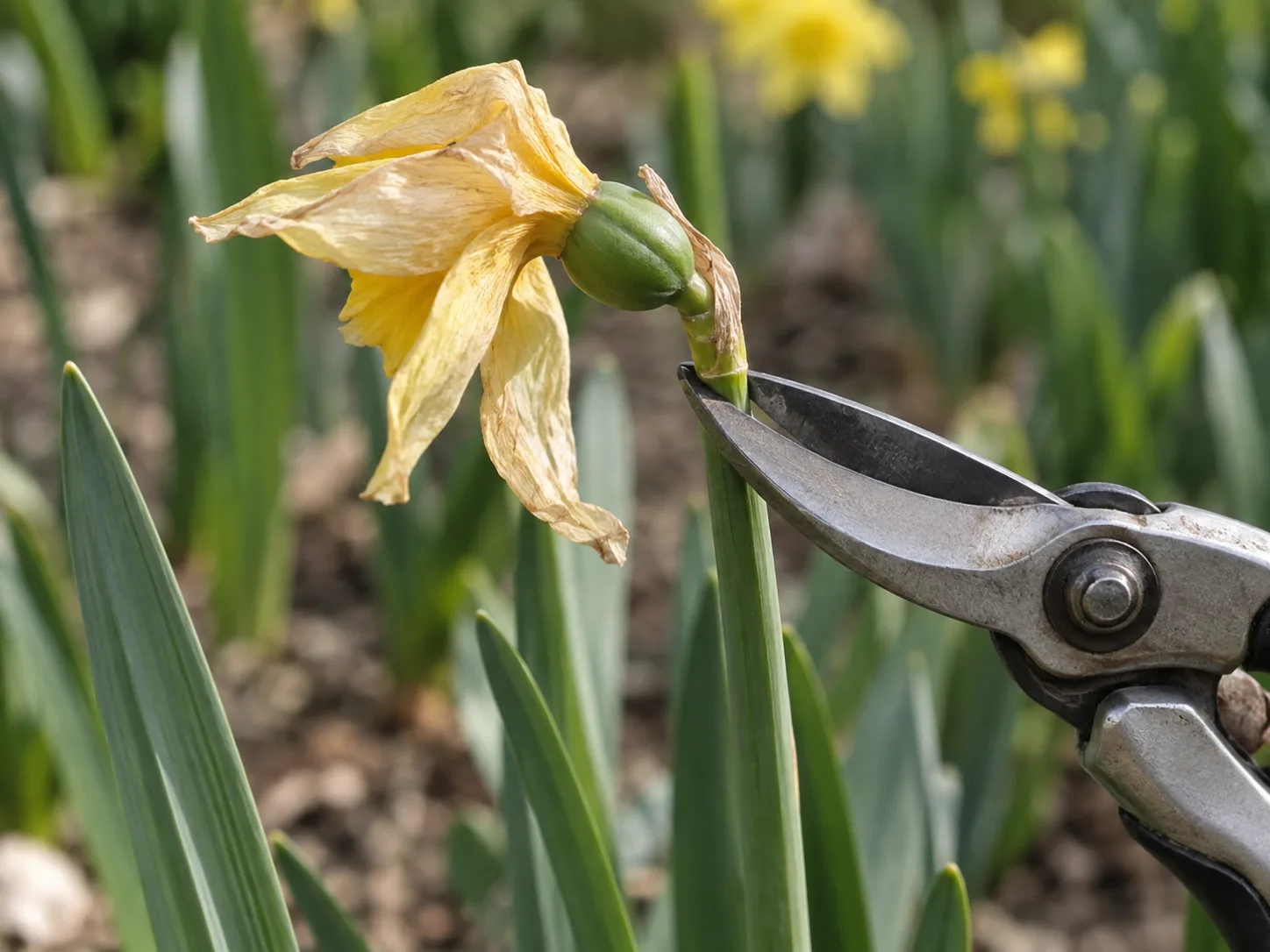
Once a flower fades, you may remove the spent bloom and its developing seed capsule for a tidy bed. Leave the green leaves and stems intact until they yellow naturally; they are replenishing the bulb for the next flowering cycle. Do not braid, knot, or tie foliage down, and do not mow it while green. The RHS estimates that yellowing can take around six weeks after flowering, though local weather changes the timing. See our practical guide to deadheading daffodils for exactly what to cut.
If a clump produces plenty of leaves but fewer flowers over several seasons, check light, drainage, depth, and crowding before blaming the cultivar. A congested clump can be divided after foliage dies back, then replanted at the proper depth. Avoid digging bulbs while leaves are still green unless a site problem makes it necessary. Our guide to growing and caring for daffodils covers more troubleshooting.
Handle bulbs with care. NC State Extension classifies daffodils as poisonous if eaten and notes that the bulbs can cause severe skin irritation in its Narcissus profile. Wear gloves if you are sensitive, wash after handling, and store bulbs away from children and pets. The same caution applies to the plant material; do not assume a cultivar is safer because it has a pale or pink cup.
Design Ideas for a Longer, Softer Spring Show
Treat pink daffodils as a transition color. Salmon and apricot cups sit naturally beside yellow flowers and warm pink tulips, while blush and ivory combinations work with blue-violet grape hyacinths or blue squill. A few cool-colored companions can keep a warm pink bed from reading too orange; a repeated patch of white daffodils can make the pink cups look clearer without adding another strong color.
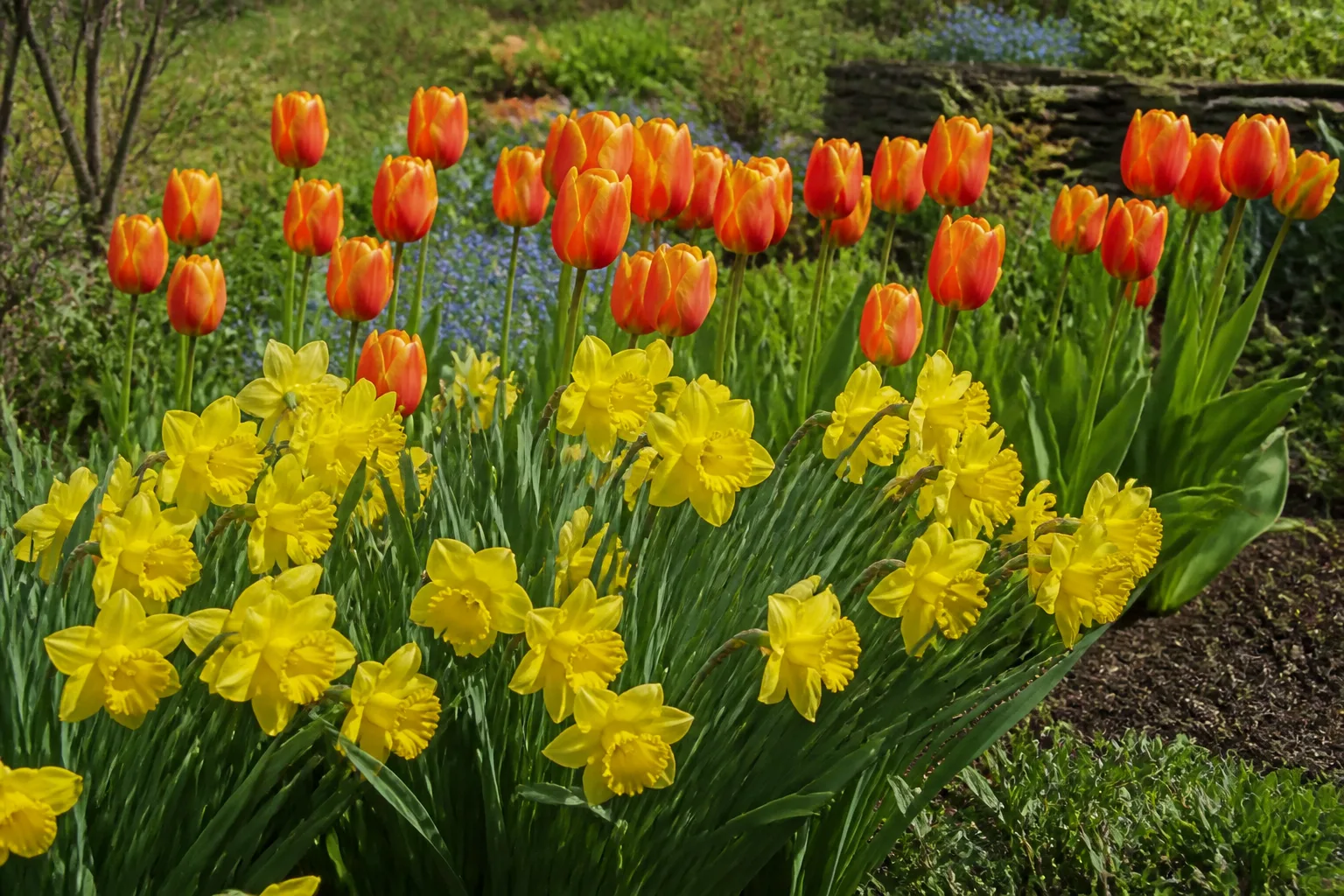
Plant by height and viewing angle: taller ‘Pink Pride’ or ‘Chromacolor’ can sit toward the middle or back of a border, while smaller or more detailed forms belong near a path. Daffodils can also be grown in pots, but a pot display needs drainage and a plan for the leaves after bloom. If the container is crowded for a short seasonal display, move the bulbs into the ground after flowering and let the foliage die down before tidying it away.
For a natural look, plant bulbs in loose groups of at least six rather than in a ruler-straight row. Repeat one or two cultivars in several places so the garden feels connected, then add a later-blooming choice to extend the season. Keep a simple map or label each group: when the foliage disappears in summer, you will know where to leave space for the bulbs and where you can dig safely.
Conclusion
Pink daffodils are a varied group, not a single color or flower shape. Choose ‘Fragrant Rose’ or ‘Blushing Lady’ for scent, ‘Chromacolor’ for a stronger warm cup, ‘Salome’ for a changing apricot tone, and ‘Delnashaugh’ or ‘Pink Wonder’ when flower form matters most. Compare the cultivar label with your local hardiness and bloom window, because temperature and flower maturity can change the exact shade.
For next spring’s flowers, plant sound dormant bulbs in fall in a sunny-to-lightly-shaded, well-drained spot, then leave the foliage until it yellows. If the garden is already in spring, choose a flowering pot for immediate color and reserve dry bulbs for autumn planting. That simple distinction—and a variety chosen for your actual site—makes a pink daffodil display much easier to enjoy year after year.