When to Take Your Christmas Tree Down After the Holidays
Learn when to take down a real or artificial Christmas tree, how to spot drying, and how to remove, store, recycle, or reuse it safely.

The best time to take down a Christmas tree is not one universal date. For a real cut tree, take it down as soon as it becomes dry or difficult to keep watered; if it is still fresh, choose a date that fits your tradition and your community’s collection schedule. For an artificial tree, safety and household timing matter more than the calendar.
That gives you a useful rule: safety first, tree condition second, tradition third, and convenience fourth. A fresh, well-watered tree may be fine through the first week of January, while a tree with brittle needles should leave the house immediately—even if you planned to wait for Twelfth Night.
The short answer: use the earliest of these three dates
Choose the earliest date produced by this quick check:
- The safety date: today, if the tree is dry, shedding heavily, leaning, near a heat source, or connected to damaged lights.
- The tradition date: January 5, January 6, New Year’s Eve, or another date your household observes.
- The logistics date: the last day your local curbside pickup or drop-off program accepts undecorated trees.
This approach resolves the familiar argument between “leave it up until Epiphany” and “pack it away before New Year’s.” Both are reasonable traditions, but neither overrides a drying tree or a local collection deadline. Your town may publish a short pickup window, require the tree to be cut into sections, or prohibit bags, flocking, tinsel, and stands.
If you want one default for a healthy real tree, plan to remove it during the first week of January and check your local disposal calendar before that week begins. An artificial tree can stay up longer if it is stable, its lights are safe, and it is not blocking a path, but many households still use New Year’s Eve or the first weekend of January as a clean reset.
Your real tree has a safety deadline, not just a tradition
A cut Christmas tree is a temporary indoor display, not a houseplant that can keep recovering indefinitely. Water slows drying; it does not reverse a tree that has become brittle. The National Fire Protection Association’s holiday guidance notes that dried trees become increasingly flammable, that 35% of reported Christmas-tree fires occurred in January, and that a small fire can grow very quickly once it reaches a dry tree.
That is why “it still looks festive” is not a sufficient safety test. A tree can look green from across the room while its needles have lost flexibility and its branches are ready to ignite. The practical question is not whether the calendar says the holiday is over; it is whether the tree is still fresh enough to keep indoors.
Take it down now if any of these signs appear
Remove the tree the same day if you notice several of these signs, or any severe one:
- Needles feel dry, sharp, and brittle instead of flexible.
- Green exterior needles fall freely when a branch is brushed or the trunk is tapped gently.
- Small twigs snap cleanly rather than bending.
- The color is fading, the outer bark looks wrinkled, or whole branches are drooping.
- The stand has run dry and you cannot confirm that the trunk base is still taking up water.
- The tree is leaning, the stand is damaged, or ornaments make it unstable.
- Lights, plugs, or extension cords are warm, frayed, cracked, sparking, or overloaded.
- The tree is close to a fireplace, radiator, heat register, space heater, or strong winter sun.
Unplug the lights before touching the tree. Do not try to rescue a severely dry tree by moving it to a garage and leaving it there for “one more night”; remove it from the living space and follow your local yard-waste or recycling route instead.
The 60-second freshness check
Start at the inside of a lower branch, where older needles may naturally shed, then check the outer tips. Bend a green needle between your fingers. A fresh needle usually flexes before it breaks; a dry one snaps or crumbles. Run two fingers lightly along a branch and note whether only a few old needles release or a shower of exterior needles comes away.
Next, look at the smaller twigs. Flexible twigs can move slightly under pressure, while dry twigs crack. Finally, check the stand physically rather than trusting its shape: many stands still contain a little water even when the cut trunk is no longer submerged. NCTA’s care guidance specifically advises checking the water level daily and removing a tree after Christmas or when it becomes very dry.
This is not a laboratory test, and species differ. Use it as a conservative household decision: if the tree is brittle, shedding heavily, or repeatedly drying out, the benefit of keeping it up is not worth the added risk.
How long a real Christmas tree can safely stay indoors
There is no dependable expiration date that applies to every tree. A well-cared-for tree commonly stays attractive for roughly four to six weeks, but that window depends on the species, how fresh it was when purchased, the time it spent outdoors or at a lot, whether the trunk got a fresh cut, the size of the water reservoir, and the temperature and airflow in the room. Use the range as planning context, not permission to ignore the freshness check.
The National Christmas Tree Association says plain tap water is the best choice and that water holding stands kept filled can extend freshness for weeks. Its care advice also recommends a stand sized for the trunk, daily water checks, and placement away from major heat sources. Additives such as bleach, aspirin, fertilizer, and home mixtures are not a substitute for a filled stand.
Why tree type, purchase date, and room conditions change the answer
Species vary in needle retention, but a more important variable is often the tree’s history. A tree bought early and held in a warm, dry room has had a longer drying opportunity than a freshly cut tree brought in later. A small stand that runs dry for a day can also shorten the useful display period, even if the tree looked excellent on the first morning.
Room conditions matter in ordinary ways. Heat registers, fireplaces, sunny glass, and constant warm airflow increase drying; cooler placement slows it. Gardening Know How’s practical care guide likewise emphasizes a fresh cut, plenty of water, and an environment that does not accelerate moisture loss.
If you are still before Christmas and the stand has run dry, correct the care problem immediately and monitor the tree more closely. If you are already after Christmas and the tree shows brittle-branch symptoms, skip the experiment and take it down.
January 5 or 6: what Twelfth Night and Epiphany actually mean
January 5 and January 6 are both defensible traditional dates, which is why households remember different “correct” answers. The twelve days of Christmas begin on December 25; depending on how the days are counted, Twelfth Night falls on the evening of January 5 or the end of January 6. Epiphany is observed on January 6 in the Western Christian calendar and marks the close of the Christmas season for many celebrants.
The tradition is about the end of a season, not a horticultural requirement. A useful explanation of the custom from Martha Stewart’s history and tradition overview describes January 5 as a popular removal date and connects the twelve-day season with Epiphany. Other families follow January 6, Orthodox Christmas timing, a family anniversary, or no religious calendar at all.
If your tree is fresh and safe, observing January 5 or 6 is fine. If it is dry, the tradition can move to the background: pack the ornaments, unplug the lights, and remove the tree when the safety condition says to do so. A tradition is meant to support a household, not force it to keep a fire-prone object indoors.
New Year’s Eve and New Year’s Day: a practical reset
Taking the tree down on New Year’s Eve is popular because it closes the old year and leaves the house ready for January 1. It also fits families that want to clean, return furniture to its normal place, and start the new year without a room full of seasonal storage decisions. New Year’s Day works just as well if the tree remains fresh and the lights are unplugged when nobody is present.
The practical advantage is that you can pair takedown with a short reset: inspect the tree, remove all decorations, clean the floor, label the storage boxes, and confirm the recycling route. The disadvantage is that this date may be earlier than a household’s cultural or religious tradition, and it may be too late for a local pickup that runs immediately after Christmas.
Choose the date that reduces the most friction. If your municipal program collects trees during the first week of January, the pickup deadline may be more useful than an arbitrary “right” date. Keep the tree indoors until the day you can move it out safely; do not place it at the curb early if it blocks a sidewalk or violates local rules.
Artificial trees follow a different clock
An artificial tree does not dry out, so it does not have the same freshness deadline as a cut tree. Still, take it down if it is unstable, has damaged wiring, blocks an exit or walkway, or is positioned near a heat source or open flame. Artificial branches and synthetic needles can also burn, so “fake” does not mean “fireproof.”
If the lights are pre-installed, inspect the cord and plug as you fold each section. Do not store a tree with a hot, frayed, pinched, or taped-over cord; replace the light set or follow the manufacturer’s repair guidance. Keep the tree away from damp storage areas that could corrode connections, and avoid compressing delicate branch tips under heavy boxes.
Clean an artificial tree before it goes into storage
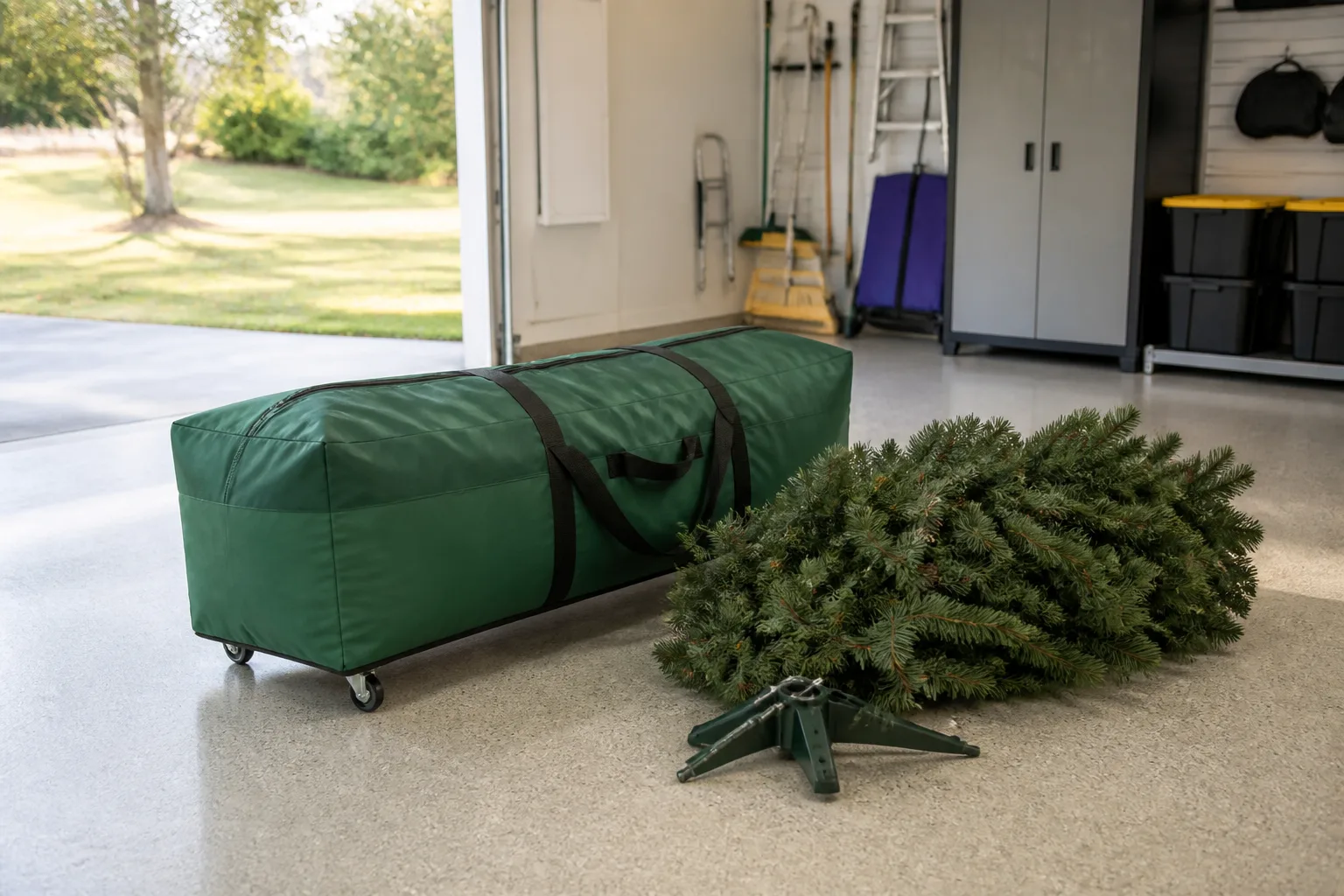
Cleaning before storage prevents dust and old needle fragments from sitting on the branches for a year. Remove ornaments and lights according to the manufacturer’s instructions, then use a soft brush, microfiber cloth, or a vacuum’s lowest setting with a brush attachment. Work from the top down so loosened dust falls onto a sheet or the floor rather than back onto already-cleaned branches.
Let any washable parts dry completely before packing. Fold or collapse the sections without forcing the hinges, label the box with the tree’s location and missing-piece notes, and store it in a cool, dry place off a damp concrete floor. A breathable tree bag is usually easier on synthetic materials than an improvised plastic wrap that traps condensation.
A low-mess Christmas tree takedown sequence
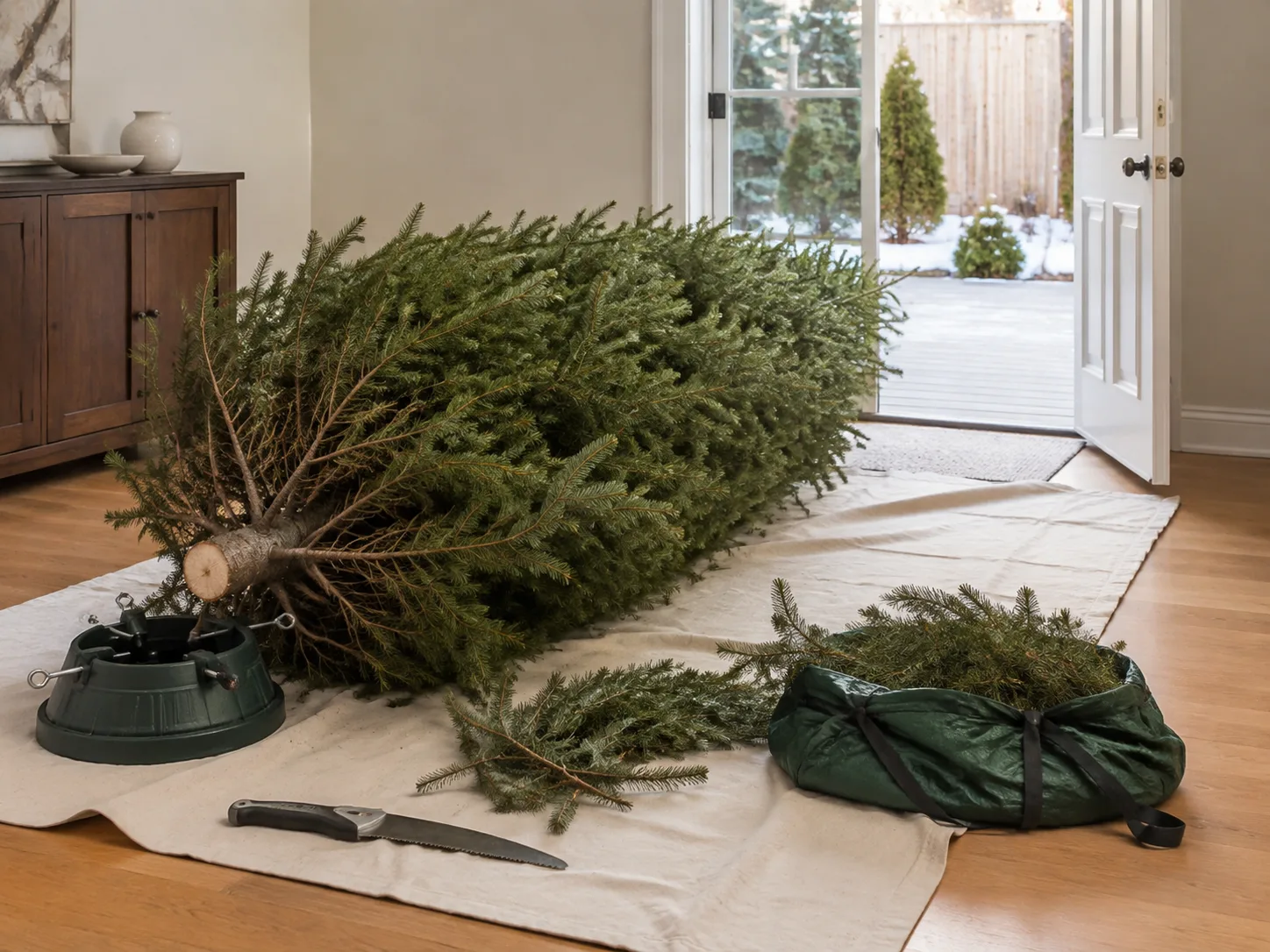
The cleanest method is slower for the first few minutes and much faster overall. Put a large sheet, old duvet cover, or purpose-made tree-removal bag under the tree before you touch the stand; move pets and small children away from the work area; and open the exit door or route you will use.
Pack ornaments before you move the tree
Unplug the lights and let any warm bulbs cool. Remove fragile ornaments from the outside first, then work inward and lower down. Check the branches, tree skirt, stand, and floor for hooks, wire, ornament caps, or small batteries that could be swept into a bag by mistake.
Wrap lights loosely around a flat piece of cardboard or a dedicated reel rather than winding them tightly around the tree. Separate sentimental or fragile ornaments into a smaller labeled box, and let children carry only unbreakable decorations. The goal is to finish the small-object work before the heavy, awkward tree starts moving.
Get the real tree out without scattering needles
If the tree is tall or the stand is heavy, use two adults. Keep the trunk low, support the stand as you lift, and move the tree horizontally over the sheet rather than dragging the stand across the floor. If possible, wrap the tree from base to tip before carrying it; if a removal bag is too small, use a sheet or tarp and secure it with soft ties, never with wire around the trunk.
Once outdoors, take off the stand and check for decorations again. Sweep or vacuum needles after the tree is gone, then empty the stand’s old water away from finished flooring and wipe the area dry. Do not shake a dry tree inside the house to make it “lighter”; that trades a few seconds of effort for needles in every nearby crack.
Recycle a real tree without guessing at local rules
Local programs are the deciding authority for disposal. Search your city, county, solid-waste provider, or parks department for “Christmas tree recycling,” then check the accepted dates, drop-off location, size limit, preparation rules, and whether the program accepts flocked or treated trees.
Before the tree leaves your home, remove every ornament, light, hook, garland, tinsel strand, stand, nail, and plastic bag. A local collection may ask you to cut a large tree in half, bundle branches, or place the tree at the curb only on a specific day. Gardening Know How’s disposal guide makes the same practical point: towns differ, and the sanitation provider—not a generic national checklist—sets the acceptable preparation.
Mulch, compost, wildlife habitat, or curbside collection?
Use this order of preference:
- Municipal chipping or green-waste collection: Usually the simplest route, especially when your town turns trees into mulch. Follow its rules exactly.
- A community drop-off: Good when pickup dates do not fit, but confirm the site is still operating and accepts your tree type.
- Home chipping or shredding: Useful if you have safe equipment and know how to handle the trunk and branches. Use fresh chips as a surface mulch only when appropriate for your garden, and keep them away from trunks and plant crowns.
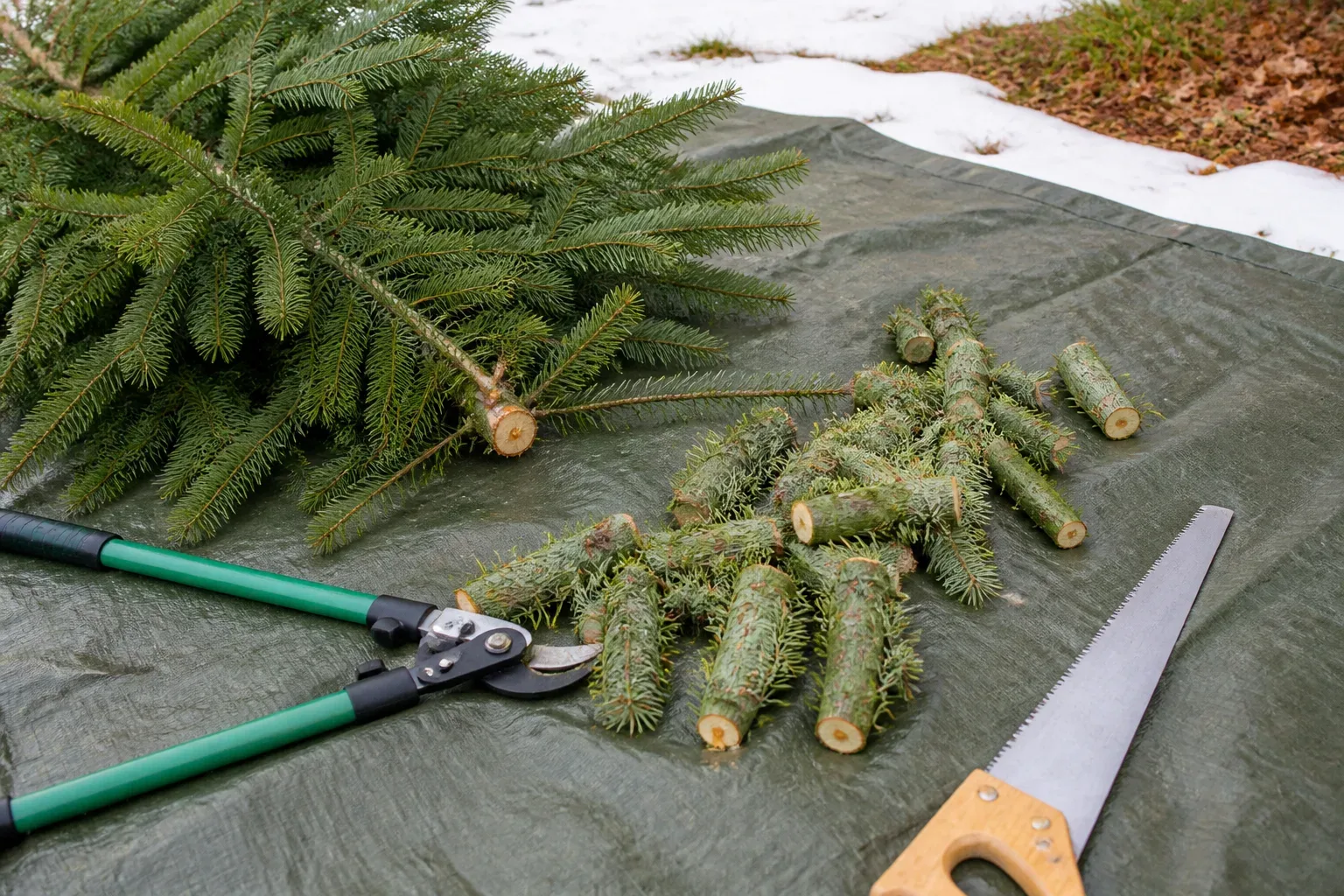
- Compost or a brush pile: Cut the tree into smaller pieces so it breaks down more efficiently. A shady brush pile can also shelter wildlife while the wood decays.
The Royal Horticultural Society’s reuse guidance recommends cutting a real tree into sticks for a wildlife-friendly stack or shredding it for mulch and green-waste composting. It also notes that Christmas trees are biodegradable and can provide habitat while they break down.
Do not assume every tree belongs in the garden. Avoid home composting material with obvious disease, heavy chemical treatment, paint, flocking, or non-biodegradable decorations. If an animal sanctuary, zoo, or conservation group wants trees for habitat or feed, confirm the program first and deliver only clean, untreated material that is still suitable for that use.
What not to do with an old Christmas tree
Do not burn a Christmas tree in a fireplace or wood stove. Resin, needles, and a tree that has not dried in a controlled way can create dangerous conditions; NCTA explicitly advises never burning any part of a Christmas tree in a wood stove or fireplace. “It is natural wood” is not enough to make it safe household firewood.
Do not leave a decorated tree at the curb, put it in a plastic bag, bury the trunk in the garden, or toss it into a woodland area without checking local rules. Do not cut branches over your compost pile if the tree has a suspected disease, and do not donate a tree with tinsel, wires, flocking, or sprayed-on products to wildlife or livestock programs.
Finally, do not spray pesticide on a tree indoors just to prolong its display. If insects appear, vacuuming and removing the tree may be the lowest-risk response; any pesticide use must match the product label and the intended indoor ornamental use. A post-holiday tree is not worth adding an avoidable chemical exposure to the room.
Conclusion: choose the date that protects both the tradition and the tree
There is no single mandatory day to take down a Christmas tree. For a fresh, stable tree, January 5 or 6 honors a common tradition, while New Year’s Eve, New Year’s Day, or the first week of January may suit your household better. For an artificial tree, choose the date that lets you clean and store it before it becomes a nuisance or a safety obstacle.
For a real tree, let condition outrank the calendar. If needles are brittle, branches snap, the stand has run dry, or the tree is near heat or faulty lights, take it down now. Then remove every decoration, wrap the tree before carrying it through the house, and use your local recycling or green-waste instructions to decide whether it becomes mulch, compost, habitat, or a scheduled collection.