Calathea Brown Edges: Causes and Practical Fixes
Diagnose Calathea brown edges by checking soil, water, humidity, light, and drafts. Fix the likely cause without adding water to already-wet roots.
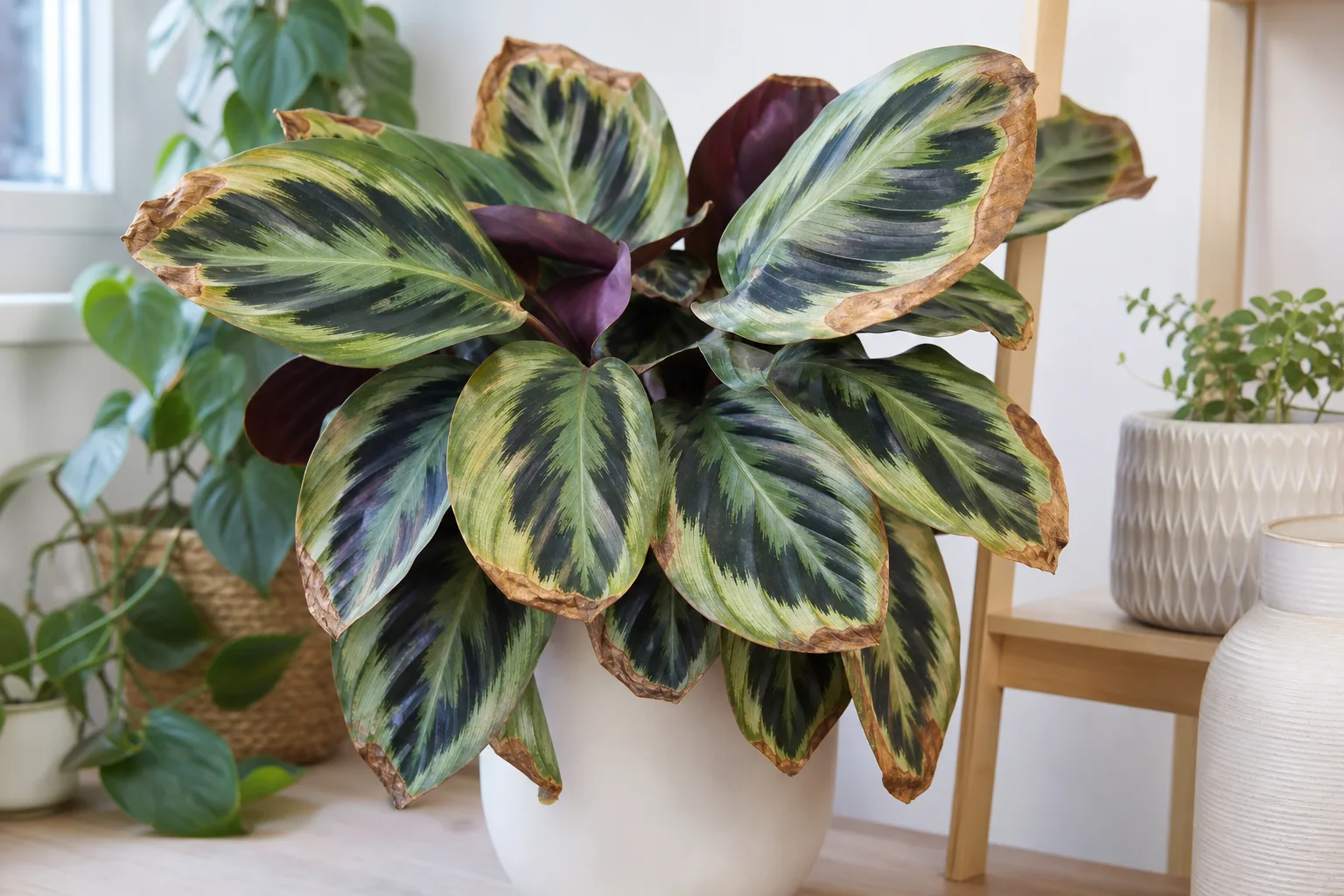
Brown, crispy edges on a Calathea are a symptom, not a diagnosis. Dry soil, roots that stay wet, mineral exposure, fertilizer buildup, low humidity, direct sun, or a draft can all leave brown tissue around a leaf; adding water is only helpful when the root ball is actually dry. Check the pattern and the soil first, then change the one condition that best fits what you see.
Calatheas—many species are now classified as Goeppertia—are tropical understory plants that prefer warmth, indirect light, steady moisture, and humid air. NC State Extension lists several distinct reasons for browning, including inadequate water, cold drafts, low humidity, direct sun, and fluoride exposure, while also warning that overwatering can cause root rot. That range is why a calendar-based fix so often misses the problem. (NC State Extension’s pinstripe Calathea profile; NC State Extension’s rose-painted Calathea profile)
Read the pattern before changing anything
Look at where the damage begins and how it is distributed. Dry, tan tissue that starts at tips or margins and feels crisp often points to water stress or a buildup in the pot; a yellowing leaf with a limp petiole and soil that remains wet points more strongly toward roots struggling in excess moisture. Neither clue is conclusive on its own, but several matching clues make a diagnosis more useful than the word “brown.”
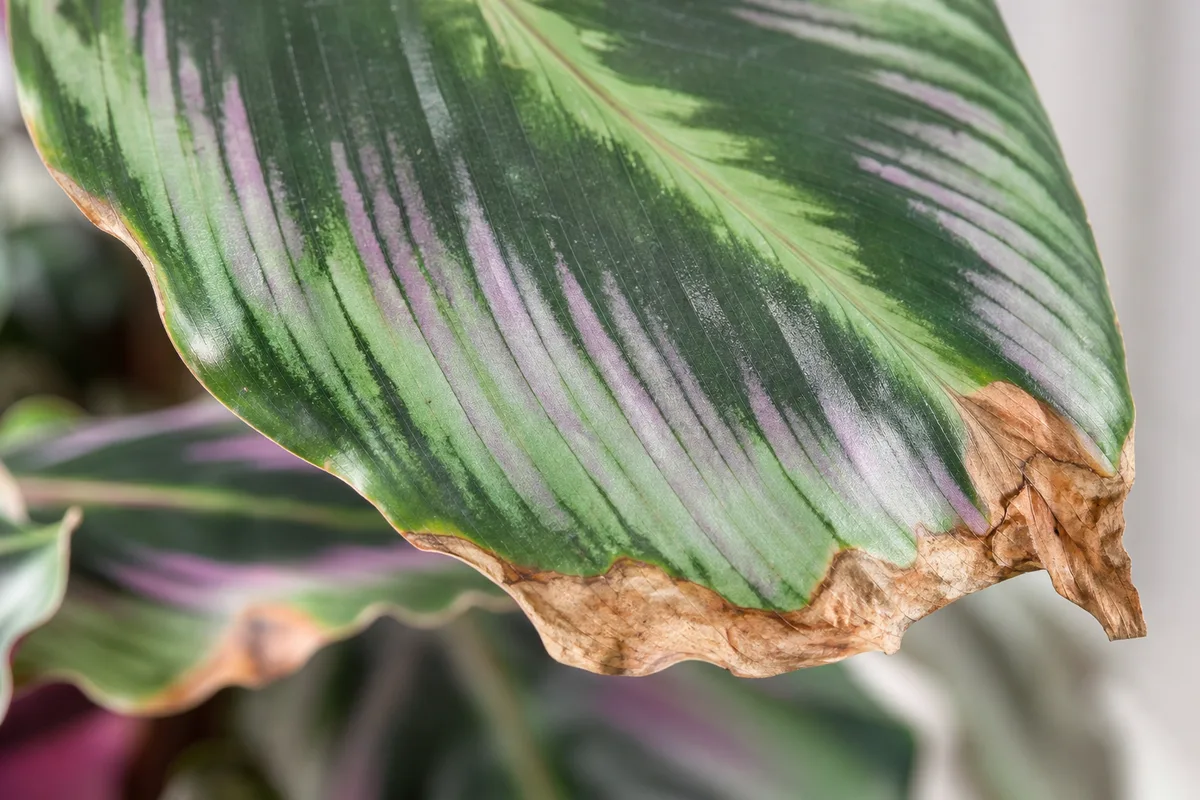
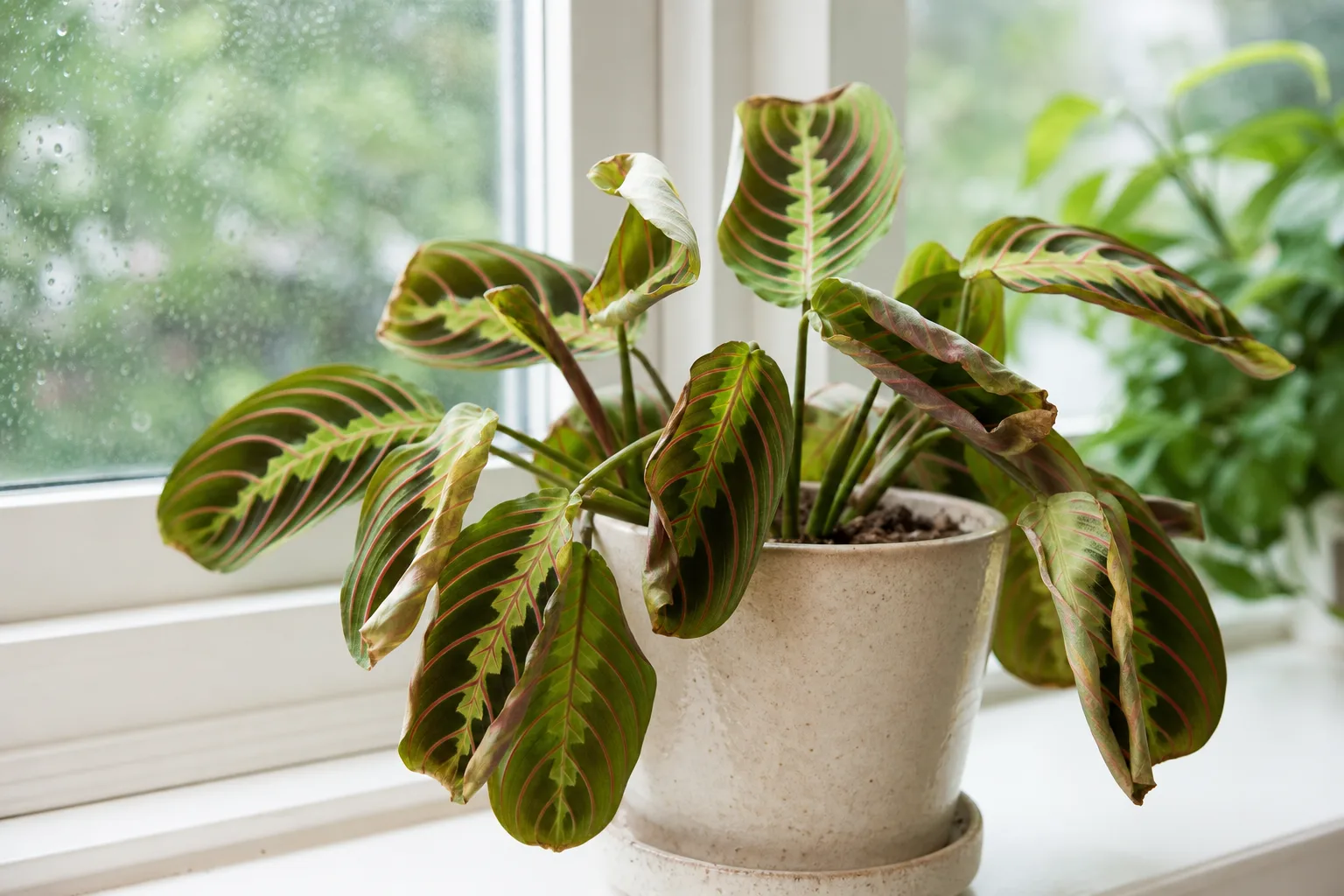
Dry, crisp margins show where damage has occurred, but the leaf pattern alone cannot identify the cause.
Then compare old and new leaves. A few damaged outer leaves with a firm center and clean new growth may be carrying old damage or aging out; browning that keeps appearing on newly opened leaves means the stress is still active. Damage concentrated on the window-facing side suggests sun or heat, while tips browning fairly evenly across the plant can fit a repeated root-zone or room-wide issue.
Brown tissue is dead tissue. It will not become green again when you correct care, so judge improvement by whether damage stops advancing and the next leaves emerge healthier—not by waiting for a scarred edge to heal.
Do a five-minute diagnosis before you water
Start with the root zone, not the watering can. Press a finger into the mix about an inch down and lift the pot to compare its weight with what it feels like just after watering. If the surface is dry but the mix below still feels slightly moist, that can be normal; if the root ball is dry through the upper few inches and the pot feels unusually light, the plant may have gone too long without water.
Check the drainage holes and saucer next. A pot that has no open drainage, sits in runoff, or stays heavy and wet for many days needs a different response from a dry pot. Note any yellow lower leaves, sour smell, mushy stems, or white crust on the soil and pot rim. These clues help separate root trouble and salt residue from simple thirst.
Finally, check the recent routine and location: water source, fertilizer frequency, direct sun, cold window glass, and nearby heating or air-conditioning vents. Use this table to choose a first lead rather than changing everything at once.
| What you notice | Check next | First likely lead |
|---|---|---|
| Light pot, dry mix below the surface, curling leaves | How often the root ball dries completely | Inconsistent or insufficient watering |
| Heavy pot, wet mix, yellowing or limp growth | Drainage holes and root firmness | Waterlogged roots or root rot |
| Similar brown tips on many leaves, mineral crust, or hard-water history | Water source and whether salts have been flushed | Dissolved minerals or fertilizer buildup |
| Damage strongest on one side | Window, vent, radiator, or cold draft | Local sun or temperature stress |
| Only an old outer leaf is affected and new growth is clean | Whether the symptom is spreading | Past damage or normal leaf turnover |
1. The root ball has dried too far between waterings
Calatheas do not like their mix to become bone dry for long. When roots cannot replace the water leaves are losing, the thinnest, most exposed margins can dry first; leaves may also curl inward or feel less supple. A pot that is light and dry below the surface supports this explanation much better than the brown edge alone.
If the mix is dry, water it thoroughly until excess runs from the drainage holes, then let the pot drain and empty the saucer. A very dry, peat-heavy root ball can sometimes pull away from the pot and repel water, so a fast splash may run down the sides without wetting the center. In that case, water slowly in two or three passes, allowing it to absorb between passes, and confirm that the middle of the root ball is damp.
Do not respond by keeping the pot constantly saturated. The goal is an evenly moist root zone with air still reaching the roots, not a permanent pool of water. Ohio Tropics’ practical Calathea guidance also emphasizes checking the potting mix instead of following a fixed calendar, because pot size, material, light, temperature, and mix all change how quickly it dries. (Ohio Tropics’ Calathea care and brown-leaf guide)
2. Waterlogged roots cannot supply the leaves
Overwatered and underwatered Calatheas can both develop crispy edges because damaged roots cannot deliver water reliably. The differentiator is often the soil: if it stays wet and heavy, especially alongside yellowing lower leaves, drooping, or a sour smell, adding another drink can make root stress worse. Roots affected by rot are typically dark and soft rather than firm and pale.
First make sure water can escape. Remove standing water from the cachepot or saucer and confirm that the nursery pot has unobstructed drainage. If the mix is still wet, wait and reassess rather than watering to “fix” the brown leaves. A plant in a cool, dim room or an oversized pot may use water slowly, so a schedule that worked in summer can become too frequent in winter.
If the plant is declining and the mix remains soggy, slide it gently from the pot and inspect the roots. Trim only roots that are clearly mushy or dead with clean scissors, then repot in fresh, airy mix in a container with drainage. Avoid disturbing a stable plant just because one leaf has a brown edge; repotting itself can add stress, and it cannot repair old leaf tissue.
3. Tap-water minerals or fluoride may be accumulating
Water quality is worth investigating when several leaves develop similar crisp tips over time, basic watering is consistent, and a pale mineral crust appears on the soil or pot rim. Some Calatheas are sensitive to fluoride: NC State’s profile for rose-painted Calathea specifically flags fluoride in tap water as a cause of brown foliage. The Pacific Northwest plant-disease handbook explains that fluoride can accumulate in leaf margins in sensitive plants, where injury appears as marginal or tip necrosis; it also notes that drought and salt injury can look similar. (NC State Extension’s rose-painted Calathea profile; Pacific Northwest Plant Disease Management Handbooks on fluorine toxicity)
That does not mean every brown Calathea needs bottled water. Municipal water differs, plant response differs, and a crust may come from fertilizer or other dissolved minerals rather than fluoride alone. If the soil is not staying wet and you have a reason to suspect water quality, run a simple trial: use rainwater collected in a clean container, distilled water, or reverse-osmosis water for routine watering while keeping light, fertilizer, and placement otherwise steady. Watch the next leaves, not the old brown ones.
Letting water stand overnight is not a reliable fluoride or mineral-removal method. Some free chlorine may dissipate from exposed water, but dissolved fluoride and mineral salts do not simply evaporate away; as water evaporates, dissolved material is left behind. If a filter is your preferred option, check its documented reduction claims rather than assuming every pitcher filter removes fluoride. Bloomscape also distinguishes between leaving water out to reduce some chlorine and using a filtration system for broader water-quality concerns. (Bloomscape’s Calathea brown-edge troubleshooting)
4. Fertilizer salts are stressing the roots
Fertilizer contains dissolved nutrients, and repeated heavy feeding can leave salts in a container that has little opportunity to shed them. A recent increase in feeding, a white crust, or browned tips that worsen after fertilizer applications make buildup more plausible. But do not add fertilizer because the plant looks unhealthy: if roots are stressed, extra salts can increase the problem instead of correcting it.
Pause feeding while you diagnose. If the mix is draining freely and not already waterlogged, one thorough rinse with low-mineral water can help carry soluble residue through the pot; let it drain completely afterward. Do not repeatedly flush a saturated container or one without drainage holes. If residue returns quickly, rethink the water source and fertilizer dose rather than performing a large flush every week.
Once the plant is growing actively and the root zone is stable, resume a balanced houseplant fertilizer at the label’s conservative rate. Calatheas do not need strong or frequent feeding to replace brown leaf tissue. A modest, consistent routine during active growth is safer than trying to force new leaves with concentrated fertilizer, and a lower-mineral water trial should not become an excuse to overfeed.
5. Dry air or direct airflow is drying leaf margins
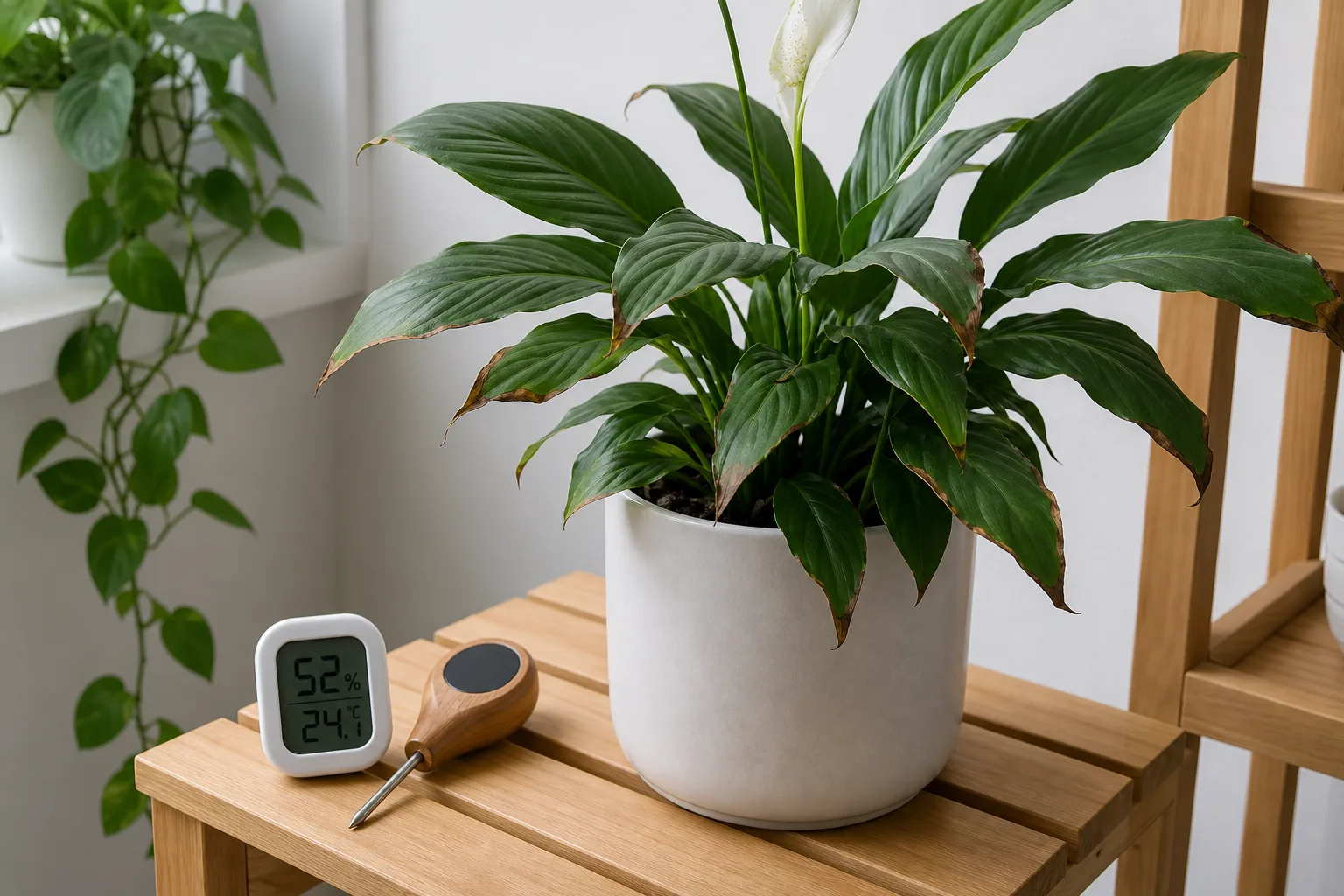
Low humidity can contribute to crisp margins, particularly in a heated room during winter, but it is easy to blame humidity for a plant that is actually drying out or sitting in soggy mix. Measure the air near the leaves with a small hygrometer and check the soil at the same time. NC State Extension recommends humidity around 60% for pinstripe Calathea; the RHS likewise recommends high humidity and draught-free conditions for Calathea grown indoors. Treat those as practical guidance rather than a precise pass-or-fail line for every species or home. (NC State Extension; RHS Calathea ornata profile)
Airflow can make a small patch of the room much drier than the reading elsewhere suggests. A plant directly beside a heating vent, fan, or air conditioner can lose moisture faster even if the room’s average humidity seems acceptable. Move it out of the air stream before changing the watering schedule; do not compensate for a vent by keeping the soil constantly wet.
6. Direct sun, cold glass, or heat can damage edges
Calatheas generally do best in bright, indirect light. Strong direct sun through glass can scorch exposed leaf tissue, while a cold window at night or warm air from a radiator can create sharp temperature changes. NC State lists excessive direct sun and cold drafts among the causes of brown leaves in Calathea; the RHS recommends sheltered, draught-free conditions and a steady temperature for C. ornata. (NC State Extension; RHS Calathea ornata profile)
Use the plant’s orientation as evidence. If the side facing a bright window, glass door, heater, or vent is more damaged than the sheltered side, adjust placement before adding water or changing the whole room. Pull the pot back from hot afternoon sun, cold panes, and direct blasts of conditioned air; a sheer curtain can soften harsh light without moving the plant into a dark corner.
Do not rotate the Calathea among several rooms while you troubleshoot. A stable spot lets you see whether new leaves improve. If the plant was recently moved, acclimate it to a brighter position gradually rather than placing it in direct sun to “help it recover.”
7. Pests, leaf spots, and old leaves need a different response
Dry, crispy edges are commonly environmental, but inspect both sides of the leaves if the damage looks patchy or keeps spreading. Fine webbing and stippling can point to spider mites; silvery scarring, tiny insects, or sticky residue suggest other pests. Expanding wet-looking spots, yellow halos, or lesions that cross the leaf blade are not the same pattern as a uniformly dry edge and may involve disease or persistently wet foliage.
Isolate a plant with visible pests from nearby houseplants and identify the pest before choosing a treatment. For suspicious spots, avoid wetting leaves repeatedly and improve gentle air circulation; do not apply an insecticide or fungicide just because a leaf is brown. If the plant has only one old outer leaf with a dry margin and the center is producing clean growth, the issue may be old damage or ordinary leaf turnover rather than an active crisis.
Fix the likeliest cause in a low-risk order
Begin with observations you can reverse easily. Record which leaves are affected, feel the mix below the surface, lift the pot, empty standing water, and move the plant away from an obvious vent or cold pane. Then choose the cause that explains the greatest number of clues. A light pot with dry soil calls for water; a heavy, wet pot calls for restraint and a drainage check.
Change one major variable at a time unless the roots are actively rotting. If the evidence points to low humidity, measure it and adjust the air; if it points to fluoride or mineral buildup, trial a lower-mineral source. Do not repot, flush, change water, add a humidifier, and fertilize on the same day. Otherwise, you may stress the plant and still have no idea which change helped.
After the first correction, give the plant a stable environment and watch the newest growth. A brown edge already present is a record of past conditions. The result you want is not instant cosmetic repair, but no further spread and leaves that open without new damage.
Water for even moisture, not a weekly schedule
Watering frequency depends on pot size, pot material, mix, root density, light, temperature, and season. Check the soil rather than setting “every Sunday” as a rule. When the top layer has started to dry but the mix below is still slightly moist, water slowly until excess drains freely; then empty the saucer. The point is to avoid both a bone-dry root ball and a pot that never gets air.
Use the same quick check each time: touch the mix, lift the pot, and notice whether leaves are curling or yellowing. If the soil is still wet, wait and check again later; if it is dry through the root ball, water thoroughly rather than sprinkling the surface. Ohio Tropics recommends adjusting the interval to the pot and environment instead of using a universal calendar, which is especially useful when indoor conditions shift between seasons. (Ohio Tropics’ Calathea watering guidance)
When water runs straight through without wetting the center, the mix may be compacted or the dry root ball may be repelling water. Rewet it in slow passes and confirm moisture in the middle. If this becomes a regular problem, refresh the mix at an appropriate time; do not keep a plant submerged to compensate for poor drainage.
Change water only when the evidence supports a trial
If the plant is otherwise stable but brown tips keep appearing, write down your current water source and check the local utility report or the filter’s specifications. Try rainwater, distilled water, or reverse-osmosis water for the next normal waterings while holding the other parts of care steady. Use a clean collection vessel for rainwater and avoid runoff from a roof or surface that could contaminate it.
Give the trial time to show up in new growth. Leaves that were already developing under the old conditions may still open with damage, so one imperfect leaf does not disprove the change. If new edges continue browning after several leaves, return to the diagnostic list: persistent wet soil, dry spells, fertilizer residue, low humidity, direct sun, and drafts can overlap with water quality.
Very low-mineral water is not a complete fertilizer. If you use it regularly, still provide nutrients cautiously during active growth and follow the product label. Do not use softened household water as a substitute for lower-mineral water; some softeners add sodium, and the plant’s response depends on the system and water chemistry.
Raise humidity without keeping leaves wet
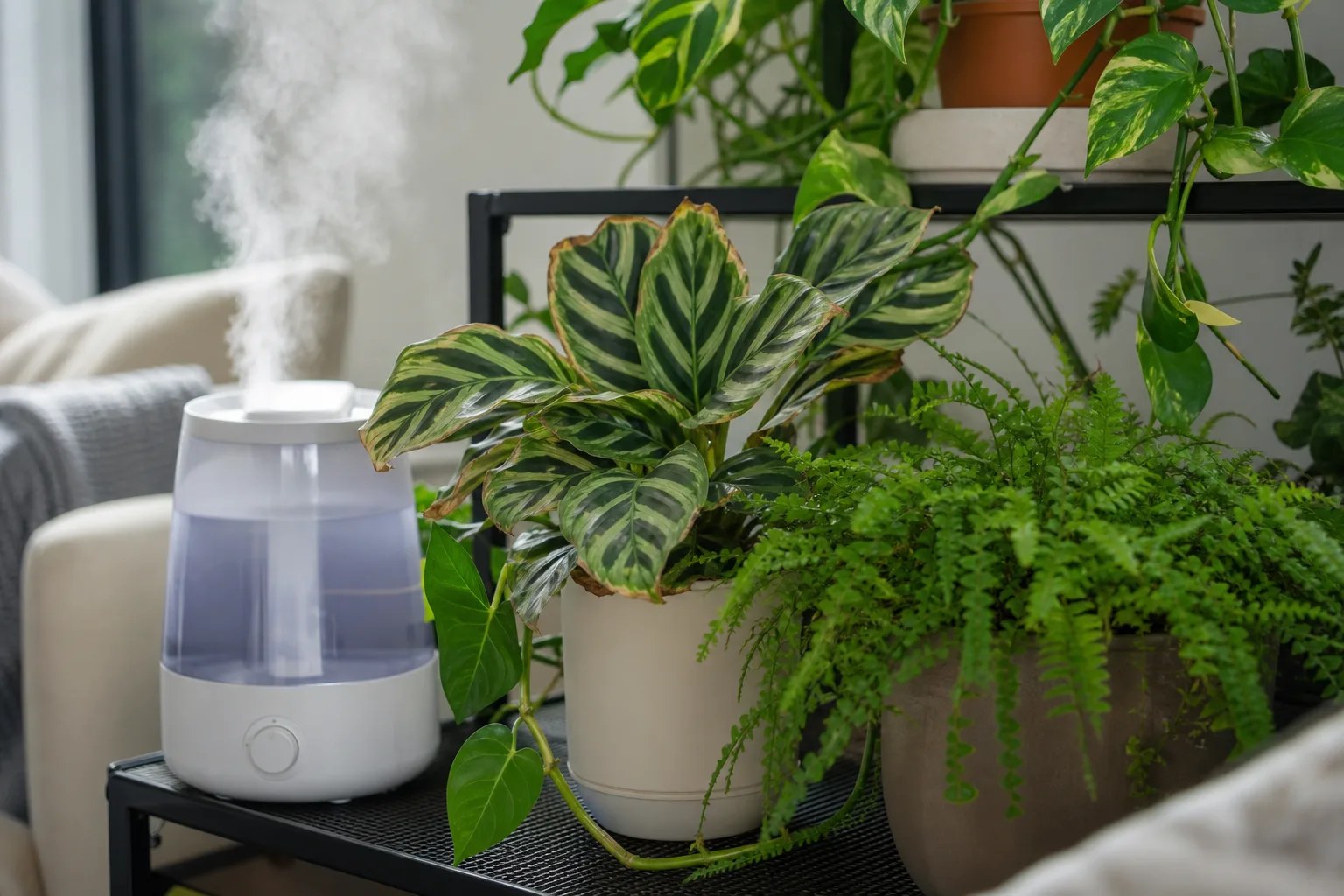
If the hygrometer shows persistently dry air, a clean room humidifier placed near—but not blowing directly onto—the plant is usually more controllable than repeated misting. Check the reading at leaf height and avoid running the room so damp that windows or walls stay wet. Grouping plants can modestly change the immediate microclimate, but it will not correct a very dry room by itself.
A pebble tray is optional, not a cure-all. If you use one, keep the pot above the waterline on the stones; the roots should not sit in standing water. Misting briefly wets the leaves but does not maintain a stable humidity level through the day, and repeatedly wet foliage in still air can create other problems. Ohio Tropics’ Calathea guidance similarly treats a humidifier as a more reliable humidity adjustment than misting. (Ohio Tropics)
Do not buy a humidifier just because one tip is brown. First check whether the mix is drying too far or the plant is parked in moving air. If low humidity is contributing, improve it gradually and keep watering decisions tied to soil moisture rather than to the humidifier setting.
Repot or flush only when the root zone calls for it
Repot when the mix has broken down, water cannot drain, roots are damaged, or the plant repeatedly dries out too quickly—not simply because a few leaf edges are brown. Choose a pot with drainage only modestly larger than the root ball and use a loose mix that retains some moisture while letting excess water escape. A much larger container can stay wet for longer around roots that do not yet occupy the soil.
Flushing can help when soluble residue is likely and the pot drains freely. Use low-mineral water, pour enough to move water through the entire root ball, and let the container drain completely. Skip flushing if the soil is already saturated, the pot lacks drainage, or the mix channels water down the sides without absorbing it. In those situations, fix the drainage or mix problem first.
Trim brown edges without sacrificing healthy leaves
Trimming is cosmetic. Use clean, sharp scissors and follow the natural outline of the leaf, cutting only the dry brown tissue and leaving a thin brown margin rather than slicing into healthy green tissue. If an entire leaf is yellow, collapsed, or mostly dead, remove it near the base instead of trimming every small blemish.
Wipe the blades between plants, especially if you suspect pests or disease. Do not strip off every leaf with a brown edge at once; the remaining green foliage is still helping the plant grow. Bloomscape’s Calathea troubleshooting also recommends clean scissors for damaged leaves, but the lasting fix is correcting the growing condition rather than pruning alone. (Bloomscape)
Track new growth and know when to reassess
Take a photo now, mark the newest leaf, and check once a week for new browning. Note the soil condition, approximate humidity, water source, and any recent feeding. This simple record prevents you from reacting to the same old brown patch every day and makes it easier to notice a pattern after a change.
Reassess if fresh leaves continue to brown, the plant begins yellowing widely, the pot remains wet for an unusually long time, or the crown and roots soften. Return to the evidence rather than adding another intervention. If the damage has changed into spreading spots, stippling, webbing, or sticky residue, inspect for pests or disease instead of treating it as a humidity problem.
Recovery is measured in healthier new growth, not in a scarred leaf returning to green. Some older leaves may remain imperfect even after you solve the cause. Keep the routine steady long enough to see what the next leaves tell you.
Conclusion
Calathea brown edges can come from too little water, roots that stay too wet, fluoride or mineral accumulation, excess fertilizer, dry air, harsh sun, or a draft. The safest first move is to check the root ball and drainage, then compare the damage pattern with water history and placement. Correct one likely cause, keep the plant stable, and judge the result by its new leaves; trim the brown tissue only if you want to improve appearance.