8 Reasons Your Orchid Won't Bloom—and What to Do
An orchid with leaves but no flowers may need brighter light, a seasonal cue, healthier roots, or time. Diagnose eight causes and choose a safe fix.
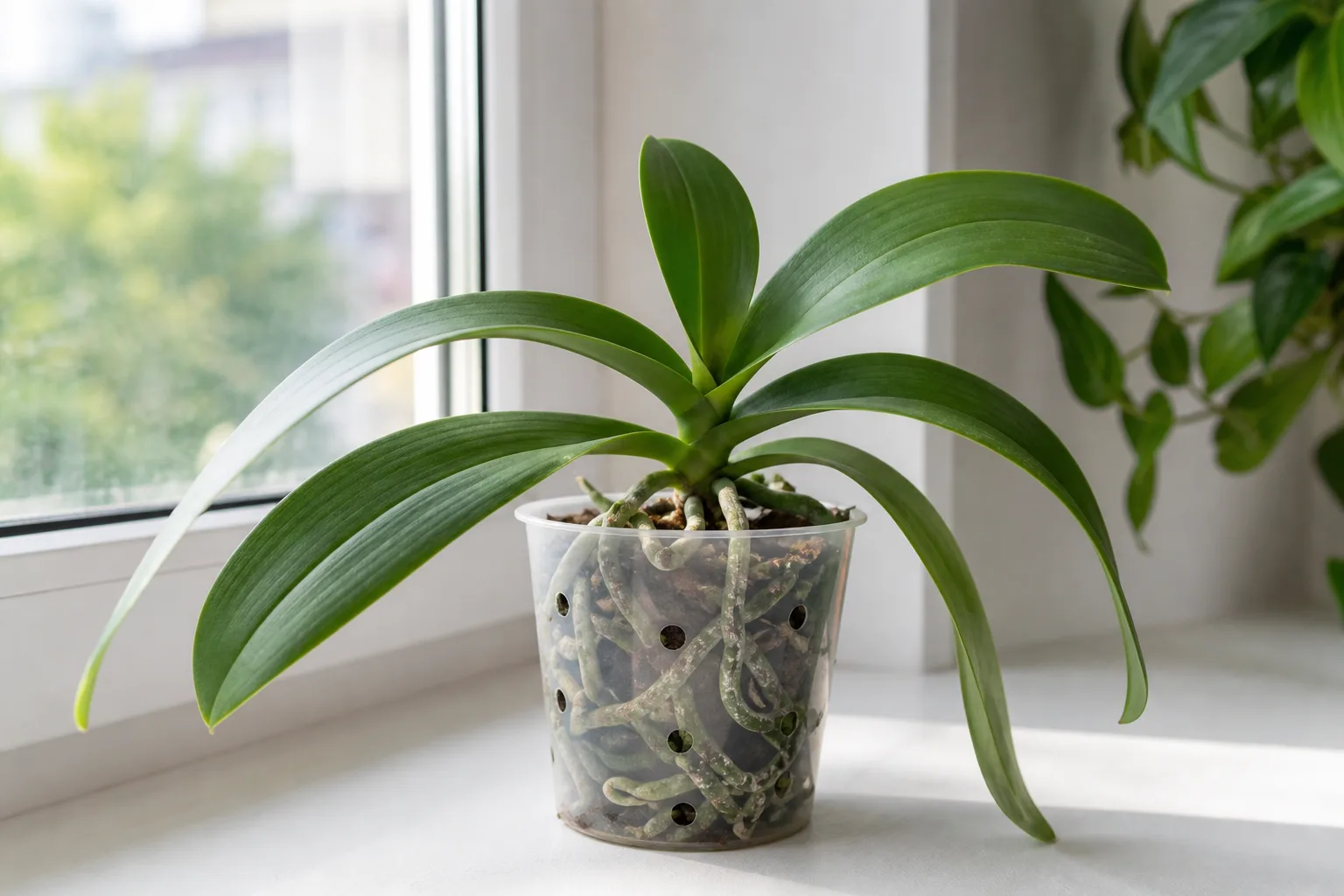
A healthy orchid can spend months with only leaves and roots above its pot. If it stays flowerless through more than one expected bloom season, check its identity, light, roots, and recent conditions before changing everything at once.
Flowering requires three things to line up: a plant healthy enough to spend energy on flowers, enough light to build that energy, and the right seasonal cue for that orchid. The American Orchid Society uses this same basic framework in its rebloom guidance. It helps explain why fertilizer alone rarely solves a flowerless orchid, and why a temperature trick that suits a moth orchid may not suit a Cattleya or Dendrobium.
Identify your orchid before changing its care
Start with the label, receipt, or nursery tag. The most common indoor orchid is the moth orchid, Phalaenopsis, with broad leaves growing from a short central crown and an arching flower stem. Other familiar types look quite different: Cattleyas often have swollen pseudobulbs, Dendrobiums grow along cane-like stems, and many Oncidiums produce branching sprays of smaller flowers. If the label is gone, a photo of the plant and its old flower can help an orchid society or knowledgeable grower identify it.
This matters because “orchid” is a huge plant family, not one care category. A universal rule such as “all orchids need a cold autumn” or “all orchids bloom once a year” is too broad to diagnose a specific plant. If you cannot identify it yet, keep it stable in bright filtered light, avoid standing water, and do not apply a drastic temperature or drought treatment.
A flowerless pause can be normal
An orchid bought in full bloom may have been grown under carefully controlled greenhouse conditions and sold at the peak of its display. Once those flowers fade, the plant has to acclimate to your home and resume leaf and root growth before it can flower again. The flowers of a Phalaenopsis can remain attractive for months; Colorado State University’s PlantTalk notes that mature plants commonly bloom from late winter into spring, but the season varies by species and hybrid. BBC Gardeners’ World likewise cautions that a moth orchid may bloom once a year rather than every few months.
Read the plant, not a calendar. Firm leaves, active green or silvery root tips, and a stable crown are good signs that the orchid is growing even without flowers. A small or recently divided plant may not yet be mature enough to flower, and an orchid recovering from transport, root loss, pests, or repotting may skip a cycle. If the plant is otherwise healthy and it has been only a few months since the display ended, patience and steady care may be the right “fix.”
1. The plant gets too little usable light
Low light is one of the most common reasons an orchid produces leaves but no flowers. A room can look bright to us while the plant sits well back from a window or behind a shade that blocks much of the daylight. The American Orchid Society describes light as the foundation for orchid growth and flowering: bloom cues cannot make up for a plant that has not stored enough energy. It also notes that Phalaenopsis needs less light than many Cattleyas, Vandas, or Cymbidiums, not that it thrives in a dark corner.
Look for patterns rather than relying on one leaf color. Very dark green foliage, weak or floppy growth, and no flowering can point to insufficient light, but leaf color varies by hybrid and can also change with nutrition. A Phalaenopsis often does well close to a bright east-facing window or behind a sheer curtain at a sunnier exposure. If you use a grow light, follow the fixture’s distance and duration guidance and put it on a timer so the orchid still gets a regular dark period. See the American Orchid Society’s light guide for why light level and day length both matter.
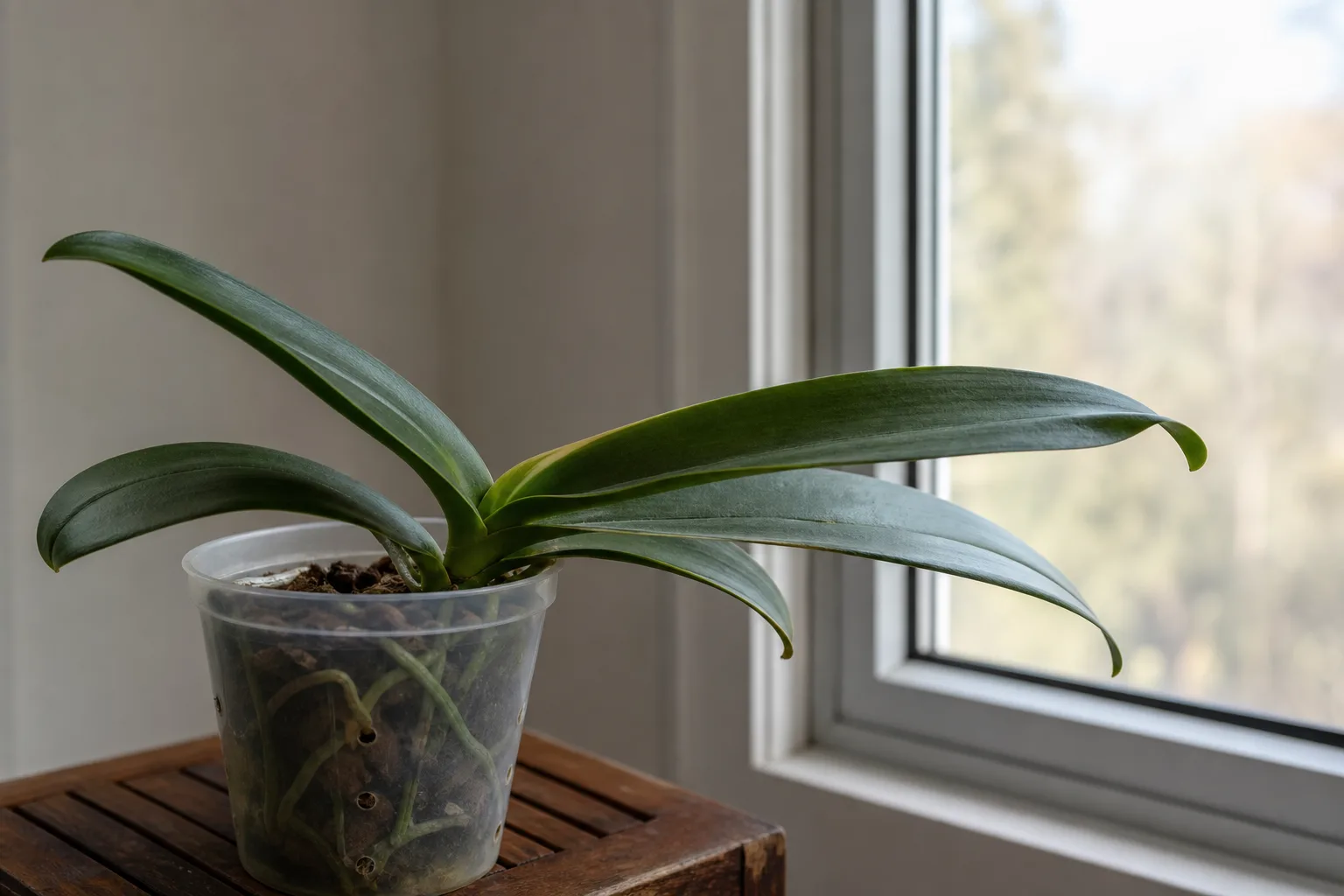
Move a dimly placed orchid gradually, not from a bookcase straight into full sun. Give it a brighter position, observe new growth over several weeks, and avoid changing its fertilizer and watering schedule at the same time. Older leaves will not necessarily become a different color after you improve light; judge the adjustment by new growth and the plant’s overall vigor.
2. Direct sun or hot leaves are damaging it
More light is not always better. Harsh midday sun through glass can overheat leaves and cause pale, yellow, white, or dry patches, especially after the plant is moved suddenly from shade. Sun-damaged tissue does not turn green again, so the goal is to stop further damage and let healthy new leaves replace the injured ones over time. A plant spending energy on recovery may not flower promptly.
Phalaenopsis usually wants bright, filtered light rather than prolonged direct sun. A sheer curtain, a position a little farther from a hot west window, or a nearby east window can reduce exposure without leaving the plant in deep shade. If the leaves feel hot to the touch, shift the plant back or add filtering. Do not use a single south-window or west-window rule: window direction, season, glazing, curtains, and distance all change the actual light the leaves receive.
If you notice bleaching or a sunken dry patch, provide more shade; do not try to “make up” for the lost bloom by applying extra fertilizer. The American Orchid Society’s light guidance emphasizes slow adjustments because a plant can burn when light rises too quickly.
3. It has not received the right temperature signal
Many Phalaenopsis hybrids initiate a flower spike after a period when nights become cooler than days. In a centrally heated room kept at nearly the same temperature around the clock, that seasonal difference may be weak. Colorado State University PlantTalk describes cooler fall nights as a way mature moth orchids form buds, while the American Orchid Society says the relevant cue varies and may involve the day-to-night temperature difference. That is a cue, not a command to chill the plant.
For a healthy, mature Phalaenopsis, a modest seasonal drop in nighttime temperature can help. Think in terms of a few weeks in a slightly cooler but still protected room, with nights around the low-to-mid 60s Fahrenheit and warmer days, rather than placing the plant outside in cold weather. The exact response differs by hybrid, and a plant may flower without a deliberate temperature treatment if it already receives the right conditions. If your home stays warm at night, first improve light and root health; do not compensate by exposing the plant to a cold draft.
Avoid turning the old “cold-night trick” into a race to the lowest temperature. Some orchid types tolerate cool conditions that would injure a warm-growing Phalaenopsis, and temperature beside a glass pane can be much lower than the room reading. Keep leaves away from icy windows and door drafts. If buds are already forming, stable conditions are more useful than moving the plant back and forth to chase a particular thermometer number.
4. Its natural season, day length, or bloom cue is being missed
Temperature is not the only signal. Some orchids respond to seasonal day length, a drier rest, or the maturity of a new growth; others flower after a combination of cues. The American Orchid Society explains that fall-blooming and spring-blooming Cattleyas can respond differently to shorter or longer days, while Phalaenopsis is more closely associated with a night-temperature change. Night lighting from a bright grow area can interfere with day-length cues for some orchids, even though ordinary room light spilling nearby may be too weak to matter.
This is why identification changes the troubleshooting plan. A Cymbidium is often grown with a cooler seasonal period, while some Dendrobiums need a rest that depends on their type. A Catasetum’s seasonal cycle can include a pronounced dry rest, but withholding water from a typical moth orchid is not an equivalent shortcut. When the label names a genus, check a care sheet for that group or ask an orchid society rather than applying advice written for another plant.
Track when new leaves, roots, and spikes appear for a full year. A timer can create a consistent light-dark cycle under lamps, but do not keep grow lights on overnight.
5. The orchid is young or rebuilding after stress
Flowering takes resources. The American Orchid Society points out that an orchid needs to be healthy and have enough stored carbohydrates before it can support blooms. If a plant recently lost roots, endured a move, suffered a pest infestation, or was repotted, it may prioritize survival and new growth. That is especially likely if leaves are soft, wrinkled, or shrinking while the plant is trying to rebuild its root system.
Age matters too. A small seedling or a young division may need several growth cycles before it reaches flowering size. Some orchids flower from mature pseudobulbs or canes rather than from a newly formed leaf, so a plant that has not finished its growth may not be ready. A store-bought orchid already in bloom is mature enough for that display, but the next flowering period still depends on how well it adjusts to the home.
If a Phalaenopsis has a green flower spike but very few functioning roots, cutting the spike back may be a reasonable way to reduce the demand for a second flush. Wait for firm new roots or leaves before expecting a reliable rebloom. For general moth-orchid care after the flowers fade, use the beginner’s orchid care guide as a companion.
6. Damaged roots or decomposed medium limit the plant
Orchid roots do more than anchor the plant: they take up water and nutrients, and many common houseplant orchids rely on air moving around those roots. If bark has broken down into fine, dense particles, or moss stays wet in the center long after watering, roots can lose the air they need. A plant may then look thirsty even while the pot is wet because damaged roots cannot move water effectively.
If your pot is clear, inspect the roots through its sides. Healthy Phalaenopsis roots are firm; they can look green when wet and silvery when dry. Brown, mushy, hollow roots or roots whose outer layer slips off suggest decay. Aerial roots growing over the rim are normal and do not prove the plant is rootbound. The University of Connecticut Extension’s orchid care and repotting guidance recommends airy orchid media and good drainage, while Savvy Gardening’s Phalaenopsis repotting walkthrough shows practical signs that bark has broken down.

Repot when the medium is deteriorating, staying soggy, smelling sour, or accompanied by failing roots—not just because flowers have fallen. If the orchid is flowering and the roots are not in immediate danger, wait until the display ends. Use fresh orchid mix and a pot that fits the root mass with drainage; oversized pots hold moisture longer. Remove only roots that are clearly dead or rotten with clean snips, and keep firm roots even if they are silver, green, or growing outside the pot.
7. Watering swings stress roots or developing buds
Both persistent wetness and long, severe drying can leave an orchid unable to support flowers. The problem is not that orchids need an exact weekly schedule; it is that the potting medium, container, and room determine how quickly the roots dry. A compact moss plug inside a decorative pot may stay damp far longer than coarse bark in a warm, airy room. Colorado State University PlantTalk and UConn Extension both stress drainage and caution against keeping Phalaenopsis roots waterlogged.
With a clear pot, water when much of the root system has turned silvery and the medium is close to dry; do not leave it bone-dry for extended periods. Water thoroughly with room-temperature water, then let every drop drain before returning the nursery pot to its cachepot. Never leave the base sitting in runoff, and keep water out of the crown where the leaves meet. Colorado State University PlantTalk and UConn Extension both emphasize drainage for moth orchids.
Wrinkled leaves do not always mean “water more.” They can also appear when roots have rotted and cannot absorb moisture. If the mix is still wet and roots are brown or mushy, adding water makes the underlying issue worse. If the mix is dry and roots are firm but shriveled, the orchid may need more complete watering or a closer look at whether its mix is drying too fast. During bud development, keep the routine steady; avoid swings from soaking to severe drought.
8. Fertilizer is absent, excessive, or misused
A plant growing for years in inert bark may benefit from regular, modest feeding, but fertilizer is not a bloom switch. A high dose cannot replace missing light, unhealthy roots, or the species’ seasonal cue. Too much fertilizer can leave salts on the pot or medium and injure roots, which makes flowering less likely. A bloom-booster formula with a very high middle number is not a reliable way to force flowers.
Use a complete orchid fertilizer at the label rate or weaker while the plant is actively growing. If the product recommends dilution, measure it rather than estimating from the cap, and occasionally water with plain water to help flush accumulated salts. Do not feed a plant with badly damaged roots as if it were in vigorous growth; stabilize its care and let healthy roots return first. Epic Gardening’s beginner orchid care guide also cautions that orchids are sensitive to overfertilizing and recommends a restrained approach.
If you have not fertilized at all, correct that gradually rather than doubling a dose in the weeks before the expected bloom season. Conversely, if you have been feeding at every watering, pause long enough to flush the medium and review the label. Different media and water sources affect how nutrients accumulate, so there is no single formula or interval that fits every pot. The useful target is steady growth without burnt root tips or a crust of fertilizer salts.
A safe Phalaenopsis rebloom routine
For a healthy moth orchid, establish a stable baseline before trying to provoke a spike. Keep it in bright filtered light, water according to how its bark or moss dries, and let the pot drain freely. Feed lightly during active root or leaf growth. Once the plant has built healthy growth, a gradual seasonal night-temperature drop may provide the cue that many Phalaenopsis hybrids need.
A practical routine looks like this:
- Confirm the plant is Phalaenopsis. If it is another genus, use that group’s care directions instead.
- Give it more useful daylight if needed. Start near a bright window and filter harsh sun; acclimate it if you move it.
- Check root condition and medium. Repot only if the medium is degraded or the roots are failing.
- Keep watering consistent. Water thoroughly as the medium nears dryness, then drain completely.
- Allow normal day and night. For a mature, healthy moth orchid, a mild cooler-night period may help; avoid cold drafts and temperature extremes.
- Wait for the plant to respond. A spike is a later growth response, not a same-week result.
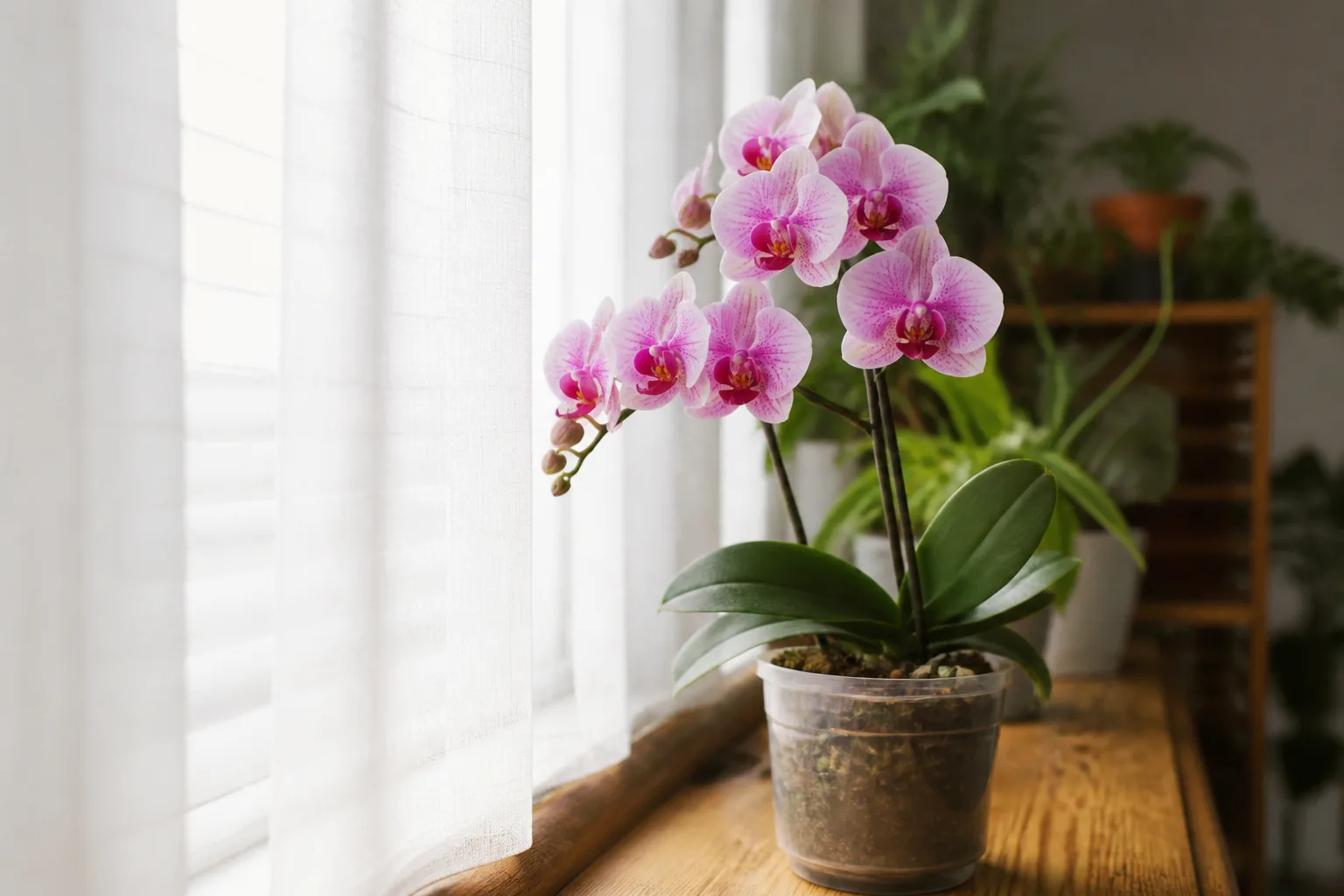
Do not combine all the fixes on one weekend. A new window, fresh pot, fertilizer change, and cool-night exposure at the same time can stress the plant and leave you unable to tell what helped. Change the clearest mismatch first, then observe new roots, leaves, and spike growth over time. BBC Gardeners’ World offers similar practical advice to keep moth orchids in indirect light and avoid sudden temperature changes, but your plant’s genus and condition should guide the final choice.
What to do with a green or brown flower spike
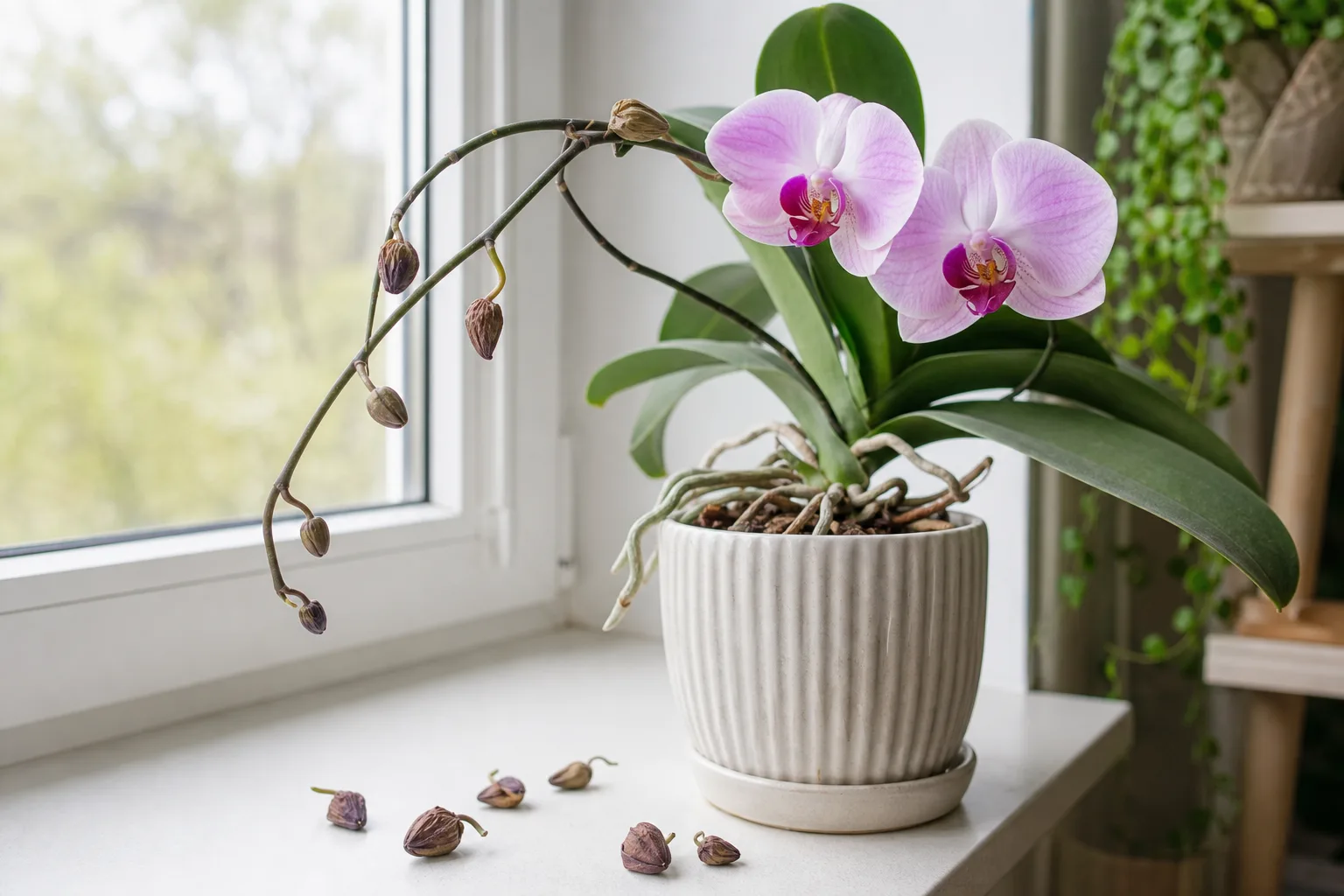
After the blossoms drop, look at the spike itself. If it has turned yellow or brown and dried, cut it near the base with clean pruners; it will not produce flowers from dead tissue. If it is still green, a healthy Phalaenopsis may branch from a node, which can produce a smaller or less predictable second flush. You can leave the stem in place, or trim above a healthy node if the plant is vigorous and you want to try that option.
There is a trade-off. A side branch may arrive sooner than a completely new spike, but supporting another round of blooms costs energy; a tired orchid with weak roots may do better if you cut the green spike at the base and let it rebuild. Neither choice guarantees a future bloom. For orchids that flower from mature canes or pseudobulbs, do not automatically cut living growth because its flowers have finished. The American Orchid Society and Colorado State University PlantTalk describe post-bloom spike choices for Phalaenopsis, but species-specific guidance is safer than pruning every orchid alike.
Use sharp, clean tools and avoid cutting into the crown or leaf base. If a spike is still carrying buds, do not repot or reposition the plant unless there is a serious root problem. Stable conditions can matter more at that point than the chance of a quicker second bloom.
If buds form and then fall
Bud drop, sometimes called bud blast, has several possible triggers. A sudden cold draft, a heater vent, large temperature changes, a sharp move from one light level to another, or a major watering disruption can all stress a plant that has already started to flower. UConn Extension notes that large temperature fluctuations can cause Phalaenopsis buds to fall; the American Orchid Society also warns growers to watch for drafty windows and ethylene near gas heaters.
Think backward from the first bud that shriveled. Did the orchid move from a store to a cold car, sit beside a door, or get placed near a heating vent? Did you leave the pot soaking or allow the medium to dry far past its normal point? Was fruit ripening or a combustion heater near the flowers? Correct the most recent plausible change and keep the plant in one stable spot. Avoid responding to bud drop by soaking the pot repeatedly; if roots are already wet, that can compound the stress.
Remove flowers or buds that have fully dried, but do not cut healthy green leaves or roots in an attempt to save the remaining buds. If the plant itself is firm and growing, the fallen buds do not mean it has lost its chance to bloom in the future. Let the current spike finish what it can, then return to the normal root, light, and seasonal-cue checks.
A low-risk 30-day troubleshooting sequence
A month is enough to improve your observations and remove obvious stressors, but it may not be enough time to make a new spike. Think of these four weeks as a controlled check, not a countdown to flowers.
Days 1–3: identify and inspect. Photograph the whole plant and its roots, find the name if possible, and note whether leaves are firm, whether the pot drains, and how damp the medium is. Check the window at the plant’s actual position, not from across the room. Write down any recent move, repot, heater exposure, or major watering change.
Week 1: correct the largest light problem. If the plant is in a dark room, move it closer to bright filtered daylight gradually. If leaves are hot or scorched, add shade or move it back. Do not rotate a plant with an emerging flower spike or change more than one main factor unless the roots are in immediate danger.
Week 2: tune watering to the pot. Confirm that runoff can escape and that no decorative container holds water around the nursery pot. Adjust how often you check based on whether the medium is bark or moss and on how quickly the center dries. If roots look healthy and the mix is not breaking down, do not repot just to “refresh” it.
Weeks 3–4: consider the cue and keep notes. If the orchid is a healthy, mature Phalaenopsis and nights have stayed uniformly warm, a modest seasonal cooler night may help. Keep it protected and avoid sudden cold. For another genus, look up its bloom cycle first. At the end of the month, compare new roots and leaf growth with your starting photograph; judge progress by plant health before expecting flowers.
When an experienced orchid grower should help
Ask for help if the orchid’s name is uncertain and its care needs do not fit the common moth-orchid routine, or if it continues to decline despite stable light, watering, and drainage. A local orchid society can often identify a plant from clear photos of the leaves, roots, and old flowers. That identification can prevent an avoidable mistake such as giving a cool-growing species warm conditions or drying a plant that needs regular moisture.
Seek a second opinion if leaves develop spreading spots, the crown becomes soft, roots keep collapsing after repotting, or pests return after treatment. These are health problems, not simply missing-bloom problems. Do not apply a random pesticide or cut away tissue until you know what you are treating; isolate a plant with a suspected pest or contagious disease and ask a local extension office or orchid group for a diagnosis.
If the orchid looks stable and is making new leaves or roots, waiting is reasonable. A Phalaenopsis may not make a spike on the schedule you expect, and other orchids can have even more specialized cycles. Keep a brief care log so you can tell whether the plant is improving and whether a seasonal cue has actually changed.
Conclusion
An orchid that will not bloom usually needs one of three things: enough light and healthy roots to build energy, a suitable seasonal cue, or more time to finish its normal growth cycle. Start by identifying the orchid, then check light, the condition of the roots and medium, watering, and the plant’s recent environment. Correct the clearest problem first and keep the rest of its care steady.
For a healthy Phalaenopsis, bright filtered light, reliable drainage, restrained feeding, and a modest cooler-night period can support reblooming. Other orchids may use different triggers, and neither a fertilizer boost nor a cold shock can replace species-appropriate care. Give the plant room to recover, make careful changes, and treat new roots and leaves as progress while you wait for its next spike.