Georgia Dogwood Heat Stress: Signs, Causes, and Recovery
Brown dogwood leaves can mean drought, hot roots, wet soil, or disease. Use these species-specific clues and recovery steps for Georgia summers.
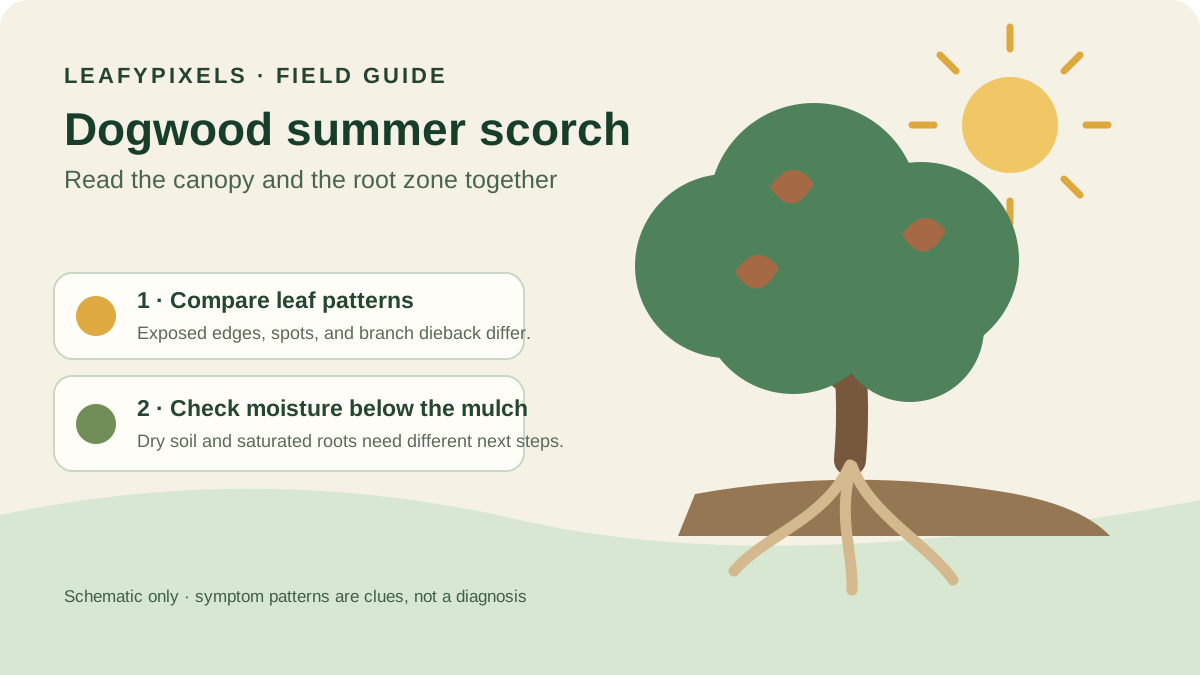
A Georgia dogwood can look suddenly exhausted in the middle of summer: leaves droop, edges turn brown, or foliage colors and falls earlier than expected. For a broader tree-level comparison of browning patterns, see our guide to brown leaves on trees. Those signs deserve attention, but they do not identify the cause by themselves. Hot weather can raise water demand while dry soil, turf competition, a recently disturbed root system, or a disease limits the tree’s ability to keep up. A tree in wet, poorly drained soil can wilt too, because damaged roots cannot supply water normally.
This guide is a source-based synthesis of published Extension and plant-health guidance, not an author-run Georgia field trial or a report on a particular tree. It can help you choose what to inspect next, but it cannot diagnose a tree.
Start by confirming the dogwood species, then compare the leaf pattern with the soil and the rest of the canopy. This is more useful than watering every time a leaf droops or applying a fungicide because a few leaves have spots. Positive Bloom also addresses Georgia dogwood summer heat; the diagnosis and care guidance below relies on the cited Extension, plant-health, and botanical references.
Quick triage before you water
- Brown margins on the exposed side, with dry soil several inches down? Check more than one spot beneath the canopy and, for a new tree, the original root ball. If the root zone is dry, water slowly across it and check again after the water has soaked in.
- Soil is wet or remains saturated? Pause supplemental watering. Note how long it stays wet and whether the tree was recently planted or the site was disturbed; persistent wilt in wet soil points to a root or drainage problem that needs assessment.
- Distinct spots, powder, trunk lesions, lower-canopy dieback, or dawn wilt? Photograph the whole tree, trunk base, and affected leaves; note when the symptoms began and recent rain, irrigation, digging, or chemical use. Ask your local UGA Cooperative Extension county office what regional plant-health diagnosis options are available.
These are next-check decisions, not a diagnosis from a photograph.
Original LeafyPixels schematic; compare canopy pattern and root-zone moisture, but do not treat the diagram as a diagnosis.
Confirm Which Dogwood You Have
“Dogwood” can describe several trees and shrubs with different tolerances and growth habits. The native flowering dogwood, Cornus florida, is a small woodland-edge tree familiar across much of the Southeast. It commonly grows under taller trees, where it receives filtered light and has a cool, organic root zone. North Carolina State Extension notes that established C. florida tolerates heat within its native range, so a hot day alone does not prove that a healthy, established tree is failing. Heat becomes a more useful clue when it coincides with dry root-zone soil, intense afternoon sun, turf competition, or a recent transplant.
Check a plant label, purchase record, or the leaf and branching pattern before applying advice for another species. Our dogwood species comparison can help distinguish flowering dogwood from Kousa, Pagoda, and shrub forms. If the label says Kousa, Pagoda, red-twig, or silky dogwood, record that name.
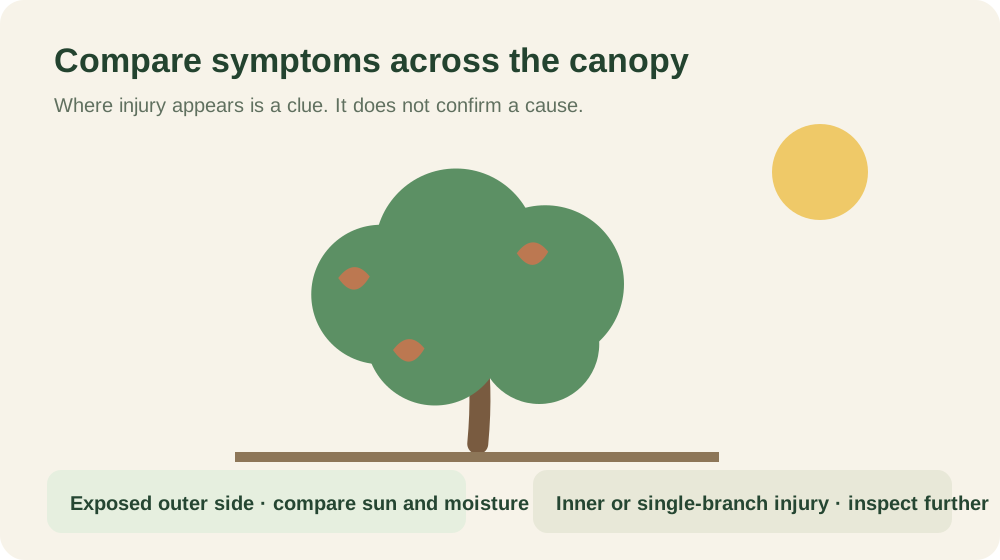
Original LeafyPixels schematic; symptom location is a clue to investigate, not a confirmed cause.
Cultivars can also differ in disease resistance. For identification and the growth conditions associated with flowering dogwood, see the NC State Extension plant profile for Cornus florida.
Flowering, Kousa, Pagoda, and Shrub Dogwoods React Differently
Flowering dogwood and Kousa dogwood are different species; they are not interchangeable labels for the same tree. Kousa and some hybrids are more resistant to dogwood anthracnose than many flowering dogwoods, but that does not mean they never suffer from drought, root damage, or leaf scorch. Pagoda dogwood (Cornus alternifolia) has a layered branching habit and is also a separate species. The Spruce’s Pagoda dogwood profile discusses its own site and care needs, which should not automatically be transferred to C. florida.
Shrubby dogwoods such as silky dogwood have different mature forms and are often used in wetter or naturalized settings; see our silky dogwood growing guide for that shrub’s care context. A diagnostic page written for a tree may not describe their normal shape or site conditions. When the species is uncertain, photograph the whole plant, leaves, trunk base, and any flowers or fruit, then ask a county Extension office or nursery to confirm the identification. Species identification helps narrow the possibilities; it does not replace checking roots and symptoms.
Read the Pattern Before Changing Care
Look at several leaves from different parts of the canopy rather than judging the tree by its worst leaf. Note whether browning starts at the tip or outer edge, whether it appears as separate spots, and whether it affects only the sunny side or branches throughout the tree. Also record the date, recent rainfall, irrigation, and any construction or planting work near the roots. A simple photo from the same angle every few days makes changes easier to judge.
The shape and distribution of injury often help separate an environmental stress from a spreading disease. They are clues, not a diagnosis: leaf scorch can coexist with a disease, and a dogwood with damaged roots may show several kinds of decline at once. Avoid pruning living branches or applying chemicals until you know which pattern you are seeing.
Brown Margins and Rolled Leaves
Heat and water stress commonly cause leaf tips or margins to turn brown and dry. The damaged area may form a fairly continuous band around the outside of a leaf, while the interior stays green at first. Leaves may curl or roll as water loss rises. University of Georgia Extension describes wilting followed by a brown edge band as a drought-scorch pattern on Georgia dogwoods. Washington State University’s Hortsense guide to dogwood scorch also describes leaf scorch and leaf roll as symptoms that can result from drought, heat, root injury, overwatering, excess fertilizer, or herbicide exposure.
A crisp brown edge does not tell you which one of those causes is present. Our leaf-scorch diagnosis guide walks through similar lookalikes across plants. Look for a matching exposure: a dry root zone, hot pavement or reflected afternoon sun, recent digging, concentrated fertilizer, or drift from lawn treatment. Brown tissue will not turn green again. The practical goal is to stop additional injury while watching whether healthy leaves and buds remain.
Wilt That Recovers Overnight Versus Persistent Wilt
A short-lived droop during the hottest part of the afternoon can reflect temporary water demand, particularly when leaves firm up by morning and the root zone is moist. Persistent limp leaves at dawn, especially with dry soil several inches down, point more strongly toward inadequate water reaching the roots. A recently planted dogwood can wilt even when the surface looks damp if its original root ball is dry or if damaged roots have not yet grown into surrounding soil. The same soil-first approach appears in our general heat-stress rescue guide.
Do not use a single midday check as a watering trigger. Compare the tree in the early morning and late afternoon for several days, and check soil at more than one spot beneath the canopy. A tree that remains wilted in consistently wet ground raises a different concern: saturated soil, root decay, or injury may be impairing uptake. More water in that situation can deepen the problem.
Early Leaf Drop and Canopy Dieback
Some early leaf drop can follow a dry spell or severe scorch, but widespread or repeated loss needs a closer look. Note whether the leaves drop evenly, whether whole branch tips die, and whether symptoms begin in the lower canopy or on one side. Sparse foliage with dead twigs, cankers, or shoots growing unusually along the trunk is more concerning than a few scorched leaves on the sunniest side.
Dogwood anthracnose and other diseases can cause leaf, twig, and branch symptoms that progress over time. Root and trunk disorders can also affect one portion of the canopy first. If branches are dying from the inside or lower canopy upward, photograph the pattern and inspect the trunk base without cutting into it. A single summer leaf drop event may be recoverable, but progressive dieback should not be written off as ordinary heat.
Separate Heat and Drought From Wet Roots
The key question is not simply “Is the weather hot?” It is whether the fine roots can take up enough water and oxygen to support the canopy. Heat and wind can speed water loss from leaves, while dry soil, shallow roots, compaction, turf, or a small transplant root ball restrict supply. Conversely, waterlogged soil can deprive roots of oxygen and damage them. Both situations can leave foliage limp or yellowing, so watering without checking the soil can make the diagnosis worse.
Think about site history as well as the forecast. Our garden drought guide explains how dry spells affect several parts of a landscape. Was the dogwood planted recently, moved, or surrounded by new pavement? Has irrigation been redirected? Was sod, soil, or a landscape fabric layer added? Did a trench or utility repair cut roots? Those events can cause a water-uptake problem that becomes visible during a heat wave even though the work happened weeks earlier. NC State Extension’s recent summer-stress guidance for dogwoods highlights the combined effects of hot root zones, competition, poor planting depth, and prolonged dry weather.
Check Moisture at Root Depth
Check moisture in two or three places from the outer half of the canopy toward the drip line, avoiding the trunk itself. Use a hand trowel or soil probe to look several inches below the surface. Soil that is dusty and dry at depth calls for a slow soak; soil that feels saturated, smells sour, or stays wet for days calls for a drainage and root-health assessment instead. Clay may feel sticky when wet and form a firm lump; sandy soil may drain quickly and look dry sooner. Compare the tree’s actual soil rather than relying on a timer or a fixed weekly rule.
For a newly planted tree, test both the nursery root ball and the surrounding soil. They can differ: water may run around a dry root ball, or a compacted planting hole may hold water while the root ball stays dry. If the two zones feel very different, adjust placement and flow so water reaches both. Keep a note of the soil condition before and after irrigation; that record helps avoid repeated shallow watering or prolonged saturation.
Tell Scorch From Dogwood Disease
Scorch usually follows a pattern of tip or marginal browning, leaf rolling, and exposure to heat or moisture stress. Disease more often produces discrete lesions, visible fungal growth, cankers, or progressive twig and branch decline. These patterns overlap, so inspect both leaf surfaces and several branch levels. Do not diagnose a disease solely because a leaf has a brown patch; drought injury, leaf spots, herbicide exposure, and physical damage can look similar in a photograph.
Flowering dogwoods can have spot anthracnose, dogwood anthracnose, powdery mildew, leaf spots, cankers, and root problems. A laboratory diagnosis may be needed when symptoms progress or when a treatment decision depends on identifying a pathogen. Penn State Extension’s dogwood disease reference compares symptoms such as discrete spots, blighted bracts, twig dieback, and cankers. The Missouri Botanical Garden’s flowering dogwood problem guide is another useful visual comparison.
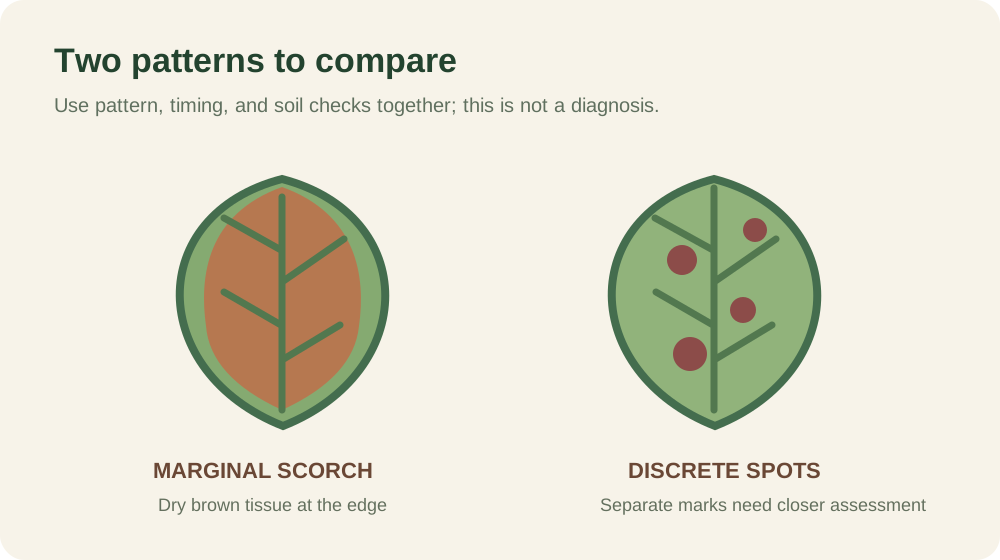
Original LeafyPixels schematic; symptom patterns alone cannot confirm a pathogen or diagnose a tree.
Spot Anthracnose and Dogwood Anthracnose Are Different
The shared word “anthracnose” can cause confusion. Spot anthracnose often appears as small reddish-purple spots on leaves or flower bracts; spots may be concentrated along veins and are commonly associated with wet spring weather. It is often mainly cosmetic. Dogwood anthracnose is a more serious disease that can progress from leaf blight to twig and branch dieback. Penn State lists branch-tip blight, dead lower branches, and water sprouts among signs of advanced anthracnose and decline; the Missouri Botanical Garden also describes dieback beginning in the lower canopy.
Look for the whole pattern: many small, distinct spots are different from broad marginal scorch, while repeated leaf and twig blight with lower-canopy dieback deserves prompt assessment. Gardeners’ Path explains the distinction between spot anthracnose and other dogwood leaf-drop causes, but photographs alone are not enough to confirm the pathogen. Do not apply a fungicide based only on the word anthracnose or on a few leaf spots. Timing, product label, tree size, and actual diagnosis matter, so ask Extension or a qualified arborist before treatment.
Powdery Mildew, Cankers, Borers, and Other Clues
A white, powdery coating on leaves or shoots suggests powdery mildew rather than ordinary heat scorch. Small gray or brown lesions with colored borders may indicate a leaf spot, especially if they appear repeatedly and are not limited to the hottest side. A sunken or cracked area on the trunk or a branch, dead bark, or a line of dead twigs is not explained by simple drought scorch. Dogwood borer injury is more likely to involve trunk or branch wounds and decline around damaged bark than a uniform brown leaf edge.
Crown canker and root disorders can cause undersized, pale leaves and progressive branch loss, sometimes with more stress during dry weather. The Missouri Botanical Garden notes that crown canker can be hard to notice at first because the underlying trunk injury may be hidden. Do not scrape bark, drill, inject, or cut into a suspected canker to “check” it. Record the location, photograph the bark and canopy, and get an expert opinion if the tree is losing branches or has a visible trunk lesion.
Use Timing and Canopy Position as Evidence
When symptoms began is as useful as what they look like. Browning that appears during a long hot, rainless stretch and is concentrated on the south or west side fits exposure stress more than a disease that spreads steadily through the canopy. Damage after a recent fertilizer application, herbicide treatment, pruning, construction, or irrigation change points toward those events. Symptoms beginning in spring or after a prolonged wet period call for a different disease and root-zone review.
Map where injury appears. If the sunny outer canopy has brown tips but shaded leaves remain healthy, investigate sun, wind, reflected heat, and moisture before looking for a pathogen. If one limb dies while neighboring leaves are green, inspect that branch’s union and trunk for injury. If several branches in the lower canopy decline over time, disease or trunk/root problems deserve attention. The Pacific Northwest Plant Disease Management Handbook’s dogwood leaf scorch notes emphasize that scorch can have environmental causes; that context is useful, but a Georgia diagnosis should also account for local conditions and species.
Recover a Heat-Stressed Georgia Dogwood Safely
A recovery plan should reduce the stress you can verify, while protecting roots that may already be vulnerable. If the soil is dry at root depth, water it slowly and broadly. If soil is wet, pause irrigation and investigate drainage rather than adding more. If the tree is in lawn, reduce grass competition without digging close to the trunk or severing roots. Change one or two factors at a time and keep notes, so you can tell whether conditions are improving.
Georgia’s hot summer conditions can coincide with drought, afternoon sun, and high competition from turf. UGA Extension has long emphasized that dogwoods can show drought symptoms early and that a thorough, low-flow watering is more useful than a quick spray over the leaves. Its Georgia guidance on summer dogwood watering describes watering at ground level from near the base outward toward the canopy edge. Adapt that principle to your soil, tree size, rainfall, and drainage rather than treating any single schedule as universal.
Water Slowly Across the Root Zone
When soil is dry, apply water near the ground in a slow, even pattern across the root area, including the outer canopy zone where feeder roots are common. A soaker hose or low-flow emitter can reduce runoff on sloped or compacted ground. Water long enough for moisture to move below the surface, then check the soil again rather than repeating a short daily sprinkle. Early morning is a practical time because water can soak in before the hottest part of the day and leaves are less likely to stay wet overnight.
Avoid aiming a strong stream at the trunk or keeping the soil continuously saturated. Mature trees have roots extending beyond the visible canopy, but do not trench or dig around a stressed tree to “find” them. For a young tree, verify that water reaches both the root ball and nearby soil. If rainfall has been substantial, check soil first; irrigation should respond to the root zone, not merely to air temperature.
Cool and Protect the Root Zone
Keep lawn grass and weeds from competing directly with the tree, using hand work or shallow surface removal well away from the trunk. A broad mulch ring can help shade soil and reduce moisture loss. NC State Extension’s dogwood summer-stress guidance recommends a moderate mulch layer with space around the trunk; keep mulch several inches away from bark and do not pile it into a cone. A deep mulch mound can hold excess moisture against the trunk and conceal the root flare. Organic mulch is generally a better fit for a woodland-edge tree than stone, which can absorb heat in sun, as UGA notes in its Georgia dogwood guidance.
If the dogwood sits in full afternoon sun and is young or newly transplanted, consider whether its site is appropriate. Do not attempt to transplant a mature, stressed dogwood during summer. For a young or newly transplanted dogwood in full afternoon sun, ask local Extension whether temporary shade is suitable; this guide does not present a shade screen as an established or tested dogwood treatment. Prioritize correcting soil moisture and root competition; shade alone will not fix a wet planting hole or root injury.
Avoid Actions That Add Stress
Do not fertilize a scorched tree to force new leaves. Fertilizer salts can further stress roots, and extra growth is not a substitute for resolving the cause. Avoid severe summer pruning, unnecessary branch removal, herbicide use near the root zone, and repeated pesticide applications without a diagnosis. Scorched leaves are already damaged; removing them will not restore their function and can remove living foliage the tree still needs.
Also avoid frequent, shallow watering that keeps only the surface damp. It may encourage shallow roots and can leave the deeper root zone dry. Conversely, a wet site should not be placed on an automatic daily irrigation cycle. If you see signs consistent with leaf scorch but the soil is moist, review drainage, compaction, planting depth, recent chemical exposure, root injury, and disease before changing the watering schedule.
What to Expect After the Heat Breaks
Brown leaf tissue stays brown. Improvement means fewer new leaves are affected, remaining foliage holds better, and buds or next season’s growth appear healthy. A dogwood may retain damaged leaves or drop some of them after severe stress. That does not automatically mean the whole tree is dying. Continue checking soil and canopy over weeks rather than expecting a visible reversal in a day or two.
A tree can take time to recover if it lost fine roots or entered summer already stressed. Keep irrigation consistent with measured soil moisture, maintain a clear mulch ring, and avoid making multiple major changes at once. If browning continues after temperatures moderate and soil moisture is suitable, or if new twig dieback appears, reassess for disease, root problems, trunk injury, or chemical exposure. Use photographs and notes to compare progress; new symptoms are more informative than old brown edges.
When to Call an Arborist or Extension Office
Get help when the canopy is losing whole branches, decline is spreading from the lower crown, the trunk has a canker or wound, or the tree remains wilted in wet soil. Seek prompt advice if the dogwood is near a walkway, driveway, or structure and dead limbs could fall. A qualified arborist can assess tree structure and root-zone conditions; the ISA arborist directory helps readers locate or verify professionals with ISA credentials. ISA notes that directory listings are voluntary, so an absent name does not establish that a person lacks a credential. A county Extension office can help interpret plant-health symptoms and direct you to diagnostic services.
Bring clear photos of the full tree, the trunk base and root flare, representative leaves from both healthy and affected areas, and any spots, powder, cankers, or insect holes. Include the species or cultivar if known, when symptoms began, recent rainfall and irrigation, and any nearby digging or chemical applications. This gives an expert enough context to separate a weather-related problem from a disease or injury. Avoid collecting samples or pruning branches until the diagnostic service tells you what it needs.
For regional help, use UGA’s county office directory to contact your local Extension office and ask what plant-health consultation or sample-submission options are available. Disease references can help distinguish symptom patterns, but they do not establish anthracnose risk for every Georgia site; ask for local guidance before treating a suspected disease.
How this guide was prepared. This is a source-based synthesis of published guidance, not an author-run Georgia field trial, measurement series, or follow-up of a specific tree. UGA Extension’s Georgia dogwood watering guidance informs the regional watering context; NC State’s dogwood summer-stress guide informs the root-zone and mulch checks; Washington State University’s scorch guide and Penn State Extension and Missouri Botanical Garden disease references inform the symptom comparisons. The triage is a next-check framework, not a diagnostic test. All three images are original LeafyPixels vector illustrations created for this guide on 2026-10-20. They explain symptom comparisons and next checks; they are not photographs, a specific Georgia tree, or field records. The page metadata names the LeafyPixels Review Board, but this guide does not identify which member reviewed it or document a dogwood-specialist sign-off; the Editorial Review Board page describes the site’s general roster and process. For an individual Georgia tree, contact your local Extension office through the county directory above or consult a qualified arborist.
Conclusion: Treat the Cause and Watch New Growth
On a Georgia dogwood, brown edges and drooping leaves can result from heat and drought, but the same tree can wilt when roots are damaged or soil stays saturated. Confirm the species, note where and when symptoms started, and check moisture below the surface before watering. Marginal scorch on an exposed side supports an environmental explanation; distinct spots, powdery growth, cankers, lower-canopy dieback, or continuing branch loss call for closer disease and injury assessment.
If the root zone is dry, water slowly across it, reduce turf competition, and keep a moderate mulch ring away from the trunk. If the soil is wet, pause irrigation and investigate drainage or root health. Leave damaged leaves in place, avoid fertilizer and unnecessary pruning during stress, and watch whether new injury stops. When the pattern progresses or the trunk and branches are involved, ask a local Extension office or qualified arborist to inspect the tree.