DIY Yard Drain Maintenance: Clear Clogs and Prevent Them
Yard drain maintenance starts with a safe cleanout: clear leaves, empty an accessible catch basin, test its outlet, and spot clogs that need a professional.
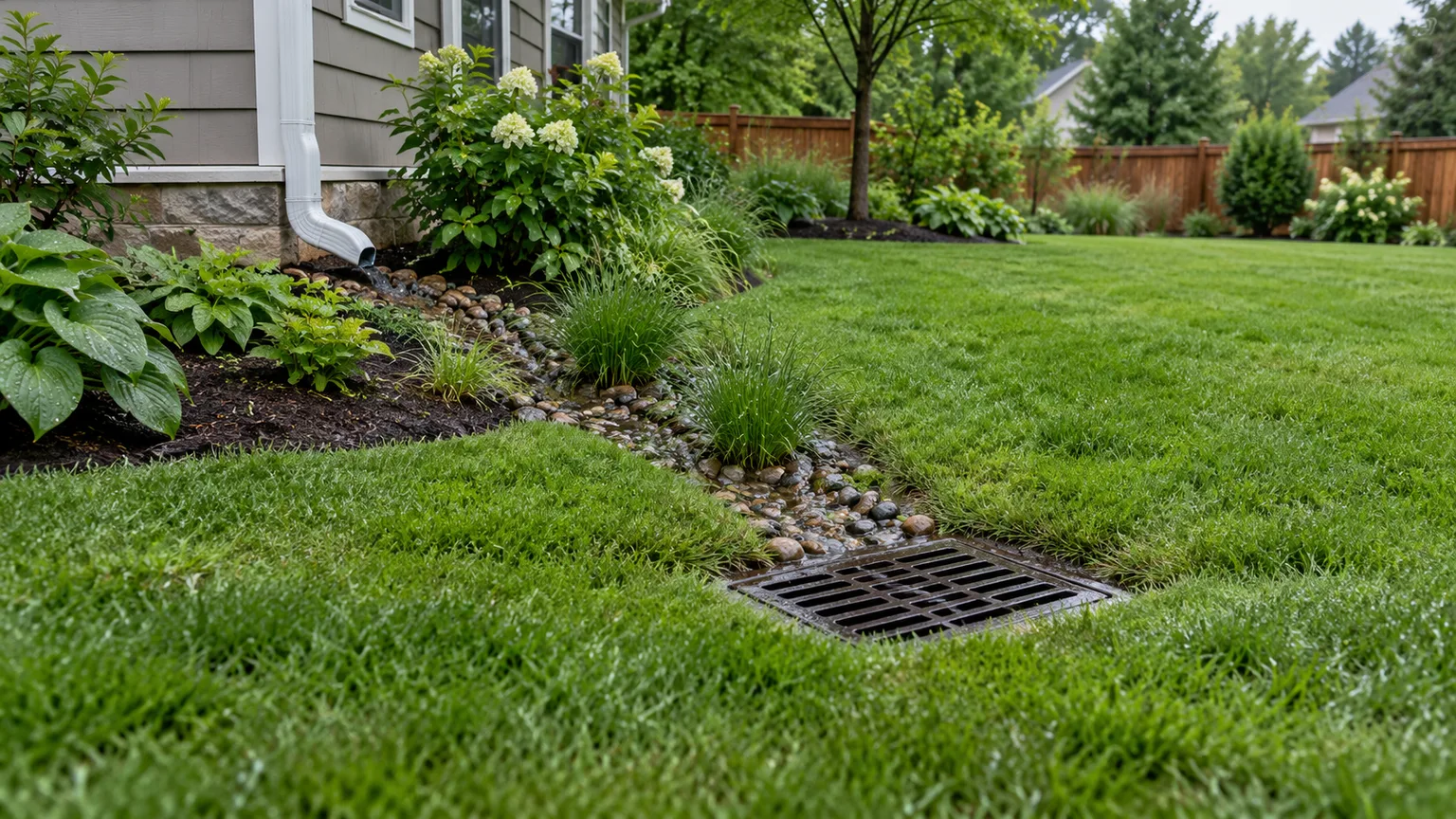
A yard drain is easiest to maintain when you know what you are looking at. Clearing leaves from a surface grate and scooping loose sediment from an accessible catch basin are reasonable homeowner jobs; forcing a cable through an unknown buried line, opening a public inlet, or entering a drainage structure are different jobs with different risks.
The useful routine is simple: identify the system, clean what you can reach without entering it, confirm where the water is supposed to go, then test gently and observe. If the grate is clear but water still stands, pause before escalating. The failure may be at the outlet, in a buried pipe, in a dry well, or in the slope and soil around the drain—not in the part you can see.
Start With the Symptom, Not a Tool
Before lifting a cover, note what happens during and after rain. Is water pooling directly over one grate, running past it, backing out of it, or collecting in a long strip of lawn? Does the problem happen after every shower or only during a storm that overwhelms gutters, hardscape, and the yard at once? A quick photograph and a note about the rainfall can reveal whether performance is changing over time.
Also look for water close to the foundation, basement seepage, soil washing away, a sunken line across the lawn, or a discharge point that stays wet between storms. Those clues matter more than whether a drain looks dirty. A clear grate cannot fix a low spot that slopes toward the house, and a powerful hose cannot repair a crushed pipe or make dense soil absorb water faster. If water is threatening the home or creating a hazard, address that first and arrange a drainage assessment instead of waiting for a routine cleaning day.
Identify the Drain Before Opening It
“Yard drain” can describe several systems. A catch basin or area drain has a surface grate over a box; leaves and grit fall into a sump below the outlet while water leaves through a pipe. A channel or trench drain collects runoff along a narrow grate, often beside a patio or driveway. A French drain usually has buried perforated pipe and gravel that collect subsurface water; it may have a cleanout, but it often has no surface grate to open.
The downstream destination matters just as much. A private line might daylight at a slope, discharge through a pop-up emitter, feed a dry well or rain garden, or connect to a permitted stormwater system. Some property drains are shared, maintained by an association, or owned by the municipality. Check a property plan, installation paperwork, visible cleanouts, or ask the prior owner or local public works department before assuming that a grate near a street belongs to you.
Clues That Reveal the System
A square grate set at a low point, with a removable box below it, usually indicates a catch basin. A long narrow grate suggests a channel drain. A round pop-up cap near the edge of the property is often an outlet rather than an inlet, while a short standpipe may be an inspection point for a dry well or underground line. A downspout that disappears into the ground can feed any of these systems, so the pipe shape at the surface alone does not confirm its destination.
If the route is unclear, do not pour dye, cleaners, or a large volume of water into it to “see where it goes.” Instead, observe it during natural rain and look for a visible outlet. You can also use existing plans or have a drainage contractor trace the line. Knowing the destination is especially important before flushing: stormwater may reach a stream without treatment, and water routed into a sanitary sewer can be subject to local rules. The U.S. EPA explains that roadside storm drains can carry household and yard pollutants directly to local waters.
When to Inspect and Clean
Inspect the grate and visible outlet at least twice a year if the yard has deciduous trees, nearby planting beds, or a roof downspout feeding the system. A spring check catches winter grit and seed pods; a late-summer or autumn check before the wettest season catches leaves and fresh mulch. In a yard with little tree cover and a clean, visible outlet, the basin may need only an annual cleanout. Let actual debris and performance set the interval rather than treating one calendar schedule as universal.
Check again after a major windstorm, nearby construction, landscaping, gutter cleaning, or a season when soil and mulch have washed toward the inlet. Keep the grate clear whenever debris starts covering its openings. If you can safely see the sump, note how quickly sediment returns and whether it is approaching the outlet pipe. Portland’s catch-basin guidance uses sediment at one-third of the depth to the lowest pipe opening as a cleaning trigger for its systems; this is a useful warning sign, not a universal design specification for every residential basin. City of Portland catch-basin guidance also calls out slow drainage and ponding at the grate as reasons to inspect.
Tools and Safety Boundaries
For a small, accessible residential basin, gather work gloves, eye protection, a hand scoop or small plastic trowel, a bucket, a flashlight, and a garden hose with a controllable nozzle. A screwdriver may loosen a cover screw if it is intended to be removed that way. A shop vacuum can help with dry leaves in a basin, but do not use electrical equipment around standing water unless it is specifically rated and the setup can be used safely; a bucket and scoop are often simpler.
Work in daylight and when the area is not actively flooding. Grates can be heavier than they look, have sharp edges, or be secured to prevent accidental access. Do not pry against a brittle plastic rim, lift a heavy cover alone, or leave an open basin unattended. Never climb or lower yourself into a catch basin or drainage vault; these are not designed for homeowner entry. Portland’s safety guidance explicitly warns against entering catch basins and leaving them open. If the cover is damaged, stuck, unusually heavy, or part of a public/shared system, stop and contact the responsible owner or a qualified contractor.
If maintenance turns into excavation, first request utility marking through 811 in the United States or the local equivalent where you live. Lines can be shallow, and a hand shovel can still damage them. The Common Ground Alliance says to contact 811 before every digging project, even a small one. Do not assume that the drain pipe is the only buried service in the area.
Clean an Accessible Catch Basin
The aim is to remove loose material the basin was designed to trap, not to dismantle the line. Keep debris out of the outlet, do not push a tool farther into the pipe than you can see, and stop if you find an unfamiliar insert, a pump, electrical wiring, a foul or chemical odor, or standing water you cannot account for. If the basin is a treatment device or has a filter cartridge, follow its manufacturer and local maintenance instructions rather than improvising.
Clear the Grate and Inlet
Brush or lift leaves, grass clippings, seed pods, and visible trash from the grate before opening it. Pull back soil, mulch, or groundcover that has crept over the frame, but do not lower the surrounding grade or alter a drainage swale just to expose the grate. A grate buried under landscape fabric, turf, or fresh mulch can be easy to miss and will keep clogging until the surface is corrected carefully.
Remove screws only if the cover is designed to be opened, then lift it with a stable grip. Set it flat where nobody can trip on it. Scoop loose debris from the top of the basin before using water; rinsing leaves and grit into the pipe simply moves the blockage farther downstream. If the grate is cracked or rocks underfoot, replace it with a compatible cover that sits securely and does not create a trip hazard. Do not leave the basin uncovered while you fetch tools or dispose of debris.
Remove Loose Debris From the Sump
Use a hand scoop or bucket to remove leaves, small sticks, mulch, and loose sediment from the visible bottom of a catch basin. A sump is supposed to collect some grit below the outlet, so finding sediment does not automatically mean the pipe is blocked. The key is whether accumulated material is filling the basin toward the pipe opening or being carried out into the line. Remove only what is safely reachable from above; never put your head, shoulders, or body into the box to reach the last inch.
Place wet debris in a bucket or bag so it cannot wash back into the grate, street, or a neighboring property. Portland advises that catch-basin solids be handled and disposed of properly, and its local directions may not match yours. For a typical private yard, follow your municipal waste guidance for ordinary leaves and soil. If sediment has an oily sheen, chemical smell, paint residue, or may have come from a spill or work area, do not compost or dump it; ask local environmental services how to handle it. Keep wash water and dirty sediment out of street inlets. Stormwater can carry lawn chemicals, animal waste, soil, and plant debris into waterways, as EPA notes. (City of Portland; U.S. EPA)
Check the Visible Outlet
Use a flashlight to inspect the visible pipe openings and any accessible outlet baffle or tee. Do not reach blindly into an opening, pull on a loose fitting, remove a baffle that appears to be part of the basin’s design, or stuff a rag into the pipe. A short, visible obstruction that can be lifted out from above may be removed carefully, but roots, a collapsed fitting, or a plug beyond sight is not an ordinary grate-cleaning task.
If you know the discharge point and can see it safely, check that it is free of leaves, turf, and trash. A pop-up emitter should not be buried under sod, and a daylight outlet should not be blocked by mud or plant growth. Do not clear a street-side inlet or a drain on public land without checking who maintains it. Take a photo of any broken elbow, separated pipe, cracked basin, or missing cover and contact the owner, property manager, city, or drainage professional responsible for the system.
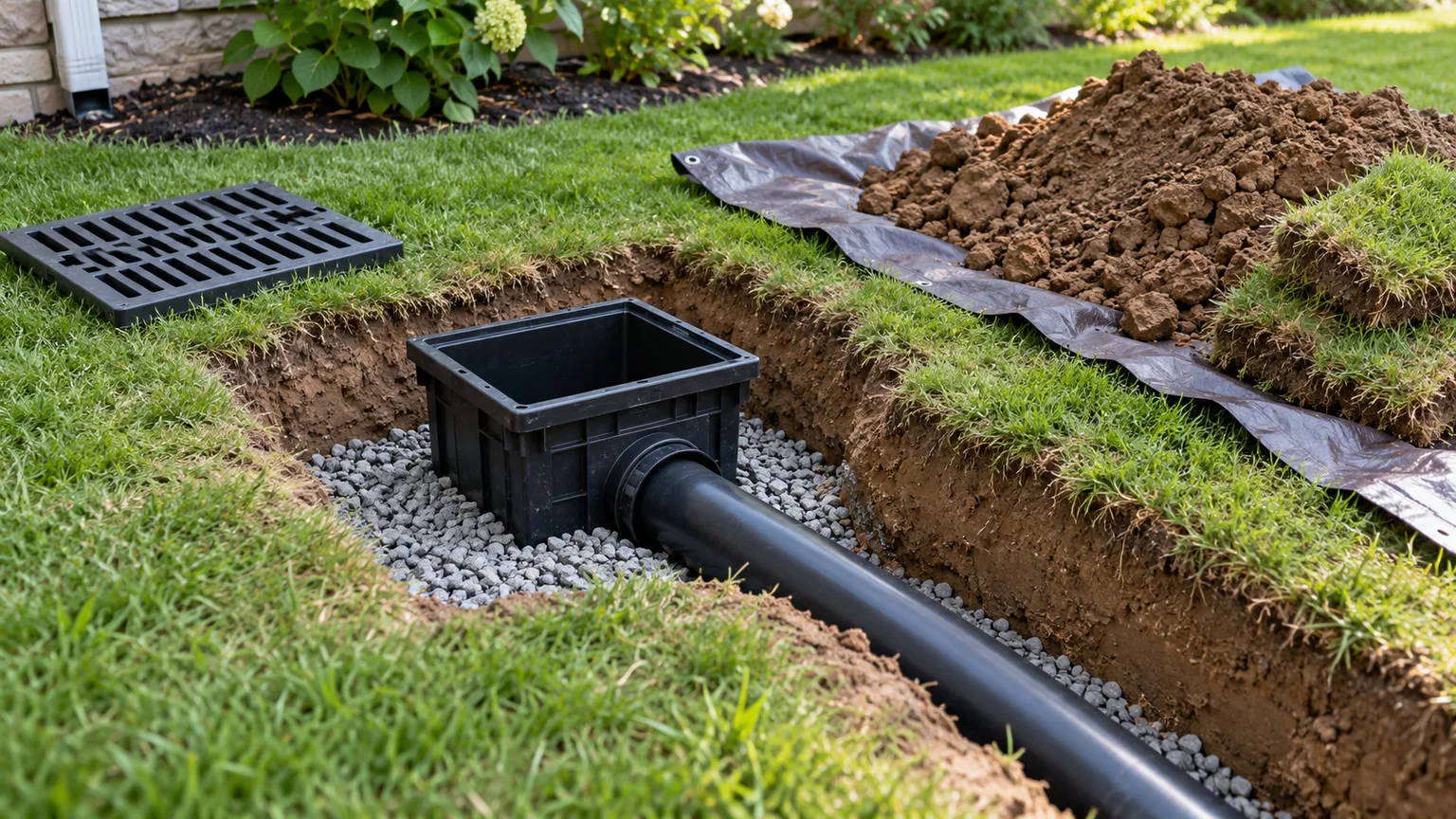
Test the Drain Gently
Once loose debris is out and the cover is still off, you can use a modest stream from a garden hose to check a known private catch basin. Keep the flow low enough that water does not rise in the box, and have another person watch the known outlet if it is not visible from the basin. The useful observation is whether water arrives and leaves freely, not how much pressure you can create. Stop immediately if the basin level rises, water appears at another grate, soil begins bubbling, or the outlet does not take the test flow.
Do not test a drain by flooding the yard or running a hose unattended. A system might connect to a dry well with limited capacity, an infiltration feature that is already saturated, or a permitted stormwater network with specific rules. NDS recommends inspecting catch basins and outlets and notes that debris can settle in the basin sump; its product-specific guidance should not be taken as permission to snake every line or flush an unknown drain. NDS landscape drainage tips include checking both the inlet and the discharge components rather than relying on the grate alone.
If the system passes a small test, replace and secure the cover, then observe it in the next natural rain. Do not leave the basin open while testing or try repeated high-volume flushes to make a slow line “catch up.” A gentle test identifies obvious flow problems; it does not certify the pipe’s condition or capacity.
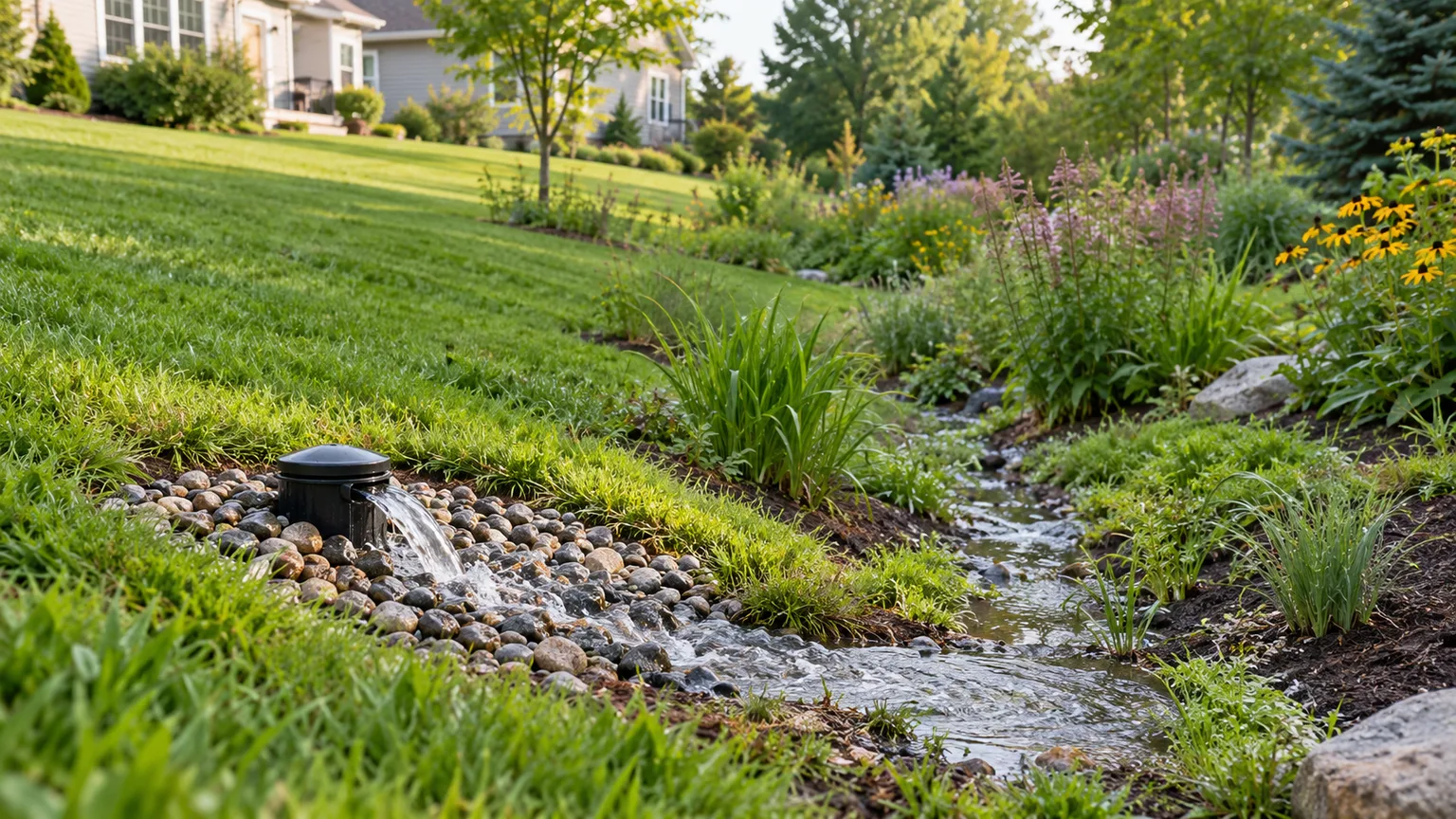
Read the Symptoms Before Escalating
A slow yard drain has several possible causes. Use the location of the standing water and the result of your simple inspection to narrow the problem, but do not force a tool through the line just to confirm a guess.
A catch basin can retain some water in the bottom of its sump below the outlet; designs differ, so do not assume every basin should be completely dry. The more useful warning is a water level that has risen toward the grate, stays unusually high compared with its normal condition, or backs up during a modest test. If you do not know the basin design, observe it in normal weather and ask the installer or property manager before deciding that standing water alone proves a clog.
| What you see | What it may mean | Sensible next step |
|---|---|---|
| Water sits over a leaf-covered grate | The inlet is blocked at the surface | Clear the grate and watch the next rain |
| Grate is clear, but the basin is packed with leaves or silt | The sump needs cleaning; material may be reaching the outlet | Scoop accessible debris, then inspect the visible outlet |
| Basin is clean, but water stays high or rises during a small test | Downstream restriction, full receiving feature, or an outlet problem | Stop flushing; have the route and outlet checked |
| Outlet flows, but a different patch of lawn stays soggy | Grading, soil infiltration, or subsurface drainage may be the issue | Observe the wet area and seek drainage-design advice |
| A soft or sunken strip follows the buried line | Possible leak, separated pipe, or trench settlement | Keep people away from the soft spot and arrange an assessment |
| Water backs toward the house or enters a basement | A foundation or capacity issue may be developing | Prioritize the home and call a qualified drainage professional promptly |
A one-time puddle during an unusually intense storm is different from ponding that persists or appears after ordinary rain. Virginia Cooperative Extension explains that stormwater flow depends on the amount of hard surface, soil, and how water is directed; soil and plants may infiltrate and filter some runoff, but no single drain solves every site. Virginia Cooperative Extension and the Northern Virginia Soil and Water Conservation District both emphasize that rain gardens and dry wells depend on appropriate location and soil conditions. That context helps separate a clogged inlet from a design or infiltration problem.
Prevent the Next Clog
The most effective prevention happens before debris reaches the grate. Keep gutters and downspout screens clear when they feed a buried drain, sweep patios and driveways before washing them, and rake leaves away from low points before a storm. Avoid piling mulch, compost, potting mix, or loose soil upslope of an inlet; a small erosion scar can deliver a surprising amount of sediment into a basin. Stabilize bare soil after garden work and keep lawn clippings out of the flow path.
Do not cover the drain with landscape fabric, gravel, a decorative pot, or a fine screen that is hard to remove and may clog more quickly than the original grate. If a removable leaf basket or filter was designed for the system, inspect it often and clean it before it blocks water. A filter that is neglected can become a dam. NDS recommends checking the catch-basin sump and cleaning accumulated material periodically; its guidance suggests more frequent checks where runoff carries heavier debris. That is a sensible principle for a private system, though the exact interval depends on trees, roof granules, soil, basin design, and local storm patterns.
Where runoff repeatedly washes soil into the drain, the repair may be upstream: restore a stable lawn edge, adjust a downspout splash area, or correct erosion with an appropriate landscape solution. Do not redirect roof water toward a neighbor, sidewalk, road, or foundation to keep it out of your drain.
A Seasonal Yard-Drain Routine
Use a short inspection rather than waiting for a flood. In spring, remove seed pods and winter grit, check that the cover is secure after freeze-thaw movement, and look for erosion where water exits. Before the rainy or leaf-fall season, clear gutters that feed the line, remove leaves from the grate and visible discharge, and make sure a pop-up emitter is not buried by turf. During the wet season, check after heavy storms if the drain serves a low patio, basement stairwell, or foundation area.
A simple log helps you notice a change. Write down the date, approximate rainfall, whether water stood at the grate, how much sediment you removed, and whether the outlet flowed. If the sump fills again after a few weeks, the problem may be more than routine organic debris; soil is washing in, a filter is missing, a pipe is broken, or runoff is carrying more material than the basin can trap. Take a photo from the same angle each time so you can compare sediment level and surface settling.
If a home is new to you, learn the drain route before the first major storm. Find each grate, cleanout, emitter, dry well lid, and swale, and note which items are private, shared, or maintained by a public agency. Do not remove lids from unfamiliar underground structures. A marked property sketch and a few photographs can save time when a contractor or public works department needs to diagnose a problem.
Fixes That Can Make a Drain Problem Worse
Do not pour drain cleaner, bleach, vinegar, degreaser, or other household chemicals into a yard drain. These products do not remove roots or repair a failed line, and storm drains may carry runoff directly to a waterway. EPA warns that stormwater can collect pollutants from yards and pavement, so use the inlet for rainwater rather than disposing of wash water or chemicals. Keep fertilizer, pesticides, oil, paint, and pet waste out of the flow path.
Avoid pushing a power auger into a pipe unless you know its size, material, route, and condition and have the training to use the machine. A cable can catch in corrugated tubing, break a fitting, or worsen a damaged section; roots and a long-standing sediment blockage often need equipment and diagnosis beyond a homeowner’s reach. A rubber drain bladder or pressure washer can also send water backward, overwhelm a basin, or damage a connection. If gentle cleaning did not restore flow, more pressure is not a reliable next step.
Do not dig a trench or install a new outlet just to give water somewhere to go. Local rules may restrict connections to public storm systems and discharge across property boundaries. A dry well or rain garden needs a suitable site, separation from foundations and utilities, adequate infiltration, and an overflow route. Fairfax County’s runoff guidance notes that soil conditions and location can make these practices unsuitable, and local codes differ. In the United States, contact 811 before digging; elsewhere, use the utility-location service for your jurisdiction. ( 811 Before You Dig )
When to Call a Professional or Local Agency
Call a drainage contractor, licensed plumber with stormwater experience, or landscape drainage specialist when a clean inlet still will not drain, a hose test makes the basin rise, the pipe is inaccessible, roots are visible, a line has settled or collapsed, water returns at another grate, or the system discharges somewhere you cannot identify. Ask the professional to trace the route and explain whether the restriction is in the catch basin, a solid pipe, a French drain, a dry well, or the outlet. A camera inspection can be useful for an unknown line, but the right service depends on the pipe and failure, not every drain automatically needing a camera or jetting.
Contact the city, county, homeowners association, or property manager if the drain appears to be in a right-of-way, shared easement, subdivision swale, or public stormwater system. Do not remove a municipal grate or vacuum out a public catch basin as a do-it-yourself task. Public inlets can be heavy, deep, contaminated, or part of a system that requires special traffic and waste-handling controls. Portland recommends trained maintenance and cautions against entering these structures; its procedures are a useful reminder that visible storm drains are infrastructure, not simply outdoor plumbing.
Get prompt help if water is moving toward a foundation, flooding an entry, undermining paving, or creating a sinkhole-like depression. Photograph the area and note rainfall, but keep people and equipment away from unstable soil. If you smell sewage or suspect a cross-connection, stop adding water and contact the appropriate utility or licensed professional; a yard drain’s destination should never be guessed from appearance alone.
Conclusion
Good yard drain maintenance is mostly careful observation and modest cleanup. Keep leaves off the grate, remove loose debris from an accessible catch-basin sump, check a known outlet, and use only a gentle test that will not overwhelm the system. Record what you see so you can tell normal seasonal debris from a recurring failure.
The boundary is just as important as the routine: do not enter a basin, flush sediment into a storm drain, or reach blindly into a buried pipe. If the grate and basin are clear but water still backs up, or if runoff threatens the home, get the line and its destination diagnosed before adding pressure or digging.



