Distorted Leaves on African Milk Tree: Mite & Light Checks
Quick answer
Distorted leaves on African Milk Tree—twisted, stunted, or uneven ridge leaves—usually mean spider mites, aphids, or etiolation from low light—not nutrient deficiency. First step: inspect the newest ridge leaves at the top of each column with a magnifier before fertilizing.

Distorted Leaves on African Milk Tree: Causes, Checks & Fixes
This guide covers distorted leaves on African Milk Tree. See also the general Distorted Leaves guide, watering, and light pages for this plant.
Distorted Leaves on African Milk Tree: Causes, Checks & Fixes
Quick answer
Distorted leaves on Euphorbia trigona are small ridge leaves that twist, pucker, cup, or stay undersized compared with healthy teardrop-shaped siblings along the same stem. See our distorted leaves guide for general symptom mechanics. On African milk tree, the diagnosis starts at the top of each vertical branch—mites and aphids attack the newest ridge flush while the green column still looks fine from across the room.
First step: magnify the topmost ridge leaves on each stem for webbing, stippling, soft-bodied insects, or uneven sizing before reaching for fertilizer.
When to use this page vs other African Milk Tree guides
| Pattern | Read next |
|---|---|
| Inward cup on dry, light pot | Curling leaves |
| Long bare stem, tiny leaves everywhere | Leggy growth |
| Webbing or moving dots confirmed | Spider mites |
| Sticky tips with soft insects | Aphids |
| Washed-out color without twist | Pale leaves |
What distorted leaves look like on African Milk Tree
Unlike broad-leaf houseplants, Euphorbia trigona carries short obovate leaves in rows along three-sided ridges. Distortion shows up as a break in that pattern:
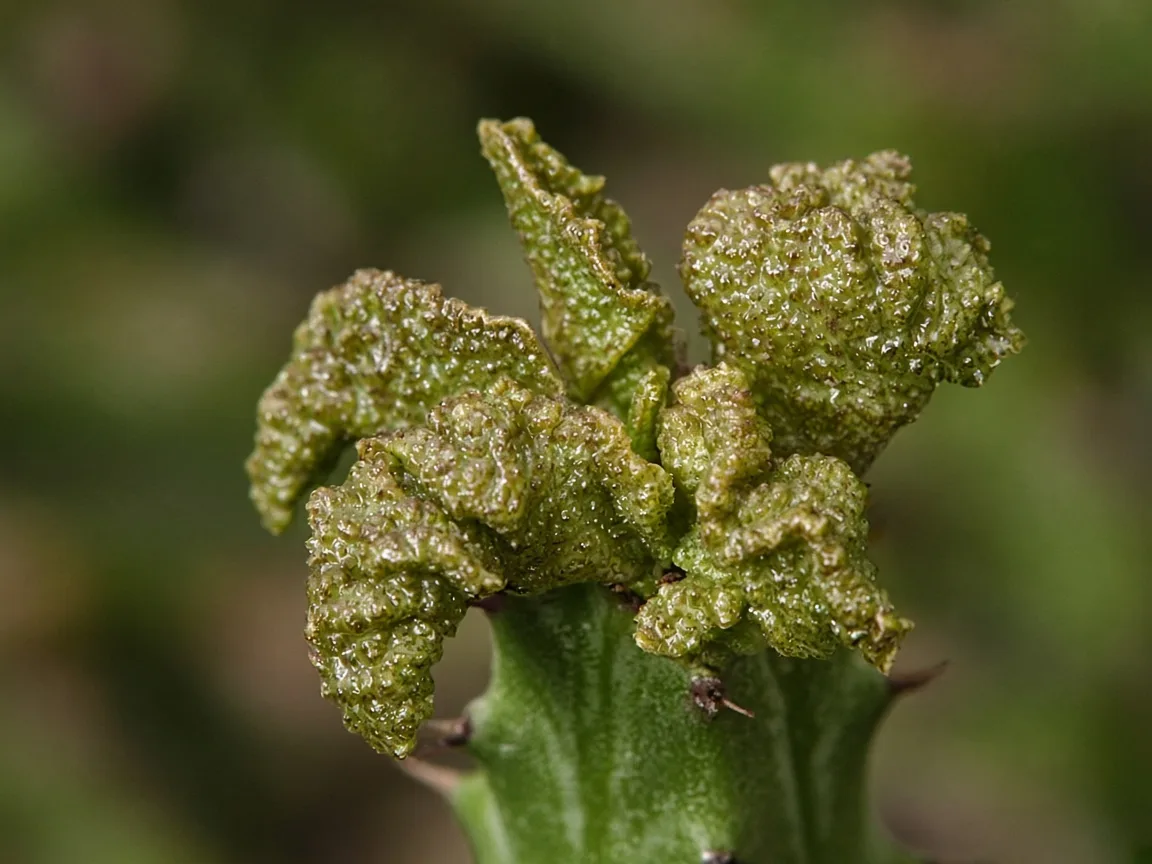
Twisted new ridge leaves at a branch tip—compare with flat teardrop-shaped siblings on lower ridges.
- Stippled, puckered, or crinkled new ridge leaves — Classic spider mite feeding on tender growth; often with fine webbing in leaf axils.
- Clusters of insects on soft branch tips — Aphid colonies distort the newest leaves while stems stay firm.
- Tiny twisted leaves along a stretched column — Etiolation from low light; internodes lengthen and ridge leaves stay small and uneven.
- One branch warped, others normal — Localized pest hotspot or mechanical damage at that tip—not a whole-plant nutrient issue.
- Odd regrowth after a ceiling bump — Tall columns hit overhead surfaces; latex weeps and the next ridge flush may emerge twisted.
Healthy milk tree leaves are teardrop-shaped with entire margins and are not long-lasting—they drop seasonally. A few old misshapen leaves low on a firm column are less urgent than twisted new flush at the growing point.
Ridge-tip inspection protocol
Euphorbia trigona branches like a candelabra. Diagnose each vertical arm separately:
- Start at the highest growing point on every branch—not the middle of the column.
- Inspect leaf axils where ridges meet; mites hide in grooves and under the smallest leaves.
- Compare branch tips side by side. One infested arm beside clean neighbors means pests, not fertilizer.
- Note whether distortion follows the direction of window light. All tips small and pale on a leaning column points to not enough light.
Wear gloves. Milky sap irritates skin and flows from spine punctures when you handle ridge tips.
Branch-tip comparison: pests vs light
This plant-only check separates the two most common indoor causes:
Pest pattern: Distortion clusters on one or two upper branches. Stippling, webbing, or insects visible at 10× magnification. Stem firm, pot weight normal, lower ridge leaves on the same branch may look fine.
Light pattern: Every branch tip shows small, twisted, or sparse ridge leaves. Column leans toward glass. Internodes look long. No webbing. Often paired with leggy growth on the same plant.
Mixed patterns happen when a dim corner also runs dry winter heat—mites thrive in dry indoor air on houseplants while weak light keeps new leaves undersized. Fix pests first, then improve light.
Ceiling-damage and fast-growth warp
A rapid vertical grower, African milk tree often hits ceilings indoors. A bent tip may weep latex; the next ridge flush can emerge twisted while lower leaves stay normal. If pests are absent, watch the next flush—prune only mushy or black tissue, not cosmetic twist alone.
Why African Milk Tree gets distorted leaves
Spider mites. The most common indoor cause on ridge leaves. Mites are tiny; damage shows as stippling, puckering, and webbing on new growth. Heated dry rooms favor outbreaks on succulents that sit near radiators—exactly where tall milk trees often live.
Aphids. Soft new branch tips attract aphids. Colonies on the uppermost ridges cause leaves to curl and distort while the triangular stem stays green and firm. NC State lists aphids among pests to monitor on Euphorbia trigona.
Low-light etiolation. Indoors, African milk tree needs bright indirect light. Dim corners produce weak, twisted, undersized ridge leaves on long internodes—the plant stretches toward glass instead of building normal foliage.
Thrips. Less common; silver scarring in grooves alongside twist warrants a thrips check. Nutrient deficiency is unlikely on a firm column—distorted new leaves with webbing are not fixed by fertilizer.
How to confirm the cause
- Magnify top ridge leaves at 10×—mites, aphids, or thrips should be visible before you treat.
- Compare branches — one warped tip vs all tips small.
- Check light — hours of bright exposure vs dim corner; see light guide.
- Lift the pot — heavy wet soil with distortion may be root stress, not pests; see overwatering.
- Review recent moves — ceiling contact or a cold draft after repotting can warp the next flush without insects.
First fix for African Milk Tree
Isolate the plant if pests are suspected, then rinse the top ridges of every branch under lukewarm running water—wipe grooves gently with a damp cloth—and re-inspect in three days with a magnifier before spraying anything.
That single rinse removes many mites and aphids from ridge axils without stacking chemicals on day one. Wear gloves throughout.
If etiolation is confirmed (all tips small, long internodes, no pests), move gradually to brighter light over one to two weeks—see not enough light.
If mites persist after two rinses, follow the rinse-and-monitor plan on spider mites. If aphids remain clustered, see aphids.
Do not fertilize a distorted plant in dim light or active pest pressure.
Mistakes to avoid
- Fertilizing before magnification — nutrients do not fix mite stippling or etiolation.
- Pruning every twisted leaf — latex exposure and stress; old twist can stay if new growth is clean.
- Misting ridges — does not control euphorbia pests and can encourage fungal spotting in grooves.
- Treating all branches when one is infested — compare tips first; you may save unnecessary sprays.
- Sudden move to harsh afternoon sun — scorches ridge leaves; acclimate bright light gradually.
Recovery timeline
After pest clearance and stable bright conditions, expect clean new ridge leaves in two to four weeks during warm active growth. Cool winter rooms slow recovery; hold extra fertilizer.
Improvement signs: Flat teardrop leaves on new flush, no new stippling, firm stem, stable branching.
Worsening signs: Webbing spreading down the column, sticky residue increasing, stem softening at soil line, or distortion on every branch despite rinses—escalate to targeted pest treatment or root checks.
Related African Milk Tree guides
- Overview — culture and sap safety
- Light — when etiolation is the driver
- Spider mites — rinse-and-monitor escalation
- Leggy growth — stretched columns with tiny leaves
- Problems hub — full symptom index
Conclusion
Distorted ridge leaves on African milk tree are tip-of-column pests or low-light etiolation in most homes—not hidden deficiency. Magnify upper ridges on each branch before feeding or repotting. Firm stems and clean new flush are the recovery signal; old twisted leaves can remain without harming the column.
Related tool
Use the Plant Problem Diagnosis Tool to narrow causes for distorted leaves on this plant before changing multiple variables at once.