Underwatering on African Milk Tree: Stem & Pot Checks
Quick answer
Underwatering on African milk tree shows up as a feather-light pot, dusty dry mix 2–3 inches deep, and slightly wrinkled but still firm triangular stems—not a soft mushy base on wet soil. First step: lift the pot and probe the mix before you pour; if stems stay firm and the skewer comes out dry, give one thorough soak and empty the saucer.
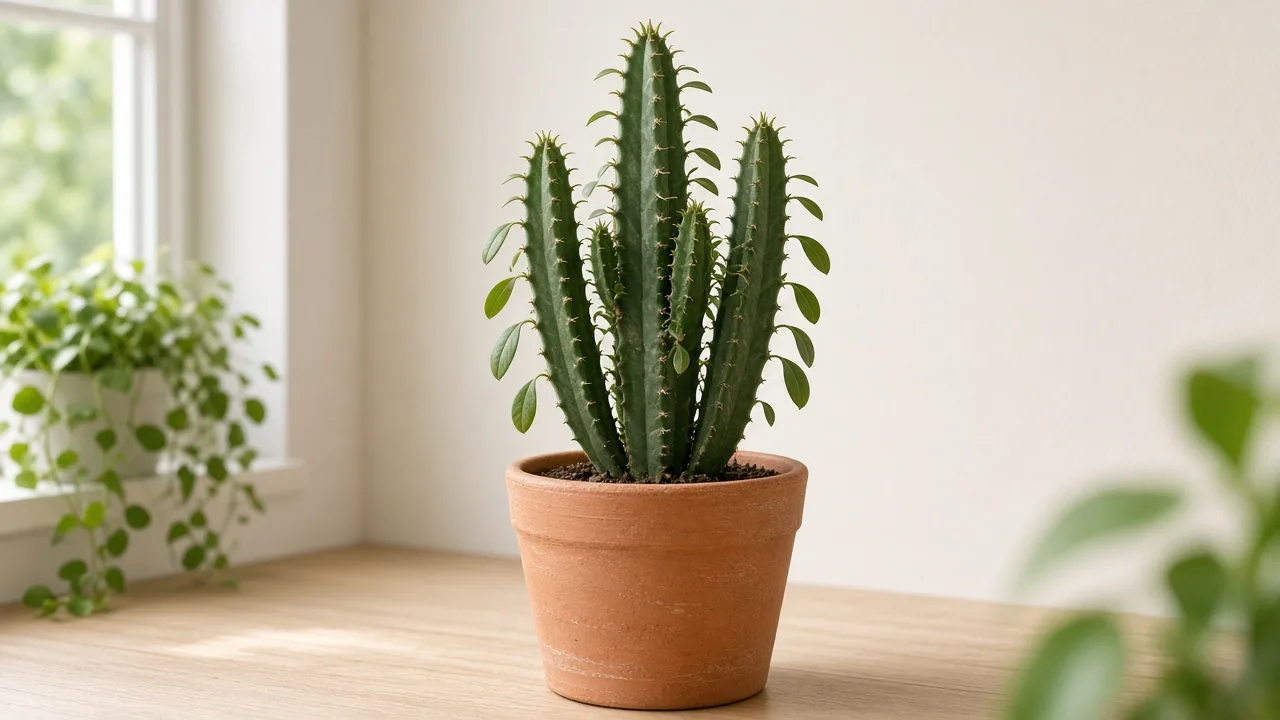
Underwatering on African Milk Tree: Causes, Checks & Fixes
This guide covers underwatering on African Milk Tree. See also the general Underwatering guide, watering, and light pages for this plant.
Underwatering on African Milk Tree: Causes, Checks & Fixes
Quick answer
Underwatering on Euphorbia trigona is the opposite trap from rot: a tall candelabra that still looks mostly green while its stored stem water is spent. African milk tree is a fast-growing drought-tolerant succulent with triangular stems that store moisture and small teardrop ridge leaves that drop when roots cannot replace what the column draws during bright active growth.
For how chronic dryness stresses succulents in general, see our underwatering guide. On African milk tree, the pattern is a feather-light pot, dusty dry mix 2–3 inches deep, firm but slightly wrinkled columns, and ridge leaves dropping in clusters—not a soft mushy base on heavy wet soil.
First step: lift the pot and probe the mix 2–3 inches deep. Do not water, repot, prune, or feed until you confirm dry soil and firm stems. If the base is soft on wet mix, switch to overwatering instead.
When to use this page vs other African Milk Tree guides
| Pattern | Read next |
|---|---|
| Heavy wet pot, soft stem base | Overwatering or root rot |
| Light dry pot, wrinkled firm column (this page) | Stay here |
| Limp ridge leaves, stems still firm | Drooping leaves |
| Whole arm collapses | Wilting |
| Crispy brown ridge tips only | Brown tips |
| Long bare stem reaching for light | Leggy growth |
| Washed-out color without wrinkling | Pale leaves |
What underwatering looks like on African Milk Tree
Unlike leafy houseplants, African milk tree photosynthesizes mainly through its thick green triangular columns. The small teardrop leaves along ridges are early warning tissue—they drop or turn papery when the plant draws down stem reserves faster than roots refill them.
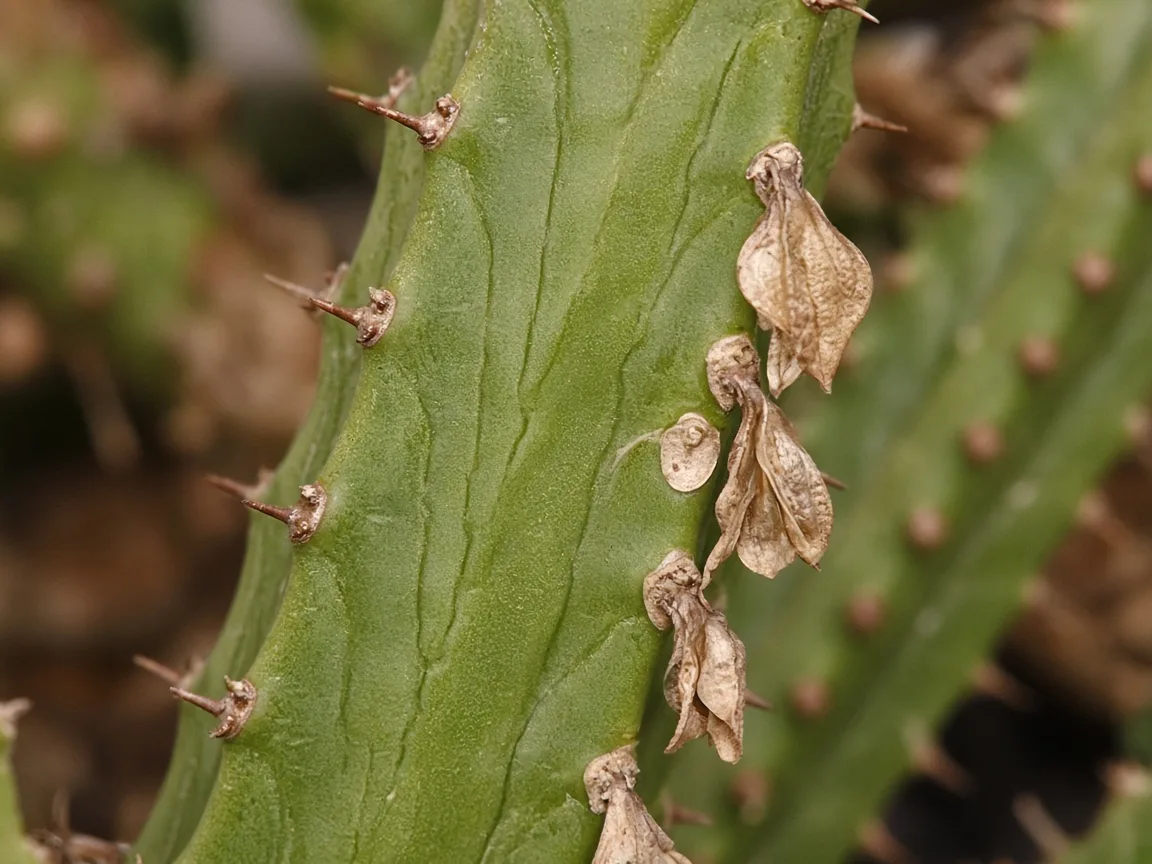
Longitudinal wrinkles along a firm triangular face—classic drought on Euphorbia trigona before the column softens.
Early signs
- Feather-light pot compared to its weight right after a thorough soak
- Subtle longitudinal wrinkling along triangular stem faces while the column still feels firm when squeezed with gloves on
- Ridge leaves turning papery or dropping in clusters, often starting on lower sections of each arm
- Dusty dry mix when a skewer is pushed 2–3 inches deep—not just surface crust
- No new teardrop leaves along upper ridges for weeks during warm bright growth
Advanced signs
- Pronounced stem shrinkage—deep grooves between ridges, columns look thinner than a month ago
- Brown crispy ridge leaves that crumble when touched; see brown leaves if only tips are affected
- Multiple column arms wrinkling at once during peak summer in a south window
- Slowed vertical growth despite bright light—roots are not delivering water
A leafless but firm green column in a cool dim room is not automatically underwatering—ridge leaves drop in dry or cool conditions as part of normal seasonal rhythm. Thirst adds light pot + dry deep mix + progressive wrinkling to that picture.
Column plumpness vs stem-base softness
This plant-only check does not apply to ferns or pothos. On Euphorbia trigona, the triangular column is the water tank:
- Firm column + slight wrinkling + light dry pot — Confirmed thirst path; one thorough soak after dry-down check.
- Firm column + dropped ridge leaves + heavy wet pot — Root stress from too much water; see overwatering.
- Soft or hollow base + wet pot — Rot, not drought; stop watering immediately.
- Smooth plump ridges + dry mix + cool room — Often winter rest; extend dry interval rather than soaking on calendar.
Always trust stem firmness at the soil line over leaf count. A milk tree can look tall and green while columns are already drawing on reserves—and it can look wrinkled in November while simply resting.
Ridge leaf cluster drop vs seasonal shed
Searchers often panic when teardrop leaves fall, but timing matters on this species.
Drought-driven drop hits during warm active growth when the pot is light, mix is dry deep down, and stems show wrinkling. Leaves may fall from several ridges on one arm within days.
Seasonal or cool-weather drop happens when nights cool, light drops, and stems stay firm and only mildly less plump. NC State notes ridge leaves are small and not long-lasting—lower foliage loss through winter can be normal if the base stays solid.
If you are unsure, lift the pot before you pour. Seasonal drop on a heavy wet pot is a stop-water signal, not thirst.
The pot-weight and skewer dry-down test
Tall milk trees in heavy ceramic pots hide drought as easily as they hide rot. Before you change anything:
- Lift or tilt the pot when you think it is dry versus right after a soak. Learn your dry weight.
- Probe the top 2–3 inches with a skewer. Surface dust-dry on peat-heavy mix can still mean damp soil below—but on gritty cactus mix, dry at this depth usually means it is time to water during active growth.
- Pinch a triangular stem face between gloved fingers. Firm with fine wrinkles = drought candidate. Soft or yielding at the base = wet-soil problem.
- Check every branch arm. Multi-stem candelabras can have one thirsty column beside a well-watered neighbor in uneven light.
- Note the season. Bright summer windows dry pots fast; cool winter rooms need longer dry intervals even when stems look slightly shrunken.
Wear gloves—milky latex irritates skin when stems are squeezed or punctured.
Why African Milk Tree gets underwatering
Euphorbia trigona evolved in dry tropical forests where rain drains fast. Indoors, most chronic underwatering comes from fear of rot—not from neglect.
Over-cautious winter watering. After a rot scare, many owners stretch dry intervals through summer too. A fast-growing column in a bright south window can empty a pot in ten days while you are still on a monthly winter schedule.
Hydrophobic or compacted mix. Old peat that has dried hard lets water run down the pot sides without rewetting the root ball. The surface looks damp after a splash; the center stays dust-dry. Gritty cactus mix in a pot only slightly larger than the root ball reduces this risk.
Undersized root mass in a tall pot. Very top-heavy candelabras in lightweight plastic tip easily; owners sometimes under-water to compensate, starving roots at the bottom while upper columns look fine briefly.
Heat and light spikes. A plant moved to a brighter patio or near a heating vent transpires faster. Calendar watering that worked in March fails in July.
Shallow splashes. Brief surface sprinkles never reach deep roots on a three-foot column. This species needs sparse but thorough soaks when dry, then a full dry-down—not teacup top-ups.
How to confirm the cause
Treat as confirmed underwatering when at least three of these match:
| Check | Underwatering | Points elsewhere |
|---|---|---|
| Pot weight | Noticeably light | Heavy days after watering → overwatering |
| Skewer 2–3 inches deep | Dry, dusty | Wet, cool → stop water |
| Stem base squeeze | Firm | Soft, hollow → root rot |
| Stem faces | Fine wrinkles, firm | Smooth and plump |
| Ridge leaves | Papery drop or limp | Yellow on wet mix → overwatering |
| Season | Warm bright growth | Cool rest only → extend interval |
If stems wrinkle but the skewer shows wet cool mix, do not soak—roots are failing to take up water. That is a wet-soil rescue path.
The first fix to try
Give one thorough bottom-up soak only after the dry-down test confirms thirst.
- Take the pot to a sink or tub. Water slowly until it runs freely from drainage holes—twice if mix was hydrophobic and water initially ran around the sides.
- Let the pot drain 15–30 minutes. Empty the saucer completely.
- Return the plant to bright light without moving it again for two weeks.
- Do not fertilize, repot, or prune stressed arms the same day.
Ridge leaves may perk within hours if stems stayed firm. Deeply wrinkled columns often smooth over three to seven days as tissues rehydrate.
If mix was bone-dry and shrunken from the pot walls, a bottom soak—setting the pot in a tray of water for 30–45 minutes, then draining—can rewet the core more evenly than a rushed top pour.
Step-by-step recovery
After the first soak:
Days 1–3: Watch for stem faces smoothing and ridge leaves regaining stiffness. No second watering yet—even thirsty succulents need oxygen back in the mix.
Days 4–14: When the top 2–3 inches feel dry again during active growth, repeat a full soak. In cool winter rooms, wait longer.
Weeks 2–4: New tiny teardrop leaves along upper ridges are the best recovery signal. Old papery leaves will not reattach; let them drop.
If wrinkling returns within days of soaking: Mix may be hydrophobic or roots may be damaged. Check whether water runs straight through. If the pot still feels oddly light right after a soak, inspect roots during the next dry window—partial root loss from past overwatering mimics drought.
Recovery timeline
| Severity | What you see | Realistic timeline |
|---|---|---|
| Mild | Slight wrinkling, few dropped ridge leaves | Stems smooth in 3–7 days after one good soak |
| Moderate | Multiple arms wrinkled, pot very light | Two to three soak cycles over 2–3 weeks |
| Advanced | Deep grooves, brown crispy ridge leaves | Columns may recover if bases stay firm; damaged leaves shed and regrow over a month |
Judge success by firmer plump ridges and new upper teardrop leaves, not by restoring every old leaf.
Lookalike symptoms
| What you see | Likely cause | Next step |
|---|---|---|
| Wrinkled firm stem, light pot | Underwatering (this page) | Soak after dry test |
| Soft base, heavy wet pot | Overwatering | Stop water |
| Limp ridge leaves, firm stem, dry pot | Drooping leaves from drought | Soak; same fix, different entry symptom |
| Whole arm collapses | Wilting | Check base firmness urgently |
| Lower leaves only, cool room, firm stem | Seasonal drop | Reduce water; do not force foliage |
| Crispy brown tips, otherwise plump | Brown tips | Check salt, light, or past dry spells |
| Sticky ridges with insects | Mealybugs or aphids | Not thirst |
Mistakes to avoid
Soaking on a wet pot because stems look wrinkled. Wilt from root damage can mimic drought. Always pair wrinkling with dry deep mix and a firm base.
Panic-watering every wrinkled winter stem. Cool short days slow uptake. A firm column with seasonal leaf loss needs longer dry intervals, not weekly soaks.
Misting the columns. Euphorbia trigona does not absorb water through stems. Misting does not fix root-zone drought and can encourage fungal spots on ridge leaves.
Fertilizing a stressed plant. Hold feed until new ridge leaves look healthy for two weeks and watering rhythm is stable—see the fertilizer guide.
Repotting immediately. Unless mix is completely hydrophobic and cannot be rewet, stabilize watering first. Fresh soil plus a stressed column adds unnecessary variables.
How to prevent underwatering next time
Match water to this plant’s biology and your room, not a calendar.
Water when the top 2–3 inches of mix are dry during active growth, then soak until drainage runs free and empty the saucer. In winter, follow restricted winter watering even if stems look slightly wrinkled—cool rooms need longer dry intervals.
Use fast-draining cactus mix with perlite or pumice in a stable pot weighted for height. Terracotta helps you read dry-down by pot weight.
Keep the plant in bright light so ridge leaves mature quickly and water uptake matches your soak schedule.
Learn dry pot weight by lifting weekly. When summer heat arrives, shorten intervals before wrinkling starts—not after columns have already shrunk.
When to worry
Mild wrinkling on a firm base after a missed watering usually responds to one good soak. Escalate within a day when:
- Stems feel noticeably thin or deeply grooved on multiple arms
- Ridge leaves drop in clusters during warm active growth
- Wrinkling returns within 48 hours of a confirmed thorough soak
- The base softens even though you have been underwatering—past root damage may need root rot inspection
If columns stay firm and only lower ridge leaves shed through a cool winter, patience beats another drink.
Related African Milk Tree guides
- Overview — culture and sap safety
- Watering — soak-and-dry rhythm after recovery
- Soil — gritty mix that rewets evenly
- Overwatering — heavy pot and soft base (opposite diagnosis)
- Drooping leaves — limp ridge foliage entry point
- Wilting — whole-arm collapse
- Problems hub — full symptom index
Conclusion
Underwatering on African milk tree is a pot-weight and column-plumpness problem on a tall green candelabra. Lift the pot, confirm dry mix 2–3 inches deep, and give one thorough soak if stems stay firm. Smooth ridges and fresh teardrop leaves on upper branches are the recovery signal; dropped ridge leaves below will not return, and that is normal once the root zone is stable again.
Related tool
Use the Plant Watering Calculator to narrow causes for underwatering on this plant before changing multiple variables at once.