Yellow Leaves on African Milk Tree: Ridge-Leaf Checks
Quick answer
Yellow leaves on African milk tree almost always mean the small teardrop ridge leaves—not the green triangular column. First step: note whether yellowing sits on the lowest sections of each arm while the pot feels heavy or light, then squeeze the lowest 5 cm of stem above soil before you water, move, or feed.

Yellow Leaves on African Milk Tree: Causes, Checks & Fixes
This guide covers yellow leaves on African Milk Tree. See also the general Yellow Leaves guide, watering, and light pages for this plant.
Yellow Leaves on African Milk Tree: Causes, Checks & Fixes
Quick answer
Yellow leaves on Euphorbia trigona usually show up on the small teardrop leaves along stem ridges, not as a uniform fade of the whole triangular column. African milk tree stores water in its upright arms and drops ridge leaves seasonally—so a few yellow lowest leaves on a firm green stem is often normal. Yellowing that spreads on wet heavy mix or comes with a soft stem base is the dangerous pattern tied to overwatering and root stress.
For how chlorosis develops on houseplants in general, see our yellow leaves hub. On African milk tree, the decisive split is pot weight plus stem-base firmness—not whether one teardrop leaf aged out.
First step: lift the pot and squeeze the lowest 5 cm of every column arm above the soil line with gloves on. Heavy wet soil with a soft base means stop watering today; a light dry pot with a firm but slightly wrinkled column means check underwatering before you soak.
When to use this page vs other African Milk Tree guides
This page is the symptom-first entry for yellow ridge foliage on a candelabra milk tree.
| Pattern | Read next |
|---|---|
| Heavy wet pot + soft stem base | Overwatering or root rot |
| Light dry pot + wrinkled firm column | Underwatering |
| Mass leaf drop in a dim room, lean toward window | Not enough light |
| Washed-out yellow-green without obvious wet base | Pale leaves |
| Crispy brown ridge leaves, light pot | Brown leaves or brown tips |
| Old leaves only, firm base, stable care | Often normal seasonal drop—stay here |
| Nutrient wash-out after heavy feeding | Nitrogen deficiency |
| Long-term soak timing | Watering guide |
What yellow leaves look like on African Milk Tree
Unlike broad-leaf houseplants, African milk tree keeps its main photosynthetic surface on thick green triangular columns. The ridge leaves are expendable early-warning tissue—they yellow, pale, or drop before the arm fails.
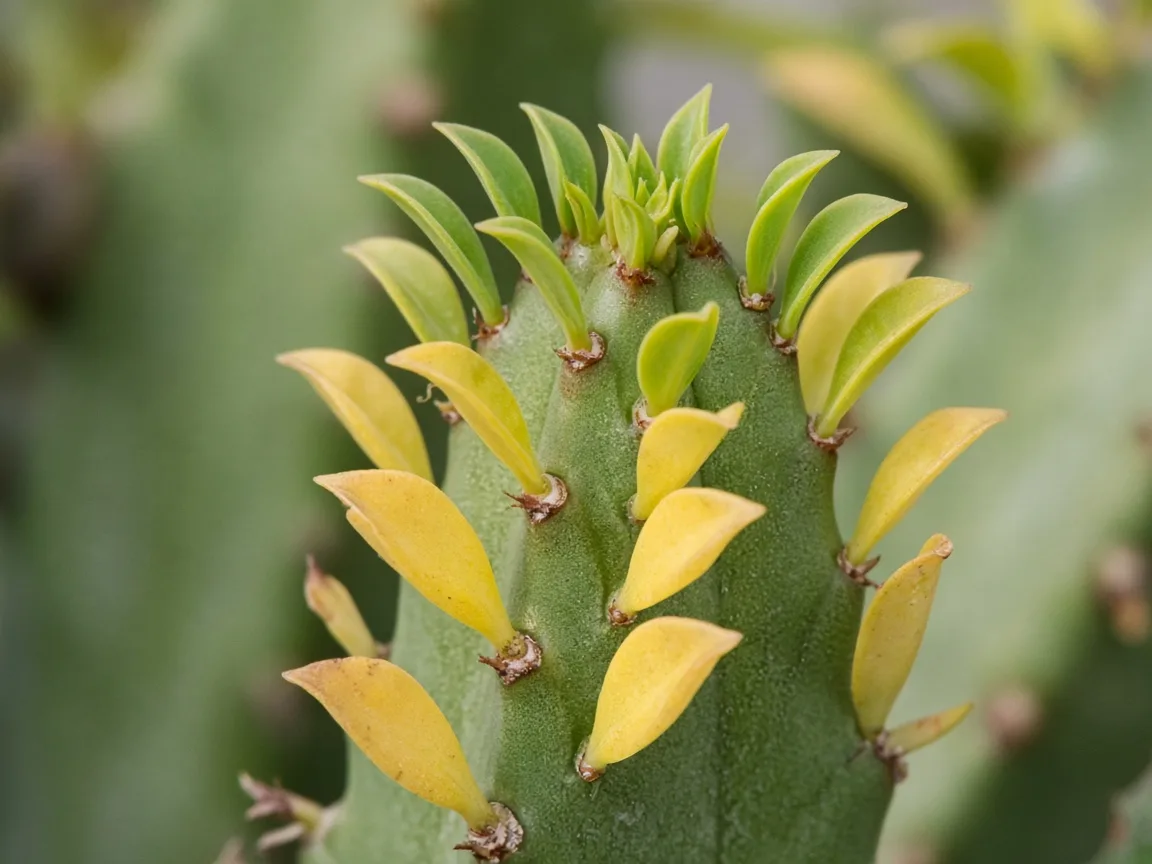
Yellow leaves on African milk tree—compare fading teardrop ridge leaves with the color and firmness of the green column behind them.
Early signs
- Yellow or lime-green teardrop leaves on the lowest sections of one or more arms while upper ridges still look normal
- Leaves drop easily when you brush the ridges—often paired with wet or dry mix, depending on cause
- Column still firm and upright—yellowing limited to ridge leaves, not translucent stem tissue
- No new tiny leaves along upper ridges for weeks while lower leaves yellow on damp mix
- Lean toward the brightest window with simultaneous leaf drop—classic low-light stress; see not enough light
Advanced or urgent signs
- Yellow lowest leaves plus dull or soft stem at the soil line on heavy wet pot
- Translucent or waterlogged patches on lower column faces
- Sour smell from mix—yellowing is rot advancing, not simple aging
- Whole arm limp despite wet soil—damaged roots cannot move water; see wilting
- Sticky residue or stippling on ridge leaves—check aphids or spider mites before assuming water stress alone
A leafless but firm green column is not automatically sick—NC State notes ridge leaves are small and not long-lasting, and are dropped seasonally. Alarm adds progressive yellowing on wet mix, soft base tissue, or multiple arms failing together.
Ridge leaf vs column diagnosis
This plant-only check does not apply to pothos or peace lilies. On Euphorbia trigona, trust the column first, ridge leaves second:
- Firm column + a few yellow lowest ridge leaves + dry light pot — Often thirst or normal aging; see underwatering if the column wrinkles.
- Firm column + yellow ridge leaves + heavy wet pot — Root stress beginning; pause all water.
- Soft yellowing base + wet pot — Confirmed rot path; same-day root rot protocol.
- Mass ridge drop + long internodes + lean — Light problem; move to brighter exposure before repotting.
- New tiny leaves on upper ridges — Recovery signal even when lower leaves are gone.
Always inspect every arm on multi-branch candelabras—one rotting column can sit beside healthy neighbors.
Why African Milk Tree gets yellow leaves
Overwatering and root stress (most serious cause)
Overwatering can cause root rot and fungal disease on this species. When mix stays wet, roots lose function; ridge leaves yellow and drop while the column may still look green. Plantvale notes soft, yellow, or mushy tissue near the soil is a rot warning on wet mix—often the first visible yellowing an owner notices.
This pattern is common in cool winter rooms when owners keep a summer watering rhythm on dense peat in an oversized glazed pot. Clemson HGIC emphasizes rot susceptibility when the plant is overwatered during slower growth.
Normal seasonal ridge leaf drop
Ridge leaves on Euphorbia trigona are small, teardrop shaped, and not long-lasting. Lower leaves yellow and fall as arms elongate or seasons shift—especially on tall plants where the lowest ridges get less light. If the stem base is firm, mix moisture matches your soak-and-dry schedule, and upper ridges push new teardrop leaves, isolated lowest yellow leaves are often benign.
Not enough light
In dim corners, milk trees drop ridge leaves en masse while stretching toward the brightest gap. Leaves may yellow before they fall; the column stays green but internodes lengthen. Cross-check not enough light and the light guide if lean and bare ridges appear without wet-soil clues.
Underwatering
Extended dry spells can yellow ridge leaves before they crisp brown. The pot feels light, a skewer comes out dusty dry 2–3 inches down, and the column may look slightly wrinkled but still firm—not soft. See underwatering when drought signs dominate.
Cool drafts and sudden moves
African milk tree prefers warm stable rooms. A cold window snap or AC blast after summer outdoors can trigger rapid ridge leaf yellowing on otherwise healthy arms. Dropped leaves are commonly tied to cold or sudden change and often recover once placement stabilizes—unlike rot, where the base keeps softening.
Pests and nutrient issues (less common)
NC State lists mealybugs, aphids, and spider mites on this plant. Stippling, stickiness, or webbing on ridge leaves can yellow tissue locally. Chronic pale yellow-green on compact growth in bright light with correct watering may point to nitrogen deficiency—but never feed a stressed column on wet mix before you confirm the root zone is firm.
How to confirm the cause
Work through this order before repotting, feeding, or spraying:
- Lift the pot — Heavy days after watering vs noticeably light when you expect dry mix.
- Skewer 2–3 inches deep — Wet cool stain on heavy pot confirms pause water; dusty dry on light pot confirms thirst check.
- Squeeze the lowest 5 cm of each arm above soil with gloves on — Soft on wet mix = rot risk; firm = follow leaf pattern.
- Map the yellowing — Lowest ridges only vs every arm vs upper new growth.
- Log light — Do direct sunbeams hit ridge tips for several hours? Lean toward glass?
- Inspect undersides — Webbing, scale, or honeydew before blaming water alone.
- Sniff the soil — Sour odor means treat as confirmed rot, not seasonal drop.
Wear gloves—milky latex irritates skin when ridges are crushed or stems punctured.
First fix to try
Stop changing variables until you know whether the pot is wet-heavy or dry-light, and whether the stem base is firm.
That single pause prevents the classic mistake: watering because ridge leaves yellowed on already-saturated mix, or soaking a rotting base because the column looks wrinkled.
- Heavy wet pot + soft base → Stop all watering immediately; see overwatering and escalate to root rot if tissue is mushy.
- Light dry pot + firm wrinkled column → One deep soak at the pot edge, then resume soak-and-dry per the watering guide.
- Mass drop + lean in dim room → Move within 12 inches of the brightest window or add a grow light before repotting—light guide.
- Few lowest yellow leaves + firm base + stable moisture → Monitor two weeks; likely seasonal—do not repot or feed.
Step-by-step recovery
Wet-soil yellowing (firm base, early stage)
- Stop watering until the top 2–3 inches of mix are fully dry throughout.
- Improve airflow at the pot base; keep temperatures in the 65–85°F (18–29°C) range this species prefers indoors.
- Resume soak-and-dry only when skewer and pot weight confirm dryness—water when soil feels dry at 1–2 inch surface depth is the extension baseline; many owners wait slightly deeper in tall pots.
- Watch for new teardrop leaves on upper ridges within two to four weeks.
Dry-soil yellowing
- Confirm dryness with skewer and pot weight—not calendar days.
- Soak until drainage runs free; empty saucers immediately.
- Wait for full dry-down before the next soak—Plant Care for Beginners recommends letting soil dry completely between waterings for this drought-tolerant succulent.
- Expect older yellow leaves to drop rather than re-green; judge new upper ridge flushes.
Light-stress yellowing
- Move to bright direct or strong indirect light; rotate weekly once growth evens.
- Hold repotting and fertilizer for two weeks while new ridge leaves size up normally.
- Accept that etiolated stem length below will not shrink—recovery shows in tighter new internodes at the top of each arm.
Rot-advanced yellowing
If the base is mushy, black, or sour-smelling, skip the dry-down wait—follow root rot unpotting or stem-cut salvage through propagation the same day.
Recovery timeline
| Severity | What to expect |
|---|---|
| Seasonal lowest-leaf drop | Yellowing stops within days; new upper ridge leaves within 1–3 weeks |
| Mild overwatering (firm base) | Mix dries in 1–2 weeks; spreading yellowing halts; new ridge leaves in 2–4 weeks |
| Drought stress | Perky column and new ridges within 1–2 weeks after one corrected soak |
| Low light correction | Drop slows in 2–3 weeks; compact new growth in 4–8 weeks |
| Rot at base | Old yellow leaves never re-green; salvage via firm top cuts over 4–8 weeks |
Judge success by firm stem tissue and fresh teardrop leaves on upper columns—not by lowest yellow leaves turning green again.
Lookalike symptoms
| What you see | Likely cause |
|---|---|
| Yellow lowest ridges only, firm base, stable moisture | Normal seasonal drop or aging |
| Yellow ridges + heavy wet pot + soft base | Overwatering / root rot |
| Yellow then crispy brown ridges, light pot | Underwatering |
| Mass drop + lean + long internodes | Not enough light |
| Washed-out yellow-green, firm base, good light | Pale leaves or nitrogen deficiency |
| Stippling + stickiness on ridges | Aphids or spider mites |
| Yellow + fungus gnats at soil | Wet mix—fungus gnats and mold on soil |
Mistakes to avoid
- Watering because ridge leaves yellowed on an already-heavy pot
- Repotting into a larger container while diagnosing yellow leaves on wet mix
- Fertilizing a stressed column before the stem base stays firm for two weeks
- Pruning every arm at once—remove only clearly dead mushy tissue; sap exposure adds stress
- Assuming a tall green candelabra is healthy without checking the lowest 5 cm of each arm
- Treating one yellow leaf as emergency rot when the base is firm and upper ridges are flushing
How to prevent yellow leaves next time
Match care to this plant’s columnar succulent biology:
- Water when the top 2–3 inches of gritty mix are dry, then soak and empty saucers—see the watering guide.
- Use fast-draining cactus mix with perlite or pumice in a stable pot with drainage—not an oversized cachepot holding wet soil around a small root ball.
- Keep bright light so ridge leaves mature quickly and seasonal drop stays limited to the lowest sections.
- Learn dry pot weight by lifting weekly; probe the stem base whenever you water.
- Expect some lowest ridge leaves to yellow and fall on tall plants—that is normal for short-lived ridge foliage when the column stays firm.
When to worry
A few yellow lowest ridge leaves on a firm base after a season change or one care misstep usually responds to a single corrected variable. Escalate same-day when:
- The stem base feels squishy, hollow, or black
- Yellowing climbs with translucency on lower column faces
- The mix smells sour
- Multiple arms soften at once
- No new upper ridge leaves appear after six weeks of corrected care
If rot has consumed the base, stem-cut salvage beats waiting for yellow leaves to re-green.
Related African Milk Tree guides
- Overview — culture and sap safety
- Watering — soak-and-dry rhythm after yellowing stabilizes
- Light — placement when mass ridge drop follows dim rooms
- Overwatering — wet-mix yellowing and stem-base checks
- Root rot — mushy base protocol
- Underwatering — dry-pot yellow-to-brown pattern
- Problems hub — full symptom index
Conclusion
Yellow leaves on African milk tree are a ridge-leaf and root-zone signal, not a reason to panic over a still-green column. Lift the pot, squeeze the lowest section of every arm, and split wet-soft rot from dry-firm thirst, dim-room drop, or normal seasonal shedding. Firm tissue and fresh teardrop leaves on upper ridges are the recovery marker—individual yellow ridge leaves below will not turn green again, and that is expected once the correct care rhythm returns.
Related tool
Use the Yellow Leaves Diagnosis Tool to narrow causes for yellow leaves on this plant before changing multiple variables at once.