Not Enough Light on African Milk Tree: Ridge Checks & Fixes
Quick answer
African milk tree without enough light stretches between ridges, leans hard toward the brightest gap, and loses the compact candelabra shape—even while the green stem still looks alive. First step: move every column arm within a foot of your brightest south or east window and confirm direct sunbeams hit the ridges for several hours before repotting or feeding.
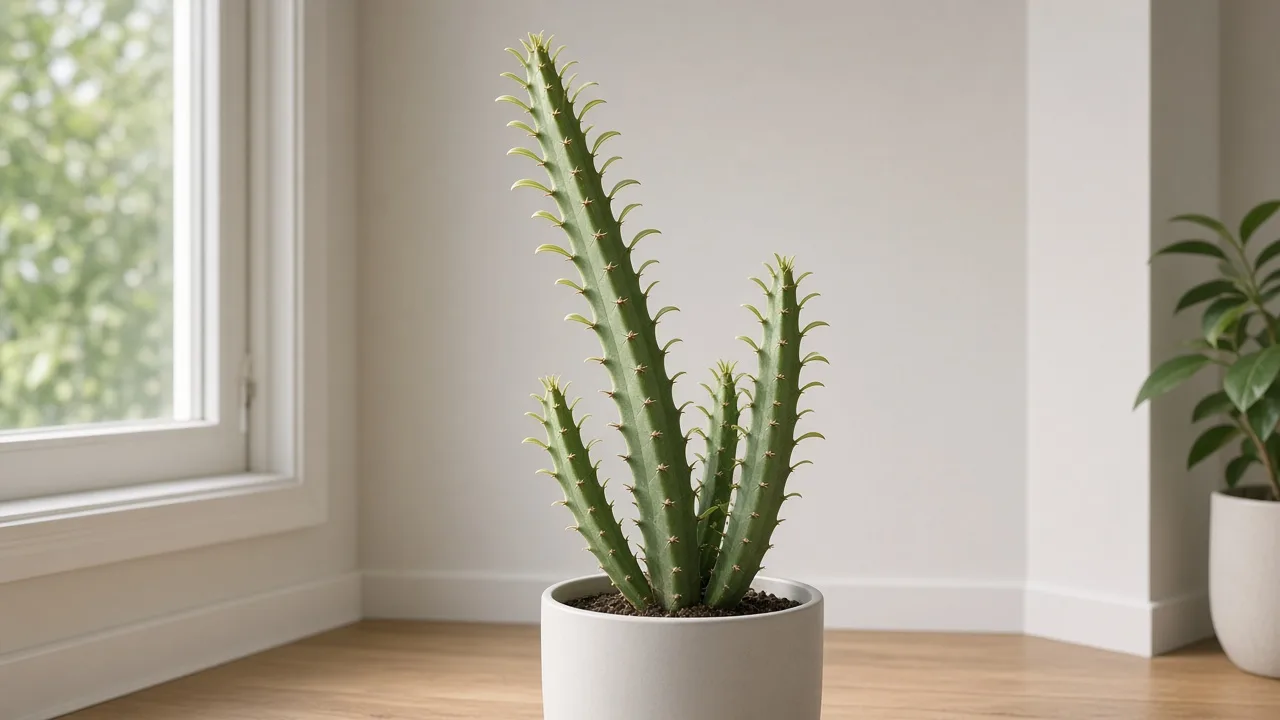
Not Enough Light on African Milk Tree: Causes, Checks & Fixes
This guide covers not enough light on African Milk Tree. See also the general Not Enough Light guide, watering, and light pages for this plant.
Not Enough Light on African Milk Tree: Causes, Checks & Fixes
Quick answer
Euphorbia trigona is a sun-loving columnar succulent, not a low-light survivor that merely tolerates a dim corner. When photons fall short, the candelabra arms stretch between ridges, lean toward the brightest gap, and push pale, soft new growth while the triangular stem still looks green enough to fool you into thinking care is fine.
For how chronic low light limits photosynthesis in general, see our not enough light hub. On African milk tree, the decisive check is direct sun hours on the ridge leaves at the top of each vertical arm—not whether the room feels bright to your eyes.
First step: move the pot within 12 inches (30 cm) of your brightest south- or east-facing window and confirm direct sunbeams touch the ridges for at least four hours on clear days (or add a close grow light—details below). Do not repot, prune, or fertilize until you have fixed placement.
When to use this page vs other African Milk Tree guides
This page is the symptom-first entry for shade-stressed milk tree—leaning columns, washed-out color, and weak ridge flushes without pest stickiness or base rot.
| Pattern | Read next |
|---|---|
| Extreme bare stem with tiny leaves everywhere | Leggy growth |
| Growth stalled but stems still compact | Slow growth |
| Washed-out color without obvious stretch | Pale leaves |
| Lower ridge leaves yellow while tips stay green | Yellow leaves |
| Soft base at soil line after dim-corner watering | Overwatering or root rot |
| Long-term placement and acclimation | Light guide |
| Full problem index | All African milk tree problems |
What not enough light looks like on African Milk Tree
Healthy milk tree in strong light builds short internodes, firm woody ridges, and small teardrop leaves along each triangular face. Shade stress breaks that silhouette in ways that are specific to this candelabra euphorb:
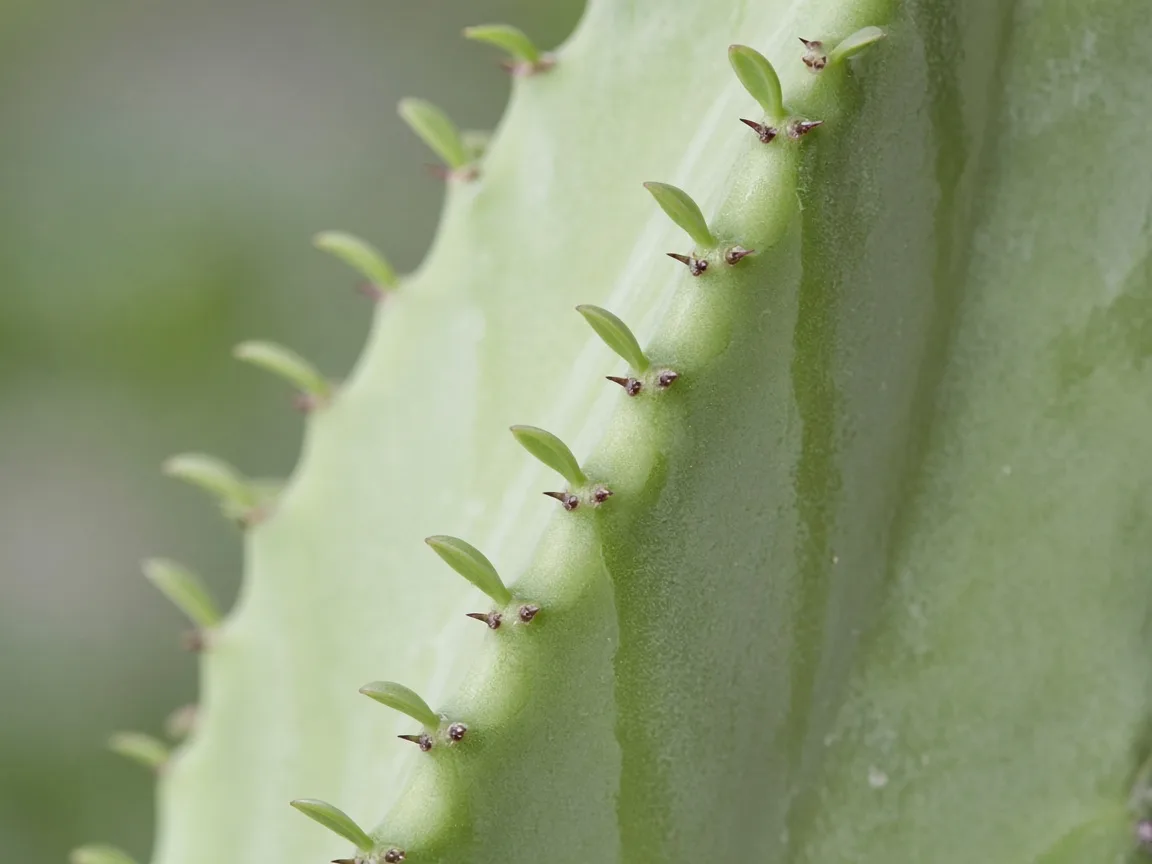
Etiolated ridge flush: small pale teardrop leaves spaced far apart on a soft green internode—compare with tighter ridges lower on the same arm.
- Directional lean — the whole pot or individual arms angle toward one window gap, skylight, or hallway opening
- Long bare green internodes — visible inches of smooth stem between ridge leaf pairs that used to sit closer together
- Thin, soft new columns — fresh vertical shoots feel pliable rather than firm and woody
- Deep plain green without red margins — cultivars like ‘Rubra’ or ‘Royal Red’ lose burgundy coloration in insufficient light and revert toward uniform green
- Sparse ridge leaves — fewer teardrop leaves along ridges; NC State notes these leaves are not long-lasting and drop seasonally, but chronic shade keeps new flushes small
- Top-heavy wobble — stretched arms gain height without the stem girth to support weight, making tall specimens unstable in light pots
This differs from leggy growth when the stretch is extreme and structural, from pale leaves when color washes out without dramatic internode length, and from overwatering when the base turns mushy even though you moved the plant recently.
Why African Milk Tree gets not enough light
African milk tree evolved in Central African semi-arid conditions where bright open light is the default. NC State lists cultural light as partial shade to full sun outdoors (two to six or more hours of direct sun), and indoor specimens need the brightest spot you can offer—not the “bright indirect” default many foliage plants accept.
Milk-tree-specific triggers:
- Room brightness vs ridge brightness — a living room that feels adequate may deliver only soft ambient light at the top of a six-foot column while lower stems sit in shade. Light intensity drops sharply with distance from glass.
- North windows and interior tables — pots more than a few feet from south or east glass rarely get enough direct sun for compact growth. The plant survives on stored stem water longer than a fern would, which delays obvious collapse.
- Seasonal shade creep — a winter sun path that was strong becomes partially blocked once outdoor trees leaf out, producing mid-season pale flushes and lean.
- Variegated and red clones in dim corners — Healthy Houseplants notes ‘Rubra’ color requires intense bright light and fades to green when light is weak—often the first warning on colored cultivars.
- Competing houseplants or curtains — sheers, tinted film, and furniture that block the window strip where the tallest arm reaches.
- Misplaced confidence after purchase — nursery stock grown under high light looks compact; the stretch often appears two to six weeks after a move to a dim shelf.
Do not assume a tall green column means light is fine. Euphorbia trigona can etiolate—produce thin pale growth that leans toward the light source while the older stem tissue stays green.
Candelabra arm lean audit
Euphorbia trigona branches like a candelabra. Low light rarely hits every arm equally, so inspect each vertical column separately—a diagnostic step that does not apply to rosette succulents or single-stem dracaenas.
- Stand behind the pot and sight along each arm toward the window. The arm leaning farthest is your light compass.
- Compare internode length within the same arm—newest six inches vs growth from last year. Widening gaps confirm etiolation, not normal seasonal leaf drop.
- Check whether only the tallest arm stretches while lower forks stay compact. That pattern means the upper canopy outgrew the light pool, not that the whole plant is diseased.
- Rotate the pot 90° and watch for correction over two weeks. Arms that keep bending back to the same compass point confirm directional shade.
- Note pot weight when dry. A dim plant uses water slowly; a heavy pot plus stretch often means you are watering for sun that is not there—cross-check watering guidance.
Red ridge color as a built-in light meter
On ‘Rubra’, ‘Royal Red’, and variegated milk trees, anthocyanin red along ridges and young leaves acts like a light gauge plain green forms do not provide.
| Ridge color on new flush | What it usually means | First adjustment |
|---|---|---|
| Deep burgundy margins in strong sun | Adequate light for that cultivar | Maintain placement; rotate weekly |
| Uniform pale green on a red clone | Chronic shade or winter dim spell | Move closer to glass or add grow light |
| Green base, red only at the very tip | Directional light—one side of the arm gets sun | Shift pot or remove window blocker |
| Bleached white patches on sun-facing ridges | Too much unacclimated direct sun | Pull back slightly or diffuse midday heat—not “more shade” as a default |
Plain green Euphorbia trigona will not show red margins, so rely on internode spacing and lean instead of color alone.
How dim light tightens the overwatering trap
Light is the throttle for water use on columnar euphorbs. A bright milk tree photosynthesizes actively, dries its gritty mix on a predictable rhythm, and stays firm. A shaded plant grows slowly, holds moisture longer in the root zone, and is more vulnerable to rot if you keep watering on a “sunny windowsill” schedule.
That coupling is especially dangerous on tall columns: the top looks thirsty while the base sits in wet mix. If you see stretch and the pot stays heavy for weeks after a soak, fix placement first, then lengthen dry intervals per the watering guide—not the reverse.
How to confirm the cause
Work through these checks in order:
- Sun-hour log at ridge height — on three clear days, note when direct rays first hit the topmost leaves and when shade takes them. Under four hours strongly points to light stress for indoor milk tree; the light guide covers window placement details.
- Internode comparison — measure distance between the last three ridge leaf pairs on the fastest-growing arm. Increasing spacing versus last season confirms etiolation.
- Lean direction — walk the sight line the plant points toward; identify the blocker (building, tree, curtain, taller furniture).
- Cultivar color check — on red or variegated clones, fading to all-green without pests or stickiness supports shade, not aphids or nutrition alone.
- Base firmness — press the lowest inch above soil. Firm green ridges with stretch above point to light; soft blackening at the soil line points to overwatering and needs a different first fix.
- Grow-light honesty — if you already run a fixture, confirm it sits 6–12 inches (15–30 cm) above the canopy and runs long enough that ridges do not keep leaning.
If direct sun at ridge height is adequate and stems still stay pale with no stretch, move to nutrition or pest checks—not more shade.
First fix for African Milk Tree
Move the pot to the brightest available window—within 12 inches (30 cm) of unobstructed south or east glass—and verify direct sun hits the ridge leaves for at least four hours on clear days.
Practical steps:
- Choose south, then east, then west exposure in the Northern Hemisphere. North glass rarely suffices without supplementation.
- Clear competing objects from the light path at the height of the tallest arm, not the windowsill floor.
- Rotate the pot a quarter turn weekly once new growth begins to straighten—prevents one-sided stretch.
- If no window delivers enough direct sun, add a full-spectrum LED grow light 12–18 inches above the canopy for 12–14 hours daily.
- Acclimate gradually if the plant lived in deep shade: increase exposure over two to three weeks to avoid sun scald on ridges moved suddenly to hot south glass.
Hold repotting, pruning, and fertilizer until you see tighter new internodes. Moving a stressed column and feeding in the same week makes it harder to read which change helped.
Step-by-step recovery after better light
Once placement is corrected:
- Week 1–2 — Lean may persist; focus on stopping further stretch. Let the mix dry fully between soaks per soil and watering norms.
- Week 3–6 — New ridge flushes should sit closer together and feel firmer. Red cultivars may begin showing color on fresh growth.
- Month 2–3 — Lower bare stem will not refill; optional pruning can shorten an arm for balance once growth is clearly compact—wear gloves because latex flows from cuts.
- Ongoing — Re-check sun path each spring; stake or weight the pot if height outpaces the new woody base.
Recovery timeline
| Stage | What you should see | If it does not happen |
|---|---|---|
| 2–3 weeks | Lean stops worsening; newest ridge leaves slightly tighter | Re-measure sun hours; fixture may be too far or blocked |
| 4–6 weeks | Firmer new internodes; normal teardrop leaf size on fresh flush | Rule out chronic overwatering at a soft base |
| 2–3 months | Visible woodiness on new growth; better stability | Consider whether pot is too large for root mass |
| 6+ months | Optional reshape via pruning; old etiolated length remains unless cut | Persistent pale tips with good sun may need a pest or nutrient check |
Old stretched stem tissue does not shorten. Recovery means better architecture on new growth, not a time machine for bare green columns.
Lookalike symptoms
| What you see | Likely cause | Where to go |
|---|---|---|
| Long bare stem, tiny leaves | Severe chronic shade / etiolation | This page + leggy growth |
| Pale all over, compact spacing | Possible nutrient issue or recent repot stress | Pale leaves, fertilizer guide |
| Yellow lower ridges, green tips | Often age or watering rhythm, not shade alone | Yellow leaves |
| Floppy entire plant, heavy wet pot | Root stress from too much water in low light | Overwatering |
| Crispy bleached patches after a move | Sun scald from too-fast acclimation | Light guide — partial step-back, not deep shade |
Mistakes to avoid
- Watering more because the plant “looks thirsty” in a dim corner — stretch plus wet mix invites base rot on euphorbs.
- Fertilizing to force color or density — excess nitrogen produces soft etiolated growth on columnar euphorbs; fix light first.
- Pruning the top before improving light — new shoots will stretch again toward the same gap.
- Assuming survival equals health — green columns can live for years while slowly becoming top-heavy hazards.
- Ignoring seasonal shade — a spot that worked in February may fail by June when deciduous trees leaf out.
How to prevent it next time
- Site new purchases within a foot of the brightest glass from day one; acclimate to direct sun over two to three weeks per the overview.
- Rotate weekly and re-measure sun after moving furniture or hanging outdoor window awnings.
- Use grow lights in north rooms or offices before stretch becomes structural.
- Match watering to actual light—dim winter corners need longer dry intervals even if the heating runs.
- For tall specimens, plan staking or a heavier ceramic pot as arms woody up in bright conditions.
Related African Milk Tree guides
- Light requirements — window choice, direct sun acclimation, and grow-light setup after you confirm shade stress
- Watering — soak-and-dry timing once photosynthesis rate matches your placement
- Soil — gritty mix that dries fast enough for a bright columnar grower
- Pruning — shorten etiolated arms safely after light is fixed (latex precautions)
- Problems hub — full cluster when symptoms overlap
Related tool
Use the Plant Problem Diagnosis Tool to separate light stress from watering and pest patterns before you change multiple variables at once.