Leaf Miners on African Milk Tree: Ridge-Leaf Checks & Fixes
Quick answer
Leaf miner larvae tunnel inside African milk tree ridge leaves, leaving pale winding tracks between the upper and lower surfaces—not ragged chew holes from caterpillars. First step: isolate the plant, wear gloves, and pinch off every mined ridge leaf at the stem, bag the foliage, and inspect soft new tips on each column arm before you spray.

Leaf Miners on African Milk Tree: Causes, Checks & Fixes
This guide covers leaf miners on African Milk Tree. See also the general Leaf Miners guide, watering, and light pages for this plant.
Leaf Miners on African Milk Tree: Causes, Checks & Fixes
Quick answer
Leaf miners on African milk tree (Euphorbia trigona) are tiny fly larvae feeding between the upper and lower surfaces of the small teardrop leaves along each ridge, leaving winding pale tunnels visible when you backlight a suspect blade. Indoor milk trees are more often troubled by mealybugs, aphids, and spider mites than leaf miners—but when serpentine mines appear after outdoor summer placement, nursery hitchhikers, or crowded plant shelves, the pattern is unmistakable if you know how to separate it from caterpillar chew or ragged holes in ridge leaves.
For how leaf miner larvae tunnel inside foliage and why contact sprays underperform, see our leaf miners guide. On African milk tree, the diagnostic clue is usually a short bordered pale trail inside a thin ridge leaf—not a full-thickness chew with pellet frass on the leaf surface or latex-exposing gouges on the green triangular stem.
First step: isolate the plant, wear gloves because of milky sap, and pinch off every mined ridge leaf at the stem—bag the removed foliage and inspect soft new tips on each column arm before you spray.
When to use this page vs other African Milk Tree guides
| Pattern | Start here | Or route to… |
|---|---|---|
| Serpentine tunnel inside the ridge leaf blade | This page | Holes in leaves if damage is full-thickness |
| Ragged holes, skeletonized tissue, pellet frass | Caterpillars | This page if tunnels stay inside tissue |
| Sticky clusters on branch tips | Aphids | — |
| Silver streaks, scarred buds | Thrips | — |
| Soft base at soil line, wet mix | Overwatering | Firm column with mined ridge leaves only |
| Long bare stem, tiny leaves everywhere | Leggy growth | — |
What leaf miners look like on African Milk Tree
The clearest sign is a serpentine mine—a twisting white or pale brown trail inside a small ridge leaf, often with a dark line of larval waste (frass) running through it. The mine widens as the larva grows. Unlike caterpillars, which skeletonize tissue between veins and leave ragged holes with pellet frass on the surface, leaf miner damage keeps the outer leaf surface mostly intact except for a small exit hole when the larva matures.
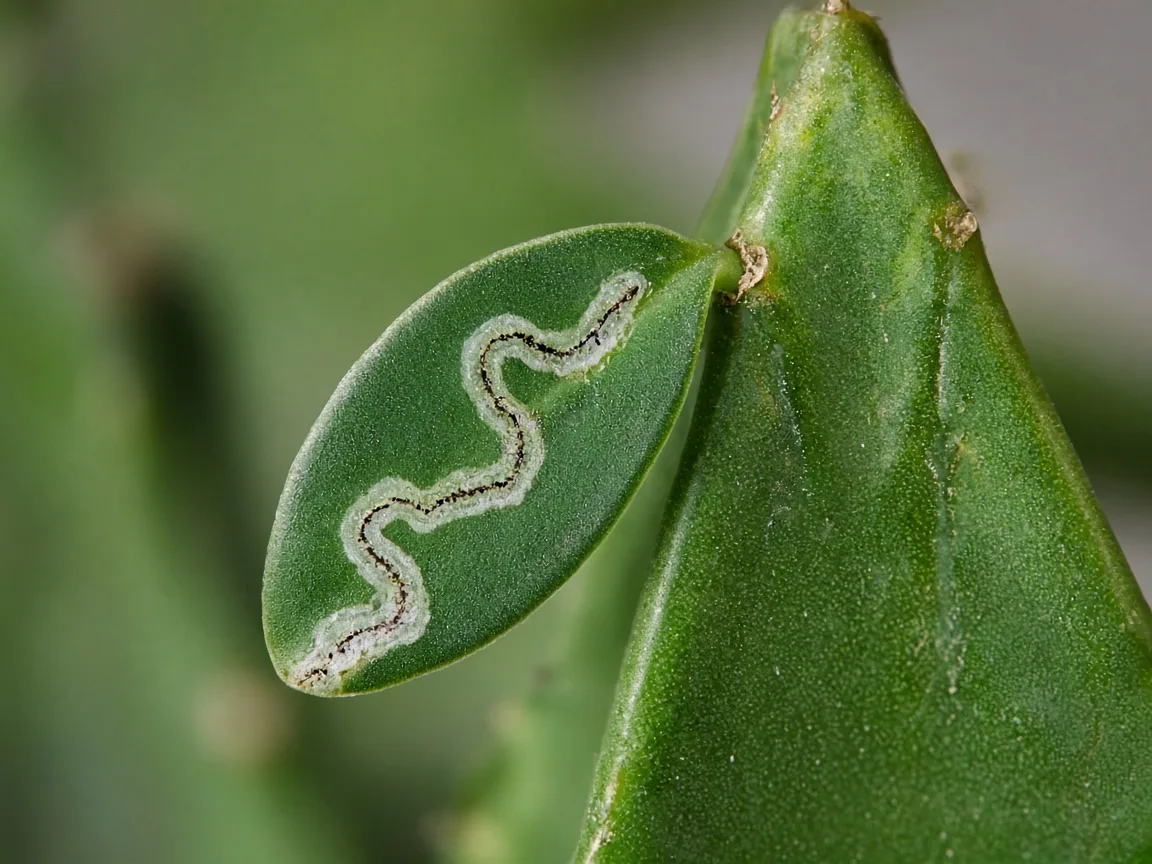
Pale bordered tunnel with a dark frass line inside a thin teardrop ridge leaf—hold the blade to light to confirm the mine stays enclosed between both surfaces.
Other clues on Euphorbia trigona:
- White stippling on green ridge leaves from adult females puncturing tissue to feed on sap before laying eggs inside the blade.
- Mines on soft new ridge leaves at branch tips where the next flush is expanding—often the highest point on each candelabra arm.
- A small yellow maggot visible inside an active mine if you gently tear the widest part of the tunnel on a thinner ridge leaf.
- Brown seedlike pupae on the soil surface or pot rim after larvae drop out of mined leaves—common beneath patio pots where debris collects.
NC State Extension describes milk tree leaves as small obovate teardrops along three-sided ridges that are not long-lasting and drop seasonally. Mines show up as pale squiggles cutting across those thin blades. Because each vertical arm carries only a handful of ridge leaves at a time, even one mined leaf looks dramatic on a tall column—even when the green stem flesh stays rock firm.
Backlight test on ridge leaves (Euphorbia trigona only)
Milk tree ridge leaves are thinner than desert rose blades but thicker than spider plant strap leaves. Backlight a suspect teardrop with a phone flashlight held behind the blade. A true leaf miner trail shows as a bordered tunnel with intact green tissue on both sides of the pale path and often a dark frass line down the center. Caterpillar damage punches through both surfaces—you see open air and missing tissue, not an enclosed trail. Mechanical tears from door bumps on tall columns leave a clean break without an internal bordered mine. Sap-exposing stem gouges on the triangular column are a different problem entirely—see holes in leaves.
Ridge leaves vs column firmness (Euphorbia trigona only)
On African milk tree, ridge leaves are expendable; the triangular column is the plant. A few mined teardrops on a hard green or red stem are cosmetic. Press the three-sided flesh between your gloved fingers—firm tissue means foliar mining, not root rot. Judge severity by how many active, expanding mines appear on new ridge flushes across multiple branch arms, not by how empty one ridge looks after you remove a single leaf. Recovery means clean tips on each vertical arm, not instant full ridge cover.
Milky sap safety when pruning mined ridge leaves (Euphorbia trigona only)
Euphorbia trigona releases milky latex that irritates skin and eyes when ridge leaves are pinched or stems are cut. Wear gloves when removing mined teardrops, keep pets away from pruned debris, and wipe tools with alcohol between cuts if mines are widespread. Bag removed foliage in the trash—do not compost mined leaves where pupae could survive. This sap-handling step is specific to euphorbia columns, not generic houseplant pest cleanup.
Why African Milk Tree gets leaf miners
Leafminers in the genus Liriomyza—including the vegetable leafminer (L. sativae) and related species—attack many greenhouse and ornamental broad-leaved plants. Adult flies lay eggs inside leaf tissue; larvae mine between epidermal layers for about two weeks in warm conditions before exiting to pupate in soil or on the pot surface. Warm patio conditions allow multiple overlapping generations through spring and summer.
African milk tree invites leaf miners for practical reasons when they do appear:
- Soft new ridge flushes at branch tips give females fresh tissue to puncture—often the only tender leaves on a tall column arm.
- Outdoor summer placement near bright light is the most common route indoors—eggs may already be inside leaves weeks before tunnels appear.
- Crowded plant shelves with milk tree grouped near begonia, impatiens, or other miner-prone ornamentals let flies move between pots.
- Warm greenhouse and nursery stock can carry mines on arrival before you ever set the pot outdoors.
- Broad-spectrum insecticide use on other pests can kill parasitic wasps that normally keep leaf miner numbers low—secondary outbreaks after aphid or spider mite sprays happen in home collections.
Leaf miners rarely kill established plants. Unusually heavy mining can cause affected ridge leaves to drop, but a stable milk tree in bright light with proper soak-and-dry watering usually outgrows cosmetic damage if you remove mines early. Ridge leaves replace faster than on sparse desert rose arms, but tall columns still look briefly bare after heavy pruning—plan for weeks, not days.
Purely indoor columns that never go outdoors and sit away from miner-prone neighbors see leaf miners uncommonly. Serpentine tunnels on thick euphorbia ridge leaves indoors are rarer than on pothos or African violets—when you see winding trails here, suspect recent outdoor time, nursery stock, or a neighboring infested plant first.
How to confirm the cause
Work through these checks before treating:
- Hold the ridge leaf to light. A bordered internal tunnel confirms leaf miner—not a ragged caterpillar hole, not a clean mechanical tear, and not circular fungal spots.
- Check whether the mine is expanding. A lengthening trail means an active larva; an old brown mine may be empty.
- Look for frass. A dark line inside the pale tunnel distinguishes miners from thrips silvering or spider mite stippling.
- Rule out chewers. Caterpillars remove tissue outright, leaving skeletonized patches and pellet frass on leaf surfaces—not enclosed trails. See caterpillars on African Milk Tree.
- Squeeze the column. Firm green or red triangular flesh means the plant is handling foliar damage. Soft, darkening tissue at the soil line points to rot—read overwatering before you focus only on pests.
- Inspect new plants and patio returns. Mines on one nursery column in a mixed display often explain sudden tunnels on otherwise healthy arms.
- Note recent sprays. A flare of mines two to three weeks after broad-spectrum insecticide fits loss of natural enemies more than random bad luck.
- Season check. Ridge leaves drop seasonally even without pests. Normal leaf fall leaves clean stem grooves without bordered internal trails on attached blades.
If you see only fine yellow dots without bordered trails, suspect spider mites in dry indoor air. Silvery scarring without internal tunnels points to thrips. Open ragged holes with frass pellets on the leaf surface point to caterpillars, not miners.
First fix for African Milk Tree
Isolate the plant and pinch off every mined ridge leaf at the stem—discard removed foliage in the trash, not the compost pile.
Isolate the plant away from other succulents and broad-leaved houseplants on the same shelf immediately. Pinch affected teardrop leaves where they meet the ridge groove, bag removed blades, and wipe scissor blades with alcohol between cuts if mines are widespread. Wear gloves because of milky sap.
Do not reach for insecticidal soap, neem, or horticultural oil as a first response on a milk tree with a few cosmetic mines. Larvae inside leaves are shielded from contact products—insecticides are not very effective for leafminer control—and oil sprays on heat-stressed outdoor columns in full sun can burn ridge foliage. Do not change watering or fertilize a mined milk tree before you remove active larvae; soft nitrogen-rich new ridge growth is easier for flies to puncture.
| Confirmed pattern | First fix |
|---|---|
| Active serpentine mine inside ridge leaf | Isolate and prune mined leaves; bag foliage |
| Ragged through-hole with frass pellets | Hand-pick caterpillars; see caterpillars |
| Sticky clusters on branch tips | Rinse ridge tips; see aphids |
| Soft base, wet soil | Stop watering; see overwatering |
| Firm column, seasonal bare ridges | Normal leaf drop; monitor for new mines only |
Step-by-step recovery
After the first pruning pass:
- Inspect each column arm daily for one week. New stippling or expanding mines mean you missed larvae or adults are still laying eggs.
- Check soil and pot rim for brown pupae. Scrape seedlike cases into soapy water—they are the next generation waiting to hatch.
- Keep the plant in stable bright light and normal soak-and-dry watering. Firm columns and good light help milk tree push clean new ridge leaves faster than a stressed specimen in dim humidity.
- Wait two weeks before any spray decision. If mines keep appearing on new shoots after thorough pruning, a single targeted application of insecticidal soap on non-mined new growth only may reduce adult flies—but expect limited results because larvae stay protected inside tissue.
- Avoid broad-spectrum pesticides unless a separate pest crisis demands them. Killing Diglyphus parasitic wasps often triggers worse leaf miner flares later.
Do not repot, hard-prune the column, or stack multiple chemical treatments on the same day. African milk tree recovers best when you change one variable and watch new ridge tips on every branch arm.
Recovery timeline
Mined ridge tissue does not green up again. Recovery means:
- No new expanding mines for two to three weeks
- Clean new teardrop leaves emerging along ridges
- Firm triangular columns when you squeeze each arm
- Steady vertical extension without soft spots at the soil line
On a healthy milk tree with good sun, one pruned arm often shows a clean new ridge leaf within one to three weeks. A small starter column that lost most of its few ridge leaves may look bare for several weeks—that is normal for euphorbia architecture, not failure.
Signs the problem is worsening: mines spreading to every new ridge flush within days, increasing stippling despite pruning, or softening at the base alongside heavy leaf loss. The last pattern suggests concurrent root stress—split your attention between pests and watering.
Mistakes to avoid
- Spraying mined ridge leaves first. Contact products do not reach larvae inside tunnels and can burn sun-grown euphorbia foliage.
- Composting pruned leaves. Pupae can survive and reinfest other plants.
- Confusing caterpillar chew with miners. Skeletonized tissue with surface frass pellets is caterpillar damage, not a serpentine mine.
- Treating seasonal ridge leaf drop as pest damage. Firm columns and bare grooves in cool winter are normal—mines leave bordered internal trails on attached blades.
- Overwatering after leaf loss. Fewer ridge leaves transpire less water; wet soil on a tall column invites root rot.
- Handling pruned debris bare-handed. Milky latex irritates skin and is toxic to pets.
How to prevent leaf miners next time
- Quarantine new columns for two weeks before placing them beside established plants.
- Inspect ridge tips on patio plants before winter bring-in—mines are easier to catch when only one or two teardrop leaves are affected.
- Remove mined ridge leaves during weekly care before larvae exit to pupate in soil.
- Space pots for airflow on crowded summer patios so flies move less easily between miner-prone ornamentals and milk tree.
- Reserve broad-spectrum sprays for confirmed mealybug or mite crises—not routine prevention.
- Keep bright light and fast drainage so milk tree pushes healthy new ridge tissue that outgrows occasional cosmetic mining.
Related African Milk Tree guides
- African Milk Tree overview — care hub for Euphorbia trigona basics
- Problems hub — full symptom index
- Holes in leaves — when damage is full-thickness chew, not internal tunnels
- Caterpillars — ragged outdoor chew with frass
- Aphids — sticky clusters on ridge tips
- Watering guide — soak-and-dry rhythm after leaf loss
- Light requirements — bright placement for recovery growth
Use this page when you see bordered pale tunnels inside thin ridge leaves on firm columns. Route to caterpillars for skeletonized chew, holes in leaves for stem gouges and mechanical tears, and overwatering when the column base softens.
Related tool
Use the Plant Problem Diagnosis Tool to narrow causes for leaf miners on this plant before changing multiple variables at once.