Underwatering on Aglaonema Super White: Dry-Pot Checks &
Quick answer
Underwatering on Aglaonema Super White shows up as a light pot, pale crumbly mix through the top 2–3 cm, slightly cupped firm broad leaves with dull rosy-white variegation, and crisp brown tips—not a heavy wet pot with yellow lower leaves. First step: push a skewer to mid-depth; if the upper layer is dry and the pot feels light, give one thorough watering until excess drains, then wait for the next dry-down cycle.
Underwatering on Aglaonema Super White: Causes, Checks & Fixes
This guide covers underwatering on Aglaonema Super White. See also the general Underwatering guide, watering, and light pages for this plant.
Underwatering on Aglaonema Super White: Causes, Checks & Fixes
Quick answer
Underwatering on Aglaonema commutatum ‘Super White’ is the dry-side stress path on a tissue-cultured Thai hybrid with broad rosy-white and cherry-red foliage that needs brighter indirect light than green Chinese evergreens—so it often dries faster than owners expect. Aglaonema is excellent for low-light indoor locations and can store some moisture in stems and rhizomes, yet prolonged dryness still shows on broad variegated blades. For how chronic drought damages houseplants in general, see our underwatering guide. On Super White, the pattern is a light pot, pale crumbly mix through the top 2–3 cm, slightly cupped firm broad leaves, dull rosy-white variegation, and crisp brown tips—not a heavy wet pot with yellow lower leaves.
First step: lift the pot and push a finger or skewer to mid-depth. If the top 2–3 cm of mix is dry and the pot feels light while broad leaves cup slightly but stay firm, give one thorough watering until excess drains. Do not pour daily small splashes—that moistens only the surface while the center stays dry.
When to use this page vs other Super White guides
| Pattern | Read next |
|---|---|
| Light dry pot, crisp margins, firm crown (this page) | Stay here |
| Heavy wet pot + yellow lower leaves | Overwatering |
| Limp broad leaves on wet soil | Drooping leaves or wilting |
| Brown tips without obvious dry pot | Brown tips or low humidity |
| Mushy crown on damp mix | Root rot |
| Long-term dry-down rhythm after recovery | Watering guide |
What underwatering looks like on Aglaonema Super White
On a healthy Super White, broad glossy leaves splashed rosy-white, cherry-red, and green sit upright in a slow-growing compact clump. Underwatering changes that look from the tips and edges inward—usually on a light, dry pot, not a heavy wet one.

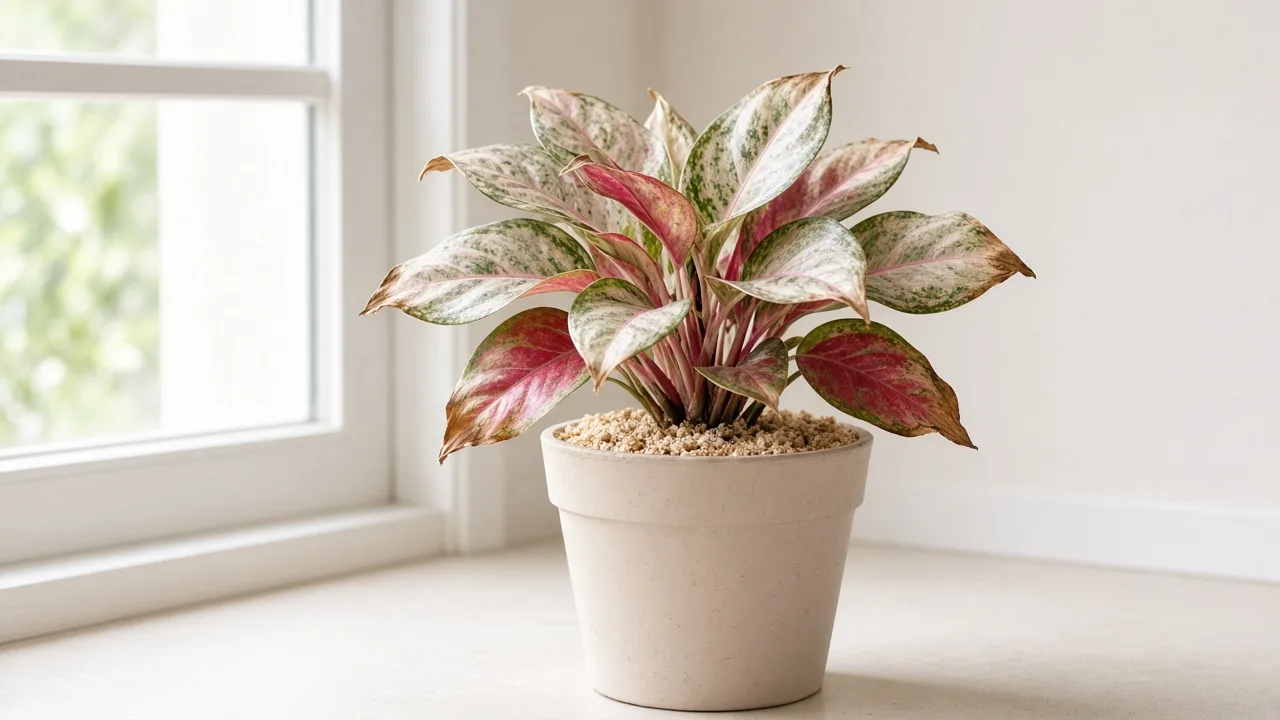
Crisp brown tips on cupped broad rosy-white leaves with faded variegation—classic early underwatering on a dry Super White, not yellow lower leaves on wet soil.
Early signs:
- Light pot when lifted—noticeably lighter than right after a thorough soak
- Pale, crumbly surface mix that pulls slightly from the pot edge through the top 2–3 cm
- Slightly cupped or limp broad leaves that still feel firm, not mushy
- Dull rosy-white variegation fading toward flat gray-green on stressed broad blades
- Brown or crispy tips and margins, especially on older lower leaves
- Slowed new leaf emergence—no fresh rosy-white flushed leaves for weeks during warm months
Advanced signs:
- Several broad petioles drooping on bone-dry mix throughout the upper root zone
- Lower leaf drop after extended drought
- Paper-thin leaf feel along the broad blade—tissue has lost turgor
- Hydrophobic dry pockets—water runs straight through while the center stays powder-dry
- Crown limpness on a very light pot after weeks without water in bright heat—possible before rhizome reserves empty
A single brown tip on one aging lower leaf in a heated dry room may be low humidity or fluoride tap water rather than pot drought—Super White is sensitive to mineral salts in hard water. Underwatering adds light weight + dry top 2–3 cm + multiple cupping broad leaves to that picture.
The broad-leaf drought signature
Super White is a high-variegation Chinese evergreen with broad glossy blades—not the narrow ribbon foliage of Cutlass or the silver-centered pattern of Silver Bay. That morphology changes how thirst looks.
When turgor drops from drought, the entire broad leaf may cup inward along the midrib rather than curling lengthwise like a ribbon. Because white zones contain minimal chlorophyll compared to green cultivars, owners sometimes miss early stress—the plant still looks dramatic while the pot has gone dry. Watch rosy-white clarity: on a thirsty Super White, crisp white and cherry-red splashes dull to flat gray-green before wide sections brown.
Stem and crown check: Petioles usually stay firm longer than the leaf blade thins. If the crown cluster where new broad leaves emerge feels soft on wet soil, that is not underwatering—see overwatering. Firm crown + light dry pot + cupped broad leaves confirms thirst.
The variegated-light dry-down surprise
Super White is often sold as a low-light plant, but its white tissue demands bright, indirect light to maintain color—and brighter filtered light uses water faster than a dim office rhythm allows. Underwatering frequently appears in the opposite setup from overwatering: a plant finally given proper light near an east window, a sheer-curtained south exposure, or a grow light at 150–300 fc.
Signs you are in this trap:
- Pot weight drops sharply within a week of the last soak
- Surface mix turns pale and dusty while new rosy-white growth stalls
- Broad leaves cup on a light pot—unlike the dim-corner overwatering trap where mix stays dark and heavy
- Variegation dulls faster than in a north-window plant on the same watering calendar
The fix is not to move Super White back into deep shade—it is to check the top 2–3 cm dry-down more often in brighter, warmer placements. See the Super White light guide for how placement changes your watering interval.
Reading the top 2–3 cm dry-down check for thirst
Super White watering on LeafyPixels follows a cultivar-specific rule: water when the top 2–3 cm of potting mix has dried, then drain fully. That matches Clemson HGIC guidance to water when the top 1–2 inches of soil feel dry—and it matters for thirst diagnosis.
Before you assume a cupping Super White needs water:
- Insert a finger or skewer to mid-pot depth. If only the top inch is dry but the lower half is still moist, wait—especially in a dim office.
- Lift the pot. Light weight plus cupped firm broad leaves at top-layer dryness points to underwatering.
- Compare to your normal rhythm from the watering guide. If you have not checked in weeks during a warm bright spell, dry-down may have passed without obvious wilt.
Dry thirst confirms when the top 2–3 cm is pale and crumbly, the pot is light, and leaves cup on firm tissue. Wet root failure confirms when mid-depth mix is cool and damp, lower leaves yellow, or the crown softens—see the overwatering guide instead.
Why Aglaonema Super White gets underwatered
Chinese evergreens store some moisture in stems and rhizomes and tolerate brief drying, which makes owners underestimate how fast a small pot can desiccate in the wrong room. Leaves may turn brown in very dry air or a drafty location even when soil moisture is borderline—humidity and watering overlap on broad variegated margins.
Fear of overwatering after reading variegated-cultivar warnings. Super White culture emphasizes root rot risk in dim light. Owners who stop checking entirely after one soggy episode often swing to chronic drought instead.
Calendar neglect after moving to brighter light. A plant that needed water every three weeks under fluorescents may need checks every 7–10 days after a summer move toward a filtered window—variegated Aglaonema selections use more water in brighter light.
Small plastic nursery pots in heated rooms. Compact Super White clumps in 4-inch pots dry fast when furnace heat runs. The top 2–3 cm can go from moist to powder-dry in four or five days.
Hydrophobic old peat. Mix that has gone completely dry may repel water. Once soil gets very dry it may need to be soaked to get properly wetted again Surface looks briefly damp after a quick splash while roots stay dry inside.
Winter heating without adjusted checks. Growth slows in cooler short days, but dry furnace air accelerates evaporation from small pots. Reduce watering frequency in winter—but still probe the top layer; drought tolerance is not immunity.
Vacation gaps and office abandonment. Super White survives longer than a fern, but broad leaves still crisp when reserves run out after extended neglect.
How to confirm the cause
Work through this checklist in order. Two or more dry-soil matches confirm underwatering before you change multiple variables.
- Lift the pot — Light compared to post-watering weight means moisture is depleted in the upper root zone.
- Skewer to mid-depth — Dry, pale, crumbly mix through the top 2–3 cm supports thirst; cool damp lower half on a heavy pot points elsewhere.
- Press the crown base — Firm on dry mix supports underwatering; soft on wet mix means root rot.
- Feel broad leaves — Slightly cupped but firm blades on dry mix; not mushy or translucent.
- Note the room — Bright filtered window, heating vent, or small pot strongly favors faster dry-down.
- Check for hydrophobic runoff — Water channels down the pot sides without wetting the center after long drought.
First fix for Aglaonema Super White
Give one thorough watering until excess runs from the drainage holes, then empty the saucer within 30 minutes.
Use room-temperature water—Clemson HGIC recommends room-temperature water for Chinese evergreens—and wet the entire root ball, not a teacup splash on the surface. Filtered or rested tap water helps if your municipal supply leaves brown tips on pale tissue. Move the pot to bright filtered indirect light while it recovers; do not blast stressed broad leaves with direct sun the same day.
That single deep soak lets you read the plant for several days without stacking repotting, fertilizer, or pruning. If water runs straight through dry hydrophobic mix, bottom-soak the nursery pot in a basin for 15–25 minutes until the surface moistens, then drain fully—see the watering guide for bottom-watering notes.
If the crown is soft on wet soil, stop—this is not an underwatering fix. Follow the overwatering or root rot protocols instead.
Step-by-step recovery
Mild cases (firm crown, light dry pot, crisp tips only)
- Water thoroughly until drainage runs free; empty saucers and cachepots.
- Wait for the top 2–3 cm of mix to dry again before the next full soak—do not water daily.
- Trim fully brown crispy tips only if they bother you; they will not re-green.
- Scout weekly for new broad leaves with strong rosy-white color.
- Resume the watering guide rhythm once pot weight cycles predictably.
Moderate cases (several cupped broad leaves, hydrophobic mix)
- Bottom-soak or re-water slowly in two passes if the first pour ran through dry channels.
- Check that soil mix is not so dense that only the center ever dries—very old peat may need refresh at the next repot window.
- Move away from heating vents or scorching glass until turgor returns.
- Hold fertilizer until new growth looks healthy for two warm weeks.
Severe cases (limp crown on bone-dry mix after long neglect)
- Bottom-soak until the root ball regains weight, then drain fully.
- Remove only fully desiccated lower leaves that crumble—leave firm tissue.
- If rhizomes are shriveled and tan but still firm when you unpot, the plant can recover with consistent soak-and-dry cycles.
- If rhizomes are black and mushy on damp mix, switch to the root rot protocol—that damage is wet-root failure, not drought.
Recovery timeline
Mild underwatering on a firm-crown Super White often shows firmer broad leaves within 24–48 hours after one proper soak. Crispy brown tips already damaged will not turn green again. Judge recovery by:
- Petioles standing at their usual compact angle
- New broad leaves emerging with strong rosy-white and cherry-red color
- Pot weight rising after watering and dropping predictably as the top 2–3 cm dries
- Cupping easing on leaves that were firm before the soak
If leaves stay limp on wet heavy soil after you watered, or the crown softens while mix stays damp, switch to overwatering diagnosis rather than adding more water.
Lookalike symptoms to rule out
| Signal | Underwatering | More likely alternative |
|---|---|---|
| Pot weight | Light, dry upper layer | Heavy → overwatering |
| Leaf tips | Crisp brown on dry mix | Crisp tips on moist mix in dry air → low humidity or brown tips |
| Leaf posture | Cup on light dry pot | Limp on wet soil → drooping leaves |
| Variegation | Dull on dry pot | Washed out in dark corner → not enough light |
| Yellow lowers | Rare on dry mix | Yellow on wet mix → yellow leaves |
| New growth | Stalled on dry pot | Stalled in dim wet pot → slow growth |
Spider mites can stipple broad leaves in dry heated rooms—inspect leaf undersides for webbing if crisping returns right after you correct watering. See spider mites if pests are present.
Mistakes to avoid
- Daily small splashes after seeing cup—surface dampness with a dry center worsens stress and can invite salt buildup.
- Fertilizing a dry plant to “wake it up”—feed only after moisture normalizes and new growth looks stable.
- Repotting immediately into a much larger pot—extra dry soil volume makes the next dry-down harder to read.
- Misting broad leaves instead of watering roots—humidity helps margins in dry air but does not replace a dry root ball.
- Assuming all droop is thirst without pot weight—wet-root limpness needs dry-down, not another soak.
- Waiting for dramatic wilt—Super White may show crisp tips and dull variegation before obvious collapse.
How to prevent underwatering next time
Match checks to how this pot dries in this room, not a calendar copied from another plant:
- Water when the top 2–3 cm of mix has dried—see the watering guide.
- Learn dry pot weight by lifting when you think the upper layer is dry versus right after watering.
- Check more often in bright filtered light, near heating vents, and in small nursery pots.
- Stretch intervals in dim offices—but still probe mid-depth; drought tolerance is not immunity.
- Refresh hydrophobic peat at repotting if water repeatedly channels around a dry core.
- Pair watering checks with the light guide whenever you move Super White.
When to worry
Treat as urgent if:
- Several broad leaves collapse on powder-dry mix and the crown feels limp
- You cannot re-wet the root ball after repeated full soaks—hydrophobic mix may need repotting
- Crisping spreads to new crown leaves within a week despite corrected watering
- The plant shows soft mushy tissue on damp soil—that is rot, not thirst
Related tool
Use the Plant Watering Calculator to narrow causes for underwatering on this plant before changing multiple variables at once.
Related Aglaonema Super White guides
- Overview — placement, growth speed, and what healthy rosy-white variegation looks like
- Watering — top 2–3 cm dry-down rhythm after underwatering stabilizes
- Light — when brighter placement speeds dry-down beyond office rhythms
- Overwatering — when a heavy wet pot and yellow lowers mean the opposite problem
- Brown tips — when crisp margins trace to dry air or fluoride rather than dry soil
- Problems hub — full symptom index for this cultivar