Yellow Leaves on Aglaonema Super White: White-Zone Pattern
Quick answer
Yellow leaves on Aglaonema Super White usually start on the oldest broad lower blades—often after rosy-white zones wash pale—while a firm crown may still push new white-and-cherry flush. First step: lift the pot and probe whether the top 2–3 cm of mix is still damp before you water, move, feed, or repot.
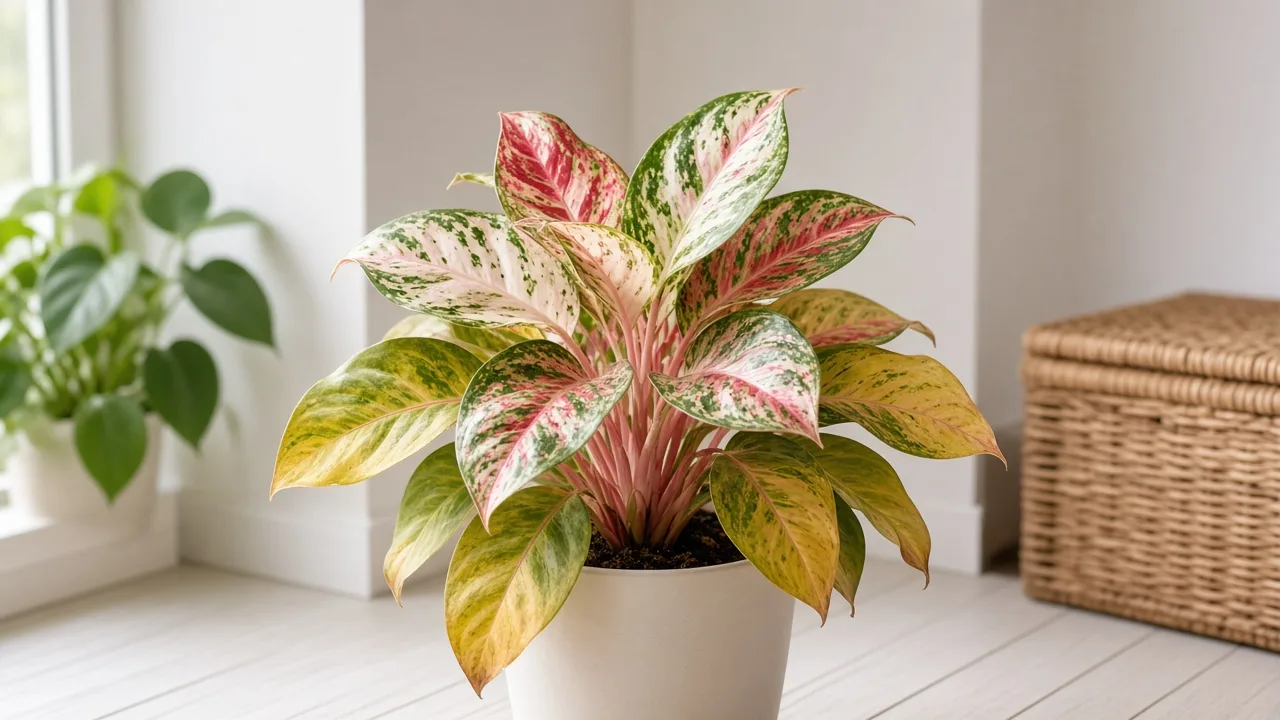
Yellow Leaves on Aglaonema Super White: Causes, Checks & Fixes
This guide covers yellow leaves on Aglaonema Super White. See also the general Yellow Leaves guide, watering, and light pages for this plant.
Yellow Leaves on Aglaonema Super White: Causes, Checks & Fixes
Quick answer
Yellow leaves on Aglaonema commutatum ‘Super White’ are a pattern problem on broad rosy-white variegated foliage, not a single diagnosis. Super White is a tissue-cultured Thai hybrid with glossy leaves splashed rosy-white, cherry-red, and green; trouble usually starts on the oldest broad blades closest to the soil line—or spreads across several lowers when a heavy wet pot sits in a dim room where this high-variegation cultivar barely uses moisture.
For how chlorosis develops on houseplants in general, see our yellow leaves hub. On Super White, the decisive split is pot weight plus which broad leaves yellow—and whether new crown spears still carry strong rosy-white and cherry-red color, not whether one leaf aged out while the crown still looks fine.
First step: lift the pot and probe whether the top 2–3 cm of mix is dry or still damp. If the upper layer is wet while lower broad leaves yellow, do not add water. That single pause lets you read wet-root stress versus normal senescence before repotting, fertilizer, or pesticide.
When to use this page vs other Super White guides
This page is the symptom-first entry for yellow broad foliage on a white Chinese evergreen.
| Pattern | Read next |
|---|---|
| Heavy wet pot + several yellow lower broad leaves | Overwatering |
| Soft crown + sour mix + mushy roots | Root rot |
| Light dry pot + crisp curled margins | Underwatering |
| Fading white on new flush + long bare petioles in shade | Not enough light |
| Uniform pale oldest lowers, smaller new blades | Nitrogen deficiency |
| Yellow between veins on old broad leaves | Magnesium deficiency |
| Yellow new crown blade with green veins | Iron deficiency |
| Washed-out green without clear wet-soil clues | Pale leaves |
| One bottom broad leaf only while white spear unfurls above | Normal aging—stay here |
| Long-term dry-down rhythm after recovery | Watering guide |
What yellow leaves look like on Aglaonema Super White
Healthy Super White holds broad glossy leaves with rosy-white and cherry-red anthocyanin zones on a dark green base in a slow, upright clump. Yellowing changes that pattern in ways that map to root zone, light, or age.
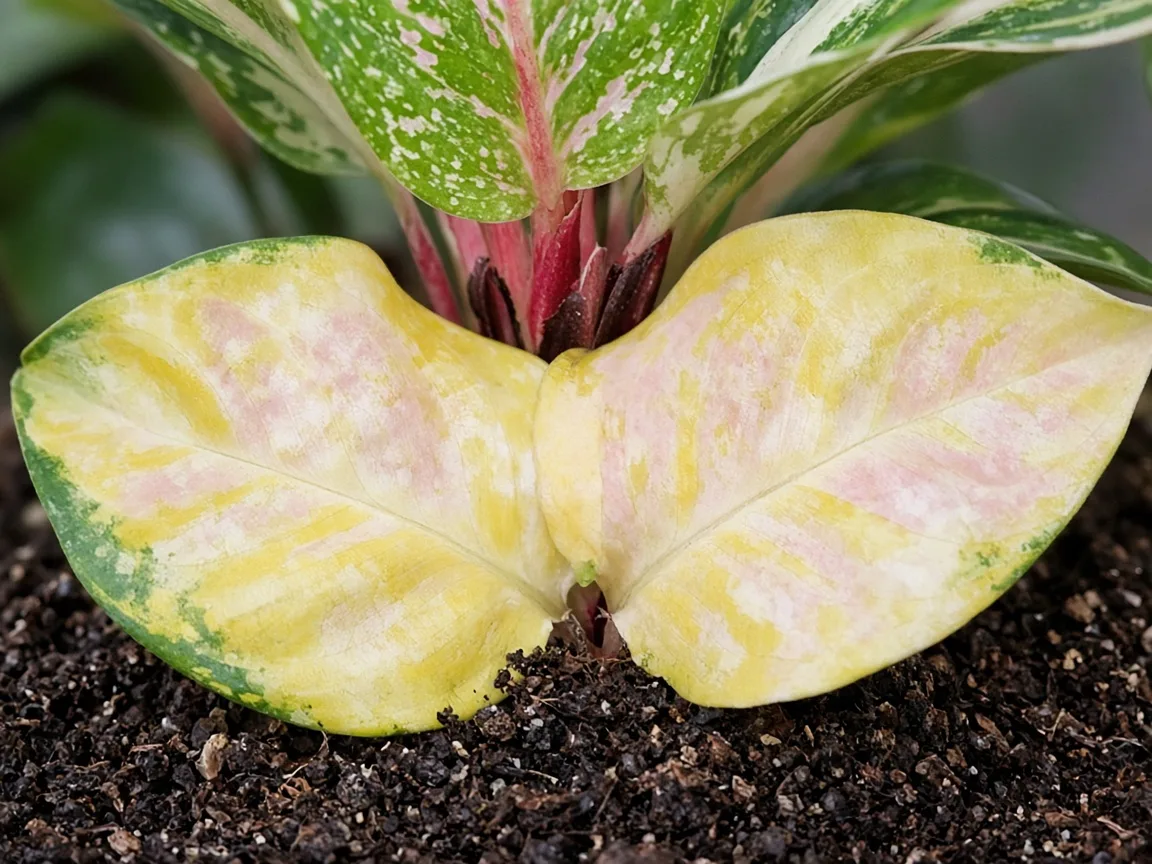
Yellow lower broad blade at the soil line—compare fading rosy-white wash with the greener white-and-cherry blade still emerging at the crown.
Typical signs:
- Yellow or yellow-green lower broad leaves while newer crown blades stay greener or still carry white and cherry-red
- Rosy-white zones washing to pale cream-yellow on stressed lower tissue before the whole blade turns butter-yellow
- Soft limp petioles on wet mix—not the crisp curl of a dry pot
- Heavy pot days or weeks after the last watering
- One outer broad leaf yellowing while a firm rosy-white spear unfurls directly above—often normal senescence on a slow clump
Not simple yellow leaves:
- Fine yellow stippling with webbing at petiole bases—spider mites
- Sticky residue on young white blades—aphids, mealybugs, or scale
- Tiny flies at the pot rim on damp peat—fungus gnats overlapping wet-soil stress
- Interveinal yellow on oldest lowers with dark green veins—magnesium deficiency
- Yellow new crown blade with green veins—iron deficiency
- Crispy brown tips with pale margins on otherwise firm leaves—fluoride or salt stress; see brown tips
Because Super White is a slow upright Chinese evergreen with broad lance-shaped leaves on short stems, one yellow lower broad blade does not always mean crisis. Several lowers failing together on saturated mix does.
Reading the rosy-white fade before full yellow
This plant-only check would be nonsense on a snake plant rosette or a ribbon-type Cutlass. On Super White, where color washes out on the broad canopy routes you faster than any generic “check your watering” advice:
- One lowest outer broad leaf only, firm crown, normal dry-down — Often normal aging as the clump sheds its oldest blade; a rosy-white spear unfurling above confirms the growing point is healthy.
- Several lower broad leaves yellow together on a heavy pot — Wet-root stress in low light; see overwatering before feeding.
- New crown spears losing white and turning plain yellow-green — Light or root stress on chlorophyll-poor white tissue; pair not enough light with moisture checks.
- Uniform pale wash on oldest lowers with smaller new blades — Mobile nutrient loss; cross-check nitrogen deficiency only after roots are firm and mix is not chronically wet.
- Yellow new crown tissue with green veins — Immobile iron issue at the unfurling blade; not the same as lower-leaf senescence.
Always read the newest crown spear, not only the largest old broad leaf, when deciding urgency.
How white-zone tissue yellows before green zones on Super White
Super White is a tissue-cultured Thai hybrid whose pale rosy-white sectors lack chlorophyll. When roots fail from chronic wet mix, those white patches often dull and go limp before the green margins fully yellow—a pattern that does not appear on solid-green Aglaonemas like Maria or Silver Bay.
Because white tissue transpires without replacing water through photosynthesis, Super White can look stressed on the variegated face even when overall soil moisture is borderline. Owners sometimes pour more water when they see pale limp white zones, deepening the cycle. Pair white-zone dulling with pot weight and a finger check at 2–3 cm depth before you add another drink.
The variegated light paradox: bright needs vs slow dry-down
Super White breaks the usual Aglaonema office-plant story in two directions at once. It needs brighter filtered light than green Chinese evergreens to hold white and cherry-red color—but many owners still place it in dim corners because “Aglaonemas tolerate low light.” In that setup, a peat-heavy nursery pot may stay wet for two weeks after one watering while broad leaves slowly lose firmness.
Chinese evergreens tolerate low light but root rot occurs if overwatered. Plants in waterlogged soil die because roots cannot absorb oxygen; damaged roots then fail to move moisture to broad variegated leaves even when the pot feels damp. The trap is not ignorance about light alone—it is calendar watering in a pot that dries too slowly for how little the plant transpires in shade.
The fix pairs brighter indirect light with water only when the top 2–3 cm dries—not more water to “perk up” limp leaves on soggy soil. See the Super White light guide for placement and the watering guide for dry-down rhythm.
Why Aglaonema Super White gets yellow leaves
Overwatering in low light (most common serious cause)
Chronic wet peat-perlite mix in a cachepot starves rhizome roots of oxygen. NC State notes root rots can occur with over-watering and recommends allowing the medium to dry between waterings. Lower broad leaves yellow first while the crown may still look firm until rot advances.
Normal lower-leaf senescence
Slow-growing variegated aglaonemas shed one aging broad blade at a time from the outside of the clump. Dead or yellowing leaves should be removed under normal interior care. If the petiole is firm, dry-down rhythm is stable, and a rosy-white spear unfurls above, isolated bottom yellowing is expected—not a repot emergency.
Not enough light compounding wet mix
In deep shade, Super White uses even less water and loses white anthocyanin, which can look like yellowing before true chlorosis spreads. Mix that dried in a week near an east window may take three weeks in a dim cubicle—so the same watering volume becomes overwatering without any extra drinks. Yellow lowers plus washed white zones plus wet skewer in dim rooms point here before deficiency.
Underwatering (less common but real)
Extended dry spells yellow margins and tips on a light pot with dusty dry upper mix. Broad leaves may curl slightly but stay firm—not limp on wet soil. See underwatering when pot weight and skewer confirm drought.
Nutrient depletion
Nitrogen is mobile, so deficiency symptoms show up first on lower leaves as general yellowing—uniform pale oldest broad blades with smaller new crown spears. Iron and magnesium show different vein patterns on glossy tissue; route to the specific deficiency pages rather than assuming “yellow means feed.” Never fertilize a waterlogged clump—uptake fails when roots stay saturated.
Cold drafts and sudden moves
Aglaonema prefers daytime temperatures in the 70 to 80-degree F range and is intolerant of cold. A drafty window or AC blast after summer outdoors can yellow several broad leaves at once. Stabilize placement before repotting or feeding.
Pests (local yellowing with other signs)
NC State lists aphids, mealybugs, spider mites, and scale on Aglaonema. Stippling, stickiness, or removable shells on broad undersides yellow tissue locally—inspect before blaming water alone.
How to confirm the cause
Work through this order before repotting, feeding, or spraying:
- Lift the pot — Heavy days after watering vs noticeably lighter when you expect dry mix.
- Probe the top 2–3 cm — Wet cool stain on heavy pot means pause water; dusty dry on light pot means thirst check. Clemson recommends allowing the top 1–2 inches of soil to dry before watering again.
- Press the crown base gently — Softness on wet mix is rot risk; firm tissue follows leaf pattern.
- Count which broad leaves yellow — One lowest only vs several lowers vs new crown tissue.
- Check rosy-white color on new spear — Strong white and cherry-red vs washed yellow-green on wet pot vs dim room.
- Inspect broad undersides — Webbing, scale, honeydew before assuming care error.
- Sniff the mix — Sour odor means treat as confirmed root stress, not aging.
First fix to try
Stop changing variables until you know whether the pot is wet-heavy or dry-light, and whether the crown is firm.
That single pause prevents the classic mistake: watering because broad white-variegated leaves yellowed on already-saturated mix, or repotting and feeding while roots are still oxygen-starved.
- Heavy wet pot + several yellow lowers → Stop all watering until the top 2–3 cm of mix dries; see overwatering.
- Soft crown + sour mix → Same-day root rot protocol.
- Light dry pot + slightly curled firm broad leaves → One thorough soak, then resume top-layer dry-down per the watering guide.
- Washed white + long petioles in dim room → Move to brighter filtered light before changing pot size—not enough light.
- One firm bottom broad leaf yellow + white spear above → Monitor two weeks; trim when mostly yellow per the pruning guide.
Step-by-step recovery
Wet-soil yellowing (firm crown, early stage)
- Stop watering until the top 2–3 cm of mix is dry throughout.
- Empty cachepots and saucers; improve airflow at the pot base.
- Resume soak only when skewer and pot weight confirm dryness—UF/IFAS notes interior Aglaonema still needs modest balanced feed during growth, but not on saturated roots.
- Watch for the next crown spear with strong rosy-white and cherry-red color within two to four weeks.
Dry-soil yellowing
- Confirm dryness with skewer and pot weight—not calendar days.
- Water thoroughly until drainage runs free; empty saucers within 30 minutes.
- Wait for top-layer dry-down before the next drink.
- Expect older yellow broad blades to finish fading; judge new white-and-cherry blades at the crown.
Light-stress yellowing
- Move to brighter filtered indirect light—east window, sheer-filtered south or west, or a timed grow lamp 12–18 inches above the crown.
- Hold repotting and fertilizer for two weeks while new leaf spacing tightens and white color returns.
- Accept that stretched petioles below will not shrink—recovery shows in firmer new blades with stronger rosy-white splashes.
Nutrient-related pale lowers
- Confirm firm white roots and stable moisture first.
- Apply one measured complete fertilizer on moist soil during active growth per the fertilizer guide—only after wet-root failure is ruled out.
- Route interveinal or crown-tip patterns to the specific deficiency pages.
Recovery timeline
| Severity | What to expect |
|---|---|
| One aging lower broad leaf | Yellowing stops at that blade; new crown spear within 2–4 weeks |
| Mild overwatering (firm crown) | Mix dries in 1–2 weeks; spreading yellowing halts; new white spear in 2–4 weeks |
| Drought stress | Perky broad leaves and new spear within 1–2 weeks after one corrected soak |
| Low light correction | Drop slows in 2–3 weeks; stronger white on new growth in 4–8 weeks |
| Rot at crown | Old yellow blades never re-green; salvage via division or firm-section rescue |
Judge success by firm crown tissue and fresh broad leaves with strong rosy-white and cherry-red color—not by lowest yellow blades turning green again.
Lookalike symptoms
| What you see | Likely cause |
|---|---|
| One lowest broad leaf yellow, firm crown, stable moisture | Normal senescence |
| Several yellow lowers + heavy wet pot | Overwatering |
| Yellow lowers + soft crown + sour mix | Root rot |
| Crisp margins, light pot, dry skewer | Underwatering |
| Washed white + long petioles in shade | Not enough light |
| Uniform pale oldest lowers, smaller new spears | Nitrogen deficiency |
| Yellow between veins on old broad leaves | Magnesium deficiency |
| Yellow new blade, green veins at crown | Iron deficiency |
| Stippling + webbing on undersides | Spider mites |
Mistakes to avoid
- Watering because broad white-variegated leaves yellowed on an already-heavy pot in a dim office
- Fertilizing yellow leaves on saturated mix—salts stress roots that are already oxygen-starved
- Repotting into a larger container while diagnosing yellowing on wet mix
- Moving straight into direct sun to dry the soil—sun scorch on pale Super White tissue adds a second stress
- Pruning several firm green blades before the crown stabilizes—remove only fully yellow lowers
- Treating interveinal yellow as nitrogen when vein rails stay dark green—switch to magnesium or iron pages
How to prevent yellow leaves next time
Match care to this variegated aglaonema’s slow rhythm:
- Water when the top 2–3 cm of mix has dried—not on a fixed weekly calendar.
- Use well-drained peat-perlite mix in a pot with drain holes only one size up.
- Empty saucers and cachepots within 30 minutes after every soak.
- When Super White moves deeper into shade, stretch dry intervals—light and water change together.
- Allow the medium to dry between waterings in cooler winter rooms.
- Scout the soil line weekly—fungus gnats and dark damp peat are early warnings before crown failure.
- Feed lightly during active growth per the fertilizer guide after roots stay firm for two weeks.
When to worry
A single yellow lower broad leaf on a firm crown after stable care usually responds to monitoring—not emergency repot. Escalate same-day when:
- The crown feels soft or collapses at the soil line
- Mix smells sour or roots are black and mushy on inspection
- Several lower broad leaves yellow within a week while soil stays wet
- The clump leans or wilts on saturated mix without recovering after the top 2–3 cm dries
Related Aglaonema Super White guides
- Overview — placement, growth speed, and what healthy rosy-white variegation looks like
- Watering — top-layer dry-down rhythm after yellowing stabilizes
- Light — filtered placement when washed white and wet mix overlap
- Overwatering — wet-mix yellowing with pot-weight tests
- Root rot — when soft crown and mushy roots confirm advanced damage
- Problems hub — full symptom index for this cultivar
Conclusion
Yellow leaves on Aglaonema Super White are a broad-blade and root-zone signal on a slow variegated clump—not a reason to stack repotting, feed, and pesticide on the same day. Lift the pot, map which broad blades yellow, and split wet-soft root stress from dry thirst, shade etiolation, nutrient wash-out, or one aging lower blade. Firm crown tissue and the next spear with strong rosy-white and cherry-red color are the recovery marker—individual yellow broad blades below will not turn green again, and that is expected once the correct care rhythm returns.
Related tool
Use the Yellow Leaves Diagnosis Tool to narrow causes for yellow leaves on this plant before changing multiple variables at once.