Fungus Gnats on Aglaonema Super White: Moisture Checks &
Quick answer
Fungus gnats on Aglaonema Super White almost always signal moist organic soil in a heavy pot—often from watering on a calendar while the top 2–3 cm of peat mix never dries. First step: confirm larvae with a potato slice on the surface, let the upper profile pass a dry skewer test before the next soak, and place a yellow sticky trap at the rim while you fix the watering rhythm.
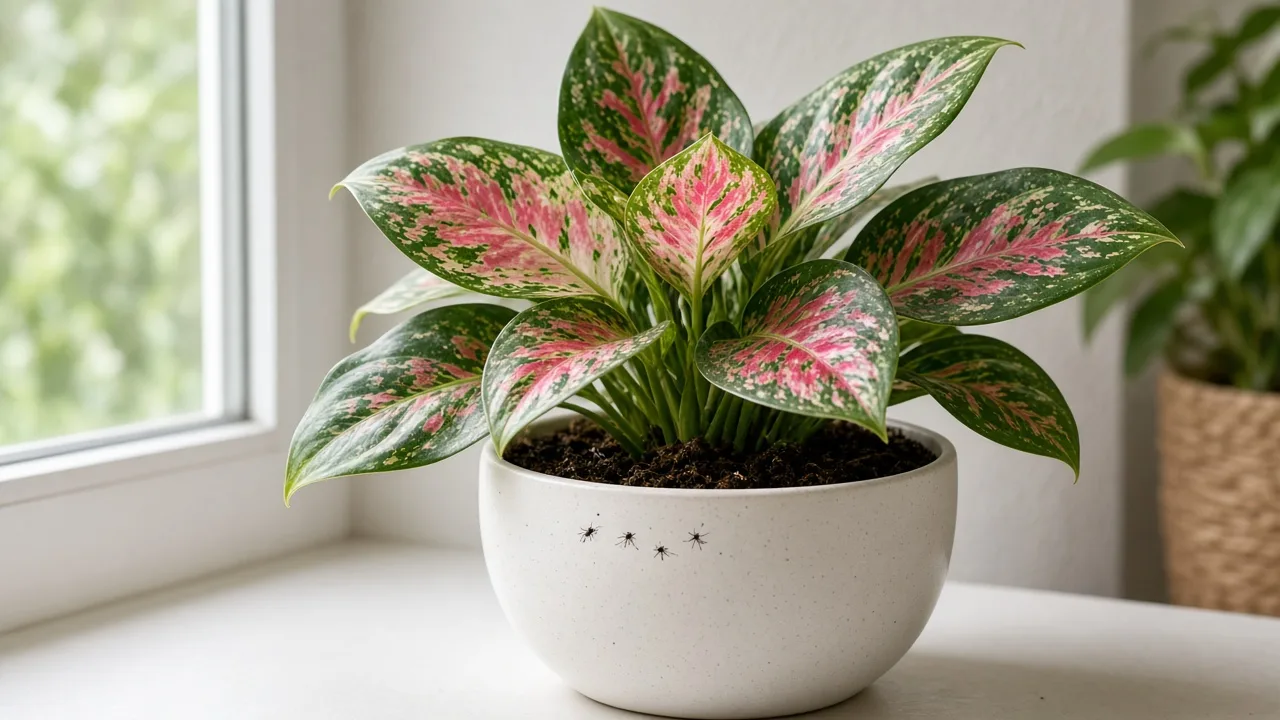
Fungus Gnats on Aglaonema Super White: Causes, Checks & Fixes
This guide covers fungus gnats on Aglaonema Super White. See also the general Fungus Gnats guide, watering, and light pages for this plant.
Fungus Gnats on Aglaonema Super White: Causes, Checks & Fixes
Quick answer
Fungus gnats on Aglaonema commutatum ‘Super White’ are almost always a soil-moisture and mix problem, not insects attacking the broad rosy-white leaves. Super White needs bright indirect light to hold its white variegation, but a heavy pot in a dim corner—or calendar watering while peat stays damp—is exactly where adult females lay eggs in moist organic debris and larvae feed on fungi, decaying matter, and fine roots.
For how fungus gnats behave in moist potting media in general, see our fungus gnats hub. On Super White, the useful clues are flies at the rim of a heavy pot, a dark damp peat surface that never lightens, calendar watering while the top 2–3 cm of mix stays wet, and yellow lower leaves from chronic saturation—not chewed white tissue.
First step: press a raw potato chunk cut-side down on the mix for 48 hours to confirm larvae, let the top 2–3 cm dry before the next soak, and set a yellow sticky trap at the pot rim. Make that one correction before repotting, systemic drenches, or spraying the whole room.
When to use this page vs other Aglaonema Super White guides
This page is the soil-line and moisture entry when tiny flies appear around a Super White pot.
| Pattern | Read next |
|---|---|
| White or gray fuzz on soil surface without many flies | Mold on soil |
| Soft black base, sour smell, crown collapse | Root rot or overwatering |
| Light pot, crisp leaf margins, no flies | Underwatering |
| Sticky residue on leaf axils with soft insects | Mealybugs |
| Fine webbing on broad leaves | Spider mites |
| Mix stays wet despite sparse watering | Soil guide — drainage and pot size |
What fungus gnats look like on Aglaonema Super White
On this plant you usually notice adults at the pot rim and windows before any crown damage. The broad glossy clump with rosy-white and cherry-red splashes often looks fine while the soil story is wrong.
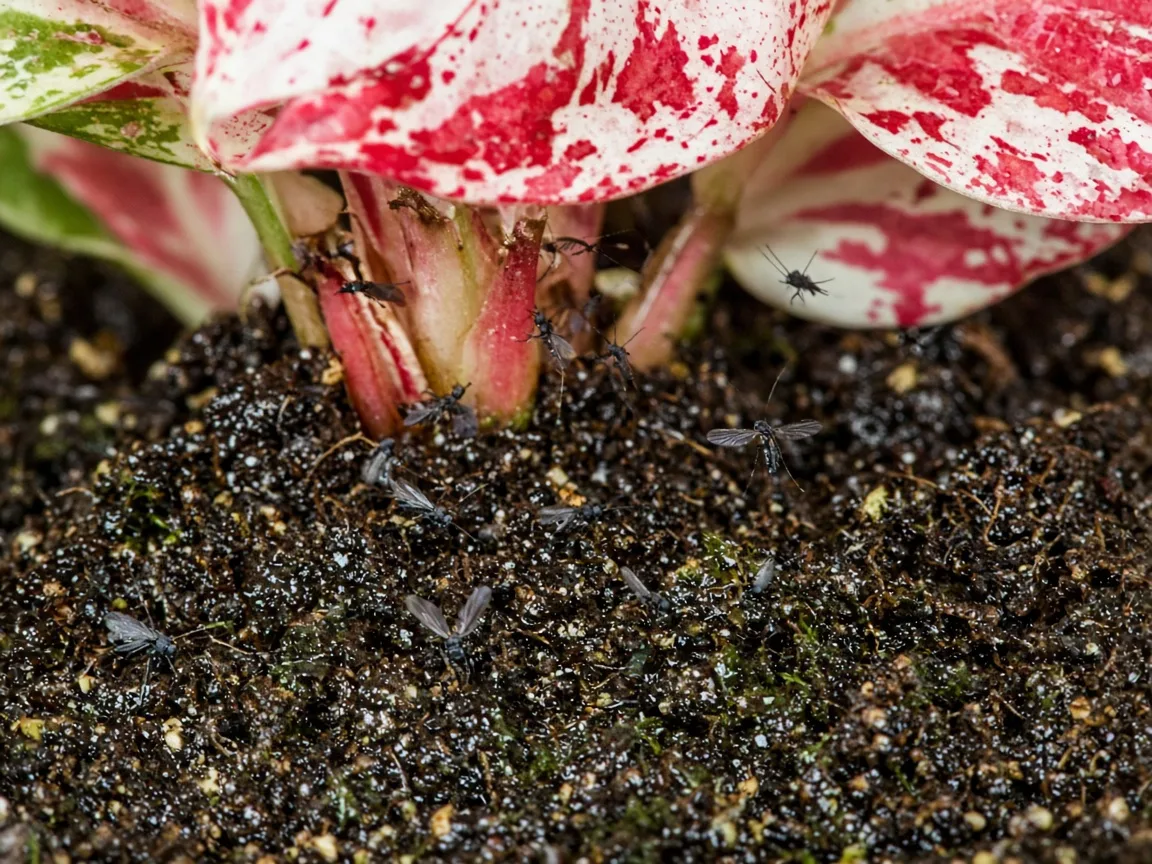
Tiny dark flies on moist peat at the Super White soil line—larvae need this damp layer; the white-splashed leaves above can stay firm while gnats breed below.
Typical signs:
- Small dark, mosquito-like flies about 1/16 to 1/8 inch long with long segmented antennae
- Flies that rise when you disturb the soil surface or a nearby damp houseplant pot
- Adults resting on windows, walls, or the outside of a cachepot—not crawling on broad leaves
- Slender translucent larvae with black head capsules under a potato slice on the mix
- Optional shiny slime trails on the soil surface when larvae are abundant, as UC IPM describes on container media
What Super White looks like when gnats are only part of the story:
- New broad leaves still emerge with strong white and cherry-red variegation and firm petioles—gnats are likely a surface-habitat nuisance tied to wet peat
- Yellow lower leaves with a heavy wet pot—prioritize overwatering and yellow leaves over insecticide
- Drooping leaves with dry deep mix and no flies—see underwatering before blaming larvae
Established Super White clumps have rhizomatous roots that tolerate brief drying better than prolonged saturation. Larval root chewing is more serious in seedlings and young divisions than on a mature firm clump—though chronic wet soil still deserves correction.
Fungus gnats vs. other small flies near display pots
Several tiny flies share windowsill space with variegated Aglaonema. Identifying the adult prevents the wrong fix.
| What you notice | Likely insect | Where it breeds | First check |
|---|---|---|---|
| Slender dark fly, long antennae, Y-shaped wing vein | Fungus gnat | Damp peat mix, compost surface, organic top-dress | Skewer dry test, potato slice, sticky trap at rim |
| Stockier fly, short bristle-like antennae, green algae on saucer | Shore fly | Algae on wet saucers, fouled cachepots | Clean saucer; compare antennae |
| Fly on fruit or kitchen waste | Fruit fly | Fermenting food | Remove food source |
| Fly from floor drain | Drain or moth fly | Drain biofilm | Clean drain—not the Super White pot |
UC IPM notes that fungus gnats have long segmented antennae, while shore flies around algae have short bristle-like antennae.
Why Aglaonema Super White gets fungus gnats
Moist peat below firm white-splashed leaves. Owners see glossy broad leaves with rosy-white variegation and assume the pot is fine. Peat-coco mix can stay damp at the bottom and surface while the foliage looks acceptable—exactly where fungus gnat larvae feed.
Calendar watering in dim corners. Super White needs brighter light than green cultivars, but many pots sit in hallways or back from east windows where growth is slow. Watering every week because it is Tuesday, without checking whether the top 2–3 cm have dried, keeps peat permanently moist through cool winter months.
Oversized decorative pots. A heavy ceramic cachepot or pot two sizes too large holds a reservoir of wet soil the compact clump never dries out. Gnats breed in that unused zone even when new leaves look clean.
Dense tissue-cultured clumps after division. Super White is often sold as a tight rosette of several crowns. Organic debris and damp pockets collect between broad leaves at the soil line where adults land and lay eggs—especially right after spring repotting.
Fresh organic top-dress or slow-release fertilizer on the surface. Manure, blood meal, or undecomposed compost on the peat surface adds food for fungi and larvae. Cross-check the fertilizer guide if flies appeared right after feeding.
Neighboring houseplants are the real source. Adults are weak fliers that often stay near breeding media but drift to windows and nearby pots. A constantly wet fern or pothos on the same shelf can supply flies that seem to belong to the Super White.
Recent repot into peat-retaining mix. Spring repotting into bagged indoor plant soil without enough perlite leaves a wet profile through the first warm month—peak gnat season indoors. See the soil guide for Super White-appropriate blends.
The bright-light placement vs. slow dry-down trap
Aglaonema Super White misleads owners because variegated leaves hide root-zone mistakes.
The cultivar is marketed for bright indirect light, but many pots end up in dim corners where white fades to green and water use stays low. Broad glossy leaves can look acceptable while peat at the crown stays too wet. None of that tells you whether the top 2–3 cm of mix has been saturated for three weeks.
Pot weight beats leaf color. Lift the nursery pot when you think it is dry. If it still feels heavy days after watering, gnats will keep breeding even though the foliage looks fine.
Skewer depth, not surface color. Push a bamboo skewer to the pot bottom. Pull it out and feel for dampness in the upper 2–3 cm—the same depth referenced in the watering guide. Dark peat can look acceptable on top while the profile stays wet in a hallway.
Cachepot blindness. A nursery pot inside a decorative sleeve often holds hidden runoff. Empty it within 30 minutes after every soak; standing water keeps the inner mix anaerobic and gnat-friendly.
Winter shelf shift. Cool dim rooms slow Super White growth but do not stop gnat lifecycles in warm soil. Indoor plants use less water while media stays moist—extend dry intervals when heat drops, even if broad leaves still look perky.
Light changes without watering changes. Moving Super White farther from a window for summer glare—or deeper into a display corner—reduces dry-down speed. Pair placement shifts with the light guide and a revised watering check, not the same calendar interval.
This dry-down logic is specific to slow-growing variegated Chinese evergreens in peat mix—not a succulent soak-and-dry schedule or a fern that wants evenly moist media.
Reading white variegation vs. yellow lower leaves
Super White diagnosis should separate normal old-leaf aging from wet-soil stress that feeds gnats.
Healthy crown signals while gnats are present:
- Newest broad leaves unfurl with strong rosy-white and cherry-red variegation
- Petioles feel firm where they meet the soil line
- Only the lowest one or two old leaves yellow while the crown stays dense
- Potato test shows larvae, but stems do not smell sour
Wet-soil stress that needs more than sticky traps:
- Several yellow leaves at once, starting from the bottom up
- Soft or collapsing crown with a heavy wet pot
- Sour smell when you lift the nursery pot from a cachepot
- Persistent flies while skewer never exits dry in the top 2–3 cm
Yellow lower leaves on Super White often overlap overwatering in heavy pots—the same condition that grows fungus gnats. Treat moisture first; do not assume yellowing means nutrient deficiency or pests on the broad foliage.
Do not confuse white fade with gnat damage. White zones reverting to green in deep shade is a light placement issue—flies at the rim do not cause that pattern. Gnats signal wet peat; pale new growth without flies signals insufficient light.
Broad-leaf debris pockets under the rosette
Tissue-cultured Super White pots carry broad overlapping leaves in a tight rosette. That shape creates plant-only gnat habitat:
- Fallen white-tinged leaf tips lodge under outer leaves and hold moisture against peat
- Water runs down petiole channels and pools at the inner rosette base
- Fresh division wounds and exposed rhizome edges shed organic debris for larvae
- A wide shallow bowl pot dries at the outer rim while the center stays damp
When scouting, part the outer leaves gently and look at the soil between stems—not only the pot rim. Scrape fallen debris from the crown zone before you judge whether larvae are abundant.
If you recently divided or repotted, expect a two-to-four-week gnat flare while peat settles and you relearn dry-down speed in the new container. Quarantine divided pots away from clean collections until trap counts fall.
How to confirm larvae without stressing the rosette
Use monitoring tools on the damp organic surface, not on the broad leaves:
- Observe flies at rest — Soil surface, pot rim, window glass, and outer cachepot—not leaf undersides.
- Skewer or finger test 2–3 cm deep — Confirm whether the next soak is actually due per Clemson dry-down guidance.
- Lift pot weight — Compare to a known-dry day if you can.
- Potato slice test — Raw potato chunks cut-side down for 48 hours; check for larvae underneath, then discard and replace with fresh potato.
- Yellow sticky trap — Small square at the rim catches adults and confirms activity trend over a week.
- Inspect cachepot and saucer — Algae, standing water, or decomposing leaf bits at the base.
- Shake neighboring pots — Flies may emerge from a wet neighbor instead of the Super White.
If the skewer is dry in the top 2–3 cm, larvae are absent on the potato test, and flies still appear, widen the search before treating the Super White mix.
First fix for Aglaonema Super White
Confirm larvae with a potato slice on the mix, then stop watering until the top 2–3 cm pass a skewer dry test—empty any cachepot runoff—and place one yellow sticky trap at the pot rim. Re-check in four to seven days before adding drenches or repotting.
This single step targets the moist conditions fungus gnats need without bone-drying a clump that may already have mild root stress. Rhizomatous roots access moisture deeper in the pot; a one-to-two-week surface dry-down on a firm crown is safer than flooding with insecticide on day one.
Do not repot on day one unless the crown is soft, black, or smells sour—that is root rot triage, not a gnat-only fix.
Step-by-step recovery
After the initial dry-down and trap:
- Resume thorough watering only when the skewer exits dry 2–3 cm down. Soak until runoff, then discard cachepot water—see the watering guide.
- Keep sticky traps at the rim for two weeks to track adult decline. Replace when coated.
- Apply Bti if larvae persist on potato tests after two dry cycles. Mosquito Bits or Gnatrol mixed as a soil drench targets fly larvae; repeat at five-day intervals while mix stays intermittently moist enough for larvae to feed.
- Top-dress with perlite if peat surface stays dark between soaks—improves surface drying without trapping moisture if the layer is thin and mineral.
- Move the plant outdoors briefly for any pyrethrin spray only if labeled for houseplants and Bti failed—UC IPM recommends against indoor fogging. Spray soil surface and pot rim, not broad foliage.
- Repot in spring if mix stays wet despite corrected watering—shift to well-draining peat-perlite mix in a pot only one size up, and wait several days before the first soak after repotting.
Avoid systemic houseplant granules on day two unless larvae remain abundant and crowns stay firm—correct moisture first on slow-growing Aglaonema.
Recovery timeline
Sticky traps often show fewer adults within one week once the surface dries reliably. Larvae in deep wet pockets may need two to three dry-soak cycles plus Bti—roughly two to four weeks total indoors.
Improvement signs: Fewer flies on traps, dry skewer at proper depth before each soak, firm petioles, new broad leaves with strong white variegation.
Worsening signs: Soft crown at soil line, several yellow leaves at once, persistent lean, or flies increasing while mix never dries—switch to overwatering and root rot diagnosis rather than repeating sprays.
Old lower leaves may yellow and drop on their own; that is normal aging on a compact rosette, not proof gnats damaged the crown.
Lookalike symptoms
| What you see | More likely | Quick check |
|---|---|---|
| Tiny flies at pot rim, damp peat | Fungus gnats | Long antennae; potato larvae |
| White fuzz on soil, few flies | Mold on soil | Surface mycelium; ventilation |
| Soft black crown base | Root rot | Smell; firmness test |
| Light pot, dry deep mix | Underwatering | Crisp margins; no larvae |
| Sticky leaf axils | Mealybugs | White cottony insects |
| Algae on saucer, short-antenna flies | Shore fly | Clean saucer; not mix larvae |
Mistakes to avoid
Do not mist the soil or top-dress with sphagnum moss to fight gnats—extra surface moisture extends larval habitat on peat-loving Super White.
Do not water on a fixed weekly calendar because the plant is on a display shelf. Dim corners reduce dry-down speed; use the skewer test instead.
Do not repot into fresh peat-heavy mix without perlite while larvae are active—you may spread insects to clean media without fixing drainage.
Do not bone-dry a clump that already shows soft tissue at the crown—measured dry-down on firm stems only.
Do not spray pyrethroids indoors across flight paths—UC IPM advises soil-focused control and moving plants outdoors briefly if sprays are used.
Do not ignore cachepot runoff. Standing water is both gnat habitat and an overwatering risk for Chinese evergreen roots.
Do not handle soil bare-handed if you have sap sensitivity—Super White contains calcium oxalate crystals; wear gloves when disturbing crowns during inspection.
How to prevent fungus gnats next time
Use well-draining peat-perlite mix in a stable pot only one size larger than the root ball.
Match watering to season and light—longer dry intervals in cool dim months per the watering guide.
Empty cachepots and saucers within 30 minutes after every soak.
Quarantine new plants for two weeks before placing them beside Super White on a shared shelf.
Scout the soil line weekly after repotting or moving the plant to a dimmer room.
Avoid fresh manure or undecomposed compost on the surface; use balanced feeds from the fertilizer guide mixed into the profile instead.
Pair placement with realistic light—bright filtered light speeds dry-down without scorching pale tissue; see the light guide.
When to worry
A few fungus gnats on an otherwise firm Super White with correctable wet surface soil are common in mixed houseplant collections and rarely threaten a mature clump once moisture is fixed.
Escalate when crowns soften at the soil line, several broad leaves yellow together, larvae stay abundant on potato tests after three dry cycles, or flies persist while the skewer never dries—those patterns overlap root rot and need root-zone triage, not another sticky trap alone.
Related Aglaonema Super White guides
- Overview — culture and toxicity
- Watering — top-layer dry-down for variegated leaves
- Soil — peat-perlite blends and pot size
- Light — bright indirect placement without overwatering
- Overwatering — when wet mix damages roots in heavy pots
- Mold on soil — surface fuzz without flying adults
- Root rot — soft crown and collapse
- Problems hub — full symptom index
Conclusion
Fungus gnats on Aglaonema Super White are a pot-base moisture signal in most homes—not insects eating rosy-white variegation. Confirm larvae at the soil line, dry the upper profile before the next soak, and trap adults while you align watering with a slow-growing variegated Chinese evergreen. Firm crowns and a stable dry-down rhythm are the recovery markers; persistent wet peat with a soft base means root problems, not flies alone.
Related tool
Use the Plant Problem Diagnosis Tool to narrow causes for fungus gnats on this plant before changing multiple variables at once.