How to Grow Bottle Gourd (Lagenaria siceraria) — Overview
Lagenaria siceraria
Grow bottle gourd or lauki on a sturdy trellis with full sun, warm-season sowing, steady moisture, hand pollination, and young-fruit harvest.
How to Grow Bottle Gourd (Lagenaria siceraria) — Overview
Start with wateringThe most common care mistake for Bottle GourdWatering guide → →Bottle Gourd care essentials
Light
Water
Keep the root zone consistently moist through establishment and fruit swell, but avoid waterlogged soil. Cucurbit vines use water quickly in full sun and wilt visibly when dry.
Soil
Light, sandy or loamy, well-drained soil rich in organic matter. pH 6.0–7.5 suits most cultivars.
Humidity
Temperature
Fertilizer
About Bottle Gourd
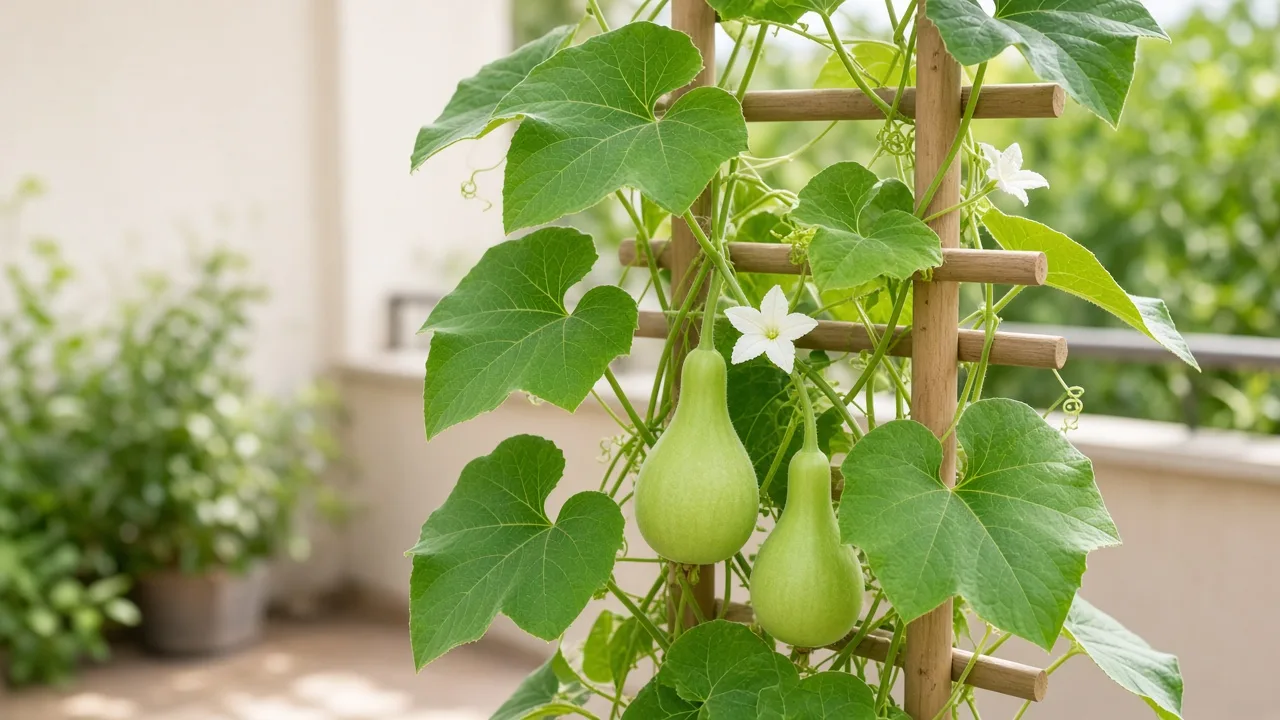
Bottle Gourd is native to Western tropical Africa (widely cultivated across South and Southeast Asia and the Indian subcontinent), typically reaches Vines 3–5 m long; spread 3–5 m on trellis or ground indoors, with rapid vine growth; young fruit for cooking in roughly 2–3 months; mature hard-shelled gourds need a long warm season growth. Bottle Gourd has a herbaceous annual vine growth habit and part of the Cucurbitaceae family. It is also known as Lauki, Doodhi, Calabash gourd, and White-flowered gourd.
| Detail | Information |
|---|---|
| Also known as | Lauki, Doodhi, Calabash gourd, White-flowered gourd |
| Native region | Western tropical Africa (widely cultivated across South and Southeast Asia and the Indian subcontinent) |
| Mature size | Vines 3–5 m long; spread 3–5 m on trellis or ground |
| Growth rate | Rapid vine growth; young fruit for cooking in roughly 2–3 months; mature hard-shelled gourds need a long warm season |
| Growth habit | Herbaceous Annual Vine |
| Scientific name | Lagenaria siceraria |
| Family | Cucurbitaceae |
How to Grow Bottle Gourd (Lagenaria siceraria) — Overview
Bottle gourd (Lagenaria siceraria), called lauki, doodhi, or ghiya across South Asia, is a fast-growing annual cucurbit vine grown for tender young fruit, edible shoots, and—when fully mature—hard dried shells. Britannica describes it as native to tropical Africa but cultivated for millennia in warm regions worldwide. Unlike compact kitchen herbs, this species needs full sun, warm soil, steady moisture, and several metres of climbing room on a sturdy trellis, fence, or terrace railing.
Before you buy seed, decide your goal. Cooking lauki means harvesting while the skin is still soft and light green. Craft or birdhouse gourds mean leaving fruit on the vine until the rind hardens and colour shifts toward yellow or tan, with stem attached at harvest Missouri Botanical Garden. The same species serves both uses, but spacing, support, and patience differ.
What Bottle Gourd Is and How It Grows
Scientific identity and cucumber-family relatives
Bottle gourd belongs to Cucurbitaceae, the cucumber and melon family. NC State Extension lists it as an annual climbing vegetable with large white night-blooming flowers, twining stems, and tendrils. It shares pests, pollen habits, and rotation rules with ridge gourd, pumpkin, and cucumber—so repeating cucurbits in the same bed every season invites recurring beetle and mildew pressure.
Common names overlap in seed catalogs: calabash gourd, white-flowered gourd, and opo squash often refer to forms of L. siceraria with different fruit shapes—round, bottle-shaped, or long cylindrical types My Kitchen Garden.
Growth habit, vine length, and timeline
Plants grow rapidly from seed but need a long hot season for quality mature fruit Missouri Botanical Garden. Vines commonly reach roughly 3–5 m (10–16 ft) on supports NC State Extension. Leaves are large and hairy; fruits are botanically a pepo that can exceed 90 cm on some ornamental cultivars though kitchen lauki is usually picked much smaller.
For tender cooking gourds, many Indian terrace growers see usable fruit in about 70–90 days after sowing when heat and water stay steady My Kitchen Garden. Hard-shell drying needs the full warm season plus weeks of on-vine maturation.
Warm-Season Sowing: Soil Heat Matters More Than Calendar Dates
Frost-free windows and 21 °C soil
Bottle gourd is killed by frost and sulks in cold, wet soil. NC State Extension recommends direct seeding outdoors after frost danger passes and ground temperature reaches about 21 °C (70 °F). Missouri Botanical Garden gives the same 70 °F threshold and notes that short-season climates can start seed indoors in peat pots a few weeks before the last frost, then transplant without disturbing roots.
Planting calendar for Indian growers
On north Indian plains, sow after the last cool snap—often late February through March for an early summer crop, or with the kharif rains June–July when nights stay warm. In humid coastal and southern regions, multiple sowings are possible from spring through monsoon as long as drainage stays good. Hill stations with cool nights should wait until soil warms consistently; a week of cold rain after sowing causes poor germination and seed rot.
This timing is the opposite of cool-season greens like spinach. Bottle gourd is a heat-tolerant cucurbit once established Missouri Botanical Garden, not a winter balcony herb.
Light Needs in Brief
Bottle gourd wants full sun—at least six hours of direct light daily NC State Extension. On a terrace, south- or west-facing rails usually outperform shaded courtyards. Missouri Botanical Garden notes that plants tolerate hot, humid summers and may accept light afternoon shade in the hottest lowland afternoons, but deep shade produces weak vines and few female flowers.
Window measurements, reflector tricks, and heat-stress diagnosis live in the dedicated Bottle gourd light guide. This overview only sets the rule: bright sun plus warm air, with cautious shade during extreme heat waves.
Water and Root-Zone Basics
Cucurbit vines transpire heavily in full sun. NC State Extension advises consistent moisture through establishment and fruit swell while avoiding waterlogged soil. The LeafyPixels hub matches extension practice: press a finger 2–3 cm into the mix and water when that layer feels dry, especially if leaves show midday wilt that recovers overnight.
Containers on hot terraces may need checks every one to two days during fruit swell; in-ground mounds hold moisture longer but still fail if fruit rests on saturated soil. Overwatering shows as yellow lower leaves and soft spots where gourds touch wet ground; underwatering shows as wilt that does not recover by evening and poor fruit set. Seasonal schedules, saucer habits, and first-response steps are in the Bottle gourd watering guide.
Soil, pH, and Why Pot Size Must Match the Vine
Fertility, drainage, and pH range
NC State Extension places bottle gourd in sandy or loamy, well-drained soil with good drainage and steady moisture. The LeafyPixels plant-detail hub targets pH 6.0–7.5 with high organic matter—a range compatible with most Indian garden loams after compost incorporation.
A workable container blend mirrors the hub recipe: about 50% quality potting mix or garden loam, 30% mature compost, and 20% perlite or coarse sand for aeration. Dense, airless mixes invite root disease; pure sand dries too fast for flowering vines.
Containers vs. ground on terraces
Bottle gourd can grow in pots, but the pot must be wide and deep—often 50 cm diameter or larger—with a trellis anchored to the pot or railing. A decorative 20 cm pot cannot support a vine that wants metres of stem. Match volume to expected spread or train aggressively on a fixed trellis. Mix recipes, pH checks, and wrong-soil warning signs are expanded in the Bottle gourd soil guide and Bottle gourd fertilizer guide.
Trellis, Spacing, and Training Stems Early
NC State Extension recommends planting several seeds in mounds about 90 cm (3 ft) apart when vines climb supports, or 1.2–1.8 m (4–6 ft) apart if vines trail on the ground. Thin to the strongest seedlings after true leaves appear.
Train tendrils upward within the first two weeks of growth. Hanging young fruit stays cleaner than gourds sitting on wet monsoon soil, which reduces rot and soil stains Missouri Botanical Garden. For ornamental hard shells, supports must be strong enough that mature fruit never touches the ground.
Pruning side shoots, tip-pinching for bushier flowering, and trellis hardware are covered in the Bottle gourd pruning guide. Seed starting, peat-pot transplant timing, and mound prep are in the Bottle gourd propagation guide and Bottle gourd repotting guide.
Night Flowers, Pollination, and Fruit Set
Large white flowers open at night NC State Extension. Bees and moths usually transfer pollen, but hand pollination often improves fruit set on screened balconies or high terraces where pollinators rarely visit Missouri Botanical Garden. Identify male blooms (thin stem, no swelling at base) and female blooms (tiny fruit shape behind the flower), then brush pollen in early morning if night flowers are already closing.
Blossom drop and misshapen fruit often trace to heat stress, drought during flowering, or failed pollination—not mysterious “plant mood.” Fix water and pollination before reaching for extra fertilizer.
Harvest: Tender Lauki vs. Hard Calabash
For everyday cooking, pick gourds while the skin is tender, glossy, and light green, before seeds harden and rind turns woody. Slice lengthwise and check flesh; young fruit should feel like firm zucchini, not cork.
For dried containers or crafts, leave fruit on the vine until the shell hardens and colour shifts yellow or brown, then cut with several centimetres of stem attached and dry in a ventilated shade Missouri Botanical Garden. Mixing up harvest goals—cooking an over-mature gourd or drying a tiny fruit—accounts for many beginner disappointments.
Food Safety: Never Eat Bitter Bottle Gourd
Many lines are mild and staple curries across South Asia, but some fruits are bitter and inedible Missouri Botanical Garden. Before cooking a new harvest or unfamiliar seed lot, taste a tiny piece of raw flesh; if it is bitter, discard the entire gourd—do not peel, salt, or cook it away. Cucurbit bitterness signals compounds linked to serious illness in people. This rule is non-negotiable and separate from normal mild lauki flavor.
Pests, Diseases, and Airflow
NC State Extension lists typical cucurbit issues: aphids, cucumber beetles, squash bugs, squash vine borers, and diseases such as downy mildew, powdery mildew, and anthracnose. Inspect leaf undersides weekly, remove collapsed stems promptly, and avoid overhead irrigation late in the day on food crops.
Good spacing, trellis airflow, and crop rotation beat repeated spraying on vegetables you plan to eat. If vines melt down suddenly in mid-summer, suspect vine borer or bacterial wilt and remove affected stems rather than nursing a dying plant through the heat.
Common Bottle Gourd Care Mistakes
Undersizing support and pots is the most frequent terrace error—a metre of decorative trellis for a five-metre vine yields shade stress and no fruit. Sowing too early in cold soil produces weak, disease-prone seedlings. Letting fruit sit on wet ground during monsoon invites rot and insect entry.
Skipping hand pollination on isolated balconies leads to “all flowers, no gourds.” Harvesting over-mature fruit for curry gives fibrous, seed-heavy lauki. Ignoring bitterness on a new cultivar risks food safety. Treating bottle gourd like a houseplant—low light, small pot, no trellis—conflicts with its biology as a sun-loving annual vine.
Pets, Grazing, and Human Food Crops
Bottle gourd is cultivated as human food, but that does not prove pet safety. The ASPCA Animal Poison Control plant list does not provide a species-specific entry for Lagenaria siceraria in the database reviewed for the LeafyPixels hub. Prevent cats, dogs, and other animals from grazing vines or fallen fruit, and contact a veterinarian after meaningful ingestion or vomiting.
Do not assume edibility for people extends to unrestricted pet access, especially on pesticide-treated terrace plants.
When to Use This Page vs. Other Bottle Gourd Guides
Use this overview when you need the whole picture—identity, season, trellis space, light and water summary, pollination, harvest stage, and safety—before opening a single-topic guide. Open the Bottle gourd light guide for sun hours, heat stress, and balcony orientation. Use Bottle gourd watering when wilt, saucer habits, or monsoon frequency need troubleshooting.
Bottle gourd soil and Bottle gourd fertilizer cover mix recipes, pH, and feeding without repeating here. Bottle gourd propagation and Bottle gourd repotting walk through seed starts and seedling pot-ups. Bottle gourd pruning explains tip cuts and side-shoot management for manageable terrace vines.
Related Bottle Gourd Guides
- Bottle gourd hub — profile, grower notes, and tools
- Bottle gourd light — sun hours, terrace placement, heat shade
- Bottle gourd watering — finger-test depth, container frequency, wilt clues
- Bottle gourd soil — mixes, pH, drainage, wrong-soil signs
- Bottle gourd fertilizer — nitrogen timing, fruit-stage feeding
- Bottle gourd propagation — sowing dates, peat pots, germination
- Bottle gourd pruning — vine training and tip pruning
Conclusion
Bottle gourd rewards growers who respect its warm-season vine biology: sow after soil warms near 21 °C (70 °F), site plants in full sun, keep steady moisture without waterlogging, and budget metres of trellis before seed hits soil. Train stems early, pollinate night flowers when bees are scarce, and harvest tender lauki while skin stays soft—while testing every new line for bitterness before cooking. Match container size to vine vigor, rotate away from other cucurbits, and follow sibling guides when one lever—light, water, soil, feed, propagation, or pruning—needs deeper instruction than this overview can hold.
How to care for Bottle Gourd?
When should you water Bottle Gourd?
Keep the root zone consistently moist through establishment and fruit swell, but avoid waterlogged soil. Cucurbit vines use water quickly in full sun and wilt visibly when dry.
- Press a finger 2–3 cm into the soil - Keep the root zone consistently moist through establishment and fruit swell, but avoid waterlogged soil.
- water when it feels dry and the vine shows early midday wilting that recovers overnight - Cucurbit vines use water quickly in full sun and wilt visibly when dry.
- Drain excess water - Keep the root zone consistently moist through establishment and fruit swell, but avoid waterlogged soil.
What soil works best for Bottle Gourd?
Light, sandy or loamy, well-drained soil rich in organic matter. pH 6.0–7.5 suits most cultivars.
- 50% quality potting mix or garden loam - Light, sandy or loamy, well-drained soil rich in organic matter.
- 30% mature compost
- 20% perlite, coarse sand, or fine bark for drainage - Light, sandy or loamy, well-drained soil rich in organic matter.
Grower notes for Bottle Gourd
Budget space for a long vine
Bottle gourd is a vigorous annual climber, not a compact pot herb. NC State Extension notes vines can spread about 3–5 m, so plan a sturdy trellis, fence, or rooftop railing before sowing. A shallow decorative pot without support will not produce reliable fruit.
Sow warm and give full sun
Direct-sow or transplant after frost danger passes and soil reaches about 21°C (70°F). Missouri Botanical Garden recommends full sun with light, well-drained soil and consistent moisture. Heat and humidity are tolerated once roots are established.
Support fruit for cooking or crafts
For tender lauki, train vines on a trellis so young gourds hang rather than sit on wet soil. For ornamental hard shells, keep mature fruit off the ground so skins stay clean and rot-free. The same species is grown for edible young fruit and dried calabash containers.
Pollinate night-blooming flowers
Large white flowers open at night. Hand pollination often improves fruit set when bee activity is low on balconies or in screened rooms. Harvest cooking gourds while the skin is still tender and light green; leave fruits for drying until the rind hardens and color shifts toward yellow or tan.
Never eat bitter fruit
Missouri Botanical Garden notes that some bottle gourd lines can be bitter and inedible. Taste a tiny piece of raw fruit before cooking a new harvest; discard the entire gourd if it tastes bitter, because cucurbit bitterness can cause serious illness in people.
Watch cucurbit pests early
Like other cucumber-family crops, bottle gourd attracts squash vine borers, cucumber beetles, and downy mildew when crowded or overwatered. Inspect leaf undersides weekly, keep airflow around the vine, and remove badly infested stems rather than spraying repeatedly on food crops.
Edible crop, but limit pet access
Bottle gourd is a human food crop, but the ASPCA plant database does not list Lagenaria siceraria. Prevent unrestricted pet grazing and ask a veterinarian before offering vines or fruit.
Young bottle gourd is eaten as a vegetable, but bitter fruit can be toxic to people and must be discarded. Pet-specific safety for this species was not established in the ASPCA listings reviewed.
Watering Bottle Gourd
For Bottle Gourd, press a finger 2–3 cm into the soil; water when it feels dry and the vine shows early midday wilting that recovers overnight and water check every 1–2 days in warm weather or containers; water when the top 2–3 cm is dry rather than on a fixed calendar. Increase frequency during hot, dry spells and heavy fruit load; ease back as vines senesce near harvest.
| Detail | Information |
|---|---|
| How often | Check every 1–2 days in warm weather or containers; water when the top 2–3 cm is dry rather than on a fixed calendar |
| How to check | Press a finger 2–3 cm into the soil; water when it feels dry and the vine shows early midday wilting that recovers overnight |
| Seasonal changes | Increase frequency during hot, dry spells and heavy fruit load; ease back as vines senesce near harvest |
Signs of overwatering
- wilting with persistently wet soil
- yellowing lower leaves
- soft fruit spots where gourds rest on damp ground
Signs of underwatering
- limp leaves that do not recover by evening
- blossom drop or small, misshapen fruit
- dry soil pulling from container edges
Soil & potting for Bottle Gourd
Use a mix of 50% quality potting mix or garden loam, 30% mature compost, 20% perlite, coarse sand, or fine bark for drainage for Bottle Gourd. Good drainage with steady moisture; saturated beds encourage root disease and fruit rot where gourds touch wet soil. Target soil pH around 6.0–7.5. Repot not routinely repotted—direct-sow or start seed in peat pots and plant out once frost risk has passed, ideally in sow after soil warms to about 21°C (70°F), typically late spring through early summer in frost-prone regions.
| Detail | Information |
|---|---|
| Recommended mix | 50% quality potting mix or garden loam, 30% mature compost, 20% perlite, coarse sand, or fine bark for drainage |
| Drainage | Good drainage with steady moisture; saturated beds encourage root disease and fruit rot where gourds touch wet soil |
| Soil pH | 6.0–7.5 |
| Repotting frequency | Not routinely repotted—direct-sow or start seed in peat pots and plant out once frost risk has passed |
| Best season to repot | Sow after soil warms to about 21°C (70°F), typically late spring through early summer in frost-prone regions |
Signs it needs repotting
- seedlings are root-bound in starter cells before transplant
- a container is too small to support a 3 m+ vine and trellis
- drainage has failed and the mix stays sour-smelling