Calathea White Fusion Fertilizer Guide
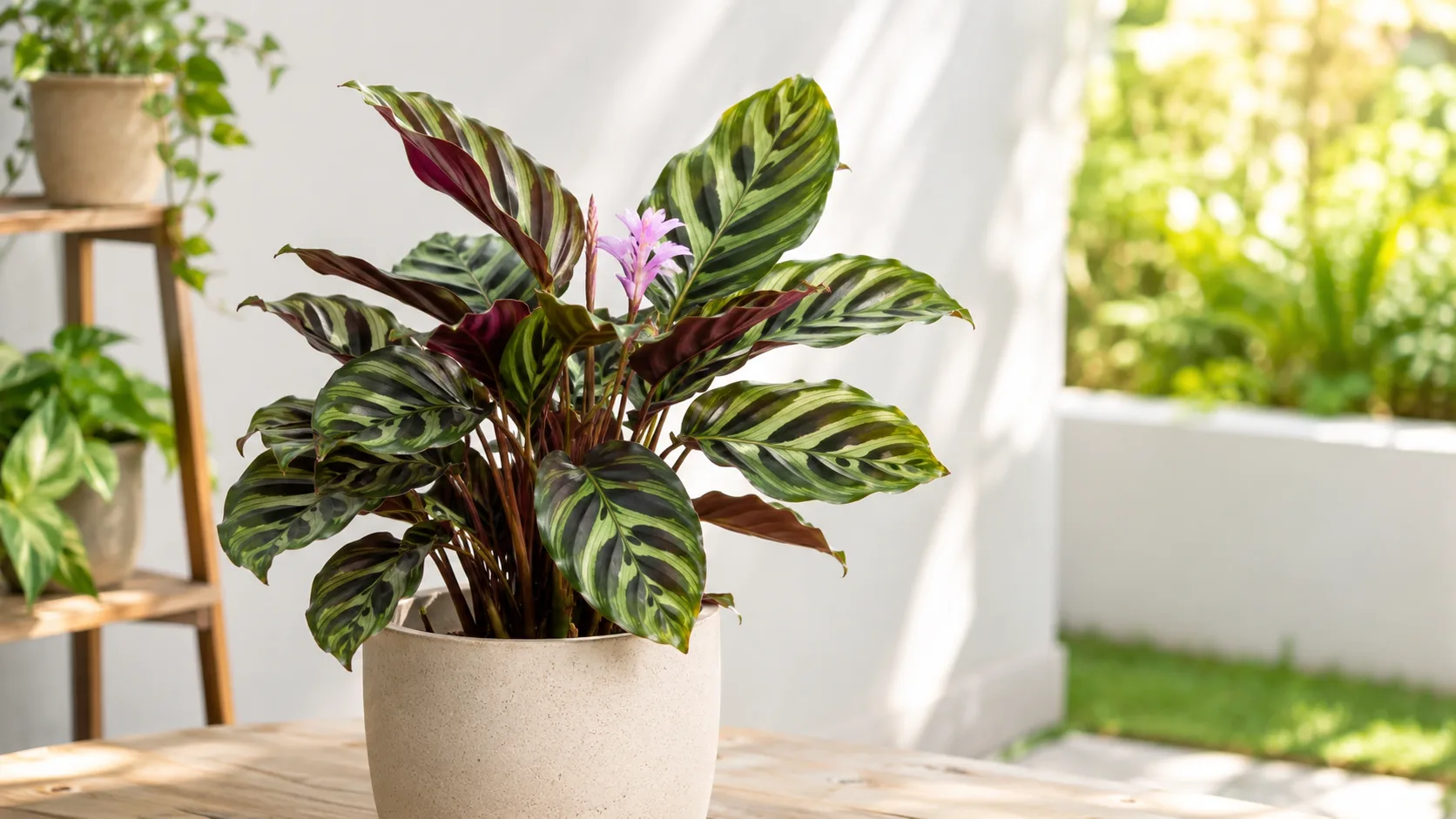
Calathea White Fusion Fertilizer Guide
Calathea White Fusion Fertilizer Guide
White Fusion at a glance: Goeppertia lietzei ‘White Fusion’ — a marbled white-and-green prayer plant cultivar. Foliage: heavily variegated leaves with white, green, and lilac brushstrokes; white sections burn fastest in dry air or hard water. Humidity: 60–80% RH; a humidifier is strongly recommended year-round. Water: rainwater, distilled, or filtered water only — fluoride and minerals brown white variegation within one unfurl cycle. Difficulty: high — among the most humidity- and water-quality-sensitive calatheas sold.
Calathea White Fusion — sold as Goeppertia lietzei ‘White Fusion’ and still labeled Calathea ‘Fusion White’ on many tags — is not a heavy feeder dressed in dramatic leaves. It is a compact Marantaceae prayer plant whose heavy white marbling reduces the leaf area that can photosynthesize, so growth is modest even when light, humidity, and watering are correct. Fertilizer maintains tissue the plant is already building; it cannot bleach back brown white sectors caused by fluoride, dry air during unfurl, or salt shock. The practical default: complete liquid houseplant fertilizer at quarter to half label strength, applied every four to six weeks from mid-spring through early fall onto moist soil, with a full pause in late autumn and winter unless strong grow-light growth clearly continues.
For genus-wide prayer-plant rules and cultivar comparisons, see the Calathea fertilizer hub. This page focuses on what changes when every new leaf is a marbled report card and white tissue shows damage first.
The Short Answer: How to Feed White Fusion
Product: Complete water-soluble 10-10-10 or foliage-oriented 3-1-2 with micronutrients listed on the label. Many experienced growers prefer urea-free formulas for sensitive prayer plants.
Strength: Quarter to half the label’s indoor-houseplant dilution. Start at quarter strength for new purchases, lower-light rooms, or any history of crispy white margins.
Frequency: Every four to six weeks during active growth (roughly April through September in temperate homes). Royal Horticultural Society calathea guidance recommends once a month during the growing season and no feeding October through March — that monthly cadence aligns when you use conservative strength on a slow variegated cultivar.
Pause rule: Stop when new spears slow, days shorten, or the plant shows stress. Hold food four to six weeks after repotting or division.
Recovery from overfeed: Flush with plain filtered or rainwater, discard runoff, pause feeding four to six weeks, resume at weaker strength.
Why White Fusion Needs More Restraint Than Green Calatheas
Prayer plants evolved as understory clump-formers with fine rhizomatous roots in fast-draining forest litter — not as hungry feeders in rich garden soil. NC State Extension on Goeppertia advises fertilizing only during the growing season with half-strength organic houseplant fertilizer — a genus baseline that already assumes restraint. White Fusion sits at the sensitive end of that genus because its showiest tissue is also its most fragile.
NC State’s Goeppertia lietzei profile describes ‘White Fusion’ as compact, with each leaf uniquely variegated in white, green, and purple, wavy margins, and the species habit of folding leaves at night and unfolding by day. That nightly movement is a health signal more reliable than any single old leaf edge — if folding stops while you are feeding heavily, pause food and audit moisture and humidity before increasing dose.
The mistake most White Fusion owners make is copying a three-to-four-week schedule written for faster green cultivars like Rattlesnake, then blaming humidity when the newest marbled unfurl opens with brown white sectors. Overfeeding does not always yellow the whole plant instantly. It often deposits soluble salts in a small pot where evaporation concentrates minerals even when uptake slows — and White Fusion’s white tissue loses moisture and shows burn at the margins before green sections look affected.
White Sectors and Photosynthetic Limits
White and pale sectors on variegated leaves contain far less chlorophyll than green tissue. The plant must support those pale sections using energy from green areas — which means White Fusion builds new leaves more slowly and uses less total nitrogen per month than a solid-green calathea of similar pot size. More fertilizer does not restore marbling lost to dim light; it often accelerates salt buildup while the grower waits for pattern improvement that only brighter indirect light can deliver.
What Fertilizer Does for Marbled Prayer-Plant Leaves
Fertilizer supplies mineral elements the potting mix loses over time. Each watering leaches some nutrients through the drainage hole. Root uptake removes others. Peat or coco breaks down and releases less nutrition over months. Even a well-run White Fusion — stable 60–80% humidity, filtered water, bright indirect light — eventually needs a modest nutrient input if you want full-sized new leaves rather than progressively smaller spears with washed-out pattern.
Nutrients support chlorophyll-rich green tissue and root tips while the plant pushes one new spear at a time from the crown. Fertilizer does not paint white brushstrokes on the blade; genetics and light do. Think of feeding as maintenance for visible active growth, not a rescue tonic for brown tips caused by hard tap water or dry air during unfurl.
Pale or small new leaves can mean several things. Low light produces weaker spears before they open. True nitrogen deficiency can yellow older tissue when the mix is genuinely depleted. Salt burn browns white margins while green centers still look fine. Adding fertilizer when the real limit is water chemistry or humidity is the fastest way to damage a cultivar whose whole appeal is the condition of the newest marbled leaf.
Why Nutrients Cannot Replace Light or Humidity
RHS Fusion White lists partial shade and moist but well-drained compost — cultural conditions that must be stable before any dose increase. NC State notes White Fusion does best above 60% humidity and with filtered or distilled water because fluoride in tap water browns foliage. If white sectors crisp while soil moisture looks correct, switch water sources and raise humidity before reaching for the fertilizer bottle.
Best Fertilizer Type for Calathea White Fusion
The best product is one you can measure accurately, dilute conservatively, and stop immediately if the plant reacts. Brand matters less than form, analysis, and your ability to avoid doubling doses accidentally. Many prayer-plant growers prefer urea-free liquid formulas because urea can add root-zone stress in sensitive species, though plenty succeed with standard complete houseplant liquids when diluted and applied on moist soil.
White Fusion does not need a specialty “variegation booster.” It needs the same complete nutrition other Goeppertia species use, applied more carefully because damage is visible on white tissue within one unfurl. If a label offers a houseplant rate, treat that rate as the ceiling, then cut it again for White Fusion. Never combine a full liquid dose with fresh controlled-release prills unless you know exactly what is already in the mix.
Liquid vs Slow-Release for Sensitive Cultivars
| Form | Advantage for White Fusion | Main risk | Best use case |
|---|---|---|---|
| Liquid or water-soluble | Precise dose; easy to pause | Over-application; salt spikes | Most indoor White Fusion growers |
| Slow-release pellets | Steady low release | Hard to remove if plant reacts; stacks with liquid | Fresh repot only, with label math |
| Organic liquids | Gentle profile | Variable analysis; odor indoors | Growers who already use them successfully |
The RHS calathea growing guide notes that mixing slow-release fertiliser into compost at repotting can supply nutrients for months, meaning you may not need liquid feed in the first year — a useful rule for White Fusion, which often arrives in nursery mix with starter charge already present.
N-P-K Ratios That Work Indoors
Fertilizer labels show N-P-K — nitrogen, phosphate, potash. Nitrogen drives leaf development, which matters for a foliage plant. Phosphorus supports root function. Potassium helps regulate water movement inside cells. A balanced 10-10-10 or foliage-weighted 3-1-2 both work when diluted properly. Avoid high-phosphorus bloom boosters for routine care, and skip foliar sprays as your primary method — marbled leaves spot easily and nutrient films do not replace steady root uptake.
Dilution and Application: Step-by-Step
N.C. Cooperative Extension states that house plants should be fertilized when cultural conditions are favorable, that many growers succeed diluting fertilizer to half strength, and that strong concentrations can burn roots. Extension also warns: never apply fertilizer to dry potting mix — water first if the medium is not already moist.
Application sequence for White Fusion:
- Confirm the plant is actively growing — a visible new spear or recent clean unfurl, not wilt or yellowing from rot.
- Check soil moisture at the top 2 cm; water with filtered or rainwater if dry, or proceed if appropriately moist.
- Mix fertilizer to quarter or half the label’s houseplant dilution in your watering can.
- Pour evenly across the soil surface until a small amount drains from the bottom.
- Empty the saucer after 10–15 minutes so roots do not sit in fertilized runoff.
- Log the date and dose; wait at least four weeks before the next application unless growth is exceptionally fast in bright conditions.
Worked Quarter-Strength Example
Suppose your label reads 1 teaspoon (5 ml) per gallon (3.8 L) for houseplants. Quarter strength for White Fusion:
- Quarter strength: 1.25 ml per gallon — roughly ¼ teaspoon per gallon.
- Half strength: 2.5 ml per gallon — roughly ½ teaspoon per gallon.
For a 6-inch (15 cm) pot that takes about 1 pint (500 ml) of solution per thorough watering, scale proportionally: at quarter strength, that is about ⅛ teaspoon in 500 ml water. When in doubt, use the weaker mix and judge by the next one or two new leaves, not the day after feeding.
Spring and Summer Feeding Schedule
Active growth for most indoor White Fusion specimens runs from mid-spring through early fall — when new spears appear regularly, room temperatures sit in the 65–75°F (18–24°C) range NC State recommends, and the plant folds and unfolds leaves on schedule each day.
Baseline: Feed every four to six weeks at quarter to half strength on moist soil. Faster pushes in bright east-window placements with high humidity may tolerate the four-week end; dimmer rooms or recent stress should stay at six weeks and quarter strength only.
April–May: Resume only after sustained new growth returns — not because the calendar flipped. First spring dose should be weak. June–August: Peak growth window; most plants need two to three light feeds total if on a four-to-five-week rhythm. September: Taper — one optional weak feed if growth is still strong; otherwise stop.
When to Stretch to Six-Week Intervals
Stretch feeding when: the plant sits more than a few feet from the window, the pot dries slowly in a humid bathroom, you recently repotted into nutrient-containing mix, or white crust has appeared on the soil surface before. White Fusion in a lower-light corner uses nutrients slowly; calendar feeding without growth checks is how salt loads build through summer.
Winter Feeding: When to Pause Completely
Usually stop entirely from late autumn through early spring. Shorter days, cooler rooms, and slower dry-down mean roots cannot use extra nutrients efficiently. Continuing to feed through winter often produces salt buildup and brown white margins by midwinter — symptoms that overlap with dry furnace air and are easy to misdiagnose.
Resume weak feeding only when sustained new spear growth returns in spring. Exception: if White Fusion grows actively under supplemental grow lights in a warm room through winter, you may apply quarter strength every six to eight weeks while watching for white crust on the soil surface.
Signs You Are Over-Fertilizing White Fusion
Over-fertilizing is common because symptoms overlap low humidity, fluoride damage, and underwatering. Fertilizer-linked stress often follows a feed or two and includes:
- Brown or crispy white sectors on the newest unfurling leaf, especially along margins
- White crystalline crust on the soil surface or inner pot rim
- Leaf drop despite moist soil
- Stalled spears that abort halfway through unfurl
- Reduced nightly folding when root function declines
White tissue burns first because it transpires faster at the margins and has less metabolic buffer than green tissue. Do not compensate with more feed “to help the plant recover.”
Salt Crust and Stalled Unfurls
If a new spear opens with torn or browned white patches immediately after feeding, treat fertilizer as the prime suspect alongside water quality. Flush with plain appropriate water, pause feeding, and judge recovery on the next clean unfurl — old burned tissue will not revert.
Salt Flush and Recovery After Overfeed
Recovery steps:
- Stop all fertilizer immediately.
- Flush with plain filtered, distilled, or rainwater — roughly three times the pot volume in repeated passes, letting excess drain fully each time.
- Discard all runoff; never let the pot sit in stale leachate.
- Hold plain water only for four to six weeks minimum.
- Resume at quarter strength only after a new spear opens with clean white sectors.
- Severe cases with persistent crust or sour smell may need repotting into fresh mix without new fertilizer for another month.
Even careful feeders should leach salts periodically during active growth: once every one to two months, water thoroughly with plain water until excess drains, especially if you fertilize regularly or use harder water.
New Purchases, Repotted Plants, and Stressed Specimens
Newly purchased White Fusion often arrives with starter nutrient charge in the nursery mix. N.C. Cooperative Extension notes recent purchases may not need fertilizer for two to three months if color and growth are good. Acclimate to your water and humidity before assuming hunger.
After repotting or division, wait four to six weeks before the first liquid application unless you used completely inert mix and the plant actively grows without transplant shock. Stressed plants — curl from dry air, droop from underwatering, yellowing from rot — need the stress resolved first. Extension guidance is explicit: never fertilize a diseased, injured, or damaged plant; fertilizer is not medicine.
The ASPCA lists Calathea as non-toxic to dogs and cats, but chewing any plant can cause mild stomach upset. Store concentrated fertilizer out of reach.
When to use this page vs other Calathea White Fusion guides
- Calathea White Fusion overview — Start here for whole-plant context, buying checks, and first-month settling-in notes before deep-diving feeding.
- White Fusion light — Fix brightness and window placement before increasing fertilizer; pale pattern usually means light, not hunger.
- White Fusion watering — Moisture rhythm and filtered water quality matter more than dose for crisp white tissue.
- White Fusion soil — Mix structure affects how salts concentrate; repot timing changes when to resume feed.
- Calathea fertilizer hub — Genus-wide prayer-plant feeding rules and cultivar comparison table when you own multiple calatheas.
Related Calathea White Fusion guides
- Calathea White Fusion overview
- White Fusion light
- White Fusion watering
- White Fusion soil
- White Fusion repotting
- White Fusion propagation
Conclusion
Calathea White Fusion fertilizer success is matching quarter to half-strength complete liquid feed to visible active growth on a slow variegated cultivar — not treating food as a shortcut for humidity, filtered water, or bright indirect light. Feed every four to six weeks through spring and summer, pause through winter, flush salts before dormancy, and let clean white sectors on the newest unfurl be your feedback loop. When the next marbled leaf opens without crispy white margins, the routine fits; when crust appears or folding stops, pull back before you reach for the measuring spoon again.