Calathea White Fusion Watering Guide: Schedule & Soil Checks
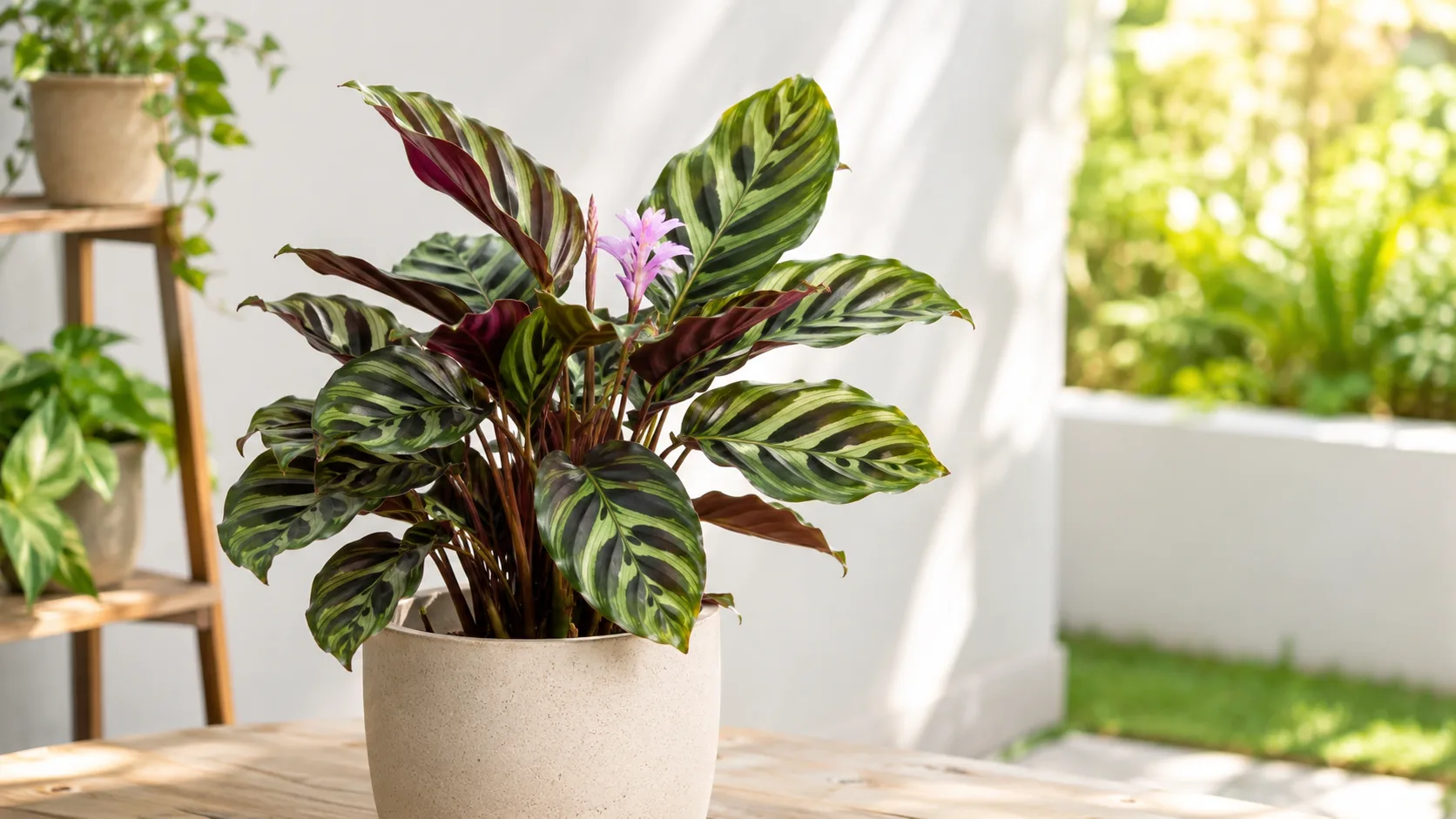
Calathea White Fusion Watering Guide: Schedule & Soil Checks
Calathea White Fusion Watering Guide: Schedule & Soil Checks
Calathea White Fusion (Goeppertia lietzei ‘White Fusion’) is one of the most visually striking prayer plants sold — and one of the fastest to punish watering mistakes on its white sectors. A new spear can unfurl with crisp brown margins while the green portions still look fine, which makes owners reach for the watering can when the real problem is hard tap water, dry air during unfurl, or soil that has been wet too long. White Fusion is not a “water more” plant or a “water less” plant. It is a check the mix, use clean water, and pair moisture with humidity plant. This guide covers when to water, how to read the potting mix, which water to use, seasonal adjustments, and what too-wet or too-dry looks like on this cultivar specifically.
White Fusion at a glance: Goeppertia lietzei ‘White Fusion’ — a marbled white-and-green prayer plant cultivar. Foliage: heavily variegated leaves with white, green, and lilac brushstrokes; white sections burn fastest in dry air or hard water. Humidity: 60–80% RH; a humidifier is strongly recommended year-round. Water: rainwater, distilled, or filtered water only — fluoride and minerals brown white variegation within one unfurl cycle. Difficulty: high — among the most humidity- and water-quality-sensitive calatheas sold.
For whole-plant context, see the Calathea White Fusion overview. Light and water use are tightly linked — a plant in strong Calathea White Fusion light dries faster than one in a dim corner.
The Short Answer: When to Water Calathea White Fusion
Water Calathea White Fusion when the top 2 cm (about ¾ to 1 inch) of potting mix has begun to dry and the pot feels noticeably lighter than it did right after a thorough watering. In many homes during active spring and summer growth, that dry-down happens about every 5 to 7 days in a standard plastic nursery pot with a peaty, well-draining mix. In cooler, darker fall and winter months, the same plant may need water only every 7 to 10 days, because growth slows and the mix holds moisture longer. Those ranges are starting points, not rules — light, humidity, pot size, and soil composition change the timeline within days.
The NC State Extension Gardener Plant Toolbox notes that Goeppertia lietzei prefers moist, well-drained potting mix and recommends watering with filtered or distilled water to prevent leaf browning from fluoride in tap water. The RHS advises watering moderately when in growth on Fusion White, avoiding the foliage, and keeping the compost just moist in winter. The goal is even moisture around the roots with oxygen still moving through the mix — not permanently wet soil and not a cycle that swings to bone-dry. Water thoroughly until excess drains from the bottom, then empty the saucer or cachepot so roots never stand in stale runoff.
Why White Fusion Watering Is Harder Than Green Calatheas
Generic calathea advice — keep soil moist, avoid drought, use room-temperature water — is directionally correct but incomplete for White Fusion. This cultivar carries large sectors of white tissue that photosynthesize poorly and lose moisture faster than green blade area. That means edge crisping and unfurl damage can appear on White Fusion while a plain green Calathea lancifolia in the same room looks fine on the same watering rhythm. Water chemistry matters more here too: NC State Extension warns that fluoride in tap water can brown leaf edges and tips, and White Fusion’s pale sectors show that damage within one unfurl cycle rather than gradually over months.
White Fusion also folds its leaves at night (nyctinasty) like other prayer plants, which confuses diagnostics. Daytime curl can mean thirst, rot, low humidity, or cold drafts — and owners often water into already-wet mix because the leaves look stressed. The fix is always to read the root zone first, then interpret foliage. A plant in wet, heavy soil with yellow lower leaves does not need more water even if the white margins look sad.
What Heavy White Variegation Changes About Moisture
White variegation is not decorative only — it changes how the leaf handles water loss. Green chlorophyll tissue moves water and sugars efficiently; white sectors lack that machinery and behave more like thin paper at the margin. During unfurl, when a new spear is expanding, dry air plus marginal soil dryness produces torn or browned white tissue that green calatheas might survive without obvious scarring. That is why White Fusion pairs watering with humidity above 60 percent (60 to 80 percent in most homes) and a humidifier — not because humidity replaces soil moisture, but because unfurl-stage leaves cannot tolerate both dry air and irregular root-zone water at once.
If new leaves open with brown white patches while the soil feels appropriately moist, suspect water quality or humidity before changing frequency. If oldest leaves yellow while soil stays wet for more than a week, suspect overwatering or poor drainage regardless of how the white sectors look.
How Often to Water Calathea White Fusion
There is no universal “water every seven days” rule for White Fusion. Frequency depends on light intensity, room temperature, humidity, pot size and material, soil composition, and seasonal growth speed. A plant pushing new spears in a warm, bright room may need water every 4 to 6 days in a small pot. The same cultivar in a cool, dim winter room may go 10 to 14 days between thorough waterings because photosynthesis slows and the mix retains moisture longer.
Treat calendar ranges as reminders to check, not commands to pour. Check your White Fusion twice a week during active growth and once a week in winter. The useful target is consistent moisture without saturation — White Fusion should not cycle between desert-dry and flood-wet. Repeated full dry-outs stress fine roots and make rewetting difficult in peat-heavy mixes. Constant sogginess invites rot, fungus gnats, and winter oedema when the plant cannot transpire fast enough in cool, dim conditions.
Growing Season vs. Winter Rhythm
Think of the year as two moisture personalities. Growing season (roughly spring through early fall): shorter dry-down window, top 2 cm beginning to dry, full thorough drinks, active observation of new unfurls. Resting season (late fall through winter): longer dry-down window, surface can go drier before the next watering, same thorough technique when you do water.
The RHS Calathea growing guide advises keeping compost evenly moist during the growing season, then in autumn and winter allowing the surface to dry out before rewetting while never letting compost dry out completely. Fusion White specifically should stay just moist in winter per the RHS cultivar page — more dry-down tolerance than summer, not abandonment. A plant on a cold windowsill in January may sit in cool, wet mix for weeks if you keep a summer schedule; adjust checks before adjusting volume.
Soil Moisture Checks Before You Water
Reliable watering starts with two or three consistent checks, not one glance at the surface. Peaty mixes often look dark when partially dry depending on additives, so color alone is unreliable. The best growers combine touch, depth, and weight until they know their specific pot’s rhythm.
Check one — the finger test: Insert a finger into the mix near the pot edge to about 2 cm (¾ to 1 inch) deep. If the mix feels cool and clearly damp, wait. If it feels barely moist or dry at that depth, the plant is likely ready. Work at the edge rather than punching the center of a tight rosette.
Check two — the skewer test: Push a dry wooden skewer or chopstick down near the edge, leave it for a minute, pull it out. A damp stick means wait. A dry stick with only surface crumbs means proceed. This catches hidden wet cores after overwatering or repotting into a larger volume.
Check three — pot weight: Lift the pot right after a proper watering and notice the heft. Lift it every day or two as it dries. A ready-to-water pot feels distinctly lighter than the post-watering baseline. Weight prevents watering because the surface looks dry while the root zone is still saturated — a common mistake in moisture-retentive mixes.
Finger Test, Skewer, and Pot Weight
Each method catches a different failure mode. Fingers are fast for routine checks. Skewers reveal hidden wet cores when you are recovering from overwatering or diagnosing yellow leaves with wet soil. Pot weight stops you from adding water when the lower half is still saturated — the classic path to fungus gnats and soft stems at the base.
Build a simple log for two weeks: date, which checks you used, whether you watered, and how new unfurls looked two days later. White Fusion responds quickly enough that you will see the pattern without treating any interval as permanent law.
Best Water for Calathea White Fusion
White Fusion is more sensitive to water chemistry than a pothos or snake plant. NC State Extension explicitly recommends filtered or distilled water and warns that fluoride in tap water can brown foliage — especially damaging on white variegation. The best default for most growers is room-temperature rainwater, distilled water, or filtered water with fluoride and chlorine reduced.
If you must use tap water, the RHS notes that calatheas prefer rainwater because mains tap water contains lime and chlorine, but they will tolerate tap water left to stand for at least 24 hours so chlorine can evaporate — with the caveat that chloramine in some municipal supplies does not dissipate as easily. Never use softened water intended for household pipes; sodium accumulates in small pots over months. Watch for white crust on the pot rim — a sign salts are building. An occasional flush with appropriate plain water, letting excess run through the mix, helps if you fertilize regularly.
Why Fluoride Burns White Tissue First
Brown tips on White Fusion are not always a frequency problem. They often trace to water quality, low humidity during unfurl, or fertilizer salt buildup — sometimes all three. Municipal tap water may contain fluoride, which many Marantaceae tolerate poorly when it accumulates through repeated watering. Hard water adds calcium and magnesium that leave crust on the soil surface. If you water correctly by every soil check but new white sectors keep browning, switch water sources before chasing humidity gadgets alone.
Letting tap water stand overnight helps with chlorine but not reliably with chloramine. If standing water does not improve new growth after four to six weeks, try rainwater or filtered water for a full growing season and compare unfurl quality on the next two leaves.
How to Water White Fusion Properly
When checks say the plant is ready, water thoroughly and evenly across the soil surface until water runs freely from the drainage holes. That full pass rewets the root zone and flushes stale pockets. Partial splashes that only wet the top inch train shallow roots and leave the center dry — then the plant looks underwatered while the saucer never fills.
After watering, wait a few minutes and empty any saucer, tray, or decorative cachepot. White Fusion hates standing in runoff more than it hates missing one check-in by a day. If you use a cachepot for aesthetics, lift the nursery pot out, water at the sink, drain completely, then return it.
Water the soil, not the foliage, when you can. NC State Extension notes that wet foliage and poor air circulation increase fungal and bacterial risk. White Fusion’s broad blades hold droplets that can leave marks in bright light. Top watering is standard and flushes salts. Bottom watering — setting the pot in shallow water until the surface moistens — can keep the top drier and helps reduce fungus gnats per RHS guidance; remove and drain fully afterward. Either method succeeds when full root-zone rewetting is followed by full drainage.
Signs You Are Overwatering Calathea White Fusion
Overwatering is the more dangerous failure mode because root damage can progress while upper leaves still look acceptable. Watch for yellowing lower leaves, limp stems with wet, heavy soil, musty or sour smell from the mix, fungus gnats near the surface, new spears that stall or rot before opening, and wilting despite wet soil — a classic sign that fine roots have failed while the mix stays heavy.
White Fusion in low light plus moisture-retentive mix plus no drainage is a predictable overwatering setup. The plant transpires slowly, the mix stays wet for weeks, and the first visible sign is often a yellow bottom leaf while painted upper leaves still look striking. NC State Extension lists overwatering as a cause of root rot on Goeppertia lietzei. Prayer folding at night is normal; persistent daytime droop with wet soil is not.
Oedema — patchy, water-soaked areas on leaves — can appear when roots are stressed and winter humidity is high. The RHS warns that careful winter watering prevents oedema on calatheas. If spots appear in cool wet conditions, reduce frequency before reaching for fungicides.
Recovery When the Root Zone Stays Too Wet
If several overwatering signs appear together, stop watering immediately and confirm drainage. Empty standing water. Move the plant to bright indirect light with good air movement — not harsh sun — so the mix can dry at a controlled pace. Skip fertilizer until new healthy growth returns.
If soil stays wet for more than a week without improvement, or stems soften at the base, inspect roots. Trim mushy material with clean scissors, repot into fresh airy mix if needed, and water lightly only when the new mix approaches the dry threshold. Do not “fix” overwatering with tiny daily sips — that keeps the center anaerobic without flushing salts or rewetting evenly.
Signs You Are Underwatering Calathea White Fusion
Underwatering usually announces itself on the newest unfurl first. Look for daytime leaf curl beyond normal prayer movement, crisp brown edges on white sectors, limp foliage with light, dry pot weight, soil pulling away from the pot wall, and spears that open torn or browned. NC State Extension notes that curling can result from lack of water or low humidity — check soil before assuming thirst.
A single dry episode is often recoverable with one full, draining drink. Repeated drought cycles damage fine roots and make the plant react badly when water finally returns — the next unfurl may brown even after rewetting. Rehydrate thoroughly, then resume check-based watering rather than panic-misting or daily micro-doses.
Compacted, hydrophobic peat that repels water is underwatering’s hidden partner. If water runs straight down the sides without soaking the root ball, break the surface gently, water slowly in passes, or bottom-water until the core moistens. Then fix the schedule so the mix never shrinks away again.
Seasonal Watering Adjustments Through the Year
Seasonal adjustment keeps even moisture without constant wetness. In spring, as light strengthens and new spears appear, shorten the interval between checks. Many plants move from a ten-day winter rhythm to a five-day summer rhythm without any change except longer days and warmer rooms.
In summer heat, a bright-window White Fusion in terra cotta may need more frequent checks, not necessarily more water per session — still one full drink when dry. In air-conditioned rooms, soil may dry slower than outdoor heat suggests; trust the pot, not the weather app.
In fall, begin allowing more surface dryness before rewetting, matching RHS calathea guidance. In winter, reduce volume slightly if you historically overwatered during holidays — but never let the entire root ball desiccate. The failure mode to avoid is alternating holiday neglect with guilt floods. When heating runs, pair seasonal watering with humidity management — dry air increases edge crisping on white tissue but does not replace drainage discipline.
How Pot Size, Mix, and Drainage Change the Schedule
Pot size changes everything the day you repot. Fresh mix in a too-large pot stays wet in the center while roots occupy only a fraction of the volume — classic post-repot yellowing. Right-size pots dry predictably; oversized pots require longer waits between waterings even when the plant looks perky.
Mix texture determines how long moisture lingers. NC State Extension recommends peaty, well-drained mix with perlite or vermiculite so soil stays moist but not soggy. Dense all-purpose soil without amendment holds water too long. Match frequency to the mix you actually use — details in the Calathea White Fusion soil guide.
Drainage holes are non-negotiable. A decorative pot without holes is a cachepot only — plant stays in a liner with holes, or you drill holes. Plastic nursery pots hold moisture longer and make weight change easy to feel. Terra cotta breathes and pulls water from the mix, so checks may need to happen a day or two sooner. The cachepot trap — water draining into a sealed outer shell — is the number-one hidden overwatering cause; lift, drain, return every time.
How Light and Humidity Affect Water Use
Light drives transpiration. A White Fusion in bright indirect light — what NC State Extension recommends — uses water faster than one in a dim bathroom. When you move a plant to a brighter spot, shorten the check interval for two weeks and watch weight. When you move it dimmer, lengthen the interval even if the calendar month did not change.
Humidity above roughly 60 percent reduces edge browning on white sectors and supports clean unfurls, but it does not mean you can keep soil soggy. High humidity with wet roots still produces yellow leaves and gnats. Low humidity with correct watering may still show minor edge tan on winter leaves — increase humidity and keep soil checks honest. In their native tropical forest-floor habitats, calatheas grow in loose organic soil that stays lightly moist but drains freely after rain — indoors you approximate that with checks, not constant pouring.
Temperature extremes change uptake too. Cold roots in wet mix near a drafty window metabolize slowly and stay wet dangerously long. Hot dry air above a radiator pulls moisture from leaves faster than roots can supply if the mix is dry — curl and crisp white edges follow. Place White Fusion where temperature and light are stable, then tune water to that microclimate.
Common Calathea White Fusion Watering Mistakes
Mistake 1 — Watering on a calendar without checking soil. Seven days means “look on day seven,” not “pour on day seven.” Mistake 2 — Treating leaf curl as thirst without checking soil. Curl with wet soil is overwatering; curl with dry light pot is thirst. Mistake 3 — Using tap water on white variegation. Edge burn on new unfurls often traces to fluoride before frequency. Mistake 4 — Leaving the pot in a full saucer. Root rot follows even when top dressing looks fine. Mistake 5 — Small daily sips instead of full drinks. Shallow wetting trains weak roots. Mistake 6 — Ignoring repot and pot-size changes. Fresh repot equals slower dry-down until roots grow. Mistake 7 — Blaming humidity alone for brown white tissue. Check soil, water quality, and light before buying another gadget.
The costliest mistake for White Fusion specifically is letting soil go dry while a new spear unfurls, then flooding repeatedly afterward. The damaged white sectors will not repair; you wait for the next leaf and fix the check routine. Prevention beats cosmetic rescue on a cultivar where every flaw is visible on the pale brushstrokes.
Conclusion
Calathea White Fusion watering comes down to a repeatable habit: check the top 2 cm of mix and pot weight before every drink, water thoroughly with room-temperature filtered or rain water, drain completely, and shorten or lengthen the interval as seasons, light, and pot type change. Growing season often lands near every 5 to 7 days for many indoor setups; winter often stretches toward 7 to 10 days with more surface dryness before rewetting — but your pot tells the truth faster than any schedule.
Read the root zone first, then the white sectors on the newest unfurl. Clean spears with strong marbling mean moisture, humidity, and water quality are working together. Yellow bases with wet soil mean pause and fix drainage. Crisp white edges on a light dry pot mean a full drink and a better check habit — not another misting session. Get soil checks and water chemistry right, and White Fusion stops feeling random. The prayer plant will still fold its leaves at night and demand stable humidity, but the watering side becomes predictable — and that is the part you control.
When to use this page vs other Calathea White Fusion guides
- Calathea White Fusion overview — Start here for whole-plant context before deep-diving this topic.
- Calathea White Fusion light — Adjust watering checks after any light change; transpiration shifts within days.
- Calathea White Fusion soil — Fix mix and drainage before chasing a new watering calendar.
- Calathea White Fusion repotting — Repotting changes dry-down speed; revisit checks for two weeks after.
- Calathea White Fusion fertilizer — Salt buildup mimics water-quality burn on white tissue; flush if tips brown despite good moisture.