Brown Tips on Calathea White Fusion: White Sectors
Quick answer
Brown tips on Calathea White Fusion usually scar the white marbled sectors while a new spear is opening—dry air and mineral-heavy water hit that tissue before the green zones. First step: look at the newest half-open leaf and note whether brown sits on white patches, the leaf rim, or only on older blades.
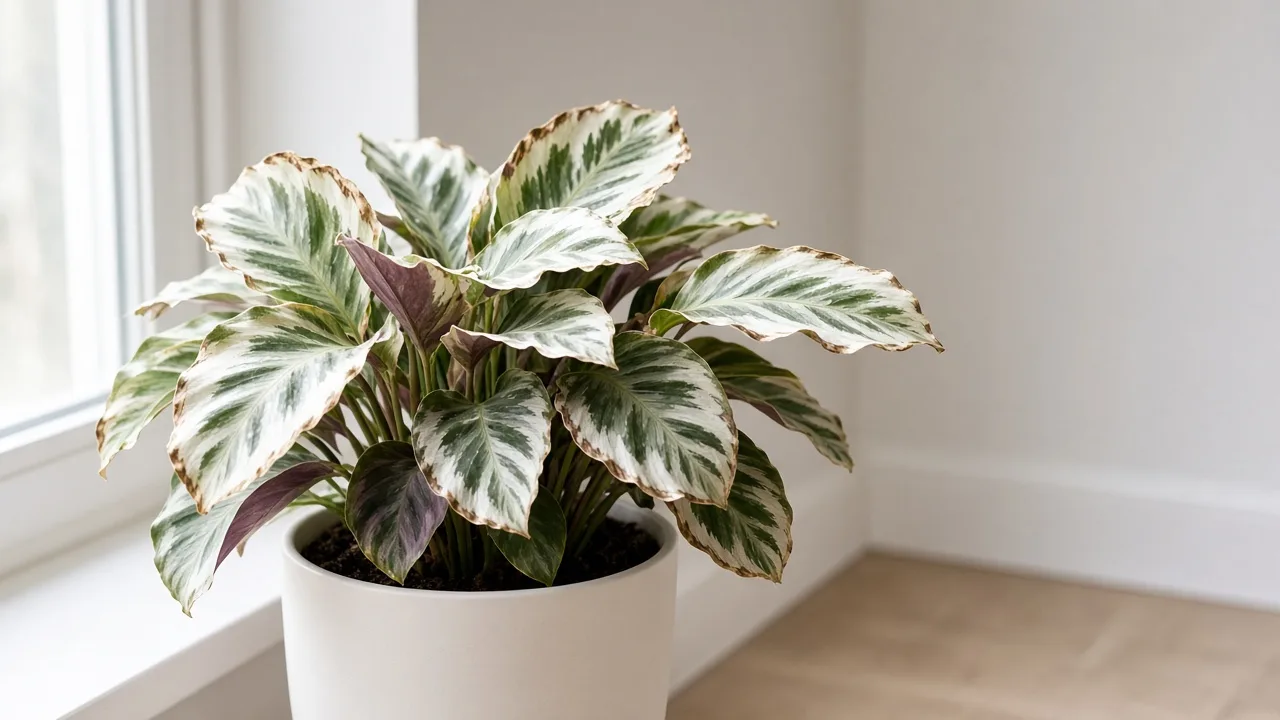
Brown Tips on Calathea White Fusion: White Sectors, Unfurls, or Water Quality?
This guide covers brown tips on Calathea White Fusion. See also the general Brown Tips guide, watering, and light pages for this plant.
Brown Tips on Calathea White Fusion: White Sectors, Unfurls, or Water Quality?
Quick answer
Calathea White Fusion (Goeppertia lietzei ‘White Fusion’) is a heavily variegated prayer plant with marbled white, green, and purple-pink undersides—not a solid green zebra like Freddie or a fishnet mosaic like Musaica. Brown tips here almost always mean the white tissue dried faster than the rest of the leaf while a spear was opening, or minerals in tap water accumulated at the margin. For how tip burn works on houseplants in general, see our brown tips hub. On White Fusion, the first fork is the newest unfurl plus whether brown sits on white patches—not a generic “water more” guess.
First step: inspect the newest rolled or half-open leaf before trimming anything. If tan crispy tissue tracks the white marbling or the thin rim of the spear, treat humidity and water quality as the lead suspects. If only the oldest outer leaves are crisp while new spears open clean, look at placement, salts, or normal aging instead.
Members of Goeppertia prefer high humidity, moist but drained soil, and water without damaging minerals (NC State Extension — Goeppertia). The RHS links browning of leaf tips and edges to dry air on calatheas (RHS calathea growing guide).
When to use this page vs other Calathea White Fusion guides
This page is for crispy tan tips and margins, especially on white variegated sectors. Use sibling guides when the main story is different:
| What you see | Start here instead |
|---|---|
| Leaves hanging limp with wet mix | Overwatering on Calathea White Fusion or root rot |
| Whole plant drooping in dry mix | Underwatering or drooping leaves |
| Faded marbling, no crisp tips | Not enough light |
| Room air feels dry everywhere | Low humidity |
| Stippling or webbing on undersides | Spider mites |
| Routine moisture rhythm | Calathea White Fusion watering |
What brown tips look like on White Fusion’s marbled leaves
White Fusion leaves are thin at the margin and carry large white sectors that cannot replace lost water as quickly as green tissue. Brown tips are usually dry, papery, and tan to dark brown at the very end of the blade, along one edge of an unfurling spear, or following the white marbling like a map.
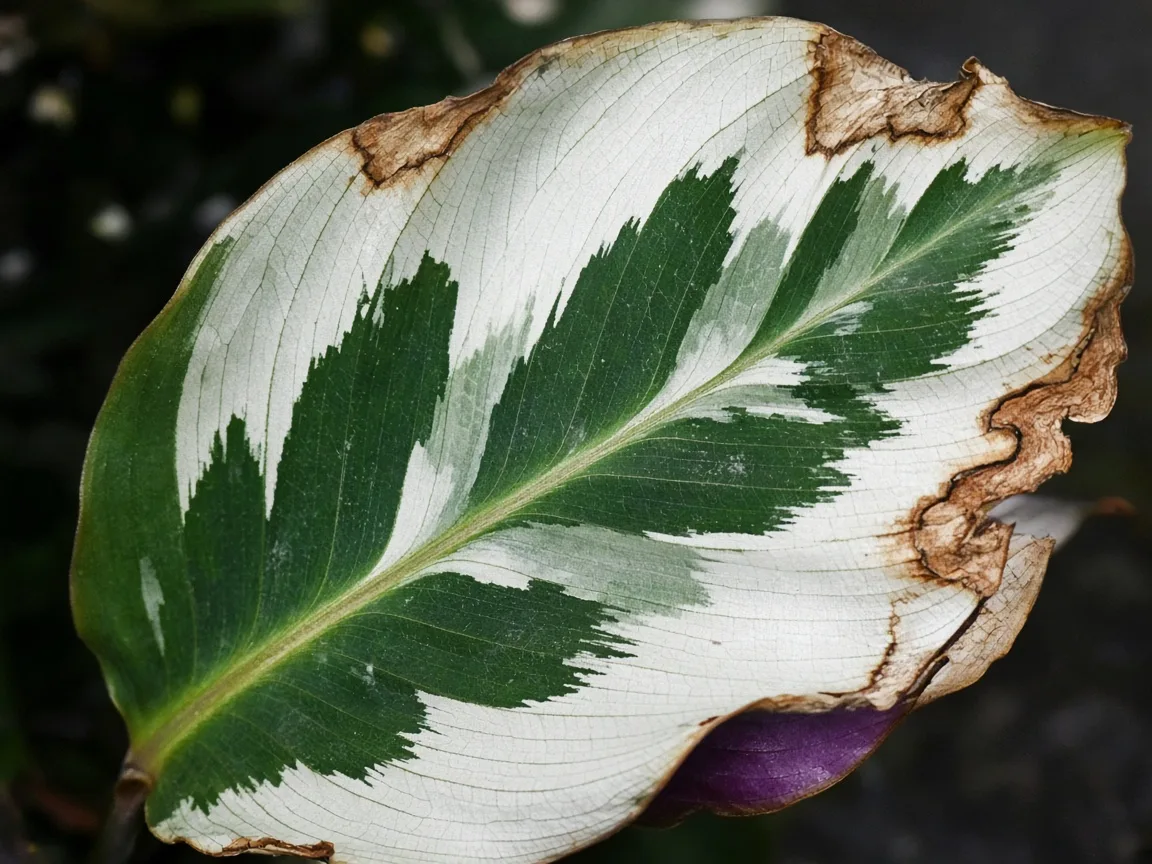
On White Fusion, check whether burn sits on white patches of the newest spear or only on older outer leaves—tip tissue will not re-green once it has dried.
Typical White Fusion patterns:
- Newest spear — brown seam on white sectors, stuck unfurl, or torn edge that never smooths out
- White patch halos — pale marbling turns tan before the green zones crisp (often dry air or harsh water)
- One-sided crisping — leaf edge nearest a vent, AC register, or bright window browns first
- Lower outer leaves only — oldest blades tan at the tip while new growth stays clean (often placement or normal aging)
When brown tips suggest a bigger problem:
- New spears keep opening burned after you fixed water and air
- Brown tips plus yellow lower leaves and a heavy wet pot
- Daytime leaf curl that does not relax at night (thirst or root stress — see wilting)
- Fine stippling with edge damage (spider mites)
Why white sectors burn before green on a new unfurl
Each White Fusion leaf is unique marbling, but the physics is consistent: white tissue has less chlorophyll and transpires quickly when room air is dry. While the spear is still rolled, the exposed rim and pale patches lose moisture before the blade finishes expanding. That is why growers often see a full leaf look fine except for a crispy white “frame” on the leaf that just opened.
Calatheas are notoriously sensitive to dry indoor air and inconsistent watering (The Spruce — grow calathea indoors). White Fusion is less forgiving than all-green cultivars because there is simply more non-green surface area on every new leaf.
Reading White Fusion’s night fold vs true tip burn
White Fusion is a true prayer plant: leaves fold upward at night and lower by day. That nyctinastic movement is normal. Tip burn is not.
| Signal | Normal White Fusion behavior | Tip burn or stress |
|---|---|---|
| Leaf position | Upright at night, more horizontal by day | Stuck half-rolled spear with a dry brown rim on white tissue |
| Margin texture | Smooth edge on open leaves | Crispy, tan tissue that does not rehydrate |
| Pattern | Whole plant moves together on schedule | One leaf or one white sector scars while neighbors stay clean |
| Soil | Top 2 cm drying on your usual rhythm | Same curl plus wet mix for days |
If the plant folds on schedule but only the opening white margin is brown, focus on humidity at leaf height and filtered water—not on forcing more water into an already wet pot.
Why Calathea White Fusion gets brown tips
Dry air during unfurl
White Fusion needs roughly 60–80% relative humidity to keep marbled spears opening cleanly. NC State notes that brown leaf edges on Goeppertia can follow low humidity (NC State Extension — Goeppertia). The RHS lists browning of leaf tips and edges as a common calathea issue tied to dry air (RHS).
Misting alone rarely holds moisture through a full unfurl cycle; a humidifier at leaf height is the reliable fix when white sectors keep tanning.
Tap-water minerals and fluoride
Prayer plants in the Goeppertia group are sensitive to tap water. NC State recommends distilled or rainwater for related species because fluoride in tap water can brown leaf edges and tips (NC State — G. veitchiana). If humidity is reasonable but every new spear opens with burned white margins, switch the water source before you change anything else.
The RHS notes that calatheas prefer rainwater; tap water may be used if left to stand so chlorine can dissipate, though that does not address all minerals (RHS).
Watering rhythm mistakes
White Fusion wants evenly moist mix, not bone-dry swings and not a soggy pot. Letting the root zone collapse while a new spear forms can crisp margins—including white tissue first. Keeping roots too wet stops them from delivering water to the farthest tip. Cross-check watering and pot weight before you only raise humidity.
Salt buildup and heavy feeding
Excess fertilizer and minerals from hard water can accumulate in peat-based soil and scorch margins, especially on a plant already stressed by dry air or tap water. White crust on the rim or soil surface is a clue; pair with yellow leaves if lower blades fade.
Light and heat at the margin
White Fusion needs bright indirect light—more than plain green calatheas—but direct sun bleaches white sectors and dries the thin edge fast (Calathea White Fusion light). Brown tips on the side facing glass or a heater are often placement, not disease.
How to confirm the cause on White Fusion
Run these checks in order:
- Newest spear — brown on white marbling, stuck unfurl, or torn edge?
- Humidity at leaf height — not across the room from a cheap meter on the floor.
- Water source — straight tap, overnight tap, filtered, distilled, or rainwater.
- Pot weight — heavy and wet days after watering points to overwatering, not simple dry air.
- Marbling on the last two leaves — dull white halos plus crisp tips often mean environment or water, not pests.
- Leaf undersides — stippling or webbing changes the diagnosis to mites.
Quick pattern fork:
- New leaves damaged on white tissue → humidity or water quality first
- Oldest leaves only → placement, aging, or salts
- Many leaves declining with tips → roots and crown firmness
First fix
Do not trim yet. Water the next cycle with rain, distilled, or filtered water and change nothing else for long enough to judge the next spear.
That single test targets a high-probability White Fusion failure mode without stacking repotting, fertilizer, and pruning on the same day. If the plant sits in a dry draft or within a metre of a heating vent, move it now—but keep the main experiment readable.
If the pot is clearly waterlogged, skip extra water and follow dry-down steps in overwatering instead of chasing tips with more moisture.
Recovery by cause
If dry air drove the burn
- Run a humidifier near the plant, or use a pebble tray with the pot above the water line—not occasional mist alone (RHS humidity guidance).
- Watch the next unfurl, especially whether white sectors open clean.
- Pair with low humidity if the whole room runs dry in winter.
If water quality drove the burn
- Switch to rain, distilled, or filtered water; avoid softened water high in salts.
- Flush the pot only when drainage is good and roots are firm—not as a day-one repot reflex.
If the mix dried too far
- Water when the top 2 cm begins to dry, per White Fusion’s usual rhythm—do not wait for wilt on every leaf.
- Pay extra attention while a spear is forming.
If roots are too wet
- Pause watering until the pot lightens.
- Inspect the crown; if stems soften, use root rot steps rather than more humidity.
What not to do
- Do not trim first and diagnose later.
- Do not water more when the pot is already heavy and wet.
- Do not assume daily misting replaces stable humidity around the spears.
- Do not fertilize a plant that is still burning at the margins.
- Do not judge success by old brown tissue turning green.
Recovery timeline
Crispy tips stay crispy. On White Fusion, measure recovery by the next one or two spears:
Good signs
- New leaf opens without a stuck brown rim on white marbling
- Purple-pink undersides look fresh on the newest blade
- No new crisping after the water-source change
- Night folding stays regular without chronic daytime curl
Bad signs
- Two consecutive spears open burned after water and placement fixes
- Tips spread while the pot stays soggy
- Crown softness or widespread yellowing
If two clean unfurls do not follow your fixes, recheck humidity, salts, and roots before repeating the same guess.
How to prevent brown tips on White Fusion
- Keep filtered or rainwater on hand for regular watering (NC State — Goeppertia).
- Target humidity above roughly 60% when you can measure it, especially in heated winter air (NC State — G. veitchiana).
- Follow the watering guide dry-down check—top 2 cm, not calendar dates.
- Keep White Fusion in bright indirect light per the light guide; avoid sun on pale sectors.
- Feed lightly in active growth only; skip fertilizer on a stressed plant.
Related Calathea White Fusion guides
- Calathea White Fusion overview
- Calathea White Fusion watering
- Calathea White Fusion light
- Calathea White Fusion soil
- Low humidity on Calathea White Fusion
- Overwatering on Calathea White Fusion
- Spider mites on Calathea White Fusion
- Calathea White Fusion problems hub
Related tool
Use the Plant Problem Diagnosis Tool to narrow causes for brown tips on this plant before changing multiple variables at once.