Root Rot on Crown of Thorns: Stem-Base Checks & Salvage
Quick answer
Root rot on Crown of Thorns usually follows wet, cool mix around thorny stems—especially in winter when growth slows. First step: stop watering and unpot today to see whether roots are firm or mushy and whether the stem base above soil is still hard.
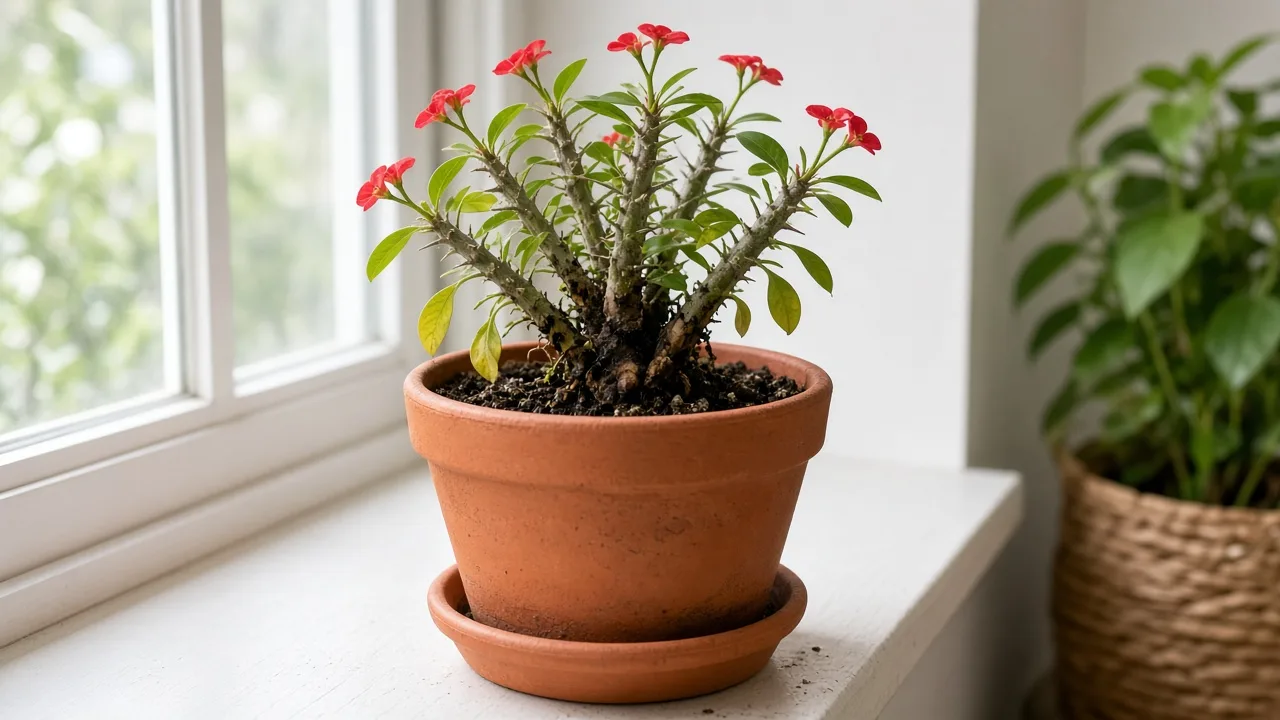
Root Rot on Crown of Thorns: Causes, Checks & Fixes
This guide covers root rot on Crown of Thorns. See also the general Root Rot guide, watering, and light pages for this plant.
Root Rot on Crown of Thorns: Causes, Checks & Fixes
Quick answer
Root rot on Euphorbia milii (Crown of Thorns overview) is thorny-stem failure in soil that stays wet too long—not ordinary thirst on a sunny windowsill. This Madagascar succulent euphorb wants dry to medium moisture in well-drained mix and does not tolerate wet, cold soils. In a pot, roots need both water and oxygen; when air is cut off, roots decay and the plant cannot take up water or nutrients.
For how chronic wet mix destroys roots in general, see our root rot guide. On Crown of Thorns, the pattern is a heavy wet pot, sour-smelling mix, yellow lower leaves on damp soil, and—most tellingly—a darkened or softened stem base at the soil line while upper thorns still look upright.
First step: stop all watering and unpot the plant today. You need to see whether roots are firm or mushy and whether the lowest thorny stem is still hard before you add water, fertilizer, or hope the red bracts recover.
| What you find | What it usually means | Read next |
|---|---|---|
| Heavy wet pot, firm stem base, no mush on roots | Early overwatering stress | Dry-down workflow on the overwatering page |
| Mushy roots + soft black base (this page) | Root rot climbing the stem | Stay here |
| Light dry pot, wrinkled stems, dropped leaves | Underwatering | Watering guide after a dry-down check |
| Limp leaves on wet soil, firm base | Wilting or drooping leaves | Cross-check light and drainage |
| White mold or gnats on wet surface | Mold on soil or fungus gnats | Fix moisture before repotting twice |
When to use this page vs other Crown of Thorns guides
| Pattern | Read next |
|---|---|
| Routine dry-down before assuming rot | Watering guide |
| Mix stays wet but roots still firm | Overwatering |
| Mushy roots + soft stem base | This page |
| Lower leaves yellow on wet mix only | Yellow leaves |
| Bare stems in cool dry winter, hard base | Normal rest—see watering seasonal notes |
| Chronic re-rot after repot | Soil guide and repotting |
What root rot looks like on Crown of Thorns
Unlike leafy tropicals, Crown of Thorns stores water in succulent stems and keeps blooming when conditions are warm and bright. Rot often starts at the soil line on thorny stems while colorful bracts still look presentable—so owners keep watering because the plant “still has flowers.”
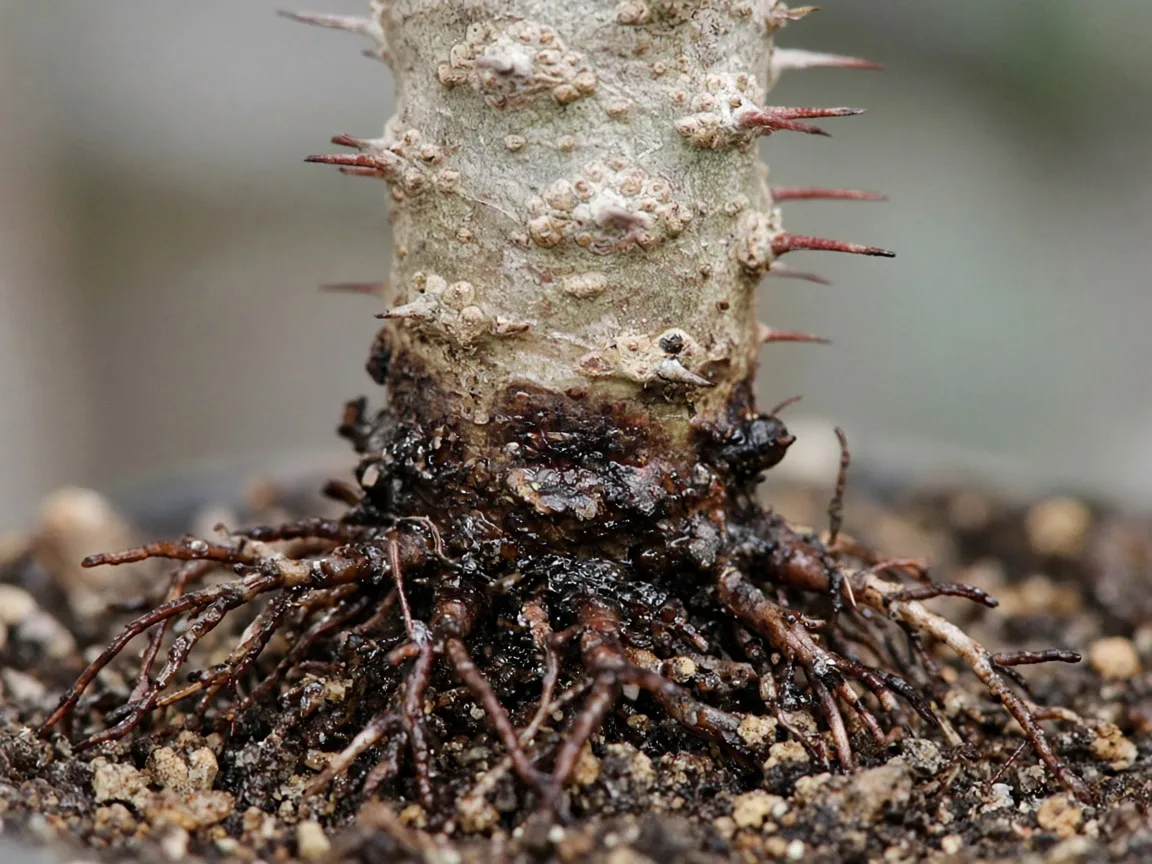
Root rot at the soil line—darkened soft tissue where thorny stems meet damp mix; healthy roots should be firm and pale, not brown and sludgy.
Above-soil clues
- Heavy pot that stays damp for a week after one drink
- Yellowing lower leaves while mix surface stays dark and cool—not the crisp wrinkle of drought
- Soft, mushy, or translucent leaves on wet soil per your plant profile signs
- Black or brown bases at the soil line on thorny stems
- Bracts and leaves dropping while soil is still wet (not the seasonal drop on dry mix)
- Fungus gnats or surface mold on constantly damp mix
Wilting on wet soil happens because damaged roots cannot move water upward—the top looks thirsty even though the problem is too much water below.
Below-soil confirmation
After you unpot, healthy roots are pale, firm, and slightly woody on an older plant. Rot shows as:
- Brown, black, or translucent mush that slips off the stem
- Roots that smell sour with the mix
- A hollow or squishy zone where stem meets roots
- Fine feeder roots rotted away, leaving only thick decayed stubs
Press the lowest thorny inch above the former soil line. Firm green-gray bark with dry corky texture is salvageable. A dent that holds your thumb pressure means rot has left the root zone.
Winter leaf drop vs root rot on Crown of Thorns
Cyclical leaf drop is normal before the resting season, usually winter on this species. That messy shed can look alarming, but it is not rot when:
- The stem base stays hard and does not blacken
- Mix is dry between drinks (pot feels light)
- Bracts may pause, but upper stems are not water-soaked
- Room is cooler and growth has slowed
Rot is the combination of soft black stem base + sour wet mix, not bare thorny branches alone. If you watered on a summer schedule while the plant rested in a cool room, suspect rot—not seasonal leaf loss.
Why Crown of Thorns gets root rot
Crown of Thorns evolved for intense sun, rocky soil, and long dry spells in Madagascar. Indoors it is an easy high-light houseplant when drainage matches that history—but potential disease pests include stem and root rots on constantly moist indoor mix.
Overwatering while still blooming
Red, pink, or yellow bracts make it tempting to keep soil moist “for the flowers.” Heat-loving succulents still rot quickly in wet soil with poor drainage—leaves store water, so above-ground stress shows late. Match drinks to the watering guide (top 2 inches dry), not to bract color.
Heavy mix and cachepots
Standard peat-heavy potting soil holds moisture too long for thorny euphorbs. A decorative pot without drainage, or a nursery pot sitting in a full saucer, keeps the stem base wet—the first tissue to fail. See the soil guide for cactus blend plus perlite or pumice.
Cool, wet roots
NC State notes Crown of Thorns does not like wet, cold soils or temperatures below about 35°F. In cool rooms, uptake slows; water you add in November may still suffocate roots in December. Reduce frequency sharply when growth pauses—same as winter rest in the overview.
Pathogens on waterlogged mix
Phytophthora root rot is primarily a disease of waterlogged soils, and symptoms overlap with simple oxygen starvation. Fixing drainage and removing mushy tissue matters more than spraying without an unpot inspection.
How to confirm root rot before you repot
Work in this order so you do not spread decay or irritate skin with sap:
- Weigh the pot after your last watering. Still heavy 7–10 days later on a small indoor pot? Suspect poor drainage or rot.
- Press the stem base through the pot rim if you are not ready to unpot. Spongy tissue means unpot today.
- Sniff the drainage hole—soil without oxygen often smells sour or rotten.
- Unpot onto newspaper. Wear gloves—milky sap irritates skin. Knock away wet mix; rinse roots lightly with lukewarm water only if you need to see the rot line.
- Tug outer roots gently. Mush that separates confirms rot; firm white roots with a hard stem base may be early overwatering instead.
Document how far blackening climbs on the stem. Salvage odds drop when softness passes more than an inch above the old soil line.
The first fix to try
Stop watering and unpot immediately—that single action prevents another drowned week while you plan surgery. Do not fertilize, mist, or “perk it up” with a drink.
If roots are mostly firm with only a few brown tips and the stem base is hard:
- Let mix dry completely in the same pot with drainage open
- Move to maximum safe light per the light guide
- Re-test stem base in 48 hours; if still firm, resume soak-and-dry only when top 2 inches are dry
If any stem base softness or widespread root mush appears, continue to the recovery workflow below—do not wait for all bracts to fall.
Step-by-step recovery when roots are mushy
1. Trim to firm tissue
With gloves on, cut away every soft root back to firm white or tan flesh. If the stem base is blackened, slice upward into hard green-gray stem until you hit tissue that does not dent. Sterilize pruners between cuts; sap is sticky.
Lay the plant on dry newspaper out of direct sun until cut surfaces are dry to the touch—often 3–7 days for stem wounds on a thick euphorb. NC State recommends letting sap dry before placing cuttings in medium; the same callus rule applies to rot surgery.
2. Repot dry into fast-draining mix
Use a slightly smaller clean pot with a drainage hole. Fill with the gritty mix from the soil guide—not fresh heavy peat. Seat the plant so the callused base sits just above the mix line; burying a wounded stem invites re-rot.
Do not water for the first 7–14 days after repotting unless every stem shrivels deeply on bone-dry mix and the base is still firm. When you do water, soak lightly and empty the saucer.
3. Stem-cutting salvage if the base fails
If softness climbs past firm tissue, take healthy upper stem cuttings before the whole plant collapses. Let sap dry on cut ends for several days, then root per the propagation guide. Discard the rotten base and do not reuse infected mix.
Recovery timeline
| Stage | What to expect |
|---|---|
| Days 1–7 | No watering after surgery; stem may look static while callusing |
| Weeks 2–4 | If stable, first light drink; lower yellow leaves may drop—ignore cosmetic loss |
| Weeks 4–8 | New leaf tips or bracts on firm upper stems signal success |
| 2+ months | Full silhouette fills in slowly; this is a moderate grower, not a pothos rebound |
Dead yellow leaves and spent bracts will not re-green. Judge recovery by firm stem bases, no spreading blackness, and new growth at thorny tips.
Lookalike symptoms
| Symptom | Often confused with rot | How to tell apart |
|---|---|---|
| Seasonal leaf drop | Root rot | Hard stem + dry mix + cool season |
| Underwatering wrinkle | Rot wilt | Light pot, dry top 2 inches, firm base |
| Spider mites | Yellow leaves on wet soil | Stippling, webbing; roots firm when unpot |
| Mealybugs at axils | Stem blackening | White fluff on stems; base firm |
| Not enough light | Slow decline | Leggy pale growth; roots healthy on unpot |
What not to do
Do not water more because leaves look limp on already wet mix—that accelerates rot. Avoid standard potting soil alone in a closed cachepot. Do not feed a recovering plant until new growth looks normal for two weeks.
Skip fungicide alone without removing mush and fixing drainage. Do not repot into a much larger pot; extra wet volume dries slowly. When pruning, wear gloves—Crown of Thorns is toxic and sap irritates skin; keep trimmed debris away from pets and children.
Do not stack hard pruning, repotting, and pesticide on the same day unless pests are confirmed.
How to prevent root rot next time
- Water when the top 2 inches are dry, not on a calendar—see watering
- Use cactus mix plus perlite in terracotta or other breathable pots (soil guide)
- Empty saucers and cachepots after every drink
- Give full sun indoors so the plant uses water actively (light guide)
- Cut back water in cool months when rest leaf drop begins
- After repotting, follow dry-callus timing in the repotting guide
- Quarantine new plants; inspect stem bases weekly during warm growth
When to worry
Escalate immediately if the stem base dents under light pressure, black streaks climb several inches, or more than half the root mass is mush on inspection. A few yellow leaves on wet soil with a still-firm base and partial root mush is manageable with aggressive trim—not a reason to discard the plant on day one.
If the main stem is hollow after trimming, pivot to upper cuttings while tissue is still green. Chronic re-rot after two thorough salvages usually means mix or pot choice is still too wet—re-read soil before a third attempt.
Related Crown of Thorns guides
- Crown of Thorns overview
- Watering
- Soil
- Light
- Overwatering
- Yellow leaves
- Wilting
- Propagation
- Problems hub
Related tool
Use the Root Rot Risk Checker to narrow causes for root rot on this plant before changing multiple variables at once.
Conclusion
Root rot on Crown of Thorns is wet mix eating the thorny stem base while flowers distract you from the soil line. Stop watering, unpot, and trust a firm stem—not yellow leaves—to tell you whether salvage is still realistic. Prevention is boring and effective: gritty mix, open drainage, and dry-down checks that continue even when bracts are bright.