Underwatering on Dracaena Marginata: Causes, Checks & Fixes
Quick answer
Underwatering on Dracaena marginata shows as a very light pot, dry mix in the top half of the container, limp narrow red-edged blades on firm gray canes, and crispy brown tips without yellow mushy tissue at the soil line. First step: water once until steady runoff drains freely, then wait until the upper half of the mix dries before the next soak.

Underwatering on Dracaena Marginata: Causes, Checks & Fixes
This guide covers underwatering on Dracaena Marginata. See also the general Underwatering guide, watering, and light pages for this plant.
Underwatering on Dracaena Marginata: Causes, Checks & Fixes
Quick answer
Dracaena marginata (Madagascar dragon tree) is drought-tolerant and stores some moisture in its slim gray canes, so it survives missed drinks longer than a peace lily—but chronic dryness still shows up as limp narrow swords, crispy brown tips, and a feather-light pot when the top half of the mix has been empty too long. For how chronic root-zone dryness limits uptake in general, see our underwatering guide. On marginata, drought usually hits one crown’s blade cluster first while bare cane below stays exposed, and the red or pink leaf margin crisps before the green center—unlike overwatering, which yellows lower clusters on heavy wet soil.
First step: Water once at the soil surface until steady runoff exits drain holes, drain the saucer within 10–15 minutes, and recheck moisture at mid-pot depth in three to five days. Do not fertilize, repot, and prune on the same afternoon.
Routine rhythm lives in the Dracaena marginata watering guide.
When to use this page vs other marginata guides
This page is the dry-pot-first entry when you suspect the dragon tree went too long without a real soak.
- Drooping leaves — wet vs dry fork when blades hang limp; start here if you are not sure which side you are on
- Wilting — sudden collapse or cane limpness beyond gradual drought droop
- Brown tips — primary when tips brown but soil is evenly moist (fluoride or low humidity)
- Overwatering — yellow lower blades and soggy mix; the more common dracaena mistake indoors
- Root rot — soft mushy cane at soil line with wet mix, not a light dry pot
- Yellow leaves — when yellowing spreads after prolonged bone-dry soil or repeated drought cycles
What underwatering looks like on Dracaena marginata
Healthy marginata blades are long, narrow, and stiff, with green centers and red or pink margins arching from tufts atop smooth gray canes. Underwatering changes texture and posture before it kills the plant.
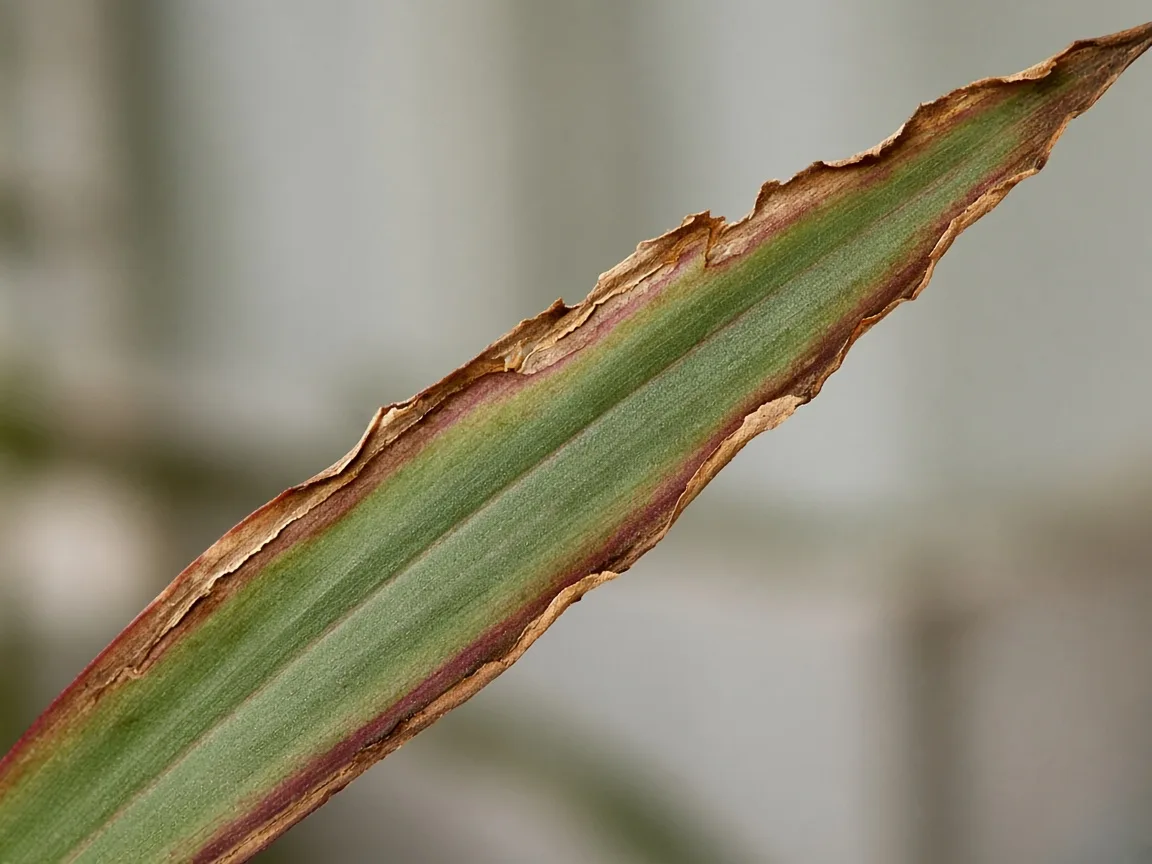
Dry crispy red margins on an otherwise green narrow blade—pair with a light pot and dry mix at mid-depth, not wet yellow lower leaves.
Typical drought cues on this species:
- Limp or slightly curled narrow blades in one or more crown rosettes, often worst on the longest outer swords
- Brown, dry tips and margins that crumble when pinched—leaves may brown if soils are too moist or too dry, but drought pairs crisp edges with dry mix, not a heavy pot
- Very light pot weight and mix pulling slightly away from the pot wall after weeks of neglect
- Dust-dry soil when you push a finger or dry skewer to mid-pot (the upper-half dry rule from the watering guide)
- Firm gray cane at the soil line—spongy tissue on wet mix points to root rot instead
Missouri Extension notes that excessive drying leads to browning of leaf tips as well as leaf drop on dracaenas. On marginata, that tip burn often starts on the thin red margin before the whole blade yellows.
After prolonged bone-dry soil, lower blades may yellow then brown while the crown still droops—Ohio Tropics describes droop accompanied by yellowed lower leaves when mix stayed dry too long. That overlap can look like yellow leaves from other causes; pot weight and mid-depth moisture separate drought from chronic wet feet.
Slim canes, narrow blades, and the top-half dry test
Marginata’s slim profile tricks owners who learned “dracaenas are drought tolerant.” The cane holds reserves, so visible stress lags behind an empty root zone—by the time several swords hang limp, fine root hairs may already be damaged.
NC State Extension recommends allowing plants to dry between waterings but not severely in well-draining mix. RHS guidance for dracaena puts the practical trigger at dry top 5 cm (2 in) before watering again. For typical indoor marginata pots, that aligns with checking whether the upper half of the container has dried—push 5–8 cm (2–3 in) deep or insert a skewer to mid-pot before pouring.
In a bright south or west window, narrow leaves transpire quickly; a root-bound 20 cm (8 in) pot can flip from moist to critically dry in five to seven summer days. In a dim office corner, the same calendar interval may be safe—but then owners often underwater after a past overwatering scare, swinging too far toward neglect.
Red margins as the first drought alarm
Unlike broad corn-plant straps, marginata’s red-edged tissue is thin. When the root ball dries, margins often turn papery and brown while the green blade center still looks colored—easy to misread as fluoride burn alone. Fluoride damage commonly appears on moist mix when you have been watering on schedule with tap water; drought pairs crisp margins with light pot weight and dry skewer at mid-pot.
NC State notes marginata is sensitive to fluoride like other dracaenas. Fix water quality after you confirm the root zone was actually dry—soak first, then switch to rainwater or filtered water if new tips still burn on correctly timed drinks.
Multi-cane pots and uneven drying
Commercial marginata are often sold as two or three canes of different heights in one container. Each crown transpires independently; the tallest rosette in the brightest spot may go limp while a shorter cane still feels firm. One surface sprinkle that wets only the top inch does not rehydrate a dry center—water must reach the root mass until runoff.
Terracotta, small nursery pots, and hydrophobic peat after vacation gaps make this worse: water runs down the inside wall while the middle stays dusty. If runoff appears in seconds but the pot still feels light, bottom-water for 20–30 minutes in a sink, then drain fully—once, not daily.
Why Dracaena marginata gets underwatered
Underwatering is less common than overwatering on indoor dracaenas, but marginata still dries out when care rhythm fights its biology:
- “Drought tolerant” advice without a moisture check—cane storage delays droop until damage is moderate
- Calendar watering in summer while the plant sits in bright light or near heating vents
- Fear after root rot—owners skip drinks until mix is bone dry for weeks
- Hydrophobic soil and shallow splashes that never reach roots
- Oversized canopy, undersized root ball after beheading—fewer roots pull less water for many blades
- Winter forgetfulness combined with dry furnace air—Missouri Botanical Garden recommends reducing watering from fall to late winter, which means longer dry windows, not zero water forever
Ohio Tropics suggests letting at least the top quarter of the mix dry before watering again and warns against leaving the pot completely dry for too long—marginata can survive a miss, but repeated extreme drought yellows lower foliage and stalls new swords.
Lookalike symptoms to rule out
| What you see | Most likely cause | Next step |
|---|---|---|
| Limp blades, light dry pot, firm gray cane | Underwatering | One deep soak; this page |
| Limp blades, heavy wet pot, yellow lower clusters | Overwatering | Overwatering guide |
| Limp blades on wet soil + soft mushy cane | Root rot | Root rot guide |
| Brown tips only, soil moist, no canopy droop | Fluoride or low humidity | Brown tips |
| Gradual limpness in dim room, soil stays moist | Low light + wet feet | Not enough light |
| Sudden limpness after cold night | Temperature shock | Move off glass; recheck soil moisture |
The RHS lists dying leaves or brown leaf tips as possible signs of overwatering, underwatering, fluoride, dry air, drafts, or heat—always pair leaf cues with pot weight and mid-pot moisture, not a single symptom photo.
How to confirm the cause
Work through these checks in order:
- Lift the pot — Learn its weight after a proper soak versus when the top half has dried. A dramatically lighter pot with limp blades supports drought.
- Mid-pot probe — Dry, crumbly mix at 5–8 cm (2–3 in) with limp thin blades supports underwatering. Damp cool soil at depth with limp blades means do not add water—see drooping leaves for the wet-soil branch.
- Cane firmness — Press the lower gray trunk. Firm wood fits drought or mild stress. Soft spongy tissue on wet mix is urgent—see root rot.
- Margin vs center — Crispy red edges with dry mix fit drought. Even brown tips on moist mix fit fluoride—test water after you fix dryness.
- Drainage history — Confirm you are not leaving the plant in a sealed cachepot; drought diagnosis assumes water can enter and exit the root ball when you do water.
If the pot is light, skewer dry at mid-pot, and canes are firm, treat as underwatering even if lower blades already yellowed from an earlier dry spell.
First fix for Dracaena marginata
Water thoroughly once at the soil surface until steady runoff exits drain holes—not repeated teaspoons that never reach the center. Drain every drop from the saucer within 10–15 minutes.
That single deep soak is the entire first fix. Wait 24–48 hours and recheck blade turgor and pot weight before any secondary step.
If blades stay limp on now-moist soil
Roots may have died back during the dry spell. Hold off on more water until the top half dries again; persistent limpness on damp mix after two dry-down cycles suggests root damage—follow the wet-soil branch on drooping leaves rather than soaking daily.
If mix repelled water (hydrophobic peat)
Set the nursery pot in a sink with water halfway up the pot for 20–30 minutes, let drain fully, then return to bright indirect light. Do not leave the pot submerged overnight.
What not to do on day one
- Do not fertilize a drought-stressed marginata to “perk it up”
- Do not repot simple dry droop—rehydrate first; repot only if you confirm failed mix or compaction after two correct soaks
- Do not mist instead of watering when the root ball is dry—misting does not restore uptake on cane dracaenas
- Do not prune every limp blade before new growth firms—you need leaves to photosynthesize during recovery
Wear gloves when trimming crispy blades if pets might chew fallen tissue—Dracaena is toxic to cats and dogs.
Recovery timeline
Mild drought droop on a firm cane often shows visible firming within 24–48 hours after one proper soak. Blades may not return to their original stiff arch, but they should feel less thin and the pot should regain weight.
Moderate chronic drought with yellowed lower leaves may take one to three weeks before new tight swords open at the crown. Old yellow blades rarely green up—remove them once new growth looks healthy.
Severe root hair loss from months of neglect can take several weeks of correct top-half dry rhythm before growth rate normalizes. If no new leaves emerge after six to eight weeks on a firm cane with stable watering, inspect roots during a dry-down window—not while mix is soggy.
How to prevent underwatering next time
Prevention is check frequency tied to light and pot size, not a fixed “water monthly” rule.
- Use the top-half dry rule from the watering guide—typically every 10–21 days in active growth and longer in winter, always probing before pouring
- Bump checks when the plant moves closer to a window or when summer heat and AC dry air increase transpiration through narrow blades
- Empty saucers after every soak; stale runoff is not underwatering prevention—it causes rot that mimics thirst
- Match mix to the soil guide so dry-down is predictable; heavy peat in bright light may need faster checks than a gritty blend
- Weekly pot-weight habit during travel season catches dry pots before margins crisp across every crown
Related Dracaena marginata guides
- Dracaena marginata overview
- Watering
- Light
- Soil
- Drooping leaves
- Overwatering
- Brown tips
- Problems hub
Related tool
Use the Plant Watering Calculator to estimate check-in intervals for Dracaena marginata in your light and pot size before you miss another dry-down window.