Brown Tips on Dracaena Marginata: Causes, Checks & Fixes
Quick answer
Brown tips on Dracaena marginata almost always mean fluoride or salts are concentrating at the pointed ends of narrow strap leaves while water moves up slim canes. First step: water with rainwater, distilled, or reverse-osmosis water for four weeks and skip your next fertilizer dose.
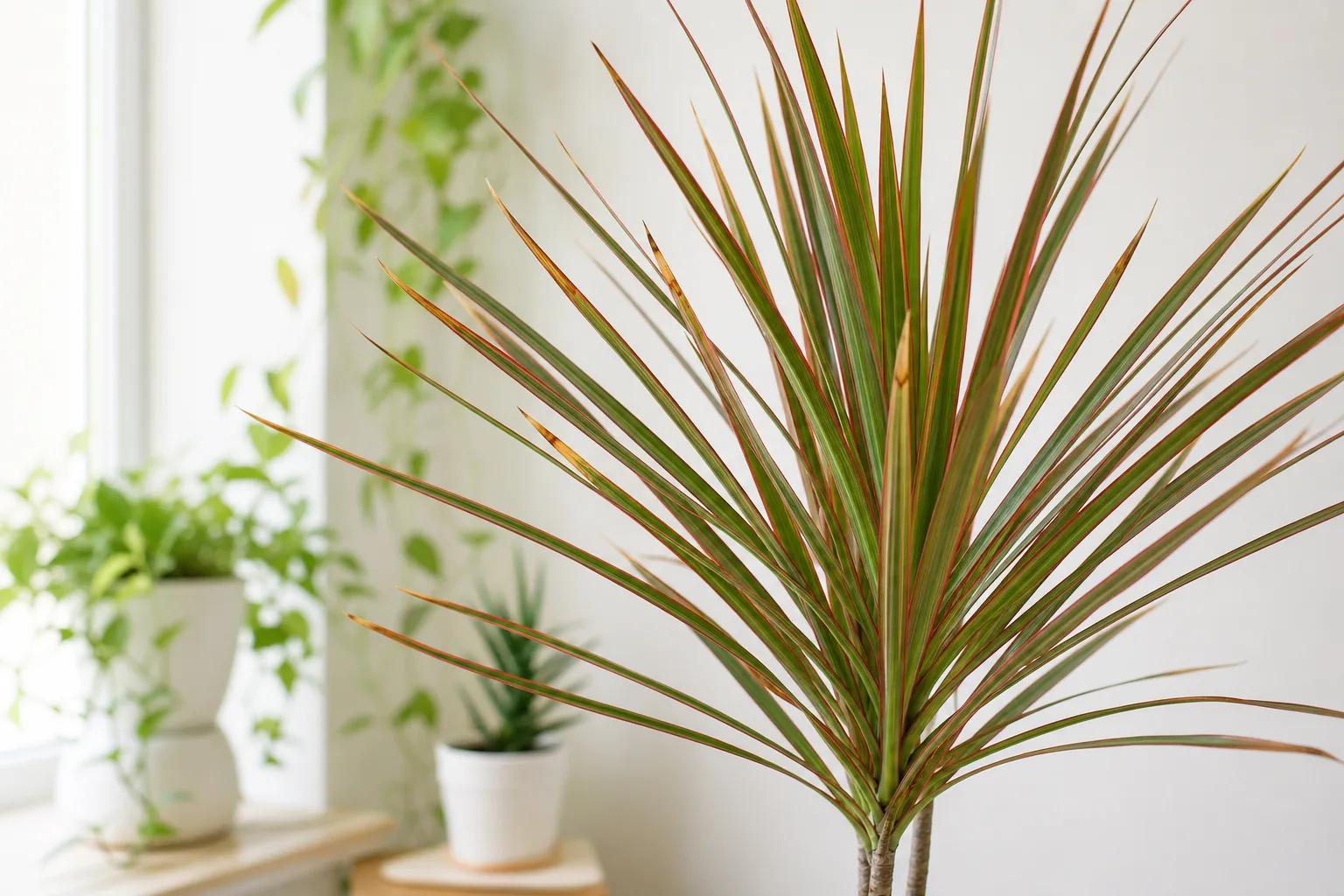
Brown Tips on Dracaena Marginata: Causes, Checks & Fixes
This guide covers brown tips on Dracaena Marginata. See also the general Brown Tips guide, watering, and light pages for this plant.
Brown Tips on Dracaena Marginata: Causes, Checks & Fixes
Quick answer
Brown tips on Dracaena marginata (Madagascar dragon tree, red-edged dracaena) show up as dry, papery necrosis at the pointed ends of narrow strap leaves on slim gray canes. Unlike the broad blades of corn plant (Dracaena fragrans), marginata leaves are thin, arching, and often red- or pink-edged—so minerals and dry air hit the tip and colored margin first, long before the green center looks stressed.
For how marginal leaf burn works on houseplants in general, see our brown leaf tips guide. On marginata, the fork you want early is water chemistry on firm canes (fluoride and salts) versus drought on a light pot with dusty mix throughout.
The leading causes are fluoride and dissolved salts in tap water, fertilizer salt buildup, low humidity and heat vents, long dry spells between drinks, and less often spider mites in very dry air. NC State Extension notes that marginata is sensitive to fluoride, which causes leaf discoloration, and recommends distilled or non-fluorinated water with a well-draining mix and drying between waterings—but not severe drought.
First step: use rainwater, distilled, or reverse-osmosis water for every watering for the next four weeks and skip your next scheduled fertilizer dose. That removes the two stressors most specific to marginata without repotting, heavy pruning, or stacking humidifier fixes on day one.
What brown tips look like on slim dragon-tree canes
Marginata is sold as one or several slim canes in a pot, each topped by a whorl of sword-shaped leaves 12–24 inches long with red, pink, or cream margins on cultivars like Tricolor and Colorama. Tip burn reads differently than on a compact Janet Craig rosette or a wide corn-plant blade:
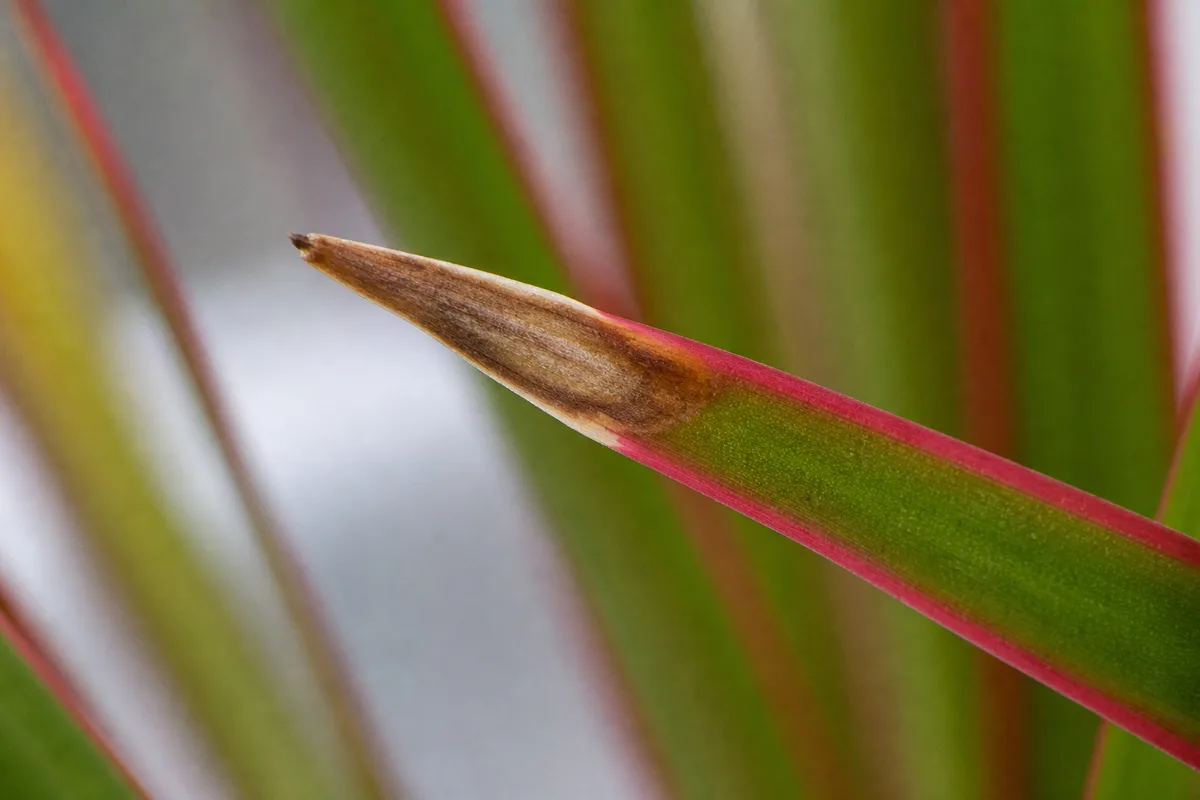
Brown tip symptoms on Dracaena Marginata — compare crisp margin tissue with healthy green on the same strap leaf.
- Fluoride or salt burn — Dry tan-to-brown tips on newest strap leaves at the cane crown, sometimes with a thin yellow band before dead tissue. Older whorls may stay mostly green while fresh growth shows damage first. White crust on soil or pot rim points to mineral buildup from hard tap or heavy feeding.
- Low-humidity accent — Papery tips on leaves nearest a radiator, vent, or sunny glass while inner whorls look cleaner. Soil moisture often reads normal; gray canes stay firm. See low humidity on Dracaena Marginata when placement is the lead suspect.
- Underwatering — Tips crisp with a very light pot, mix dry well below the surface, and crown leaves droop before you notice obvious wilt on stiff older blades. Differs from fluoride burn on damp-to-normal dry-down schedules.
- Normal aging — One or two oldest strap leaves on a bare lower cane with minor tip tan while new whorls stay clean. Low priority if watering rhythm and water source are sound.
Worry when every new whorl tips, soil stays wet and sour, or cane tissue softens at the base—not when a single outer leaf near winter heat shows a few millimeters of brown.
Why marginata tips brown before the rest of the leaf
Fluoride in tap water (most common)
Dracaenas are very sensitive to fluoride toxicity. Fluoride from municipal water can accumulate in foliage over time, move in the transpiration stream, and collect in leaf margins where tips turn brown and necrotic. NC State lists marginata among dracaenas that need distilled or non-fluorinated water because fluoride causes discoloration.
On marginata, each narrow leaf exports water to a single sharp tip—there is little blade area to dilute damage, so tip bands show up on multiple canes in the same pot when tap water is the driver.
Perlite, salts, and light feeding
University of Missouri IPM advises using potting mix without perlite, since perlite can contribute fluorides, and notes that rainwater or deionized water helps prevent tip and edge necrosis. Marginata has a low fertilizer requirement per NC State—controlled-release feed in spring, summer, and fall—so heavy liquid feeding or skipping flushes lets soluble salts concentrate and mimic fluoride burn.
Dry air on red-edged margins
RHS lists fluoride in tap water, very dry air, and heat sources among causes of dying leaves or brown leaf tips on dracaenas. Marginata tolerates indoor humidity better than many ferns, but heated winter rooms can still crisp exposed strap tips—especially on the cane facing the vent—while fluoride-sensitive new growth tips brown on every whorl regardless of placement.
Drought on multi-cane pots
MU IPM notes that excessive drying leads to browning of leaf tips as well as leaf drop, and that dracaenas should stay slightly moist for best appearance. Marginata tolerates longer dry-downs than corn plant per our overview, but weeks of bone-dry mix in a crowded three-cane pot still crisps tips before lower leaves yellow. Pair with underwatering when the crown droops and the pot feels hollow.
Tip burn alone rarely means root rot, but brown tips plus wet soil, yellow lower leaves, and a soft cane need overwatering and root rot checks before you change water chemistry.
Reading the newest whorl (marginata-specific check)
Marginata grows from the cane tip, pushing one tight cluster of strap leaves at a time. That growth habit makes the newest whorl your best diagnostic screen:
- Brown tips on the whorl that just opened while older leaves only show age spots → suspect fluoride, salts, or recent heavy feed, not yesterday’s missed watering alone.
- Clean newest whorl but crispy tips on outer leaves beside a heat vent → suspect dry air; fix placement before repotting.
- Brown tips on every cane in the pot at once on a normal top-half dry-down → strongly suspect shared water source (tap fluoride/hardness), not individual cane disease.
This whorl test fails on corn plant (continuous blade flush) and on compacta (tight rosette of short leaves)—it is specific to cane-top whorl growth on marginata.
How to confirm the cause
Work through these checks in order:
- Newest whorl — Tips already brown on the freshest cluster? Water chemistry or salts lead. Only lower, older straps affected? Humidity or aging more likely.
- Soil surface — White crust or gritty film → plan a flush; do not fertilize until salts leach.
- Top-half moisture and pot weight — Per RHS, water when the top 5 cm (2 in) feels dry; marginata often uses a deeper half-pot dry-down per our watering guide. Bone-dry throughout with a light pot → drought layered in. Cold, damp mix with tipping → pause water and inspect roots.
- Water and feed history — Months of hard tap only? Recent full-strength feed through winter? Matches fluoride or salt patterns.
- Placement — Heat vent, radiator, or blowing AC within a metre? Sun-heated glass baking strap tips?
- Leaf undersides — Stippling and webbing → spider mites, not humidity alone.
Write down the dominant pattern before you change three variables at once.
The first fix to try
Use rainwater, distilled, or reverse-osmosis water for every watering for the next four weeks, and cancel the next fertilizer application.
Soak until runoff exits drainage holes—the same thorough drink you would use with tap—then empty the saucer. Do not repot, flush heavily, and prune all tips the same day unless white salt crust is obvious; then make one first watering a leach with plain low-fluoride water at roughly two to three times pot volume, and hold feed for six weeks.
Inspect the next whorl that opens. Clean tips on new straps mean you are on the right track.
Step-by-step recovery
Add these one at a time after the water switch, based on what you confirmed:
- Raise humidity toward 40–50% if only older tips browned and the newest whorl stayed clean. A small humidifier beats misting narrow leaves in dim corners.
- Move off heat paths — Pull the pot back from vents so red-edged straps are not in a constant dry stream.
- Stabilize dry-down — Water when the top half of the mix is dry, then soak fully. See Dracaena Marginata watering for depth checks and winter slowdown.
- Trim cosmetic tips — Follow each leaf’s curve; leave a thin brown edge. The Spruce notes trimming is optional for plant health and targets dead tissue only.
- Resume feed cautiously — After six to eight weeks with clean new tips, use half-strength liquid feed monthly in spring and summer only, aligned with our fertilizer guide.
If tips keep browning on low-fluoride water with stable humidity, unpot one cane and check roots. Mushy tissue needs rot protocol; tight white roots in hydrophobic mix may need repotting into fresh, well-draining soil—one size up at most.
Recovery timeline
Brown tip tissue does not re-green. Judge success by new whorls on firm gray canes:
- Weeks 1–2 — Old tips stay brown; no new spread down margins is encouraging.
- Weeks 3–6 — The next one or two whorls should open with clean or mostly clean tips if water quality or humidity was the issue.
- After two months — Persistent tipping on every new whorl despite filtered water warrants root inspection and salt flush or repot.
Slow growth is normal. Firm canes, green lower straps, and one clean new whorl count as recovery even if trimmed older leaves still show blemishes.
Lookalike symptoms
| What you see | Often confused with | How to tell apart |
|---|---|---|
| Crispy tips only; firm cane; appropriate dry-down | Underwatering | Underwatering droops the crown and leaves the pot very light with dusty mix deep down. |
| Brown tips + wet soil + yellow lower leaves | Overwatering / root rot | Rot softens cane bases and smells sour; pure tip burn keeps firm wood. See yellow leaves. |
| Tips worse in winter near a vent | Low humidity | Localized to exposed straps; newest whorl may stay clean if fluoride is not the driver. |
| Stippling + webbing | Spider mites | Damage speckles the blade, not only the point. |
| Brown after repotting | Transplant shock | Shock fades with even moisture; chemical tip burn continues on new whorls weeks later. |
For genus-wide fluoride context, see Dracaena brown tips.
Mistakes to avoid
- Pouring more water because tips look dry—overwatering yellows lower leaves on wet mix while tips still crisp.
- Increasing fertilizer to green up edges—adds salts on a light-feeding cane plant.
- Assuming overnight tap sitting fixes fluoride—chlorine may off-gas; fluoride does not.
- Using perlite-heavy mix when tips persist on good water—consider a flush and a soil refresh without extra fluoride sources.
- Repotting, flushing, pruning hard, and moving the same day—marginata stalls when every variable shifts at once.
- Trimming into green tissue—fresh brown often follows the cut on narrow leaves.
How to prevent brown tips next time
- Water source — Rainwater, distilled, or RO for long-term leaf quality where tap is fluoridated or hard.
- Feed lightly — Follow fertilizer timing; flush salts during active growth if you feed monthly.
- Dry-down discipline — Top half dry before the next soak, not surface-only checks; ease off in dim or cool months.
- Placement — Bright indirect light per our light guide, away from heat vents; target 40–50% RH in heated winters.
- Weekly whorl glance — The newest strap cluster tips tell you if water chemistry is drifting before every cane in the pot crisps.
When to worry
Escalate if every new whorl tips after four weeks on low-fluoride water, cane bases soften, soil smells sour, or stippling and webbing spread—those patterns need root or pest protocols, not another humidity tray alone.
For a firm plant with isolated tip damage, one correction at a time usually restores clean new growth within a month or two.
Related guides: Dracaena Marginata overview · Watering · Low humidity · Overwatering · Underwatering · Yellow leaves · Problems hub
When to use this page vs other Dracaena Marginata guides
- Dracaena Marginata watering — Use for routine moisture and fluoride-aware water choice before assuming tips are the main issue.
- Dracaena Marginata problems hub — Browse all common issues on this species.
- Low humidity — Start here when only vent-side leaves crisp and the newest whorl stays clean.
- Underwatering — Start here when the crown droops and the pot is very light with dry mix throughout.
- Overwatering — Start here when tips pair with wet soil, sour smell, or yellow lower leaves.