Slow Growth on Jade Plant: Causes, Checks & Fixes
Quick answer
Jade plant (Crassula ovata) grows in seasonal pulses-not year-round flushes-and often pauses in winter. A true stall in spring or summer usually means weak light, damp soil stress, or root congestion. First step: confirm the season, then move to brighter direct sun and verify the mix dries between waterings.
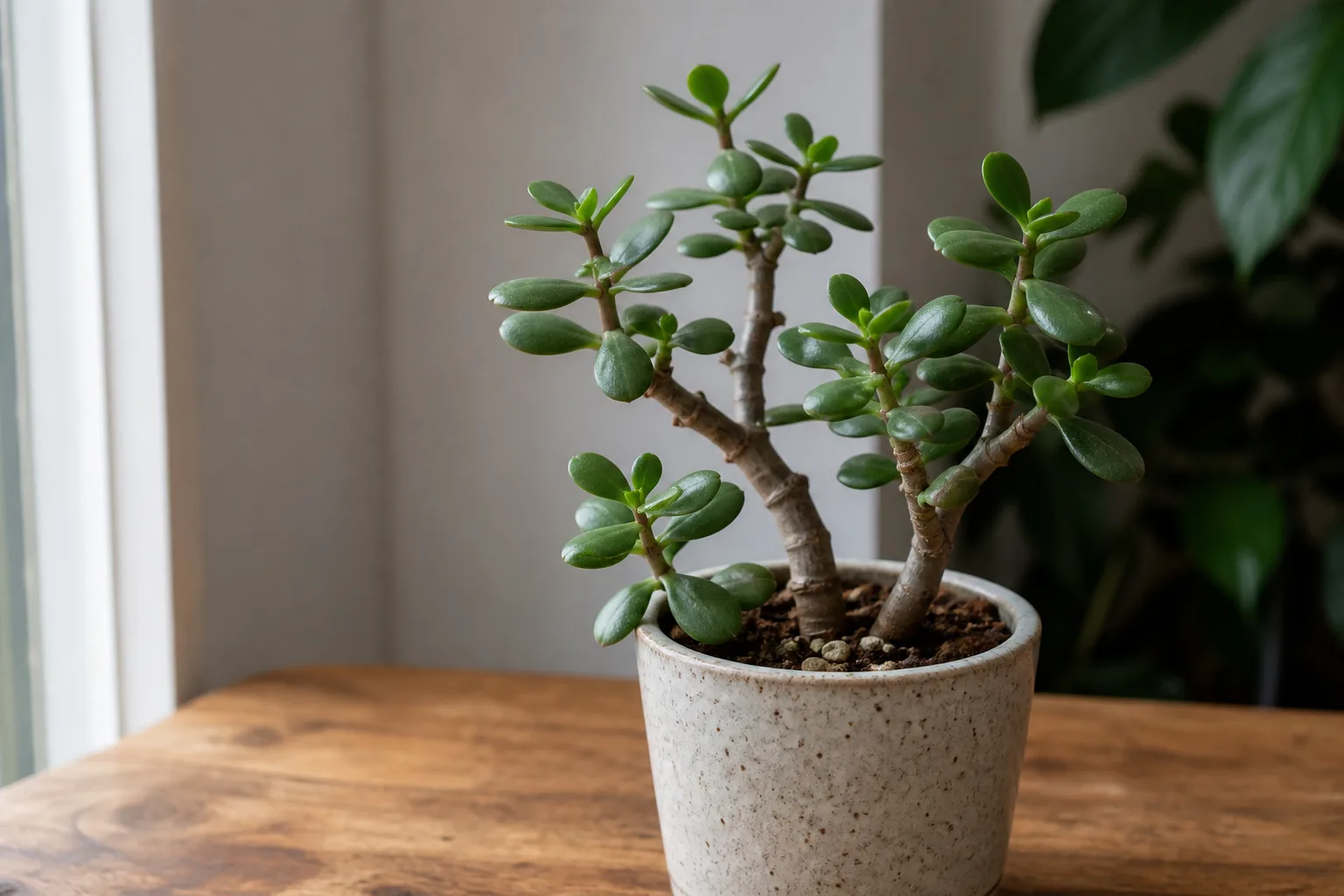
Slow Growth on Jade Plant: Causes, Checks & Fixes
This guide covers slow growth on Jade Plant. See also the general Slow Growth guide, watering, and light pages for this plant.
Slow Growth on Jade Plant: Causes, Checks & Fixes
Quick answer
Crassula ovata is naturally slower than leafy tropicals. Mature indoor specimens commonly reach 18–30 inches over many years rather than racing upward each month. Growth comes in pulses: active pushes in warm bright months, then a marked slowdown when days shorten and you water less in fall and winter.
This page is about growth pace-whether your jade is resting normally or stuck. If stems are stretching with long gaps between leaf pairs, start with leggy growth on jade instead. If the main issue is pale color and weak leaves in shade, see not enough light on jade. Slow growth here means little or no new tip extension while the plant otherwise looks healthy-or a stall that persists through spring and summer.
First step: confirm the calendar. Quiet growth in short-day months can be normal rest. If it is active season and tips stay frozen, move the pot to brighter direct sun and confirm the mix actually dries between deep waterings-do not repot and fertilize on the same day as the light move.
Slow growth vs. leggy growth vs. not enough light
These jade slugs overlap but answer different questions:
| Your question | Best page | What you will find there |
|---|---|---|
| ”Is no growth in winter OK?” | This page | Seasonal pulse rhythm, rest vs. stall table |
| ”Why are internodes so long?” | Leggy growth | Etiolation, stretch measurement, prune-after-light protocol |
| ”My jade is pale in a dim corner” | Not enough light | Placement, hand-shadow test, grow-light setup |
| ”Water runs through; still no push” | Root-bound | Circling roots, repot timing |
| ”Zero new tips for months in good sun” | No new growth | Dormancy misread, cold drafts, post-repot pause |
| ”New leaves stay tiny and pale with long gaps” | Stunted growth | Abnormal leaf size, not normal woody pace |
Slow growth is often the early signal before obvious stretch. A jade that barely extends tips in a dim spot may look “just slow” for months, then suddenly show long internodes. Catching the stall early-before etiolation dominates-saves a year of recovery pruning.
This page is not for stunting. If newest leaf pairs stay abnormally small and pale with months between pairs while stems look thin-not simply quiet-use stunted growth on jade instead. Slow growth here means healthy-looking tissue that simply adds height slowly or pauses seasonally.
Is slow growth normal for Jade Plant?
Yes, in the right season. Jade stores water in leaves and stems and grows in bursts rather than constant flushes. In active growth (roughly spring through summer), you should usually see at least some new paired leaves or tip extension under four or more hours of direct sun. In winter, growth often slows sharply when days shorten and watering is reduced-a semi-dormant rest Wisconsin Horticulture and Clemson HGIC both describe for indoor jade.
Normal slow growth still looks healthy: stems stay firm, leaves stay plump, newer tissue stays compact, and the plant simply adds little height. Problem slow growth pairs a stall with stretch beginning, mix that stays damp for many days, water that runs through without the pot gaining weight, or no new tips through warm bright months after light and watering improve.
Month-by-month growth expectations indoors
Use this as a rhythm check-not a rigid calendar. Latitude, window direction, and grow lights shift timing.
| Month (Northern Hemisphere) | Typical growth pace | Normal care shift |
|---|---|---|
| Jan–Feb | Very slow or paused | Infrequent water; no fertilizer push |
| Mar–Apr | Wake-up; first new pairs | Gradual water increase as days lengthen |
| May–Aug | Fastest pulse | Regular dry-down checks; brightest placement |
| Sep–Oct | Slowing | Reduce water as growth tapers |
| Nov–Dec | Rest / minimal extension | Dry-down stretches; hold feed |
If your jade pushes nothing new from May through August in a south window with firm stems, that is not normal seasonal rest-it is an active-season stall worth diagnosing.
What slow growth looks like on Jade Plant
Watch for these patterns on Crassula ovata:
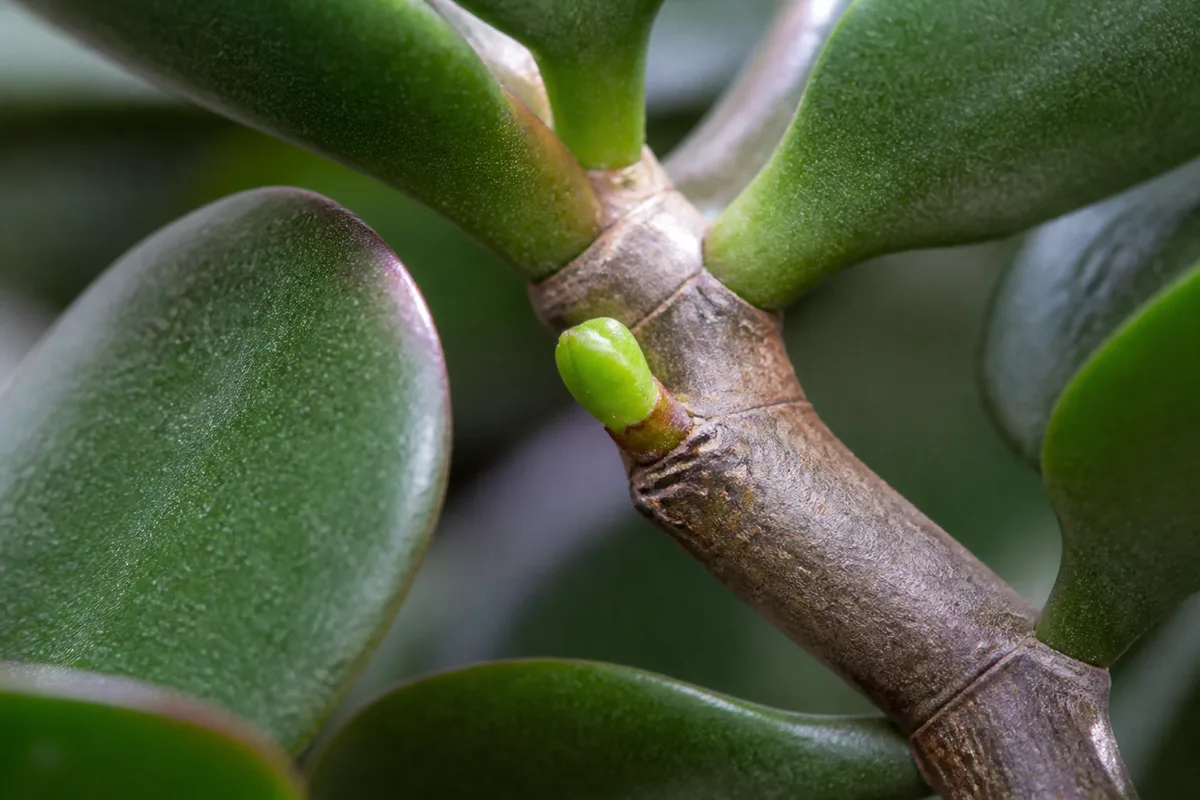
Slow Growth symptoms on Jade Plant - compare with healthy tissue on the same plant.
- Likely normal rest: compact shape, firm trunk, plump leaves, little growth in cool short-day months, soil drying slowly because uptake is low.
- Likely low-light stall: tips frozen for weeks while stems start leaning; spacing between recent leaf pairs widens before obvious whip-thin stretch; dull flat green without red margins under strong light on many cultivars.
- Likely dim-wet trap: same dim placement plus mix that stays damp ten or more days; pot feels heavy; growth flatlines because roots lack oxygen even before stems soften-photosynthesis is slow, so the plant cannot use water you keep supplying on a sunny-window calendar from another room.
- Likely wet-soil stress: lower stem softens, soil smells stale, or leaves collapse while mix stays wet-overwatering and poor drainage are major root-rot triggers on drought-adapted succulents.
- Likely root congestion: water runs through immediately after watering, roots circle the pot wall, and growth stays flat in active season despite adequate light-see root-bound on jade.
Stretch that has already happened is permanent tissue; slow growth is your window to fix light before the plant becomes a leggy rescue project.
Cultivar pace on jade
Not every Crassula ovata cultivar pulses at the same speed. Standard jade and variegated forms often push visible new pairs in warm months when light is strong. Clemson HGIC notes Copper Jade and Hobbit Jade as extremely slow-growing even in good conditions-quiet tips on those varieties can be normal for weeks while a standard jade on the same shelf would show fresh pairs. Hummel’s Sunset and Tricolor need strong light for color; in dim spots they stall longer before stretch shows. Judge pace against your plant’s recent history, not a generic timeline, and compare new tips to older pairs on the same branch.
Two worked pace checks
Scenario A - December rest (likely normal): A ten-year jade in a south window has firm woody stems, plump leaves, and no new pairs since November. You water every three to four weeks; top inch stays dry for ten days after each drink. Soil does not smell sour. Verdict: seasonal rest-hold water, skip fertilizer, recheck in March.
Scenario B - May stall (fix needed): Same window, same plant, but it is mid-May with fourteen-hour days. Tips have not moved since early April; recent leaf pairs sit 1.5 inches apart and the pot leans toward glass. Mix at the top inch still feels damp twelve days after your last watering. Verdict: active-season light stall plus dim-wet trap-brighten placement, acclimate over one to two weeks, and reset watering from dry-down, not calendar.
These two cases share “no new growth” but differ in calendar, internode spacing, and soil behavior. That is why season and the seven checks below matter more than a single symptom.
Why Jade Plant growth stalls
1) Light is too weak indoors
Jade needs high light to maintain compact growth and steady pulses. South-facing windows are usually best, with west-facing as a common second choice Penn State Extension. NC State Extension lists jade cultural light as full sun to partial shade outdoors-indoors you are usually targeting the brighter end of that range. Placement more than four to six feet from glass, north rooms without supplemental light, or heavy curtains most of the day slows growth first-shape quality declines next.
2) Winter rest is being misread as a problem
Jade can slow naturally in fall and winter, especially indoors. During this period, less frequent watering is expected and helpful Missouri Botanical Garden. Panic-fertilizing or repotting during winter rest usually does not fix pace-and can stress a plant that is already idling.
3) The dim-wet trap
This pairing is easy to miss: dim jade photosynthesizes slowly and uses little water, but owners often keep the same weekly watering that worked in a sunny window. Mix stays wet, roots lose oxygen, and growth flatlines without obvious yellow leaves yet. The fix is both brighter light and a watering reset-not more fertilizer.
4) Soil stays wet too long
A pot too large for the root mass or dense peat-heavy mix keeps roots wet and oxygen-poor. Jade prefers fast drainage and drying cycles between deep waterings. Chronic wetness stalls growth before obvious collapse appears.
5) Root-bound or exhausted old mix
Jade tolerates some root tightness, but extreme circling or compacted years-old media limits uptake. Water races through air gaps while roots cannot access moisture evenly-growth stalls in the season when it should pulse. Repotting every few years as new growth resumes can restore momentum; timing details live in the jade repotting guide.
How to confirm the cause
Work through these seven checks in order so you do not stack random fixes:
- Season check - Is it late fall through winter with firm plump leaves? Reduced growth may be normal rest; note the month before panicking.
- Window direction and distance - Is the pot within two to three feet of south or west glass? North alone rarely sustains active-season pulses without grow lights.
- Direct sun hours - On a clear day, confirm sunbeams hit leaves for at least four hours. Room brightness without sun on foliage is not enough for compact pulse growth.
- Hand-shadow test - Hold your hand twelve inches above leaves at midday. A sharp dark shadow means useful intensity; a faint ghost shadow predicts continued stall or future stretch.
- Dry-down speed - After a thorough watering, track days until the top inch is fully dry. Mix still wet at day ten in a dim spot signals the dim-wet trap-adjust light and watering together.
- Stem and root condition - Firm wood-colored stems support recovery. Soft dark bases, sour smell, or collapse while wet point to rot escalation-not rest.
- Repot history - Has the same soil sat for three or more years, or does water run through in seconds? Root congestion or exhausted mix may cap growth even when light is adequate.
Normal rest vs. true active-season stall
| Signal | Normal winter rest | True stall (fix needed) |
|---|---|---|
| Calendar | Nov–Feb (roughly) | May–Aug in good light |
| Stem feel | Firm, woody | Firm or softening at base |
| Leaf texture | Plump, no collapse | Plump, or yellow/mushy if wet |
| New tips | None or very few | None for 4+ weeks in active season |
| Soil behavior | Dries slowly; infrequent water OK | Stays damp too long, or runs through fast |
| Internodes | Compact on any new growth | Widening gaps on recent growth |
| Urgency | Low if firm | Medium; high if soft base or sour soil |
If leaves are wrinkled and the pot is very light with firm stems, underwatering may explain stress better than slow growth from rest. If yellow mushy leaves stack with wet soil in a bright window, diagnose overwatering first.
Stall type comparison - rest vs. light vs. wet vs. root-bound
| Signal | Normal winter rest | Light stall | Dim-wet / wet-soil stall | Root-bound stall |
|---|---|---|---|---|
| Season | Nov–Feb | Active months | Any; worse in dim corners | Active months after years in same pot |
| Stem feel | Firm, woody | Firm; may lean | Firm at first; base may soften later | Firm |
| Leaf texture | Plump | Plump; dull green | Plump then wrinkled or yellow if rot starts | Plump; may wrinkle between drinks |
| New tips | None or very few | Frozen 4+ weeks | None despite calendar watering | None; water runs through fast |
| Soil | Dries slowly; infrequent OK | Wet too long in dim spot | Heavy pot; damp 10+ days | Dry in hours after water; light pot quickly |
| Internodes | Compact on any new growth | Widening on recent pairs | Compact until rot; then collapse | Even spacing but no extension |
| First fix | Wait; reduce water | Brighten sun; acclimate | Dry out; brighten; fix mix if needed | Repot in spring to slightly larger pot |
| Urgency | Low if firm | Medium | Medium–high if sour smell | Medium in active season |
Use this table after the seven checks when more than one cause seems possible. Most indoor stalls in active season trace to the light or dim-wet columns-not winter rest.
First fix to try
Confirm season, then move jade to the brightest safe location where leaves receive several hours of direct sun daily Clemson HGIC Wisconsin Horticulture.
Do not repot, fertilize, and relocate on the same day. Sequence matters:
- If it is active season and stems are firm, improve light first-acclimate over seven to fourteen days to avoid sun scorch on leaves coming from shade. Wisconsin Horticulture recommends gradual light increases for houseplants moving to stronger sun.
- Once placement is brighter, water only after the mix has dried through the top inch or more; reset the calendar from the dim corner.
- Reassess new tip growth for two to four weeks before secondary fixes.
Acclimation over 7–14 days (active season only):
- Shift the pot closer to glass by a few inches every two or three days, or
- Stage through an east window first, then south or west once leaves show no scorch, or
- For outdoor summer placement, start with morning sun only and expand after one week
Target end placement: within two feet of south or west glass where leaves receive four to six hours of direct sun daily, or a grow light six to twelve inches above the canopy if natural sun is insufficient.
If natural light is limited, a full-spectrum grow light six to twelve inches above the canopy for twelve to fourteen hours daily can supplement indoor conditions-turn it off at night.
Keep relocated jade away from pets when moving to brighter shelves-jade is toxic to cats and dogs if chewed.
Step-by-step recovery
If low light is primary
- Increase light gradually over seven to ten days; shift closer to glass every few days or stage through an east window before south or west.
- Rotate the pot weekly for even exposure only after total daily light is adequate.
- Expect compact new tips before older stretched sections improve-stretch that already happened does not shorten back.
If the dim-wet trap is primary
- Pause watering until mix is dry throughout the root zone; lift the pot-light weight confirms dry-down.
- Move to brighter light so future water use matches supply.
- Shift to a faster-draining succulent mix only if soil structure is clearly degraded; do not upsize the pot at the same time unless roots are rotting.
If wet soil or rot risk is primary
- Stop watering immediately if the base softens or soil smells sour.
- Inspect roots-trim black mushy tissue, repot into a smaller well-draining container if needed.
- Resume deep but infrequent watering only after dry-down returns and firmness stabilizes.
If root congestion is primary
- Repot in active season to a container only slightly larger-see jade repotting guide for mix and timing.
- Tease circling roots gently; use high-porosity mix and a drainage hole.
- Keep water conservative for two to three weeks while roots re-establish Wisconsin Horticulture.
Hold fertilizer until new compact growth proves the plant is actively taking up nutrients again-usually several weeks after light and root conditions stabilize.
Recovery timeline
First two weeks after light correction: posture often firms; existing elongated sections stay as they are; look for the first tiny new leaf pair at a tip.
Three to six weeks in active season: new pairs spaced compactly at branch tips are the clearest success signal; soil should dry faster than in the dim spot.
Two to three months: steady pulse growth on multiple branches; repotted plants may need the full window before obvious extension.
Worsening during recovery: new tips absent despite four to six weeks in your brightest window (light still insufficient), softening stem bases, persistent sour soil, or leaf drop while mix stays wet-inspect roots and halt water rather than adding feed.
Structural recovery is slow: older stretched or scarred sections do not tighten. Judge success by new compact growth, not by old flawed tissue reshaping itself.
Slow growth lookalikes to rule out
Before you repot or feed, confirm you are on the right slug:
| What you see | Likely issue | Where to go |
|---|---|---|
| Long gaps between leaf pairs, lean toward glass | Etiolation already underway | Leggy growth on jade |
| Pale flat leaves, no stretch yet | Chronic under-lighting | Not enough light on jade |
| Wrinkled leaves, very light pot, firm stems | Drought stress | Underwatering on jade |
| Yellow mushy leaves, sour wet mix in bright sun | Overwatering / rot risk | Overwatering on jade |
| Water races through; roots circle pot wall | Root congestion | Root-bound on jade |
| Zero tips for months despite good light and dry-down | Dormancy misread or post-repot pause | No new growth on jade |
| Tiny pale new pairs with long gaps, firm stems | True stunting, not seasonal pace | Stunted growth on jade |
Slow growth is the early warning on several of these paths. If internodes on new growth already exceed one to two inches, you are past slow growth-follow leggy growth on jade for stretch recovery and pruning timing. Fixing light and dry-down here often prevents a leggy rescue or root inspection later.
What not to do
Do not over-fertilize to force growth-nitrogen on a stressed jade in dim light can produce weak stretch without fixing pace Penn State Extension.
Do not upsize to a huge pot hoping for faster growth; excess wet soil around a small root mass stalls jade further.
Do not water on a calendar from a brighter room when the plant still sits in shade-match drinks to dry-down and season.
Do not repot during winter rest unless rot forces it; spring wake-up is the safer repot window for congestion fixes.
Do not assume slow always means more water-a heavy wet pot in low light is often the cause, not the cure.
How to prevent chronic slow growth
Place jade where direct sun hits leaves for most of the growing season. University of Maryland Extension classifies jade among high-light houseplants suited to south-facing windows.
Match watering to dry-down and season: more frequent checks when summer sun dries the pot quickly; longer intervals during cool winter rest when uptake slows Clemson HGIC Missouri Botanical Garden.
Refresh mix or repot on a multi-year rhythm before water races through exhausted soil. Plan autumn grow-light or brightest-window placement before stretch begins, not after months of stall.
Full culture rhythm lives in the jade watering guide and jade light guide.
When to worry
Slow growth becomes urgent when paired with:
- Stem softness or darkening at the base
- Persistent leaf collapse while soil stays damp
- Sour or musty wet media smell
- Water running through instantly with a plant that keeps wilting-possible root loss
Those signs point to root or stem decline, not harmless seasonal slowdown. Stop watering, inspect roots, and use the root rot on jade guide rather than waiting for spring.
A firm jade with flat growth and normal dry-down after a light move can wait through the rest of the active season before repotting for congestion-rot symptoms cannot.
Conclusion
Slow jade growth is often seasonal and healthy-especially in short-day months when firm stems and plump leaves persist. A true stall in warm bright weather usually traces to weak light, the dim-wet trap, exhausted soil, or root congestion. Fix light and dry-down first; repot and feed only after the plant proves it is growing again. When softness, sour soil, or collapse join the stall, escalate to root inspection immediately.
Related Jade Plant guides
- Jade plant overview - culture, seasonal rhythm, troubleshooting hub
- Leggy growth on jade - when slow stall has already become stretch
- Not enough light on jade - placement, grow lights, dim-wet pairing
- No new growth on jade - months without tips despite good care
- Root-bound on jade - circling roots and fast drain-through
- Overwatering on jade - wet-soil stalls and rot risk
- Jade plant light guide - windows, acclimation, supplemental lighting
- Jade repotting guide - timing, mix, congestion recovery
- Stunted growth on jade - tiny pale new leaves vs. normal slow woody pace
Related tool
Use the Plant Problem Diagnosis Tool to narrow causes for slow growth on this plant before changing multiple variables at once.