Mogra Iron Deficiency: How to Confirm and Correct It
Quick answer
Iron deficiency is plausible when Mogra’s newest leaves turn yellow between green veins, especially in a high-pH or poorly aerated root zone. Confirm the pattern and test the potting mix before adding iron or changing pH; excess water, compaction, and other nutrient problems can look similar.
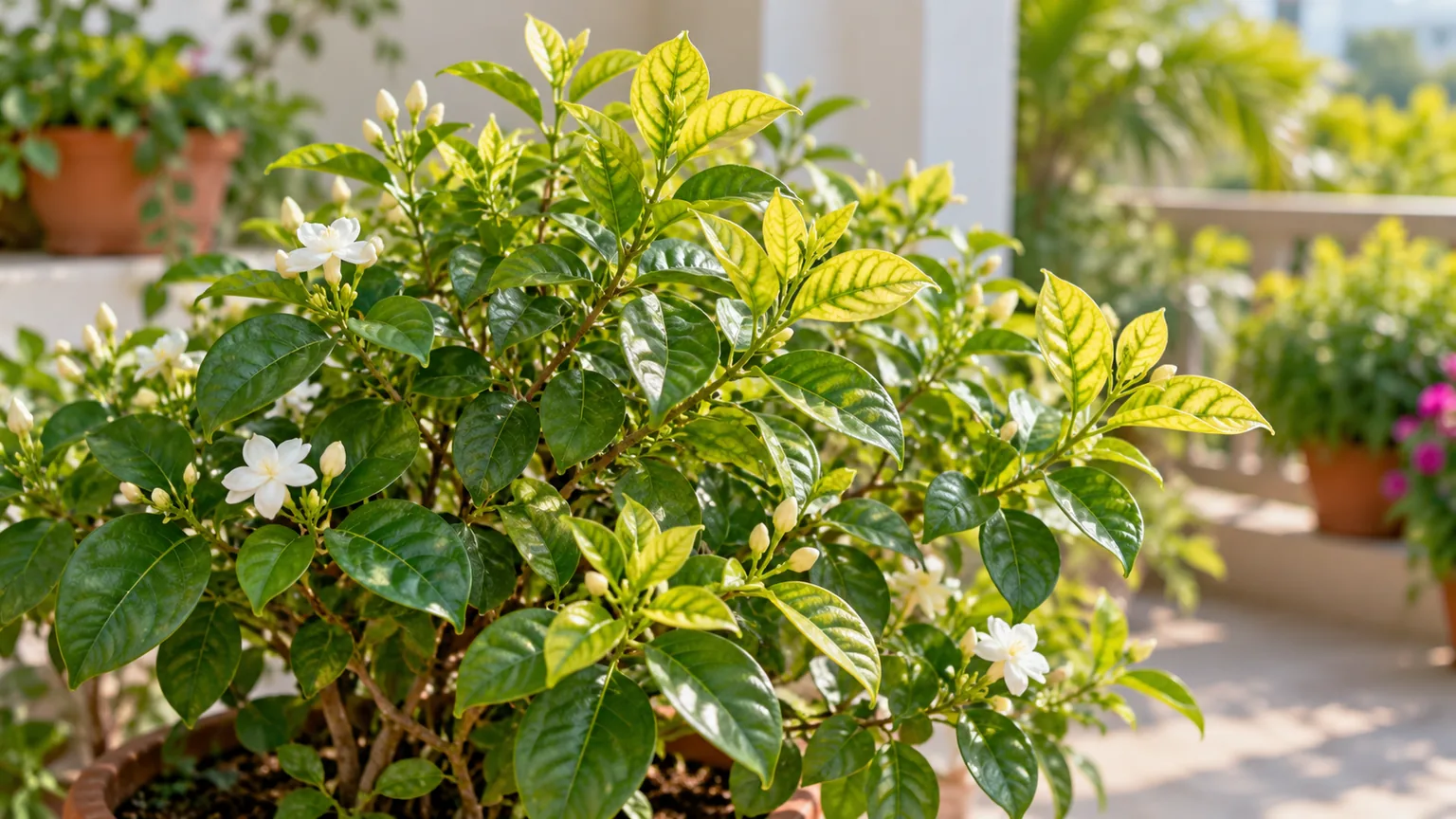
Iron Deficiency on Mogra: Causes, Checks & Fixes
This guide covers iron deficiency on Mogra. See also the general Iron Deficiency guide, watering, and light pages for this plant.
Iron Deficiency on Mogra: Causes, Checks & Fixes
Quick answer
Iron deficiency is plausible when Mogra’s newest leaves turn yellow between greener veins, especially if the root-zone mix is alkaline or stays poorly aerated. Do not treat a pale leaf as proof that the plant needs more iron. First compare the leaf pattern, check the mix and roots, and test the pH; wet or compacted soil and other nutrient problems can interfere with uptake or create similar color changes.
For the general nutrient process, see the iron-deficiency guide. This page focuses on how to decide whether that pattern fits Mogra and what to check before applying a product.
What iron chlorosis looks like on Mogra
On Mogra, inspect the tips of actively growing shoots before the older leaves lower on the bush. The classic iron-chlorosis pattern is yellow tissue between veins that remain greener, most visible on young leaves. In more advanced cases, the newest leaves can become very pale and their margins may scorch; a University of Utah Extension overview describes this progression in iron chlorosis, while Colorado State University Extension notes that symptoms commonly begin on the youngest leaves. (Utah State University Extension; Colorado State University PlantTalk)
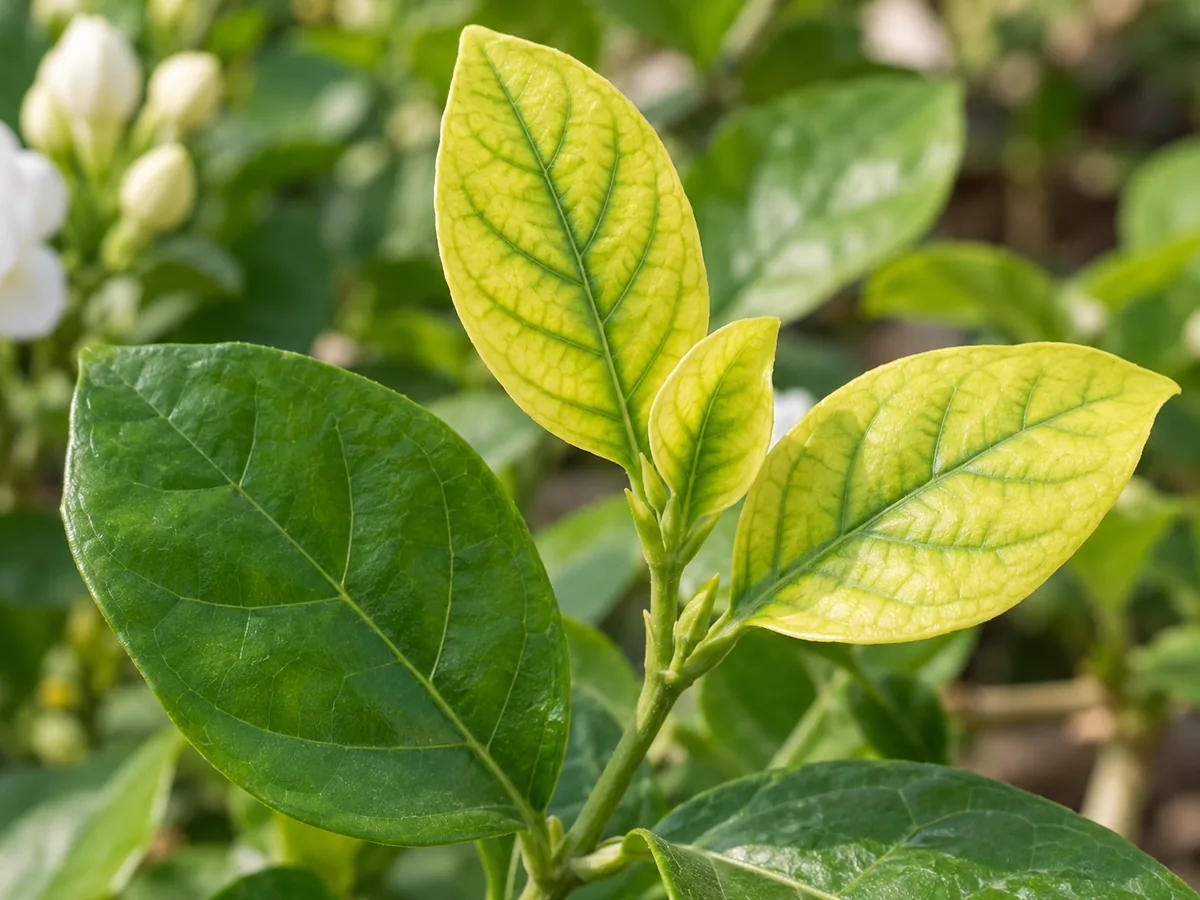
Mild interveinal paling on new Mogra growth is a clue to investigate, not proof of an iron shortage.
A single pale leaf is not enough to diagnose a deficiency. Look for the same pattern across several new leaves, and note whether the older foliage is still relatively green. A whole plant that fades evenly, a branch that wilts after watering, or older leaves that yellow first should send you down a different diagnostic path.
Flowering is not a reliable iron test. Mogra may flower poorly because light, season, pruning, or general root health is off. Use leaf age and vein contrast to assess suspected chlorosis, and use the Mogra overview for its broader growth and placement needs instead of treating “no flowers” as proof of low iron.
Why a Mogra can show iron chlorosis
Iron can be present in the potting mix but unavailable to roots. At higher soil pH, chemical reactions can bind iron into forms that plants absorb poorly; Utah State University Extension describes this as a common reason for chlorosis in alkaline soils. Colorado State University Extension gives a similar explanation and notes that species differ in their susceptibility, so a high pH reading raises suspicion but does not diagnose the problem by itself. (Utah State University Extension; Colorado State University PlantTalk)
That distinction matters for a potted Mogra. Adding a general-purpose fertilizer may supply more nutrients without correcting the conditions that keep iron unavailable. Repeated doses can also make the root environment harder to interpret. The Mogra nutrient-lockout guide is a better next stop if several nutrient symptoms overlap or a feed history is unclear.
A root-zone problem can also interfere with iron uptake. Colorado State University Extension lists overly wet or dry soil, temperature extremes, and poor aeration from compaction or overwatering among factors that contribute to iron deficiency. If the pot remains heavy, the mix has collapsed, or water drains unusually slowly, correct that condition before trying to push new growth with fertilizer. (Colorado State University PlantTalk)
Mogra’s normal care helps put those clues in context. It is a bushy flowering shrub that grows more actively in warm weather and uses water more quickly when it has the bright placement needed for flowering. Check moisture by feel instead of following a fixed calendar: the Mogra watering guide explains the top-layer check and seasonal adjustment. A mix that stays wet for days in low light is a different situation from a sun-grown plant whose pot dries quickly between waterings.
How to confirm the cause before treating
Start with the youngest leaves
Compare at least three leaves from different shoot tips. Iron chlorosis is more likely when the newest leaves show a repeated green-vein/yellow-between-veins pattern and older leaves are less affected. Photograph the same tips in natural light so you can tell whether the pattern is spreading or simply more noticeable under indoor lighting.
If the yellowing is uniform rather than concentrated between veins, or starts mainly on older leaves, do not assume iron deficiency. Nutrient mobility and the sequence in which symptoms appear can help separate deficiencies, but a visual guess is not enough to choose a treatment. A horticulture comparison of iron and magnesium chlorosis describes the different leaf-age patterns; the Mogra yellow-leaves guide covers broader causes when the pattern is not a close match.
Check the mix, drainage, and roots
Feel the potting mix below the surface, not only the top crust. Lift the pot to compare its weight with a recently watered pot. If it is still heavy well after watering or feels dense and airless, inspect the drainage holes and the lower part of the mix. Do not unpot a stable Mogra just to look for a deficiency; unpot only when the drainage failure or root decline is strong enough to justify disturbing it.
If you do need to inspect roots, focus first on whether the mix drains and whether the roots remain in saturated media. Colorado State University Extension identifies overly wet or dry conditions and poor aeration as contributors to iron-availability problems, so a drainage failure should be addressed before adding iron. If the leaves are also distorted, compare the Mogra distorted-leaves guide for related root and watering clues. (Colorado State University PlantTalk)
Test the root-zone pH
Use a test method intended for potting media or ask a local soil-testing service how to prepare a container sample. Take the sample from the root zone rather than from a surface crust or fertilizer granule. Repeat an unexpected reading before making a large change. A reading near neutral is not automatically harmful to Mogra, and the exact risk depends on the plant, mix, and water history. Extension guidance places iron availability problems more often in alkaline conditions, but it also stresses that susceptibility varies among species. (Utah State University Extension; Colorado State University PlantTalk) A horticulturist’s iron-chlorosis guide likewise recommends testing pH before selecting a chelate; its plant-specific thresholds should not be transferred to Mogra.
Write down the test result, when the plant was last watered, and what fertilizer was used. That small record can prevent a sequence of guesswork changes. If pH is not elevated and the mix drains well, investigate light, watering, root health, and other nutrient patterns before concluding that Mogra needs supplemental iron.
The first fix: confirm before adding iron
First, test the root-zone mix and match the result to the new-leaf pattern. Do not start with iron chelate, a high-phosphorus bloom booster, or an acidifier. Utah State University Extension notes that available treatment methods can differ in how quickly they act and how long they last; it recommends matching the approach to the site rather than assuming one remedy works in every case. Its guidance is written for landscape trees, so treat it as general iron-chlorosis context, not a Mogra dosing schedule. (Utah State University Extension)
If the new growth fits iron chlorosis and a suitable test confirms high pH, use a product explicitly labeled for container ornamentals and for the measured pH range. Follow its label for rate and application method. Do not copy a landscape-tree dose, combine soil and foliar products, or apply extra because the leaves remain yellow the next day. A product that is not suitable for the root-zone pH may not solve the underlying problem.
If pH is within the expected range but the mix stays wet or compacted, correct drainage and watering first. Resume Mogra’s usual moisture routine only after the root zone begins drying normally. If you find extensive root decay, repot into a fresh, free-draining mix only when the current medium is failing; avoid changing the pot, light, feed, and pruning routine together.
Recovery steps that fit Mogra
If high pH is confirmed
Make one measured correction at a time. For a pot with sound roots but unsuitable mix, replacing the mix during active growth may be more predictable than pouring a strong acidifier through the container. Choose a well-draining potting medium appropriate for a flowering Mogra, keep the pot size close to the existing root ball, and avoid disturbing healthy roots more than necessary.
If repotting is not needed, ask a local extension service or qualified horticulturist to interpret the test and product label before lowering pH. Container media are small systems, so test first and follow any pH-amendment label rather than guessing at a rate; a horticulturist’s guide to iron chlorosis recommends careful, gradual pH adjustment. Do not add vinegar or citrus juice by guesswork, or bury rusty metal as an iron source. Elemental sulfur can be used as a measured pH amendment in some soils, but use it for a Mogra pot only when the test, product directions, and local advice support that choice; a horticulturist’s guide to iron chlorosis also cautions that rusty nails do not correct high-pH iron unavailability.
If the mix is wet or compacted
Let the surface layer dry according to Mogra’s normal watering check, then correct the reason the lower mix stayed wet. Confirm the drainage hole is open and remove standing water from a cachepot. If the substrate has collapsed or no longer drains, repot once into a loose medium rather than repeatedly aerating the roots. Compare the Mogra distorted-leaves guide if water-related symptoms are also changing new growth.
Do not keep Mogra bone-dry to “force” new roots. The goal is a moist but aerated root zone, not alternating drought and saturation. In bright warm weather it can use water faster; during cooler, slower growth it uses less. Let the plant and pot tell you when to water, and check the Mogra watering guide if you are unsure how that seasonal rhythm should change.
If pH and drainage look normal
Look for a competing explanation before feeding. Review whether the plant recently moved to a darker spot, whether the latest growth is unusually small, and whether the same yellowing appears on older leaves. Check the undersides of new leaves for pests, and check whether fertilizer has been applied repeatedly or at a stronger rate than the label allows.
When the pattern does not match iron chlorosis, follow the specific symptom rather than treating every pale leaf with iron. Older leaves that yellow first may fit a different nutrient or root issue; pale growth across the whole shrub may also point to low light or general stress. Compare the Mogra magnesium-deficiency guide and fertilizer-burn guide when those patterns or recent feeding history apply. A horticulture comparison of iron and magnesium chlorosis also uses leaf age to distinguish the two patterns.
What recovery looks like on a Mogra
The first good sign is that the discoloration stops advancing into the newest leaves. Watch the next flush at the shoot tips for stronger green color and normal leaf size. Keep a dated photo and avoid changing several conditions at once; otherwise it becomes difficult to tell which correction helped.
Do not use a badly yellowed or browned leaf as the only measure of recovery. Compare dated photos of Mogra’s shoot tips and check whether the next leaves continue to show the same interveinal pattern. That keeps the diagnosis tied to the part of the plant where iron chlorosis typically appears first.
Mogra grows more slowly when conditions are cool or when it is between active growth and flowering. That can make recovery appear delayed, even when the cause has been addressed. Judge progress over new growth rather than expecting a visible change within a day or two. If the next flush remains pale, repeat the pH and moisture checks before applying another dose.
Persistent decline deserves a wider inspection. If the mix remains saturated or symptoms keep spreading while drainage is poor, prioritize the root zone over iron. If the shoot tips are becoming nearly white and shrinking while the lower plant also weakens, seek local extension or nursery advice with the pH result, fertilizer label, and dated photos in hand.
Lookalikes and mistakes to avoid
Iron chlorosis has a particular location and pattern: young leaves, yellow tissue between greener veins. Uniform yellowing, symptoms beginning on older leaves, or soft wilt after watering do not fit that pattern as neatly. Use the Mogra yellow-leaves guide for broad yellowing and the magnesium-deficiency guide when older leaves show the stronger pattern. If symptoms began after feeding, compare them with fertilizer burn.
Avoid these common mistakes:
- Adding iron without checking pH. More iron will not reliably help if the root zone cannot make it available.
- Treating “no flowers” as proof. Mogra’s flowering depends on more than nutrition; follow the plant’s light and seasonal care in the Mogra overview.
- Changing the mix and feeding at the same time. Make one correction, record it, and assess the next growth.
- Using a landscape-tree product rate on a pot. Container volume and label directions matter.
- Acidifying by guesswork. Test first and use only a measured, plant-appropriate product.
- Pruning away every pale tip. Remove only dead or badly damaged tissue once the plant is stable; pruning does not correct root-zone chemistry.
Prevent iron chlorosis from returning
Keep Mogra in a mix that drains while retaining moderate moisture. Check it before watering instead of following a fixed interval, and reduce watering when growth and evaporation slow. If the mix is repeatedly saturated, compacted, or unusually alkaline, correct that root-zone condition rather than compensating with frequent feeding. For other plant problems and their scope, visit the Mogra problems hub.
Feed only during active growth and follow the fertilizer label. Do not use extra fertilizer to force flowering when Mogra is pale; first distinguish iron chlorosis from root trouble, low light, or a different deficiency. Keep a simple record of the product, dilution, and date. A repeated young-leaf pattern after feeding is a reason to recheck the mix, not to increase the dose.
If Mogra is watered with mineral-heavy tap water and the mix repeatedly tests alkaline, ask a local extension laboratory or horticulturist how to assess the water and root zone before attempting acidification. Water pH alone may not tell the whole story, and adding acid without a measurement can damage the root environment. Recheck new leaves after each correction and keep the light, pot size, and pruning routine steady while the plant recovers.
When to use this page vs other Mogra guides
Use this page when the newest Mogra leaves show repeated yellowing between green veins and the root zone may be alkaline or poorly aerated. If all leaves are yellowing, start with yellow leaves; if older foliage is affected first, compare magnesium deficiency. If growth is pale after repeated fertilizer use, see fertilizer burn. For broader Mogra care and symptoms, return to the plant overview or the problems hub.
Related tool
Use the Plant Problem Diagnosis tool to organize the symptom pattern and narrow down what to inspect before changing several care factors at once.
Related Mogra guides
- This iron-deficiency guide: use for the young-leaf, green-vein pattern when high pH or poor aeration is possible.
- Yellow leaves: use when yellowing is widespread, uniform, or not limited to young shoot tips.
- Magnesium deficiency: use when the older leaves show the stronger yellowing pattern.
- Fertilizer burn: use when leaf damage followed a recent or concentrated feed.
- Watering: use when the mix stays wet, dries unusually fast, or watering timing is uncertain.