Nutrient Lockout on Mogra: Causes, Checks & Fixes
Quick answer
Nutrient lockout means Mogra roots cannot take up nutrients effectively even when some are present in the potting mix. Pale leaves, slow growth, or fewer flowers do not confirm it: pH, fertilizer salts, waterlogged or dry roots, and low light can overlap. Pause extra feeding, check the recent care history and root-zone condition, then use a suitable pH or soluble-salt test before changing the mix.
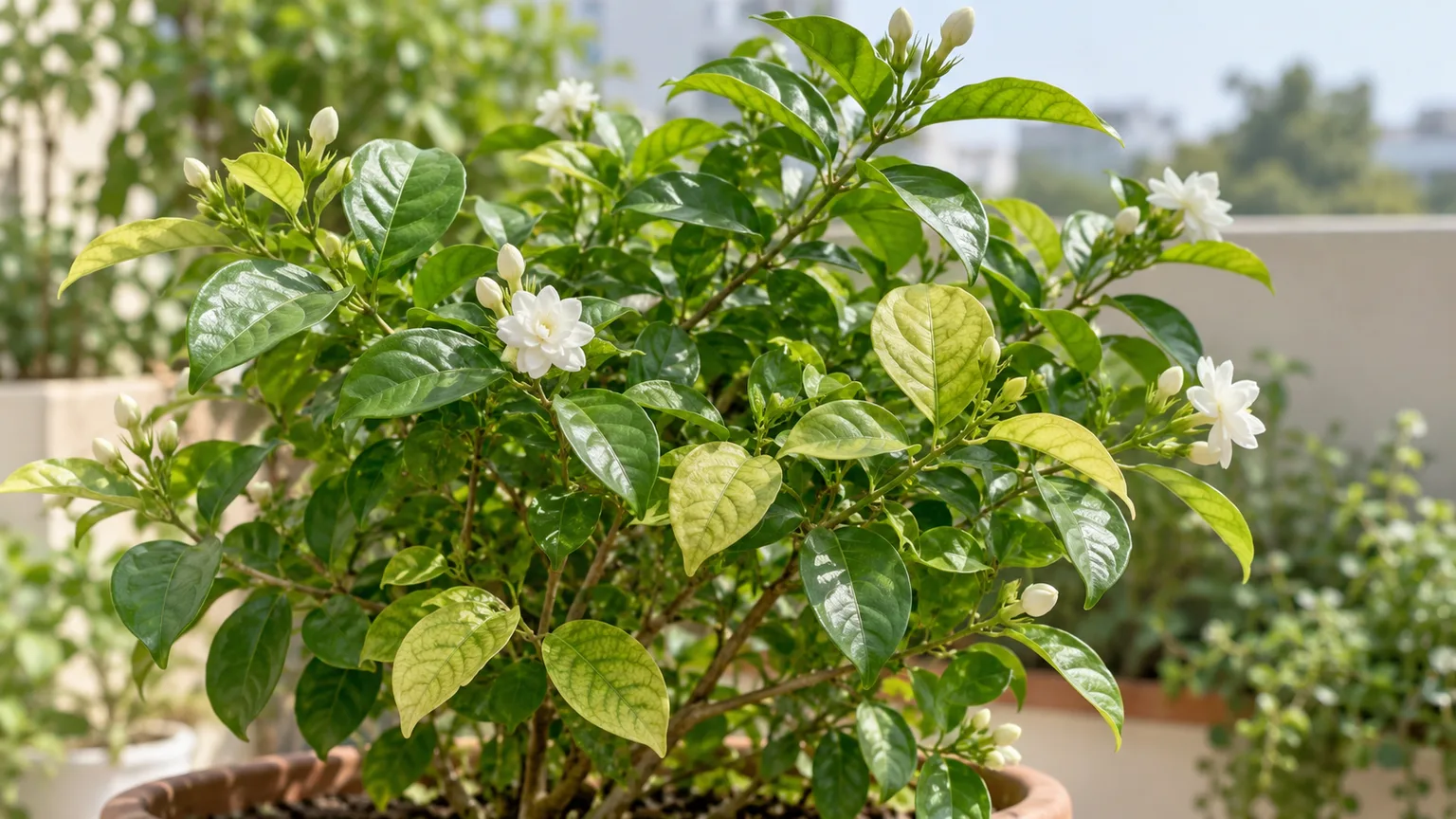
Nutrient Lockout on Mogra: Causes, Checks & Fixes
This guide covers nutrient lockout on Mogra. See also the general Nutrient Lockout guide, watering, and light pages for this plant.
Nutrient Lockout on Mogra: Causes, Checks & Fixes
Quick answer
Nutrient lockout is a root-zone problem: nutrients may be present, but Mogra cannot take them up well. A pale leaf, weak shoot, or disappointing bloom is not enough to diagnose it. Soil pH affects which nutrients are available, while soluble-salt buildup can injure roots and interfere with water uptake; dry, waterlogged, or poorly lit conditions can create similar symptoms too (NC State Extension on soil pH and salinity; RHS on lookalike growing-condition problems).
First, stop adding fertilizer while you check the pot and recent care. Note when Mogra was last fed, what product and dose you used, whether the pot drains freely, and whether the affected leaves are old or new. Correct only what the evidence points to; adding more fertilizer to a stressed root system can make the problem worse (UConn houseplant fertilization guidance).
What nutrient lockout can look like on Mogra
On Mogra, a nutrient problem may show up as leaves losing color, slower shoot growth, or a weaker flower flush. Those signs can also follow poor light, irregular watering, root damage, pests, or a seasonal pause, so they do not identify lockout by themselves. The RHS nutrient-deficiency guide notes that pale or yellow leaves, stunted growth, and poor flowering can accompany deficiencies, while other growing conditions can resemble them.
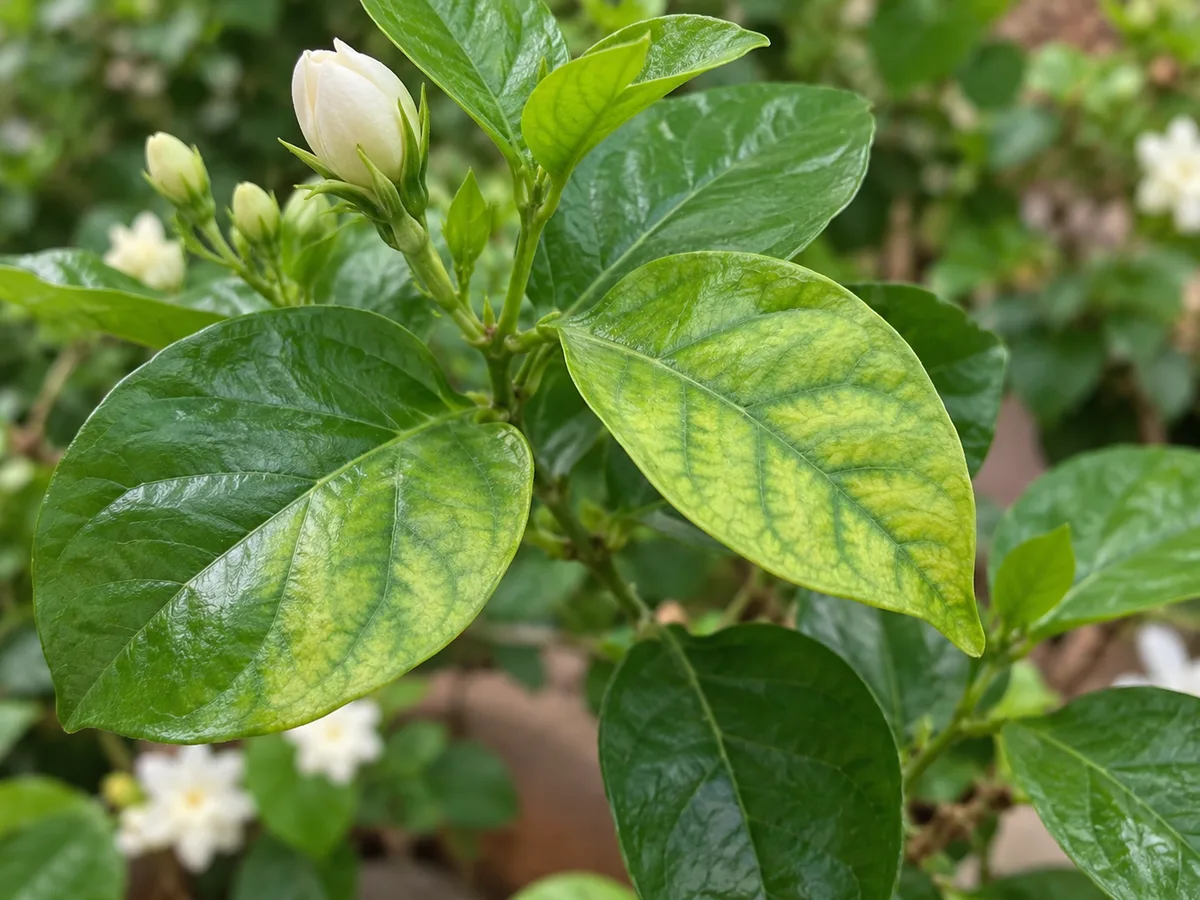
Pale foliage is a clue to investigate the root zone; it is not a diagnosis of a particular nutrient or of lockout.
Look at the pattern across the whole plant. One fading old leaf may be normal aging; several leaves changing together, pale new growth, or the same pattern returning after each feed deserves a closer check. Damage soon after fertilizing raises concern about salt injury, while gradual change without recent feeding points elsewhere.
“Nutrient lockout” is often used loosely. Here it means reduced uptake because root-zone conditions make nutrients less available or roots less able to absorb them; it is different from a shortage in the mix and cannot be diagnosed by appearance alone. For the general mechanism, see the nutrient lockout guide; the checks below focus on a potted Mogra.
Start with Mogra’s last flower flush, not the fertilizer bottle
Mogra is Arabian jasmine, Jasminum sambac, a flowering jasmine grown for its fragrant blooms (Britannica’s Arabian jasmine entry). That flowering habit can tempt a grower to reach for a “bloom booster” whenever flowers slow down. But fewer flowers do not prove that Mogra lacks phosphorus or that nutrients are locked out: light, recent pruning, water stress, temperature, and the plant’s active growth stage all affect what a jasmine does.
Compare the plant with its recent pattern: did leaves fade before flowers dropped, did Mogra move to a dimmer spot, or was it pruned just before the expected flush? Healthy shoots without flowers suggest a different question from weak, pale growth. Check the Mogra light guide before treating reduced flowering as a fertilizer signal.
Jasmine guidance describes sunny to lightly shaded conditions and well-drained soil, while cautioning against overwatering. Treat this as context because jasmine species and indoor conditions differ; if Mogra’s pot stays wet for days, more fertilizer will not restore root uptake (Gardening Know How’s jasmine growing guide).
Read Mogra’s older leaves against its newest shoots
Leaf age and location are clues, not a laboratory test. Nitrogen deficiency often begins on older leaves, while some less-mobile nutrients show first on new growth; overlapping symptoms and stress blur the pattern (Gardeners’ Path).
Inspect one old lower leaf, a mature leaf, and the newest pair on an actively growing shoot. Note whether paling is between veins, at the margins, or uniform, and check undersides for pests. If old leaves alone are affected while new growth is normal, avoid drastic treatment; persistent pale or distorted new leaves warrant a root-zone check.
Compare the shoot with Mogra’s growth stage: active growth can use nutrients, while cooler or dimmer conditions may slow growth and reduce demand. Base feeding on visible growth rather than a fixed calendar (UConn’s houseplant fertilization guide).
Why nutrients can be present but unavailable
Potting-mix pH
Growing-medium pH influences nutrient availability. A mix can contain nutrients that roots cannot use effectively when pH is unsuitable; very acidic and alkaline conditions can both contribute to deficiencies (NC State Extension). Jasmine care references give broad soil guidance, not a measured target for every Mogra pot.
If symptoms persist despite stable care, test the medium or ask an extension service which method suits container mix. Test before adding acidifiers, lime, or micronutrients; a guessed correction can make another nutrient less available.
Fertilizer salts or unsuitable feeding
Repeated or overly concentrated fertilizer can leave soluble salts in a container. UConn lists brown roots or tips, wilting, poorly shaped leaves, and a white crust on pot rims as signs of overfertilization; salts can burn roots and interfere with water uptake (UConn houseplant fertilization guidance). A Mogra that looks “hungry” after frequent feeding may need less fertilizer, not more.
White material on a pot rim is a clue, not proof of excess feed. Check its timing against feeding, tip burn, wilting, and drainage. If the source water is mineral-rich, include it in the history and ask whether a soluble-salt test would help.
Roots that cannot do their job
Roots need both moisture and air. Saturated mix, slow drainage, or a sour smell can reduce uptake even when feeding is normal; dry container mix can limit uptake too, as the RHS explains.
Jasmine care guidance notes that Jasminum sambac can be vulnerable with a poor root system. Check roots if the pot stays wet, Mogra wilts in damp mix, or stems decline, but do not unpot a stable plant just to look for a nutrient diagnosis (Bob Vila’s jasmine-care guide).
How to confirm the likely cause
Work through the evidence in this order so you do not mistake a care problem for a nutrient problem.
- Record recent inputs. Note fertilizer, dose, last feeding, water source, repotting, and location changes. Container nutrients can run out, but blind feeding can also create excesses (Epic Gardening).
- Check moisture and drainage. Feel the upper mix and lift the pot; open drainage holes and empty any outer cachepot. Compare the dry-down with the Mogra watering guide.
- Look for salt clues. Check the rim and surface for crust, then compare its timing with feeding, tip burn, and wilt. Crust alone does not establish that nutrient availability is the problem.
- Map the leaf pattern. Note whether older or newer leaves are affected and check undersides for pests. Compare only a matching interveinal pattern with the Mogra iron-deficiency guide or magnesium-deficiency guide.
- Test before changing pH. If decline continues, ask an extension service about a potting-medium pH and soluble-salt test. NC State Extension identifies pH and electrical conductivity as measures related to nutrient availability and soluble-salt concentration.
Treat lockout as more likely when measured pH or salt trouble fits the timing, or when heavy feeding is followed by crust, tip burn, or root stress. It remains unconfirmed when the only evidence is yellow leaves, low flowering, or slow growth. Use the Mogra problems hub to compare alternatives.
First fix: pause feeding while you check the root zone
Stop adding fertilizer for now. Extra nutrients cannot correct pH or drainage, and excess can damage roots. Do not add Epsom salts, iron, phosphorus, or a “bloom” product based only on leaf color.
Keep Mogra in its current suitable light while checking the pot, unless the location is clearly wrong. Avoid changing feed, mix, watering, and position at once; if fertilizer burn seems likely, first confirm that the pot drains freely.
Correct the cause without shocking Mogra
If recent feeding and salt buildup fit
If the pot drains freely and roots are not soft or rotting, leaching with plenty of water can reduce excess fertilizer salts. Let water run through the drainage holes, then empty the saucer; UConn’s guidance specifies that drainage must be free. Do not flush a pot that stays wet.
Pause feeding while Mogra stabilizes. If crust returns or damage continues, replace a failed medium rather than repeatedly flushing. See Mogra fertilizer burn when injury began after an excessive dose.
If the pot stays wet or roots look unhealthy
Do not leach a slow-draining pot. If it smells sour, has soft dark roots, or Mogra wilts in wet mix, unpot to confirm root damage. Remove dead roots and replace collapsed or waterlogged medium with fresh, free-draining mix, as jasmine root-rot guidance recommends; avoid a much larger pot that would stay wet around the remaining roots.
After repotting, keep light and watering steady and hold fertilizer until Mogra resumes active growth. Damaged roots need a stable moisture pattern before they can use a stronger feed.
If a test confirms pH or a nutrient shortage
Use the test result to guide correction. If pH is unsuitable, follow the lab’s recommendation or replace the medium; do not improvise with vinegar, lime, or sulfur. If pH is suitable and Mogra is actively growing, use a complete fertilizer according to its label rather than guessing at one nutrient; UConn notes that excess fertilizer can harm roots and leaves.
Without a test, do not assume Mogra has a specific deficiency. Stabilize light, watering, and drainage, then watch new growth. Resume routine feeding only when Mogra is growing and the root zone is sound; use the Mogra fertilizer guide for normal care.
Lookalike problems to rule out
| What you see | More useful clue | What to check next |
|---|---|---|
| Pale leaves with weak growth | Can occur with deficiencies, but overlaps with stress | Compare old and new leaves, then review light, moisture, and feeding |
| Yellowing with wet, heavy mix | Waterlogging can resemble a deficiency | Check drainage and roots before adding fertilizer |
| Pale or stretched shoots with fewer flowers | Often points first to inadequate light for a flowering jasmine | Recheck placement using the Mogra light guide |
| Brown tips or wilt soon after feeding, possibly with a crust | Raises concern about excess fertilizer salts | Stop feeding and assess whether the pot drains; do not add another product |
| Interveinal yellowing on young leaves | Can fit iron unavailability, but does not prove it | Test the medium before using an iron supplement |
| Fine stippling or distorted foliage | Pests can imitate nutritional stress | Inspect leaf undersides and new growth before changing the feed |
If the pattern does not fit a measured nutrient or root-zone issue, compare Mogra’s basic care guides before treating it as lockout.
Recovery timeline: judge the next Mogra growth
Recovery has no reliable fixed date. It depends on the cause, root function, growth stage, and whether the cause was corrected; a slow-growing Mogra may take longer to respond than one producing fresh shoots.
Do not expect a badly yellowed or scorched leaf to turn green again. Photograph the plant after correction and judge new leaves over the next few weeks. Improvement means symptoms stop spreading, fresh foliage looks more normal, and the pot dries predictably. If new growth stays pale or Mogra keeps wilting, return to diagnosis instead of increasing fertilizer.
Mistakes that keep the problem going
- Feeding whenever leaves pale. Symptoms overlap, and salts may worsen root injury; confirm the cause first.
- Stacking supplements. Several products at once hide the cause and can create an imbalance.
- Changing pH without a test. A guess can make another nutrient less available.
- Flushing a slow-draining pot. Leach only when water can pass through and leave the container.
- Treating flowers as the only health measure. Light, pruning, and growth stage also affect Mogra’s blooms.
- Repotting after one old leaf yellows. Disturb the roots only when the medium or root condition supports it.
Prevent nutrient lockout in Mogra
Keep the root zone consistent with a pot that drains and a mix that holds some moisture without staying saturated. If water runs down the sides or the pot stays heavy, correct the mix or watering pattern before changing fertilizer. Review the Mogra soil guide.
Water as the mix begins to dry rather than following a calendar. A sunny, actively growing Mogra may use water faster than one in a cool, dim spot; compare pot weight as well as the surface.
Feed during active growth and follow the product label. Container mixes have finite nutrient reserves, but this calls for measured feeding, not dose increases whenever growth slows (Epic Gardening; Gardeners’ Path).
Keep a short record of new leaves or flowers, pot dry-down, and feeding dates. A symptom that starts after feeding differs from gradual paling after months without nutrients. If it returns despite stable care, test the medium instead of cycling through remedies.
When to get help
Ask an extension or horticulture service for help if Mogra keeps declining, several nutrients seem involved, or a pH result is far outside guidance. Share plant photos, the fertilizer label, your watering history, and test results. If roots or the stem base are failing, prioritize root health; fertilizer cannot restore dead tissue.
Related Mogra guides
- Use the Mogra overview for the full care context and to check whether light or seasonal growth has changed.
- Use Mogra watering when the pot alternates between drying hard and staying wet.
- Use Mogra soil when drainage, compaction, or an old mix may be limiting roots.
- Use Mogra fertilizer for routine feeding after the root zone is stable.
- Use Mogra fertilizer burn when damage began after a heavy dose.
- Use Mogra iron deficiency or Mogra magnesium deficiency only when the leaf pattern fits those narrower questions.
Related tool
Use the Plant Problem Diagnosis Tool to compare likely causes before changing several parts of Mogra’s care.