Nitrogen Deficiency on Monstera Adansonii: Causes, Checks &
Quick answer
On Monstera adansonii, nitrogen deficiency is plausible when several older leaves turn evenly pale yellow-green, growth slows, and the newest leaves remain healthier. First check the leaf-age pattern and root-zone condition; do not fertilize until wet roots, drought, low light, pests, and normal aging are less likely.
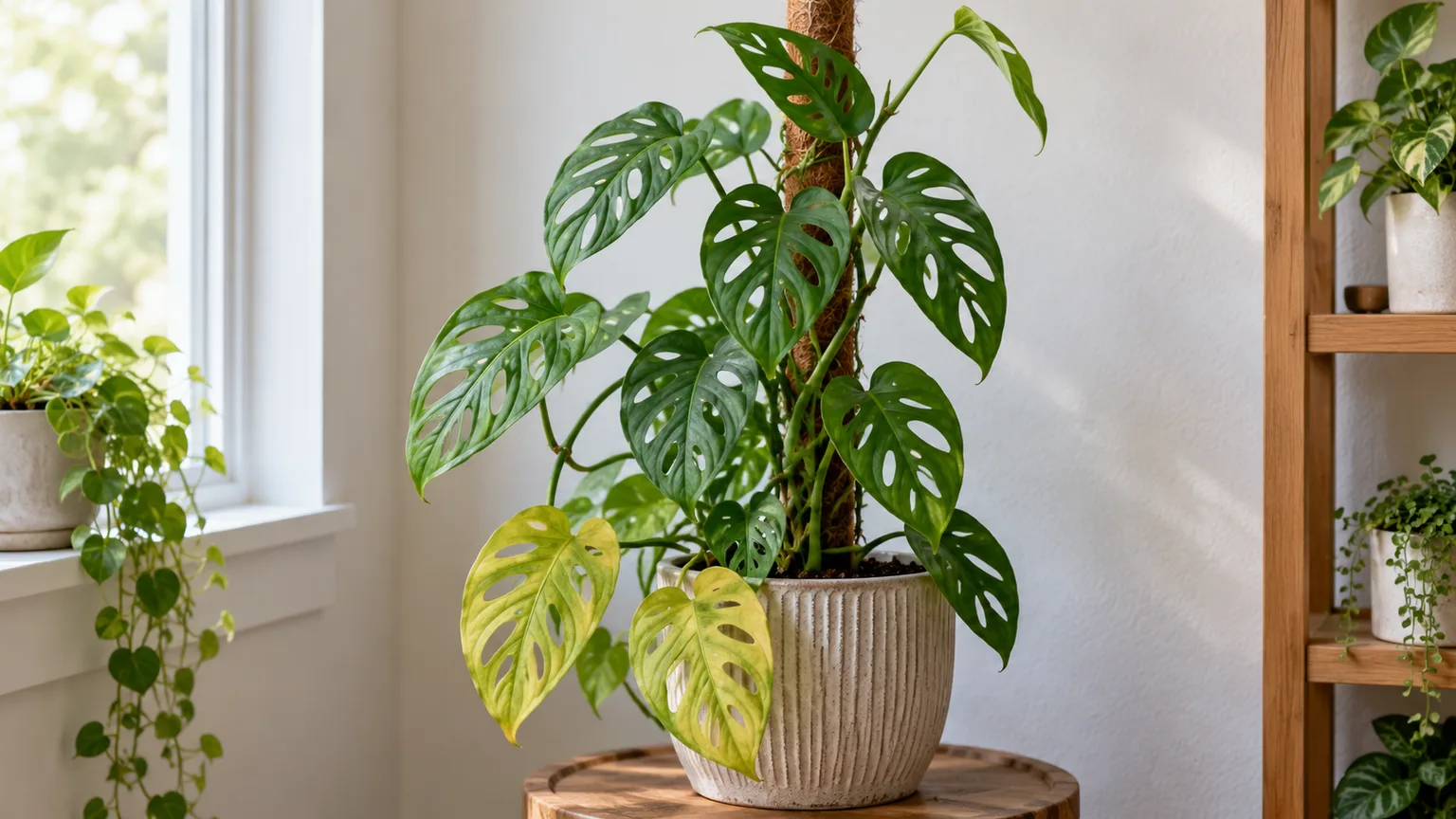
Nitrogen Deficiency on Monstera Adansonii: Causes, Checks & Fixes
This guide covers nitrogen deficiency on Monstera Adansonii. See also the general Nitrogen Deficiency guide, watering, and light pages for this plant.
Nitrogen Deficiency on Monstera Adansonii: Causes, Checks & Fixes
Quick answer
Nitrogen deficiency is plausible on Monstera adansonii when several older leaves become evenly pale yellow-green, growth slows, and newer leaves stay greener for a time. It is not confirmed by a single yellow leaf, pale unfurling growth, or a plant that simply looks less lush. The first step is to compare leaf age and check the potting mix before adding fertilizer. If the root zone is healthy, the plant is actively growing, and its mix has gone a long time without feeding, one label-directed houseplant feed may be reasonable. If the pot is soggy, bone dry, poorly lit, recently repotted, or showing pests, address that cause first.
The nitrogen-deficiency symptom guide explains the general nutrient pattern; this page applies it cautiously to a climbing Monstera adansonii. No special susceptibility should be assumed for this species. For the plant’s identity and full care baseline, use the Monstera adansonii overview while you inspect the vine.
What nitrogen deficiency looks like on Monstera adansonii
The pattern that raises suspicion is gradual, fairly even paling on mature leaves, often beginning with the oldest leaves lower on the vine. A nitrogen-deficient plant can also produce weaker, slower growth. The RHS description of nitrogen deficiency identifies pale yellow leaves and stunted or spindly growth, with older leaves affected before younger foliage. That is a general plant pattern, not a diagnosis unique to Monstera adansonii.
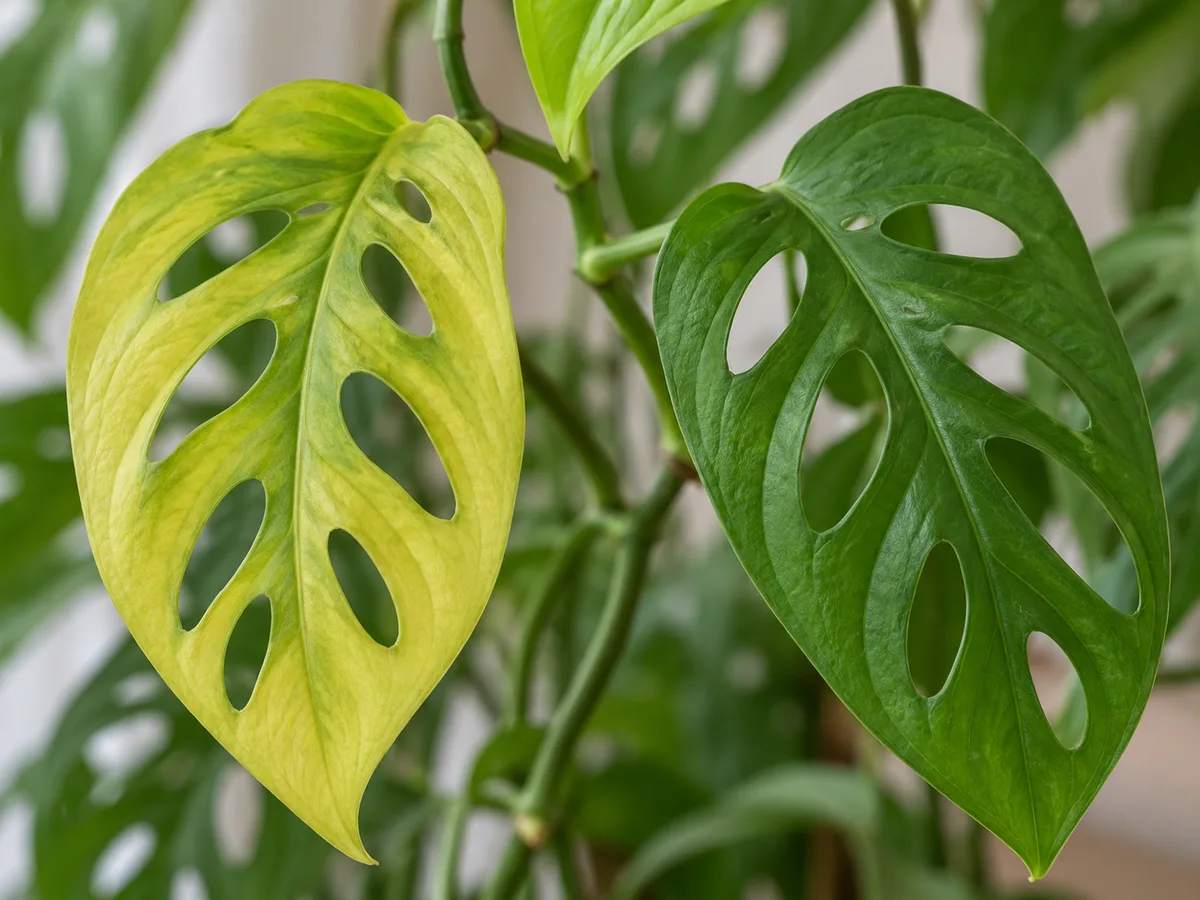
Even paling on an older leaf can fit nitrogen deficiency, but leaf color alone cannot confirm the cause.
On this plant, follow the same stem from its oldest attached leaves toward its growing tip. A pattern that gradually involves more than one lower, mature leaf is more meaningful than a single isolated yellow leaf. Note whether the newest leaves still open and hold their usual green color, whether internodes are extending at their normal pace, and whether the vine continues to make new leaves. Write down which leaves changed first; photographs taken in similar light every week are more useful than relying on memory.
Monstera adansonii has a slender climbing or trailing habit and distinctive oval openings in its leaves. The NC State Extension profile describes the species as a fast-growing climber with characteristic holes and a preference for bright, indirect light and moist, well-drained soil. Those features make it practical to compare leaves along one vine and to distinguish a normal leaf opening from loss of color. They do not mean that every yellow leaf is a nutrient symptom.
Read color along the vine, not just across the pot
A hanging plant can put older leaves at the outer or lower end of a long stem, while an upright or pole-trained plant may keep new leaves gathered near its support. The physical arrangement changes where you need to look, but it does not change the diagnostic rule: compare old and new leaves on the same growing stem. If a single branch is paling while another branch from the same pot remains green and grows normally, check whether that section is shaded, bent, damaged, or losing contact with the support before assuming the whole plant lacks nitrogen.
A fertilizer problem usually does not make only one leaf turn yellow overnight. Marking the leaf positions helps show whether the pattern is slowly advancing from mature leaves toward newer growth or whether one leaf has simply aged out. If the growing tip itself is limp or turning yellow, look more closely for water or root stress, cold exposure, or a problem at that stem section. A nitrogen diagnosis becomes less persuasive when the newest leaves deteriorate first while older leaves remain green.
The holes are normal; the color pattern is the clue
The oval fenestrations are part of Monstera adansonii’s normal leaf form. A hole is not a missing nutrient symptom, and the number or shape of the openings should not be used to decide whether the plant needs fertilizer. Look instead at the green tissue between the openings: nitrogen-related paling is diffuse across the blade, rather than a cluster of isolated feeding marks.
If a new leaf is still unfurling, judge its color after it has opened and settled rather than comparing it with a mature leaf in a different position. A support pole, nearby wall, or dense canopy can also cast enough shade to make one side look darker in a photograph. Turn the pot only if that helps you compare the same surfaces in even light; do not move it into direct sun to make the color easier to see.
Why the same yellow leaf can point to different causes
A nitrogen shortage is more plausible if the plant has been growing steadily in the same potting mix for a long time, has not been fed during active growth, and is now paling across several older leaves. Container media contain a finite supply of nutrients, and the RHS notes that nutrients in container compost can run low over time. That history increases the possibility of depletion; it still does not prove it. A recently repotted plant in fresh mix, or one that was fed recently, has a weaker case for an immediate nitrogen top-up.
Care conditions matter because stressed roots may be unable to take up nutrients that are already present. The RHS lists drought, waterlogging, light deprivation, and poor establishment among conditions that can resemble nutrient deficiency. Monstera adansonii’s preferred moist, well-drained mix is not the same as continuously wet compost; its watering guide can help you compare moisture at the root ball with your normal watering pattern. Likewise, check whether the plant’s spot still provides useful indirect light before deciding that slow growth is a fertilizer problem.
Use the plant’s recent history, not just the fertilizer bottle. Note the date of the last feeding, the date of any repotting, the season, and any move to a darker room. A pot that has stayed damp much longer than usual may signal a change in light or root function; a hanging basket that dries very quickly needs a different moisture check from a large floor pot. The leaf symptom is the clue that starts the investigation, not the conclusion that ends it.
How to check a Monstera adansonii before feeding
Use a short, ordered inspection so that a real deficiency is not confused with a problem that fertilizer cannot correct.
- Map the affected leaves. Identify whether the paling is uniform or patchy and whether it starts on older mature leaves lower on a vine. Compare two or three leaves at different ages. A single yellow leaf at the base may be ordinary aging; repeated paling across older leaves deserves closer checking.
- Check the mix and pot. Feel the mix a few centimeters below the surface and lift the pot to compare its weight with a recently watered pot. Make sure the drainage holes are open and that the container is not standing in water. If the mix is still wet well after watering, or completely dry through the center, do not treat yellowing as a straightforward shortage.
- Look at the roots only if the pot gives a reason. You do not need to unpot a stable plant just because one leaf is yellow. If the mix smells sour, stays wet for unusually long, or stems near the soil are soft, slide the root ball out carefully enough to inspect. Healthy roots should feel firm; widespread dark, soft roots and a sour smell support a root-health problem, not a need for more fertilizer. NC State lists overwatering as a risk for root rot on Monstera adansonii.
- Check light and recent changes. Has the vine been moved away from its bright-indirect-light location, or has a pole, curtain, or shelf begun shading the leaves? Did the yellowing start after a repot, a cold draft, or an abrupt watering change? A sudden change tied to one event weighs more than an old feeding gap.
- Inspect leaf surfaces and stems. Turn over several leaves and check along the petioles and stem joints for webbing, cottony residue, sticky droplets, or small insects. Pests can create yellow mottling or weakening that does not follow a simple old-to-new pattern. If you find signs, route to the plant’s pest and problem hub and identify the pest before applying any spray.
- Review the feeding record. Check the label of any fertilizer used, how much was mixed, and whether the plant was fed recently. A plant that has received repeated feeds or has crusty residue on the mix may have salt or fertilizer stress. More nitrogen would add to that problem.
These checks separate evidence from assumptions. Strong evidence for deficiency is a consistent older-leaf pattern plus a long feeding gap or depleted old container mix, healthy roots, suitable light, and continued growth that has slowed. Evidence against it includes sudden widespread yellowing in wet mix, wilting despite damp soil, dry crispy tissue, pest signs, or color loss concentrated in new leaves. If two explanations remain possible, correct the clearest care problem and wait for the next growth response before changing another variable.
Lookalikes to rule out on this plant
The broader yellow-leaves guide for Monstera adansonii covers the symptom across causes. For a nitrogen check, use these differences to decide what to inspect next:
| What you see | More likely direction | What to check next |
|---|---|---|
| Several older leaves are evenly pale, growth is weaker, and the mix is old or has not been fed for a long time | Nitrogen deficiency is plausible, but not confirmed | Check moisture, roots, light, and feeding history before using a houseplant feed |
| One oldest leaf yellows while the rest of the vine and its new growth look normal | Normal aging may fit better | Watch whether the change spreads to other mature leaves |
| Yellowing appears with persistently wet mix, drooping, soft stems, or sour odor | Waterlogging or root damage | Check drainage and root firmness; use the plant’s overwatering guide |
| Leaves lose firmness and the pot is unusually light or mix is dry through the root ball | Underwatering or uneven drying | Recheck the whole pot and watering method; compare with the underwatering guide |
| New leaves turn yellow between green veins while mature leaves stay green | Iron availability may fit better | Compare with the plant’s iron-deficiency guide and review root conditions before feeding |
| Older leaves yellow between veins or develop brown dead patches rather than paling evenly | Magnesium deficiency is another nutrient pattern to distinguish | Compare with the plant’s magnesium-deficiency guide before adding nitrogen |
| Yellowing is concentrated on shaded stems and growth becomes stretched | Insufficient light may be contributing | Restore useful bright indirect light gradually; see the plant’s light guide |
| Fine stippling, webbing, sticky residue, or distorted young leaves accompany yellowing | Sap-feeding pests may be involved | Inspect leaf undersides and stem joints before feeding or spraying |
Uniform yellowing of older leaves fits nitrogen deficiency better than the green-vein pattern commonly associated with iron deficiency. The Gardening Know How comparison of houseplant yellowing causes also distinguishes older-leaf nitrogen symptoms from interveinal iron symptoms and warns that water, light, and pest problems can produce yellow leaves too. These patterns overlap in real plants, especially when the roots are impaired, so treat them as clues rather than a home laboratory test.
An isolated yellow leaf does not justify pulling the plant from its pot or applying a concentrated fertilizer. If many leaves change at once, the stem base softens, or the vine wilts while the mix is wet, move to the water and root diagnosis first. The UW-Madison horticulture outreach column on yellow leaves notes that both natural aging and waterlogged roots can explain yellowing, and that more extensive yellowing deserves investigation rather than a reflex feed.
The first correction: one measured houseplant feeding, only when it fits
If your inspection supports nutrient depletion—several older leaves paling evenly, a healthy and draining root zone, adequate indirect light, active growth, and no recent fertilizer—the first correction is a single measured feeding with a fertilizer intended for houseplants. Use the dilution and frequency on that product’s label. Do not double the dose, use lawn fertilizer, or combine a liquid feed with extra pellets in the same week. The Penn State houseplant-care guidance recommends a fertilizer designated for houseplants and describes feeding during the brighter growing season, when indoor plants are growing more actively.
Keep the potting mix at its normal moisture level and distribute the diluted feed over the root area as the label directs. Do not pour concentrated fertilizer onto dry roots or spray it onto Monstera adansonii leaves unless the product is explicitly labeled for foliar use. A single, label-rate application is a measured correction; adding an unverified nitrogen boost to a stressed plant is not. If the mix has a visible salt crust or the plant has recently been fed heavily, do not add another fertilizer. Review the plant’s fertilizer guide and correct the feeding routine instead.
The RHS guidance on feeding plants advises using the minimum fertilizer needed and following product directions, especially for container-grown plants. That restraint matters in a Monstera adansonii pot because the plant depends on a limited volume of mix. Excess fertilizer can injure roots or leave a plant with soft, overly lush growth; it cannot compensate for a waterlogged root ball, an undersized light source, or damaged roots.
If the checks point more strongly to water or light stress, fix only that established cause. For a wet, poorly draining pot with soft or failing roots, remove damaged tissue and refresh the mix only when the root inspection supports it; the soil guide for Monstera adansonii explains the airy, well-drained base this climbing aroid needs. For an overly dim position, restore bright indirect light rather than feeding to force growth. Do not repot a healthy plant merely because its older leaves are pale.
What recovery should look like
Nitrogen does not recolor an old leaf on demand. The more useful test is whether the yellowing stops spreading and the vine resumes healthy growth. During the next few weeks of active growth, watch the next leaf as it opens and settles: it should have its normal green color and hold firmness, while the stem continues to extend without new older leaves paling in sequence. Take a weekly photograph in similar light and mark the leaf that was most recently affected, so changes are easier to compare.
A plant entering a darker or cooler season may grow slowly even after its root zone and feeding are corrected. In that case, do not keep applying fertilizer in an attempt to force a new leaf. Match the feeding to actual growth and label timing, and expect the plant’s response to wait until conditions support growth. When daylight and growth slow, reduce or pause feeding rather than treating the calendar alone as proof of a deficiency.
Older yellow leaves may remain pale or eventually drop. Removing them is optional unless they are mostly dead or interfere with inspection; keeping one temporarily lets you see whether the pattern is advancing. A clean new leaf, stable roots, and no new yellowing are better signs of recovery than an old leaf becoming perfectly green again. Fenestrations may appear as the leaf matures, but their appearance does not measure nutritional recovery.
Escalate the investigation if several leaves continue to yellow after the suspected cause has been corrected, if the newest growth deteriorates, or if the stem near the mix softens. Recheck the roots and drainage, inspect for pests, and look for a light or temperature change that coincided with the symptoms. If the root system has mostly collapsed and the remaining vine has no firm healthy node or viable roots, the original plant may not be recoverable; do not keep feeding a failing root system. When a healthy node remains, clean propagation can be considered as a separate salvage decision, but it is not the first treatment for a nutrient problem.
Mistakes that make nitrogen deficiency worse
The most common mistake is treating yellow as a fertilizer instruction. Waterlogged roots can no longer support normal uptake, and direct extra fertilizer cannot repair the damaged roots. A plant with a dry center may also fail to take up nutrients evenly. Confirm the moisture pattern and drainage before feeding; if the symptoms fit wet mix, use the plant’s overwatering path rather than adding more soluble salts.
Another mistake is focusing on the newest tip without checking the leaves below it. A pale new leaf with green veins points away from the classic older-leaf nitrogen pattern. Yellowing on the window-facing side after a move may reflect light exposure, while many tiny spots, stippling, webbing, or sticky residue call for a pest inspection. Look at several leaves in context, not just the leaf that is easiest to see from the room.
Do not acidify the mix or add Epsom salts, iron, or a high-nitrogen product based only on a photograph. A Monstera adansonii container is not an outdoor field where a soil test can guide broad amendment; changing pH or layering nutrients without a confirmed cause can make the root zone harder to read. If you suspect a micronutrient issue, check how the pattern differs from nitrogen and whether root stress is limiting uptake. Use a product designed for houseplants and its label, not a fertilizer recipe copied from a lawn or vegetable bed.
Finally, avoid changing the pot size, support pole, light location, and fertilizer routine all at once. Monstera adansonii is a vine, so a sudden move or support change can shift how the leaves are lit and how the pot dries. When you alter several factors together, a later improvement cannot tell you which correction helped. Keep a short note of one change and its date; the next leaf will give a clearer signal.
Prevent a repeat without overfeeding
Make fertilizer part of an active-growth routine rather than a response to every damaged leaf. Check the product label, use a houseplant-specific formulation, and feed only while the vine is making growth under adequate light. Reduce feeding when daylight and growth slow. If you repot into fresh mix, record the date and product information so you do not stack fertilizer on a potting mix that may already contain starter nutrients.
The Monstera adansonii profile describes a fast-growing climber that uses aerial roots to attach to supports, and it prefers bright indirect light with moist, well-drained soil. A supported vine that receives usable light and can dry down between waterings is easier to monitor than a crowded plant hidden behind curtains. A moss pole or trellis can improve access to the growing stem, but it does not replace checking the pot itself. Keep the pole’s moisture separate from the container’s moisture: a damp support surface is not evidence that the root ball is wet or dry.
Check the vine every week or two while you water. Look at the oldest leaves first, scan for pests beneath the fenestrated blades, and lift a hanging pot before deciding whether its mix has dried. If one old leaf yellows while the rest of the vine keeps growing, note it and wait. If the same uniform paling appears on several older leaves, compare the feeding history with the root-zone condition before changing the dose.
Seasonal light matters more than a fixed fertilizer calendar. A Monstera adansonii near a bright window in spring may be producing leaves, while the same position in winter may provide too little light for active growth. Maintain the plant’s usual indirect-light placement and adjust watering as the pot dries; do not continue full-season feeding if growth has stopped. The plant’s care overview and its soil guide give the baseline for evaluating that routine.
Use a diagnosis tool before changing the dose
If the leaf pattern remains ambiguous, use the Plant Problem Diagnosis tool to compare the symptoms with other likely causes. Once you have decided that feeding is appropriate, the Fertilizer Dilution Calculator can help convert the label’s instructions into a measured mix. These tools support the inspection; neither can confirm nitrogen deficiency from leaf color alone.
When to use this page vs other Monstera Adansonii guides
Use this guide when multiple older leaves are becoming evenly pale and the plant’s growth is slowing, especially when the mix has been in the pot for a long time without feeding. Use the yellow-leaves guide when the main clue is simply discoloration and the cause is not yet clear. If the plant’s newest leaves are small or the vine has stopped extending without a clear color pattern, compare the slow-growth guide.
Choose the watering or root guides when soil moisture, drainage, soft stems, or loss of firmness explain more than the fertilizer history. Choose the light guide when the vine is stretched toward a window or one side has been shaded. This page does not replace the wider Monstera adansonii problem hub; it narrows the question to nitrogen and shows when the evidence is strong enough to consider a feed.
Related Monstera Adansonii guides
- For general discoloration: yellow leaves helps when the older-versus-newer pattern is unclear or other stress signs are present.
- For a nutrient comparison: slow growth is more useful when growth rate is the main symptom and leaves remain mostly green.
- For wet mix or root decline: overwatering covers persistent wetness, while underwatering covers a light pot and dry root ball.
- For routine prevention: the plant’s fertilizer guide and watering guide help keep the vine’s feeding and root-zone conditions aligned.