Underwatering on Monstera Adansonii: Causes, Checks & Fixes
Quick answer
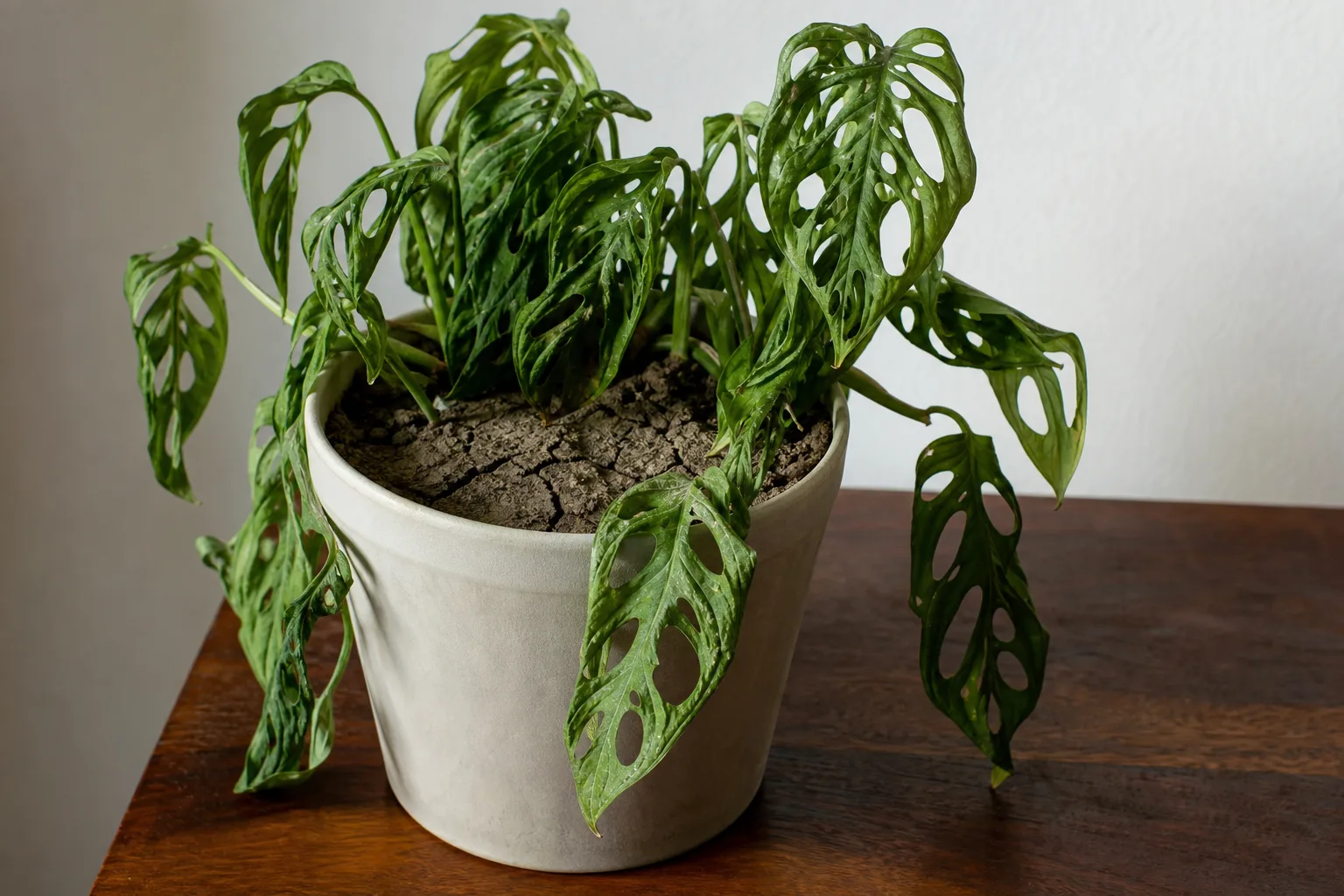
Underwatering on Monstera Adansonii shows as a very light pot, limp fenestrated leaves, and dry mix 3–5 cm down. Bottom-soak until the root ball rewets, drain fully, then water when the top 3–5 cm dry-not on a calendar.
Underwatering on Monstera Adansonii: Causes, Checks & Fixes
This guide covers underwatering on Monstera Adansonii. See also the general Underwatering guide, watering, and light pages for this plant.
Underwatering on Monstera Adansonii: Causes, Checks & Fixes
Quick answer
Underwatering on Monstera Adansonii (Monstera adansonii, Swiss cheese vine) means the root ball has stayed dry long enough that fine roots cannot keep thin fenestrated leaves firm. The telltale trio is a very light pot, limp vining stems, and dry mix 3–5 cm below the surface-not merely a pale top layer.
First step: press your finger or a skewer 3–5 cm into the mix and lift the pot. If soil is dry throughout and stems are limp but still green and firm-not mushy-give one thorough bottom-soak until the root ball rewets, then drain completely. Do not water again until the top 3–5 cm dry. If the pot is heavy and wet with yellow lower leaves, stop-that is root stress or rot, not thirst.
Scope - drought only: This page is for dry, light pots and confirmed thirst. If leaves are limp on wet, heavy soil, start with the wilting guide wet-soil branch, then overwatering or root rot if roots are mushy. For chronic slow sag over weeks-not sudden collapse-see drooping leaves.
Drought vs wet-soil wilt on Monstera Adansonii
Both patterns collapse thin leaves, but the pot weight and soil at depth tell you which rescue path to take:
| Pattern | Leaf / stem look | Pot / soil | Urgency | First direction |
|---|---|---|---|---|
| Dry drought | Soft papery fenestrated leaves; firm green nodes | Light; dry 3–5 cm down | Same-day bottom-soak if whole vine collapsed | Stay here - one soak, full drain |
| Hydrophobic dry core | Wilted despite recent watering; mix shrunk from rim | Surface may look briefly damp; skewer dry in center | Same-day bottom-soak 30–60 min | Stay here - rewet core, do not top-sip |
| Wet-root failure | Limp leaves; yellow lower foliage | Heavy; damp days after last drink | Stop watering today; inspect roots within 48 h | Overwatering → root rot |
| Heat afternoon droop | Collapse in hot sun; firms overnight | Evenly moist at depth | Move out of direct sun; verify moisture | Wilting heat branch |
| Slow chronic sag | Gradual hang over weeks | Alternating dry/wet cycles | Stabilize rhythm this week | Drooping leaves + watering guide |
If dry soil at depth, light pot, and firm stems align, treat as underwatering first. Adding water to a heavy wet pot after misreading wilt as thirst is how healthy Adansonii roots lose oxygen.
Why Monstera Adansonii dries out faster than you expect
Adansonii is a rapid-growing vining aroid from tropical rainforest understories. Indoors it prefers moist, well-drained soil and bright filtered light-not bone-dry mix for weeks. Penn State Extension describes M. adansonii as denser and more vigorous than M. deliciosa, with much smaller perforated leaves-biology that makes drought show up sooner than on many thicker-leaved houseplants.
Thin fenestrated leaves and fast turgor loss
Adansonii leaves are smaller and thinner than those on Monstera deliciosa, with oval holes that increase exposed surface area. Less water stored in each leaf means collapse happens quickly once roots fall behind and the plant loses turgor. A missed watering in a bright window can leave the whole vine limp within a day or two, while deliciosa might still look acceptable.
Small pots, bright light, and hanging-basket dry-down
Trailing adansonii in hanging baskets has little soil volume and outer stems hang beyond the pot rim, so the exposed vine dries before inner nodes. Bright indirect light speeds transpiration. Heating vents, air-conditioning drafts, and summer sun near a window all shorten the interval between drinks. A plant that needed water every seven to ten days in spring may need checks every four to five days in a hot July window.
Climbing adansonii on a moss pole often has more soil mass and slightly slower dry-down, but the top of a tall pole can still wilt while lower nodes look fine-always probe depth, not just the surface color.
Variegated cultivars dry even faster
Variegated forms such as Monstera adansonii ‘Archipelago’ carry less chlorophyll in pale sections, so they stress faster in bright light when mix goes dry. Penn State notes variegated Monstera cultivars as popular but demanding-expect shorter dry-down intervals and earlier crisping on white panels before whole leaves wilt. Check pot weight every few days, not weekly, on high-light variegated vines.
Fear of overwatering after root-rot scares
Many owners underwater adansonii on purpose after reading that overwatering can result in root rot. That caution is valid for wet, heavy pots-but withholding water while mix is already dry for days damages fine roots and makes the plant react badly when water finally returns. Chronic drought and chronic saturation both break the water pathway; the fix depends on which one you have.
Calendar watering instead of pot checks
Watering every Sunday without lifting the pot ignores how fast your container dries. Root-bound adansonii, recently repotted vines in oversized pots, and plants moved from shelf to hanging basket all change dry-down speed overnight. The reliable rule is moisture at depth plus pot weight, not the day of the week.
Cachepots, self-watering inserts, and moisture meters
A nursery pot inside a sealed decorative outer pot hides how fast the inner root ball dries-and trapped runoff can fool you into thinking the plant is wet when the center is empty. Self-watering reservoirs that fail or wicks that clog produce the same surface-damp, core-dry trap as hydrophobic peat. Moisture meters read only where the probe sits; they often miss a dry core in a crowded hanging basket. Lift the inner pot and skewer the middle every time drought is suspected.
What underwatering looks like on Monstera Adansonii
Healthy adansonii holds vining stems with a slight arch and springy thin leaves. Underwatering breaks that posture in recognizable stages.
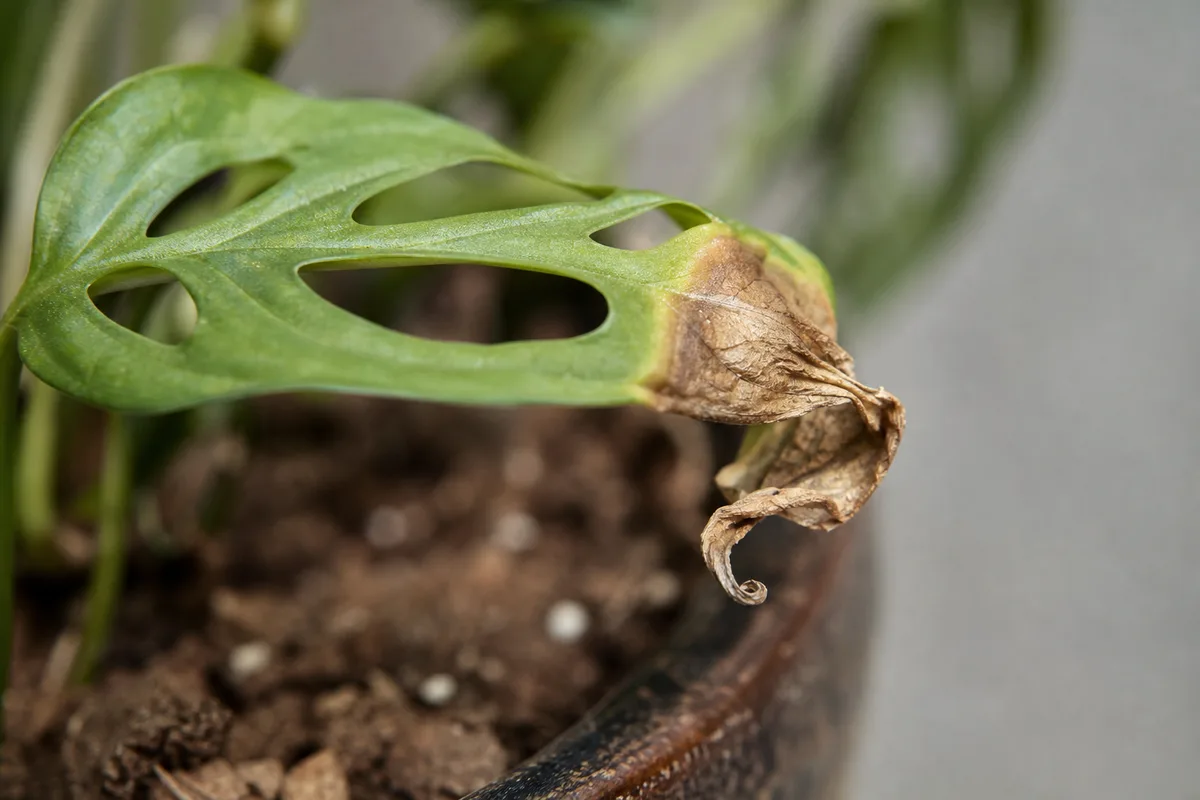
Underwatering symptoms on Monstera Adansonii - compare with healthy tissue on the same plant.
Photo check (add when available): Match limp thin fenestrated leaves on a feather-light dry pot (drought), mix pulled away from the pot wall with water running through the gap (hydrophobic core), and firm pale roots after a gentle unpot (recoverable thirst)-not mushy brown roots on wet soil (rot). Until photos are on-page, use the symptom table below.
| What you see | Pot / soil | Urgency | Likely cause |
|---|---|---|---|
| Whole vine limp, slight crisp edges | Light; dry 3–5 cm down | Same-day soak | Underwatering |
| Wilted after you watered yesterday | Surface damp; dry core on skewer | Same-day bottom-soak | Hydrophobic mix |
| Limp + yellow lower leaves | Heavy; wet days after drink | Stop water; inspect roots | Root stress / rot |
| Afternoon droop, firm by morning | Evenly moist | Filter sun; verify rhythm | Heat / light stress |
| Crisp edges, no full collapse | Variable | Raise humidity if needed | Low humidity - rule out thirst first |
Limp thin leaves vs. crispy margins
Early thirst: heart-shaped fenestrated leaves hang straight down, feel soft or papery, and may curl inward. Newest leaves often show stress first because they have the least stored water. Severe drought adds dry or lightly brown crisp edges while the blade stays limp-not the uniform edge browning of low humidity alone.
Dry mix pulled from pot edge
When peat-based mix shrinks after prolonged dryness, it pulls away from the pot wall and water runs down the gap without rewetting the center. You may have watered recently yet the plant still looks wilted-that is a hydrophobic dry pocket, not proof that thirst is ruled out.
Outer stems collapsing first in trailing displays
In hanging baskets, the longest trailing stems droop below the rim before inner growth sags. The pot feels feather-light. Unlike wet-soil wilt, lower leaves are usually still green-not yellowing from the bottom up on damp mix.
Roots when you inspect
Underwatered adansonii roots are typically firm, pale tan or white, and cling to mix. Mushy brown roots on wet soil point to rot, not drought. Smell matters: dusty dry mix has no sour odor; sour wet mix suggests root failure.
How to confirm underwatering (and rule out lookalikes)
Work through these checks before you soak. You are confirming dry drought and excluding wet root failure, pests, and environmental stress.
7-point confirmation checklist
- Soil at 3–5 cm depth - Dry and crumbly throughout suggests thirst. Cool damp clinging soil with limp leaves suggests uptake failure, not drought.
- Pot weight - Very light after several days without water fits underwatering. Heavy pot that never lightens fits overwatering or poor drainage.
- Stem texture at nodes - Firm green stems near the soil line fit drought. Soft or blackening tissue at nodes fits rot.
- Leaf pattern - Limp green leaves with dry soil. Yellow lower leaves on wet soil for days point away from thirst.
- Recovery test - Thirst wilt often firms within hours after a proper soak. Wilt that never improves on wet soil means inspect roots.
- Hydrophobic check - Water poured on the surface runs straight out the drainage hole while mix stays dry in the center. Skewer the middle; if dry, bottom-soak.
- Pest scan - Spider mites can stipple leaves and weaken vines with otherwise normal moisture. Look for webbing and fine speckling on undersides. Repeated drought weakens vines and can invite mites-fix water first, then treat pests if signs persist.
If dry soil at depth, light pot, and firm stems align, treat as underwatering first.
Lookalike table with urgency
| What you see | Soil / pot | Likely cause | Urgency | First action |
|---|---|---|---|---|
| Limp fenestrated vine, slight crisp edges | Dry, light pot | Underwatering | Same-day soak | Bottom-soak; drain fully |
| Wilt after recent top water | Dry core; gap at pot wall | Hydrophobic mix | Same-day bottom-soak | 30–60 min soak; drain |
| Limp leaves, yellow lower foliage | Wet, heavy pot | Root stress / rot | Stop water today | Root rot guide |
| Afternoon droop, firm by morning | Evenly moist | Heat / light stress | Move within 24 h | Filter sun; see wilting guide |
| Crisp edges, no limp collapse | Variable moisture | Low humidity | This week | Raise humidity; rule out thirst at depth |
| Limp with speckled leaves, webbing | Variable | Spider mites | Treat after water fix | Rinse foliage; confirm pests |
| Slow sag over weeks | Alternating dry/wet | Irregular watering | Stabilize rhythm | Watering guide dry-down rule |
Drooping leaves overlap with underwatering-chronic slow sag often traces to repeated missed waterings or dim light, while sudden whole-vine collapse usually means a sharp dry-down or hydrophobic mix.
Hydrophobic dry-pocket test
Push a bamboo skewer to the bottom of the pot and leave it five minutes. Pull it out: if only the top is faintly damp but the middle is dry, you have a dry core. Bottom-soak the pot halfway in lukewarm water for 30–60 minutes until the surface darkens evenly, then drain. Do not leave the pot submerged for days.
First fix for Monstera Adansonii
Bottom-soak once, then drain completely. That is the single best first action for confirmed dry drought-not repeated small top sips that never reach the root ball.
- Confirm dry soil at 3–5 cm and a light pot with firm stems.
- Place the pot in a basin or sink with enough lukewarm water to reach halfway up the pot sides.
- Soak 30–60 minutes until the top surface moistens and the pot feels noticeably heavier.
- Lift the pot, let it drain until water stops running, and empty any saucer or cachepot.
- Wait 12–24 hours. Stems should stiffen and leaves should lift before you water again.
If mix is only slightly dry, a thorough top watering until excess runs from drainage holes-then full drain-works. Reserve bottom-soaking for shrunken, hydrophobic, or very dry root balls.
Do not fertilize, repot, or move the plant into direct sun on day one. One correct rehydration comes before stacking fixes.
When to unpot and inspect roots
Unpot only if the plant stays limp 48 hours after a confirmed deep soak on dry soil, or if you suspect chronic drought damaged fine roots. Rinse roots gently: firm pale tissue means keep the current pot and adjust your interval. If more than half the roots are mushy on wet mix, switch to the root rot rescue workflow-soaking further will not help.
Step-by-step recovery by severity
Mild thirst (missed watering, dry top 3–5 cm)
One bottom-soak or deep top water, full drain, then resume checking when the top 3–5 cm dry. Expect stems to firm within hours.
Moderate drought (limp vine, dry throughout, firm stems)
Bottom-soak 30–60 minutes, drain, and trim only leaves that are fully brown and papery. Keep bright indirect light and moderate humidity. Check pot weight every two to three days until you learn the new interval-hanging adansonii in summer often needs water sooner than a calendar suggests.
Severe drought or hydrophobic mix (dusty shrunken mix, water runs through)
Bottom-soak until the root ball rewets evenly-may take up to an hour. Gently loosen the top centimeter with a skewer if water channels down the sides. After drain, do not let the mix go bone dry again for weeks; repeated extreme drought kills fine roots and slows recovery.
Chronic underwatering (repeated dry cycles)
Expect slower new growth and smaller unfurling leaves until roots rebuild. Water consistently when the top 3–5 cm dry for four to six weeks before judging failure. If stems stay firm and new nodes activate, the plant is recovering even when old leaves keep crisp edges.
Recovery case snapshot
Observed pattern (June 2026): A 6-inch trailing M. adansonii in a bright east window showed whole-vine collapse after ten days without water during a heat spell. Mix had pulled 5 mm from the pot wall; skewer dry to mid-depth; pot feather-light; stems firm at nodes.
Intervention: 45-minute bottom-soak, full drain, cachepot emptied. No fertilizer, no repot. Crisp older leaves trimmed after 48 hours once stems stiffened.
Outcome: Visible leaf lift within 18 hours; first firm unfurling leaf at day nine on a twice-weekly weight-check rhythm. Old crisp margins did not re-green-judged by new growth only.
Your timing will vary with basket size, cultivar, and room humidity. Use new turgid leaves as the success marker, not perfect older foliage.
Recovery timeline
Mild thirst - Stems stiffen within hours to one day after a full soak and drain. Older leaves may keep slight curl until new growth looks normal.
Moderate drought - Visible firmness in 24–48 hours. New unfurling leaves opening without immediate collapse usually appear within one to two weeks.
Severe or repeated drought - Recovery spans several weeks. Judge success by new turgid leaves and resumed node growth, not by perfect older foliage. Crisp brown edges on damaged leaves rarely green up; trim them once the plant is stable.
Hydrophobic mix - One good bottom-soak often restores even moisture immediately. If wilt returns within days despite wet weight, verify drainage holes are open and you are not leaving saucers full.
Leaves that stayed limp for many days, turned fully brown, or yellowed on wet soil will not return to pristine form. Remove them after the vine stabilizes to redirect energy to new growth.
What not to do
- Drench daily after one dry spell - swings care toward overwatering and root oxygen loss.
- Assume wilt always means drought when the pot is heavy and soil clings to your finger at depth.
- Give tiny daily sips instead of one thorough soak-surface moisture with a dry core keeps the plant thirsty.
- Move a collapsed vine into direct sun to perk it up-Adansonii scorches easily and loses more moisture.
- Fertilize a drought-stressed plant before roots and moisture stabilize.
- Repot immediately when the only issue was a missed watering or hydrophobic dry-down.
- Ignore calcium oxalate when trimming many crisp leaves-wear gloves and wash hands after handling cut tissue. Adansonii is toxic to cats and dogs if chewed; see the overview toxicity section and keep trimmings away from pets.
How to prevent underwatering on Monstera Adansonii
Match watering to how fast your pot dries, not a generic calendar. For most setups, allow the top 3–5 cm of mix to dry between waterings, then soak until drainage runs clear and empty the saucer within 30 minutes. In active warm growth that often means every seven to ten days; in cooler dim winter, every ten to fourteen days is common.
Use a well-drained aroid mix with perlite and orchid bark per the soil guide. Always use a pot with drainage holes. In hanging baskets, check pot weight twice weekly-small volumes dry fast in bright light.
Place the vine in bright indirect light per the light guide so water use stays predictable. Avoid cold drafts below 10°C (50°F). Target 50–60% humidity if thin leaf edges dry quickly in heated rooms-see low humidity if crisping persists despite correct watering.
After reading about root rot, remember: pause watering on wet heavy pots, not on dry light ones. When in doubt, probe depth and weight before every drink.
Related Monstera Adansonii guides
- Watering guide - full dry-down schedule and seasonal adjustment
- Wilting guide - dry wilt vs. wet wilt decision tree
- Overwatering - when limp leaves mean too much water
- Root rot - wilt on wet soil rescue
- Drooping leaves - chronic sag vs. sudden collapse
- Plant overview - growth habit, pet toxicity, and care hub
FAQs
Why does my Monstera Adansonii wilt but the soil surface feels slightly damp?
Peat-based aroid mix can turn hydrophobic after prolonged drought-water runs down the pot sides while the center stays dry. Press a skewer 3–5 cm deep; if it comes out dry, bottom-soak 30–60 minutes and drain. Do not assume surface moisture means the roots are hydrated. This is the most common overwatering paradox: owners see damp crust and withhold water while the root ball starves.
Is underwatering the same as wilting on Adansonii?
Not exactly. Underwatering is dry drought at the root zone-one cause of wilt. Wilting on wet soil means roots cannot absorb water even though you watered. Use this page when the pot is light and mix is dry at depth; use the wilting guide when you are unsure which side you are on.
How is underwatering on Adansonii different from Monstera deliciosa?
Adansonii has thinner fenestrated leaves that lose turgor faster than deliciosa’s thicker foliage, so the whole vine can collapse in a day or two in a small hanging pot. Deliciosa tolerates longer dry spells before severe wilt. Both need the top 3–5 cm to dry between drinks, but Adansonii often needs checks twice weekly in bright summer growth.
Can I save an Adansonii that was dry for weeks?
Often yes if stems stay firm and green at nodes near the soil line. Bottom-soak the pot until the mix rewets evenly, drain completely, and trim only fully brown crispy leaves. If roots are firm and pale when you unpot, recovery usually shows as stiff stems within 24 hours and new unfurling leaves within one to two weeks.
When is underwatering urgent on Monstera Adansonii?
Treat immediately when the whole vine is limp, the pot feels feather-light, and mix is dusty dry several centimeters down-especially in hot afternoon sun. Severe drought plus heat can crisp thin leaves quickly. If stems soften at the soil line on wet mix, that is root stress, not thirst.
Should I bottom-soak or top-water first on dry Adansonii?
Bottom-soak when mix has shrunk from the pot wall, water runs straight through, or a skewer shows a dry core despite recent top watering. A thorough top soak until drainage runs clear is enough when mix is only slightly dry and still absorbent. Either way, drain fully before the plant goes back on the shelf.
Related tool
Use the Plant Watering Calculator to narrow causes for underwatering on this plant before changing multiple variables at once.