Drooping Leaves on Norfolk Island Pine: Causes, Checks &
Quick answer
Drooping on Norfolk Island Pine almost always traces to water imbalance or weak light. First step: probe the top 2–3 cm of soil and lift the pot-dry and light means underwatering; wet and heavy means pause watering and inspect roots.
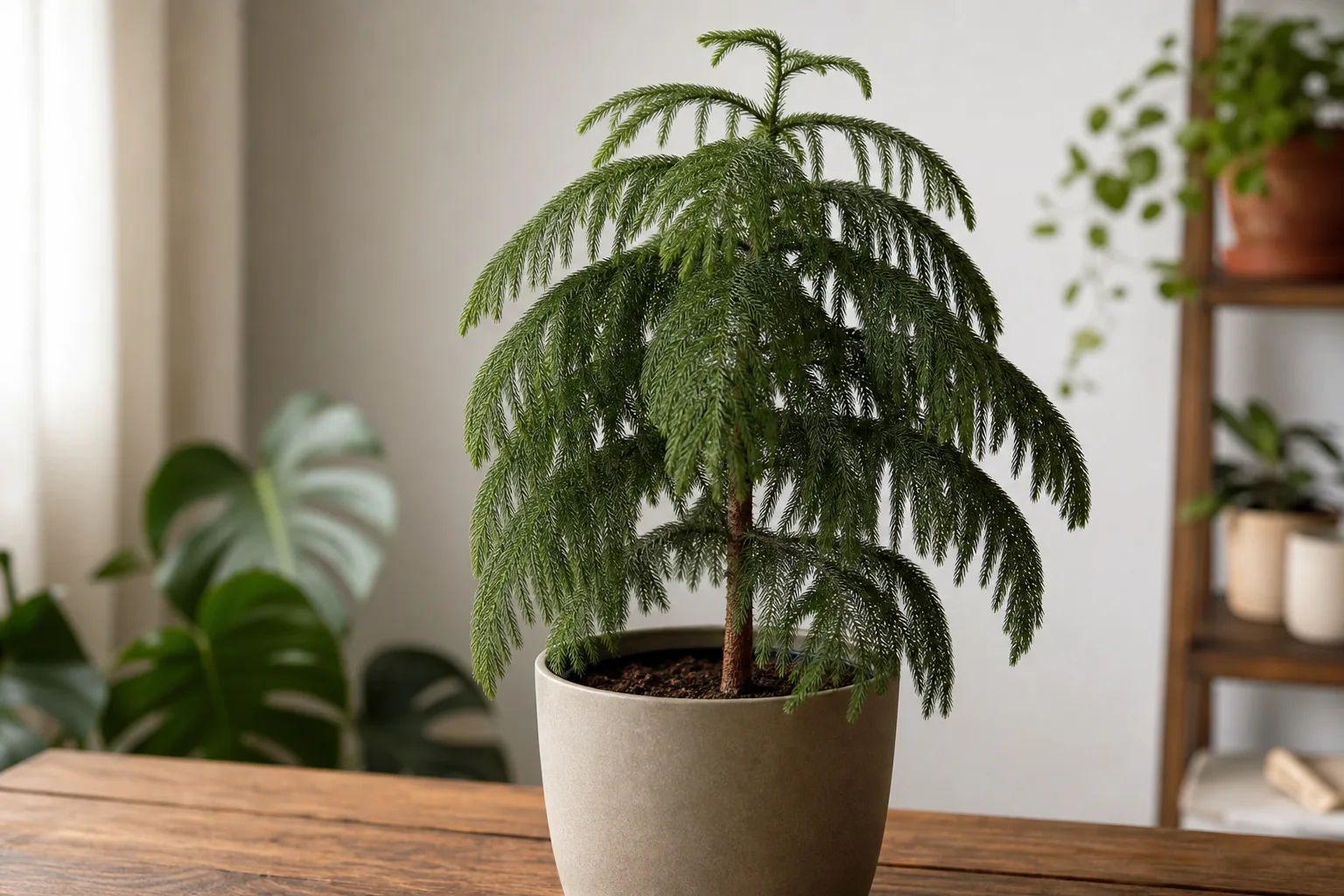
Drooping Leaves on Norfolk Island Pine: Causes, Checks & Fixes
This guide covers drooping leaves on Norfolk Island Pine. See also the general Drooping Leaves guide, watering, and light pages for this plant.
Drooping Leaves on Norfolk Island Pine: Causes, Checks & Fixes
Quick answer
Drooping branches on Norfolk Island Pine (Araucaria heterophylla) mean the tree lost turgor-the internal water pressure that keeps its whorled tiers upright. Unlike a thirsty peace lily that collapses dramatically, Norfolk Island Pine droop is often subtle at first: one horizontal branch tier sags, needles feel soft instead of springy, or the whole silhouette looks floppier than its usual symmetrical pyramid.
First step: check soil moisture at 2–3 cm depth and lift the pot. Dry, dusty mix with a light container usually means underwatering. Wet, heavy mix with limp foliage despite moisture points to root stress or rot. Do not pour water until you know which pattern you have-adding water to already-soggy roots is one of the fastest ways to turn temporary droop into permanent branch loss.
What drooping leaves look like on Norfolk Island Pine
Healthy Norfolk Island Pine carries whorled tiers of horizontal branches with soft, needle-like juvenile leaves. Secondary branches naturally spread outward or droop slightly-that is normal architecture, not a problem. Stress droop looks different:
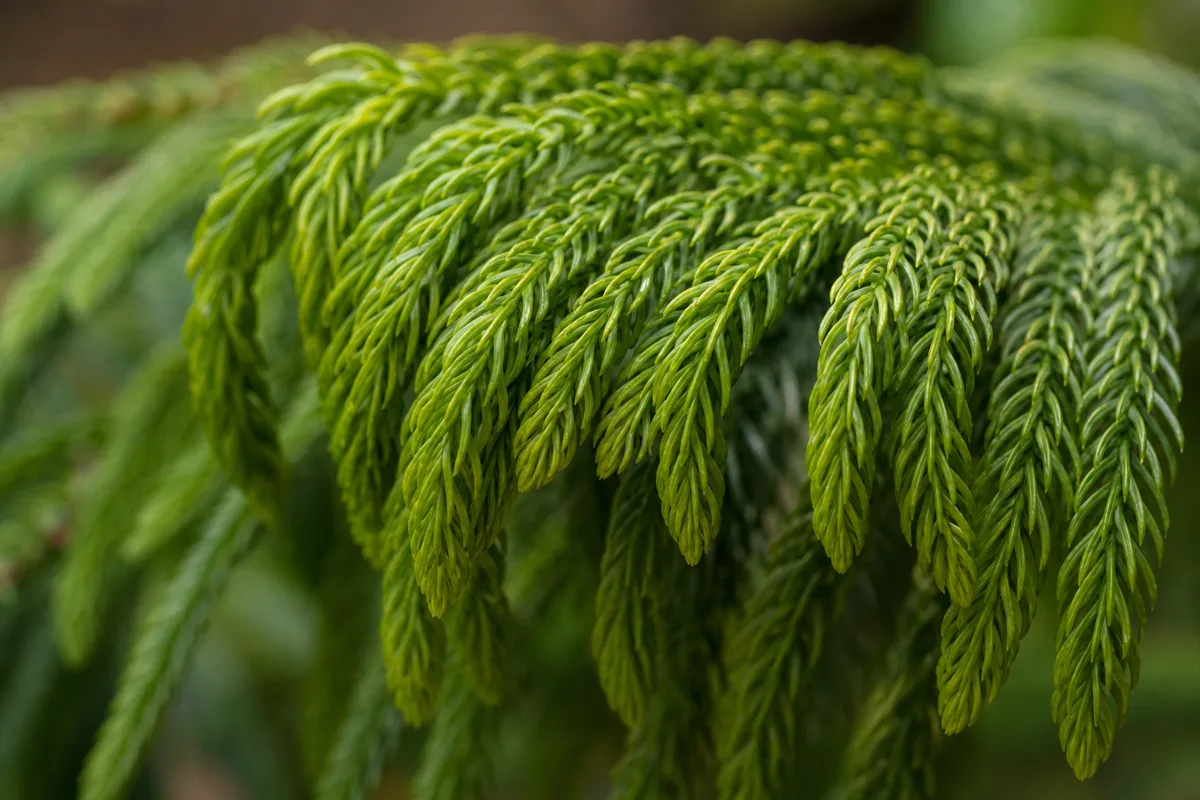
Drooping Leaves symptoms on Norfolk Island Pine - compare with healthy tissue on the same plant.
- Whole tiers hang lower than neighboring whorls, sometimes touching pot rims or furniture
- Needles lose spring and feel limp when you touch them, not crisp and firm
- One side droops while the rest stays upright-common when the tree leans toward a window for light
- Upper tiers sag while lower branches brown and drop-often pairs with dry air or inconsistent watering
- Droop with yellowing on multiple tiers while soil stays wet-root uptake failure, not simple thirst
Drooping is not the same as brown tips (usually low humidity), yellow lower needles (often overwatering or aging), or leggy stretch (weak light producing long gaps between whorls). Drooping is about loss of rigidity, not color change alone-though the two often appear together once stress has continued for days.
Why Norfolk Island Pine gets drooping leaves
Norfolk Island Pine is a subtropical conifer sold as a living holiday tree, then kept indoors year-round. It wants cool roots, steady moisture, bright light, and humidity above what most heated homes provide. Drooping happens when care drifts from that profile.
Underwatering and dry root zones
Indoor heating, low humidity, and small decorative pots dry Norfolk Island Pine quickly-especially after the plant moves from a humid greenhouse to a dry living room. When roots cannot absorb enough water, branches lose turgor and sag. Severely dry mix may repel water on the surface while the root ball stays bone dry underneath, so a quick top-water does not fix the droop.
Overwatering and root damage
Norfolk Island Pine needs evenly moist soil, not constant saturation. Persistently wet mix-common in pots without drainage, oversized containers, or dim corners where the tree barely drinks-deprives roots of oxygen. Damaged roots cannot move water upward, so branches droop even though the soil feels wet. Mushroom root rot is a documented problem on Norfolk Island Pine overview when drainage fails.
Insufficient light
Indoor Norfolk Island Pine grows best with full sun for compact symmetrical form, though some afternoon shade prevents bleach. In typical homes, bright indirect light with a few hours of morning sun is the target. When light is weak, new growth is sparse, branches grow thin, and existing tiers lose the strength to hold themselves horizontal-creating a droopy, one-sided silhouette as the tree reaches toward the brightest window.
Low humidity and heat stress
Norfolk Island Pine prefers moderate to high humidity and cool indoor conditions around 55–65°F. Dry winter air above heating vents accelerates water loss through needles faster than roots can replace it, especially if watering was already borderline. Hot, dry drafts produce midday droop that may partially recover overnight-check whether branches firm up by morning before assuming root rot.
Recent moves, Norfolk Island Pine repotting guide, and physical damage
Relocation stress-new light level, temperature swing, or root disturbance after repotting-commonly triggers temporary droop as the tree adjusts. Norfolk branches are somewhat brittle; bumping the tree, pets brushing past, or rough handling can snap or weaken whorls so they hang at odd angles. That mechanical droop does not respond to watering.
How to confirm the cause
Work through these checks in order before changing anything else:
- Soil moisture at depth - Stick your finger 2–3 cm into the mix. Dry = suspect thirst. Wet for several days = suspect root stress. Surface dust on top of a heavy pot can mislead; probe deep.
- Pot weight - Lift the container. Light and dry together confirm underwatering. Heavy and wet together warn against more water.
- Smell and drainage - Sour odor from the pot, water sitting in the saucer, or no drainage holes strongly suggest overwatering injury.
- Light exposure - Is the tree more than 1–2 m from the brightest window? Does it lean one direction? Weak light droop often affects the shaded side first.
- Environment history - Recent move from porch to indoors, new heater season, or repot within two weeks? Context matters as much as soil.
- Root inspection (if wet + droopy) - Slide the root ball out gently. Healthy roots are firm and pale; rotting roots are brown, mushy, and may smell bad.
- Overnight recovery test - If droop appeared on a hot afternoon but branches firm up by morning with stable soil moisture, heat stress-not rot-may be the driver.
| Pattern | Likely cause | First direction |
|---|---|---|
| Light pot, dry 2–3 cm down, limp tiers | Underwatering | Thorough soak, then reset dry-down rhythm |
| Heavy pot, wet mix, limp tiers | Overwatering / root damage | Stop watering; inspect roots |
| Drooping toward one window, long gaps between whorls | Low light | Move to brighter spot; rotate monthly |
| Droop after holiday move, stable moisture | Relocation stress | Hold care steady 2–3 weeks |
| Midday sag, recovery by morning | Heat / low humidity | Move off vents; raise humidity |
First fix for Norfolk Island Pine
Determine wet versus dry, then act on that single finding.
If the top 2–3 cm is dry and the pot feels light, water thoroughly until a little runs from the drainage holes, empty the saucer, and recheck in six to twelve hours. For severely dry mix that sheds water off the surface, bottom-soak the pot in a basin for twenty to thirty minutes, then drain fully.
If the mix is wet, the pot is heavy, and branches stay limp, do not add more water. Move the tree to brighter indirect light if it was in shade-light helps the root zone dry-and wait until the top 2–3 cm dries before the next drink. If droop continues beyond forty-eight hours with no dry-down, unpot and inspect roots before repotting or pruning.
Everything else-humidity trays, grow lights, repotting-comes after this moisture read. Stacking fixes without diagnosis is how Norfolk Island Pines lose entire whorls.
Step-by-step recovery
When underwatering caused the droop
- Water deeply once, ensuring the entire root ball rewets-not just the surface.
- Empty the saucer within thirty minutes so roots are not re-soaked.
- Move the tree away from heating vents and fireplaces while it rehydrates.
- Run a humidifier or pebble tray if room humidity is below 40%-Norfolk Island Pine recovers faster when transpiration demand drops.
- Resume watering when the top 2–3 cm dries, not on a fixed calendar.
When overwatering or root rot caused the droop
- Stop watering immediately.
- Unpot and rinse roots gently with lukewarm water.
- Trim mushy, brown roots back to firm tissue with clean scissors; sterilize blades between cuts.
- Discard saturated mix; repot into fresh, slightly acidic, well-draining potting mix with perlite-same size pot or slightly smaller, never oversized.
- Water lightly once after repotting, then let the top 2–3 cm dry before the next drink.
- Hold fertilizer until new growth looks firm for two weeks.
When low light caused the droop
- Move to the brightest available spot with bright indirect light and a few hours of gentle morning sun.
- Rotate the pot a quarter turn every one to two weeks for even growth.
- Avoid jumping straight to harsh south-window afternoon sun-acclimate over a week to prevent needle bleach.
- Do not prune drooping tiers immediately; wait for compact new whorls to confirm light was the limiter.
When relocation or repotting caused the droop
- Keep light, temperature, and watering as stable as possible.
- Do not repot again, fertilize, or prune living branches for at least two to three weeks.
- Maintain humidity near 50% while roots re-establish.
Recovery timeline
Simple thirst droop often shows visible firming within six to twenty-four hours after a proper soak-touch the needles and watch whether tiers lift slightly.
Heat-stress midday droop that resolves overnight may need one to two weeks of stable placement and higher humidity, not repeated emergency watering.
Root-related droop takes two to six weeks minimum to stabilize after correcting drainage and trimming decay. Judge success by firm new growth at branch tips, not by old needles returning to their original angle-drooped mature needles rarely spring back fully.
Low-light recovery shows as tighter new whorls within two to three weeks after light improves. Old elongated, sagging tiers remain unless you remove dead tissue only.
Worsening signs: entire whorls brown and detach, sour smell intensifies, soft trunk tissue at the soil line, or collapse spreads upward despite dry correct watering. Those patterns mean advanced root or stem decay.
Lookalike symptoms
- Leggy growth on Norfolk Island Pine - Long spaces between whorls and leaning toward light, but branches may still feel firm. Fix light, not water volume.
- Wilting - Nearly identical mechanism; on Norfolk Island Pine the terms overlap. Use soil moisture to split thirst from rot.
- Brown tips on Norfolk Island Pine - Needle ends dry and tan while branches stay rigid; points to humidity or salt buildup, not turgor loss.
- Yellow lower needles - Often normal aging on lower tiers or early overwatering signal; not always accompanied by droop.
- Mechanical damage - Snapped branch at one whorl with rest of tree upright; no soil pattern explains it.
What not to do
Do not water on schedule without checking the top 2–3 cm-Norfolk Island Pine droop from both extremes.
Do not mist as the main fix-surface moisture does not rehydrate a dry root ball and can encourage fungal issues on dense needle clusters.
Do not prune living branches to reshape a droopy tree. Norfolk Island Pine does not sprout new leaders from bare whorls; aggressive trimming creates permanent gaps in the symmetrical form.
Do not fertilize a drooping, stressed tree hoping for perk-up-salts on damaged roots worsen the collapse.
Do not repot on day one unless roots are clearly rotting or the mix is failing. Transplant shock adds another droop layer.
Do not move the tree repeatedly between rooms hunting a fix-each relocation resets adjustment.
How to prevent drooping leaves next time
Match watering to how fast your pot dries in your light and humidity: allow the top 2–3 cm to dry, then water until a little drains out, and always empty the saucer.
Place Norfolk Island Pine where it receives bright indirect light with some morning sun for four to five hours daily. Rotate monthly so all sides stay evenly strong.
Maintain 50–60% relative humidity in winter-humidifier, pebble tray, or grouping with other plants. Keep the tree away from heating vents, fireplaces, and cold drafty doors.
Use slightly acidic, well-draining mix with perlite in a pot with open drainage holes sized to the root ball-not a decorative cachepot without holes.
After holiday season, move the tree gradually from dim interior spots back toward the brightest window rather than leaving it in low light for months.
When to worry
Treat droop as urgent when:
- Soil is wet and sour-smelling with widespread tier collapse
- More than one whorl browns and drops within a week
- Roots are mostly mushy on inspection
- The trunk feels soft at the base
- Drooping persists beyond forty-eight hours after a confirmed correct watering correction
Slow droop on one tier after a dry weekend is manageable. Rapid structural collapse with wet roots is not-salvage firm upper whorls only if lower rot has not reached the trunk.
Conclusion
Drooping leaves on Norfolk Island Pine are a water-and-structure signal, not a mystery disease. Read the root zone first-dry and light means soak; wet and heavy means stop watering and inspect roots. Pair that with honest light and humidity checks, because weak branches droop even when watering is technically correct. Fix the primary stressor once, hold care steady, and judge recovery by firm new growth-not by expecting old sagging tiers to stand at attention again.
When to use this page vs other Norfolk Island Pine guides
- Norfolk Island Pine watering guide - Use for routine moisture checks before assuming drooping leaves is the main issue.
- Norfolk Island Pine problems hub - Browse all 4 common issues on this species.
- Root Rot on Norfolk Island Pine - Different entry point when symptoms overlap with drooping leaves.