Onion Propagation Guide: Sets, Seed & Timing
Onion Propagation Guide: Sets, Seed & Timing
Onion Propagation Guide: Sets, Seed & Timing
Onion propagation for kitchen bulbs (Allium cepa, pyaz) means starting a new crop from sets (small immature bulbs), seed, or purchased seedlings—not from rooting a hollow leaf the way you might with a houseplant. The RHS grow-your-own onion guide describes sets as the easiest, fastest route, with seed offering more variety at the cost of time and seedling care. Every path still depends on the same biology: plants must grow plenty of leaves before daylength triggers bulbing, and the cultivar must match your latitude.
If you are filling a balcony trough or deep planter, pair this page with onion soil and onion light so the young crop lands in loose, sunny conditions from day one. Propagation only succeeds when roots stay intact, moisture stays steady, and you plant the right short-day, long-day, or day-neutral type for your region.
Best propagation method for Allium cepa
For most home growers—especially in containers—planting heat-treated sets into their final pot is the most predictable propagation method. Sets root quickly, need little indoor space, and reach harvest weeks ahead of direct-sown seed in many seasons (RHS grow-your-own onion guide). Seed is cheaper and opens more cultivar choices, but onion seed loses viability quickly and needs an early indoor start or a long outdoor season (RHS grow-your-own onion guide). Purchased seedlings trade cost for convenience when you only want a handful of plants.
Sets, seeds, or purchased seedlings
Sets suit beginners and small patios: push firm bulbs into prepared mix, keep birds off until they root, and maintain even moisture. Seed suits growers who want specific reds, whites, or storage types and can sow indoors about 8–10 weeks before outdoor planting, as Cornell’s home-gardening onion profile recommends for transplants (Cornell home gardening). Seedlings from a nursery work when you missed the indoor window—treat them like fragile transplants and plant into the final container without repeated pot-ups, because onions stall when roots are disturbed.
Why kitchen scraps will not grow a bulb crop
A leftover onion base in water may sprout green leaves, but that is not reliable propagation for a swollen bulb. Bulb onions are biennials grown as annuals; the harvestable bulb forms only when a properly started plant accumulates leaves and then experiences the right daylength for its type. Grocery bulbs may also be treated or stored in ways that weaken sprouting. For pyaz you can actually cook with, start from sets, seed, or certified seedlings instead of hoping a pantry remnant will reswell underground.
Match daylength before you multiply plants
Onions are photoperiodic: they switch from leaf growth to bulbing after sensing enough daylight hours. Plant the wrong class and you can get lush tops with peanuts for bulbs—exactly the mismatch described in the onion overview hub notes for Indian latitudes. Short-day types suit many warm lower-latitude gardens; long-day types need the extended summer days of higher latitudes; day-neutral types fall between.
Short-day choices for warm latitudes and India lowlands
In hot plains and coastal terraces, favor short-day or locally labeled Kharif/Rabi cultivars from a regional seed supplier rather than copying a northern European calendar. Utah State University Extension notes that onions form bulbs under long days and heat, and that planting too late can yield leaves without bulbs (Utah State University Extension). In practice that means your propagation date must leave enough cool weeks for leaf growth before the long-day bulbing window arrives for your variety. When in doubt, ask the seller which daylength group the seed or sets belong to.
Timing onion propagation for India and cool seasons
Think in cool-season establishment, not peak summer heat. In northern and hill regions, autumn or late-winter planting of sets or transplants often matches a traditional Rabi rhythm. In mild lowlands, sow or plant during the coolest months you can keep mix moist without baking roots. USU Extension suggests seeds or sets in spring for early production, with transplants needing roughly eight weeks of grow time before garden planting (Utah State University Extension). Seed sown outdoors typically emerges in about two to three weeks when soil is warm enough (Utah State University Extension).
Avoid starting a long-day cultivar so late that bulbing daylength arrives before the plant has six to eight healthy leaves. The RHS emphasizes that seed-raised plants must be growing strongly by late spring when lengthening days trigger bulb formation (RHS grow-your-own onion guide).
Propagating onion sets in containers
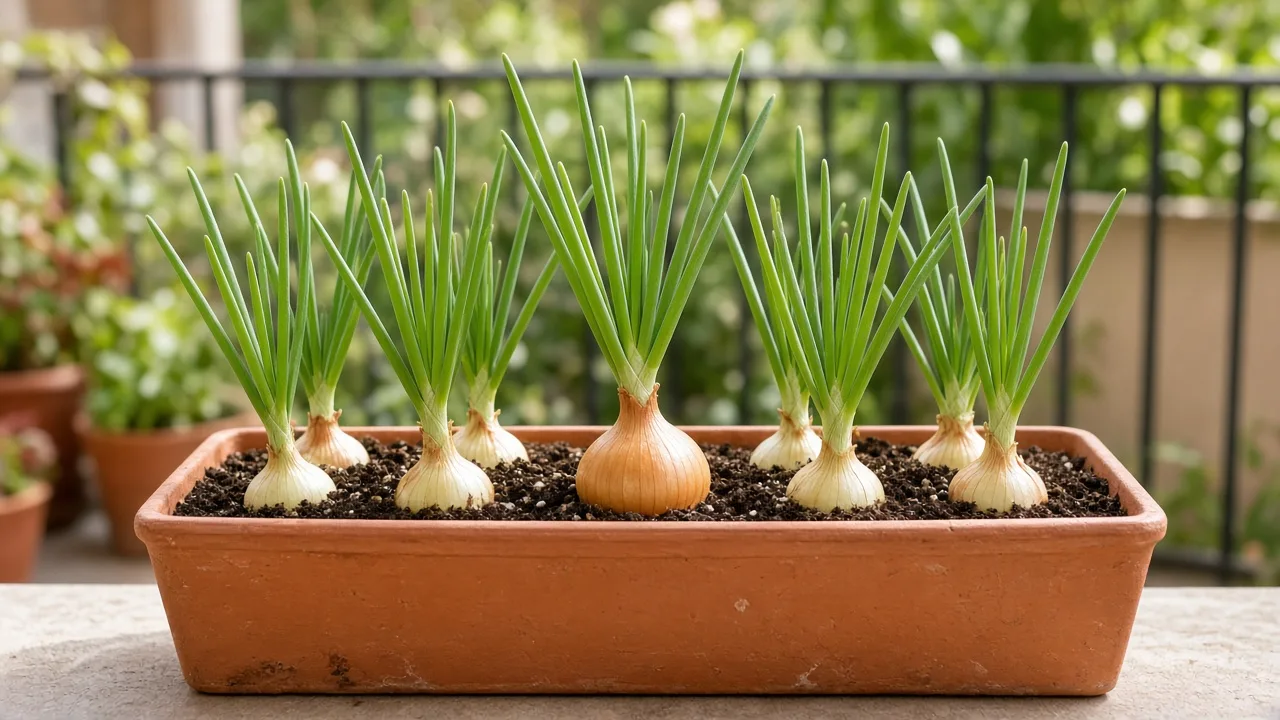
Use a planter at least about 25 cm deep and wide enough for several bulbs with elbow room—see onion repotting for why shallow pots fail. Fill with loose, well-drained mix from onion soil guidelines. Firm, disease-free sets without soft spots propagate best; heat-treated sets bolt less than non-treated stock (RHS grow-your-own onion guide).
Depth, spacing, and pointing tips up
Plant sets so the pointed tip just shows at the surface—about 2 cm (¾ in) deep in drills or pushed into loose mix (RHS grow-your-own onion guide). Space roughly 10–15 cm (4–6 in) apart in the container; wider spacing yields larger individual bulbs (RHS grow-your-own onion guide). Gardening Know How recommends similar spacing and at least six hours of sun for container onions (Gardening Know How). Water after planting and expect birds to peck loose sets until roots anchor—cover with light fleece or mesh for a week if needed (RHS grow-your-own onion guide).
Starting onions from seed indoors
Sow indoors from mid-winter to early spring in modular trays with peat-free seed compost, about 1.3 cm (½ in) deep (RHS grow-your-own onion guide). One seed per cell gives the largest bulbs; multi-sowing three or four seeds per module produces a clump of smaller onions (RHS grow-your-own onion guide). Keep trays warm and bright; seedlings often appear within a couple of weeks, then move to cooler bright conditions to avoid leggy growth.
Cornell’s profile suggests starting transplants inside about eight to ten weeks before the last frost date, sowing several seeds per cell or in flats at ¼ inch depth (Cornell home gardening). For India, translate that logic to your local cool window rather than a foreign frost calendar.
Hardening off and gentle transplanting
Harden off indoor plants before they go outdoors, then plant into the final container at the same depth they grew, spaced about 10 cm apart (RHS grow-your-own onion guide). Do not split multi-seeded modules—plant the clump intact if you multi-sowed (RHS grow-your-own onion guide). Minimize root tearing; a stalled onion after transplant usually means damaged roots or hot, dry mix. Water thoroughly once, then follow the steady moisture rhythm in onion watering.
Direct sowing onion seed in final pots
When outdoor temperatures are cool enough to keep seedbeds moist, you can sow directly in a deep pot or bed. Sow about 1.3 cm deep in rows 20–30 cm apart, then thin in stages to about 10 cm between plants (RHS grow-your-own onion guide). USU Extension lists direct seed at ¼–½ inch deep with eventual spacing of 3–4 inches in the row (Utah State University Extension). Direct sowing skips transplant shock but needs flawless surface moisture through slow germination.
Aftercare once new onions are established
Treat propagation as finished only when plants are actively growing new leaves. Full sun drives bulbing—see onion light—and even moisture prevents drought stress that invites bolting (onion watering). Light feeding after establishment can help, but correct daylength and spacing matter more than heavy fertilizer (onion fertilizer). Snip any flower stalks as soon as they appear so energy stays in the bulb (onion pruning).
Onion is toxic to cats and dogs if eaten in quantity; keep sets, trimmings, and sprouting scraps away from pets when propagating on a patio (ASPCA Onion).
Common propagation failures and first fixes
Bolting soon after planting often traces to wrong set type, heat stress, or oversized sets—choose heat-treated stock and steady moisture (RHS grow-your-own onion guide). Sets sitting on the surface usually means birds or loose planting—reseat and cover briefly. Seedlings collapsing at the soil line match classic damping-off behavior when trays stay soggy and crowded (NC State Extension damping-off). No bulb, only leaves frequently means a daylength mismatch or a crop planted too late for its type (Utah State University Extension). Rotting sets point to waterlogged mix—restart in fresh, drained soil per onion soil.
When to use this page vs other Onion guides
Use this page when you are creating new onion plants—choosing sets vs seed, sowing, planting depth, and first-week care. For ongoing moisture checks, read onion watering. For mix recipes and pH, onion soil. For sun hours and weak growth, onion light. For the full life cycle and variety notes, start at the onion overview hub.
Related Onion guides
- Onion overview — daylength groups, container size, and harvest cues
- Onion soil — drainage and mix for sets and seedlings
- Onion watering — moisture through leaf growth and dry-down near harvest
- Onion light — direct sun requirements on patios
- Onion fertilizer — light feeding after establishment
- Onion pruning — removing flower stalks that steal bulb size
Conclusion
Propagating onion means picking the right daylength-matched stock, then starting it with minimal root disturbance in a deep, sunny container. Sets are the fast path for most balconies; seed rewards planners who can sow modules early and transplant gently; purchased seedlings help when time is short. Plant with tips just showing, space for 10–15 cm of growth, protect new sets from birds, and keep moisture steady without waterlogging. When leaves are thriving and flower stalks stay removed, you have turned a set or seed into a crop ready for the rest of the onion care cluster.