Curling Leaves on Peace Lily: Causes, Checks & Fixes
Quick answer
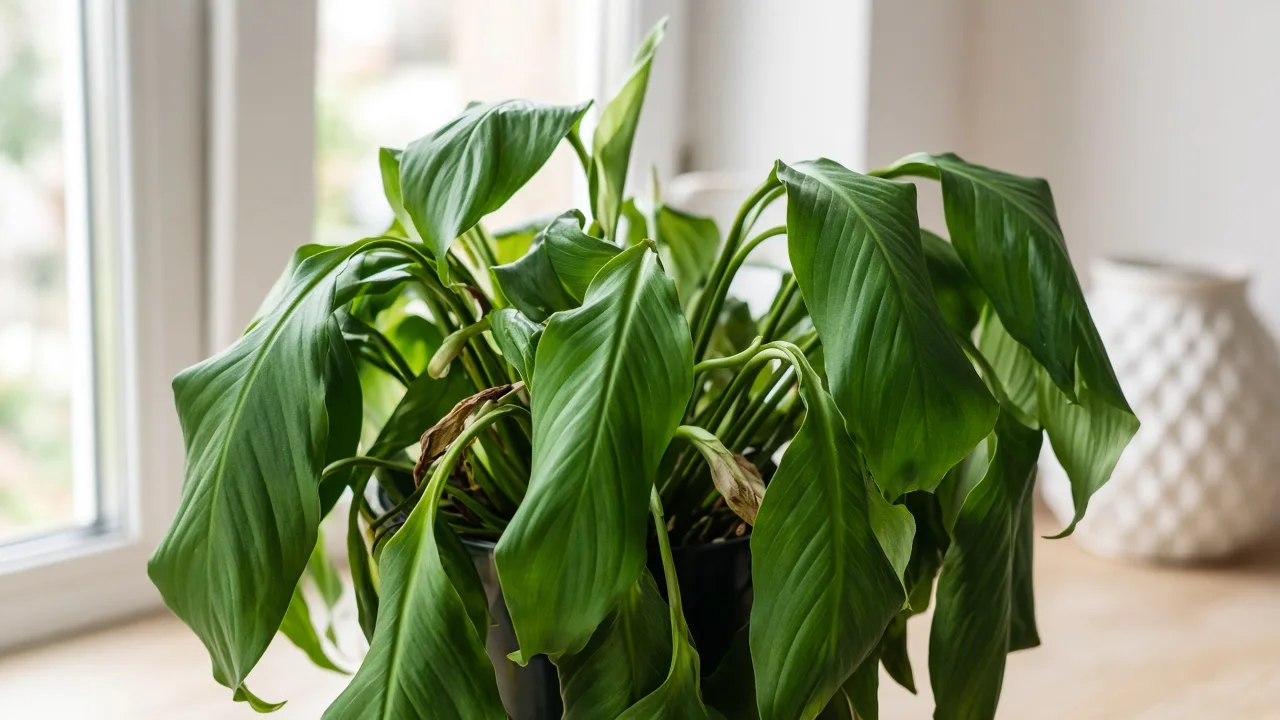
Curling on peace lily is usually thirst, dry air, or spider mites—not one diagnosis. First step: push a finger 3–5 cm into mix and flip a curled leaf to check undersides for stippling or webbing before you water or spray.
Curling Leaves on Peace Lily: Causes, Checks & Fixes
This guide covers curling leaves on Peace Lily. See also the general Curling Leaves guide, watering, and light pages for this plant.
Curling Leaves on Peace Lily: Causes, Checks & Fixes
Quick answer
Curling leaves on Spathiphyllum are a posture change, not a disease label. Peace lilies communicate thirst with dramatic droop before margins cup inward—but the same wide, glossy leaves can also curl from dry indoor air, spider mites on the undersides, or direct sun hitting a window-side plant.
First step: Check mix moisture 3–5 cm down and inspect the underside of the most curled leaf. A light, dry pot with limp curl means drink; stippling and webbing mean pests; a heavy wet pot with wilt means hold water and check roots.
For general curl mechanics on houseplants, see our curling leaves guide. On peace lily, the pattern almost always ties to this species’ wide-blade water loss, droop-when-dry signal, and sensitivity to fluoride-heavy tap on stressed tissue.
Use this page to name the curl type, confirm the cause, and pick one first fix. For baseline moisture rhythm, see peace lily watering. For droop without obvious cupping, see wilting and drooping leaves.
When to use this page vs other peace lily guides
| You are seeing… | Start here | Or route to… |
|---|---|---|
| Inward cup or rolled margins | This page | — |
| Full collapse without tight curl | Wilting | Underwatering |
| Only dry crispy tips | Brown tips | Low humidity |
| Yellowing with soft texture | Yellow leaves | Overwatering |
| Stippling + webbing on undersides | Spider mites | This page for early curl stage |
What curling looks like on Peace Lily
Peace lily leaves are broad, lance-shaped, and held on long petioles from a clumping crown. Curl shows up in distinct ways:
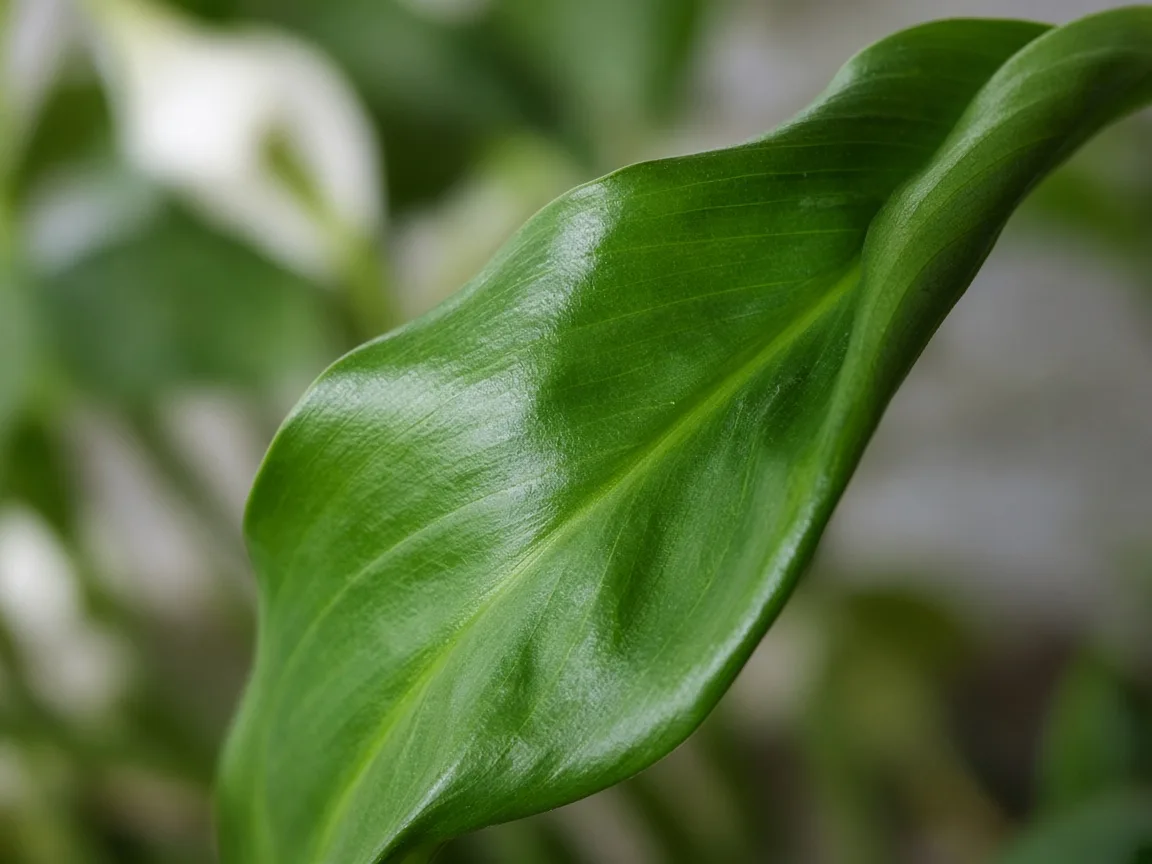
Inward margin cup on a peace lily blade—posture change from thirst, dry air, or mites, not a disease label by itself.
Thirst curl — The whole leaf droops first, then margins roll inward or the blade cups like a taco. The pot feels light; mix at 3–5 cm is dry. RHS notes peace lilies recover quickly after prompt watering when roots are sound.
Dry-air curl — Edges curl while the center stays greener, often in winter near heating vents. No dramatic wilt cycle; several leaves look equally affected. NC State links brown tips to low humidity and underwatering on peace lily.
Mite curl — Upper leaves cup or twist; undersides show pale stippling and sometimes fine silk. Clemson lists spider mites among common peace lily pests.
Sun cupping — Leaves on the window side fold away from harsh light. Clemson warns against direct sun on peace lily; Missouri Botanical Garden recommends bright filtered light, not direct sun.
Wilt-on-wet curl — Leaves curl and soften while mix stays damp for days. This is a root-zone red flag, not a humidity fix—see overwatering and root rot.
The droop-before-curl timeline (peace lily only)
Unlike many houseplants, peace lily often droops visibly before margins curl when thirsty. Owners who miss the droop may only notice curl after tissue has already dehydrated at the edge. If you water on a fixed weekday, the sequence is often: slight droop → inward margin roll → crispy edge on the oldest leaf → full limp collapse. Catching the droop stage prevents permanent edge damage on wide blades.
Diagnosis traps on peace lily
Wilt without cup — Full petiole collapse with little margin roll points to wilting or sudden root failure. Curl means the blade shape changed while still partially stiff.
Misting wet-soil curl — Spraying foliage on a plant that already has damp mix and soft stems worsens root stress. Wilt-on-wet curl needs dry-down, not humidity boosts.
Distorted new spears — Twist and silver scars on unfurling center growth belong on distorted leaves, not this page. Open-blade cupping only is the curl signal here.
Why Peace Lily leaves curl
Peace lily evolved as an understory aroid with large surface-area leaves that lose water fast in dry rooms. Curling reduces exposed blade area—a stress response when roots cannot supply water fast enough or when air pulls moisture from margins quicker than the vascular system replaces it.
Underwatering remains the most common indoor cause. The plant’s famous droop signal is easy to miss in busy offices; delayed watering leaves margins curled even after the petiole re-stiffens.
Low humidity stacks with thirst in heated homes. RHS advises misting or a pebble tray when air is too dry—peace lily leaves may brown at edges and curl when RH drops.
Spider mites exploit the same dry conditions. Wide peace lily leaves give mites plenty of feeding sites on the underside, where owners rarely look.
Direct sun heats the blade and accelerates transpiration on the exposed side, producing cupping or twist away from the glass.
Root stress from overwatering can produce curl with paradoxical wilt—damaged roots cannot move water even when soil is wet. Do not mist this pattern; dry down and inspect.
Confirm the cause in five checks
Run these before repotting, fertilizing, or spraying:
- Moisture at 3–5 cm: Dry with a light pot supports thirst. Damp for many days on a heavy pot supports root stress—hold water.
- Droop test: Water thoroughly if dry; if petioles firm within 2–4 hours, thirst was likely the driver.
- Underside inspection: Stippling, moving specks, or webbing → isolate and see spider mites.
- Window exposure: Midday sun on the leaf surface → move to bright filtered light per light guide.
- Humidity at leaf level: Below ~40% RH near foliage with winter heat → add pebble tray; see low humidity.
First fix by confirmed cause
Choose one first action:
| Confirmed cause | First fix | After 48–72 h if stable |
|---|---|---|
| Dry mix, healthy roots | Water until excess drains; discard saucer water | Resume watering when 3–5 cm dries |
| Dry air only | Pebble tray or group plants; keep off heat vents | Mist is optional; fix water rhythm first |
| Spider mites | Isolate; rinse leaf undersides thoroughly | Follow spider mites if activity persists |
| Direct sun | Move to bright indirect light | Trim only fully scorched tissue |
| Wet mix, wilt-on-wet | Stop watering; brighter indirect light | Inspect roots if smell or soft stems appear |
Do not fertilize curled, stressed foliage. Over-fertilizing burns peace lily tips and roots.
Recovery timeline
| Phase | Timing | Improvement | Worsening |
|---|---|---|---|
| Post-soak | Hours 2–8 | Petioles firm; curl loosens on thirst cases | No change on wet soil |
| Stabilization | Days 3–10 | No new curl; new leaves flat | More curl on wet mix |
| New growth | Weeks 2–4 | Glossy center leaves | Distorted unfurling with ongoing mites |
Old curled tissue may not fully flatten after severe dehydration or mite damage. New center leaves are the progress marker.
What not to do
- Do not water on schedule when the pot is already heavy. Wilt-on-wet curl means roots, not thirst.
- Do not spray pesticides before rinsing and confirming pests. Peace lily leaves are broad—soap burn on sun-stressed tissue compounds damage.
- Do not place a curled plant in direct sun to “help it recover.” Filtered light only.
- Do not assume curl always means underwatering. Check undersides and pot weight every time.
How to prevent curling on Peace Lily
- Water when 3–5 cm of mix dries or leaves first droop—not on calendar autopilot.
- Keep bright, indirect light so the plant uses water between drinks.
- Maintain moderate humidity in winter; see low humidity.
- Wipe leaf undersides monthly to catch mites early on wide foliage.
- Use filtered or settled water on a plant prone to margin stress—see brown tips.
For species baseline, see peace lily overview and problems hub.
Related Peace Lily guides
- Underwatering — dry-pot droop and recovery soak
- Wilting and drooping leaves — posture collapse without tight cupping
- Low humidity — winter edge curl and crisp margins
- Spider mites — stippling on broad leaf undersides
- Overwatering and root rot — wilt-on-wet curl
- Peace lily watering — moisture rhythm hub
Conclusion
Curling on peace lily rewards a simple order: moisture depth and pot weight, then leaf undersides, then light and humidity. Thirst curl on a dry pot is the fastest fix—a thorough drink often flattens foliage within hours. Wet-soil curl with soft stems is a pause-water moment. Stippling means mites, not mist. Route to sibling guides once you know which branch you are on, and judge recovery by new center leaves emerging flat and glossy.
Related tool
Use the Plant Problem Diagnosis Tool to narrow causes for curling leaves on this plant before changing multiple variables at once.