Spider Mites on Peperomia Hope: Causes, Checks & Fixes
Quick answer
Spider mites on Peperomia Hope cause pale stippling and fine webbing on round succulent leaves, especially in dry winter air near windows. First step: isolate the plant and rinse leaf undersides thoroughly, then confirm active mites before repeating soap or oil treatments.
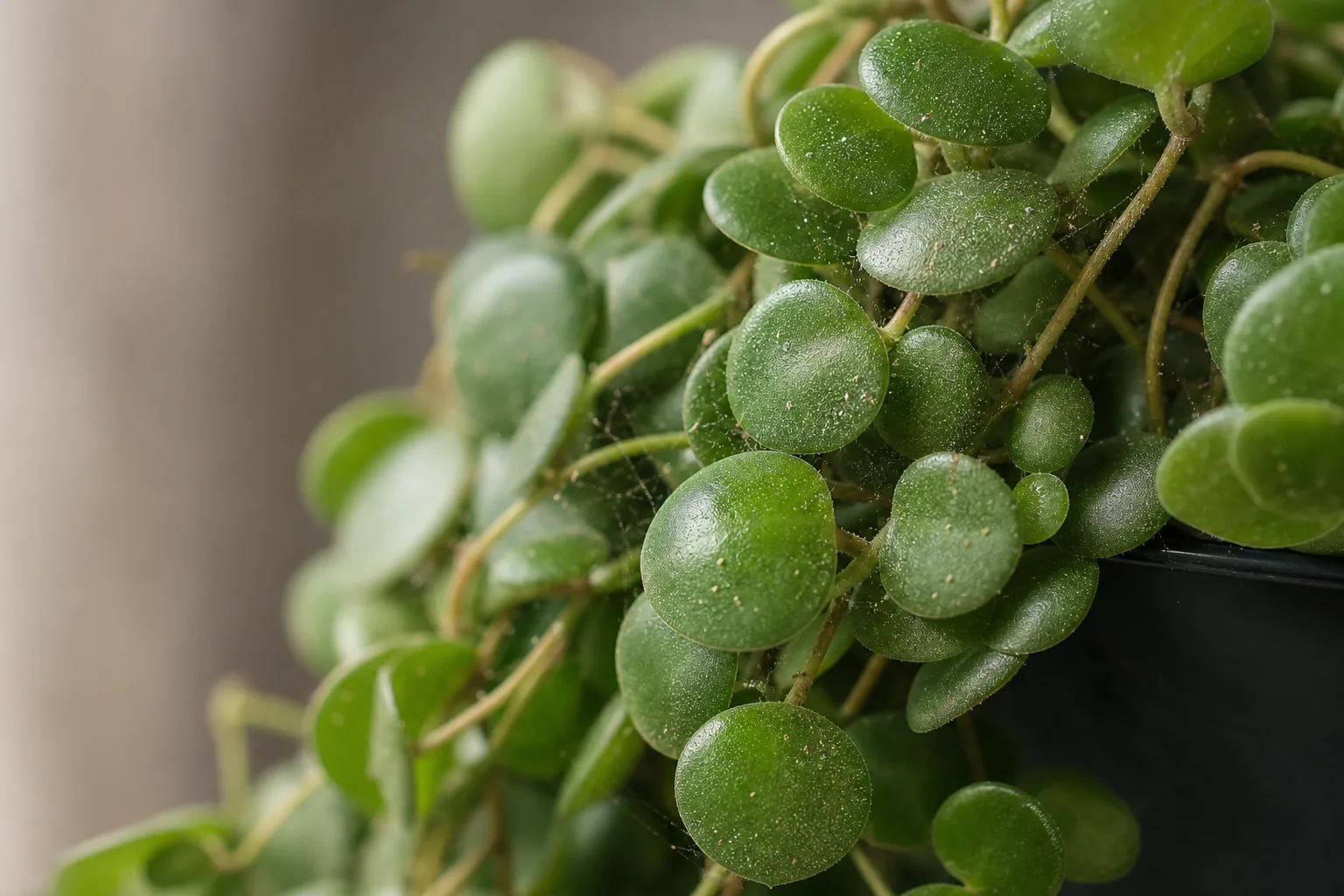
Spider Mites on Peperomia Hope: Causes, Checks & Fixes
This guide covers spider mites on Peperomia Hope. See also the general Spider Mites guide, watering, and light pages for this plant.
Spider Mites on Peperomia Hope: Causes, Checks & Fixes
Quick answer
Spider mites on Peperomia Hope (Peperomia tetraphylla ‘Hope’) show up as pale stippling and fine webbing on the round, succulent leaves along trailing stems-usually after weeks of hot, dry indoor air when heating runs and humidity drops.
First step: isolate the plant and rinse every leaf underside under lukewarm water. You need to knock down live mites and confirm they are actually present before you commit to repeat sprays. One treatment rarely clears an outbreak because eggs hatch on a cycle of roughly five to seven days in warm rooms.
Peperomia Hope is a slow trailing cultivar with semi-succulent leaves and a small root system. Mite damage costs more recovery time here than on faster peperomias because new round leaves take longer to replace stippled ones-and aggressive rinsing must not waterlog the crown, where Peperomia Hope overview is prone to rot.
What spider mites look like on Peperomia Hope
The twospotted spider mite (Tetranychus urticae) is an arachnid, not an insect-adults are about 1/50 inch long and easiest to see with a hand lens on leaf undersides, where they pierce cells and suck sap.
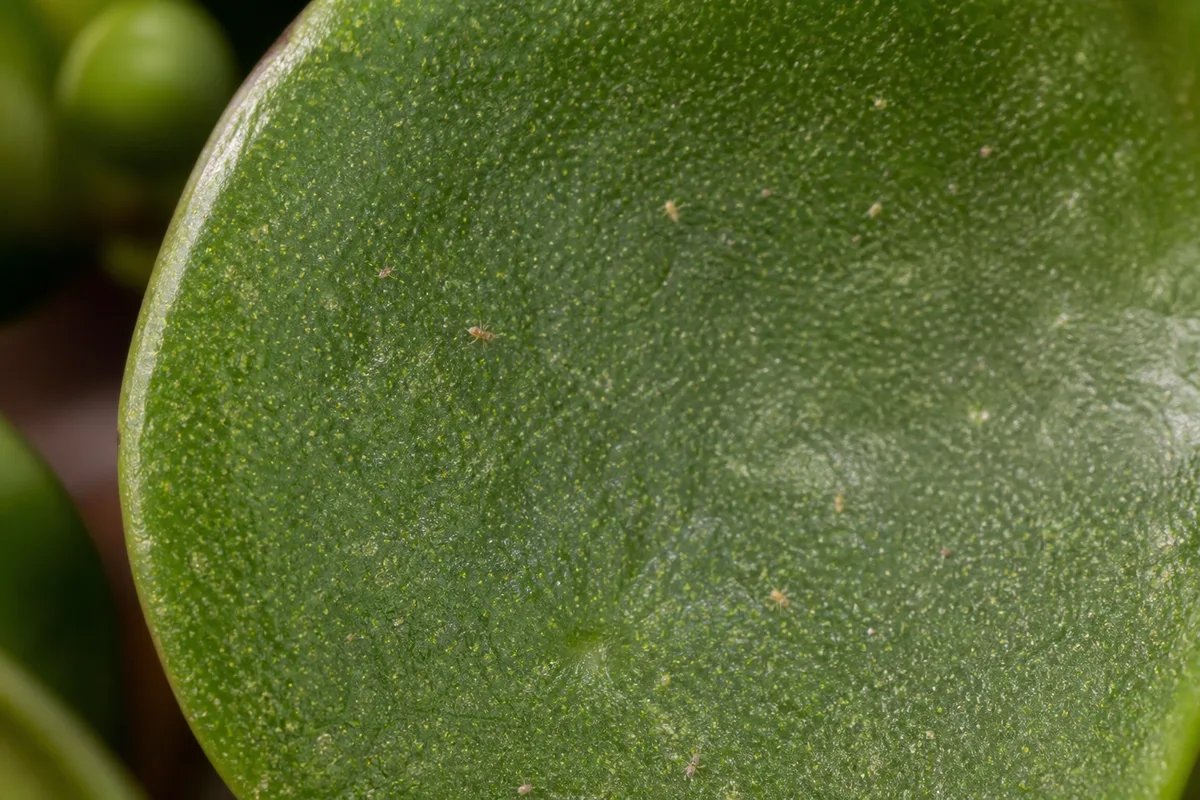
Spider Mites symptoms on Peperomia Hope - compare with healthy tissue on the same plant.
On Peperomia Hope, early damage often reads as:
- Tiny yellow or white dots scattered across round leaves, breaking the faint striping and making foliage look sandy or dull
- Gray or washed-out green zones where feeding collapses tissue between veins on thick succulent blades
- Fine silk webbing at leaf axils, stem joints, or where trailing vines meet the pot-visible once colonies grow
- Slight leaf curl or drop on outer vine sections if feeding continues unchecked
Because each leaf is small, thick, and round, stippling looks patchy and obvious long before the whole plant bronzes. Webbing at a single stem joint is already a mid-level infestation, not a cosmetic quirk.
Mites themselves look like moving pinpoints-greenish, amber, or orange-red with two dark spots when magnified. Shake a suspect leaf over white paper; specks that crawl confirm mites better than guessing from leaf color alone.
Why Peperomia Hope gets spider mites
Spider mites prefer warm, dry conditions-exactly what many homes provide when heat runs and humidity drops in winter. Under optimum warmth near 80°F, the twospotted spider mite can complete a generation in as few as five days, so a small colony can cover a trailing vine within two weeks if untreated.
Peperomia Hope is often placed in Peperomia Hope light guide near a window or in a hanging basket where trailing stems look best. That placement is correct for the plant-but the same microclimate can become a dry heat pocket when a radiator, register, or forced-air vent sits nearby. Missouri Botanical Garden lists spider mites among common problems on peperomias, and dry leaf surfaces on fleshy round leaves give mites stable feeding sites.
Peperomia Hope-specific risk factors:
- Trailing habit creates dozens of leaf axils and stem joints where webbing hides on cascading vines
- Semi-succulent leaves hold water in tissue, but mites still drain sap from the surface-stressed plants in dry air show damage quickly
- Small root systems mean the plant cannot bounce back fast if mites plus overwatering stress the crown at once
- Winter watering reduction is correct for rot prevention, but the same season drops humidity and favors mite reproduction
- New plants or outdoor summer trips can introduce mites when vines touch other pots or come inside in autumn
Chronic overwatering is the primary cultural enemy on Peperomia Hope, but dry air plus underwatering stress can also weaken leaves and make mite stippling look worse faster. The care cross-check below keeps water, humidity, and rinsing aligned without swapping one error for another.
How to confirm the diagnosis
Work through these checks before spraying anything:
- Paper tap test - Hold white paper under a round leaf and tap the blade sharply. Moving specks point to mites; static debris does not.
- Underside inspection - Lift trailing vines gently-stems snap if handled roughly-and check axils with a 10× lens. Look for mites, amber eggs, cast skins, and webbing.
- Pattern on round leaves - Random speckles across the blade with intact shape fit mite feeding. Uniform yellowing near the crown with wet soil often fits overwatering instead.
- Webbing location - Silk at nodes and between leaves confirms mites. No webbing with only wrinkled, thin-feeling leaves may be underwatering.
- Environment scan - Note distance to heat vents, sunny glass, and room humidity. Mites flare when air is dry and warm.
- Neighbor plants - Mites crawl short distances or drift on air between pots on the same shelf. Inspect adjacent peperomias, pothos, and ferns even if they look fine today.
If the pot is heavy, soil smells sour, and crown leaves yellow without stippling or webbing, root stress from overwatering is a more likely primary issue-though mites can still ride along on weakened foliage. Fix the dominant problem first.
First fix to try
Move the plant away from healthy collection plants, then wash it.
Take Peperomia Hope to a sink or shower and rinse every leaf underside with lukewarm water for several minutes. Support trailing stems so they do not snap while you angle vines so water runs off petioles and nodes where webbing collects. Colorado State Extension recommends periodically hosing small plants with a forceful jet to dislodge mites and eggs before chemical controls.
Let the pot drain fully afterward. This plant risks crown rot if soil stays wet-do not leave it sitting in runoff. Cover the soil surface with foil during an aggressive rinse if you worry about waterlogging the crown in a shallow hanging basket.
After washing, confirm live mites remain with the paper tap test. If specks still move, schedule follow-up treatments. If nothing moves and stippling is old, you may only need environmental correction and monitoring-but one rinse is not proof of cure because eggs keep hatching.
Do not reach for fertilizer, Peperomia Hope repotting guide, or pruning half the vine on day one unless leaves are so webbed they block spray coverage. Isolation plus thorough washing is the single best first action.
Step-by-step recovery
Once mites are confirmed, proceed in this order:
- Quarantine - Keep the plant in a separate room or at least two feet from others until two clean weekly checks pass.
- Physical washing - Repeat sink or shower rinses every three to four days for two weeks to knock down adults and nymphs between sprays.
- Contact spray - Apply insecticidal soap or horticultural oil labeled for spider mites, covering tops, bottoms, petioles, and stems until runoff. Soaps and oils kill only on contact and do not reliably kill eggs.
- Repeat on schedule - UF/IFAS guidance for twospotted spider mites calls for two or more applications at five-day intervals in summer or seven-day intervals in cooler months. Plan at least three rounds.
- Test sensitive foliage first - Thick succulent peperomia leaves can burn if oil or soap is applied in hot sun or on drought-stressed tissue. Spray a small section and wait 48 hours before treating the whole plant.
- Trim only heavy webbing - Remove a few fully bronzed, silk-coated leaves to improve coverage. Keep enough foliage for the plant to photosynthesize.
- Raise humidity modestly - Aim for the plant’s normal 40–50% range with a humidifier or pebble tray, not constant misting that keeps leaves wet overnight and invites fungal rot on this species.
- Inspect the collection - Treat or wash nearby susceptible plants on the same schedule so mites do not boomerang back.
Avoid broad-spectrum indoor insecticides that kill predatory mites without controlling twospotted spider mites well-those products can worsen mite outbreaks after predators die off.
Recovery timeline
Expect one to two weeks before active mites stop showing up on paper taps, assuming you combine washing with repeat soap or oil applications on schedule.
New clean round leaves along trailing stems are the real success marker. On Peperomia Hope, expect three to six weeks before fresh growth looks normal again during spring or summer active growth; winter recovery can take longer because the plant grows slowly.
Old stippled leaves will not green up again. They can stay on the plant if intact, or you can trim them for appearance once new growth is healthy.
Signs treatment is working: fewer moving specks on paper, no new webbing, and emerging leaves free of fresh stippling.
Signs things are worsening: webbing advancing along multiple vines, crown leaves dropping in clusters, or mites appearing on plants you already treated-usually means missed undersides, skipped repeat sprays, or infested neighbors still nearby.
Lookalike symptoms
- Underwatering - Wrinkled, thin-feeling round leaves with a very light pot and dry soil throughout; no stippling pattern or webbing.
- Overwatering / root stress - Uniform yellow leaves near the crown, soggy soil, and soft stem bases without mite specks or silk. Primary risk on Peperomia Hope but a different fix.
- Low humidity alone - Crisp brown tips without random stippling or webbing; often winter-only on leaf margins.
- Normal aging - One or two older lower leaves fade and drop while new growth stays clean; no crawling specks on paper.
- Thrips - Silvery scrape marks and black specks (frass); insects are elongated, not round mites.
- Dust or water spots - Wipe away with a damp cloth; dust does not move on white paper.
Webbing is the clearest divider. If you see silk at stem joints, assume mites until proven otherwise.
Mistakes to avoid
Do not stop after one spray because leaves look better for a day-eggs hatch on a cycle and repeat applications are required.
Do not spray only the tops of leaves. Mites feed underneath; incomplete coverage leaves survivors.
Do not soak the soil repeatedly while fighting mites. Peperomia Hope already suffers when mix stays wet at the crown; allow soil to dry on top before rewatering even during treatment weeks.
Do not mist leaves heavily to raise humidity-trapped moisture on round leaves and tight stem clusters can cause fungal spotting. Use a humidifier instead.
Do not mix homemade soap sprays-commercial insecticidal soaps are formulated to reduce phytotoxicity; homemade mixes can burn leaves.
Do not ignore nearby pots on the same shelf. Mites migrate faster than this slow cultivar recovers.
Peperomia Hope is non-toxic to cats and dogs, so rinsing near pets is safer than on many houseplants-but still keep treated plants out of reach until sprays dry.
Peperomia Hope care cross-check
Mite recovery sticks better when baseline care is stable:
- Light - Keep bright indirect light without pressing the basket against hot glass. Move it a foot back from the pane if leaf edges heat up midday.
- Water - Water when soil dries completely through the top layer, not on a fixed calendar. Lighter pots and dry knuckle tests beat guessing-especially in winter when watering should be reduced.
- Humidity - Target 40–50% near the canopy, especially when heat runs. A humidifier beats misting for consistent mite suppression without wet foliage overnight.
- Pot size - Match the container to roots, not vine length. Oversized hanging baskets stay wet and stress the crown while mites feed above.
- Fertilizer - Hold feed until new growth looks clean for two weeks. Fertilizing stressed, mite-damaged plants pushes weak tissue.
Fixing mites without adjusting the dry window seat that triggered them invites a repeat outbreak next heating season.
How to prevent it next time
- Quarantine new plants for two to three weeks and inspect undersides before mixing them into a display.
- Rinse trailing vines monthly in winter-the same season UMN Extension recommends washing houseplants to keep mites in check.
- Run a humidifier in the room where the hanging basket sits in bright light.
- Dust leaves gently so mites cannot hide in debris on round leaf surfaces.
- Check before and after moving plants outdoors for summer; rinse before bringing them back inside.
- Space pots so vines do not touch and you can see undersides during routine care.
Prevention on Peperomia Hope is mostly environment plus inspection, not a single chemical barrier.
When to worry
Escalate if webbing covers most of a trailing vine, crown leaves drop faster than new ones appear, or mites return within a week of three properly timed sprays-often a sign of a reservoir plant nearby or oil burn that reduced leaf coverage.
If the plant is small, heavily defoliated, and sits among many others, discarding it in a sealed bag may protect the collection-University of Minnesota Extension lists that as the best option when most of the plant is covered with mites.
A few stippled leaves on one vine with firm stem bases and clean new tips is manageable. Total bronzing on a slow cultivar with no new growth for a month is not.
Conclusion
Spider mites on Peperomia Hope are a dry-air, warm-window problem that shows first as stippling on round succulent leaves and later as webbing along trailing stems. Confirm with a paper tap and underside inspection, then isolate and wash before repeat insecticidal soap or horticultural oil applications on a five- to seven-day schedule.
Judge success by clean new leaves, not by old speckled ones. Keep humidity steady without waterlogging the crown, avoid misting that traps moisture on foliage, and inspect neighbors so this slow trailing plant is not fighting the same outbreak twice.
When to use this page vs other Peperomia Hope guides
- Peperomia Hope watering guide - Use for routine moisture checks before assuming spider mites is the main issue.
- Peperomia Hope problems hub - Browse all 7 common issues on this species.
- Slow Growth on Peperomia Hope - Different entry point when symptoms overlap with spider mites.