Aphids on Philodendron Imperial Green: Causes, Checks &
Quick answer
Aphids on Philodendron Imperial Green cluster on new leaves and tender petioles at the crown, sucking sap and leaving sticky honeydew on glossy foliage. First step: isolate the plant, rinse colonies off with lukewarm water, then treat leaf undersides and petiole sheaths with insecticidal soap; repeat every five to seven days until new growth stays clean.
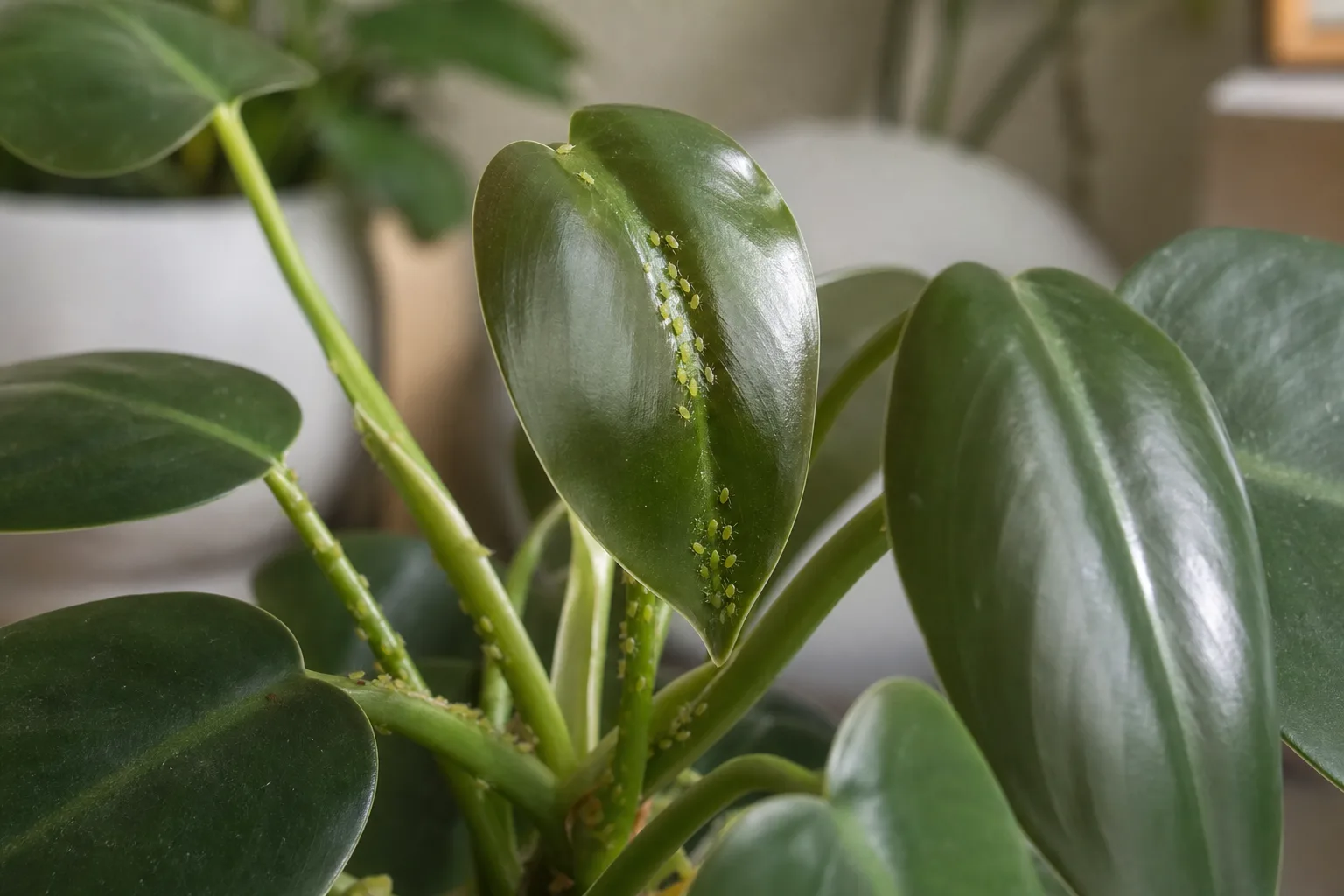
Aphids on Philodendron Imperial Green: Causes, Checks & Fixes
This guide covers aphids on Philodendron Imperial Green. See also the general Aphids guide, watering, and light pages for this plant.
Aphids on Philodendron Imperial Green: Causes, Checks & Fixes
Quick answer
Aphids on Philodendron Imperial Green cluster on new leaves and tender petioles at the crown, sucking sap and leaving sticky honeydew on glossy foliage. First step: isolate the plant, rinse colonies off with lukewarm water, then treat leaf undersides and petiole sheaths with insecticidal soap; repeat every five to seven days until new growth stays clean.
Philodendron erubescens ‘Imperial Green’ is a self-heading rosette-all new leaves push from one central crown, not along climbing stems. That architecture concentrates aphid feeding on the unfurling glossy tips and petiole sheaths at the top, where dinner-plate-sized leaves are most vulnerable. Penn State Extension describes aphids as small, soft-bodied insects that feed on branch tips and leaf undersides and cause distorted new growth. On Imperial Green, a colony at the crown can deform the very leaves you bought the plant for before you notice anything on mature foliage below.
Why Philodendron Imperial Green gets aphids
Aphids are less common on indoor Imperial Green than on outdoor garden plants, but they appear reliably on fresh crown growth-especially after summer outdoors or when windows are open in warm weather. Penn State Extension recommends isolating new plants for about three weeks and inspecting foliage, stems, and soil before mixing them with your collection. Imperial Green’s dense crown and thick glossy leaf mass can hide colonies tucked into petiole sheaths until honeydew appears on leaves below.
Soft, actively growing tissue is what aphids target. Clemson HGIC notes that aphids are usually found on young tender growth and on the underside of leaves, using piercing-sucking mouthparts that can distort tissue. Imperial Green’s unfurling glossy leaves are exactly that kind of tissue-softer and more nutrient-rich than the hardened mature leaves lower on the rosette. Aphids often gather where the petiole meets the emerging leaf and along the sheath wrapping new growth.
Populations explode quickly once established. Clemson HGIC explains that females of most aphid species give birth to live young, so colonies can grow exponentially within days at warm indoor temperatures. A few insects on one petiole tip on Monday can become a crown-wide infestation by the following week if left untreated.
Stressed plants and heavy feeding schedules make infestations worse. NC State Extension notes that aphids and other pests thrive on plants under stress or that have received nitrogen fertilizer, which can reduce plant defenses. Imperial Green pushed with frequent high-nitrogen fertilizer in dim light produces soft, pale new growth that aphids prefer-and the plant has less reserve to recover from sap loss at its single crown.
Clemson HGIC confirms that aphids can infest philodendrons along with mealybugs, scale, and spider mites. Self-heading types like Imperial Green concentrate all active growth at one point, so pest pressure at the crown affects every future leaf rather than just one vine section. Winged aphids can also drift through open windows to windowsill specimens during warm months.
What aphids look like on Philodendron Imperial Green
Early signs concentrate at the crown, not scattered across the whole plant. Watch for these patterns together:
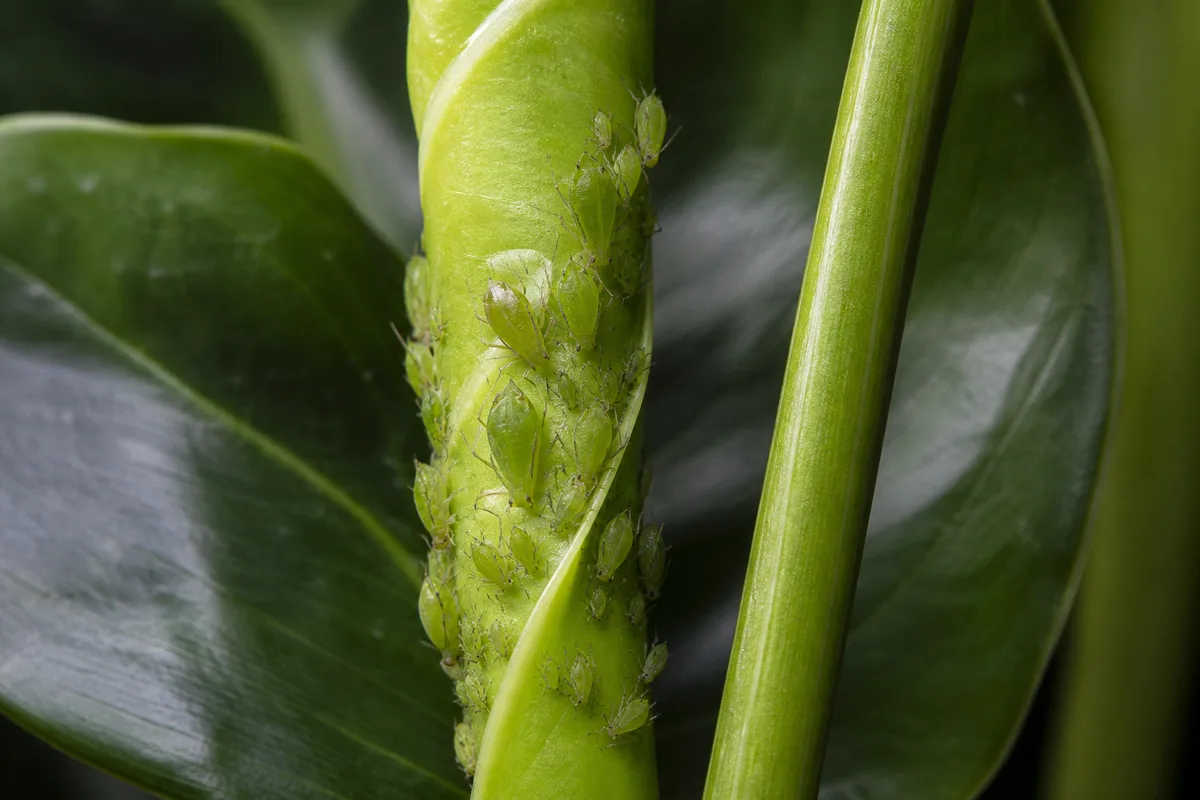
Aphids symptoms on Philodendron Imperial Green - compare with healthy tissue on the same plant.
- Clusters of pinhead-sized green, black, brown, or pink soft-bodied insects on glossy new leaves, petiole tips, or sheaths at the central crown
- New leaves curling, puckering, or opening smaller and less glossy than usual
- Shiny, sticky honeydew on large glossy leaf surfaces or the pot rim-aphids, mealybugs, whitefly, and scale all secrete it when feeding
- Black sooty mold growing on honeydew, dulling the glossy finish of mature leaves
- Ants climbing the pot or stems to harvest honeydew
- Fine white cast skins left behind after aphids molt, visible on petioles with a hand lens
On Imperial Green, the damage pattern is top-heavy. Lower mature glossy leaves may look fine while the crown is actively infested. Penn State Extension notes that aphids cluster around new stem growth-on this self-heading cultivar, that means the crown and the petiole tips of the newest two or three leaves, not climbing stems or runners.
Unlike spider mites, aphids are visible without magnification when populations build. They are slow-moving and pear-shaped, not web-spinning or stippling.
How to confirm the cause
Do not treat from one sticky spot alone. Use this inspection order:
- Crown and petiole tips - Look where glossy leaves emerge. Aphids gather on soft tissue here before they spread downward.
- Leaf undersides of new growth - Tilt the top leaves up and check with a hand lens or phone magnifier.
- Honeydew test - Run a finger along a glossy leaf below the crown. Sticky residue with no scale bumps points to sap-feeding insects like aphids.
- White paper tap test - Hold white paper under the crown and gently tap petioles. Dislodged aphids on the paper confirm live colonies.
- Neighbor plants - Check philodendrons, pothos, and monsteras nearby; aphids move between arum-family houseplants in the same room.
- Entry history - Recent outdoor summer placement or open windows in warm weather increases likelihood.
Confirmed aphids are soft-bodied, pear-shaped, and usually grouped-not isolated hard bumps (scale) or white cottony patches (mealybugs). If you see mummified tan aphid bodies, parasitic wasps may already be working; still treat active live colonies.
Lookalike symptoms to rule out
| Symptom pattern | More likely cause | Quick check |
|---|---|---|
| Soft pear-shaped insects in clusters at crown | Aphids | Tap test dislodges live insects |
| White cottony patches in leaf axils | Mealybugs | Cottony residue clings when swabbed |
| Hard oval bumps that do not move | Scale | Immobile; not grouped soft bodies |
| Fine stippling and webbing on undersides | Spider mites | Dry conditions; no sticky honeydew |
| Silvery scrape marks, barely visible insects | Thrips | No honeydew clusters at crown |
| Dry white crust that wipes off | Mineral deposits | No live insects; not sticky when fresh |
Normal Imperial Green growth-large glossy new leaves maturing over weeks-is not pest damage. Distorted, sticky, or insect-covered new growth is. One yellowing lower leaf while the crown stays clean is usually old-leaf senescence, not aphids.
First fix for Philodendron Imperial Green
Isolate the plant the same day you confirm aphids. Penn State Extension advises isolating affected plants to prevent spreading to adjacent houseplants.
Move Imperial Green to a sink or shower and rinse colonies off with lukewarm water at moderate pressure-enough to dislodge aphids from petiole sheaths and leaf undersides without shredding soft new leaves. Clemson HGIC recommends rinsing aphids off with a water hose and nozzle at adequate pressure, but cautions that a powered pressure washer is too strong. Cover the pot with plastic wrap or a bag secured around the stem so you do not soak the root zone or flood the self-heading crown while spraying foliage. Angle water outward from the central crown so moisture does not pool where new leaves emerge.
After rinsing, apply insecticidal soap to all surfaces aphids contact-especially leaf undersides, petiole tips, and sheaths at the crown. Penn State Extension recommends contact sprays of insecticidal soap applied to undersides of leaves where insects commonly feed. UC IPM notes that soaps have little or no residual action, so sprays must reach the pest directly and be repeated at regular intervals until the population is controlled.
For tight clusters in leaf sheaths, use a cotton swab dipped in rubbing alcohol on individual aphids after the initial rinse-Penn State lists this for difficult-to-reach areas. Work carefully around soft unfurling leaves; alcohol on tender tissue can cause spotting if over-applied.
Make one primary treatment pass before adding systemic products or repotting. Do not fertilize, prune heavily, and spray on the same day. Wear gloves when handling treated foliage-all philodendron parts contain calcium oxalate crystals toxic to pets if chewed.
Step-by-step recovery
After the first rinse and soap treatment:
- Keep the plant isolated in bright indirect light with good airflow so treated surfaces dry quickly-see the Imperial Green light guide for placement during quarantine.
- Repeat insecticidal soap every five to seven days until two consecutive inspections find no live aphids on the crown. Clemson HGIC recommends repeating insecticidal soap at four- to seven-day intervals because contact sprays leave no residual protection once dry.
- Wipe honeydew from mature glossy leaves with a damp cloth so sooty mold does not block light to lower foliage-large Imperial Green leaves show honeydew shine more visibly than matte foliage on other houseplants.
- Check the crown with a hand lens every three to four days during active treatment-not just the leaves facing the room.
- If ants are present, clean the pot exterior and saucer; ants protect aphids from natural enemies and can sustain colonies even after spraying.
- Hold fertilizer until the infestation clears-Clemson HGIC notes that high nitrogen promotes succulent growth aphids prefer and can boost reproduction.
- Once clean, watch the next two new glossy leaves as your recovery marker. They should unfurl without curling, stickiness, or insect clusters at petiole tips.
- Keep the plant quarantined two to three weeks after the last live aphid is found before returning it to your main collection.
If live aphids persist after three soap cycles, a horticultural oil spray labeled for houseplants is the next step-still applied to undersides and petiole sheaths with direct contact. Avoid oil on drought-stressed plants or in hot direct sun. Patch-test one leaf first if the plant sits in afternoon sun.
Recovery timeline
Light infestations caught at the crown often clear within one to two weeks of repeated rinsing and soap. Moderate cases with honeydew on several large glossy leaves may need three to four weeks and three full treatment cycles before new growth stays clean.
Leaves already distorted by feeding will not fully flatten or regain perfect gloss. Success means the next new leaves emerge firm, properly glossy, and insect-free-not cosmetic repair of damaged tissue. Imperial Green grows moderately from a single crown, so expect one to three weeks between clean new leaves depending on light and season.
Sooty mold on honeydew can take additional weeks to fade after insects are gone. Wiping leaves during treatment speeds recovery on this cultivar because the glossy surface holds honeydew visibly.
What not to do
- Do not ignore sticky leaves because mature glossy foliage still looks fine-the crown may be heavily infested.
- Do not spray only the leaf tops; aphids feed on undersides and petiole tips Penn State and Clemson both emphasize.
- Do not use a pressure washer or blast that tears soft unfurling leaves.
- Do not flood the self-heading crown during repeated rinsing-moisture trapped where new leaves emerge raises rot risk separate from the aphid problem.
- Do not use homemade dish soap on large philodendron leaves; use labeled insecticidal soap products.
- Do not fertilize while fighting aphids-nitrogen pushes aphid-friendly soft shoots.
- Do not return the plant to your main collection until two clean inspections confirm no live aphids.
- Do not assume one soap spray finished the job-contact insecticides require repeat applications because they leave no residual protection.
- Do not let pets access treated plants while spray residue is still wet.
Philodendron Imperial Green care cross-check
Aphids exploit soft growth, but chronic overwatering or low light weakens the crown separately. Cross-check these while treating:
- Light - Bright indirect light keeps new glossy leaves firm. Weak pale new growth often signals stress that overlaps with pest vulnerability. See the light guide.
- Watering - Water when the top 3–5 cm of mix is dry per the watering guide. Soggy roots do not cause aphids, but a stressed crown recovers more slowly from sap loss.
- Fertilizer - Hold off until the infestation clears, then resume dilute feeding on Clemson HGIC’s philodendron schedule rather than heavy nitrogen pushes.
How to prevent aphids next time
Quarantine every new plant-including Imperial Green specimens with perfect nursery crowns-for two to three weeks per Penn State guidance. Inspect petiole tips and new growth weekly during spring and summer when aphid reproduction is fastest.
When moving plants outdoors for summer, inspect before bringing them back inside. Penn State’s bringing houseplants indoors checklist covers daily inspection for the first one to two weeks after transition.
Avoid over-fertilizing with high-nitrogen products that produce extra-soft tender growth. Use balanced or slightly reduced feeding during peak aphid season indoors. Keep plants in bright indirect light so new glossy leaves harden quickly rather than staying soft and attractive to sap feeders.
Disinfect pruners with alcohol or a 10% bleach solution after cutting infested tissue, per Penn State sanitation guidance, so you do not spread aphids or eggs to clean plants.
When to worry
Treat aphids as medium severity on Imperial Green-but escalate promptly when:
- Colonies cover the entire crown and new leaves stop unfurling
- Ants are actively farming the plant and colonies rebound within days of treatment
- Sooty mold covers most leaf surfaces, reducing photosynthesis across the rosette
- New leaves emerge severely distorted three times in a row despite three soap cycles
- Aphids spread to multiple plants in the same room
The single-crown architecture means heavy sap loss at the top affects the whole plant. Catching colonies when they are still on one or two petiole tips is far easier than rescuing a honeydew-coated rosette with stunted growth.
Related Imperial Green guides
- Philodendron Imperial Green overview - hub for all care topics
- Mealybugs on Imperial Green - primary lookalike pest
- Spider mites on Imperial Green - dry-air pest with different symptoms
- Aphids on Imperial Red - sibling P. erubescens cultivar comparison
- Watering and light - care context during quarantine recovery
Conclusion
Recovery milestones to watch:
- Week 1: Live aphid count drops after first rinse and soap; honeydew stops accumulating on new growth.
- Week 2–3: Two consecutive crown inspections find no live insects; next leaf begins unfurling without curl or stickiness.
- Week 3–4: Plant cleared for return to main collection after quarantine; sooty mold fading on wiped mature leaves.
Aphids on Philodendron Imperial Green show up first on soft glossy new growth and petiole tips at the central crown-not on mature leaves alone. Confirm with live soft-bodied insects, sticky honeydew, and the white-paper tap test. First fix: isolate, rinse the crown without flooding it, treat undersides and petiole sheaths with insecticidal soap, and repeat every five to seven days. Judge recovery by clean new glossy leaves, not by old distorted foliage returning to perfect form.